The Science of the Furniture Industry Ecosystem
How Materials, Engineering, Ergonomics, Psychology, Manufacturing, Logistics, Sustainability, Data, and Human Behaviour Work Together to Shape the Global Furniture Economy
By The Furniture Times (TFT) Editorial Desk
Global Furniture Science, Innovation & Industry Intelligence Desk
Furniture is often seen as a finished object.
A chair.
A table.
A sofa.
A bed.
A cabinet.
A workstation.
But furniture is never only an object.
Behind every successful furniture product is a complex scientific ecosystem involving material behaviour, structural engineering, human anatomy, psychology, chemistry, manufacturing technology, digital design, logistics, environmental science, market research, and consumer behaviour.
A chair may look simple, but it must support the body safely.
A sofa may appear decorative, but it depends on foam density, frame strength, textile performance, posture, comfort science, and long-term durability.
A dining table may look elegant, but its success depends on timber stability, joinery, load distribution, surface protection, packaging, delivery, and user interaction.
A hospital bed, school desk, hotel chair, office workstation, or outdoor lounger must perform under very different conditions.
This is why the furniture industry ecosystem should not be understood only as a manufacturing or retail sector.
It is a scientific system.
It is a meeting point between nature and engineering.
Between craftsmanship and data.
Between human biology and product design.
Between industry and psychology.
Between creativity and measurable performance.
The future of furniture will increasingly belong to companies that understand this science.
Furniture Begins with Material Science
Every piece of furniture begins with materials.
Wood, metal, glass, foam, fabric, leather, plastic, composite boards, stone, ceramics, adhesives, coatings, and hardware all behave differently.
Material science helps manufacturers understand:
- Strength
- Flexibility
- Density
- Moisture response
- Heat resistance
- UV resistance
- Corrosion
- Fatigue
- Chemical stability
- Surface wear
- Fire behaviour
- Recyclability
Choosing the wrong material can create serious problems.
A timber unsuitable for humid conditions may warp.
A metal without proper protection may corrode.
A fabric with weak abrasion resistance may fail in a hotel.
A foam with poor recovery may lose comfort.
An adhesive may weaken under heat.
A coating may discolour under sunlight.
The customer may see only the finished product, but the manufacturer must understand how every material will behave throughout the product’s life.
Wood Science Is Central to Furniture Manufacturing
Wood remains one of the most important materials in the global furniture industry.
However, wood is not a uniform material.
Different species have different characteristics.
They vary in:
- Density
- Grain
- Hardness
- Moisture movement
- Workability
- Natural durability
- Colour
- Stability
- Resistance to insects
- Finishing behaviour
Wood is hygroscopic, which means it absorbs and releases moisture from the surrounding air.
This causes expansion and contraction.
If moisture content is not controlled properly, furniture may crack, bend, split, or deform.
Seasoning and kiln drying are therefore scientific processes.
The objective is not simply to remove water.
The objective is to bring timber to a moisture level suitable for its intended environment.
Furniture designed for a dry climate may behave differently when installed in a tropical region.
Manufacturers must understand local humidity, storage conditions, production environments, packaging, and final destination.
Wood science affects every stage of the value chain.
Engineered Wood Changed the Industry
The development of plywood, particleboard, medium-density fibreboard, laminated veneer lumber, and other engineered panels transformed furniture production.
These materials allowed manufacturers to:
- Use wood resources more efficiently
- Produce consistent surfaces
- Reduce waste
- Standardise dimensions
- Enable mass production
- Support flat-pack furniture
- Create complex laminated forms
However, engineered boards also require scientific control.
Manufacturers must consider:
- Resin quality
- Formaldehyde emissions
- Board density
- Edge strength
- Screw-holding capacity
- Moisture resistance
- Surface compatibility
- Lamination performance
A board may look acceptable but perform poorly under stress.
This is why testing and certification matter.
Structural Engineering Determines Safety
Furniture must carry loads.
A chair carries a person.
A bed carries one or more users.
A shelving unit carries books and objects.
A cabinet supports doors and internal storage.
A table experiences weight, movement, and repeated impact.
Structural engineering helps determine whether furniture is safe and durable.
Designers and manufacturers must understand:
- Load paths
- Stress concentration
- Joint strength
- Deflection
- Fatigue
- Balance
- Stability
- Tipping risk
- Impact resistance
A weak joint can cause failure even when the material itself is strong.
An unstable cabinet can become dangerous.
A poorly designed chair may collapse after repeated use.
Furniture safety is therefore not based on appearance.
It is based on engineering.
Joinery Is Applied Mechanical Science
Traditional joinery methods such as mortise-and-tenon, dovetail, dowel, finger joints, and lap joints reflect centuries of practical engineering.
These joints distribute force in different ways.
Modern furniture manufacturing also uses:
- Screws
- Bolts
- Cam fittings
- Connectors
- Welding
- Adhesives
- Staples
- Metal brackets
Each joining method has advantages and limitations.
The correct choice depends on:
- Material
- Load
- Product type
- Assembly process
- Repairability
- Cost
- Production volume
- Disassembly requirements
A dining chair may require a different joint strategy from a modular wardrobe.
A flat-pack table must survive transport and customer assembly.
A hotel bed must withstand repeated commercial use.
Joinery is therefore one of the most important technical sciences within furniture production.
Ergonomics Connects Furniture with the Human Body
Furniture interacts directly with the human body.
This makes ergonomics essential.
Ergonomics studies how products and environments should be designed around human capabilities and limitations.
Important measurements include:
- Seat height
- Seat depth
- Backrest angle
- Lumbar support
- Armrest height
- Work-surface height
- Leg clearance
- Reach distance
- Body movement
- Pressure distribution
Poorly designed furniture can cause discomfort, fatigue, and reduced productivity.
In office environments, poor seating may contribute to posture-related problems.
In schools, unsuitable furniture may affect concentration and comfort.
In healthcare, furniture must support patients safely.
In hospitality, comfort influences the entire guest experience.
Ergonomic design is therefore not optional.
It is a core part of product performance.
Anthropometry Makes Furniture Inclusive
Anthropometry is the scientific study of human body measurements.
Furniture must be designed for real people, but people differ by:
- Height
- Age
- Gender
- Body proportion
- Mobility
- Cultural background
- Physical ability
A chair designed around a single average user may not suit the wider population.
Inclusive furniture design considers a range of body dimensions.
This is especially important for:
- Public seating
- Educational furniture
- Healthcare furniture
- Workplace furniture
- Senior-friendly products
- Accessible furniture
As populations age and workplaces become more diverse, anthropometric data will become increasingly important.
Comfort Can Be Measured
Comfort may feel subjective, but many of its elements can be studied.
Researchers examine:
- Pressure points
- Muscle activity
- Spinal position
- Thermal comfort
- Cushion recovery
- Movement
- Support
- Seat firmness
- Fabric feel
A sofa may feel comfortable for five minutes but become uncomfortable after one hour.
A mattress may feel soft in a showroom but provide poor support during sleep.
A chair may look luxurious but create pressure behind the knees.
Comfort science helps companies move beyond guesswork.
It allows product development teams to test and improve performance.
Psychology Shapes Furniture Choice
Furniture is functional, but it is also emotional.
Consumers do not buy furniture only because they need an object.
They buy it because they want a certain feeling.
Furniture may communicate:
- Comfort
- Status
- Security
- Identity
- Taste
- Belonging
- Simplicity
- Luxury
- Tradition
- Modernity
Colour psychology affects perception.
Dark colours may feel formal or luxurious.
Light colours may create a sense of openness.
Natural materials may communicate warmth and authenticity.
Minimalist designs may suggest calm and order.
Furniture purchasing is therefore partly psychological.
Brands that understand emotional motivation can create stronger products and more effective communication.
Environmental Psychology Influences Interior Design
Environmental psychology studies how spaces affect human behaviour and wellbeing.
Furniture arrangement can influence:
- Social interaction
- Privacy
- Concentration
- Movement
- Stress
- Collaboration
- Relaxation
A workplace with badly arranged furniture may reduce communication.
A hospital waiting area with uncomfortable seating may increase stress.
A restaurant layout may affect customer turnover.
A hotel room may feel either welcoming or restrictive depending on furniture placement.
The science of furniture extends beyond the product itself.
It includes how the product operates within a space.
Colour Science Matters More Than Decoration
Colour is influenced by light, material, texture, and surrounding objects.
The same fabric may appear different under daylight, warm light, or cool light.
Wood finishes may shift in appearance depending on the lighting environment.
Digital product images may not always match real-world colour.
Colour science is therefore important in:
- Product development
- Photography
- Showroom design
- E-commerce
- Material selection
- Quality control
Poor colour communication can create dissatisfaction and returns.
Furniture companies must manage colour accurately across physical and digital channels.
Surface Science Protects Furniture
The surface of furniture is the part customers see and touch.
Surface treatments protect materials from:
- Moisture
- Scratches
- Heat
- Chemicals
- UV exposure
- Stains
- Wear
- Microbial growth
Finishing processes may include:
- Lacquering
- Painting
- Powder coating
- Oiling
- Waxing
- Laminating
- Veneering
- Plating
- Sealing
The quality of a finish depends on chemistry, application conditions, curing, surface preparation, and environmental control.
A beautiful finish can fail if applied incorrectly.
Surface science is therefore essential for both appearance and durability.
Textile Science Drives Upholstery Performance
Upholstered furniture depends heavily on textiles.
Fabric performance can be measured through:
- Abrasion resistance
- Pilling
- Colourfastness
- Tear strength
- Stretch
- Stain resistance
- Fire performance
- Breathability
- Cleanability
A fabric suitable for a private home may not be appropriate for a hotel lobby.
A healthcare environment may require antimicrobial or easy-clean materials.
Outdoor upholstery must resist sunlight and moisture.
Textile selection is therefore a technical decision.
Foam Science Determines Long-Term Comfort
Foam is a critical component in sofas, chairs, mattresses, and other upholstered products.
Important foam characteristics include:
- Density
- Firmness
- Compression resistance
- Recovery
- Durability
- Airflow
- Heat response
Low-quality foam may feel comfortable initially but collapse quickly.
High-density foam may provide durability but require careful comfort balancing.
Different layers can be combined to create support and softness.
Furniture companies must understand how foam behaves over years, not only during showroom testing.
Adhesive Chemistry Is Hidden but Essential
Adhesives are used in:
- Wood joints
- Veneering
- Laminating
- Upholstery
- Edge bonding
- Composite production
The correct adhesive depends on temperature, moisture, material, pressure, and use.
An adhesive may work well indoors but fail outdoors.
Another may create strong bonding but release undesirable emissions.
Curing time and application accuracy also affect performance.
Because adhesives are invisible after assembly, their importance is often underestimated.
Yet a bonding failure can destroy the entire product.
Manufacturing Science Enables Consistency
Craftsmanship creates uniqueness.
Manufacturing science creates repeatability.
A factory must produce the same product consistently across large quantities.
This requires control over:
- Tolerances
- Machine calibration
- Cutting accuracy
- Assembly sequence
- Moisture
- Temperature
- Tool wear
- Quality inspection
- Production timing
A difference of only a few millimetres can create assembly problems.
A misaligned drilling process can weaken joints.
A dull cutting tool can damage surfaces.
Scientific manufacturing turns design intent into repeatable production.
CNC Technology Changed Precision
Computer numerical control machinery transformed furniture manufacturing.
CNC machines can:
- Cut
- Drill
- Route
- Engrave
- Shape
- Repeat complex patterns
Digital instructions allow accurate production across multiple units.
CNC technology supports:
- Customisation
- Mass production
- Reduced waste
- Faster prototyping
- Complex geometry
- Digital integration
However, machines still depend on correct programming, maintenance, materials, and operators.
Technology does not eliminate knowledge.
It changes the type of knowledge required.
Robotics and Automation Are Expanding
Furniture factories increasingly use robotics for:
- Material handling
- Sanding
- Spraying
- Welding
- Packaging
- Assembly
- Inspection
Automation can improve safety, speed, and consistency.
However, furniture production contains many irregular shapes, materials, and customised products.
This means full automation is not always simple.
The future may involve collaborative systems in which workers and robots operate together.
Human craftsmanship will remain important, especially in premium, customised, and artisanal furniture.
Quality Control Is a Scientific Discipline
Quality control is not simply checking whether furniture looks acceptable.
It includes measurable standards.
Furniture may be tested for:
- Static load
- Repeated load
- Impact
- Stability
- Drawer performance
- Hinge durability
- Surface resistance
- Fire behaviour
- Weather resistance
- Corrosion
- Packaging strength
Testing helps identify weaknesses before products reach customers.
A strong quality system reduces:
- Returns
- Complaints
- Warranty costs
- Reputation damage
- Safety risk
Quality should be designed into the process, not inspected only at the end.
Packaging Is Engineering
Furniture packaging must protect products during:
- Factory handling
- Warehousing
- Truck transport
- Sea freight
- Air freight
- Last-mile delivery
Packaging science considers:
- Impact
- Vibration
- Compression
- Moisture
- Abrasion
- Stacking
- Corner protection
- Product movement
Over-packaging increases cost and waste.
Under-packaging creates damage.
The goal is optimisation.
A beautifully manufactured product can become worthless if packaging fails.
Logistics Is a Core Part of Furniture Science
Furniture is difficult to transport because it is often:
- Large
- Heavy
- Fragile
- Irregularly shaped
- Expensive to return
Logistics planning includes:
- Container utilisation
- Route optimisation
- Warehouse design
- Delivery sequencing
- Assembly scheduling
- Reverse logistics
- Damage prevention
Flat-pack furniture became successful partly because it improved transport efficiency.
The shape of the product and package can affect the entire business model.
Furniture design must therefore consider logistics from the beginning.
Supply Chain Science Connects the Ecosystem
Furniture products depend on multiple suppliers.
A sofa may require timber, foam, fabric, springs, adhesives, thread, hardware, packaging, and transport.
A disruption in one material can delay the whole product.
Supply-chain management uses data to study:
- Supplier reliability
- Lead times
- Inventory
- Risk
- Cost
- Capacity
- Demand
Companies that understand their supply chains can respond more effectively to shortages, geopolitical disruptions, shipping delays, and price increases.
Inventory Is a Mathematical Challenge
Furniture inventory is expensive.
Products occupy space.
Styles change.
Colours go out of fashion.
Customers expect availability.
Too much inventory ties up capital.
Too little inventory causes delays.
Businesses use forecasting models to estimate:
- Demand
- Seasonal patterns
- Product popularity
- Regional preferences
- Replacement cycles
Data science can improve these decisions.
However, poor data can create poor forecasts.
Technology works only when information is accurate.
Economics Shapes Every Furniture Decision
Furniture companies must balance value and cost.
A product price reflects:
- Materials
- Labour
- Machinery
- Rent
- Energy
- Logistics
- Marketing
- Warranty
- Profit
- Tax
- Risk
The final price must be acceptable to the customer while supporting the business.
Costing errors can destroy companies.
A product may sell well but lose money.
A large order may increase revenue while damaging cash flow.
Furniture entrepreneurship requires strong economic understanding.
Consumer Behaviour Is a Science
Customers do not always behave logically.
They may:
- Compare products for weeks
- Choose based on reviews
- Abandon purchases
- Prefer familiar brands
- Respond to scarcity
- Trust visual presentation
- Avoid complicated choices
Consumer-behaviour research helps retailers understand how people move from awareness to purchase.
Furniture is usually a high-consideration purchase.
Customers may require:
- Inspiration
- Comparison
- Reassurance
- Visualisation
- Social proof
- Financing
- Delivery confidence
Successful retailers design the entire decision journey.
Retail Science Shapes Showrooms
Furniture showrooms are carefully designed environments.
Retailers study:
- Product placement
- Walking paths
- Lighting
- Scent
- Sound
- Room settings
- Signage
- Price presentation
- Customer interaction
A product displayed alone may feel less attractive than the same product shown in a complete room.
Showrooms help customers imagine ownership.
Retail science turns space into a selling environment.
E-Commerce Introduced New Scientific Challenges
Online furniture retail requires accurate digital representation.
Retailers must manage:
- Product photography
- Dimensions
- Colour accuracy
- 3D models
- Augmented reality
- Reviews
- Delivery data
- Returns
The customer cannot touch or test the product.
Technology must reduce uncertainty.
Online furniture is therefore a combination of retail, psychology, data, design, and logistics.
Artificial Intelligence Is Entering the Ecosystem
AI is being used for:
- Product recommendations
- Demand forecasting
- Customer service
- Design assistance
- Visual search
- Inventory planning
- Pricing
- Quality inspection
- Predictive maintenance
AI may help customers find furniture suited to room size, style, budget, and use.
Factories may use AI to identify defects.
Retailers may use AI to predict demand.
However, AI depends on data quality.
Poor information produces poor recommendations.
Furniture Search Is Becoming More Intelligent
Customers increasingly search through complete questions.
They may ask:
- Which sofa is best for a small apartment?
- What outdoor furniture survives tropical weather?
- Which chair is best for long working hours?
- What furniture is safest for elderly users?
Search systems and AI assistants need structured product information.
Furniture companies must describe products clearly and accurately.
Digital visibility is becoming part of product science.
Sustainability Is Applied Environmental Science
Furniture uses natural resources, energy, chemicals, packaging, and transport.
Environmental science helps companies measure:
- Carbon emissions
- Water use
- Material efficiency
- Waste
- Toxicity
- Biodiversity impact
- Product lifespan
- Recycling potential
Sustainability is not only a marketing message.
It is a measurable system.
Companies must understand the full lifecycle of furniture.
Lifecycle Assessment Changes Product Thinking
Lifecycle assessment studies the environmental impact of a product from raw material to end of life.
It may include:
- Extraction
- Processing
- Manufacturing
- Transport
- Use
- Repair
- Disposal
- Recycling
A product made from a sustainable material may still have a high impact if it is poorly manufactured or transported inefficiently.
Lifecycle thinking prevents narrow conclusions.
Circular Design Is Growing
Circular furniture aims to remain useful for longer.
It may be designed for:
- Repair
- Reuse
- Refurbishment
- Disassembly
- Recycling
- Material recovery
This changes how products are joined, labelled, and manufactured.
A product permanently bonded with mixed materials may be difficult to recycle.
A modular product may be easier to repair and upgrade.
Circular design requires scientific planning from the beginning.
Durability Is a Sustainability Strategy
One of the most effective environmental strategies is to make furniture last longer.
Durable products reduce replacement demand.
They also protect customer value.
Durability depends on:
- Materials
- Engineering
- Joinery
- Finishing
- Maintenance
- Repairability
A long-lasting product can support both sustainability and brand reputation.
Climate Science Affects Outdoor Furniture
Outdoor furniture must survive:
- Sunlight
- Rain
- Humidity
- Salt air
- Temperature change
- Insects
- Wind
Different climates create different challenges.
Coastal furniture requires corrosion resistance.
Tropical furniture requires moisture and UV protection.
Cold climates require freeze-thaw durability.
Outdoor furniture should be designed for specific environmental conditions.
Fire Science Is Critical
Furniture can contribute to fire risk.
Upholstery, foam, textiles, timber, and coatings all behave differently under heat.
Fire testing may examine:
- Ignition
- Flame spread
- Smoke
- Heat release
- Toxic gases
Regulations differ across countries and product categories.
Commercial furniture often requires strict compliance.
Fire performance must be considered during material selection.
Indoor Air Quality Matters
Furniture materials can release volatile organic compounds.
These may come from:
- Adhesives
- Coatings
- Foam
- Composite boards
- Textiles
Indoor air quality is especially important in:
- Homes
- Schools
- Offices
- Healthcare environments
Low-emission materials and proper curing can reduce risk.
Future consumers are likely to demand more transparency about indoor environmental health.
Acoustics Is Part of Furniture Design
Modern offices and public spaces often require acoustic control.
Furniture can absorb or redirect sound.
Acoustic products include:
- Panels
- Booths
- Dividers
- Upholstered seating
- Screens
Acoustic science is becoming more important as open spaces and hybrid work environments expand.
Lighting and Furniture Work Together
Furniture appearance depends heavily on light.
Lighting affects:
- Colour
- Texture
- Mood
- Visibility
- Function
Task furniture requires appropriate illumination.
Retail displays need lighting that reveals materials accurately.
Bedrooms and lounges require softer lighting.
Furniture and lighting should be planned together.
Educational Furniture Requires Learning Science
School furniture affects:
- Posture
- Attention
- Movement
- Collaboration
- Comfort
- Accessibility
Modern learning spaces often require flexible furniture that supports different teaching methods.
Educational furniture should be based on child development, ergonomics, and learning behaviour.
Healthcare Furniture Requires Special Science
Healthcare furniture must consider:
- Infection control
- Cleanability
- Patient safety
- Mobility
- Accessibility
- Comfort
- Durability
A hospital chair is not the same as a home chair.
Materials, seams, surfaces, and dimensions may require special design.
Healthcare furniture is a highly technical field.
Hospitality Furniture Is Experience Engineering
Hotels, resorts, and restaurants use furniture to shape guest experience.
Hospitality furniture must balance:
- Appearance
- Comfort
- Durability
- Cleaning
- Brand identity
- Heavy use
A beautiful chair that fails quickly is not suitable.
Hospitality furniture must perform under repeated commercial conditions.
Office Furniture Is Connected to Productivity
Workplace furniture affects:
- Posture
- Focus
- Collaboration
- Movement
- Privacy
- Wellbeing
The growth of hybrid work has changed office design.
Companies need flexible, ergonomic, and technology-friendly furniture.
Workplace science is increasingly connected to organisational performance.
Data Is Becoming the New Material
Traditional furniture companies worked mainly with physical materials.
Modern companies also work with data.
They collect information about:
- Customer preferences
- Product performance
- Returns
- Delivery times
- Sales
- Defects
- Inventory
- Reviews
This data can reveal where the business should improve.
The companies that use data effectively will make better decisions.
Research and Development Must Grow
Many furniture SMEs rely on experience but invest little in formal research.
The future requires stronger collaboration between:
- Manufacturers
- Universities
- Designers
- Engineers
- Material scientists
- Technology companies
- Government agencies
Research can improve:
- Materials
- Ergonomics
- Production
- Sustainability
- Safety
- Digital commerce
The furniture industry needs more laboratories, testing centres, innovation hubs, and knowledge networks.
Skills Development Is Scientific Infrastructure
Machines and technology are only effective when people know how to use them.
The industry needs skilled workers in:
- Carpentry
- Upholstery
- CNC
- Design
- Engineering
- Quality control
- Digital marketing
- Data
- Logistics
- Sustainability
Training should combine practical skills with scientific understanding.
A stronger workforce creates a stronger ecosystem.
The Science of Entrepreneurship
Furniture entrepreneurship also involves science.
Entrepreneurs must test:
- Market demand
- Pricing
- Product-market fit
- Customer response
- Operational capacity
Successful founders do not rely only on intuition.
They observe.
Measure.
Test.
Learn.
Adapt.
Entrepreneurship becomes more effective when decisions are based on evidence.
Furniture Is a System, Not a Product
The greatest lesson is that furniture should not be viewed in isolation.
A product is connected to:
- Materials
- People
- Machines
- Transport
- Retail
- Space
- Culture
- Environment
- Technology
- Economics
A change in one area affects the others.
Cheaper material may increase returns.
Better packaging may reduce damage.
Improved ergonomics may increase customer satisfaction.
Accurate data may reduce inventory.
This systems view is essential.
The Future of Furniture Science
The next generation of furniture may include:
- Smart sensors
- Adaptive seating
- Health monitoring
- Responsive materials
- AI customisation
- Robotic production
- Digital passports
- Circular materials
- On-demand manufacturing
Furniture may become more intelligent, personalised, and connected.
However, technology must still serve human needs.
The best furniture will remain safe, useful, comfortable, durable, and meaningful.
Final Perspective
The science of the furniture industry ecosystem is the science of how humans shape materials to improve life.
It brings together biology, psychology, chemistry, engineering, design, manufacturing, economics, logistics, environmental science, and technology.
Every successful furniture product is evidence of this collaboration.
The industry must move beyond viewing science as something limited to laboratories.
Science is present in every timber board.
Every foam layer.
Every joint.
Every machine.
Every delivery route.
Every customer decision.
Furniture companies that understand this will produce better products.
Reduce waste.
Improve safety.
Build stronger brands.
Compete more effectively.
And create greater value for society.
The future of furniture will not be built by creativity alone.
It will be built by creativity guided by science.
Closing Quote
“Furniture is where material science, human comfort, engineering, psychology, craftsmanship, and commerce meet. The future of the industry belongs to those who understand the complete ecosystem.”
— The Furniture Times (TFT) Editorial Desk
The Furniture Times (TFT) & Furniture Industry Search Engine (FISE)
“TFT tells their story. FISE helps the world find them.”
FurniReviewology helps the world trust them.
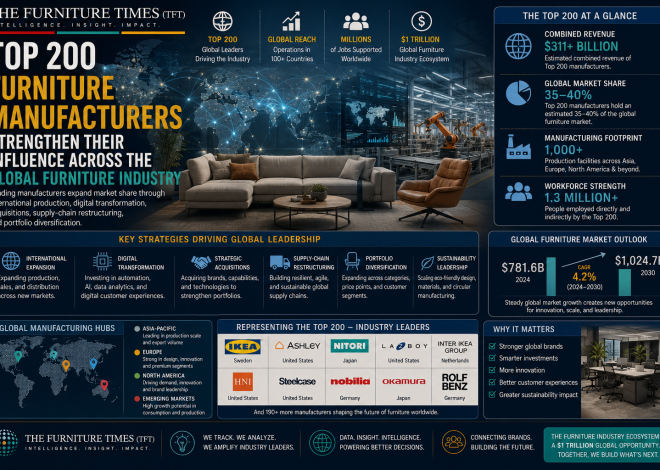
The furniture industry ecosystem is a $1 trillion industry ecosystem.