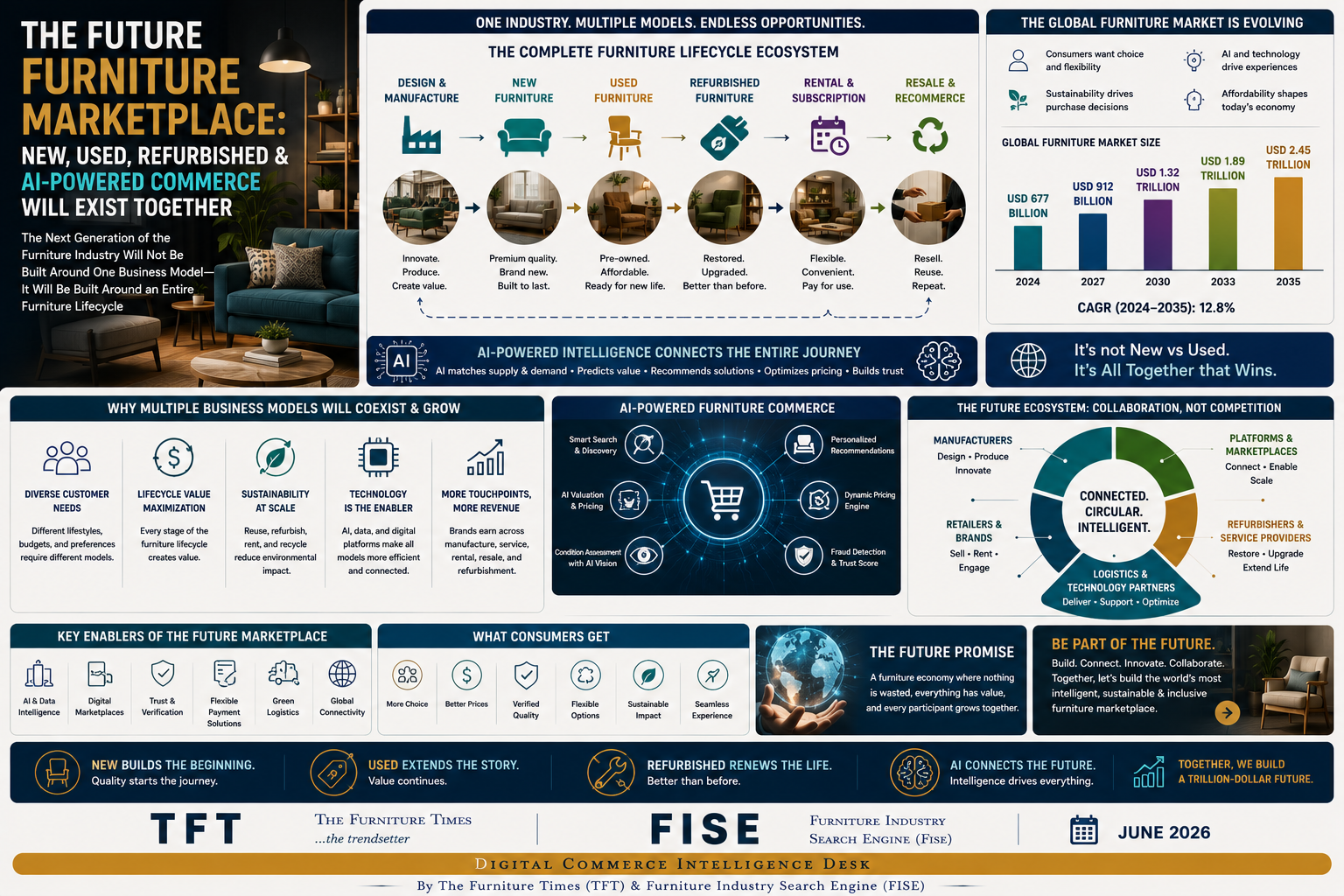
The Future Furniture Marketplace: Why New, Used, Refurbished & AI-Powered Commerce Will Exist Together
The Next Generation of the Furniture Industry Will Not Be Built Around One Business Model—It Will Be Built Around an Entire Furniture Lifecycle
Digital Commerce Intelligence Desk
By The Furniture Times (TFT) & Furniture Industry Search Engine (FISE)
June 2026
For more than one hundred years, the furniture industry has operated with a relatively simple business model.
Manufacture.
Distribute.
Sell.
Deliver.
The transaction ended once the customer purchased the product.
For decades this model powered one of the world’s largest manufacturing sectors.
It created global brands.
Millions of jobs.
International trade.
Economic development.
But the furniture industry of 2035 will look dramatically different.
Not because furniture itself is disappearing.
But because the way people discover, access, own, use, upgrade, maintain and replace furniture is changing forever.
The future marketplace will not belong exclusively to manufacturers.
Nor exclusively to retailers.
Nor to second-hand marketplaces.
Nor to rental businesses.
The future belongs to an ecosystem where every stage of a furniture product’s life creates value.
Tomorrow’s marketplace will combine:
- New furniture
- Premium furniture
- Second-hand furniture
- Rental furniture
- Refurbished furniture
- Upcycled furniture
- AI shopping assistants
- Furniture subscriptions
- Circular economy services
- Industry search platforms
The companies that understand this shift will define the next generation of furniture commerce.
The Era of One-Time Sales Is Ending
For decades, furniture companies focused on one objective.
Selling the next product.
Once sold, customer relationships often weakened.
The product disappeared into homes.
Years later it entered classified advertisements.
Eventually it reached landfill.
Manufacturers rarely participated beyond the original sale.
That business model is becoming outdated.
The future belongs to businesses that participate throughout the entire furniture lifecycle.
The Marketplace Will No Longer Be Divided
Historically, businesses belonged to separate categories.
Manufacturers made furniture.
Retailers sold furniture.
Repair shops repaired furniture.
Second-hand dealers sold used furniture.
Rental companies rented furniture.
Tomorrow those boundaries will become increasingly blurred.
One company may simultaneously operate:
- Manufacturing facilities
- Online stores
- Certified pre-owned programmes
- Furniture rental services
- Refurbishment centres
- Spare parts divisions
- Subscription plans
- AI-powered customer support
The modern furniture company will become a lifecycle management business.
New Furniture Will Always Matter
Innovation will never disappear.
Consumers will continue demanding:
- New designs
- Better materials
- Smarter technology
- Sustainable products
- Improved comfort
Manufacturers will continue investing in research and development.
Interior designers will continue creating new trends.
New furniture remains the foundation of the industry.
But it will become only one part of a much larger ecosystem.
Premium Furniture Will Become Lifetime Assets
Luxury furniture is also changing.
Premium buyers increasingly expect products that:
- Last decades
- Can be repaired
- Can be upgraded
- Retain resale value
- Include maintenance services
- Offer digital product passports
Luxury furniture will increasingly resemble luxury watches and luxury automobiles.
Ownership continues.
But product lifecycle management becomes equally valuable.
Second-Hand Furniture Will Become Organized
The second-hand market has traditionally been fragmented.
Small dealers.
Classified advertisements.
Independent sellers.
Tomorrow’s market will become far more professional.
Certified inspection.
Digital verification.
AI pricing.
Quality grading.
Warranty support.
Manufacturer-backed resale programmes.
The second-hand furniture industry will mature into a trusted commercial sector.
Rental Furniture Will Continue Expanding
Consumer lifestyles continue changing.
Students relocate frequently.
Professionals move internationally.
Expatriates require temporary housing.
Corporate accommodation grows.
Digital nomads travel continuously.
These consumers increasingly value flexibility over ownership.
Furniture rental provides:
- Lower upfront costs
- Faster furnishing
- Flexible upgrades
- Convenient relocation
Rental becomes another permanent pillar of the furniture economy.
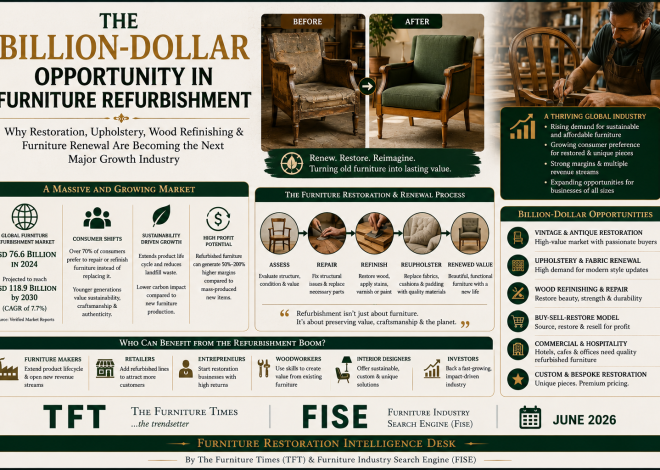
Refurbished Furniture Will Gain New Respect
Refurbishment is no longer associated with old furniture.
It represents sustainability.
Craftsmanship.
Circular manufacturing.
Responsible consumption.
Hotels increasingly refurbish.
Offices renew existing furniture.
Homeowners restore family furniture.
Manufacturers establish refurbishment centres.
The future values restoration alongside innovation.
Upcycled Furniture Will Create New Creative Industries
Upcycling goes beyond repair.
It transforms products into something entirely new.
Old doors become dining tables.
Industrial materials become shelving.
Vintage wood becomes designer furniture.
Discarded products become artistic creations.
Upcycling combines:
- Sustainability
- Design
- Creativity
- Entrepreneurship
It creates entirely new market opportunities while reducing waste.
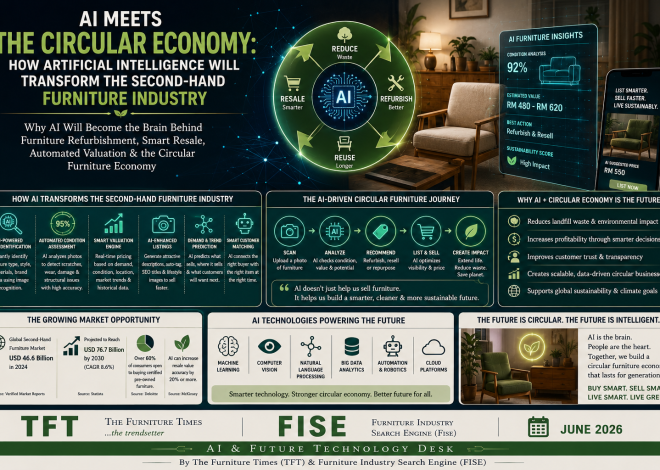
Artificial Intelligence Will Become the Customer’s First Consultant
Perhaps the biggest transformation will not happen inside factories.
It will happen inside search.
Tomorrow’s customer may never browse hundreds of products.
Instead they will simply ask:
“Recommend the best furniture for my apartment.”
“Find sustainable dining furniture under my budget.”
“Show certified refurbished office furniture near me.”
Artificial Intelligence will:
- Compare products
- Analyse specifications
- Recommend alternatives
- Estimate delivery
- Suggest financing
- Personalize purchasing
AI becomes the digital salesperson.
Furniture Subscriptions Will Create Predictable Revenue
Furniture subscriptions will continue expanding.
Instead of purchasing furniture once, customers subscribe.
Monthly.
Quarterly.
Annually.
Subscriptions may include:
- Delivery
- Installation
- Maintenance
- Replacement
- Upgrades
- Collection
This creates predictable recurring revenue for businesses while providing flexibility for customers.
The Circular Economy Connects Everything
The circular economy becomes the framework connecting every business model.
Products move through multiple stages:
Manufacturing.
Retail.
Ownership.
Maintenance.
Trade-in.
Refurbishment.
Rental.
Resale.
Recycling.
Every stage generates economic value.
Waste becomes opportunity.
Products become long-term assets.
Industry Search Platforms Will Become Essential
The furniture marketplace is becoming increasingly complex.
Customers no longer search only for furniture.
They search for:
- Refurbishment
- Rental
- Certified furniture
- Designers
- Spare parts
- Upholstery
- Restoration
- Antique experts
- Hospitality suppliers
General search engines provide millions of results.
Industry-specific platforms become increasingly valuable.
This is precisely why Furniture Industry Search Engine (FISE) exists.
The future furniture ecosystem requires specialised discovery.
Why TFT Matters More Than Ever
As business models multiply, education becomes increasingly important.
The Furniture Times serves as the industry’s intelligence platform.
Helping businesses understand:
- Emerging trends
- Consumer behaviour
- Technology
- Sustainability
- AI
- Circular commerce
- Future opportunities
Knowledge becomes a competitive advantage.
The Future Customer Will Think Differently
Tomorrow’s buyer will no longer ask only:
“Where can I buy furniture?”
Instead they may ask:
“Can I rent it?”
“Can I subscribe to it?”
“Can I trade it in later?”
“Can it be repaired?”
“Can AI help me choose?”
“Can I verify its history?”
“Can I resell it?”
Every one of these questions creates new business opportunities.
The Businesses That Will Win
Future market leaders will combine:
✓ Manufacturing
✓ Digital commerce
✓ AI
✓ Circular economy
✓ Refurbishment
✓ Rental
✓ Subscriptions
✓ Searchability
✓ Sustainability
✓ Customer education
✓ Industry visibility
They will no longer define themselves by products alone.
They will define themselves by customer lifetime value.
The Role of TFT & FISE
The Furniture Times and Furniture Industry Search Engine were created because the furniture industry is entering a completely new era.
The future requires more than manufacturing.
It requires:
Visibility.
Discoverability.
Trust.
Knowledge.
Data.
Artificial Intelligence.
Industry collaboration.
Searchability.
TFT tells the industry’s story.
FISE ensures the world can find it.
Together they help build the infrastructure for the next generation of the global furniture ecosystem.
TFT & FISE Analysis
The future furniture marketplace will not replace one business model with another.
Instead, it will integrate every business model into one connected ecosystem.
Manufacturers.
Retailers.
Rental companies.
Refurbishment specialists.
Designers.
Technology providers.
AI companies.
Search platforms.
Circular economy businesses.
Everyone becomes part of one value chain.
The companies that embrace this ecosystem mindset will outperform those focused solely on manufacturing new products.
Final Verdict
The future furniture marketplace is not about choosing between:
New or used.
Ownership or rental.
Manufacturing or refurbishment.
Artificial Intelligence or craftsmanship.
The future is about integrating them all.
Tomorrow’s market will reward businesses that understand the complete furniture lifecycle.
Products will generate value before purchase.
During ownership.
After ownership.
And even after refurbishment.
The companies that continue focusing only on producing new furniture may struggle to capture tomorrow’s opportunities.
The businesses that embrace every stage of the furniture lifecycle—from manufacturing to resale, refurbishment, rental, AI-powered commerce, and circular economy services—will build stronger brands, stronger customer relationships, and stronger long-term profitability.
Because the future of furniture is no longer defined by a single sale.
It is defined by a product’s entire journey.
By The Furniture Times (TFT) & Furniture Industry Search Engine (FISE)
Digital Commerce Intelligence Desk | June 2026
“TFT tells their story. FISE helps the world find them.”
The furniture industry ecosystem is a $1 Trillion Dollar Industry.