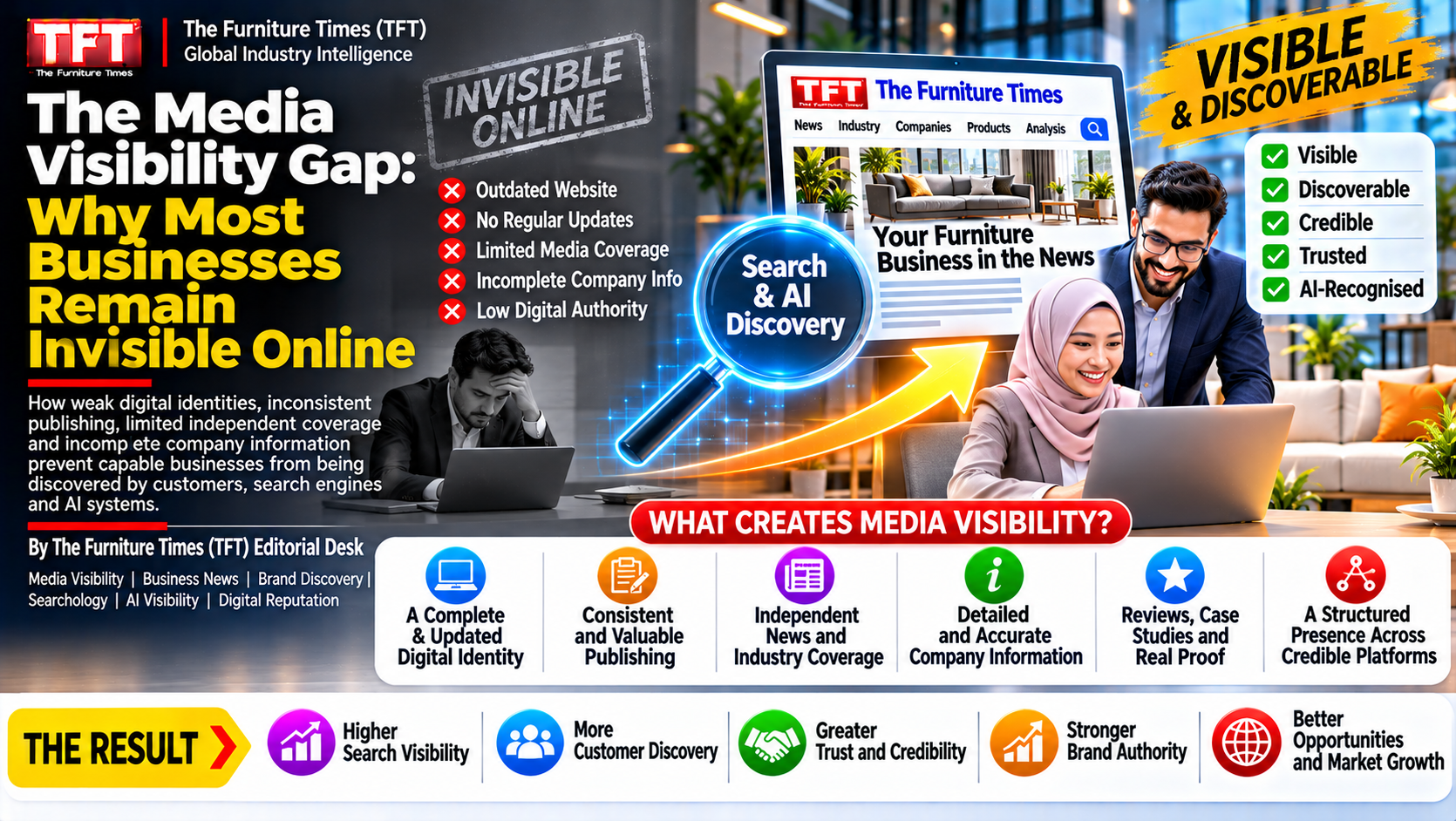
The Media Visibility Gap: Why Most Businesses Remain Invisible Online
How weak digital identities, inconsistent publishing, limited independent coverage and incomplete company information prevent capable businesses from being discovered by customers, search engines and AI systems
By The Furniture Times (TFT) Editorial Desk | Media Visibility | Business News | Brand Discovery | Searchology | AI Visibility | Digital Reputation | Global Industry Intelligence
Millions of businesses exist in the physical economy but remain almost invisible in the digital world.
They manufacture products, employ people, serve customers, complete projects and contribute to local economies. Some have operated for decades. Others possess specialised technical capabilities that would be valuable to buyers across the world.
Yet when prospective customers search for them, little appears.
Their websites may be outdated. Their products may be hidden inside PDF catalogues. Their business listings may contain incorrect addresses. Their social accounts may have been inactive for years. Their customer reviews may be scarce, and independent media coverage may be nonexistent.
The company is operational—but its digital evidence is weak.
This is the media visibility gap: the distance between what a business genuinely does and what the market can discover, understand and verify online.
The gap is no longer merely a marketing weakness. It affects:
- Customer discovery
- Search-engine visibility
- AI-generated recommendations
- Buyer confidence
- Supplier relationships
- Distributor recruitment
- Export development
- Investment interest
- Recruitment
- Reputation
- Long-term brand value
In an economy increasingly shaped by digital research and artificial intelligence, an invisible business may be excluded before it receives an opportunity to compete.
A Good Business Can Still Be Digitally Invisible
Many business owners believe quality will eventually create recognition.
Quality is essential, but it does not automatically produce visibility.
A company may manufacture excellent furniture, provide reliable logistics, deliver professional interior projects or supply specialised materials. However, search engines and AI assistants cannot visit its factory, inspect its workmanship or listen to years of word-of-mouth recommendations.
They depend on available information.
If the digital record is incomplete, machines—and potential customers—may be unable to determine:
- Whether the company is still active
- What it manufactures or sells
- Where it operates
- Which industries it serves
- Whether it exports
- Who leads it
- What distinguishes it
- Whether customers trust it
- How it can be contacted
The problem is not necessarily poor quality.
The problem is that the evidence of quality has not been documented and distributed.
The Visibility Gap in One Table
| What the business knows about itself | What the internet may show |
|---|---|
| Twenty years of experience | No founding date |
| Hundreds of completed projects | No published case studies |
| Reliable products | Few or no customer reviews |
| Skilled employees | No visible team or expertise |
| Export capability | No countries or markets listed |
| Strong production facility | No current factory information |
| Custom manufacturing | Generic website description |
| Industry certifications | Certificates not explained or linked |
| Active operations | Last update published several years ago |
| Trusted local reputation | Almost no independent online references |
This difference creates a dangerous perception gap.
Customers cannot value what they cannot see. Search systems cannot classify what they cannot understand. AI systems cannot confidently recommend what they cannot verify.
Why Most Businesses Remain Invisible
1. They mistake having a website for being visible
A website is necessary, but its existence does not guarantee discovery.
A business may have a website that:
- Is not properly indexed
- Loads slowly
- Performs poorly on mobile devices
- Contains very little readable information
- Uses generic page titles
- Has no location-specific content
- Provides no product specifications
- Has broken links
- Contains outdated contact details
- Has not published anything recently
A website is only one part of a digital identity.
Visibility develops when the website is supported by current news, accurate business listings, reviews, industry profiles, product information, external mentions and consistent company data.
2. They publish only advertisements
Many companies communicate only when they want to sell something.
Their posts consist of:
- Buy now
- Limited offer
- Best price
- Contact us
- New stock
- Big discount
- Clearance sale
Promotions have a legitimate role, but they rarely explain the company’s expertise, history, capabilities or relevance.
A customer researching a major purchase wants more than a discount.
The customer may want to understand:
- How the product is made
- Which materials are used
- Whether it is suitable for the intended environment
- What warranty applies
- Whether replacement parts are available
- What projects the supplier has completed
- How previous customers were treated
- Why the company should be trusted
A business that publishes only offers becomes visible as a seller—but not necessarily credible as an expert or dependable partner.
3. They have no independent media coverage
Owned channels are important. They allow the company to control its message.
However, every claim on a company website is self-published.
A business may call itself:
- Leading
- Innovative
- Global
- Trusted
- Premium
- Award-winning
- Sustainable
- Customer-focused
These words become more meaningful when supported by independent information.
News coverage can document:
- A factory expansion
- A product launch
- An export achievement
- A completed project
- A certification
- A partnership
- A leadership appointment
- A sustainability initiative
- An industry contribution
- Original market research
Independent coverage does not replace the company website. It adds a second layer of credibility.
4. They fail to recognise their own news
Many SMEs believe that only large corporations have publishable stories.
That is incorrect.
A business may have genuine news when it:
- Opens a showroom
- Installs new machinery
- Enters a new market
- Launches a collection
- Completes a hotel project
- Develops a new material
- Achieves certification
- Trains employees
- Appoints a distributor
- Introduces repair services
- Reaches an anniversary
- Publishes research
- Forms a strategic partnership
- Adopts new technology
The challenge is not always a lack of news. It is the failure to recognise, document and communicate developments professionally.
5. Their business information is inconsistent
One platform lists the registered company name. Another uses the brand name. A third shows an old address. Social profiles display different telephone numbers. The website uses one spelling while directories use another.
This inconsistency confuses customers and machines.
A company’s digital identity should connect:
- Registered entity
- Trading brand
- Website
- Address
- Telephone number
- Founder and leadership
- Product categories
- Social profiles
- Factory and showroom locations
When these details conflict, the organisation becomes harder to verify.
6. Their product information is incomplete
Furniture and other physical products require more information than a photograph and price.
Buyers may need:
- Dimensions
- Materials
- Finish
- Colour options
- Indoor or outdoor suitability
- Commercial or residential use
- Assembly requirements
- Warranty
- Maintenance guidance
- Lead time
- Delivery coverage
- Model number
- Certification information
- Country of manufacture
Incomplete product data creates uncertainty.
It also reduces the number of relevant search queries through which a customer may discover the product.
7. Their expertise exists only inside people’s heads
Many experienced business owners possess enormous knowledge but publish almost none of it.
They know:
- Which materials perform best
- Why products fail
- What buyers commonly misunderstand
- How project costs should be calculated
- Which maintenance practices extend product life
- How regulations affect procurement
- What separates durable products from weak ones
If this expertise is never documented, the public sees no evidence of it.
Competitors with less experience but stronger communication may become more visible and appear more authoritative.
Expertise that remains unpublished cannot build digital authority.
8. They depend entirely on social media
Social platforms can support discovery and engagement, but they should not become the complete digital identity of a business.
Social content can be:
- Difficult to search systematically
- Short-lived
- Restricted by algorithms
- Dependent on platform rules
- Inaccessible without an account
- Disconnected from structured product data
- Vulnerable to account suspension or closure
A business needs durable owned and earned information beyond social posts.
This should include:
- A current website
- Searchable product pages
- Company news
- Industry listings
- Customer reviews
- Leadership profiles
- Case studies
- Technical information
Social media should distribute and amplify this information—not replace it.
9. They stop publishing during difficult periods
When sales weaken, companies often cut communication first.
This may save money temporarily, but it can widen the visibility gap.
Prolonged silence may cause:
- Reduced branded search activity
- Fewer new discovery pathways
- Outdated product information
- Lower customer confidence
- Weaker media relationships
- Declining engagement
- Less current evidence for AI systems
- Greater difficulty restarting marketing later
Large brands may remain recognisable after months of silence. Small businesses with limited awareness cannot assume the same resilience.
For an SME, disappearance can happen quickly.
10. They expect immediate results
Media visibility is cumulative.
A single article may create temporary attention. A sustained record creates long-term identity.
Businesses sometimes publish one press release, receive no immediate order and conclude that news does not work.
That interpretation ignores the broader role of media.
A credible article may later support:
- A customer’s research
- A sales presentation
- A distributor’s due diligence
- A recruitment decision
- A search result
- An AI-generated answer
- An investor’s background check
- A supplier’s credit assessment
- A future journalist’s story
The value of visibility often appears across several interactions rather than one immediate transaction.
The Four Levels of Business Visibility
Level 1: Existence
The internet can confirm that the company exists.
Minimum evidence includes:
- Business name
- Location
- Website
- Contact information
- Basic category
Many businesses never move beyond this level.
Level 2: Understanding
Customers can determine what the business actually does.
This requires:
- Clear services
- Product categories
- Markets served
- Capabilities
- Customer segments
- Accurate descriptions
Level 3: Credibility
The market can find evidence supporting the company’s claims.
This may include:
- Reviews
- News coverage
- Case studies
- Certifications
- Project references
- Leadership expertise
- Industry participation
Level 4: Authority
The business becomes recognised as a useful source of knowledge within its field.
Authority grows through:
- Original research
- Expert commentary
- Educational content
- Industry analysis
- Consistent news
- Strong external references
- Verifiable experience
A business cannot jump directly to authority while its basic identity remains incomplete.
The New Visibility Challenge: AI Is Becoming a Discovery Layer
Customers increasingly ask AI systems to identify suppliers, compare products, explain markets and recommend solutions.
Typical questions may include:
- Who manufactures hotel furniture in Southeast Asia?
- Which companies supply outdoor furniture in Malaysia?
- Where can I find tested office chairs in India?
- Which furniture exporters serve Africa?
- What brands manufacture sustainable wood furniture?
- Which logistics providers understand furniture handling?
An AI system attempts to answer using accessible information.
If a company has limited, inconsistent or unverified information, it may be excluded—not necessarily because it is unsuitable, but because the system cannot understand it confidently.
AI needs evidence
A stronger AI-readable identity may include:
- Consistent company information
- Clear category descriptions
- Structured product data
- Current news
- Independent mentions
- Leadership profiles
- Reviews
- Certifications
- Location and market information
- Relevant external links
AI visibility is not created by repeating “best furniture manufacturer” hundreds of times.
It grows from clarity, consistency, relevance and corroboration.
Media Visibility Is Not the Same as Publicity
Publicity seeks attention.
Media visibility creates a discoverable record.
The distinction matters.
A viral social post may generate attention without explaining the business. A well-written industry article may receive fewer immediate reactions but provide durable information about the company’s capabilities and relevance.
| Publicity | Media visibility |
|---|---|
| Often short-lived | Designed to remain discoverable |
| May prioritise attention | Prioritises understanding |
| Can rely on emotion | Relies on information and context |
| Often platform-dependent | Can exist across multiple channels |
| May not build trust | Can strengthen credibility when evidence-based |
| Measures reactions | Measures discovery, references and qualified interest |
A healthy strategy can use both—but businesses should not confuse temporary attention with lasting authority.
News Creates the Missing Context
A company name alone tells the market very little.
News connects the name with:
- Products
- Locations
- People
- Projects
- Industries
- Markets
- Achievements
- Expertise
- Partnerships
- Future direction
For example:
“XYZ Furniture offers quality furniture at competitive prices.”
This is promotional and generic.
A stronger news statement would be:
“XYZ Furniture, a Malaysian manufacturer of commercial outdoor seating, has introduced a repairable aluminium collection for hotels and resorts operating in tropical and coastal environments.”
The second statement creates identifiable associations:
- Malaysia
- Manufacturer
- Commercial outdoor seating
- Aluminium
- Hotels and resorts
- Tropical and coastal applications
- Repairability
That is useful information for readers, search engines and AI systems.
The Media Visibility Gap in the Furniture Industry
The global furniture industry is particularly affected because it is highly fragmented.
It includes:
- Manufacturers
- Material suppliers
- Component producers
- Importers
- Exporters
- Distributors
- Wholesalers
- Retailers
- Designers
- Architects
- Installers
- Repairers
- Logistics providers
- Testing laboratories
- Technology companies
- Independent artisans
Thousands of these businesses possess strong capabilities but remain known only within local networks.
A factory may produce furniture for major international brands yet have almost no identity of its own. An artisan may possess rare craftsmanship but rely entirely on word of mouth. A component supplier may serve dozens of factories without maintaining a proper product catalogue.
The result is an industry full of hidden capability.
This invisibility creates inefficiency:
- Buyers struggle to find suitable suppliers.
- Suppliers depend on a limited number of relationships.
- Smaller companies miss export opportunities.
- Designers cannot discover specialised producers.
- Service providers remain disconnected from manufacturers.
- AI systems repeatedly recommend the best-documented brands rather than the entire market.
The industry does not only need more companies. It needs better discovery of the companies that already exist.
Who Suffers Most From the Visibility Gap?
SMEs and MSMEs
Smaller companies often lack dedicated communications teams. Their expertise remains undocumented, and their marketing depends heavily on referrals.
Manufacturers without consumer brands
Contract manufacturers may rely on a few buyers and have little independent market identity.
Local retailers
Retailers may be known in their neighbourhood but remain invisible to customers searching online.
Export-ready businesses
Some companies possess capacity and compliance but cannot attract international enquiries because their information is incomplete.
Artisans and specialised workshops
Craftsmanship is difficult to discover when portfolios, stories and locations are poorly documented.
Furniture service providers
Installers, repairers, logistics companies, testing laboratories and consultants are frequently even less visible than finished-product companies.
The Commercial Cost of Invisibility
Digital invisibility produces measurable business consequences.
Lost enquiries
Customers choose businesses they can find and understand.
Greater dependence on price
When a company has little brand authority, buyers compare it mainly by quotation.
Longer sales cycles
Sales teams must repeatedly explain basic credibility because prospects cannot verify the company independently.
Weaker recruitment
Talented employees may overlook companies with limited public identity.
Lower partnership potential
Distributors and investors may interpret a weak digital presence as limited capability or inactivity.
Reduced AI discovery
AI systems may have insufficient information to identify the business accurately.
Greater vulnerability during downturns
When referrals decline, the company has no wider visibility system to generate discovery.
The media visibility gap eventually becomes a revenue gap.
A Complete Visibility Framework
A strong digital identity requires several interconnected layers.
| Visibility layer | Purpose |
|---|---|
| Company website | Official source of identity and information |
| Product pages | Explain exactly what is offered |
| Business listings | Establish location and contactability |
| News coverage | Document activity and relevance |
| Reviews | Provide customer evidence |
| Case studies | Demonstrate practical capability |
| Leadership profiles | Connect expertise to real people |
| Industry directories | Improve category-based discovery |
| Social media | Distribute updates and encourage engagement |
| Technical documentation | Support professional buyers |
| Structured data | Help machines interpret the information |
| Search optimisation | Improve accessibility and relevance |
No single layer can replace all the others.
A 12-Step Plan to Close the Media Visibility Gap
1. Create a master company profile
Prepare one verified document containing:
- Official company name
- Brand name
- Founding year
- Headquarters
- Factories and showrooms
- Leadership
- Products and services
- Industries served
- Markets served
- Certifications
- Contact details
- Official websites and profiles
Use it as the reference for every platform.
2. Standardise the brand name
Choose consistent spelling, capitalisation and descriptors.
If the legal company and public brand differ, explain the relationship clearly.
3. Audit search results
Search for:
- Company name
- Brand name
- Founder
- Products
- Location
- Telephone number
- Key categories
Identify incorrect, missing or outdated information.
4. Repair the website
Ensure the website clearly explains:
- Who the company is
- What it offers
- Where it operates
- Who it serves
- Why it is credible
- How to contact it
5. Improve product information
Add dimensions, materials, specifications, applications, lead times, warranties and model numbers.
6. Build a newsroom
Create a section for:
- Company announcements
- Product news
- Projects
- Expert commentary
- Research
- Industry participation
7. Publish genuine news consistently
A practical SME schedule may include:
- One company or project story each month
- One expert article each month
- One substantial industry report each quarter
- Immediate publication of major developments
8. Collect authentic reviews
Ask customers to describe real experiences involving product quality, service, delivery, installation and support.
9. Develop case studies
Explain:
- The customer’s problem
- The solution
- Product or service supplied
- Challenges
- Outcome
- Lessons
Obtain permission before identifying confidential clients.
10. Strengthen leadership visibility
Founders, engineers, designers and specialists should contribute informed commentary.
People often trust organisations more easily when they can identify the expertise behind them.
11. Join relevant industry platforms
Be present where professional buyers search by category, geography and capability.
12. Measure visibility quarterly
Track:
- Branded searches
- Search impressions
- Media mentions
- Referral traffic
- Reviews
- Qualified enquiries
- Directory discovery
- Relevant backlinks
- AI citations or mentions where observable
- Accuracy of public company information
What Makes a Business Newsworthy?
Newsworthiness does not require exaggerated announcements.
A business story becomes useful when it contains:
- A real development
- Specific information
- Clear relevance
- Verifiable facts
- Human or commercial impact
- Original insight
- A future consequence
Strong news examples
- A manufacturer introduces a low-emission panel range.
- A retailer opens a repair and refurbishment division.
- A furniture exporter enters a new market.
- A supplier achieves an important certification.
- A logistics provider launches specialised furniture handling.
- A designer completes a significant hospitality project.
- A factory invests in automation or waste reduction.
- A company publishes original industry data.
Weak pseudo-news
- We are committed to excellence.
- We provide the best service.
- Customer satisfaction is our priority.
- We are changing the industry forever.
These may be brand statements, but without evidence they are not meaningful news.
Visibility Must Be Built on Truth
The solution to invisibility is not fabricated publicity.
Businesses should never attempt to close the gap through:
- Fake awards
- Purchased reviews
- Invented partnerships
- Misleading rankings
- False customer claims
- Unsupported market-leadership statements
- Fabricated certifications
- AI-generated executive quotations presented as genuine
- Duplicate articles published solely for backlinks
False visibility creates reputational and legal risk.
Sustainable authority depends on real evidence.
A Minimum Viable Media Programme for SMEs
A smaller business does not need a multinational communications budget.
It can begin with a disciplined monthly programme.
Every month
- Publish one genuine company or project story.
- Publish one educational article.
- Update one important product or service page.
- Request reviews from completed customers.
- Correct inaccurate business information.
- Share published content across relevant channels.
Every quarter
- Publish one detailed industry analysis or expert interview.
- Review search performance.
- Audit media mentions and backlinks.
- Refresh case studies.
- Update company statistics and leadership information.
- Review the next quarter’s news pipeline.
Every year
- Publish an annual company review.
- Update the corporate profile.
- Review all products and services.
- Remove outdated information.
- Prepare a forward-looking market statement.
Consistency is more valuable than occasional bursts of low-quality content.
From SEO to Searchology
Traditional SEO asks:
“How can this page rank for a keyword?”
Searchology asks a broader question:
“How can this organisation become searchable, understandable, credible and recommendable across the complete discovery ecosystem?”
That ecosystem includes:
- Search engines
- Maps
- News platforms
- Industry directories
- Review systems
- Marketplaces
- Social platforms
- AI assistants
- Conversational search
- Product-comparison systems
A company may rank for one phrase but remain poorly understood.
Searchology therefore connects technical accessibility, company identity, product data, media authority, customer trust and AI discoverability.
The objective is not simply more traffic. It is better recognition by the right audience.
The Role of TFT, FISE and FurniReviewology
The visibility gap cannot be solved by telling every business to buy more advertising.
The global furniture ecosystem needs affordable infrastructure for storytelling, discovery and trust.
The Furniture Times—TFT
TFT helps document:
- Company news
- Investments
- Product launches
- Industry developments
- Projects
- Expert commentary
- Market intelligence
- Entrepreneurial stories
Its role is to bring furniture businesses into the global spotlight through relevant industry coverage.
Furniture Industry Search Engine—FISE
FISE is designed to make manufacturers, suppliers, retailers, designers, service providers and other ecosystem participants easier to find through structured, category-based discovery at FurnitureIndustrySearchEngine.com.
FurniReviewology
FurniReviewology, launching soon, is intended to build a dedicated review and reputation layer across the furniture ecosystem.
The relationship is direct:
TFT tells their story. FISE helps the world find them. FurniReviewology helps the world trust them.
News creates context. Search infrastructure supports discovery. Reviews strengthen confidence.
The Global Furniture Ecosystem
The Furniture Industry is a $1 Trillion USD Ecosystem in the world.
Furniture Industry Search Engine – FISE helps the world find them.
The Furniture Times – TFT tells their story.
FurniReviewology helps the world trust them.
Final Word: Invisible Businesses Are Not Always Weak—They Are Often Undocumented
The internet does not automatically recognise experience.
It recognises available evidence.
A business can operate for 30 years and still appear less credible online than a three-year-old competitor with stronger documentation, current news, complete product information and visible customer reviews.
That is the media visibility gap.
Closing it requires businesses to:
- Clarify their identity
- Document their capabilities
- Publish real developments
- Make products understandable
- Collect genuine customer evidence
- Build independent recognition
- Remain active during difficult markets
- Create information that people and machines can verify
A good company deserves to be discovered—but deserving discovery and enabling discovery are different things.
Do not remain invisible because your story was never published.
Become searchable. Become visible. Become trusted.

Related Posts
Bad Economy? Good Time to Build Your Brand Through News
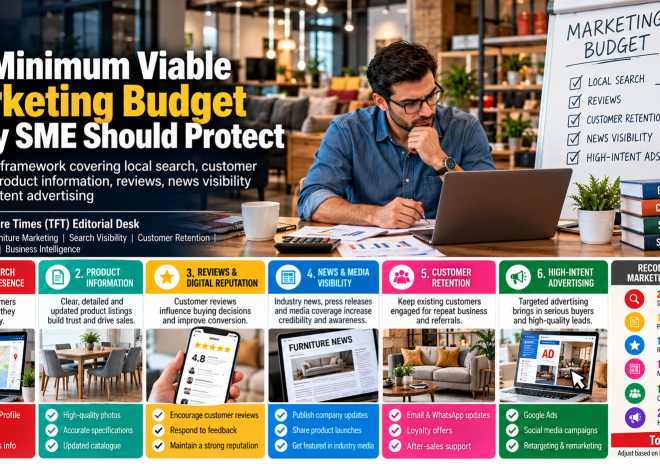
The Minimum Viable Marketing Budget Every SME Should Protect