Circular Economy in the Lighting Industry
By The Furniture Times (TFT) | Indoor & Outdoor Lighting | Sustainability & Energy
From Disposable Products to Regenerative Design: Why the Circular Economy Is Redefining the Future of the Global Lighting Industry
For more than a century, the lighting industry followed a familiar business model: manufacture a product, sell it, use it, and eventually replace it. While this approach helped drive industrial growth and technological innovation, it also created enormous environmental challenges. Millions of lighting products reach the end of their useful lives every year, generating electronic waste, consuming valuable raw materials, and increasing pressure on global supply chains.
Today, that model is rapidly changing.
Around the world, governments, manufacturers, designers, architects, developers, retailers, and consumers are embracing a new philosophy known as the Circular Economy. Instead of asking how quickly products can be replaced, businesses are asking a more important question:
How can lighting products remain valuable for longer while generating less waste and consuming fewer natural resources?
This shift is transforming the lighting industry from one focused primarily on production to one centred on durability, repairability, reuse, refurbishment, remanufacturing, recycling, and responsible resource management.
For the global furniture industry ecosystem, the transition carries significant implications. Furniture manufacturers increasingly integrate lighting into wardrobes, kitchen cabinetry, office furniture, hospitality interiors, retail displays, and smart home solutions. As lighting becomes part of furniture design, circular principles are becoming equally important for both industries.
The future of lighting will not be defined only by how efficiently products consume electricity.
It will also be defined by how responsibly they use materials throughout their entire lifecycle.
What Is a Circular Economy?
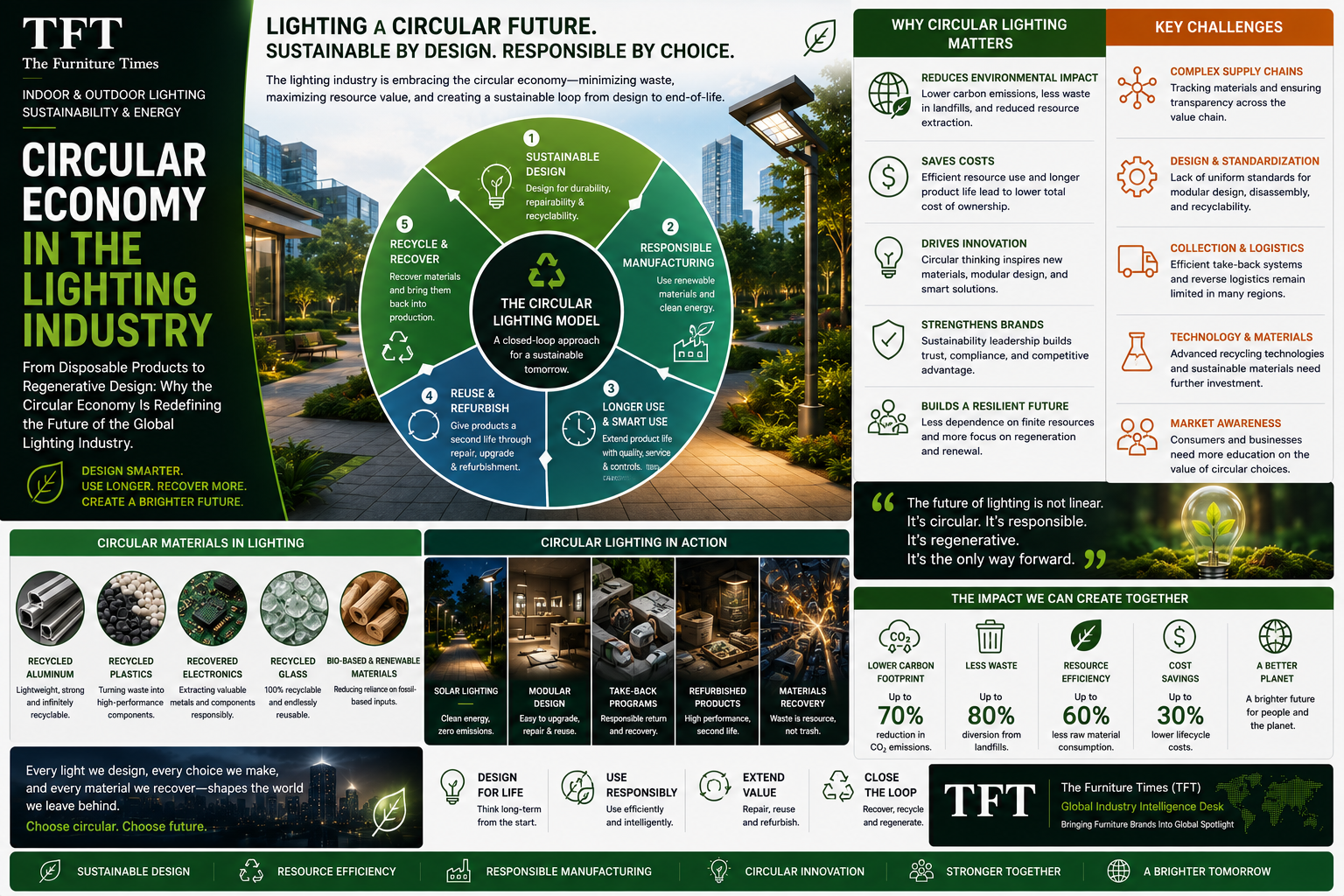
A circular economy is an economic model designed to keep products, materials, and resources in continuous use for as long as possible.
Rather than following the traditional “take, make, use, dispose” approach, circular systems aim to:
- Design products for durability.
- Extend product life.
- Repair instead of replace.
- Reuse valuable components.
- Refurbish existing products.
- Recover valuable materials.
- Minimise waste.
- Reduce environmental impact.
- Improve resource efficiency.
- Create long-term value.
In the lighting industry, this means designing products that remain useful long after their first installation.
Why the Lighting Industry Is Rethinking Product Design
Modern lighting products contain valuable materials, including:
- Aluminium.
- Copper.
- Glass.
- Steel.
- Electronic circuits.
- LED modules.
- Plastics.
- Drivers.
- Sensors.
- Smart control components.
When products are discarded prematurely, many of these resources are lost.
Circular design encourages manufacturers to create lighting systems where individual components can be repaired, upgraded, or replaced without discarding the entire fixture.
This reduces waste while lowering long-term ownership costs.
LED Technology Supports Longer Product Lifecycles
The widespread adoption of LED lighting has already contributed to more sustainable product lifecycles.
Compared with older technologies, LEDs typically provide:
- Longer operating life.
- Lower energy consumption.
- Reduced maintenance.
- Lower replacement frequency.
- Improved reliability.
- Better performance.
- Lower operating costs.
- Reduced environmental impact.
- Smart technology compatibility.
- Greater design flexibility.
However, the next step is ensuring that the surrounding fixture is just as durable and repairable as the LED itself.
Designing for Repair Instead of Replacement
One of the biggest changes in circular thinking is product design.
Future lighting systems are increasingly being developed with modular construction.
Instead of replacing an entire luminaire when one component fails, manufacturers can replace:
- LED modules.
- Drivers.
- Sensors.
- Wireless communication units.
- Control systems.
- Mounting components.
- Optical lenses.
- Smart controllers.
- Electrical connectors.
- Decorative elements.
This significantly extends product life while reducing waste.
Furniture Manufacturers Are Embracing Circular Design
Furniture increasingly includes integrated lighting.
This creates new responsibilities for manufacturers.
Circular design principles encourage furniture companies to develop products where lighting components are:
- Easy to remove.
- Easy to repair.
- Easy to upgrade.
- Easy to recycle.
- Compatible with future technologies.
- Built using recyclable materials.
- Modular in design.
- Serviceable over many years.
- Energy efficient.
- Environmentally responsible.
Furniture and lighting are becoming partners in sustainable product development.
Artificial Intelligence Improves Resource Efficiency
Artificial Intelligence is helping organisations maximise product lifecycles.
AI-powered systems can:
- Predict component failures.
- Schedule maintenance.
- Optimise energy use.
- Monitor equipment health.
- Recommend upgrades.
- Analyse operational performance.
- Reduce unnecessary replacements.
- Improve inventory planning.
- Support predictive servicing.
- Extend product longevity.
Rather than replacing products too early, businesses can make smarter lifecycle decisions based on real operational data.
Refurbishment Is Creating New Business Opportunities
The circular economy is also reshaping business models.
Instead of selling only new products, companies increasingly offer:
- Product refurbishment.
- Component upgrades.
- Lighting retrofits.
- Maintenance contracts.
- Performance monitoring.
- Product leasing.
- Circular service agreements.
- Certified remanufacturing.
- Spare parts programmes.
- End-of-life recycling services.
These services create recurring revenue while supporting environmental sustainability.
Recycling Valuable Materials
Responsible recycling remains an essential part of circular lighting systems.
Modern recycling programmes recover materials such as:
- Aluminium.
- Copper.
- Glass.
- Steel.
- Electronic components.
- Plastics.
- Rare earth materials.
- Circuit boards.
- Batteries.
- Packaging materials.
Recovering these resources reduces dependence on newly extracted raw materials and strengthens supply chain resilience.
Sustainability Is Becoming a Competitive Advantage
Businesses that adopt circular principles often experience benefits beyond environmental responsibility.
These include:
- Lower material costs.
- Stronger customer trust.
- Reduced waste.
- Better ESG performance.
- Regulatory compliance.
- Improved brand reputation.
- Greater operational efficiency.
- Supply chain resilience.
- Product differentiation.
- Long-term profitability.
Consumers increasingly value companies that demonstrate responsible manufacturing practices.
Opportunities Across the Furniture Industry Ecosystem
The circular economy is creating opportunities for:
- Furniture manufacturers.
- Lighting manufacturers.
- Architects.
- Interior designers.
- Hospitality operators.
- Property developers.
- Retail businesses.
- Facility managers.
- Recycling companies.
- Sustainability technology providers.
Collaboration across the entire value chain will accelerate the transition towards more sustainable products and business models.
Challenges That Still Need Solutions
Despite growing momentum, several barriers remain.
These include:
- Product standardisation.
- Collection infrastructure.
- Consumer awareness.
- Recycling costs.
- Design complexity.
- Material separation.
- Global regulations.
- Skilled workforce development.
- Technology upgrades.
- Cross-industry collaboration.
Addressing these challenges will require long-term commitment from governments, manufacturers, and consumers alike.
The Future Will Be Built Around Product Lifecycles
The lighting industry is moving beyond selling products.
It is beginning to manage complete product lifecycles.
Future circular ecosystems will integrate:
- Digital product passports.
- AI-powered maintenance.
- Smart asset tracking.
- Cloud monitoring.
- Digital twins.
- Predictive servicing.
- Automated recycling systems.
- Renewable manufacturing.
- Carbon reporting.
- Circular supply chains.
Every lighting product will carry valuable information throughout its lifetime, making responsible management easier than ever before.
The Most Sustainable Light Is the One That Lasts
The circular economy represents one of the most important transformations in the lighting industry’s history.
It challenges manufacturers to think beyond sales and focus on long-term value, durability, and responsible resource management.
For the global furniture industry ecosystem, circular lighting creates exciting opportunities to design products that are not only beautiful and intelligent but also repairable, upgradeable, recyclable, and built for the future.
As sustainability becomes a defining factor in purchasing decisions, businesses that embrace circular principles today will be better prepared for tomorrow’s markets.
Because true innovation is not measured only by what we create.
It is also measured by how responsibly we preserve the resources that make innovation possible.
The Furniture Times (TFT) & Furniture Industry Search Engine (FISE)
“TFT tells their story. FISE helps the world find them.”
“FurniReviewology helps the world trust them.”
The furniture industry ecosystem is a $1 trillion industry ecosystem.