Global Furniture Market Forecast
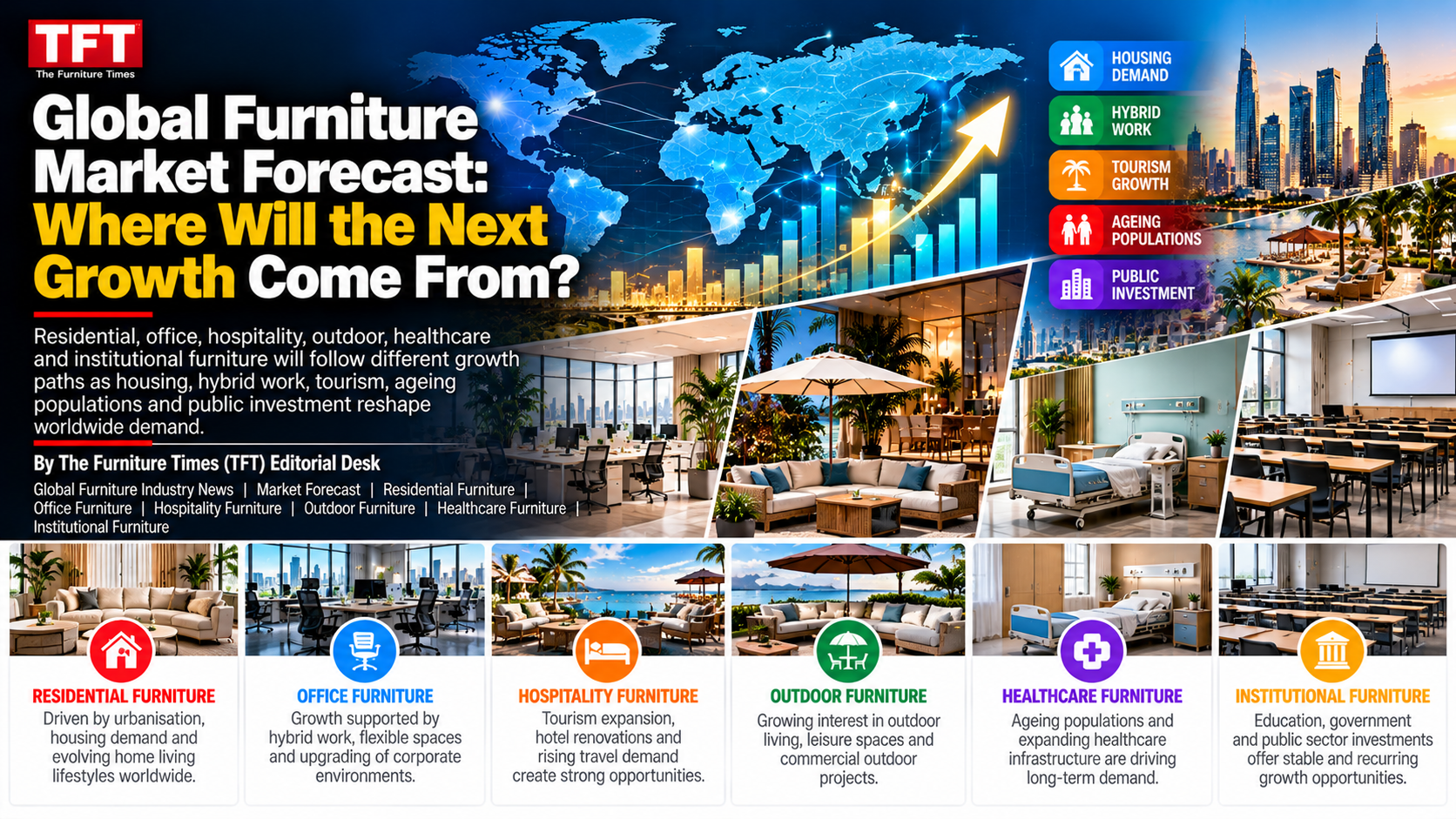
Global Furniture Market Forecast: Where Will the Next Growth Come From?
Residential, office, hospitality, outdoor, healthcare and institutional furniture will follow different growth paths as housing, hybrid work, tourism, ageing populations and public investment reshape worldwide demand
By The Furniture Times (TFT) Editorial Desk | Global Furniture Industry News | Market Forecast | Residential Furniture | Office Furniture | Hospitality Furniture | Outdoor Furniture | Healthcare Furniture | Institutional Furniture
The next phase of global furniture-industry growth will not come from one country, customer group or product category.
Residential furniture will remain the industry’s largest segment, supported by household formation, urbanisation, renovation and rental properties. But high housing costs, weak property transactions and expensive consumer finance will limit growth in several mature economies.
Office furniture will recover selectively. Companies may occupy less space per employee, yet they are investing more strategically in ergonomics, collaboration, acoustics, flexibility and workplace experience.
Hospitality furniture presents substantial opportunities through hotel construction, refurbishment, tourism infrastructure, serviced apartments and short-term accommodation. Its outlook, however, remains exposed to war, aviation costs and regional instability.
Outdoor furniture is evolving from a seasonal household purchase into a broader commercial category spanning hotels, cafés, apartments, workplaces, schools and public spaces.
Healthcare and senior-living furniture will benefit from ageing populations and expanding health systems. Institutional furniture will be supported by education, government facilities, public housing, infrastructure and eventual reconstruction in conflict-affected regions.
The Furniture Times’ central forecast is:
The next growth will come from specialised, service-intensive and demographically necessary furniture—not only from selling more conventional furniture to already-furnished households.
Global Segment Outlook
| Furniture segment | Demand outlook | Principal growth drivers | Main constraint |
|---|---|---|---|
| Residential | Moderate and uneven | Housing, renovation, rentals, urbanisation | Affordability and consumer confidence |
| Office | Selective growth | Hybrid work, ergonomics, collaboration | Smaller corporate footprints |
| Hospitality | Strong potential, high volatility | Tourism, hotels, resorts, short-term rentals | Conflict, aviation and project delays |
| Outdoor | Positive | Outdoor living, hospitality and public spaces | Climate durability and seasonality |
| Healthcare | Structurally positive | Ageing, healthcare investment, accessibility | Compliance and procurement complexity |
| Education | Positive in developing regions | Population growth, schools and universities | Public budgets |
| Government and institutional | Stable to positive | Public facilities, defence, housing and infrastructure | Tender cycles and fiscal pressure |
| Senior living | Strong long-term potential | Ageing populations and care demand | Specialised design requirements |
| Student housing | Selectively positive | Urban education and international students | Affordability and project finance |
| Reconstruction furniture | Large future requirement | Housing and infrastructure rebuilding | Security, funding and transparency |
A Growing Market—but Definitions Matter
Published forecasts differ significantly in their estimates of the global furniture market’s value.
Some research organisations include residential, office, outdoor, commercial and institutional furniture. Others include mattresses, kitchens or components. Market values may be measured at factory, wholesale or retail level.
One current forecast estimates the global furniture market at approximately US$729.61 billion in 2026, rising toward US$952.10 billion by 2031. It identifies urbanisation, delayed homeownership and hybrid-work reconfiguration as important growth drivers.
Another forecast places the market at a considerably different value because of its methodology and category coverage. These variations demonstrate why headline market-size figures should not be compared without reviewing definitions.
For furniture businesses, the more useful questions are:
- Which category is growing?
- In which country?
- At what price level?
- Through which sales channel?
- With what delivery cost?
- Under which regulations?
- At what profit margin?
A billion-dollar market forecast provides limited value if a company cannot identify the customer, distribution route and competitive advantage required to participate.
1. Residential Furniture: Still the Largest Opportunity—but No Longer the Easiest
Residential furniture will remain the foundation of the global industry.
Every newly formed household requires some combination of:
- Beds
- Mattresses
- Seating
- Dining furniture
- Storage
- Wardrobes
- Tables
- Kitchen furniture
- Children’s furniture
- Outdoor products
The long-term demand base remains strong because the world continues to urbanise, households continue to form and existing homes require replacement and renovation.
The immediate outlook is more complicated.
Growth drivers
- Population growth
- Household formation
- Urbanisation
- Housing construction
- Home renovation
- Rental-property turnover
- Short-term rentals
- Work-from-home requirements
- Replacement cycles
- E-commerce accessibility
Growth constraints
- High mortgage rates
- Expensive rent
- Limited affordable housing
- Consumer debt
- Weak confidence
- Higher food and energy costs
- Smaller living spaces
- Growth of second-hand furniture
- Competition from factory-direct platforms
- Delayed homeownership
The OECD continues to identify housing affordability as a serious problem. Although prices have eased from pandemic-era peaks in some markets, high borrowing costs have placed homeownership beyond the reach of many households. Renters also face difficult affordability conditions.
Residential furniture demand exists, but customers are changing how and when they buy.
Residential Growth Will Shift Toward Practical Products
The traditional whole-room furniture collection is losing importance for many consumers.
Customers increasingly buy one product at a time, often after extensive online comparison.
The strongest residential opportunities are likely to involve:
Beds and mattresses
Sleep remains a fundamental need. Mattresses and beds benefit from replacement demand even when housing transactions are weak.
Storage furniture
Smaller homes require wardrobes, cabinets, drawers, shelving and under-bed storage.
Multifunctional products
Sofa beds, extendable tables, folding desks, storage benches and modular systems help consumers use limited space efficiently.
Rental furniture
Students, expatriates, young professionals and mobile households may prefer rental, subscription or affordable short-term products.
Home-office furniture
Remote and hybrid work continue to create demand for compact desks, ergonomic chairs and workspace storage.
Children’s furniture
Population growth and family needs support demand, but safety, adaptability and product lifespan matter.
Repairable furniture
Consumers facing financial pressure may choose products with replaceable covers, components and spare parts.
Residential growth will therefore be strongest where products solve an actual space, mobility, affordability or durability problem.
Regional Residential Outlook
North America
The United States and Canada remain large replacement markets. Demand will improve when mortgage conditions and housing transactions strengthen, but high delivery costs and promotion-driven retail remain major challenges.
Europe
Growth will be modest and replacement-led. Compact furniture, sustainability, renovation, circularity and senior-friendly design offer more promise than conventional mass-market collections.
China
The property downturn remains a constraint. The IMF expects Chinese economic growth to slow to approximately 4% in 2027 and has highlighted weak domestic demand and the need to restore confidence in real estate.
India
India offers one of the strongest long-term residential opportunities through urbanisation, organised retail, new housing and household formation.
Southeast Asia
Indonesia, Vietnam, Malaysia, Thailand and the Philippines offer varied opportunities connected to cities, apartments, domestic tourism and rising incomes.
Africa
The need for furniture is substantial, but commercial demand is constrained by affordability, finance, distribution and infrastructure. Locally manufactured entry-level furniture could outperform imported premium products.
2. Office Furniture: Less Space, Greater Expectations
The office furniture market is not returning to the traditional model in which every employee receives a fixed desk and storage pedestal.
Hybrid work has changed the workplace.
Many employers are reducing total space while improving the quality and flexibility of the space they retain.
The new office is expected to support:
- Collaboration
- Video meetings
- Focused work
- Employee wellbeing
- Informal interaction
- Training
- Social connection
- Flexible attendance
- Rapid reconfiguration
This creates demand for different products—not necessarily fewer products in every case.
The Growth Areas in Office Furniture
Ergonomic seating
Employee wellbeing and occupational health continue to support demand for adjustable work chairs.
Height-adjustable desks
Sit-stand products remain relevant for corporate offices and home workspaces.
Collaborative furniture
Large shared tables, modular seating and project spaces support team-based work.
Acoustic products
Pods, screens, panels and enclosed booths help manage sound in open and hybrid workplaces.
Flexible and mobile furniture
Tables, partitions, whiteboards and seating on castors enable rapid space reconfiguration.
Technology-integrated furniture
Charging, cable management, screens, sensors and booking systems are becoming part of workplace design.
Hospitality-style office furniture
Lounge seating, café tables and informal meeting environments are replacing portions of traditional desk layouts.
Refurbished office furniture
Businesses seeking lower cost and environmental benefits are considering remanufactured desks, task chairs and storage.
Office Growth Will Be Geographic and Quality-Specific
Office demand is strongest in cities attracting technology companies, financial services, global capability centres and flexible workspace operators.
India provides a strong example. Office leasing reached a record 45.5 million square feet during the first half of 2026, according to CBRE data reported by Reuters. Global capability centres accounted for 43% of leasing, demonstrating how technology, engineering and business-service investment can generate substantial workplace demand.
Kuala Lumpur has also shown steady leasing activity, with the vacancy rate improving to 14.8% during the second quarter of 2026 and limited prime supply supporting rental growth.
In Hong Kong, recovery has been concentrated in premium Central offices, while other districts continue to face oversupply.
This demonstrates an important principle:
Office furniture growth will follow high-quality, well-located and experience-led workplaces—not every office building equally.
The Office Furniture Business Model Is Changing
Manufacturers and dealers will increasingly earn revenue from:
- Space planning
- Installation
- Relocation
- Reconfiguration
- Asset management
- Furniture rental
- Maintenance
- Cleaning
- Refurbishment
- Resale
- Take-back services
The commercial relationship will extend beyond the first purchase.
A company that merely delivers desks will compete primarily on price. A company that helps clients plan, install, track, reconfigure and recover furniture can create long-term value.
3. Hospitality Furniture: One of the Strongest Opportunities
Hospitality furniture is positioned for significant medium-term growth, supported by tourism infrastructure, hotel construction and refurbishment.
Demand comes from:
- Hotels
- Resorts
- Restaurants
- Cafés
- Serviced apartments
- Cruise facilities
- Airport lounges
- Wellness retreats
- Casinos
- Theme parks
- Airbnb properties
- Homestays
Tourism remained resilient during the first half of 2026 despite conflict and higher travel costs. International arrivals increased by approximately 0.4%, according to UN Tourism.
The World Economic Forum reported that global travel and tourism development conditions were at their strongest since the pandemic, with improvements in tourism infrastructure, services, cultural attractions and connectivity between 2024 and 2026.
These improvements support long-term furniture demand even though individual regions remain exposed to conflict and aviation disruption.
Where Hospitality Demand Will Emerge
Gulf countries
Saudi Arabia, the UAE and Qatar continue to develop tourism, hospitality and entertainment projects. The market offers high contract values but carries geopolitical, shipping and project-financing risks.
India
Urban business travel, religious tourism, domestic travel and international hotel investment support new construction and refurbishment.
Southeast Asia
Thailand, Vietnam, Indonesia, Malaysia and the Philippines benefit from beach, city, cultural and nature-based tourism.
Africa
Resorts, safari destinations, coastal tourism and urban hotels create opportunities, particularly for locally appropriate products.
Europe
Mature hotel markets require refurbishment, energy upgrades and brand repositioning rather than only new construction.
North America
Hotel renovation cycles, branded residences, resorts and extended-stay formats will continue generating demand.
Hospitality Furniture Must Perform Like Commercial Equipment
Hotel furniture may resemble residential furniture, but it operates under more demanding conditions.
A guest-room chair, bed, wardrobe or sofa may be used by hundreds of people during its service life.
Products need:
- Structural durability
- Replaceable components
- Cleanable surfaces
- Commercial fabrics
- Fire compliance
- Stable finishes
- Spare parts
- Repeat availability
- Efficient installation
- Repair support
Manufacturers entering hospitality should understand mock-up approval, project documentation, room schedules, delivery sequencing and site installation.
A beautiful catalogue is not enough.
Airbnb and Homestay Furniture Is Becoming a Strategic Category
Short-term rentals create a distinct furniture market between residential and commercial hospitality.
Hosts need products that photograph well, survive frequent occupancy and can be replaced quickly.
Demand includes:
- Beds and mattresses
- Sofa beds
- Dining furniture
- Luggage racks
- Work desks
- Outdoor seating
- Storage
- Bedside furniture
- Mirrors
- Compact kitchens
- Local craft pieces
Professional short-term-rental operators increasingly standardise furniture across multiple properties to simplify maintenance and replacement.
This creates opportunities for complete furnishing packages, fast installation, stable product codes and furniture maintenance services.
4. Outdoor Furniture: From Seasonal Product to Strategic Space
Outdoor furniture is no longer limited to private gardens.
Balconies, rooftops, pool decks, restaurant terraces, hotels, schools, offices and public spaces are being treated as functional extensions of indoor environments.
One current market forecast values the outdoor furniture category at approximately US$17.68 billion in 2026 and projects growth to US$27.72 billion by 2036. Market forecasts should be interpreted carefully, but the direction reflects wider investment in outdoor living and hospitality.
Growth drivers
- Hospitality development
- Restaurant terraces
- Residential balconies
- Rooftop living
- Wellness
- Resort construction
- Outdoor offices
- Public-space investment
- Home improvement
- Climate-conscious design
Outdoor Growth Depends on Climate Performance
Outdoor furniture manufacturers must design for specific environmental conditions.
A product that performs well in a dry European summer may fail in tropical humidity, coastal salt air or extreme Gulf heat.
Buyers increasingly need evidence concerning:
- UV resistance
- Corrosion resistance
- Water drainage
- Fabric colourfastness
- Mould resistance
- Wind stability
- Fastener quality
- Timber treatment
- Cushion drying
- Replacement availability
The commercial outdoor market will increasingly favour technically documented products rather than furniture marketed only through lifestyle photography.
Commercial Outdoor Furniture May Outperform Residential
Residential outdoor demand can be seasonal and discretionary.
Commercial buyers have operational reasons to invest. A hotel, restaurant or café can generate revenue from a usable terrace or poolside area.
This gives commercial outdoor furniture a clearer return on investment.
Growth opportunities include:
- Hotel loungers
- Restaurant dining sets
- Commercial parasols
- Poolside furniture
- Modular lounge systems
- Outdoor bars
- Resort cabanas
- Rooftop seating
- Public benches
- Outdoor learning furniture
Suppliers able to provide layout planning, installation, anchoring, covers, replacement cushions and maintenance will have an advantage.
5. Healthcare Furniture: Demographic Demand Becomes Structural
Healthcare furniture is positioned for long-term growth because of ageing populations, chronic disease, healthcare investment and expanding access to medical services.
The United Nations expects the number of people aged 80 and older to reach approximately 265 million by the middle of the 2030s, surpassing the number of infants. un.org
The World Bank is also pursuing a programme intended to support countries in delivering quality and affordable health services to 1.5 billion people by 2030.
These developments create demand for furniture across:
- Hospitals
- Clinics
- Rehabilitation centres
- Dental facilities
- Laboratories
- Pharmacies
- Elderly-care homes
- Assisted-living facilities
- Mental-health facilities
- Community health centres
Healthcare Furniture Is Not Ordinary Furniture
Healthcare furniture must support safety, hygiene, accessibility and clinical workflows.
Important product requirements can include:
- Cleanable surfaces
- Antimicrobial material strategies
- Chemical resistance
- Rounded edges
- Stability
- Bariatric load capacity
- Accessible heights
- Mobility and locking castors
- Replaceable upholstery
- Fire performance
- Reduced entrapment risk
- Infection-control compatibility
The purchasing decision involves more than price and appearance.
Healthcare buyers consider:
- Cleaning protocols
- Patient dignity
- Staff efficiency
- Maintenance
- Risk management
- Product lifespan
- Compliance
- Spare parts
Manufacturers entering this category need technical understanding and disciplined documentation.
Senior-Living Furniture Will Become a Major Specialisation
Senior living connects healthcare, hospitality and residential design.
Residents need furniture that feels homelike but supports mobility, safety and care.
Opportunities include:
- Higher seating
- Supportive armrests
- Stable tables
- Easy-clean upholstery
- Accessible wardrobes
- Adjustable beds
- Dementia-sensitive design
- Improved colour contrast
- Rounded edges
- Furniture suitable for carers
Products that look overly clinical may reduce emotional comfort. Products designed only for residential appearance may fail operational requirements.
The most successful senior-living furniture will balance dignity, safety, familiarity and performance.
6. Educational and Institutional Furniture: Quiet but Reliable Growth
Institutional furniture receives less media attention than household and luxury furniture, but it represents a substantial global category.
Demand comes from:
- Schools
- Universities
- Libraries
- Training centres
- Government offices
- Courts
- Police stations
- Military facilities
- Public housing
- Community centres
- Religious buildings
- Emergency accommodation
Population growth in India, Africa, Southeast Asia and other developing regions will require new educational and public infrastructure.
Mature markets will invest more in refurbishment, accessibility, flexible learning and technology-enabled spaces.
The Classroom Is Changing
Traditional rows of fixed desks are giving way to flexible educational environments.
Schools and universities increasingly require:
- Mobile tables
- Stackable chairs
- Collaborative seating
- Maker-space furniture
- Technology charging
- Flexible storage
- Outdoor learning products
- Inclusive furniture
- Laboratory furniture
- Library systems
Products must withstand intensive use while remaining easy to reconfigure.
Educational-furniture companies should understand procurement calendars, tender systems, safety requirements and replacement cycles.
Government and Defence Furniture
Government, defence and emergency-service procurement can create stable demand, particularly when consumer furniture markets are weak.
Products may include:
- Offices
- Barracks
- Training rooms
- Accommodation
- Storage systems
- Control-room furniture
- Secure cabinets
- Public waiting areas
- Emergency beds
- Field furniture
These contracts require strong compliance, traceability, delivery capacity and often local-content participation.
Payment can be dependable when procurement is well governed, but tender processes may be long and highly price competitive.
Reconstruction Will Become a Major Future Demand Category
Wars and disasters have damaged housing, schools, hospitals and government facilities across several regions.
Eventually, reconstruction will require furniture on a large scale.
Products will need to be:
- Affordable
- Durable
- Rapidly deployable
- Easy to assemble
- Repairable
- Locally appropriate
- Efficient to transport
Reconstruction demand could support factories in neighbouring countries and local production inside affected markets.
However, businesses must maintain ethical safeguards.
Reconstruction procurement should include:
- Transparent tenders
- Anti-corruption controls
- Human-rights due diligence
- Local employment
- Product traceability
- End-user verification
- Independent quality inspection
Human suffering must not become a market for uncontrolled profiteering.
Which Segments Offer Volume—and Which Offer Margin?
| Segment | Volume potential | Margin potential | Technical complexity | Sales cycle |
|---|---|---|---|---|
| Mass residential | High | Low to medium | Low to medium | Short |
| Premium residential | Medium | High | Medium | Medium |
| Office | Medium | Medium to high | Medium | Medium |
| Hospitality | High for projects | Medium to high | High | Long |
| Outdoor residential | Medium | Medium | Medium | Seasonal |
| Outdoor commercial | Medium | High | High | Medium to long |
| Healthcare | Medium | High | Very high | Long |
| Senior living | Growing | High | High | Long |
| Education | High | Medium | Medium | Tender-led |
| Government | High | Medium | High | Long |
| Reconstruction | Potentially very high | Variable | High | Funding-dependent |
High growth does not always produce high profit.
Mass residential furniture may generate volume but face severe price competition. Healthcare or hospitality furniture may produce better margins but require technical expertise, documentation and longer selling cycles.
Businesses should select categories according to capability—not only forecast growth.
The Geographic Sources of the Next Growth
Asia-Pacific
Asia-Pacific is expected to remain the strongest combination of manufacturing, consumer growth and urban development. India, Vietnam, Indonesia, Malaysia, Thailand and the Philippines offer different opportunities across residential, office and hospitality products.
Gulf markets
Saudi Arabia, the UAE, Qatar and neighbouring countries can generate significant hospitality, office, healthcare, outdoor and institutional demand. However, war and shipping risks must be included in every commercial calculation.
Africa
Africa offers long-term residential, educational, healthcare and hospitality demand. Local or regional production will often be more viable than distant imports.
North America
Growth will come through replacement, renovation, outdoor living, senior care, institutional demand and selective housing recovery.
Europe
Growth will concentrate in refurbishment, sustainability, circular furniture, senior living, healthcare, hospitality and specialised design.
Latin America
Mexico can benefit from nearshoring, while Brazil offers domestic scale. Hospitality, local manufacturing and regional trade provide selective opportunities.
Five Forces That Will Influence Every Segment
1. Affordability
Even a growing population cannot create commercial demand without purchasing power or finance.
2. Regulation
Furniture safety, timber legality, chemicals, fire performance, sustainability and accessibility rules are becoming more important.
3. Logistics
Bulky products remain exposed to freight, damage and final-mile costs.
4. Digital discovery
Buyers increasingly find suppliers through search engines, specialised platforms and AI systems.
5. Trust
Reviews, certifications, project references and transparent information reduce buyer risk.
How Manufacturers Should Choose Their Next Growth Segment
A residential manufacturer should not enter healthcare simply because the category is growing.
Before diversifying, a company should assess:
- Product knowledge
- Testing requirements
- Materials
- Equipment
- Quality systems
- Documentation
- Sales cycle
- Installation capability
- Working capital
- Warranty responsibility
- Buyer expectations
- Competitive advantage
The correct growth segment is the one where the company can build a defensible capability.
Strategic Questions for 2027
Furniture companies should ask:
- Which segment is generating enquiries now?
- Which customer group has budgets?
- Which products are essential rather than postponable?
- Can the company meet technical requirements?
- Is the category dependent on housing transactions?
- Can products be repaired locally?
- What is the complete landed cost?
- Are spare parts available?
- Can buyers find the company online?
- Does the business have credible reviews and case studies?
Growth forecasts become commercially useful only when converted into product and market decisions.
TFT, FISE and FurniReviewology: Connecting Growth With Businesses
The global furniture industry is not short of opportunities. It is short of structured connections between demand and capability.
The Furniture Times—TFT identifies where demand, investment and industry transformation are occurring.
Furniture Industry Search Engine—FISE helps buyers locate manufacturers, suppliers, retailers, designers, installers and service providers.
FurniReviewology supports purchasing confidence through reviews, reputation and customer experience.
The Furniture Times tells their story.
Furniture Industry Search Engine helps the world find them.
FurniReviewology helps the world trust them.
The furniture industry ecosystem is a $1 trillion industry ecosystem, but its commercial information remains fragmented.
The next growth will be captured by businesses that are visible when buyers begin searching.
Final Forecast
Residential furniture will remain the largest market, but its growth will be constrained by affordability and housing conditions.
Office furniture will grow through workplace transformation rather than a universal return to traditional offices.
Hospitality furniture offers one of the strongest project opportunities, particularly in Asia and the Gulf, although geopolitical and tourism risks remain.
Outdoor furniture will expand across commercial and mixed-use spaces, with climate performance becoming a decisive product requirement.
Healthcare and senior-living furniture offer some of the most durable long-term demand because they are connected to demographics and essential services.
Institutional furniture will grow through schools, healthcare, public housing, government investment and reconstruction.
The next global furniture growth story will therefore not be built on one category.
It will be built where furniture becomes essential to:
- Housing people
- Supporting work
- Enabling travel
- Extending living space
- Delivering healthcare
- Educating communities
- Rebuilding societies
The companies that understand these needs—and make their capabilities searchable, credible and dependable—will lead the industry’s next chapter.
Sources:
UN Tourism—World Tourism Barometer
World Economic Forum—Travel & Tourism Development Index 2026
JLL—Global Office Fit-Out Costs Guide 2026
CBRE—Commercial Real Estate Research
World Bank—Health
United Nations—Ageing
WTO—Global Trade Outlook and Statistics