The Business of Light: From Manufacturing to Smart Lighting Services
By The Furniture Times (TFT) | Indoor & Outdoor Lighting | Global Lighting Industry & Market
How the Lighting Industry Is Evolving from Product Manufacturing to Intelligent Service Ecosystems
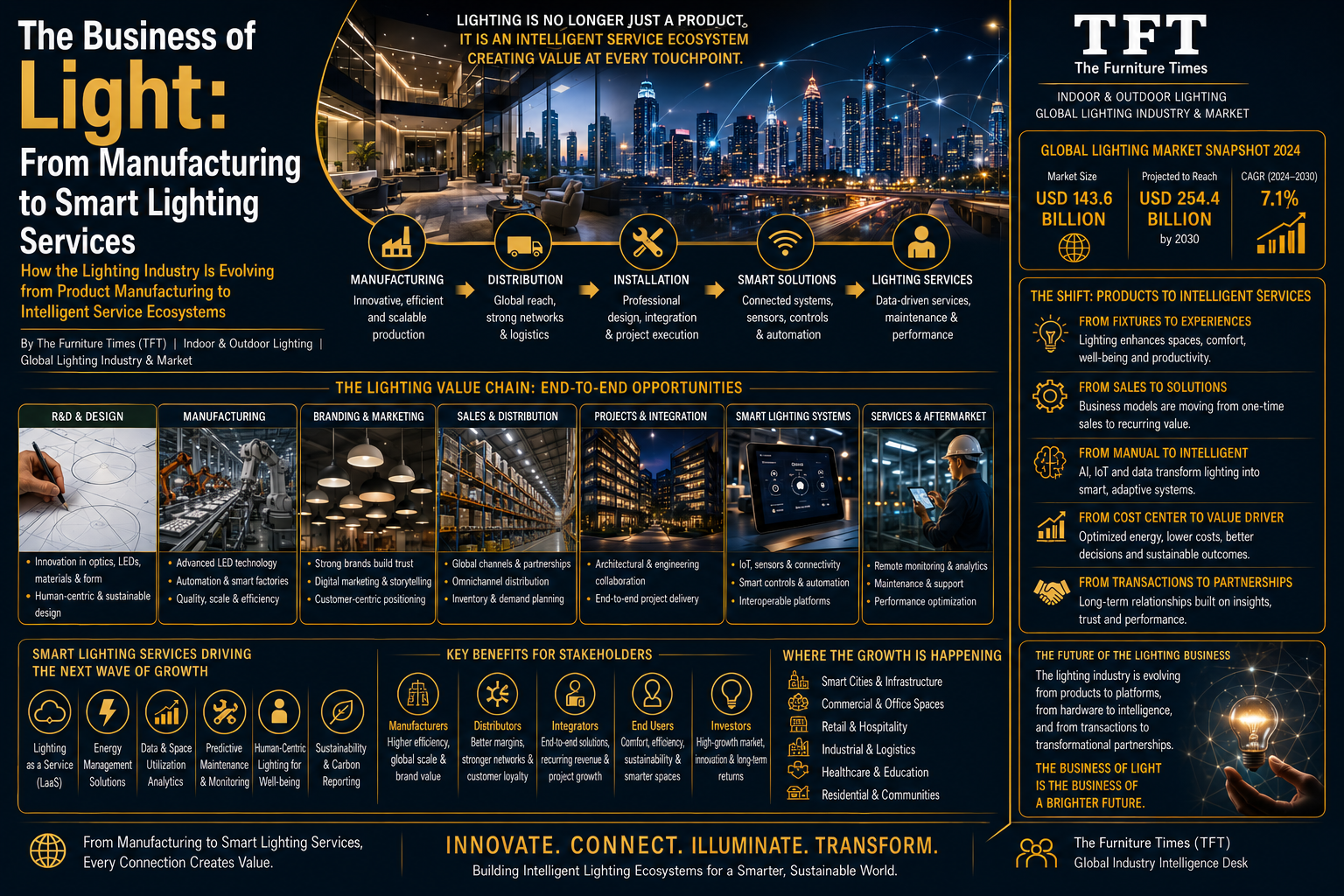
The global lighting industry is undergoing a profound transformation. For decades, the business of lighting centered on manufacturing bulbs, fixtures, luminaires, and electrical components that illuminated homes, offices, factories, streets, and public spaces. Today, however, lighting has become much more than a physical product—it has evolved into an intelligent, connected, and service-driven ecosystem that combines advanced manufacturing, Artificial Intelligence (AI), Internet of Things (IoT), cloud computing, software platforms, data analytics, predictive maintenance, and long-term customer services.
This evolution is reshaping the industry’s value chain. Manufacturers are no longer competing solely on product quality or pricing. Instead, they are increasingly delivering comprehensive lighting solutions that include design consultation, digital controls, installation, remote monitoring, software updates, maintenance contracts, energy optimization, and performance analytics.
For architects, interior designers, furniture manufacturers, property developers, facility managers, governments, hospitality operators, retailers, industrial companies, and investors, the lighting industry is no longer just about purchasing products—it is about investing in intelligent services that improve operational efficiency, sustainability, customer experience, and long-term financial performance.
Lighting Has Become a Complete Business Ecosystem
The modern lighting industry encompasses a broad ecosystem of businesses working together across the entire product lifecycle.
The ecosystem includes:
- Raw material suppliers
- Semiconductor manufacturers
- LED chip producers
- Electronics manufacturers
- Lighting fixture manufacturers
- Smart control developers
- Software companies
- AI technology providers
- Interior designers
- Architects
- Electrical consultants
- Construction companies
- System integrators
- Installation specialists
- Facility management companies
- Maintenance providers
- Energy consultants
- Smart city technology firms
- Renewable energy companies
- Digital service providers
This interconnected ecosystem generates economic value far beyond the manufacturing of lighting products alone.
Manufacturing Remains the Foundation
Although the industry is rapidly evolving, manufacturing continues to serve as its foundation.
Modern lighting factories produce:
- LED bulbs
- Decorative fixtures
- Architectural luminaires
- Commercial lighting
- Industrial lighting
- Outdoor lighting
- Street lighting
- Solar lighting
- Emergency lighting
- Smart lighting hardware
Manufacturers increasingly invest in automation, robotics, AI-powered quality control, precision engineering, sustainable materials, and advanced production technologies to improve quality while reducing production costs.
However, manufacturing alone is no longer sufficient to remain competitive.
The Shift Toward Smart Lighting Solutions
Today’s customers increasingly seek complete solutions rather than individual products.
Instead of simply purchasing fixtures, organizations now expect lighting systems that can:
- Optimize energy usage.
- Monitor occupancy.
- Integrate with building management systems.
- Improve employee productivity.
- Support sustainability goals.
- Reduce maintenance costs.
- Generate operational data.
- Enhance security.
- Improve customer experiences.
- Adapt automatically to changing environments.
Lighting companies increasingly differentiate themselves through software, intelligence, connectivity, and long-term service capabilities.
Artificial Intelligence Is Creating Service-Based Business Models
Artificial Intelligence has transformed lighting into a continuously evolving digital platform.
AI-powered lighting systems can:
- Learn user behavior.
- Adjust brightness automatically.
- Optimize energy consumption.
- Predict equipment failures.
- Analyze occupancy patterns.
- Improve building performance.
- Support emergency response.
- Generate maintenance schedules.
- Deliver operational reports.
- Recommend efficiency improvements.
Rather than selling static products, manufacturers now offer continuous AI-powered optimization services that generate recurring customer value.
Lighting as a Service (LaaS)
One of the industry’s fastest-growing business models is Lighting as a Service (LaaS).
Under this model, customers no longer purchase lighting infrastructure outright.
Instead, service providers deliver:
- Lighting system design
- Equipment installation
- Software integration
- Performance monitoring
- Remote management
- Maintenance
- Upgrades
- Energy optimization
- Technical support
- End-of-life replacement
Customers typically pay ongoing subscription or service fees rather than making large upfront capital investments.
This model provides predictable operating costs while allowing organizations to access the latest technologies throughout the system’s lifecycle.
For manufacturers, LaaS creates recurring revenue rather than relying solely on one-time product sales.
Smart Buildings Create Long-Term Service Opportunities
Commercial buildings increasingly rely on intelligent lighting as part of broader building automation systems.
Modern lighting services now include:
- Occupancy analytics
- Space utilization reporting
- Energy benchmarking
- Carbon tracking
- ESG reporting
- Cloud monitoring
- Predictive maintenance
- Asset management
- Remote diagnostics
- Digital system updates
These services generate continuous customer engagement long after installation has been completed.
Residential Smart Lighting Is Becoming Subscription-Based
Homeowners increasingly expect connected lighting systems that continue improving over time.
Future residential lighting services may include:
- Software updates
- Security monitoring
- AI personalization
- Voice assistant integration
- Energy optimization
- Smart home synchronization
- Device diagnostics
- Cloud backups
- Remote access
- Lifestyle automation
The smart home market continues creating opportunities for recurring service relationships between manufacturers and consumers.
Hospitality Demands Intelligent Lighting Experiences
Hotels, resorts, restaurants, and luxury residences increasingly use lighting to create memorable guest experiences.
Lighting service providers now support hospitality clients through:
- Mood programming
- Event lighting management
- Guest preference automation
- Remote diagnostics
- Preventive maintenance
- Sustainability reporting
- Energy optimization
- Outdoor landscape control
- Conference room automation
- Integrated entertainment systems
Rather than selling fixtures, providers increasingly deliver complete lighting experience management.
Retail Lighting Becomes Data Intelligence
Retailers use intelligent lighting to improve both customer experiences and business performance.
Modern service offerings include:
- Customer movement analytics
- Product highlighting
- Promotional scheduling
- Occupancy reporting
- Store optimization
- Energy monitoring
- Remote management
- Visual merchandising support
- Multi-location control
- Predictive maintenance
Lighting has become an important source of commercial data that supports strategic business decisions.
Smart Cities Depend on Lighting Services
Municipal governments increasingly outsource lighting management to specialized service providers.
Smart lighting service companies now manage:
- Street lighting
- Traffic-responsive lighting
- Public park illumination
- Infrastructure monitoring
- Environmental sensing
- Public safety systems
- Energy reporting
- Asset maintenance
- Cloud platforms
- Emergency communications
Cities benefit from improved efficiency while reducing operational complexity.
Sustainability Creates Ongoing Business Value
Environmental sustainability continues reshaping the lighting business.
Customers increasingly require services that support:
- Carbon reduction
- Renewable energy integration
- Green building certifications
- Circular economy practices
- Lifecycle reporting
- Waste reduction
- Energy efficiency
- ESG compliance
- Sustainable procurement
- Long-term environmental performance
Lighting providers increasingly position themselves as sustainability partners rather than product suppliers.
Furniture and Lighting Are Becoming Integrated Services
The furniture industry increasingly incorporates intelligent lighting into products.
Manufacturers now collaborate on:
- Smart wardrobes
- Illuminated kitchen cabinetry
- Sensor-based storage
- Office workstations
- Hospitality furniture
- Display systems
- Entertainment furniture
- Bathroom cabinetry
- Luxury retail fixtures
- Connected living environments
Future service offerings may include software updates, lighting customization, diagnostics, and remote configuration for integrated furniture lighting systems.
Digital Commerce Expands Service Opportunities
Lighting companies increasingly reach customers through digital platforms.
Successful organizations now invest in:
- AI-powered product search
- Virtual consultations
- BIM integration
- Online specification tools
- Digital configurators
- Virtual showrooms
- Technical webinars
- Remote commissioning
- Online training
- Customer support platforms
Digital engagement has become essential for building long-term customer relationships.
Workforce Transformation
The evolution toward intelligent lighting services creates demand for new professional skills.
Future industry careers increasingly include:
- AI engineering
- Cloud software development
- Data analytics
- Cybersecurity
- Building automation
- Digital consulting
- Sustainability advisory
- IoT engineering
- Remote monitoring
- Smart building integration
The industry’s workforce is becoming increasingly multidisciplinary.
Investment Opportunities Across the Value Chain
The transformation from manufacturing to services creates opportunities across:
- AI software
- Smart lighting platforms
- Building automation
- Cloud services
- Energy analytics
- Human-centric lighting
- Predictive maintenance
- Renewable energy integration
- Smart city technologies
- Digital infrastructure
Investors increasingly recognize that long-term value lies not only in manufacturing products but also in delivering ongoing intelligent services.
Challenges Facing Service Providers
As lighting becomes increasingly digital, several challenges must be addressed.
These include:
- Cybersecurity
- Data privacy
- Software interoperability
- Global standards
- Skilled workforce shortages
- Customer education
- Long-term software support
- Electronic waste
- Supply chain resilience
- Continuous innovation
Companies that successfully address these issues will strengthen customer trust and market leadership.
The Future of the Business of Light
The lighting industry is entering a new era where products and services are inseparable.
Manufacturing excellence will remain essential, but future competitiveness will increasingly depend on intelligence, connectivity, software, customer experience, sustainability, and long-term partnerships.
Artificial Intelligence, IoT, cloud computing, renewable energy, smart buildings, and digital infrastructure are transforming lighting into one of the most valuable technology-enabled service industries in the world.
For manufacturers, architects, developers, furniture companies, hospitality operators, governments, facility managers, investors, and technology providers, the business of light has evolved into a comprehensive ecosystem that creates continuous value long after a fixture is installed.
The future of lighting will not be defined solely by brighter LEDs or more attractive fixtures.
It will be defined by intelligent services that optimize buildings, reduce environmental impact, enhance human well-being, improve operational efficiency, and connect every illuminated space into a smarter, more sustainable global economy.
From manufacturing to managed services, from hardware to software, and from illumination to intelligence, the business of light has entered its most innovative chapter yet.