Government Policies Driving LED Adoption
By The Furniture Times (TFT) | Indoor & Outdoor Lighting | Sustainability & Energy
Lighting the Future Through Policy: How Governments Around the World Are Accelerating the Global Shift to LED Technology
The global transition to LED lighting is often viewed as a story of technological innovation. Consumers appreciate lower electricity bills, businesses value reduced maintenance costs, and cities benefit from improved energy efficiency. However, behind the rapid growth of LED lighting lies another powerful force that receives far less attention—government policy.
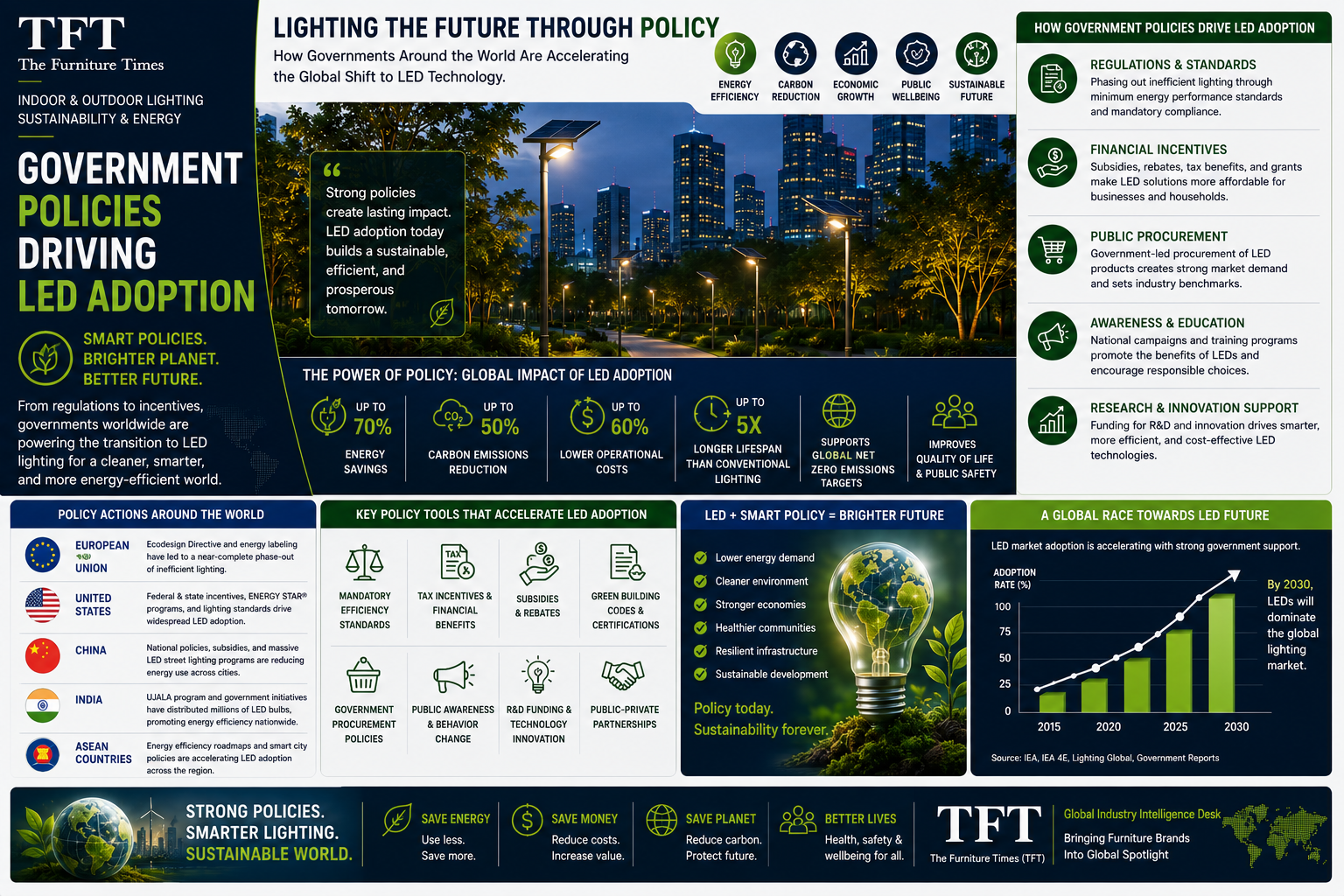
Across continents, national governments, regional authorities, and local municipalities are introducing regulations, incentives, and sustainability programmes that encourage the replacement of outdated lighting technologies with high-efficiency LED systems. These policies are not simply aimed at reducing electricity consumption; they form part of broader national strategies to strengthen energy security, reduce carbon emissions, modernise infrastructure, improve public services, and meet international climate commitments.
From public infrastructure projects and smart city initiatives to building regulations, tax incentives, and minimum energy performance standards, government action is helping reshape the global lighting industry.
For the global furniture industry ecosystem, these policy changes extend well beyond lighting manufacturers. Furniture companies, architects, interior designers, commercial developers, hospitality operators, educational institutions, healthcare providers, retailers, and smart building specialists are increasingly adapting their products and projects to meet new efficiency standards and sustainability expectations.
The future of lighting will not be shaped by innovation alone.
It will also be guided by forward-thinking public policy.
Why Governments Are Prioritising LED Lighting
Lighting represents a substantial share of electricity consumption in residential, commercial, industrial, and public buildings.
For governments seeking practical ways to reduce national energy demand, upgrading lighting infrastructure offers one of the fastest and most cost-effective opportunities.
Replacing inefficient lighting with LED technology can help countries:
- Lower electricity demand.
- Reduce greenhouse gas emissions.
- Improve energy security.
- Reduce public operating costs.
- Strengthen climate resilience.
- Improve public safety.
- Modernise infrastructure.
- Support sustainable urban development.
- Encourage innovation.
- Create new employment opportunities.
LED adoption has therefore become an important element of many national sustainability strategies.
Energy Efficiency Standards Are Raising the Bar
Many countries have introduced minimum energy performance standards for lighting products.
These regulations encourage manufacturers to produce more efficient products while gradually removing low-efficiency technologies from the market.
Common policy measures include:
- Minimum efficiency requirements.
- Product performance testing.
- Energy labelling.
- Quality certifications.
- Import regulations.
- Manufacturing standards.
- Safety compliance.
- Environmental requirements.
- Performance benchmarking.
- Consumer information programmes.
Such standards create greater confidence for both businesses and consumers.
Public Sector Leadership Is Accelerating Adoption
Governments are often among the largest purchasers of lighting systems.
Large-scale public projects increasingly involve LED upgrades across:
- Government offices.
- Schools.
- Universities.
- Hospitals.
- Airports.
- Railway stations.
- Public parks.
- Highways.
- Municipal buildings.
- Sports facilities.
These investments reduce long-term operating costs while demonstrating the practical benefits of energy-efficient lighting.
Smart City Policies Are Driving Innovation
Many governments now integrate LED lighting into broader smart city strategies.
Modern public lighting systems increasingly include:
- Motion sensors.
- Adaptive brightness controls.
- Remote monitoring.
- Environmental sensors.
- Traffic management integration.
- Public safety systems.
- Wireless connectivity.
- AI-powered analytics.
- Predictive maintenance.
- Renewable energy integration.
Streetlights are becoming intelligent infrastructure rather than simple sources of illumination.
Building Regulations Encourage Smarter Design
Building codes continue to evolve in response to environmental challenges.
New developments increasingly require lighting systems that support:
- Lower energy consumption.
- Intelligent controls.
- Daylight harvesting.
- Occupancy sensing.
- Emergency lighting efficiency.
- Building automation.
- Carbon reduction.
- Indoor environmental quality.
- Smart energy management.
- Long-term sustainability.
Architects and developers are incorporating these requirements during the earliest stages of project planning.
Financial Incentives Encourage Faster Upgrades
Many governments support LED adoption through economic incentives.
These may include:
- Tax credits.
- Investment allowances.
- Utility rebates.
- Low-interest financing.
- Green building grants.
- Public-private partnerships.
- Energy efficiency funds.
- Municipal incentive programmes.
- Industrial upgrade support.
- Renewable energy financing.
Such measures help reduce initial investment costs while encouraging wider adoption.
Artificial Intelligence Enhances Public Investment
Government investment is increasingly extending beyond LED fixtures themselves.
Artificial Intelligence enables public authorities to manage lighting infrastructure more efficiently by:
- Monitoring energy consumption.
- Predicting maintenance needs.
- Detecting equipment failures.
- Improving public safety.
- Reducing operating costs.
- Optimising lighting schedules.
- Supporting carbon reporting.
- Improving asset management.
- Enhancing infrastructure planning.
- Maximising taxpayer value.
AI transforms lighting from a fixed asset into an intelligent public service.
Opportunities Across the Furniture Industry Ecosystem
Government policies promoting LED lighting create significant opportunities for:
- Furniture manufacturers.
- Lighting manufacturers.
- Interior designers.
- Architects.
- Property developers.
- Hospitality businesses.
- Educational institutions.
- Healthcare facilities.
- Retail companies.
- Smart building technology providers.
Furniture products increasingly incorporate energy-efficient lighting that aligns with modern building regulations and consumer expectations.
Manufacturing Is Also Evolving
Policy changes encourage manufacturers to adopt more sustainable production methods.
Many companies are investing in:
- Energy-efficient factories.
- Responsible material sourcing.
- Circular manufacturing.
- Low-carbon production.
- AI-powered quality control.
- Waste reduction.
- Renewable energy.
- Water conservation.
- Smart automation.
- Environmental reporting.
Government regulations often accelerate innovation across the entire manufacturing value chain.
Challenges That Policymakers Must Address
Despite impressive progress, several challenges remain.
These include:
- Higher upfront investment costs.
- Uneven policy implementation.
- Technology accessibility.
- Rural infrastructure limitations.
- Consumer awareness.
- Counterfeit products.
- Skilled workforce shortages.
- Electronic waste management.
- International regulatory differences.
- Long-term maintenance planning.
Effective policy must balance environmental ambition with practical implementation.
International Cooperation Is Becoming More Important
Climate change is a global challenge that requires coordinated action.
Governments are increasingly sharing best practices related to:
- Energy efficiency standards.
- Product testing.
- Smart city development.
- Carbon reduction strategies.
- Green procurement.
- Building regulations.
- Circular economy initiatives.
- Renewable energy integration.
- Sustainable manufacturing.
- Digital infrastructure.
International collaboration accelerates innovation while helping countries achieve common sustainability goals.
Public Policy Is Helping Build the Future
The global shift toward LED lighting demonstrates that technological progress and effective public policy can work together to create meaningful change.
Governments are not simply regulating the lighting industry.
They are helping shape healthier cities, more efficient buildings, stronger economies, and cleaner environments.
For the global furniture industry ecosystem, these developments create exciting opportunities to design products that meet evolving environmental standards while improving the way people live, work, learn, shop, and relax.
The companies that understand emerging regulations, invest in innovation, and embrace sustainability will be best positioned for long-term success.
Because the future of lighting is not only being engineered in laboratories and factories.
It is also being written through visionary policies that encourage smarter choices, responsible manufacturing, and sustainable development for generations to come.
The Furniture Times (TFT) & Furniture Industry Search Engine (FISE)
“TFT tells their story. FISE helps the world find them.”
“FurniReviewology helps the world trust them.”
The furniture industry ecosystem is a $1 trillion industry ecosystem.