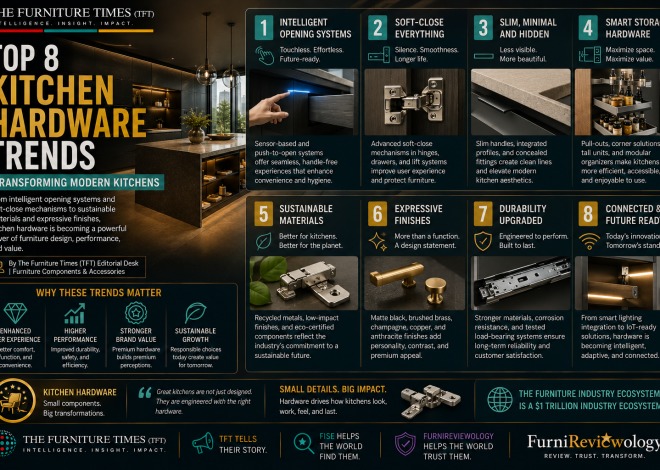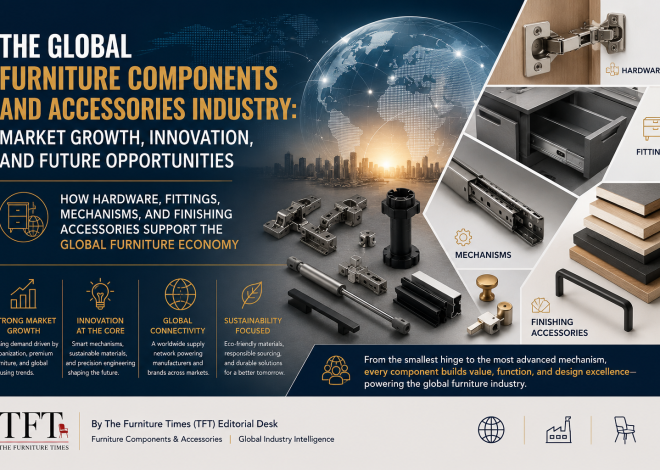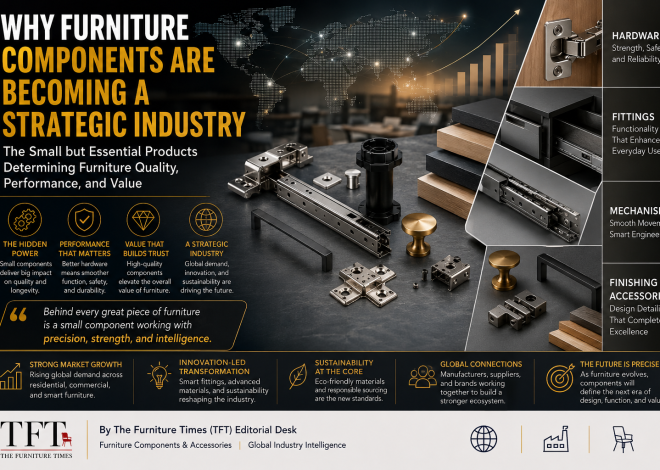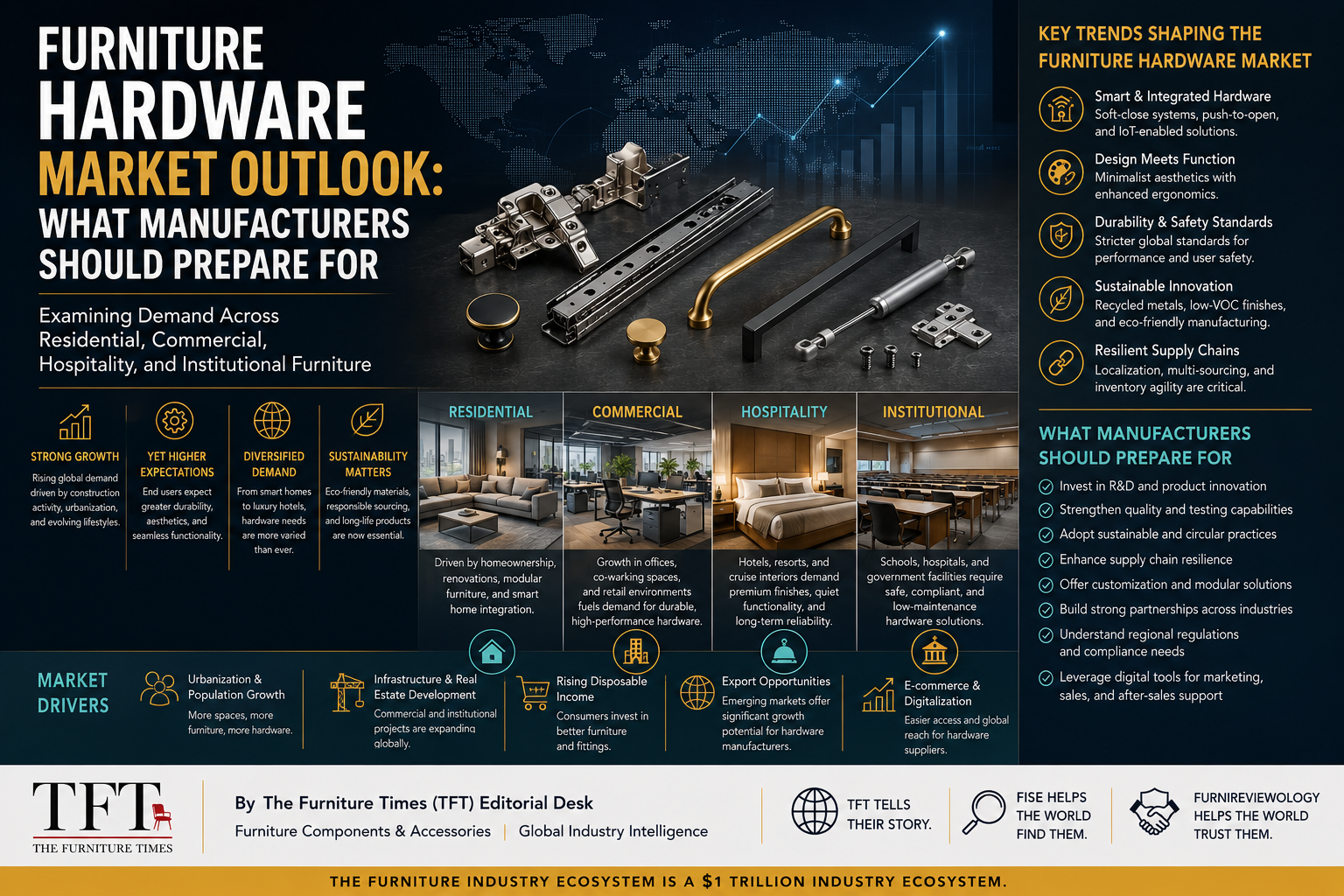
Furniture Hardware Market Outlook
What Manufacturers Should Prepare For
Examining Demand Across Residential, Commercial, Hospitality, and Institutional Furniture
By The Furniture Times (TFT) Editorial Desk | Furniture Components & Accessories | Global Industry Intelligence
The global furniture hardware market is entering a period of strategic transformation. Hinges, drawer slides, connectors, handles, castors, lifting systems, recliner mechanisms, table bases, furniture locks, electrical modules, storage accessories, and other fittings are no longer treated simply as small parts added near the end of production.
They are becoming central to furniture engineering, manufacturing productivity, product differentiation, sustainability, repairability, digital integration, and long-term customer satisfaction.
Demand is being shaped by very different forces across residential, commercial, hospitality, healthcare, education, government, retail, and public-space furniture. Residential consumers want convenience, quiet movement, efficient storage, personalisation, and easy assembly. Commercial buyers prioritise flexibility, ergonomics, connectivity, and lifecycle value. Hospitality operators demand durability, distinctive design, and fast maintenance. Institutional buyers require safety, compliance, accessibility, hygiene, documentation, and dependable replacement parts.
For furniture manufacturers, the market outlook is not simply about buying more hardware. It is about preparing for a future in which hardware systems will carry more functions, more technical data, more compliance obligations, and greater influence over the value of the finished product.
The companies that prepare early will be able to manufacture more efficiently, reduce failures, enter new markets, and deliver furniture that remains useful for longer. Those that continue treating hardware only as a low-cost purchasing category may face greater quality problems, supply disruptions, regulatory pressure, and lost customer trust.
Hardware Has Become the Operating System of Furniture
The furniture industry traditionally separated products into visible and invisible elements. Timber, fabrics, colours, finishes, shapes, and decorative surfaces received consumer attention, while hinges, screws, brackets, runners, mechanisms, and internal fittings remained largely hidden.
That distinction is disappearing.
Hardware increasingly determines how furniture behaves. It controls opening, closing, folding, extending, lifting, reclining, rotating, sliding, locking, levelling, connecting, charging, illuminating, and adapting.
A modern kitchen is not simply a group of cabinets. It is an operating system built from movement hardware, internal organisers, electrical accessories, and storage mechanisms.
An ergonomic office chair is not merely an upholstered seat. It is a coordinated system of castors, bases, gas lifts, tilt mechanisms, adjustment controls, armrests, lumbar supports, headrests, and structural connections.
A height-adjustable desk depends on lifting columns, motors, control boxes, memory panels, anti-collision sensors, frames, cable trays, and power modules.
Furniture hardware is therefore moving from passive support to active functionality.
The Market Is Becoming More Application-Specific
The same component cannot meet every furniture requirement.
A hinge used in a residential bedroom cabinet may operate a few times per day. A hinge installed in a hotel wardrobe may be used by hundreds of guests over its service life. A healthcare cabinet fitting may face frequent cleaning and strict hygiene requirements. Outdoor furniture hardware may be exposed to humidity, rain, ultraviolet radiation, heat, and coastal air.
Manufacturers should expect growing demand for hardware designed around particular applications rather than generic products.
Important application-based requirements include:
| Furniture sector | Leading hardware priorities |
|---|---|
| Residential | Convenience, affordability, quiet movement, storage efficiency, appearance |
| Commercial | Ergonomics, flexibility, connectivity, intensive-use durability |
| Hospitality | Premium movement, fast maintenance, corrosion resistance, design consistency |
| Healthcare | Hygiene, safety, accessibility, mobility, cleaning resistance |
| Education | Strength, anti-tamper design, affordability, easy replacement |
| Government and public spaces | Compliance, lifecycle value, security, documentation |
| Retail fixtures | Modularity, rapid reconfiguration, concealed connections |
| Outdoor furniture | Corrosion resistance, weather performance, replaceable parts |
Furniture manufacturers should define component specifications according to the final operating environment, expected frequency of use, load, climate, maintenance programme, and customer profile.
Residential Demand: Convenience Meets Affordability
Residential furniture remains one of the broadest demand engines for furniture hardware.
Urban population growth, housing development, apartment living, home renovation, e-commerce, and changing household needs continue to influence demand. The World Bank notes that cities face growing requirements for housing and infrastructure as urbanisation advances. This broader urban development pressure supports demand for space-efficient residential interiors and furniture. World Bank—Urban Development
However, residential hardware demand is becoming increasingly segmented.
Entry-Level Residential Furniture
Entry-level furniture requires low-cost components, but consumers still expect acceptable reliability and straightforward assembly.
The greatest opportunities in this segment include:
- Simplified knock-down connectors
- Standard hinges
- Basic drawer slides
- Lightweight handles
- Adjustable feet
- Compact packaging systems
- Colour-coded assembly components
- Tool-assisted or tool-free installation
- Standardised replacement fittings
The main challenge is balancing price with performance. Excessive cost reduction can increase failures, returns, negative reviews, and warranty expenses.
Manufacturers should avoid reducing component quality below the minimum performance expected during normal use. A small saving on fittings may create a disproportionately large after-sales cost.
Mid-Market Residential Furniture
The mid-market is becoming more demanding. Consumers want visible improvements without entering the luxury price category.
Features gaining importance include:
- Soft-close hinges
- Full-extension drawer runners
- Concealed slides
- Push-to-open mechanisms
- Better internal organisers
- Integrated handles
- Wardrobe accessories
- Cable-management systems
- Adjustable shelving
- More durable decorative finishes
This segment offers manufacturers an opportunity to use hardware as a clear product-upgrade strategy.
Instead of changing the entire product design, a furniture brand can introduce several hardware packages: standard, comfort, premium, and smart. This allows retailers and consumers to select features according to budget.
Premium and Luxury Residential Furniture
In premium furniture, hardware is expected to deliver precision, silence, durability, design integration, and an exceptional tactile experience.
Customers may not know the technical name of a mechanism, but they can recognise the feeling of a smoothly operating drawer, a perfectly aligned door, or a silent lift-up panel.
Premium demand is likely to favour:
- Ultra-slim mechanisms
- Concealed systems
- Customised metal finishes
- Motorised opening
- Integrated lighting
- Electronic locks
- Wireless charging
- Advanced wardrobe organisers
- High-load movement systems
- Custom-designed handles and profiles
Luxury furniture manufacturers should involve hardware suppliers during the design stage. Waiting until the final stages can lead to compromises involving clearances, drilling patterns, structural support, and visual integration.
Smaller Homes Will Drive Space-Saving Hardware
Urban housing constraints are increasing interest in multifunctional furniture.
This creates demand for:
- Wall-bed mechanisms
- Folding table hardware
- Extendable dining systems
- Sliding-door tracks
- Pull-out work surfaces
- Storage-bed lifting systems
- Modular sofa connectors
- Drop-leaf supports
- Convertible furniture mechanisms
- Rotating and concealed storage systems
Space-saving mechanisms carry higher engineering responsibilities than ordinary fittings. They must manage movement, balance, load, locking, and user safety.
Manufacturers entering this category should invest in mechanical testing and clear installation procedures. A transformable product must remain stable in every intended position and should not depend on customers guessing how to operate it.
Ready-to-Assemble Furniture Will Demand Better Connectors
The growth of online furniture retail has increased demand for flat-pack and ready-to-assemble products.
Shipping furniture in disassembled form can reduce storage volume and improve logistics, but it transfers part of the assembly process to the customer or installer.
Hardware must therefore be:
- Easy to identify
- Difficult to install incorrectly
- Secure under repeated use
- Compatible with automated panel drilling
- Efficient to package
- Simple to replace
- Supported by clear instructions
Missing screws, confusing connectors, damaged fittings, and inaccurate drilling patterns are frequent sources of customer dissatisfaction.
Manufacturers should prepare by developing complete assembly systems rather than collecting unrelated fasteners from different suppliers. Product codes, bag labels, digital instructions, and replacement-part access should be incorporated into the design.
Commercial Furniture: Flexibility Becomes Essential
Commercial furniture demand is shaped by offices, co-working centres, corporate campuses, retail spaces, restaurants, financial institutions, studios, and mixed-use developments.
Workplaces are changing from fixed rows of desks toward flexible environments supporting collaboration, focused work, meetings, hybrid schedules, and shared facilities.
This increases demand for hardware that enables furniture to move, adjust, connect, fold, reconfigure, and manage technology.
Height-Adjustable Workstations
Ergonomic furniture has made lifting systems one of the most important commercial hardware categories.
A modern sit-stand desk may include:
- Electric lifting columns
- Motors
- Control boxes
- Memory controllers
- Anti-collision sensors
- Structural frames
- Levelling feet
- Cable trays
- Monitor supports
- Power and data modules
Manufacturers should prepare for higher expectations around noise, movement speed, stability, load capacity, electrical safety, warranty support, and replacement electronics.
The frame, top, motor, controller, and lifting columns must be engineered as one system. Combining untested components can create instability or inconsistent performance.
Mobile and Reconfigurable Furniture
Commercial spaces increasingly require mobile tables, folding systems, movable partitions, modular seating, and flexible storage.
This supports demand for:
- Heavy-duty castors
- Locking wheels
- Quick-release connectors
- Folding table mechanisms
- Linking systems
- Mobile bases
- Cable-management fittings
- Adjustable glides
- Stackable furniture accessories
Mobility hardware must match the flooring, furniture weight, movement frequency, and safety requirements of the space.
Integrated Power and Connectivity
Workplaces expect furniture to support laptops, phones, screens, video meetings, and other devices.
This creates opportunities for integrated:
- Power sockets
- USB charging
- Wireless charging
- Data ports
- Cable channels
- Desktop power modules
- Under-desk cable baskets
- Monitor arms
- Equipment mounts
Furniture manufacturers entering this area must understand electrical compliance and serviceability. Electronic modules may have shorter operating lives than wooden or metal furniture structures, so they should be replaceable without destroying the product.
Hospitality Furniture: Strong Demand, Higher Expectations
Hotels, resorts, serviced apartments, restaurants, cafés, cruise facilities, and event venues require extensive furniture and hardware.
UN Tourism reported that international tourist arrivals grew by 4% in 2025, reflecting continued global travel demand. This recovery and expansion supports renovations, new hospitality developments, and replacement cycles across accommodation and food-service properties. UN Tourism
Hospitality furniture faces operating conditions that differ from ordinary residential use.
Hotel guests may handle drawers, doors, beds, desks, luggage racks, and wardrobes in unpredictable ways. Restaurant furniture may be moved and cleaned several times per day. Resort furniture may face sunlight, moisture, salt, sand, and temperature changes.
Hospitality buyers therefore need components that combine appearance with endurance.
Hardware Priorities for Hotels
Hotels increasingly require:
- High-cycle hinges and runners
- Secure furniture locks
- Luggage-rack fittings
- Bed connectors
- Headboard mounting systems
- Minibar hardware
- Soft-close mechanisms
- Integrated charging
- Cable-management accessories
- Wardrobe lighting sensors
- Replaceable handles and glides
- Corrosion-resistant bathroom fittings
Hospitality manufacturers should keep component records for each project. When a property requires repairs years later, the supplier should be able to identify the correct hinge, handle, runner, lock, or connector.
Restaurant and Café Furniture
Food-service furniture requires stable table bases, durable glides, replaceable feet, strong chair connectors, outdoor-rated fasteners, and finishes resistant to frequent cleaning.
Table stability is particularly important. Adjustable feet and properly engineered bases can reduce rocking on uneven surfaces.
Furniture intended for terraces and outdoor dining must use hardware suitable for the environment. Indoor-grade fasteners can corrode or deteriorate quickly in exposed locations.
Hospitality Renovation Cycles
Hotels and restaurants frequently renovate selected spaces without replacing every item. This creates demand for:
- Replacement hardware
- New handles and decorative fittings
- Refurbishment components
- Upholstery mechanisms
- Furniture repair kits
- Updated power modules
- Compatible lighting systems
Component suppliers that support refurbishment can benefit even when a property is not purchasing a complete furniture collection.
Institutional Furniture: Compliance and Lifecycle Value Lead
Institutional furniture includes products supplied to hospitals, clinics, schools, universities, laboratories, libraries, care facilities, government offices, courts, airports, transportation terminals, and public buildings.
Purchasing in this sector can involve formal specifications, tenders, documentation, safety requirements, and long-term service expectations.
The lowest-priced product does not necessarily offer the best institutional value. Buyers increasingly consider operating life, maintenance, downtime, repairability, and total ownership cost.
Healthcare Furniture Hardware
Healthcare environments demand components that support hygiene, safety, accessibility, mobility, and frequent cleaning.
Important categories include:
- Easy-clean handles
- Corrosion-resistant fittings
- Lockable medical-storage hardware
- Heavy-duty castors
- Braking systems
- Height-adjustment mechanisms
- Drawer and cabinet locks
- Anti-tip fittings
- Replaceable protective edges
- Controlled-closing systems
- Accessible pull handles
Furniture manufacturers should confirm that materials, coatings, lubricants, and construction details are suitable for the cleaning products and procedures used by the facility.
Hardware should also minimise difficult-to-clean gaps where possible.
Education Furniture
Schools and universities need cost-effective products capable of tolerating intensive use.
Demand is likely to focus on:
- Strong desk and chair connectors
- Anti-loosening fasteners
- Replaceable glides
- Durable castors
- Modular table-linking systems
- Height-adjustment hardware
- Secure storage locks
- Folding and stacking mechanisms
- Easy-to-repair components
Educational buyers may operate large furniture inventories. Standardising parts across product families can simplify maintenance and reduce storage requirements.
Public and Government Furniture
Government and public facilities may require documented compliance, procurement transparency, accessibility, security, and long-term spare-parts support.
Manufacturers should prepare complete technical files containing:
- Product specifications
- Test information
- Component identities
- Material declarations
- Warranty terms
- Maintenance instructions
- Spare-parts lists
- Installation guidance
- Compliance documentation
A manufacturer that cannot provide adequate documentation may struggle to enter institutional markets, even if its finished product appears competitive.
Sustainability Rules Will Influence Hardware Decisions
Sustainability is moving from voluntary brand communication toward more structured product requirements.
The European Union’s Ecodesign for Sustainable Products Regulation entered into force in 2024. Furniture is included among the priority product groups in the European Commission’s 2025–2030 working plan, which seeks to advance more sustainable, repairable, circular, and resource-efficient products. European Commission
The exact requirements for furniture will develop through the relevant policy process, but the strategic direction is clear: durability, repairability, material efficiency, recyclability, and reliable product information will become more important.
Hardware manufacturers and furniture producers should prepare by asking:
- Can the component be removed without damaging the furniture?
- Is a replacement available?
- Can materials be separated?
- Is the component clearly identified?
- Are repair instructions available?
- Can its material composition be documented?
- Does the design prevent refurbishment?
- Can the hardware be used through multiple product lifecycles?
Furniture designed with inaccessible mechanisms or permanent joining systems may become difficult to repair and recycle.
Digital Product Passports Will Change Component Data
Future hardware competition will involve both physical performance and digital information.
Digital Product Passports are intended to make selected product lifecycle information accessible to businesses, consumers, repairers, recyclers, and authorities. For furniture, this direction could require manufacturers to connect finished products with their materials and components.
Hardware suppliers should begin organising:
- Unique product identifiers
- Technical specifications
- Material composition
- Manufacturing origin
- Recycled content
- Compliance records
- Installation instructions
- Maintenance requirements
- Compatible replacements
- Disassembly information
- Recycling guidance
Many suppliers currently distribute this information across separate catalogues, spreadsheets, emails, and technical documents. That will become increasingly inefficient.
Structured component data should be treated as a strategic business asset.
Smart Hardware Will Expand—but Reliability Must Come First
Smart furniture represents a significant growth opportunity, but it also introduces risks.
Electronic locks, sensor lighting, motorised mechanisms, occupancy monitors, charging modules, and connected controls can add real value. However, they also create questions about software support, electrical safety, privacy, repairs, and obsolescence.
Manufacturers should avoid integrating smart components merely to follow a trend.
Every smart feature should answer a clear question:
- What problem does it solve?
- How often will the customer use it?
- Can it be repaired or upgraded?
- What happens if the software is discontinued?
- Can the furniture still operate manually?
- Is the user’s data protected?
- Is the electronic module independently replaceable?
The furniture structure may last 15 or 20 years, while an electronic component may become outdated much sooner. Modular electronic design can protect the longevity of the complete product.
Material Prices and Supply Risks Will Remain Important
Furniture hardware depends on steel, stainless steel, aluminium, zinc alloys, brass, plastics, rubber, electronics, coatings, and packaging.
Changes in metal prices, energy costs, currencies, shipping rates, and trade policies can affect component prices and availability.
A highly specialised fitting may come from one supplier or one industrial region. If supply is interrupted, an entire furniture production line can stop.
Manufacturers should identify critical components and classify their supply risk.
Questions should include:
- Is there a second approved supplier?
- Can the component be sourced regionally?
- Is the design dependent on a proprietary fitting?
- How long would qualification of an alternative take?
- How much safety stock is appropriate?
- Are the drilling patterns compatible with alternatives?
- Can the component be replaced without redesigning the furniture?
Resilience does not mean maintaining excessive inventory of every component. It means understanding which parts can stop production and preparing a response before disruption occurs.
Localisation Will Create New Manufacturing Opportunities
Furniture-producing countries often import a significant share of their precision hardware. This creates opportunities for local and regional industrial development.
Potential manufacturing categories include:
- Fasteners and connectors
- Handles and knobs
- Metal legs and bases
- Adjustable feet
- Castors and glides
- Cabinet profiles
- Upholstery components
- Wardrobe accessories
- Table mechanisms
- Packaging and assembly kits
Local manufacturing can shorten lead times, reduce minimum-order barriers, support customisation, and enable faster technical collaboration.
However, local suppliers must meet consistent tolerances, material specifications, testing requirements, and documentation standards.
Furniture manufacturers should not localise purely to reduce price. The objective should be to develop a reliable supply ecosystem.
Decorative Hardware Will Remain Fashion-Driven
Handles, knobs, legs, trims, visible profiles, nailheads, and decorative fittings help define furniture identity.
Demand will continue to move across:
- Matte black
- Brushed brass
- Bronze
- Warm metallic finishes
- Minimalist aluminium profiles
- Natural timber combinations
- Ceramic details
- Textured surfaces
- Custom colours
- Vintage-inspired fittings
Manufacturers should prepare for shorter decorative trend cycles while maintaining stable mechanical platforms.
One efficient approach is to separate the functional component from the decorative finish. A proven mounting system can support multiple handle designs, colours, and materials.
This reduces engineering risk while allowing regular collection updates.
Quality Testing Will Become a Competitive Requirement
Furniture hardware may look identical when new but perform very differently after repeated use.
Manufacturers should strengthen testing in areas such as:
- Repeated opening and closing cycles
- Static and dynamic load capacity
- Fatigue resistance
- Impact performance
- Corrosion resistance
- Surface adhesion
- Dimensional accuracy
- Fastener withdrawal strength
- Temperature and humidity performance
- Electrical safety
- Noise and movement consistency
Testing should match the final application. Hardware for a residential cabinet cannot automatically be assumed suitable for a hospital, airport, restaurant, hotel, or school.
Manufacturers should also verify production consistency. A successful laboratory sample does not guarantee that every production batch will meet the same standard.
Standardisation Can Reduce Cost and Complexity
Furniture companies often use too many similar components across their collections. Multiple hinge types, screw sizes, runners, handles, connectors, and castors increase purchasing complexity and make after-sales service more difficult.
A strategic hardware standardisation programme can reduce:
- Inventory
- Purchasing complexity
- Assembly mistakes
- Supplier fragmentation
- Spare-parts requirements
- Training time
- Packaging errors
- Maintenance difficulty
Standardisation does not mean eliminating design variety. It means using a smaller number of proven technical platforms wherever possible.
A furniture brand might use one family of hinges across several cabinets, one connector system across multiple collections, and one castor specification across compatible commercial products.
Manufacturers Must Improve Supplier Relationships
The future relationship between furniture manufacturers and hardware suppliers should move beyond price negotiations.
Strategic suppliers can contribute to:
- Product development
- Engineering analysis
- Testing
- Production-line optimisation
- Cost reduction through redesign
- Compliance documentation
- Failure investigation
- Installer training
- Replacement-parts planning
- Digital product data
Furniture manufacturers should evaluate suppliers through balanced criteria:
| Evaluation area | Key questions |
|---|---|
| Quality | Does the component perform consistently? |
| Capacity | Can the supplier meet expected volume? |
| Delivery | Are lead times reliable? |
| Engineering | Can the supplier solve application problems? |
| Documentation | Are specifications and test records complete? |
| Compliance | Does the product meet target-market requirements? |
| Service | Are claims and replacements handled efficiently? |
| Innovation | Is the supplier developing relevant new solutions? |
| Visibility | Can its capabilities and products be verified? |
| Resilience | Are materials and production risks being managed? |
Long-term collaboration can create more value than repeatedly changing suppliers for small price differences.
After-Sales Parts Must Be Designed Before Launch
Replacement-part planning is frequently delayed until customers report problems. By then, components may be difficult to identify or no longer available.
Manufacturers should prepare spare-parts systems during product development.
Each finished product should have:
- A parts list
- Unique component codes
- Clear product diagrams
- Compatibility information
- Recommended stock levels
- Replacement instructions
- Planned availability periods
- Digital ordering options
QR codes can connect customers or service technicians with the correct product record.
This is especially important for commercial, hospitality, and institutional furniture, where one property may contain hundreds or thousands of similar items.
E-Commerce Will Require Better Hardware Communication
Online furniture buyers cannot physically test drawers, hinges, mechanisms, or handles before purchasing.
Product pages should therefore explain hardware benefits clearly.
Instead of writing only “premium hardware,” manufacturers should provide meaningful information:
- Soft-close operation
- Full-extension access
- Tested load capacity
- Corrosion-resistant finish
- Adjustable alignment
- Replaceable components
- Tool-free assembly
- Integrated cable management
- Warranty coverage
Accurate descriptions can improve buyer understanding and reduce unrealistic expectations.
Manufacturers should also include close-up images, short demonstration videos, assembly guides, and downloadable specifications.
AI Search Will Influence Supplier Discovery
Purchasing teams increasingly use search engines, digital marketplaces, professional platforms, and AI tools to identify suppliers.
A hardware manufacturer may produce excellent components but remain commercially invisible if its website does not clearly describe products, applications, test data, materials, and export capabilities.
Suppliers should create searchable information for every major product category, including:
- Product names and codes
- Dimensions
- Materials
- Load ratings
- Finishes
- Application sectors
- Installation methods
- Test standards
- Certifications
- Compatible products
- Replacement information
- Geographic availability
AI systems cannot confidently recommend companies that provide incomplete, inconsistent, or unverifiable information.
Digital visibility is becoming part of the hardware supply chain.
What Manufacturers Should Prepare for Now
Furniture manufacturers should consider a structured readiness programme covering the following priorities.
1. Segment Hardware by Application
Create different performance specifications for residential, commercial, hospitality, healthcare, education, public-space, and outdoor furniture.
2. Audit Critical Components
Identify every part capable of stopping production or causing a serious warranty problem.
3. Review Supplier Concentration
Develop approved alternatives for strategically important fittings where practical.
4. Standardise Technical Platforms
Reduce unnecessary component variation across product families.
5. Strengthen Testing
Verify load, cycle, corrosion, impact, dimensional, and electrical performance according to the final application.
6. Design for Repair
Use accessible fittings, reversible connections, identifiable parts, and replaceable mechanisms.
7. Organise Component Data
Prepare digital specifications, material records, test information, installation instructions, and spare-parts details.
8. Prepare for Circularity Requirements
Monitor emerging policies concerning durability, repairability, product information, recycled content, and end-of-life management.
9. Plan Smart Features Carefully
Choose modular, serviceable electronic systems that provide clear user value.
10. Improve Replacement-Part Access
Make spare parts searchable and available through retailers, distributors, service partners, or direct ordering.
11. Build Hardware Into Product Strategy
Involve engineers and suppliers early rather than selecting fittings after the design is complete.
12. Communicate Component Value
Explain hardware performance to retailers, specifiers, installers, and consumers.
Outlook: From Volume Supply to Value Creation
Demand for furniture hardware will continue to expand across multiple end-use markets, but growth will not be equal across every product category.
Basic hardware will remain highly price-sensitive. At the same time, stronger opportunities are likely to develop around:
- Soft-close and concealed movement
- Space-saving mechanisms
- Ergonomic adjustment systems
- Smart and powered components
- Modular commercial furniture
- Hospitality refurbishment
- Healthcare and accessible furniture
- Corrosion-resistant outdoor fittings
- Replacement parts
- Circular and repairable hardware
- Digitally documented components
- Custom decorative accessories
The most competitive suppliers will offer more than physical parts. They will offer engineering knowledge, technical data, testing, supply reliability, installation support, replacement programmes, and product-development collaboration.
Furniture manufacturers, meanwhile, must recognise that hardware is no longer a final detail. It is a central part of performance, brand reputation, sustainability, and customer value.
The market is moving from hardware as a commodity toward hardware as an intelligent system.
That transition will reward companies that prepare early, invest in quality, organise their component data, build resilient supplier networks, and understand the different needs of residential, commercial, hospitality, and institutional buyers.
The furniture may attract the customer’s attention—but its hardware will determine how well it works, how long it lasts, and whether the customer continues to trust the brand.
The Furniture Times (TFT) & Furniture Industry Search Engine (FISE)
“TFT tells their story. FISE helps the world find them.”
FurniReviewology helps the world trust them.
The furniture industry ecosystem is a $1 trillion industry ecosystem.