
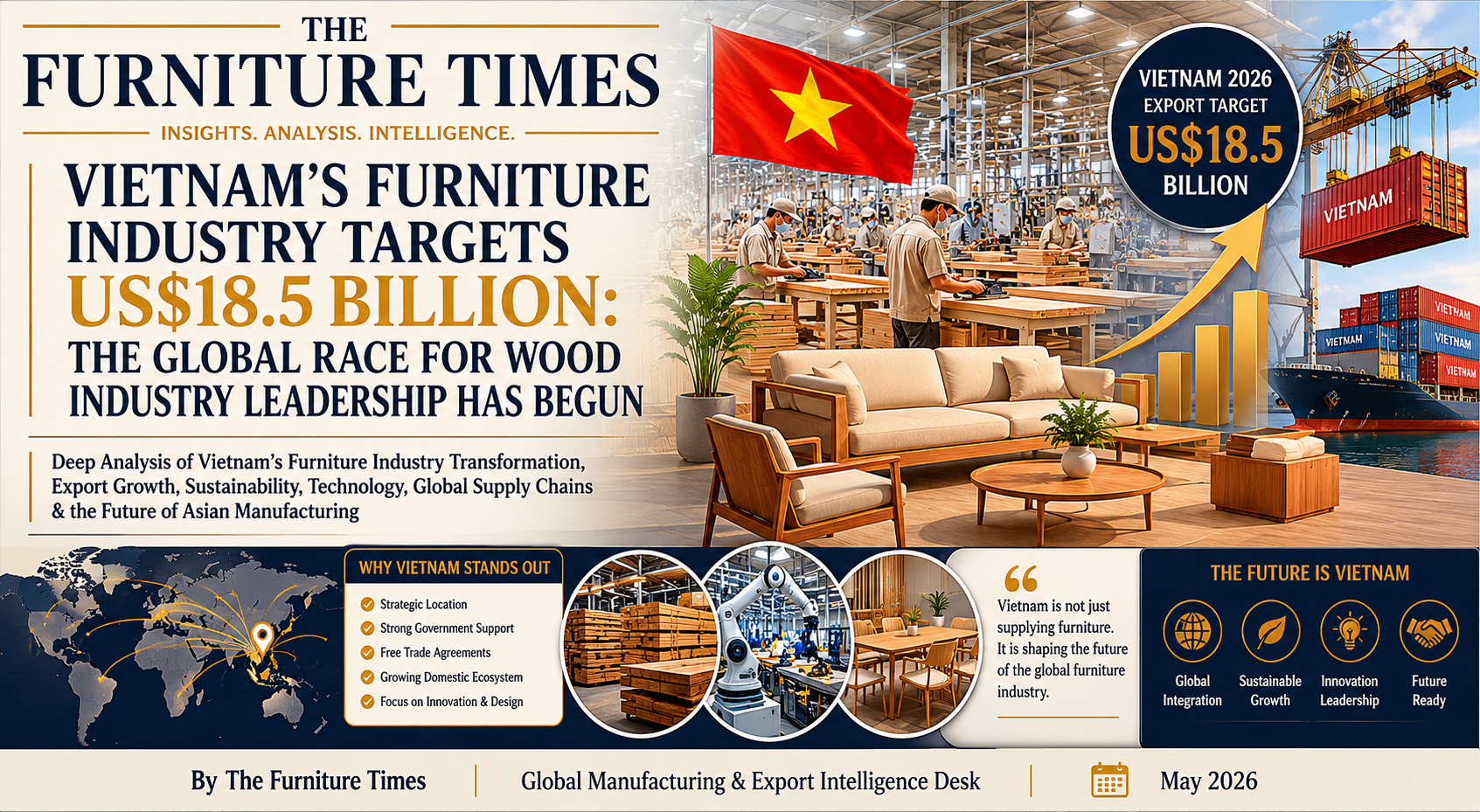
Vietnam’s Furniture Industry Targets US$18.5 Billion: The Global Race for Wood Industry Leadership Has Begun
Deep Analysis of Vietnam’s Furniture Industry Transformation, Export Growth, Sustainability, Technology, Global Supply Chains & the Future of Asian Manufacturing
By The Furniture Times | Global Manufacturing & Export Intelligence Desk | May 2026
Vietnam’s furniture and wood industry is entering one of the most important chapters in its modern history.
As the country targets between US$18.5 billion and US$19 billion in wood and furniture exports, industry leaders, manufacturers, exporters, policymakers, and investors are closely watching what could become one of the most significant industrial success stories in the global furniture ecosystem.
What makes Vietnam’s story remarkable is not simply export growth.
It is the speed of transformation.
The country is evolving from:
a manufacturing destination
into:
a global furniture powerhouse.
And the world is paying attention.
Vietnam’s Furniture Industry Is No Longer Emerging
For years, Vietnam was considered a fast-growing alternative manufacturing hub.
Today, that narrative has changed.
Vietnam has firmly established itself as one of the world’s leading furniture-exporting nations, with exports exceeding US$17 billion and products reaching more than 160 international markets.
The country has become a critical supplier for:
the United States
Japan
Europe
China
South Korea
Australia
Middle Eastern markets
Vietnam is no longer participating in the furniture industry.
It is helping shape it.
The US$18.5 Billion Ambition
Industry targets for 2026 reflect strong confidence despite global uncertainty.
Vietnam’s wood and furniture industry aims to achieve approximately US$18.5 billion in exports, while some industry organizations project potential exports approaching US$19 billion if positive market conditions continue.
This growth is supported by:
strong manufacturing infrastructure
increasing global demand
expanding production capacity
growing international confidence in Vietnamese suppliers
The target is ambitious.
But many industry observers believe it remains achievable.
Nghia Son Furniture Reflects the Industry Transformation
Companies such as Nghia Son Furniture symbolize the wider evolution occurring across Vietnam’s furniture ecosystem.
Manufacturers are increasingly focusing on:
product diversification
brand development
direct customer engagement
higher-value products
global market expansion
Rather than competing solely on low-cost manufacturing, companies are investing in:
value creation.
This marks a major strategic shift.
Global Supply Chains Are Creating New Opportunities
One of the biggest opportunities for Vietnam comes from global supply chain restructuring.
International buyers increasingly seek:
diversified sourcing
reduced dependency on single-country production
reliable manufacturing partners
scalable production ecosystems
Vietnam continues benefiting from this shift.
Many international retailers increasingly recognize Vietnam for:
quality improvements
manufacturing consistency
production flexibility
export reliability
This positions the country strongly in the next phase of global sourcing.
Sustainability Is Becoming a Business Requirement
One of the most important developments shaping the industry is sustainability.
Global buyers increasingly demand:
FSC-certified materials
legal timber sourcing
environmental compliance
traceability systems
green manufacturing practices
Vietnamese manufacturers are responding by investing in:
certified plantations
clean energy systems
sustainable sourcing
environmentally responsible production
The future export market increasingly rewards:
responsible manufacturers.
Technology Is Reshaping the Industry
Vietnam’s furniture sector is no longer relying solely on traditional woodworking.
Factories increasingly invest in:
CNC systems
automation
smart manufacturing
digital production management
advanced machinery
Foreign direct investment is also helping accelerate industrial modernization, with significant capital flowing into technology upgrades and clean-energy manufacturing facilities.
The future furniture factory will increasingly combine:
craftsmanship
automation
digital intelligence
Design Is Becoming the Next Competitive Battlefield
Historically, many manufacturers operated under:
OEM models
producing products for foreign brands.
Today, experts increasingly encourage Vietnamese companies to develop:
original designs
proprietary brands
direct-to-consumer channels
product innovation strategies
This transition allows businesses to capture higher margins and build stronger global recognition.
The future of furniture exports may depend less on production volume and more on:
intellectual value.
Vietnam’s Workforce Remains a Strategic Advantage
The industry continues benefiting from a skilled manufacturing workforce.
Vietnam’s furniture sector employs hundreds of thousands of workers across:
woodworking
furniture assembly
upholstery
finishing
logistics
export operations
Craftsmanship remains one of the country’s strongest assets.
However, labor dynamics are changing.
Manufacturers increasingly face competition for talent from:
technology industries
higher-wage sectors
urban employment markets
This means workforce development is becoming increasingly important.
Challenges Remain Significant
Despite strong growth prospects, the industry faces multiple risks.
These include:
Trade & Tariff Risks
Changes in international trade policies continue creating uncertainty, particularly in major export markets.
Logistics Costs
Global shipping disruptions and geopolitical instability continue influencing transportation expenses.
Regulatory Pressure
Environmental standards and traceability requirements continue becoming stricter in Europe and North America.
Market Dependence
A significant portion of exports remains concentrated in a limited number of major markets.
The industry’s future resilience may depend heavily on diversification.
New Markets Are Opening
Vietnam is increasingly expanding beyond traditional export destinations.
Emerging opportunities include:
India
Middle East
ASEAN markets
hospitality sectors
sustainable construction industries
Large-scale infrastructure projects and hospitality expansion across the Gulf region create particularly strong opportunities for furniture exporters.
This diversification may reduce dependency on a small group of markets.
Green Furniture Is Becoming a Major Opportunity
The industry is witnessing growing demand for:
FSC-certified furniture
sustainable wood products
eco-friendly panels
biomass-related products
low-emission furniture solutions
Wood pellets and biomass products have also shown strong growth as global energy markets increasingly focus on renewable alternatives.
The future furniture economy increasingly overlaps with:
sustainability economics.
Digital Transformation Is Accelerating
Vietnamese furniture businesses increasingly adopt:
virtual showrooms
online product catalogs
digital trade platforms
augmented reality visualization
blockchain-supported traceability
Digital transformation is becoming a necessity rather than a luxury.
The next generation of buyers increasingly discovers suppliers through:
search engines
AI systems
digital platforms
online sourcing networks
The Furniture Times Industry Insight
Vietnam’s furniture industry is entering a new phase.
The next decade will likely be defined by:
sustainability
technology
design
traceability
visibility
digital discoverability
The companies that win globally may not simply be the cheapest.
They may become:
the most innovative
the most trusted
the most sustainable
the most visible
The future furniture economy increasingly rewards:
value creation over volume creation.
Final Thought
Vietnam’s goal of reaching US$18.5 billion in furniture and wood exports represents far more than a trade target.
It represents a national industrial transformation.
The industry is moving from:
manufacturing
toward:
innovation
From:
production
toward:
value creation
From:
OEM dependence
toward:
global brand development
The world is no longer looking at Vietnam simply as a furniture factory.
It is increasingly viewing Vietnam as one of the most important furniture ecosystems shaping the future of global manufacturing.
And that transformation is only accelerating.
The Furniture Times remains dedicated to bringing the latest updates, intelligence, trends, opportunities, and transformations from across the global furniture industry ecosystem.
