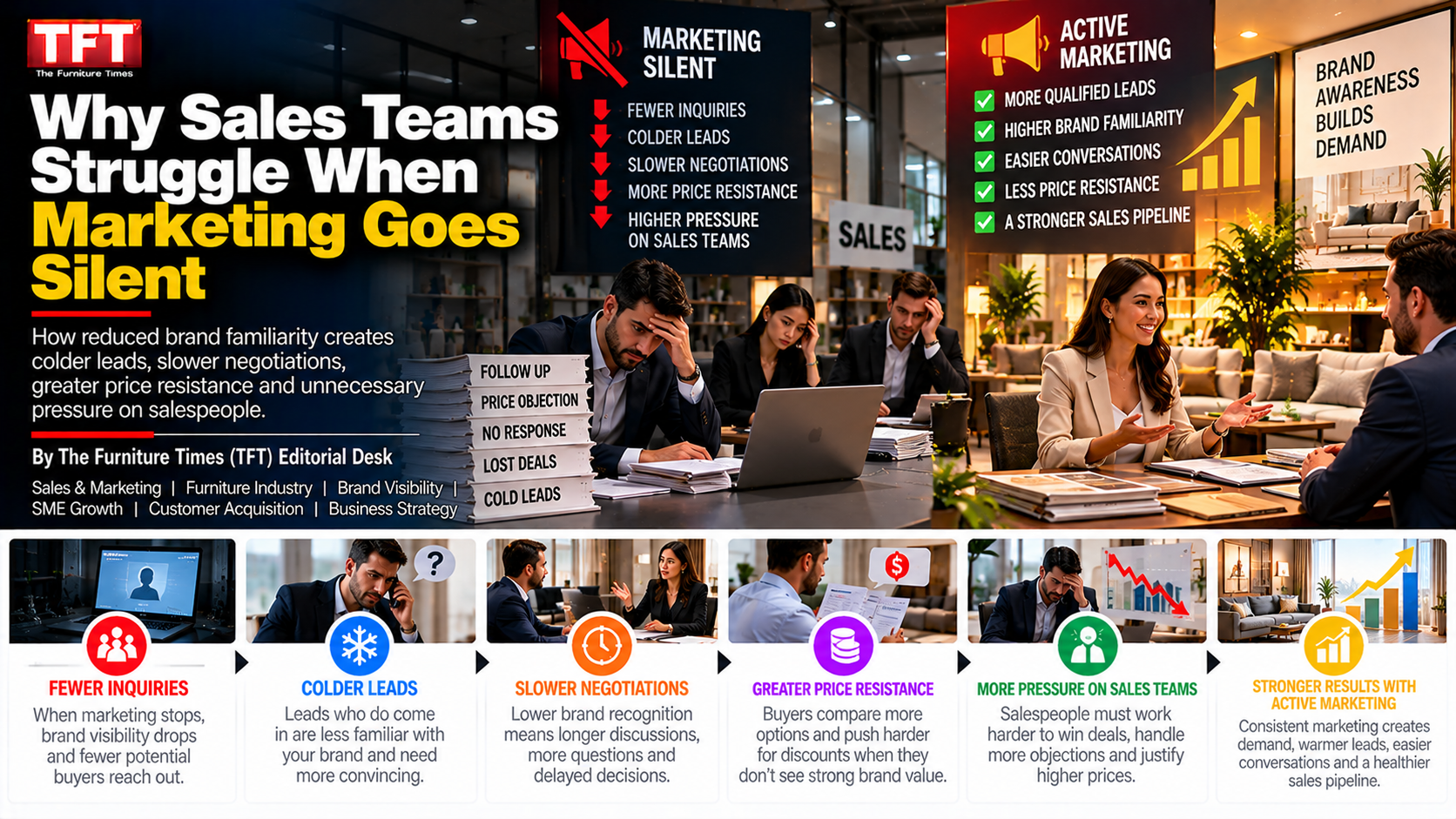
Why Sales Teams Struggle When Marketing Goes Silent
How Reduced Brand Familiarity Creates Colder Leads, Slower Negotiations, Greater Price Resistance and Unnecessary Pressure on Salespeople
By The Furniture Times (TFT) Editorial Desk
Sales & Marketing | Furniture Industry | Brand Visibility | SME Growth | Customer Acquisition | Business Strategy
When sales decline, many businesses immediately look at the sales team.
Management asks why enquiries are not converting, why quotations remain unanswered, why negotiations take longer and why salespeople are failing to achieve their targets.
The response is often predictable:
- Increase the number of calls.
- Follow up more aggressively.
- Offer another discount.
- Contact old customers.
- Extend payment terms.
- Hire new salespeople.
- Replace underperforming staff.
- Increase commissions.
- Demand daily activity reports.
These measures may increase activity, but they do not necessarily address the real problem.
Sometimes the sales team is not failing because it has stopped working. It is struggling because marketing has stopped preparing the market.
When a company becomes quiet—no news, no advertising, no project stories, no customer reviews, no product education and no visible industry participation—its salespeople are forced to approach customers without the support of brand familiarity.
Every lead becomes colder. Every claim requires more explanation. Every quotation faces greater doubt. Every negotiation takes longer.
The salesperson must attempt to create awareness, establish credibility, explain the product, defend the price, overcome risk and close the transaction—all within the same conversation.
That is not an efficient sales system.
Marketing creates familiarity before the conversation. Sales converts that familiarity into commercial action.
When marketing disappears, sales must begin from zero.
Marketing silence does not remain inside the marketing department
Some companies treat marketing as separate from sales.
They believe marketing produces advertisements and social-media posts, while salespeople produce revenue. When finances become difficult, marketing is therefore classified as optional, while the sales team is expected to maintain performance.
This distinction overlooks how customers make decisions.
Before speaking with a salesperson, a buyer may:
- Search for the company
- Visit its website
- Read news about the business
- Compare its products
- Look for reviews
- Check social-media activity
- Examine completed projects
- Investigate its directors
- Search for distributors
- Ask industry contacts
- Compare it with competitors
- Use an AI assistant to identify suppliers
If the company has remained silent, the prospective customer may find little current evidence that the business is established, active or credible.
The resulting uncertainty enters the sales conversation.
The prospect may ask:
- Who are you?
- How long have you been operating?
- Have you completed similar projects?
- Who else purchases from you?
- Why have I never heard of your company?
- Where can I read about your products?
- What makes you different?
- How do I know you will deliver?
- Are there independent reviews?
- Why should I pay more than your competitor’s price?
These are not merely sales objections. They are symptoms of weak market preparation.
The three temperatures of a sales lead
Leads are commonly described as cold, warm or hot. The difference is not only the customer’s need. It is also the customer’s familiarity, confidence and readiness.
| Lead condition | What the prospect knows | Sales difficulty |
|---|---|---|
| Cold | Knows little about the company and has limited trust | High |
| Warm | Recognises the brand or has encountered useful evidence | Moderate |
| Hot | Has a defined need and already considers the company credible | Lower |
Marketing helps move potential buyers from unfamiliarity toward recognition before direct selling begins.
News, educational content, case studies, reviews, search visibility, exhibitions, advertising and consistent industry participation create repeated contact points.
A buyer may not respond immediately after reading one article. But when the salesperson later calls, the customer may say:
“Yes, I have seen your company before.”
That sentence changes the conversation.
Without marketing, salespeople hear:
“Please send your company profile.”
The difference appears small, but commercially it is enormous. The first response contains recognition. The second places the salesperson at the beginning of the credibility process.
Brand familiarity reduces perceived risk
Furniture purchases frequently involve significant risk.
A consumer buying a sofa may worry about comfort, durability, delivery, colour accuracy, warranty and after-sales service.
A retailer purchasing from a manufacturer may worry about:
- Product consistency
- Delivery reliability
- Minimum-order quantities
- Replacement availability
- Defects
- Packaging
- Documentation
- Exclusive territories
- Customer complaints
A hotel, office or property developer faces even greater risk:
- Project delays
- Installation failures
- Specification errors
- Budget overruns
- Fire and safety requirements
- Product performance
- Warranty responsibility
- Replacement lead times
- Coordination with contractors
The buyer is not only purchasing furniture. The buyer is selecting a risk partner.
Brand familiarity does not prove that a supplier is reliable, but it can reduce the psychological uncertainty surrounding the decision. A buyer who repeatedly encounters a company’s projects, expertise, customer feedback and industry presence has more information from which to evaluate it.
When marketing goes silent, this reassurance disappears.
The salesperson then carries the burden of proving the entire organisation’s credibility during a limited number of calls or meetings.
Cold leads take longer to convert
A cold prospect rarely moves directly from introduction to order.
The journey may require:
- Initial contact
- Company introduction
- Capability explanation
- Website and profile review
- Product presentation
- Sample request
- Internal verification
- Price comparison
- Reference checking
- Management approval
- Negotiation
- Trial order
- Final purchase
Marketing can shorten several of these stages by making information available before and during the sales process.
A strong digital and editorial presence may already answer:
- What the company produces
- Which markets it serves
- Where it is located
- What projects it has completed
- Which certifications it holds
- Who leads the organisation
- What customers say about it
- Why its product is different
- How it handles delivery and support
When that information is absent, every salesperson must explain it repeatedly.
This reduces the time available for:
- Understanding customer needs
- Developing solutions
- Preparing accurate proposals
- Managing important accounts
- Building partnerships
- Closing qualified opportunities
Marketing silence therefore reduces sales productivity even when the number of leads remains unchanged.
Silent companies create slower negotiations
Negotiations slow down when buyers are uncertain.
A customer who lacks confidence may request:
- More meetings
- Additional samples
- Extra references
- Longer credit
- Stronger guarantees
- Smaller trial orders
- More contractual protections
- Further management approval
- Repeated price revisions
Some due diligence is normal and necessary. But when the supplier has weak public credibility, the buyer has fewer independent signals with which to reduce uncertainty.
The quotation is then evaluated mainly on:
- Price
- Payment terms
- Delivery time
- Immediate product appearance
The company’s broader value—experience, reliability, service, knowledge, quality systems and reputation—may not enter the decision because it has not been communicated.
The sales team must repeatedly defend factors that stronger marketing could have demonstrated before negotiation began.
Price becomes the default conversation
The less customers understand about a brand, the more likely they are to compare it only by price.
Suppose three suppliers offer visually similar dining sets.
Supplier A has:
- Recent project news
- Detailed product specifications
- Customer reviews
- Manufacturing information
- Material explanations
- Warranty details
- Installation guidance
- A visible company history
Supplier B has only a basic website.
Supplier C sends a quotation through WhatsApp with no supporting information.
Even if all three products are technically similar, the buyer’s perception will not be identical.
Supplier A has created more reasons to be evaluated beyond price. Suppliers B and C may be forced to discount because they have not provided enough evidence of differentiated value.
Marketing silence therefore creates price sensitivity.
The company may believe customers have become unreasonable, but the customers may simply be unable to see why the business deserves a higher price.
When differentiation is invisible, discounts become the salesperson’s easiest tool.
Excessive discounting weakens the sales team
Discounting can sometimes close a transaction, move inventory or support a defined campaign. It becomes dangerous when it replaces brand value.
A salesperson under pressure may gradually learn that the only effective response to customer resistance is a lower price.
This creates several problems:
- Gross margins decline.
- Sales commissions may fall.
- Customers wait for future discounts.
- Premium positioning becomes difficult.
- Existing customers demand the same offer.
- Salespeople stop defending value.
- Management blames sales for weak margins.
- The company attracts more price-sensitive buyers.
- Service expectations remain high despite lower revenue.
Eventually, the sales team is asked to sell more volume at lower margins to customers who have little loyalty.
Marketing should give salespeople reasons to protect the price:
- Proven durability
- Better materials
- Original design
- Faster delivery
- Strong warranty
- Local service
- Replacement availability
- Customisation
- Responsible production
- Documented project experience
Without visible evidence, these advantages sound like sales claims rather than verifiable strengths.
Salespeople become substitute marketers
When official marketing stops, individual salespeople often create their own materials.
They may:
- Design promotional images
- Write product descriptions
- Record videos
- Manage social-media accounts
- Build personal contact lists
- Prepare company profiles
- Request customer testimonials
- Create price sheets
- Photograph completed projects
- Write follow-up messages
Initiative is valuable, but an uncontrolled approach creates inconsistency.
Different salespeople may communicate:
- Different prices
- Different warranties
- Different product specifications
- Different delivery promises
- Different brand messages
- Different company information
The result is fragmented market identity.
Furthermore, time spent producing improvised marketing material is time not spent selling.
Salespeople should contribute market intelligence and customer insight, but the company should provide a reliable communication infrastructure.
The emotional cost of marketing silence
A neglected brand affects sales morale.
Salespeople know when customers do not recognise the company. They experience rejection directly. They see competitors appearing in search results, industry publications, exhibitions and customer discussions.
Over time, this can create:
- Lower confidence
- Fear of approaching major accounts
- Frustration with management
- Dependence on discounts
- Short-term selling behaviour
- Higher staff turnover
- Reduced ambition
- Internal conflict between departments
Management may interpret these symptoms as laziness or insufficient discipline.
But telling salespeople to “work harder” does not solve a market-recognition problem.
A capable salesperson can improve the conversation. The salesperson cannot, alone, create years of brand credibility during a single meeting.
Existing customers also notice the silence
Marketing is not only for acquiring new customers. It reminds existing customers that the company remains active, relevant and improving.
When communication stops, existing customers may assume:
- The business is struggling.
- Product development has stopped.
- The company no longer serves their market.
- Competitors are more innovative.
- Service capabilities have declined.
- The brand may not be reliable in the future.
This is especially risky in furniture markets with long replacement cycles. Customers may not purchase every month, but they should continue encountering the company between buying occasions.
News about new products, projects, certifications, facilities, people and service improvements keeps the relationship alive.
Without these reminders, competitors can enter the customer’s consideration set before the next purchasing cycle.
How news supports the sales process
Business news can perform several practical sales functions.
1. It creates a legitimate reason to contact customers
Instead of sending another message saying, “Are you ready to order?”, a salesperson can share useful news:
- A new collection
- A completed project
- An expanded service
- A new certification
- A material innovation
- A delivery improvement
- An industry report
- A technical guide
This makes follow-up less repetitive and more valuable.
2. It provides third-party credibility
Coverage in a relevant publication can support the company’s claims. It should not be treated as an automatic endorsement, but independent editorial visibility may reassure customers that the business has a real industry presence.
3. It explains value before price
A detailed article can communicate manufacturing, design, material and service advantages that cannot fit inside a quotation.
4. It keeps dormant leads warm
A potential customer may not be ready to purchase today. Regular, relevant communication helps the company remain familiar until the need becomes active.
5. It supports sales presentations
Salespeople can include news coverage, case studies and expert commentary in presentations and proposals.
6. It strengthens follow-up
After a meeting, the salesperson can share specific supporting content rather than sending a generic reminder.
7. It builds a searchable record
News articles create a timeline of company activity that customers, distributors and procurement teams can examine.
What furniture companies should publish
The best sales-supporting content addresses questions buyers genuinely ask.
Manufacturers
Useful stories can include:
- New machinery and production capacity
- Quality-control improvements
- Product testing
- Material sourcing
- Export-market entry
- Factory expansion
- New collections
- Sustainable production
- Certifications
- Customisation capabilities
- Packaging improvements
- Reduced lead times
Retailers
Retail-focused content can cover:
- New showroom openings
- Collection launches
- Delivery services
- Interior consultation
- Customer buying trends
- Furniture-care guidance
- Financing options
- Local projects
- After-sales support
- Product comparison guides
Component suppliers
Suppliers can publish:
- New hardware
- Performance improvements
- Test results
- Material innovation
- Manufacturing technology
- Stock availability
- Technical applications
- Sustainability information
- Installation guidance
- Supply-chain developments
Logistics and service providers
News can explain:
- Furniture-handling expertise
- Warehousing expansion
- Delivery coverage
- Installation capacity
- Damage-reduction systems
- Reverse logistics
- Repair services
- Project-completion records
- Technology adoption
- New regional operations
Every useful article gives the sales team another credibility asset.
Marketing should answer objections before sales hears them
A coordinated company identifies recurring objections and develops content to address them.
| Sales objection | Marketing asset |
|---|---|
| “Your price is too high.” | Lifecycle-cost comparison or quality explanation |
| “We have never heard of your company.” | Company profile, history and news coverage |
| “Can you handle a project of this size?” | Capacity report and relevant case study |
| “How do we know the furniture will last?” | Testing, materials and warranty information |
| “Have you supplied this sector before?” | Industry-specific project portfolio |
| “What happens if something breaks?” | After-sales and replacement policy |
| “Can you deliver to our location?” | Logistics-coverage information |
| “Are your products certified?” | Accurate certification documentation |
| “Why should we trust your claims?” | Reviews, references and independent coverage |
| “What makes your product different?” | Design, engineering and feature comparison |
This approach allows marketing and sales to operate as one commercial system.
A practical sales-and-marketing alignment model
Furniture businesses can build a simple monthly process.
Step 1: Sales reports the market reality
The sales team should identify:
- Most common objections
- Reasons for lost orders
- Questions customers repeatedly ask
- Competitor claims
- Emerging product demand
- Frequently requested documents
- Important market changes
Step 2: Marketing converts those insights into assets
Marketing can create:
- News articles
- Case studies
- Product guides
- Comparison pages
- Videos
- Frequently asked questions
- Customer testimonials
- Technical documents
- Sales presentations
- Email campaigns
Step 3: Sales uses the assets deliberately
Content should be matched to the stage of the buyer journey:
- Awareness: industry news and company introductions
- Consideration: guides, project stories and product comparisons
- Evaluation: technical specifications, testing and reviews
- Negotiation: value evidence, service commitments and case studies
- Retention: product updates, maintenance advice and company news
Step 4: Both teams measure commercial influence
Track:
- Content used in successful proposals
- Enquiries influenced by news
- Frequently shared articles
- Lead-to-meeting conversion
- Quotation-to-order conversion
- Average negotiation time
- Average discount
- Repeat enquiries
- Branded searches
- Returning website visitors
The purpose is not to prove that one article directly created the entire sale. It is to understand how communication reduces friction throughout the buying process.
The minimum visibility system sales teams need
Even when budgets are limited, a company should protect a basic level of market presence.
At minimum, salespeople need:
- An accurate company profile
- A professional website
- Current contact information
- Clear product pages
- Updated catalogues
- Recent company news
- Credible project examples
- Customer reviews
- Consistent brand messaging
- Searchable business listings
- Technical specifications
- Warranty and service information
- High-quality product photography
- Leadership and factory information
- Answers to common objections
This is not an extravagant marketing programme. It is commercial infrastructure.
Sending salespeople into the market without these assets is similar to sending installers to a project without drawings or sending a delivery team without the correct address.
When marketing cuts may be necessary
Not every marketing expense should be protected.
Businesses should reduce activities that are:
- Poorly targeted
- Unmeasured
- Repetitive
- Misleading
- Producing unqualified leads
- Unrelated to the company’s market
- Consuming money without a clear purpose
A downturn should encourage better allocation.
The company might reduce broad advertising while protecting:
- High-intent search visibility
- Customer retention
- Product information
- Industry news
- Review management
- Local discovery
- Sales-enablement content
The objective is not “spend regardless of the results.” It is “do not eliminate the visibility and trust systems on which sales depends.”
Cut waste, not market presence.
Why hiring more salespeople may not solve the problem
When revenue declines, management may recruit additional salespeople.
This can increase coverage, but it may also multiply the same difficulty.
If the company lacks:
- Brand recognition
- Qualified leads
- Useful content
- Clear differentiation
- Reliable customer data
- A consistent follow-up system
- Competitive evidence
then every new salesperson enters the same cold market.
The business increases salary, commission, training and management costs without solving the awareness problem.
Before expanding the sales force, leadership should ask:
- Do customers recognise our brand?
- Are we generating sufficient qualified demand?
- Can prospects verify our claims?
- Do salespeople have strong supporting materials?
- Is our difference clear?
- Are reviews and project references available?
- Can buyers find us online?
- Are we publishing evidence of activity?
- Is marketing warming the market?
More salespeople can amplify a functioning system. They cannot permanently compensate for an invisible brand.
Management must stop forcing sales to carry the whole company
Sales teams should be accountable for:
- Prospecting
- Qualification
- Relationship development
- Needs analysis
- Proposal management
- Negotiation
- Closing
- Account growth
They should not carry sole responsibility for:
- Market awareness
- Corporate credibility
- Brand positioning
- Search visibility
- Company reputation
- Editorial communication
- Product education
- Review infrastructure
Those are organisational responsibilities.
When management cuts marketing and maintains the same sales targets, it transfers the cost of invisibility to frontline employees.
Salespeople then pay through longer working hours, more rejection, greater discount pressure and increasing fear of missing targets.
That may produce short-term activity, but it rarely creates sustainable growth.
The TFT, FISE and FurniReviewology visibility framework
The global furniture industry remains highly fragmented. Thousands of capable manufacturers, suppliers, retailers, designers and service providers are difficult to find and even harder to verify.
The Furniture Times ecosystem addresses three connected commercial needs.
The Furniture Times (TFT) helps furniture businesses communicate their stories, developments and expertise.
Furniture Industry Search Engine (FISE) is designed to help the world discover and connect with participants across the furniture ecosystem.
FurniReviewology adds the reputation and customer-experience layer needed to strengthen trust.
The relationship is straightforward:
TFT tells their story.
FISE helps the world find them.
FurniReviewology helps the world trust them.
For sales teams, these are not abstract media concepts. They represent the three conditions required before many transactions can progress:
- The customer must know that the company exists.
- The customer must be able to find and understand it.
- The customer must develop sufficient confidence to proceed.
The final message
Salespeople cannot consistently convert a market that the company has stopped preparing.
When marketing goes silent:
- Leads become colder.
- Familiarity declines.
- Trust takes longer to establish.
- Negotiations slow down.
- Price resistance increases.
- Discounting becomes more common.
- Sales productivity falls.
- Employee morale weakens.
- Competitors become easier to remember.
- Recovery becomes more difficult.
Marketing does not replace sales. Sales does not replace marketing.
Marketing creates recognition, relevance and confidence. Sales turns those conditions into relationships, proposals and revenue.
A company that wants stronger sales must give its salespeople more than targets. It must give them a visible, credible and differentiated brand to represent.
Do not blame the salesperson for a cold market if the company has stopped warming it.
Keep the brand visible. Keep the market informed. Give the sales team a reason to call—and give the customer a reason to listen.
If you are not searchable, you do not exist.