Press Releases in Hard Times
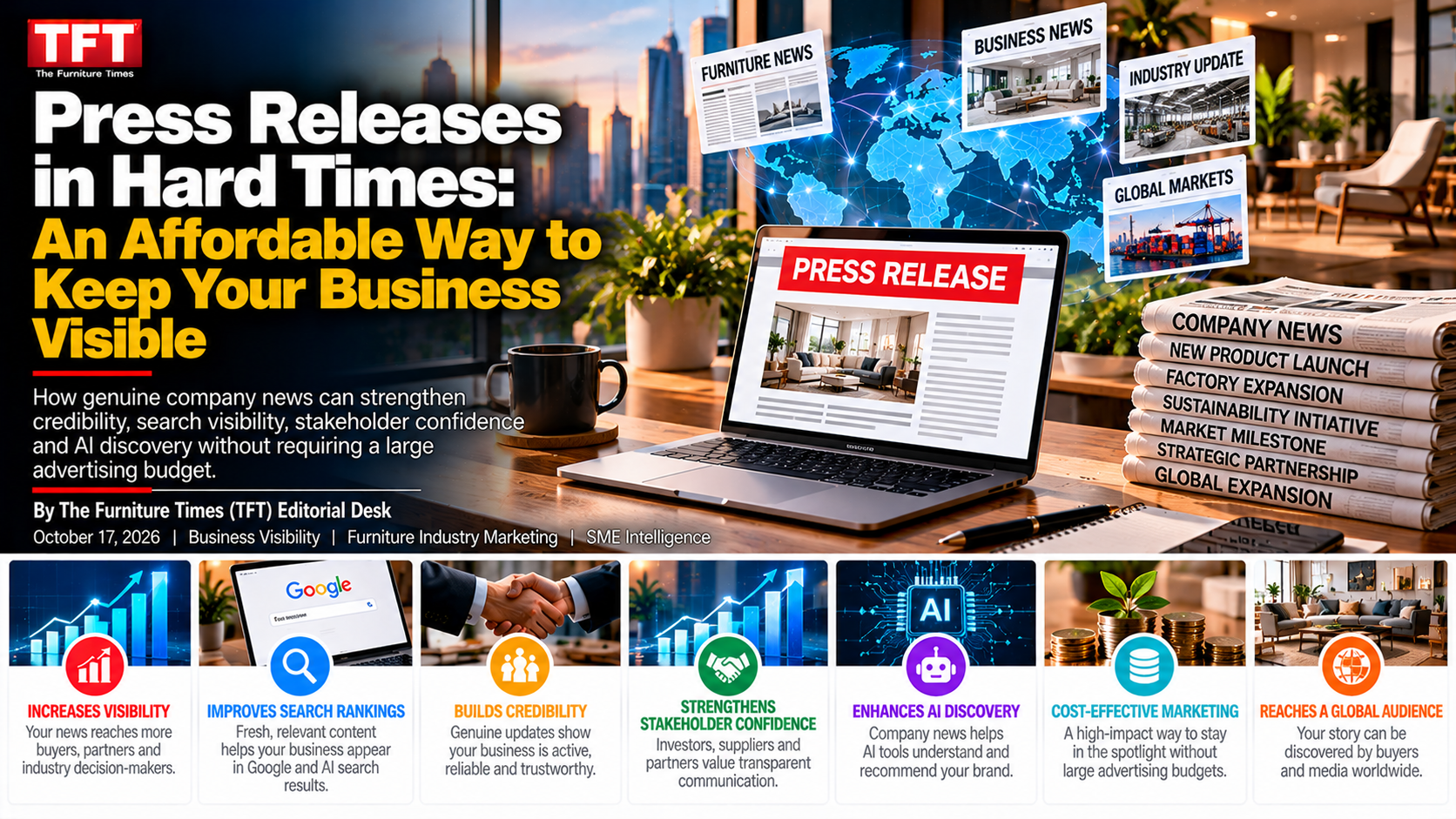
Press Releases in Hard Times: An Affordable Way to Keep Your Business Visible
How genuine company news can strengthen credibility, search visibility, stakeholder confidence and AI discovery without requiring a large advertising budget
By The Furniture Times (TFT) Editorial Desk
October 17, 2026 | Business Visibility | Furniture Industry Marketing | SME Intelligence
When markets slow, marketing is often one of the first budgets to be reduced.
Furniture manufacturers postpone campaigns. Retailers stop promoting anything except discounts. Suppliers attend fewer exhibitions. Service providers reduce communication. Smaller companies become quiet while they wait for demand to recover.
The instinct is understandable. When orders weaken, cash must be protected.
But prolonged silence creates another business risk: invisibility.
Customers may assume the company is inactive. Dealers may question its momentum. Suppliers may become uncertain about future demand. Potential employees may look elsewhere. Journalists, search engines and AI-assisted discovery systems receive little new information about the business.
Meanwhile, competitors that continue communicating appear more active, capable and relevant—even if their commercial position is not fundamentally stronger.
This is where a disciplined press-release strategy can provide exceptional value.
A genuine press release will not replace product quality, customer service, advertising or direct selling. It cannot guarantee media coverage, search rankings, backlinks, enquiries or inclusion in AI-generated answers.
It can, however, transform a real business development into a durable, searchable and reusable information asset.
For small and medium-sized furniture enterprises, that makes press releases one of the more affordable ways to maintain visibility during difficult periods.
Silence Is Not a Neutral Position
A business that stops communicating does not remain in the same position. It gradually loses share of attention.
Consider what happens when a prospective buyer searches for a furniture company and finds:
- An outdated website
- No recent announcements
- Product pages last updated several years ago
- Old social-media accounts
- Inconsistent business information
- Few independent references
- No evidence of investment or innovation
- No current project or customer stories
- No clear indication that the company remains active
The buyer may not contact the company to verify the situation. The uncertainty itself may be enough to redirect the enquiry.
This is especially dangerous for SMEs. Large brands can remain visible through store networks, historic advertising, customer familiarity and extensive distribution. Smaller businesses usually have less accumulated recognition.
When an SME becomes quiet, it can disappear quickly from the consideration set.
Press releases help address this problem by documenting activity. Each legitimate announcement tells the market that the company continues to manufacture, supply, employ, innovate, invest, deliver or expand.
In hard times, activity is a confidence signal.
A Press Release Is Not Merely a Publicity Document
Many businesses think of a press release as a short announcement sent to journalists in the hope of receiving free coverage.
That is only one possible outcome.
A properly prepared release can simultaneously function as:
- A dated corporate record
- A media information source
- A search-discoverable webpage
- A sales-enablement asset
- A stakeholder update
- A source for newsletters and social media
- A reference for distributors and dealers
- Evidence of market activity
- Input for company profiles and directories
- A structured source of facts for search and AI systems
- An internal record of business development
A single well-researched announcement can therefore support several departments.
Marketing can use it for promotion. Sales can send it to prospects. Human resources can use it to support recruitment. Management can share it with financial institutions and investors. Distributors can circulate it in their markets. Journalists can use it as the basis for reporting.
The economics become especially attractive when one core story is responsibly adapted into several formats.
Advertising Buys Attention; News Documents Progress
Advertising and press releases perform different functions.
Advertising gives the company control over the message, placement, audience and duration. It is valuable when a business needs immediate reach, product promotion or measurable lead generation.
A news announcement serves another purpose. It documents something that has happened.
That distinction affects credibility.
An advertisement may say:
We are an innovative furniture manufacturer.
A news release can say:
The company has installed a new automated panel-processing line capable of improving material utilisation and shortening production lead times.
The first is a claim. The second presents a reportable development that can be examined, photographed, quoted and verified.
Similarly, an advertisement may declare that a company is committed to sustainability. A stronger release could document:
- A certified timber-sourcing programme
- A reduction in factory waste
- A new furniture-repair service
- The introduction of recyclable packaging
- A take-back or refurbishment initiative
- Investment in lower-emission finishing equipment
- Publication of measurable environmental targets
Credibility grows when claims are connected to evidence.
Advertising tells the market what a company wants people to believe. Genuine news shows what the company has actually done.
Businesses need both—but during financially difficult periods, credible news can extend visibility without requiring continuous media spending.
What Qualifies as Genuine Company News?
A press release should contain new, relevant and verifiable information.
Furniture businesses frequently underestimate how many legitimate stories they possess.
Investment and manufacturing news
Potential announcements include:
- Opening or expanding a factory
- Installing new machinery
- Introducing automation or robotics
- Increasing production capacity
- Establishing a new finishing, upholstery or testing facility
- Adopting energy-efficient equipment
- Improving worker safety systems
- Opening a warehouse or distribution centre
- Adding a new manufacturing capability
The announcement should explain the business significance, not merely state that equipment was purchased.
Readers may want to know what the investment changes: capacity, precision, lead times, customisation, material efficiency, employment or market reach.
Product and design news
A product release becomes stronger when it explains:
- The problem the product addresses
- The intended customer or application
- Materials and construction
- Functional improvements
- Safety or testing considerations
- Dimensions and available variants
- Repairability and replacement components
- Designers or technical teams involved
- Availability and target markets
Simply describing a collection as “luxurious,” “innovative” or “world-class” provides little news value.
Certification and compliance news
Furniture manufacturers can announce:
- Product certifications
- Quality-management certification
- Environmental certification
- Chain-of-custody recognition
- Fire-safety testing
- Strength and durability testing
- BIS certification in India
- Market-specific compliance approvals
- Factory audit completion
The release must identify the relevant scope accurately. It should never imply that all products or facilities are certified when an approval applies only to selected models, materials or locations.
Market expansion
Valid developments include:
- Appointment of a distributor
- Opening of a showroom
- Entry into a new country
- Launch of an export programme
- Establishment of a regional office
- First delivery to a new market
- Participation in a major procurement project
- Expansion into hospitality, healthcare, education or workplace furniture
A useful release should explain why the market matters and how customers will be supported.
Partnerships and projects
A company may announce:
- A design collaboration
- A manufacturing partnership
- A logistics agreement
- A technology integration
- A hospitality furnishing project
- A residential development contract
- A dealer-network partnership
- A university or research collaboration
- A repair, recycling or take-back initiative
The announcement should clearly describe each party’s role. Vague “strategic partnerships” without visible substance can reduce rather than improve credibility.
People, skills and employment
Furniture businesses can also create legitimate news around:
- Senior appointments
- Apprenticeship programmes
- Artisan training
- New technical teams
- Workforce expansion
- Safety achievements
- Skills-development partnerships
- Succession and leadership transitions
- Recognition of long-serving employees
These stories humanise the company and demonstrate organisational capability.
What Should Not Become a Press Release?
Not every promotional message deserves to be presented as news.
Weak or misleading releases include:
- Unsupported claims of being the “best” or “largest”
- Routine discounts presented as major corporate developments
- Old information republished with a new date
- Awards with no identifiable organiser or methodology
- Market forecasts copied without permission or context
- Partnerships that have no defined activity
- Product announcements without specifications or availability
- Claims of sustainability without supporting evidence
- Fabricated quotations
- Exaggerated customer numbers
- Paid promotional articles presented as independent journalism
- Pages created mainly to carry keyword-rich backlinks
Google says its systems are intended to prioritise helpful and reliable information created for people, including original reporting, evidence, clear sourcing and accurate authorship. Publishing mass-produced announcements solely to attract search traffic is unlikely to build durable authority.
The test is straightforward:
If the company name were removed, would the announcement still contain information that a customer, supplier, investor or industry professional could find useful?
If not, the story probably requires further development.
How Press Releases Support Business Credibility
Credibility is built through consistency between claims, evidence and independent observation.
A good press release creates a dated statement that can be checked later. It identifies what happened, when it happened, where it occurred, who was involved and why it matters.
Over time, a series of accurate announcements forms a corporate timeline.
A furniture manufacturer’s news archive might show:
- 2023: Factory modernisation
- 2024: New hospitality collection
- 2024: Environmental certification
- 2025: Export partnership
- 2025: Product-testing laboratory opened
- 2026: Repair and refurbishment service launched
- 2026: Regional distribution centre established
Individually, each story supports a specific development. Collectively, they show continuity, capability and direction.
That record can become valuable during:
- Vendor evaluations
- Distributor negotiations
- Bank-finance discussions
- Investment due diligence
- Government applications
- Recruitment
- Export-market development
- Large project tenders
- Customer risk assessments
Credibility is particularly important during a slowdown because stakeholders become more cautious. Buyers want reassurance that suppliers will remain operational. Dealers want evidence of support. Employees want stability. Financial institutions want evidence of management activity.
A credible news programme cannot eliminate these concerns, but it gives stakeholders more information on which to base decisions.
Search Visibility: A Long-Term Information Asset
A press release published on a technically accessible website can create another relevant page through which people may discover the company.
For example, a manufacturer may be difficult to find for broad searches such as “office furniture manufacturer.” A detailed announcement about opening an office-chair testing facility in a specific city may be relevant to more precise searches involving:
- The company name
- Product category
- Factory location
- Testing capability
- Certification
- Investment
- Export activity
- New machinery
- Industry partnership
The search value comes from real information—not from repeating keywords.
A strong release naturally contains important entities and relationships:
- The company’s correct legal and trading name
- Location
- Product categories
- Industry segment
- Partners
- Certifications
- Executives
- Markets served
- Dates
- Measurable developments
- Authoritative supporting links
This information helps users and machines understand the business.
What press releases cannot guarantee
Publishing a release does not automatically produce:
- First-page rankings
- Google News inclusion
- High-authority backlinks
- Increased domain authority
- Media interviews
- Sales enquiries
- AI citations
Search performance depends on many factors, including website accessibility, content quality, source reputation, relevance, competition and independent recognition.
Businesses should also avoid purchasing press-release placements solely to obtain ranking links. Google classifies buying links or posts containing links for ranking purposes as link spam.
If distribution or coverage is paid, the commercial relationship should be disclosed, and links should be qualified appropriately where required.
The objective is not to manufacture authority. It is to make legitimate company activity accessible and understandable.
The Emerging Importance of AI Discovery
Customers increasingly use conversational systems and AI-assisted search to identify suppliers, compare products and understand markets.
They may ask:
- Which companies manufacture hotel furniture in Malaysia?
- Which Indian furniture brands hold the required certification?
- Who supplies sustainable school furniture in Europe?
- Which Vietnamese manufacturers offer custom upholstery?
- What furniture companies have recently expanded in the Middle East?
- Which suppliers provide repairable or circular furniture?
AI systems do not magically know every business. They depend on information available through accessible sources, licensed datasets, search systems and other retrieval methods.
A company with little current information online is harder to identify, understand and confidently describe.
A strong press release can contribute useful facts to this information environment:
- The company exists and remains active
- It operates in a particular location
- It manufactures or supplies defined products
- It has completed a specific investment
- It works with identified organisations
- It has entered a market
- It possesses a particular capability
- A named executive has made an attributable statement
However, businesses should not publish artificial stories designed to manipulate AI-generated responses. Google’s spam policies explicitly address attempts to manipulate both traditional search rankings and generative AI responses in Search.
AI visibility should therefore be approached as a result of clear identity, useful information, consistent facts and credible references—not as a shortcut.
Structure Information So Machines Can Understand It
Good journalism and technical publishing should work together.
Each press release should have:
- A descriptive headline
- A clear publication date
- A visible author or editorial source
- The correct company name
- A concise introductory summary
- Named locations
- Product and industry categories
- Relevant executive names and titles
- Supporting photographs with captions
- Links to authoritative company pages
- Contact information
- Accurate article metadata
The company website should also maintain consistent organisational information, including its official name, address, telephone number, logo, website and recognised profiles.
Google’s guidance explains that Organization structured data can help it understand administrative details about an organisation and distinguish it from other entities. Structured data is not a guarantee of visibility, but accurate machine-readable information can improve clarity. developers.google.com
For an article, publishers may also implement appropriate Article or NewsArticle structured data, alongside:
- Headline
- Date published
- Date modified
- Author
- Publisher
- Representative image
- Canonical URL
Technical markup must match what users can see on the page. Structured data should never be used to disguise advertising or fabricate credentials.
Press Releases Can Reassure Multiple Stakeholders
One of the greatest advantages of a press release is its ability to serve several audiences.
| Stakeholder | Information they may value |
|---|---|
| Customers | Product availability, service continuity, quality improvements and new capabilities |
| Dealers | New collections, territorial support, stock availability and marketing activity |
| Suppliers | Production plans, factory investments and future requirements |
| Employees | Organisational stability, achievements and growth direction |
| Job candidates | Career potential, training and company momentum |
| Banks and investors | Investment activity, market expansion and management strategy |
| Designers and architects | Product specifications, collaborations and project capability |
| Government agencies | Employment, exports, manufacturing investment and compliance |
| Journalists | Verifiable developments, quotations, images and industry context |
| AI and search systems | Clear, consistent and accessible business facts |
This makes a press release more than a customer-acquisition tool. It is a stakeholder-confidence instrument.
During a downturn, stakeholders do not expect constant celebration. They do expect clear communication.
News can include operational resilience, such as:
- Maintaining production despite supply disruption
- Establishing alternative sourcing channels
- Supporting customers through longer project timelines
- Expanding repair services
- Reducing minimum order quantities
- Adding local stock
- Improving logistics visibility
- Training employees for new production processes
Honest resilience stories are often more credible than exaggerated growth announcements.
How to Write an Effective Furniture Industry Press Release
1. Begin with the actual news
The headline should state what happened.
Weak:
Leading Furniture Company Continues Its Journey of Excellence
Stronger:
ABC Furniture Opens New Upholstery Facility to Expand Hospitality Production
The second headline identifies the company, action and business purpose.
2. Answer the essential questions immediately
The opening should cover as many of the following as possible:
- Who?
- What?
- Where?
- When?
- Why?
- How?
Readers should not need to reach the fifth paragraph before discovering the announcement.
3. Add measurable evidence
Replace broad claims with facts.
Instead of “significantly increased capacity,” state the actual increase if it can be responsibly disclosed.
Useful evidence may include:
- Investment value
- Facility size
- Number of machines
- Production capacity
- Jobs created
- Markets served
- Product categories
- Delivery-time improvements
- Waste reduction
- Test standards
- Certification scope
Every number should be reviewed before publication.
4. Explain industry relevance
A release becomes more useful when it connects the company development with a broader challenge.
For example, a new spare-parts programme matters because furniture buyers increasingly want longer product life and easier maintenance.
A regional warehouse matters because importers face uncertain freight schedules and longer lead times.
A testing facility matters because institutional buyers require evidence of safety, strength and durability.
This context turns corporate information into industry intelligence.
5. Use quotations that add meaning
A quotation should explain strategy, customer impact or future direction.
Avoid empty statements such as:
We are delighted to announce this exciting milestone.
A stronger quotation might explain:
The investment allows us to produce smaller customised batches while maintaining consistent upholstery quality, which is increasingly important for boutique hotel and serviced-apartment projects.
The quotation should sound like a real person and should be approved by the named speaker.
6. Include a clear company description
The boilerplate should state:
- What the company does
- Where it operates
- Who it serves
- Its principal capabilities
- Its official website
Avoid unsupported superlatives.
7. Provide useful media material
A release is easier to cover when it includes:
- High-resolution photographs
- Accurate captions
- Executive headshots
- Product specifications
- Factory information
- Supporting data
- Media contact details
- Relevant website links
Visuals should document the actual development, not merely provide generic stock imagery.
One Genuine Story Can Produce Many Affordable Assets
A company does not have to create every communication item from the beginning.
One properly researched story can become:
- A formal press release
- A detailed newsroom article
- An email-newsletter feature
- A LinkedIn company update
- A short executive post
- A distributor information sheet
- A website project page
- A sales presentation slide
- A Google Business Profile update, where appropriate
- An internal employee announcement
- A trade-show talking point
- A factual update to a business directory or industry profile
- A short video interview
- A customer FAQ
- An entry in the company’s annual review
This repurposing improves the return on the original reporting effort.
The facts must remain consistent across every channel. Product names, dates, investment figures, executive titles and certification claims should not change from one version to another.
An Affordable Visibility Framework for SMEs
A smaller furniture company does not need a global public-relations agency to begin.
Foundation level
The business can:
- Identify genuine news internally
- Create a basic editorial calendar
- Publish releases in its website newsroom
- Maintain accurate company information
- Prepare usable photographs
- Share announcements with customers and partners
- Submit relevant stories to specialised industry media
- Track basic search and referral performance
Focused professional level
A growing company may add:
- Professional editorial review
- Media-list development
- Industry-specific distribution
- Executive interview preparation
- Search-friendly website publishing
- Structured data
- Translation for priority markets
- Professional photography
- Measurement through analytics and Search Console
Multi-market level
An exporter or international group may require:
- Market-specific versions
- Local-language editing
- Regional spokespersons
- Regulatory review
- Coordinated distributor communication
- Country-specific media outreach
- Trade-show integration
- Crisis-response protocols
- Central fact-checking and approval
The correct level depends on the importance and complexity of the story.
A high-risk announcement involving financial performance, safety, legal disputes, certification, acquisitions or regulatory matters should receive appropriate professional and legal review.
What Should Be Measured?
A press-release programme should not be judged only by how many websites reproduce the announcement.
Useful indicators include:
- Relevant media coverage
- Quality of referring publications
- Branded-search impressions
- Search visibility for company developments
- Referral traffic
- Time spent on the release page
- Distributor and customer responses
- Sales-team use of the article
- Newsletter engagement
- Profile views
- Direct enquiries
- New relationships with journalists
- Accurate appearance in search and AI-assisted results
- Growth in authoritative company references
The business should distinguish between visibility and business outcomes.
A release may support credibility without immediately producing a sale. Another may generate distributor enquiries. A technical announcement may become valuable months later when a buyer conducts due diligence.
The cumulative record matters.
Common Press-Release Mistakes
Publishing too frequently without meaningful news
Constant low-value announcements train audiences to ignore the company.
Publish when there is something real to communicate.
Treating the release as an advertisement
A press release should inform before it persuades.
Hiding the important fact
The news should appear in the headline and opening paragraph.
Making unverifiable claims
Words such as “largest,” “first,” “leading” and “most sustainable” require evidence.
Using artificial quotations
Corporate language weakens authenticity.
Ignoring difficult questions
If an expansion has been delayed or a product has changed, communicate accurately. Selective wording must not become deception.
Distributing the same release indiscriminately
A furniture-manufacturing investment belongs with industrial, business, regional and furniture publications—not every unrelated website.
Expecting backlinks as payment
Editorial coverage must remain an independent decision. Paid or sponsored distribution should be transparently identified.
Forgetting the company website
The organisation should retain an authoritative version in its own newsroom, even when external distribution is used.
Publishing without follow-up
Someone must be available to answer questions, supply photographs and verify facts.
Marketing and advertising claims should be truthful, evidence-based and not misleading. Businesses must also clearly distinguish advertising from independent editorial material.
The Opportunity for the Furniture Industry
The furniture industry contains thousands of manufacturers, component suppliers, retailers, designers, logistics businesses, installers, repair specialists, testing laboratories, craftspeople and technology providers whose achievements remain poorly documented.
They invest, innovate and employ people—but frequently fail to communicate those developments.
This weakens the visibility of the entire sector.
The furniture industry ecosystem is a $1 trillion industry ecosystem, yet much of its business activity remains fragmented across private conversations, trade fairs, messaging applications and disconnected company pages.
The result is a major information gap.
Buyers struggle to identify qualified suppliers. Manufacturers struggle to communicate capability. Smaller companies struggle to establish credibility. Search engines and AI systems receive incomplete or inconsistent information.
A stronger culture of genuine industry reporting can help close that gap.
TFT, FISE and FurniReviewology: From News to Discovery and Trust
The Furniture Times can help document credible developments across the furniture value chain.
A manufacturer’s investment, a retailer’s expansion, a designer’s innovation, a logistics company’s new capability or an artisan’s growth story deserves more than a temporary social-media post.
It deserves a durable industry record.
That record becomes more powerful when connected with structured discovery and credible customer experience:
The Furniture Times tells their story.
Furniture Industry Search Engine helps the world find them.
FurniReviewology helps the world trust them.
Together, these functions address three different business needs:
- Credibility: documented industry news and verified company developments
- Visibility: structured discovery across products, services, locations and capabilities
- Trust: transparent customer and stakeholder experience
A press release is therefore not an isolated document. It can become the starting point for a stronger and more understandable digital identity.
The Final Message
Hard times require cost discipline—but disappearing from the market is not a sustainable cost-saving strategy.
A furniture SME does not need to manufacture artificial excitement or issue a release every week. It needs to recognise genuine developments, document them accurately and communicate them consistently.
A new employee-training programme can be news.
A completed hotel project can be news.
A product certification can be news.
A new repair service can be news.
A factory improvement can be news.
A distributor appointment can be news.
A measurable sustainability achievement can be news.
The strongest press releases do not attempt to make an ordinary company sound extraordinary. They make real business activity visible, understandable and verifiable.
That visibility can support customers, suppliers, employees, financial stakeholders, journalists, search engines and AI-assisted discovery.
Advertising stops when the budget stops. A credible, accessible and well-published company story can continue working long after its publication date.
If you are not searchable, you do not exist.
Do not disappear during difficult times. Document your progress, communicate your value and remain part of the market conversation.
Sources:
Google Search Central—Creating Helpful, Reliable, People-First Content, Google Search Central—Spam Policies, Google Search Central—Organization Structured Data, Federal Trade Commission—Advertising and Marketing Basics