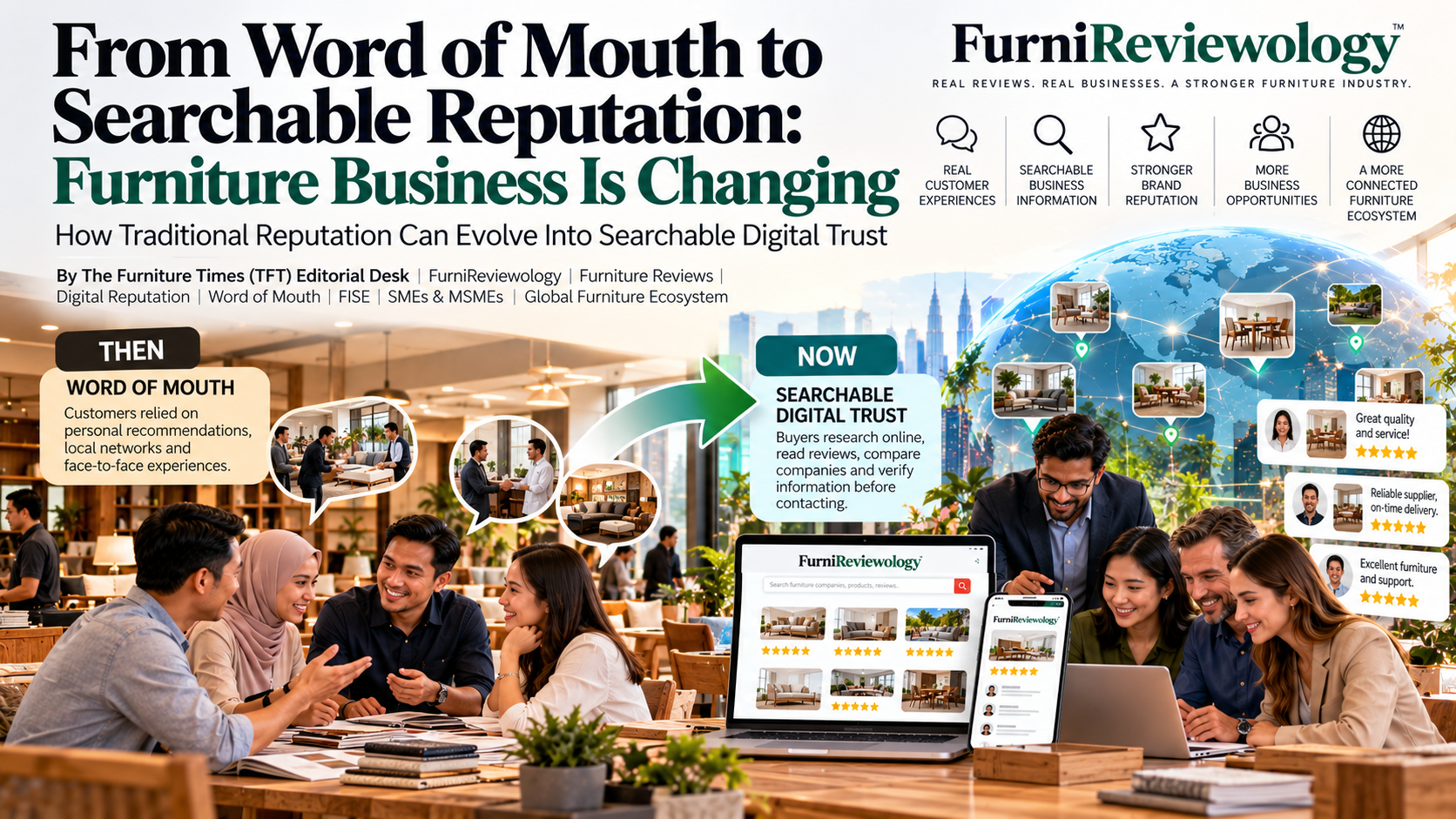
From Word of Mouth to Searchable Reputation: Furniture Business Is Changing
How Traditional Reputation Can Evolve Into Searchable Digital Trust
By The Furniture Times (TFT) Editorial Desk | FurniReviewology | Furniture Reviews | Digital Reputation | Word of Mouth | FISE | SMEs & MSMEs | Global Furniture Ecosystem
For generations, the furniture industry has grown through one of the oldest and most powerful forms of marketing:
Word of mouth.
A retailer recommended a manufacturer.
An architect introduced a supplier.
A hotel owner referred another hotel owner.
An importer told another buyer about a reliable factory.
A satisfied homeowner recommended a furniture store to relatives.
A contractor introduced a trusted furniture company to a developer.
A manufacturer recommended a component supplier to another factory.
These relationships helped build businesses long before websites, search engines, social media or online reviews existed.
And they still matter.
In furniture, trust remains deeply human.
But the way that trust travels is changing.
Yesterday, one satisfied customer might recommend your company to five people.
Today, one genuine customer experience can potentially become searchable by buyers far beyond that customer’s personal network.
Yesterday, reputation travelled primarily from person to person.
Today, reputation can also travel through search engines, review platforms, industry databases, news coverage, business listings and increasingly AI-powered discovery systems.
The furniture industry is therefore entering a new phase:
Word of Mouth Is Becoming Searchable.
And furniture businesses need to understand what that means.
Traditional Reputation Is One of the Furniture Industry’s Greatest Assets
Furniture is a relationship-driven business.
This is especially true in manufacturing, wholesale, contract furniture, hospitality, components and international trade.
A reliable supplier may serve the same buyer for decades.
A retailer may purchase repeatedly from the same manufacturer.
A hotel procurement company may return to suppliers that successfully completed earlier projects.
An importer may continue working with a factory because it understands the buyer’s specifications, packaging requirements and quality expectations.
These relationships create something extremely valuable:
reputation capital.
It is earned slowly.
One order at a time.
One delivery at a time.
One solved problem at a time.
One satisfied customer at a time.
Some furniture businesses have accumulated this reputation for 20, 30, 40 or even 50 years.
But there is a problem.
Much of that reputation remains invisible outside the company’s existing network.
Your Customers Know You — But Does the Market Know You?
Consider a small furniture manufacturer that has operated successfully for 25 years.
Its existing customers trust it.
Suppliers know it.
Employees understand its capabilities.
Local retailers recognize the company.
Perhaps international buyers have repeatedly placed orders.
Within its network, the company’s reputation is strong.
Now imagine a buyer located thousands of kilometers away.
That buyer has never met the owner.
There is no mutual friend.
There is no existing distributor making an introduction.
There is no agent explaining the company’s history.
The buyer searches online.
What happens?
If almost nothing meaningful appears, 25 years of reputation may become practically invisible to that buyer.
This is the challenge facing thousands of established furniture businesses.
They have reputation—but not necessarily searchable reputation.
Word of Mouth Has a Geographic Limitation
Traditional recommendations are powerful because they carry human trust.
But they also have limitations.
They depend on networks.
They depend on relationships.
They depend on geography.
They depend on who knows whom.
A furniture manufacturer in Malaysia may have an excellent reputation among its existing customers.
But how does a new buyer in Germany know that?
A furniture workshop in Kashmir may be respected locally.
How does an interior designer in Dubai discover that reputation?
A furniture supplier in Vietnam may have loyal customers.
How does a retailer in Australia learn about those experiences?
A specialist manufacturer in Turkey may have decades of expertise.
How does a hotel developer in Africa discover it?
Digital reputation can help reputation travel beyond traditional boundaries.
That does not replace word of mouth.
It extends its reach.
A Review Is Digital Word of Mouth
At its simplest, a genuine online review is a modern version of an old conversation.
Traditionally:
“Have you worked with this company?”
Someone answers:
“Yes. We had a good experience.”
Digitally, the same experience can become accessible to people who do not personally know that customer.
A review can discuss:
product quality,
service,
communication,
delivery,
packaging,
installation,
durability,
problem resolution,
customization,
after-sales support,
or the overall experience.
This makes customer experience potentially searchable.
That is a profound change.
A recommendation no longer necessarily disappears after a conversation ends.
It can become part of a company’s continuing digital footprint.
One Good Experience Can Travel Further Than Before
Imagine a furniture company completes a hospitality project successfully.
Traditionally, the hotel owner might recommend the supplier to several industry contacts.
That remains valuable.
But now the experience can potentially generate several additional signals.
The customer might leave a genuine review.
The project might be documented on the manufacturer’s website.
The company might publish the project in its portfolio.
Industry media might report the development where appropriate.
The company could maintain accurate business listings.
Its products and capabilities could become searchable through industry platforms.
Now the same successful project contributes to both:
offline reputation and digital reputation.
The experience has not changed.
Its discoverability has.
Searchable Reputation Is Built From Many Signals
Furniture companies sometimes think online reputation means only Google reviews.
Reviews are important, but digital reputation is broader.
A searchable business identity can include:
your company website,
company listings,
customer reviews,
product information,
industry profiles,
news coverage,
project references,
certifications,
trade-fair participation,
social channels,
leadership information,
factory information,
catalogues,
business history,
and consistent company details across platforms.
No single element defines a company.
Together, however, they can help prospective buyers develop a clearer picture.
The objective is not to create artificial popularity.
It is to make real business activity easier to discover.
This Is Especially Important for Furniture SMEs and MSMEs
Large international brands already generate digital signals almost automatically.
People search for them.
Media covers them.
Retailers mention them.
Consumers discuss them.
Dealers list them.
Design publications feature them.
Smaller businesses often face the opposite problem.
They may be commercially successful but digitally quiet.
This is especially common among:
family-owned factories,
small manufacturers,
traditional furniture makers,
component suppliers,
regional retailers,
OEM manufacturers,
artisans,
specialized workshops,
export-oriented SMEs,
and MSMEs.
Many built their businesses during an era when reputation travelled through personal networks.
That reputation should not be discarded.
It should be translated into the digital environment.
Don’t Throw Away 30 Years of Reputation
Imagine having 30 years of industry experience but presenting yourself online like a company that started six months ago.
That is what happens when established businesses fail to document their histories.
Your business may have:
served thousands of customers,
completed hundreds of projects,
exported internationally,
survived economic downturns,
developed specialized manufacturing expertise,
trained generations of employees,
built long-term supplier relationships,
and continuously improved its products.
Those achievements form part of your reputation.
Document them.
Your digital presence should help communicate the business that actually exists offline.
FurniReviewology: Turning Customer Experience Into Discoverable Context
This is one of the roles FurniReviewology can play within the furniture ecosystem.
Furniture deserves a review environment that understands furniture.
A sofa retailer and an OEM chair manufacturer are different businesses.
A hotel furniture supplier and a mattress company serve different requirements.
A hardware manufacturer and an interior designer cannot be understood through exactly the same context.
FurniReviewology is focused on building a furniture-specific layer around:
company identity, industry context, customer reviews and reputation.
For businesses, participation provides another opportunity to establish a discoverable presence.
For buyers, it can provide another source of information during research.
Start With a Free FurniReviewology Listing
For furniture companies that have spent years relying primarily on word of mouth, the transition does not have to be complicated.
Start with visibility.
Get your company listed on FurniReviewology.
The free listing opportunity provides a starting point, particularly for SMEs and MSMEs.
Establish your company identity.
Use accurate business information.
Explain what you manufacture, supply or sell.
Identify your categories correctly.
Keep your information current.
Then begin encouraging genuine customers to share genuine experiences.
Do not manufacture a reputation.
Document the reputation you have actually earned.
Your Best Customers Can Become Part of Your Digital Reputation
Furniture businesses often have customers who have purchased from them for years.
Those relationships are powerful.
Yet online, nobody knows they exist.
A business should never pressure customers for artificial praise.
But there is nothing wrong with making genuine customers aware that they can share an honest experience.
Ask customers to discuss what genuinely mattered.
Was the product satisfactory?
Was communication good?
Was delivery handled professionally?
How did the furniture perform?
How did the company respond when assistance was required?
Would they work with the business again?
Detailed, authentic experiences are more useful than empty five-star ratings.
The objective is credibility, not perfection.
Negative Reviews Are Not Automatically the Enemy
Many businesses fear reviews because they fear criticism.
But a healthy review ecosystem cannot exist if companies expect only praise.
Mistakes happen.
Deliveries can go wrong.
Products can develop problems.
Communication can fail.
Expectations can differ.
What matters is how businesses respond.
A professional response to legitimate criticism can itself demonstrate character.
A company can acknowledge an issue.
Explain what happened.
Offer a solution where appropriate.
Improve its processes.
Show future buyers that customer service does not disappear when something goes wrong.
A perfect reputation can sometimes look less believable than a transparent reputation.
Trust is not the absence of problems.
Often, trust is built through how problems are handled.
FISE Makes Reputation Discoverable Through Industry Search
A reputation has limited commercial value if potential buyers never discover the company.
That is where FISE — Furniture Industry Search Engine connects with the wider vision.
FISE focuses on making the furniture ecosystem more searchable.
A buyer may search for:
furniture manufacturers,
hospitality furniture suppliers,
outdoor furniture companies,
office furniture manufacturers,
component suppliers,
retailers,
designers,
materials,
or other industry participants.
Discovery is the beginning.
Once a company is discovered, research begins.
That creates a natural relationship:
FISE helps buyers find the company.
FurniReviewology helps buyers explore its reputation and customer experiences.
TFT Helps Turn Business Activity Into Searchable History
There is another form of reputation:
what your company actually does.
You expand a factory.
You launch a collection.
You enter another country.
You complete a significant project.
You invest in machinery.
You receive certification.
You introduce sustainable production.
You participate in a major trade show.
You celebrate 25 years in business.
These events should not necessarily disappear after a social-media post.
Meaningful business developments can become part of a company’s searchable history.
That is where The Furniture Times — TFT contributes.
TFT helps bring furniture companies, developments, ideas and industry stories into the global spotlight.
Over time, this creates a richer digital narrative.
Three Layers of Modern Furniture Reputation
The emerging furniture ecosystem can therefore be understood through three connected layers.
Discovery
Can buyers find you?
That is the FISE opportunity.
Reputation
What experiences and information can buyers discover about you?
That is the FurniReviewology opportunity.
Visibility
What has your company been doing within the industry?
That is the TFT opportunity.
Together:
FISE helps the world find them.
The Furniture Times tells their story.
FurniReviewology helps the world trust them.
Searchable Reputation Matters in the AI Era
The next evolution makes this even more important.
Buyers increasingly use AI systems to research industries, suppliers, products and companies.
Instead of typing:
“furniture manufacturers Malaysia”
a buyer might ask:
“Find manufacturers that produce commercial outdoor furniture for hotels.”
Or:
“Which furniture companies specialize in contract manufacturing?”
Or:
“Find furniture suppliers suitable for hospitality projects.”
AI systems need information from which to understand companies.
If your digital footprint is limited, inconsistent or unclear, there may be less information available through which machines can associate your business with relevant searches.
This means tomorrow’s reputation will increasingly need to be:
human-readable and machine-discoverable.
Don’t Depend on Someone Remembering Your Name
Traditional word of mouth depends on memory.
Someone must remember your company.
Someone must recommend you.
Someone must have the right conversation at the right moment.
Searchable reputation changes that equation.
Information can potentially remain available when nobody from your existing network is present.
A buyer can discover your company at midnight.
In another country.
In another time zone.
Without knowing your salesperson.
Without attending your exhibition.
Without having a mutual contact.
That does not make personal relationships less important.
It creates another route into the relationship.
Word of Mouth Isn’t Dying — It Is Scaling
Furniture businesses should not see digital reviews as the enemy of traditional relationships.
The opposite is more useful.
Think of digital reputation as word of mouth at scale.
Traditional word of mouth says:
“Ask somebody who knows us.”
Searchable reputation says:
“Here is information that can help you begin researching us.”
The strongest businesses can use both.
Personal relationships create depth.
Digital discovery creates reach.
Customer experience creates reputation.
Search makes that reputation easier to find.
Build Reputation Before You Need Reputation
The wrong time to start building digital credibility is when a major buyer is already investigating you.
The right time is now.
Do not wait until:
you need distributors,
you want to export,
sales decline,
a competitor becomes more visible,
you launch a new product,
you enter another market,
or a buyer asks for independent information.
Build continuously.
One accurate listing.
One genuine review.
One documented project.
One meaningful news story.
One updated product category.
One additional searchable reference.
Reputation compounds.
SMEs and MSMEs: Your History Is an Asset
If your furniture business has survived for years, do not underestimate what that means.
Your history is valuable.
Your repeat customers are valuable.
Your manufacturing experience is valuable.
Your craftsmanship is valuable.
Your supplier relationships are valuable.
Your projects are valuable.
Your lessons are valuable.
Your customer experiences are valuable.
But these assets create limited discovery value when nobody outside your existing circle can find them.
Make them visible.
Make them understandable.
Make them searchable.
From Recommendation to Discovery
The furniture buying journey is evolving.
Yesterday:
“Do you know a good furniture supplier?”
Today:
“Let me search the company.”
Tomorrow:
“Let me ask AI which companies I should investigate.”
The underlying requirement remains the same.
Trust.
What changes is how buyers gather the information that helps them develop that trust.
Furniture businesses must evolve with that journey.
Your Reputation Already Exists — Make It Searchable
You do not need to invent a new reputation.
If you have spent years doing good business, much of the foundation already exists.
The challenge is to translate it.
Turn business history into documented history.
Turn customer satisfaction into genuine customer reviews.
Turn company information into structured listings.
Turn products into searchable categories.
Turn achievements into industry stories.
Turn traditional reputation into discoverable digital reputation.
Start with your FurniReviewology listing.
Build your presence on FISE.
Share meaningful developments with TFT.
Encourage genuine feedback.
Keep your information accurate.
And continue earning trust the same way successful furniture businesses always have:
through good products, good service and good relationships.
The technology is changing.
The principle is not.
Reputation Still Has to Be Earned — It Can Now Also Be Found.
The Global Furniture Ecosystem
The Furniture Industry is a $1 Trillion USD Ecosystem in the world
Furniture Industry Search Engine – FISE helps the world find them.
The Furniture Times – TFT tells their story.
FurniReviewology helps the world trust them.