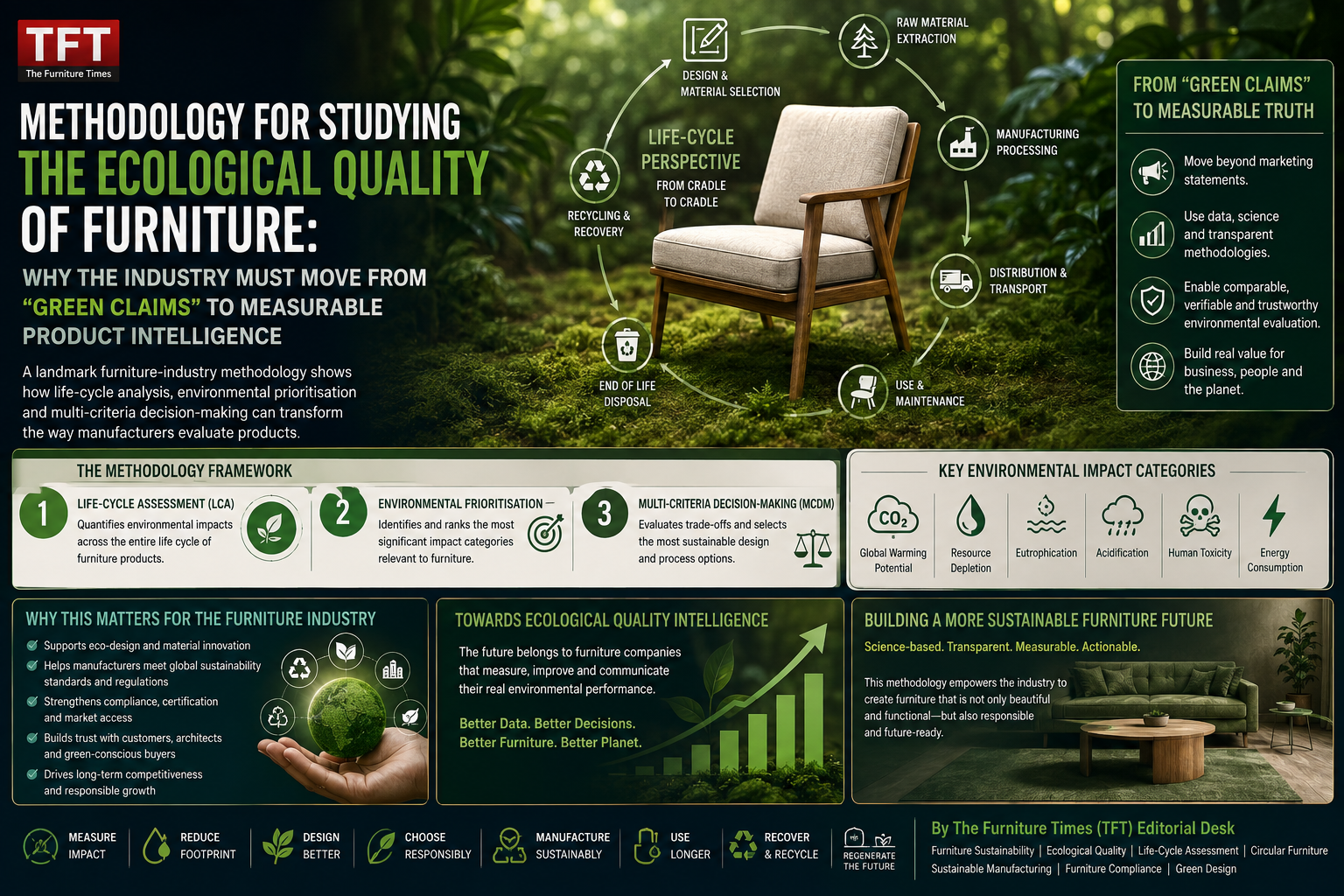
Methodology for Studying the Ecological Quality of Furniture
Why the Industry Must Move From “Green Claims” to Measurable Product Intelligence
A landmark furniture-industry methodology shows how life-cycle analysis, environmental prioritisation and multi-criteria decision-making can transform the way manufacturers evaluate products
By The Furniture Times (TFT) Editorial Desk | Furniture Sustainability | Ecological Quality | Life-Cycle Assessment | Circular Furniture | Sustainable Manufacturing | Furniture Compliance | Green Design
The furniture industry is entering a period in which environmental performance can no longer be treated simply as a marketing message.
For decades, furniture companies have often communicated sustainability through individual attributes: timber sourcing, recycled materials, low-emission finishes, recyclable packaging, energy-efficient factories or environmentally friendly labels.
But a much harder question is now emerging:
How environmentally responsible is the furniture product as a whole, across its entire life cycle?
That question is at the heart of the research paper “Methodology for Studying the Ecological Quality of Furniture,” by Leon Oblak and Matej Jošt, published in Drvna Industrija in 2011. The research developed a methodology combining life-cycle analysis, modified ABC analysis and multi-criteria decision-making to evaluate the ecological quality of furniture products. The researchers tested the methodology on three kitchen products from a well-known manufacturer and found substantial differences in ecological performance between products made by the same company.
The significance of the research extends far beyond the three kitchens examined.
Its central message is increasingly relevant to the global furniture industry in 2026: a company’s environmental reputation cannot automatically be transferred to every product it manufactures.
Different products can have dramatically different environmental footprints because of their materials, energy consumption, production processes, emissions, waste, packaging, transportation, maintenance requirements and end-of-life possibilities.
That makes ecological quality a product-level intelligence problem, not merely a corporate slogan.
And as global furniture regulation moves toward durability, repairability, resource efficiency and better product information, this methodology offers an important conceptual foundation for the next generation of furniture sustainability. The European Commission’s current Ecodesign for Sustainable Products framework, for example, specifically identifies furniture among the product groups being prioritised for future sustainability requirements and links the transition to better information through Digital Product Passports.
The Furniture Industry Is Entering the Age of Measurable Sustainability
The furniture industry has traditionally evaluated products through familiar commercial metrics:
- Selling price
- Production cost
- Margin
- Design
- Functionality
- Quality
- Durability
- Consumer preference
- Production capacity
- Delivery time
Environmental performance was often treated as an additional consideration.
That model is changing.
Furniture manufacturers are increasingly being asked:
- Where did the timber come from?
- Was it legally and sustainably sourced?
- What percentage of recycled material is used?
- What chemicals were used?
- How much energy was required?
- What emissions were generated?
- How much waste was produced?
- How far did the product travel?
- Can it be repaired?
- Can components be replaced?
- Can it be disassembled?
- Can its materials be recycled?
- What happens when the customer no longer wants it?
These questions move the industry from environmental marketing toward environmental measurement.
The 2011 research anticipated this challenge by arguing that ecological suitability should be considered throughout a product’s life cycle rather than evaluated through isolated production characteristics.
What Is “Ecological Quality” in Furniture?
Ecological quality should not be confused with one simple characteristic.
A wooden chair is not automatically environmentally superior simply because it is made from wood.
A recycled-plastic chair is not automatically superior because it contains recycled material.
A locally manufactured product is not automatically superior if its materials are environmentally intensive.
Similarly, a product labelled “eco-friendly” may still have significant environmental impacts elsewhere in its life cycle.
Ecological quality is therefore multidimensional.
It can involve:
1. Raw materials
What materials enter the product?
2. Material origin
Where do those materials come from?
3. Energy
How much energy is required during production?
4. Emissions
What pollutants are generated?
5. Waste
How much manufacturing waste is created?
6. Chemicals
What adhesives, coatings, finishes, preservatives or other substances are used?
7. Packaging
How much packaging is required and what happens to it?
8. Transportation
How far do materials and finished products travel?
9. Product use
What happens during the furniture’s service life?
10. Maintenance
Can the furniture be repaired and maintained rather than replaced?
11. End of life
Can the furniture be dismantled, reused, refurbished or recycled?
The research specifically describes life-cycle analysis as covering areas including raw-material and energy acquisition, production, transport, distribution, packaging, use, maintenance, recycling and final disposal.
This is the foundation of modern furniture sustainability thinking.
The Research’s Three-Part Methodology
The researchers combined three analytical approaches.
1. Life-Cycle Analysis
Life-cycle analysis examines environmental impacts across the product’s life.
The research describes potential impact categories including:
- Climate change
- Ozone depletion
- Smog formation
- Eutrophication
- Acidification
- Toxicological effects
- Resource depletion
- Water use
- Land use
- Noise
The objective is to understand the environmental consequences associated with materials, energy, manufacturing and other stages of the product’s existence.
For furniture manufacturers, this is a major conceptual shift.
Instead of asking:
“Is this material environmentally friendly?”
the company asks:
“What is the environmental consequence of using this material within this particular product and supply chain?”
That is a much more sophisticated question.
Why Life-Cycle Thinking Matters for Furniture
Imagine two dining tables.
Table A
- Solid timber
- Minimal synthetic material
- Long expected service life
- Repairable construction
- Replaceable components
- Efficient packaging
Table B
- Lower-cost composite material
- Multiple synthetic components
- Heavy chemical finishing
- Difficult-to-repair construction
- Large packaging volume
- Shorter expected life
Simply saying “Table A is wooden” and “Table B is engineered wood” does not provide enough information to determine overall ecological performance.
A complete assessment must examine the entire system.
The same applies to upholstered furniture.
A sofa might contain:
- Timber
- Metal springs
- Foam
- Polyester
- Adhesives
- Dyes
- Coatings
- Plastic feet
- Packaging
The environmental performance of the sofa is the combined consequence of those components and their associated manufacturing and logistics processes.
This is why furniture sustainability cannot be reduced to a single material.
The Second Method: Modified ABC Analysis
The researchers recognised a practical problem.
Furniture companies can have hundreds or thousands of environmental parameters.
Attempting to investigate every parameter with equal intensity can become expensive and confusing.
The methodology therefore uses a modified ABC analysis to identify the environmental parameters requiring the greatest attention.
The researchers adapted the traditional Pareto-style approach so that the most important environmental causes could be prioritised. In their framework, the highest-priority parameters were those responsible for the greatest share of environmental impact.
The methodology introduced five categories:
- A
- AB
- B
- BC
- C
The researchers describe A and AB as requiring immediate attention, B and BC as requiring medium-term action, while C represents secondary effects with comparatively lower significance.
This is extremely useful for manufacturers.
A factory does not necessarily need to solve every environmental problem simultaneously.
It needs to identify the critical environmental drivers first.
The 80/20 Principle Can Change Factory Sustainability
The research applies the familiar principle that a relatively small number of causes may account for a large proportion of consequences.
For a furniture factory, those major causes might be:
- One high-impact finishing process
- One inefficient production line
- One major material category
- Excessive energy consumption
- High-volume packaging waste
- A particular chemical
- Large quantities of rejected panels
- Inefficient transport
- Excessive offcuts
Rather than spreading environmental investment equally across every activity, management can concentrate resources where the environmental return is greatest.
This creates a practical sustainability strategy.
Instead of saying:
“We need to become greener.”
the management team can ask:
“Which five processes are responsible for the greatest environmental burden, and what can we change first?”
That is actionable.
The Third Method: Multi-Criteria Decision-Making
The final component of the methodology is multi-criteria decision-making.
Furniture companies rarely make decisions based on environmental performance alone.
They must simultaneously consider:
- Cost
- Quality
- Function
- Durability
- Design
- Manufacturing feasibility
- Customer demand
- Environmental performance
- Compliance
- Availability
- Supply risk
Multi-criteria decision-making allows these factors to be organised into a structured decision framework.
The researchers explain that complex alternatives can be broken down into individual parameters, evaluated separately and then combined into an overall assessment. Their model used a hierarchical criteria structure and decision-support software.
This is highly relevant to today’s furniture industry.
A manufacturer might compare three chair designs:
| Criterion | Chair A | Chair B | Chair C |
|---|---|---|---|
| Material efficiency | High | Medium | High |
| Durability | High | High | Medium |
| Production cost | Medium | Low | High |
| Energy consumption | Low | Medium | High |
| Repairability | High | Low | Medium |
| Recycled content | Medium | High | High |
| Transport efficiency | High | Medium | Low |
| Overall ecological quality | High | Medium | Medium |
The purpose is not to create an artificial “perfect product.”
The purpose is to make trade-offs visible.
The Three Kitchens Produced Three Different Environmental Outcomes
Perhaps the most important finding from the research is that the three kitchens manufactured by the same company did not perform equally from an ecological perspective.
The final evaluation ranked:
Kitchen 1 — Ecologically acceptable
Kitchen 3 — Ecologically questionable
Kitchen 2 — Ecologically problematic
The researchers concluded that the company could reconsider materials, raw materials and its product assortment based on these findings, including potentially discontinuing Kitchen 2 and modifying Kitchen 3.
This finding is powerful.
It means sustainability cannot be evaluated only at the company level.
A company can have an environmentally responsible factory while still producing individual products with significantly different ecological performance.
The “Green Company” Problem
This creates a major challenge for furniture brands.
A company may say:
“We are a sustainable furniture manufacturer.”
But which products?
Which factories?
Which materials?
Which collections?
Which suppliers?
Which production lines?
Which markets?
Which packaging systems?
Which end-of-life pathways?
Corporate sustainability reporting can provide useful information, but customers increasingly need product-level information.
A sustainable company can manufacture an unsustainable product.
A conventional manufacturer can sometimes produce an exceptionally efficient product.
The important question is not simply who made it.
It is:
How was this particular product designed, manufactured, distributed, used and ultimately managed at the end of its life?
The Furniture Product Should Be Treated as an Environmental System
Furniture design traditionally focuses on:
Form + Function + Cost + Quality
The next generation needs to consider:
Form + Function + Cost + Quality + Environmental Performance + Circularity + Traceability
That changes the role of designers.
A designer must think about:
- Material quantity
- Material combinations
- Joinery
- Disassembly
- Repair
- Component replacement
- Fastener selection
- Surface treatment
- Packaging
- Transport dimensions
- Expected lifespan
- End-of-life separation
A beautiful product that cannot be repaired or dismantled may create a different environmental burden from a slightly simpler product designed for decades of use.
Sustainable Furniture Starts at the Design Stage
Manufacturers often attempt to improve environmental performance after a product has already been designed.
That can be expensive.
If the product has:
- Complex glued construction
- Mixed inseparable materials
- Difficult-to-source components
- Non-replaceable mechanisms
- Excessive material thickness
- Oversized packaging
then environmental improvements may require major redesign.
The better approach is designing for environmental performance from the beginning.
This is increasingly aligned with European policy.
The EU’s Ecodesign for Sustainable Products Regulation establishes a framework intended to make products more durable, repairable and resource-efficient. Furniture is explicitly among the product groups prioritised in the EU’s 2025–2030 working plan.
Furniture Sustainability Is Becoming a Regulatory Issue
The EU Ecolabel already provides a useful illustration of how environmental criteria can be applied to furniture.
The current EU Ecolabel furniture criteria cover free-standing and built-in furniture such as tables, shelves, cupboards, chairs and sofas for indoor and outdoor use. The criteria address areas including wood and wood-based materials, plastics, metals, upholstery materials, padding, glass and hazardous substances. The current criteria are valid through 31 December 2029.
The criteria also address sustainable sourcing.
For relevant wood, cork, bamboo and rattan content, the EU framework requires chain-of-custody certification through independent third-party schemes such as FSC, PEFC or equivalent systems under the applicable criteria.
This illustrates an important trend:
Environmental performance is moving from voluntary marketing toward documented product characteristics.
Digital Product Passports Could Change Furniture Forever
The next major step is information.
The European Commission’s ESPR framework includes the Digital Product Passport, intended to improve access to information about product sustainability, durability, repairability and material composition across the value chain.
For furniture, the concept is particularly powerful.
Imagine scanning a QR code attached to a chair and finding:
- Manufacturer
- Product model
- Manufacturing location
- Material composition
- Timber source
- Certifications
- Repair instructions
- Spare parts
- Cleaning instructions
- Maintenance schedule
- Carbon information
- Recyclability
- Disassembly instructions
- Warranty
- Replacement components
- Authenticity information
The QR code would no longer simply be a marketing device.
It could become the digital identity of the furniture product.
From Ecological Quality to Furniture Intelligence
This is where the methodology developed in the 2011 research becomes particularly interesting for the modern industry.
The research asks:
How environmentally good is the product?
The modern digital ecosystem can take the next step:
What exactly is this product, where did it come from, what is inside it, how was it produced, how sustainable is it, how can it be repaired, and what happens to it next?
That is Furniture Product Intelligence.
It combines:
- Product data
- Material data
- Environmental data
- Compliance data
- Supplier information
- Certification
- Repair information
- Reviews
- Authenticity
- Lifecycle data
The furniture industry is therefore moving toward a world where a product may have both a physical identity and a digital identity.
Ecological Quality Must Include Durability
One of the most important sustainability questions is also one of the simplest:
How long will the furniture last?
A product that uses slightly more material but lasts 20 years may have a better lifecycle profile than a lightweight product that must be replaced every three years.
Durability can reduce:
- Replacement demand
- Manufacturing requirements
- Transport
- Packaging
- Waste
- Resource extraction
This is why environmental quality should not automatically mean “minimum material.”
The goal is not necessarily to use the least material.
The goal is to use materials efficiently for the required performance and lifespan.
Repairability Is the Missing Sustainability Metric
Furniture companies often talk about recyclable materials.
But before recycling, there is a more valuable question:
Can the furniture continue to be used?
Repair can extend product life.
Consider a sofa with a damaged:
- Leg
- Cushion
- Fabric cover
- Spring
- Frame component
If the individual component can be replaced, the sofa may remain useful for years.
If the product is designed as a sealed, inseparable system, a small failure may lead to disposal of the entire product.
Repairability should therefore become a measurable furniture attribute.
Modular Furniture Has an Environmental Advantage
Modularity can support ecological performance because individual elements can be replaced or upgraded.
Examples include:
- Replaceable table legs
- Interchangeable chair components
- Modular shelving
- Replaceable sofa covers
- Removable upholstery
- Replaceable hardware
- Standardised mechanisms
A modular product can potentially evolve with the customer.
This reduces the need to discard the complete product when one component becomes obsolete.
Furniture Waste Is a Design Problem
Furniture waste does not begin when the consumer throws away the product.
It can begin during design and manufacturing.
Waste can be generated through:
- Cutting
- Machining
- Defective components
- Excess packaging
- Product damage
- Overstock
- Returns
- Unsold inventory
- Replacement parts
- End-of-life disposal
A furniture factory should therefore measure waste throughout the product lifecycle.
The question should not be:
“How much waste do we recycle?”
It should also be:
“Why did we generate this waste in the first place?”
Prevention generally has greater value than downstream treatment.
Material Selection Is Becoming a Strategic Decision
The modern furniture manufacturer must compare materials through a much broader lens.
For example:
Solid wood
Potential strengths:
- Renewable when responsibly sourced
- Repairable
- Durable
- Long service life
Potential concerns:
- Illegal or unsustainable sourcing
- Transport
- Moisture management
- Finishing chemicals
Metal
Potential strengths:
- Strong
- Durable
- Recyclable
Potential concerns:
- Energy-intensive production
- Mining impacts
- Coating requirements
Plastic
Potential strengths:
- Lightweight
- Mouldable
- Potentially recyclable
Potential concerns:
- Fossil feedstocks
- Additives
- Mixed-material combinations
- End-of-life challenges
Composite panels
Potential strengths:
- Efficient use of wood fibres
- Consistent dimensions
- Efficient manufacturing
Potential concerns:
- Resin systems
- Formaldehyde emissions
- Difficult separation
- End-of-life processing
There is no universally perfect furniture material.
The correct question is:
Which material and construction system produces the best overall performance for the intended application and lifecycle?
Upholstery Requires Its Own Ecological Assessment
Upholstered furniture is particularly complex.
A sofa may contain:
- Wood
- Metal
- Foam
- Fabric
- Adhesives
- Thread
- Coatings
- Plastic
- Filling materials
The EU Ecolabel framework specifically addresses upholstery covering and padding materials as separate environmental criteria.
This illustrates why furniture cannot be evaluated by its visible outer material alone.
A sofa may look natural on the outside while containing a complex combination of synthetic materials internally.
Future furniture intelligence will need to expose that hidden composition.
Chemicals Are a Major Part of Ecological Quality
Furniture manufacturing involves numerous chemical inputs:
- Adhesives
- Paints
- Varnishes
- Primers
- Stains
- Preservatives
- Flame retardants
- Fillers
- Waxes
- Oils
- Sealants
- Resins
- Lubricants
The EU Ecolabel criteria specifically restrict hazardous substances and address chemicals used in finishing and assembly.
This is important because ecological quality and human health can overlap.
A furniture product must not simply minimise resource use.
It must also be safe for:
- Factory workers
- Installers
- Retail employees
- Consumers
- Children
- Indoor environments
Environmental responsibility and product safety should increasingly be treated as interconnected disciplines.
Packaging Is Part of Furniture’s Ecological Footprint
Furniture can require substantial packaging because products must survive long-distance transportation.
Packaging may include:
- Corrugated cardboard
- Plastic film
- Foam
- Edge protectors
- Pallets
- Strapping
- Protective sheets
The packaging system should be evaluated alongside the product.
A furniture product that uses fewer raw materials but requires enormous protective packaging may have a different lifecycle profile from a product designed for efficient flat-pack transport.
This creates opportunities for:
- Better carton design
- Reusable packaging
- Recycled content
- Reduced plastic
- Modular packaging
- Flat-pack engineering
- Damage prevention through structural design
Packaging optimisation can reduce both environmental impact and logistics costs.
Transport Must Be Included
Furniture often travels through multiple stages:
Forest → material supplier → component factory → furniture factory → port → shipping vessel → distribution centre → retailer → customer
Each stage has environmental implications.
That is why lifecycle assessment is so valuable.
A factory may reduce its electricity consumption while simultaneously sourcing components from extremely distant suppliers.
Another manufacturer may use slightly more energy in production but significantly reduce transportation requirements through regional sourcing.
The overall answer depends on the complete lifecycle.
Sustainability Cannot Be Separated From Economics
One of the strongest ideas in the research is that ecological analysis can support business strategy.
The researchers concluded that the methodology could help a company reconsider materials, raw materials and product assortment and improve competitiveness.
This remains highly relevant.
Sustainability investments can produce commercial benefits through:
- Lower energy costs
- Reduced waste
- Better material utilisation
- Lower packaging costs
- Reduced transportation
- Longer product life
- Fewer warranty claims
- Stronger compliance
- Market access
- Brand differentiation
The environmental department and finance department should not operate as separate worlds.
A good sustainability strategy should eventually answer:
What environmental improvement also improves business resilience?
The Danger of Greenwashing
As sustainability becomes commercially valuable, greenwashing becomes a greater risk.
A company may promote:
- “Eco furniture”
- “Green chair”
- “Sustainable wood”
- “Natural materials”
- “Responsible manufacturing”
without providing sufficient evidence.
This is dangerous for both consumers and legitimate manufacturers.
The future of furniture sustainability should therefore move toward verifiable claims.
Evidence may include:
- Certification
- Testing
- Chain-of-custody records
- Material declarations
- Lifecycle calculations
- Factory data
- Recycled-content documentation
- Chemical compliance
- Repairability information
- Product passports
The industry should make it easier to distinguish between marketing language and measurable performance.
Why the Research Is Still Relevant in 2026
The paper was published in 2011.
The furniture industry has changed dramatically since then.
Today, companies have:
- Cloud databases
- IoT sensors
- AI
- Digital twins
- ERP systems
- Product lifecycle management
- Automated production
- Carbon accounting
- Digital traceability
- QR codes
- Digital Product Passport initiatives
- Advanced material databases
Yet the fundamental problem identified by the researchers remains:
Furniture companies need a systematic method for understanding environmental performance.
The technology has changed.
The need for structured methodology has become even greater.
From Three Kitchens to Millions of Furniture Products
The original research evaluated three kitchens.
Imagine applying the same principle to millions of products.
A future global furniture intelligence system could evaluate products based on:
Material profile
Wood, metal, plastic, textiles, glass, composites and other materials.
Environmental profile
Energy, emissions, waste and resource use.
Compliance profile
Applicable regulations and standards.
Durability profile
Expected service life and testing.
Repair profile
Availability of parts and repair instructions.
Circularity profile
Disassembly, reuse and recycling.
Supply-chain profile
Material origin and manufacturing locations.
Trust profile
Reviews, certifications and verified business information.
Digital profile
Product identity and machine-readable information.
This could create an entirely new category of Furniture Sustainability Intelligence.
The Future Furniture Manufacturer May Need an Environmental Data Sheet
In the same way that a product has:
- Dimensions
- Weight
- Price
- SKU
- Warranty
future furniture may also have:
- Material composition
- Environmental impact
- Repairability score
- Recyclability information
- Recycled content
- Timber certification
- Chemical information
- Manufacturing origin
- Product lifespan
- Spare-parts availability
That would fundamentally change furniture procurement.
A hotel purchasing 2,000 chairs could compare suppliers not only by:
Price + Quality + Delivery
but also:
Environmental Performance + Durability + Repairability + Traceability + Lifecycle Cost
This would create a much more sophisticated market.
What Manufacturers Should Start Doing Now
1. Create a product environmental inventory
Document every major material and process.
2. Map the product lifecycle
Start from raw-material extraction and finish at end-of-life.
3. Identify the biggest environmental drivers
Use prioritisation rather than trying to fix everything simultaneously.
4. Measure energy
Track electricity and fuel by production line or product category where practical.
5. Measure waste
Separate production waste from packaging, defects and returns.
6. Analyse chemical inputs
Know what is being used and why.
7. Improve material traceability
Know where critical materials originate.
8. Design for repair
Make components replaceable.
9. Design for disassembly
Avoid unnecessary permanent combinations of incompatible materials.
10. Optimise packaging
Reduce material without increasing product damage.
11. Evaluate transportation
Include logistics in environmental calculations.
12. Build product-level sustainability data
Do not rely only on corporate-level sustainability claims.
13. Prepare for digital product information
The direction of travel is toward greater transparency.
14. Train designers
Ecological quality must begin before production.
15. Make environmental claims evidence-based
Every important claim should have supporting documentation.
A New Furniture Industry KPI: Ecological Quality
The industry has countless KPIs:
- Revenue
- EBITDA
- Sales volume
- Gross margin
- Production efficiency
- Defect rate
- Delivery time
- Customer acquisition cost
It may be time to add another:
Ecological Quality Score
Such a score could combine:
Materials + Energy + Emissions + Waste + Chemicals + Durability + Repairability + Transport + End-of-Life
It should not necessarily be a single universal score immediately.
Different product categories require different weightings.
A hospital bed and a garden chair should not be evaluated using exactly the same criteria.
But the concept of structured product-level ecological intelligence is increasingly difficult to ignore.
The Future Is Not Simply “Sustainable Furniture”
The next generation will be more sophisticated.
It will be:
Measured furniture.
Traceable furniture.
Repairable furniture.
Durable furniture.
Documented furniture.
Circular furniture.
Searchable furniture.
And eventually:
Intelligent furniture.
The transformation will be driven not only by environmental concerns but also by regulation, procurement, customer expectations, insurance, supply-chain transparency and digital commerce.
TFT Industry Analysis: Ecological Quality Is Becoming Part of Furniture Competitiveness
The most important lesson from the Oblak and Jošt methodology is not that one particular kitchen is better than another.
It is that environmental performance can be analysed systematically.
The researchers demonstrated that products from the same manufacturer can have significantly different ecological characteristics and that the results can inform production-assortment and strategic decisions.
That principle is highly relevant to today’s global furniture industry.
The furniture manufacturer of the future cannot simply say:
“We are sustainable.”
It will increasingly need to demonstrate:
“This product is sustainable because we can show you the materials, processes, impacts, certifications, durability, repairability and lifecycle information.”
That is a much stronger proposition.
And it creates a new competitive battlefield.
Companies that can measure, document and communicate environmental performance may gain advantages in procurement, regulation, export markets and consumer trust.
The furniture industry is therefore moving from green storytelling to furniture environmental intelligence.
The 2011 methodology provides an early foundation for that transition.
In 2026, the question is no longer whether furniture should be environmentally responsible.
The more important question is:
Can the furniture industry make ecological quality measurable, comparable, searchable and trustworthy?
The companies that answer that question first may have an important advantage in the next generation of global furniture manufacturing.
What This Means for the Global Furniture Ecosystem
The implications extend beyond manufacturers.
Designers must design for lifecycle performance.
Material suppliers must provide credible environmental information.
Manufacturers must collect product and process data.
Exporters must understand environmental requirements in destination markets.
Retailers must communicate evidence rather than vague claims.
Architects and interior designers need reliable product information.
Hotels and developers increasingly need sustainability data for procurement.
Consumers need transparent information to make meaningful choices.
Repair businesses become part of the product lifecycle.
Recyclers need material and construction information.
Technology companies can connect physical products with digital records.
The result is a much broader ecosystem in which ecological quality becomes part of the furniture product’s identity.
The Next Opportunity: Make Furniture Searchable by Sustainability
The industry has spent decades building databases around:
- Product name
- Brand
- Price
- Dimensions
- Category
- Location
The next generation can add:
- Material
- Certification
- Environmental performance
- Repairability
- Circularity
- Durability
- Sustainability claims
- Verified reviews
- Product lifecycle information
This is where the wider Furniture Industry Search Engine (FISE) concept becomes strategically relevant to the industry’s future: the more structured the industry’s product, manufacturer, compliance, sustainability and trust data becomes, the easier it becomes for buyers and AI-driven discovery systems to identify the right products and companies.
Sustainability will increasingly be something that buyers search for, not merely something brands advertise.
Conclusion: The Furniture Industry Needs a New Definition of Quality
For generations, furniture quality has largely meant:
Strong + Beautiful + Functional + Durable.
The definition is expanding.
Tomorrow’s definition may be:
Strong + Beautiful + Functional + Durable + Safe + Repairable + Traceable + Resource-Efficient + Environmentally Responsible.
The methodology developed by Leon Oblak and Matej Jošt demonstrates why this transition requires structured analysis rather than assumptions. Their combination of lifecycle analysis, modified ABC prioritisation and multi-criteria decision-making showed that ecological quality can differ significantly between products within the same manufacturing business.
More than a decade later, regulation and technology are moving in the same direction.
The European Union’s current sustainability framework places furniture among priority product groups for ecodesign development, while the EU Ecolabel already provides furniture-specific environmental criteria covering materials, hazardous substances and other lifecycle considerations.
The furniture industry’s next competitive advantage may therefore not come from simply producing more furniture.
It may come from knowing more about every piece of furniture it produces.
And the most valuable furniture product in the future may be one whose environmental story is not merely claimed—but measured, documented, verified and searchable.

Related Posts

Global Furniture Industry Intelligence Report (2026)
Why Global Trade Is Inefficient