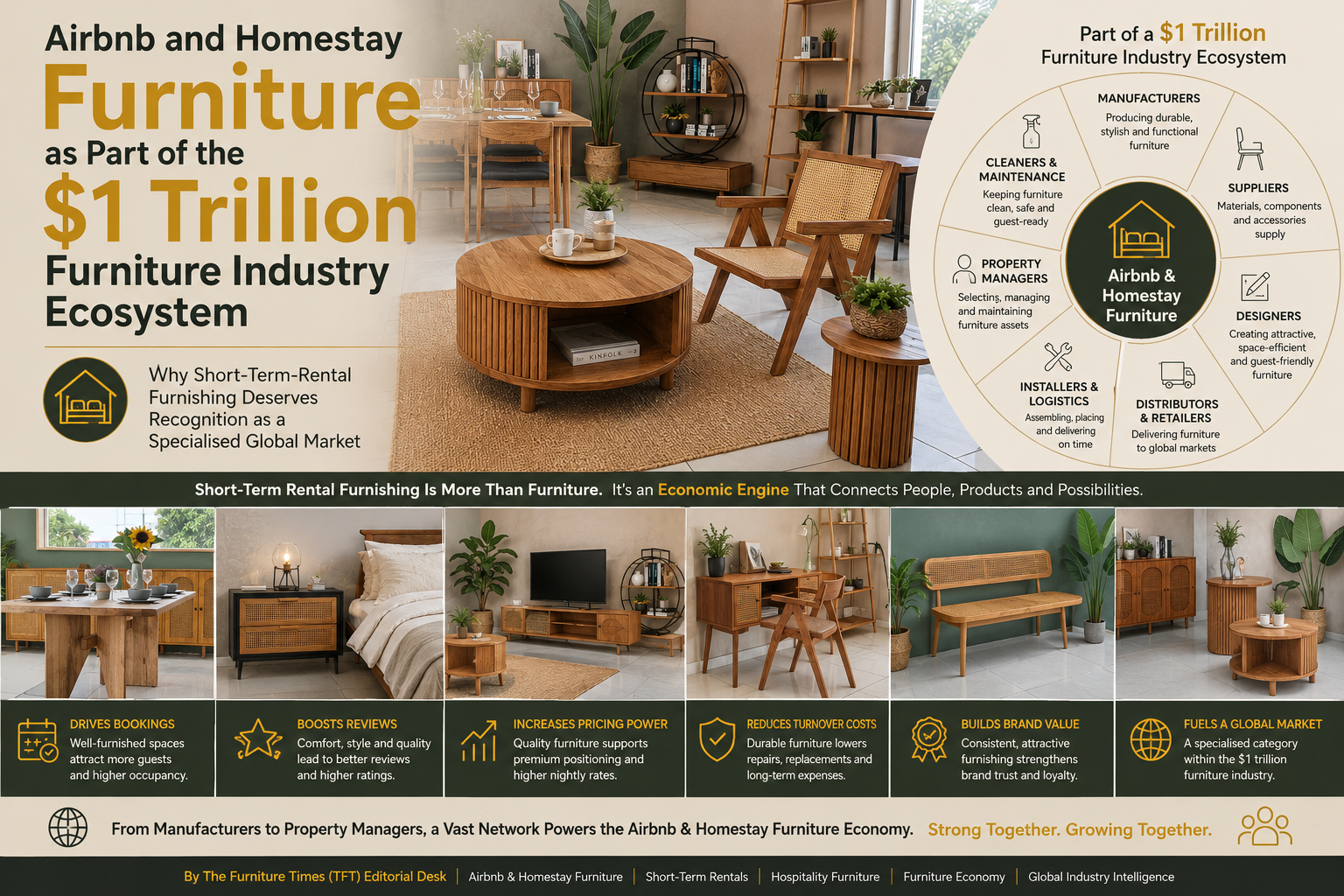
Airbnb and Homestay Furniture as Part of the $1 Trillion Furniture Industry Ecosystem
Airbnb and Homestay Furniture as Part of the $1 Trillion Furniture Industry Ecosystem
Why Short-Term-Rental Furnishing Deserves Recognition as a Specialised Global Market
By The Furniture Times (TFT) Editorial Desk | Airbnb & Homestay Furniture | Short-Term Rentals | Hospitality Furniture | Furniture Economy | Global Industry Intelligence
The global furniture industry ecosystem is a $1 trillion industry ecosystem—but many of its fastest-evolving categories remain insufficiently recognised, measured or understood.
One of those categories is Airbnb and homestay furniture.
Millions of apartments, holiday homes, villas, cottages, guesthouses, serviced residences, farm stays and other short-term accommodations operate across the world. Every one of these properties requires furniture. Beds, mattresses, sofas, dining sets, wardrobes, desks, luggage benches, outdoor furniture, lighting, window coverings and decorative products form the physical infrastructure through which the accommodation experience is delivered.
Yet short-term-rental furnishing is rarely treated as an independent global market.
It is often absorbed into residential furniture, hospitality furniture, contract furnishing, interior design, real-estate investment or home-improvement statistics. This makes the sector difficult to measure, even though its economic activity is visible across manufacturing, retail, logistics, installation, photography, cleaning, maintenance and property management.
Short-term rentals are no longer an experimental corner of tourism. They have become a major accommodation category—and their furniture requirements are becoming increasingly professional, specialised and commercially significant.
It is time for Airbnb and homestay furniture to be recognised as a distinct part of the global furniture industry ecosystem.
Millions of Listings Represent Millions of Furnished Environments
The scale of platform-based accommodation makes the furniture opportunity impossible to dismiss.
As of May 2026, Airbnb reported:
- More than 9 million active listings
- More than 150,000 cities and towns with active listings
- Presence across more than 220 countries and regions
- Approximately 5.5 million hosts
- More than 2.5 billion cumulative guest arrivals
These figures relate only to Airbnb and do not include the entire vacation-rental and homestay economy operating through other global, regional and independent booking channels. Airbnb Newsroom
Every active property contains a furnishing package of some scale.
A modest private room may require a bed, mattress, bedside table, wardrobe, desk and chair. A family apartment may require several bedrooms, dining furniture, a living-room package and storage. A premium villa may contain multiple suites, lounges, outdoor dining sets, poolside furniture, parasols, daybeds and custom pieces.
The cumulative volume of furniture supporting this accommodation infrastructure is substantial.
Moreover, furnishing demand is not limited to new listings. Existing properties generate recurring demand through repairs, replacements, upgrades, renovations and repositioning.
The addressable opportunity should therefore be understood as an installed furniture base requiring continuous service—not merely a one-time retail purchase.
Why the Market Remains Statistically Invisible
Airbnb and homestay furniture is difficult to quantify because transactions are distributed across numerous channels.
An individual host may purchase a bed from a retail chain, a mattress online, dining chairs from a local wholesaler and outdoor furniture from a specialist supplier. A property manager may procure contract furniture directly from a factory. A luxury-villa developer may hire an interior-design firm to manage the entire project. Another host may buy second-hand furniture and use local craftspeople for custom additions.
These transactions may be recorded under:
- Residential furniture
- Hospitality furniture
- Contract furniture
- Home furnishings
- Interior design
- E-commerce
- Real-estate development
- Renovation
- Tourism investment
- Outdoor furniture
- Mattress retail
- Furniture rental
- Local craft production
The absence of a clear statistical category does not mean the market is small. It means the market is fragmented.
Many important furniture sectors remain hidden because conventional research follows product categories rather than end-use environments. Short-term-rental furnishing cuts across nearly every major furniture segment.
That is precisely why it deserves separate recognition.
Short-Term-Rental Furniture Is Neither Fully Residential nor Fully Hotel
The category occupies an important position between residential and commercial furnishing.
It must often look like residential furniture because guests choose short-term rentals partly for their warmth, individuality and home-like environment. At the same time, it must operate like hospitality furniture because it faces repeated occupancy, public reviews, frequent cleaning and unpredictable use.
This creates a unique performance profile.
Airbnb and homestay furniture must combine:
- Residential appearance
- Hospitality-grade durability
- Efficient cleaning
- Visual impact in photographs
- Broad guest appeal
- Space efficiency
- Repairability
- Fast replacement
- Commercial value
- Flexible use
Conventional home furniture may not be designed for hundreds of different users. Traditional hotel furniture may be too standardised, institutional or expensive for many independent hosts.
Short-term-rental furniture therefore occupies a valuable middle market: more durable and operationally efficient than ordinary residential products, but more flexible and emotionally appealing than conventional contract furniture.
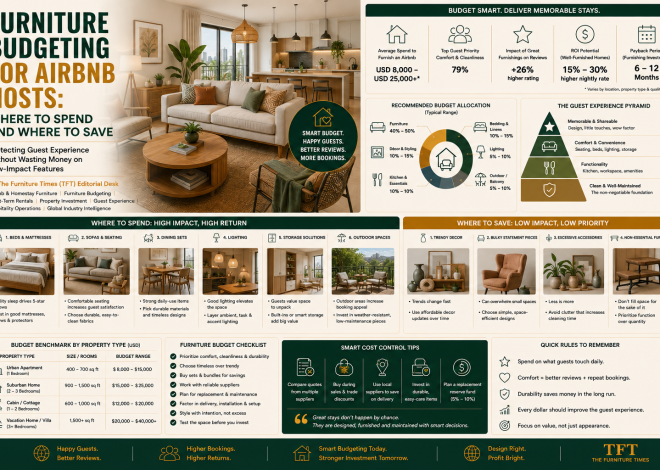
Furniture Has a Direct Commercial Function
In a private home, furniture primarily supports the lifestyle of its occupants. In a short-term rental, furniture also supports revenue.
Its commercial influence begins with the listing photographs.
A potential guest evaluates the property through images before experiencing it physically. The appearance and arrangement of furniture help communicate:
- Comfort
- Cleanliness
- Property quality
- Available space
- Sleeping capacity
- Dining capacity
- Design identity
- Family suitability
- Business-travel readiness
- Outdoor-living opportunities
- Overall value
Furniture can help a listing attract attention, strengthen booking confidence and support a property’s desired market positioning.
Once the guest arrives, the same products influence comfort, functionality and satisfaction. After departure, furniture-related experiences may appear in reviews that shape future booking decisions.
Furniture therefore connects four critical parts of the accommodation business:
- Marketing
- Pricing
- Operations
- Guest satisfaction
Few other physical property assets influence all four so visibly.
Short-Term Rentals Expand the Furniture Customer Base
The growth of short-term accommodation has created new furniture buyers.
Traditional furniture businesses generally focused on households, retailers, hotels, offices, restaurants, institutions and property developers. The market now includes a much wider customer base:
- Individual Airbnb hosts
- Homestay owners
- Vacation-rental investors
- Property-management companies
- Co-hosting businesses
- Serviced-apartment operators
- Corporate-housing providers
- Real-estate developers
- Rental-arbitrage operators
- Boutique accommodation brands
- Rural tourism operators
- Luxury-villa managers
- Interior-design companies
- Turnkey furnishing specialists
- Furniture-leasing companies
Some of these customers buy one room at a time. Others furnish hundreds of properties.
This creates a market with both retail and contract characteristics. It includes small orders, customised projects, bulk purchasing, repeat replacement and ongoing service relationships.
Furniture businesses able to serve this mixed purchasing structure can access a customer group that traditional sales channels may overlook.
Every New Listing Activates a Supply Chain
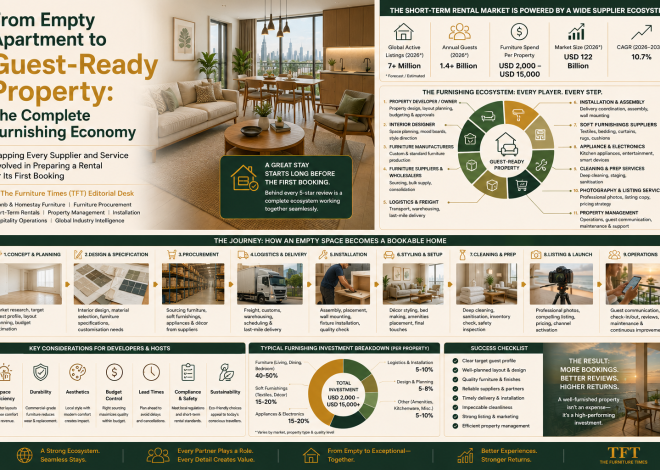
When a new short-term-rental property enters the market, it activates economic activity across the furniture ecosystem.
The process may involve:
- Furniture manufacturers
- Mattress producers
- Component suppliers
- Fabric and foam companies
- Furniture distributors
- Interior designers
- Space planners
- Furniture stylists
- Logistics providers
- Warehouses
- Installers
- Property photographers
- Cleaning companies
- Maintenance technicians
- Furniture repairers
- Upholsterers
- Property managers
- Technology platforms
- Resellers and recyclers
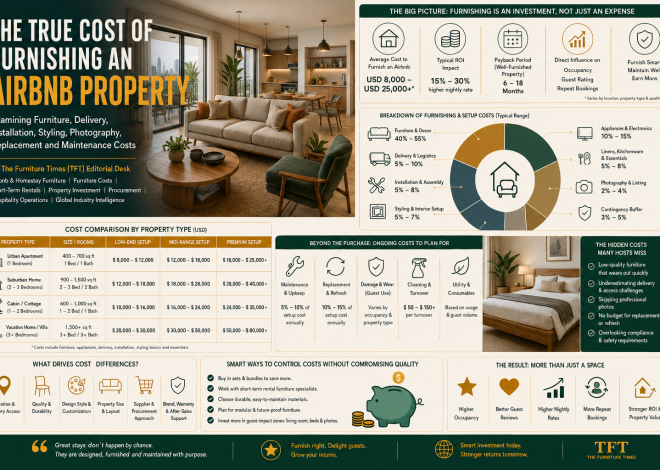
This demonstrates why the category’s value cannot be calculated solely by adding the retail prices of furniture.
The true economic contribution includes design fees, transportation, assembly, photography, maintenance, cleaning, repair, refurbishment and eventual asset recovery.
Airbnb and homestay furnishing is therefore not simply a product category. It is a service-supported commercial ecosystem.
Beds and Mattresses Form the Core of the Market
The sleeping environment is central to any accommodation business.
Beds and mattresses are among the most important purchases because sleep quality can directly affect guest satisfaction and reviews. These products also face repeated use, frequent linen changes and regular inspection.
The category creates demand for:
- Durable bed frames
- Stable headboards
- Hospitality-appropriate mattresses
- Mattress protectors
- Twin-to-king conversion systems
- Bunk beds
- Sofa beds
- Rollaway beds
- Bedside tables
- Reading lights
- Integrated charging access
- Under-bed storage
- Replacement mattress programmes
Manufacturers can develop products specifically around the operational needs of hosts and housekeeping teams.
Bed frames that allow efficient cleaning, remain quiet during use and use replaceable components can deliver greater value than products selected purely for appearance.
Living and Dining Furniture Support the Home-Like Experience
One of the defining attractions of short-term rentals is the ability to live differently from a conventional hotel room.
Guests may cook, eat together, work, entertain children or relax in a shared living area. Furniture supports these activities.
This creates demand for:
- Sofas
- Modular seating
- Sofa beds
- Lounge chairs
- Coffee tables
- Side tables
- Dining tables
- Dining chairs
- Benches
- Bar stools
- Media units
- Storage consoles
Capacity matters.
A property advertised for six guests should ideally provide enough comfortable living and dining space for six people. If the property contains beds for six but only three dining chairs, the furnishing plan does not fully support the advertised experience.
Short-term-rental furniture must therefore be planned as a system rather than as a collection of individual products.
Compact Furniture Creates Value in Urban Markets
Many short-term rentals operate in apartments where space is limited and real-estate costs are high.
Compact and multifunctional products can increase the property’s usefulness without making it feel crowded.
Opportunities include:
- Extendable dining tables
- Nesting tables
- Storage beds
- Wall-mounted desks
- Foldable tables
- Modular sofas
- Sofa beds
- Stackable seating
- Slim wardrobes
- Luggage benches with storage
- Convertible twin and king beds
- Balcony furniture for small spaces
The commercial value of compact furniture is not simply that it saves room. It can help an operator accommodate more guest activities within the same floor area.
Manufacturers that specialise in space-efficient design can become important partners for urban short-term-rental operators.
Outdoor Furniture Strengthens Destination Appeal
Outdoor areas are frequently among the most marketable features of vacation homes, villas, rural homestays and tropical properties.
A balcony, terrace, garden, pool deck or rooftop becomes more valuable when guests can use it comfortably.
The sector creates demand for:
- Outdoor dining sets
- Lounge seating
- Sun loungers
- Daybeds
- Parasols
- Swings
- Balcony sets
- Poolside tables
- Bar furniture
- Modular outdoor sofas
- Weather-resistant storage
- Outdoor cushions
Material selection must reflect the climate.
Properties in Malaysia and other tropical markets require furniture capable of handling humidity, rainfall, UV exposure and frequent cleaning. Coastal properties must consider salt air and corrosion. Wind-exposed balconies need stable furniture and safe positioning.
The right outdoor products can convert underused space into a central element of the property’s identity and perceived value.
Remote Work Has Expanded Furniture Expectations
Travellers increasingly combine accommodation with work, business, study or extended stays.
A dining chair and improvised table may not be sufficient for a guest spending several hours on a laptop. This creates growing demand for:
- Compact desks
- Ergonomic task chairs
- Adjustable lighting
- Accessible sockets
- Integrated USB charging
- Cable-management systems
- Multifunctional consoles
- Video-call-friendly backgrounds
The work area does not need to resemble a corporate office. It should fit the property’s design while providing genuine comfort and functionality.
Furniture suppliers can develop work-from-anywhere packages specifically for studios, apartments, homestays and villas.
Furniture Investment Can Support Nightly-Rate Positioning
Location and market demand remain major determinants of accommodation pricing. Furniture alone cannot transform every property into a premium listing.
However, it can affect perceived value.
A professionally furnished property may:
- Look stronger in photographs
- Communicate greater quality
- Feel more complete
- Appeal to a better-defined guest segment
- Support premium positioning
- Differentiate itself from nearby competition
- Reduce dependence on discounting
The strategic question is not whether expensive furniture automatically creates higher rates. It is whether the furnishing investment helps the property occupy a stronger position in its market.
A luxury villa requires furniture that supports the promised experience. A budget studio requires clean, durable and intelligent products. A family homestay needs sufficient seating, storage and sleeping arrangements.
The most successful furnishing strategy aligns design investment with guest expectations and revenue potential.
Reviews Turn Furniture Quality Into Public Market Intelligence
Short-term rentals operate in an environment where guests publicly evaluate the property.
Furniture-related complaints may include:
- Uncomfortable mattresses
- Unstable beds
- Broken chairs
- Stained sofas
- Inadequate dining capacity
- Difficult sofa beds
- Insufficient storage
- Poor workspaces
- Damaged outdoor furniture
- Products that do not match the listing photographs
These comments remain visible to future travellers.
Airbnb reported that more than 250 million nights had been booked at Guest Favourite listings following the programme’s launch, with those listings maintaining an average overall rating of 4.92 when its 2025 global quality report was published. Furniture is only one part of a much wider quality system, but sleep, comfort, functionality and interior condition can all affect the guest experience reflected in reviews. Airbnb Global Quality Report
This makes furniture quality publicly accountable in a way that conventional residential furniture often is not.
Durability Creates Recurring Industrial Opportunity
The short-term-rental market generates initial demand, but its long-term importance comes from recurring demand.
Furniture faces wear, accidental damage, changing design expectations and repeated cleaning. Over time, properties require:
- Replacement mattresses
- New upholstery
- Refinished surfaces
- Updated dining chairs
- Replacement sofa modules
- New outdoor cushions
- Furniture hardware
- Replacement bed components
- Refreshed headboards
- Updated workstations
- Complete interior renovations
This recurring demand is valuable to manufacturers, distributors, repairers and refurbishment companies.
However, the market should not depend on disposable furniture. Products that fail prematurely increase costs and environmental waste. The stronger opportunity lies in durable, repairable and service-supported furniture that creates long-term supplier relationships.
The Market Needs Furniture Lifecycle Management
Furniture in short-term accommodation should be managed as a commercial asset.
Operators need to understand:
- Purchase cost
- Installation date
- Expected service life
- Cleaning requirements
- Repair history
- Warranty status
- Replacement-part availability
- Guest feedback
- Property location
- Residual value
- End-of-life options
For a single host, a basic furniture inventory may be sufficient. For an operator managing hundreds of units, digital asset management can become essential.
This creates opportunities for furniture companies to provide documentation, digital records, product codes, care instructions and replacement support.
In the future, furniture performance data may connect directly with property-management systems.
Turnkey Furnishing Is Becoming a Major Service Category
Many investors want to move quickly from an empty property to a booking-ready listing.
They do not want to coordinate dozens of suppliers independently. This creates demand for turnkey furnishing companies capable of providing:
- Space planning
- Interior concepts
- Furniture packages
- Mattresses
- Lighting
- Curtains and blinds
- Bedding
- Artwork
- Kitchen equipment
- Delivery
- Installation
- Styling
- Photography preparation
- Furniture inventories
- After-sales support
Turnkey services reduce complexity and may shorten the period during which the property generates no income.
Suppliers can develop packages for:
- Private rooms
- Studios
- One-bedroom apartments
- Family apartments
- Urban condominiums
- Beach houses
- Rural homestays
- Luxury villas
- Serviced residences
- Large group properties
This moves the furniture company from product seller to accommodation-infrastructure partner.
Standardisation Will Grow With Professional Management
Individual hosts may purchase products opportunistically. Large property managers require greater consistency.
Portfolio operators benefit from standardised furniture because it simplifies:
- Procurement
- Budgeting
- Installation
- Maintenance
- Spare-parts management
- Staff training
- Replacement
- Quality control
- Interior refreshes
- Inventory tracking
Standardisation does not require every property to look identical. Operators can create several design packages tailored to different markets and guest segments.
Manufacturers can support this process through repeatable collections, controlled customisation, long-term product availability and regional stock.
This business-to-business opportunity may become one of the most important parts of the specialised market.
Airbnb Furnishing Creates Opportunities for SMEs
The sector is particularly accessible to small and medium-sized businesses.
A local furniture workshop may supply custom headboards. A rattan specialist may furnish balconies and villas. An upholsterer may maintain sofas across a property portfolio. A photographer may specialise in short-term-rental interiors. A repairer may provide rapid-response services to hosts.
Other SME opportunities include:
- Local furniture packages
- Installation
- Furniture assembly
- Property styling
- Upholstery cleaning
- Mattress care
- Mobile repair
- Furniture rental
- Refurbishment
- Storage
- Asset liquidation
- Handmade decorative products
- Outdoor-furniture maintenance
Short-term-rental furnishing can keep more tourism expenditure within local economies, particularly when operators source products and services from nearby businesses.
Local Craftsmanship Can Differentiate Properties
Many guests choose homestays and vacation rentals because they want a sense of place.
Locally made furniture can help communicate cultural identity through:
- Regional timber
- Woven rattan
- Traditional textiles
- Carved details
- Local colour palettes
- Artisan tables
- Handmade lighting
- Cultural patterns
- Locally produced artwork
This gives smaller manufacturers and artisans an opportunity to participate in global tourism through local property supply.
However, decorative identity must be balanced with durability, consistency and repairability. A heavily used chair requires different performance considerations from a decorative accent.
The strongest products combine authentic design with reliable construction.
Sustainability Must Become Part of the Category’s Identity
The growth of short-term-rental furniture also creates environmental responsibility.
Frequent replacement of inexpensive, non-repairable products can produce significant waste. Furniture may be discarded because one component fails, the property changes style or an operator exits the market.
A more sustainable industry should support:
- Durable construction
- Modular products
- Replaceable components
- Washable upholstery
- Refinishable surfaces
- Repair networks
- Furniture take-back
- Refurbishment
- Resale
- Responsible material sourcing
- Product traceability
- Recycling
- Planned end-of-life recovery
Professional operators should evaluate furniture according to lifecycle cost and environmental impact, not only initial purchase price.
The most sustainable product is often the one that remains safe, attractive and useful for the longest period.
Furniture Leasing Could Expand Access
Furniture leasing and subscription models may become increasingly relevant.
These models can help:
- New hosts reduce initial capital requirements
- Investors furnish multiple units
- Seasonal operators avoid long-term storage
- Property managers standardise portfolios
- Premium properties refresh interiors
- Corporate-rental providers adapt inventory
- Developers offer furnished rental-ready packages
A furniture-as-a-service provider could combine products, delivery, installation, repair, replacement and eventual removal within one agreement.
The business model must account for damage, logistics and product recovery, but it could create a recurring-revenue opportunity within the furniture ecosystem.
The Secondary Market Deserves Attention
When a short-term-rental property is renovated or leaves the market, its furniture needs somewhere to go.
Some products can be:
- Refurbished
- Reupholstered
- Resold
- Donated
- Transferred to another property
- Used in long-term rentals
- Recycled
- Broken down for components
Without organised recovery channels, usable furniture may become waste.
Dedicated secondary markets for hospitality and short-term-rental furniture could help operators recover value while giving new hosts access to more affordable products.
Searchable furniture inventories, condition reports and professional refurbishment could make this market more credible and efficient.
Regulation Will Influence Future Demand
The short-term-rental sector faces regulatory uncertainty in many cities.
Restrictions on operating licences, rental duration, property type, taxation and zoning may affect supply. Some properties may convert to long-term rental or exit the accommodation market.
However, regulatory pressure does not eliminate the furniture opportunity. It can change its form.
A property leaving the short-term market may require:
- Furniture removal
- Resale
- Refurbishment
- Reconfiguration
- Long-term-rental furniture
- Asset storage
- Liquidation
At the same time, stronger regulation may encourage remaining operators to become more professional and invest in higher-quality, compliant furnishings.
Furniture suppliers should therefore understand local accommodation policies and avoid relying entirely on uncontrolled listing growth.
The Industry Needs Better Data
One of the greatest challenges is the lack of reliable data specifically identifying Airbnb and homestay furniture.
The industry needs research on:
- Average furnishing cost by property type
- Replacement cycles
- Most frequently damaged products
- Regional purchasing patterns
- Contract versus retail sourcing
- Material preferences
- Furniture’s relationship with reviews
- Maintenance expenses
- Furniture leasing adoption
- Refurbishment volumes
- End-of-life disposal
- Portfolio standardisation
- Supplier performance
Better data would help manufacturers develop appropriate products, enable operators to plan budgets and allow investors to understand the true cost of furnishing.
The absence of data should be treated as a market-intelligence opportunity.
The Industry Also Has a Searchability Problem
The market is fragmented not only in data but also in discovery.
A host searching for durable furniture may not know which manufacturers serve short-term rentals. A property manager may struggle to find a reliable local installer or repairer. A furniture manufacturer may have suitable products but remain invisible to accommodation buyers.
This creates the need for specialised search and industry-discovery infrastructure.
Furniture Industry Search Engine (FISE) can help bring manufacturers, suppliers, designers, installers and service providers into a more searchable global ecosystem.
The principle is straightforward: if you are not searchable, you do not exist in the moment the buyer needs you.
TFT tells their story. FISE helps the world find them. FurniReviewology helps the world trust them.
For a fragmented emerging category, visibility, discovery and credibility will be essential to growth.
Why Formal Recognition Matters
Recognising Airbnb and homestay furniture as a specialised market would benefit the industry in several ways.
Better Product Development
Manufacturers could create products around the actual demands of frequent guest use.
Better Market Data
Researchers could estimate the sector’s size, growth, purchasing behaviour and replacement cycles.
Better Buyer Education
Hosts could learn how to evaluate durability, cleanability, safety and lifecycle cost.
Better Supplier Discovery
Property managers could find appropriate manufacturers and service providers more efficiently.
Better Compliance
Products could be selected with clearer attention to commercial-use requirements and local regulations.
Better Sustainability
The industry could build repair, take-back, refurbishment and resale systems.
Better Investment Decisions
Operators could understand furnishing as part of property performance rather than an uncontrolled startup expense.
Formal recognition gives the category a clearer identity and encourages companies to invest in serving it.
A Strategic Opportunity for Furniture-Producing Countries
Major furniture-producing nations are well positioned to develop specialised short-term-rental collections.
China, Vietnam, Malaysia, Indonesia, India, Turkey, Poland, Italy, Mexico and other manufacturing centres have strengths across timber furniture, upholstery, mattresses, outdoor furniture, rattan, metal products and customised manufacturing.
The opportunity includes:
- Export-ready furniture packages
- Regional fulfilment centres
- Customisable contract collections
- Outdoor furniture for rental properties
- Space-saving urban products
- Durable mattress systems
- Locally inspired collections
- Flat-pack solutions
- Replacement components
- Digital product catalogues
Malaysia, for example, has expertise in timber, rubberwood, metal, upholstery and outdoor furniture, while its position within Southeast Asia gives it access to growing tourism and property markets.
Furniture-producing nations that recognise this category early can build dedicated manufacturing, branding and distribution capabilities around it.
What Manufacturers Should Prepare For
Manufacturers entering the sector should understand that hosts and property managers buy outcomes, not only products.
They need furniture that helps them:
- Launch properties quickly
- Present rooms attractively
- Support advertised occupancy
- Reduce cleaning time
- Prevent failures
- Respond to damage
- Maintain interior consistency
- Control replacement cost
- Protect reviews
- Keep properties bookable
Manufacturers should consider offering:
- Dedicated short-term-rental collections
- Clear performance specifications
- Commercially appropriate testing
- Removable and washable covers
- Replaceable components
- Modular designs
- Multi-unit pricing
- Furniture packages
- Rapid replacement
- Installation services
- Repair support
- Digital warranty records
- Lifecycle-cost information
The companies that solve operational problems will be better positioned than those competing only on style and price.
The Future: A Connected Furnishing Infrastructure
The future short-term-rental furniture market may become much more connected.
A professional operator could select a room package through a digital platform, visualise it within the property, place the order, schedule installation and receive a complete digital furniture inventory.
After launch, the operator could track:
- Product condition
- Cleaning requirements
- Guest feedback
- Repair history
- Warranty status
- Replacement availability
- Expected service life
- Sustainability information
- End-of-life recovery
Artificial intelligence could analyse reviews and identify furniture problems before they become widespread. Digital product passports could contain material, repair and recycling information. Local service networks could receive automated repair requests.
Furniture would no longer disappear from the management system after installation. It would remain a visible and measurable property asset throughout its lifecycle.
Conclusion
Airbnb and homestay furniture deserves recognition as a specialised global market within the $1 trillion furniture industry ecosystem.
It serves millions of accommodation properties, influences bookings and reviews, creates repeat replacement demand and supports an extensive network of manufacturers, designers, distributors, installers, photographers, cleaners, repairers, property managers and technology providers.
Its products must meet a distinctive combination of requirements:
- Residential warmth
- Hospitality durability
- Digital visual appeal
- Efficient cleaning
- Flexible space use
- Rapid replacement
- Repairability
- Commercial value
This combination makes short-term-rental furniture different from conventional household furniture and traditional hotel furnishing.
The category is already operating at global scale. What it lacks is formal recognition, reliable data, stronger supplier visibility and dedicated product development.
For the furniture industry, the opportunity is larger than selling products to individual hosts. It is about building a complete furnishing infrastructure for one of the world’s most dynamic accommodation economies.
Airbnb and homestay furniture is not a minor furniture niche. It is an emerging global market—and an important part of the furniture industry’s future.