
Global Drivers Analysis: How the Furniture Logistics Market Is Rapidly Evolving
E-commerce, white-glove delivery, real-time tracking, specialized warehousing, reverse logistics and damage prevention are transforming how furniture moves from factories to customers
By The Furniture Times (TFT) Editorial Desk | Furniture Logistics | Global Market & Supply Chain Intelligence
The global furniture logistics industry is entering a period of sustained expansion as manufacturers, retailers, e-commerce platforms and consumers demand faster, safer and more transparent delivery services.
Furniture logistics is no longer limited to transporting products from a factory to a warehouse or retail store. It has developed into a specialized service ecosystem covering international freight, customs handling, warehousing, inventory management, direct-to-consumer distribution, final-mile delivery, assembly, installation, returns, repair, refurbishment and resale.
A July 2026 market release published by openPR, based on research from The Business Research Company, forecasts that the global furniture logistics market will reach approximately US$155.44 billion by 2030, expanding at a compound annual growth rate of about 6.1% during the forecast period.
The underlying Furniture Logistics Market Report 2026 estimates that the sector was worth US$115.27 billion in 2025 and will increase to approximately US$122.5 billion in 2026, representing year-on-year growth of around 6.3%.
This expansion reflects a fundamental change in the furniture economy: customers are no longer purchasing only a physical product. They are purchasing an end-to-end experience that includes availability, delivery speed, appointment scheduling, damage-free handling, placement, assembly, installation and post-purchase support.
Logistics has therefore become a direct contributor to brand reputation, customer satisfaction and profitability.
Furniture Logistics Market Snapshot
| Market indicator | Reported figure or finding |
|---|---|
| Estimated market size in 2025 | US$115.27 billion |
| Estimated market size in 2026 | US$122.5 billion |
| Forecast market size in 2030 | US$155.44 billion |
| Forecast CAGR | Approximately 6.1% |
| Largest region in 2025 | Asia-Pacific |
| Expected fastest-growing region | Europe |
| Principal growth areas | E-commerce, smart logistics, final-mile services, white-glove delivery and reverse logistics |
| Major service categories | Transportation, warehousing, distribution, assembly, installation and reverse logistics |
Data clarification: The report’s main narrative identifies US$155.44 billion as the forecast for 2030. A summary table on the publisher’s page labels the same amount as a 2035 forecast, creating an internal inconsistency. This TFT article uses the 2030 date because it is repeated in the market overview, forecast section and openPR release. Readers using the number for investment or strategic planning should confirm the timetable directly with the research publisher.
Furniture Is One of the Most Difficult Consumer Products to Move
Furniture presents a different logistics challenge from clothing, books, cosmetics or small electronic devices.
A sofa may be large but relatively light for its volume. A stone dining table may be extremely heavy and vulnerable to edge damage. A glass cabinet requires controlled handling. A mattress occupies substantial space. A custom wardrobe may arrive in several packages and require skilled installation.
These characteristics create unusual operational demands:
- Large storage requirements
- Low value-to-volume ratios for some products
- High handling costs
- Greater exposure to scratches, dents and breakage
- Complex packaging needs
- Restricted vehicle capacity
- Two-person or multi-person delivery
- Appointment-based service
- Access challenges in homes and buildings
- Assembly and installation requirements
- Expensive returns
- Difficult refurbishment and resale
A logistics provider may technically deliver a product on time while still creating an unsatisfactory customer experience. A sofa left at the entrance, a wardrobe delivered without assembly or a dining table damaged during installation can generate complaints, refunds and negative reviews.
For this reason, furniture logistics must be evaluated by more than transportation cost.
The Furniture Logistics Value Chain
The modern furniture logistics journey can include multiple coordinated stages:
- Raw materials and components move to manufacturing facilities.
- Finished furniture is inspected, packaged and prepared for dispatch.
- Export products move to ports, rail terminals or regional distribution centres.
- Shipments pass through customs and regulatory processes.
- Products enter central or regional warehouses.
- Inventory is allocated to retail, wholesale, project or e-commerce orders.
- Delivery appointments are scheduled.
- Products move through final-mile networks.
- Delivery teams place, assemble or install the furniture.
- Packaging is collected or recycled.
- Returns, repairs and replacements enter reverse-logistics systems.
Weakness at any one stage can damage the entire transaction.
A carefully manufactured sofa can lose value through poor packaging. Accurate inventory can be undermined by an incorrect delivery address. A successful international shipment can still fail during the final few metres inside a customer’s home.
E-Commerce Is the Strongest Structural Driver
The expansion of online furniture sales is one of the most important forces behind logistics-market growth.
Traditional furniture retail often followed a store-based model. Manufacturers supplied distribution centres, distribution centres supplied retailers, and customers arranged delivery after viewing products in person.
E-commerce changes this structure.
A customer can now purchase a bed, desk, dining set or outdoor sofa directly from a manufacturer, retailer or marketplace. The order may be fulfilled from a distant warehouse and delivered to a residential address without passing through a physical store.
This creates demand for:
- Direct-to-consumer fulfillment
- Accurate digital inventory
- Individual order picking
- Residential delivery scheduling
- Real-time customer communication
- Product-specific handling
- Assembly and installation
- Returns collection
- Refund and replacement coordination
E-commerce also increases customer expectations. Consumers accustomed to tracking smaller parcels may expect similar visibility for furniture, even though furniture delivery requires larger vehicles, more people and more complex scheduling.
The logistics industry must therefore deliver parcel-like transparency for products that cannot be handled like parcels.
Direct-to-Consumer Furniture Changes Distribution Economics
Direct-to-consumer furniture brands can avoid some traditional retail costs, but they assume greater responsibility for fulfillment.
A manufacturer selling through retailers might deliver several furniture sets to one store or warehouse. A DTC business may need to deliver those same products to many individual homes across a wide geographic area.
This increases:
- Number of delivery points
- Appointment-management complexity
- Final-mile cost
- Customer-service workload
- Risk of failed deliveries
- Reverse-logistics exposure
The economics of DTC furniture depend heavily on order density. Delivering five orders within one city zone is generally more efficient than serving five widely separated addresses.
Successful companies use route planning, regional warehouses, scheduled delivery zones and minimum-order conditions to manage these costs.
Fast Delivery Is Becoming a Competitive Requirement
Furniture has traditionally involved long lead times, especially for customized products. Customers accepted waiting several weeks or months because manufacturing and shipping were understood to be complex.
That tolerance is changing.
E-commerce platforms and large retailers have trained consumers to expect rapid order confirmation, accurate estimated delivery dates and regular updates. Even when same-day or next-day delivery is impractical, customers want certainty.
The competitive advantage is therefore not always the shortest lead time. It is the most reliable promise.
A company that promises delivery in seven days but arrives late may perform worse than a company that commits to 14 days and delivers on schedule.
Furniture companies need to align:
- Production availability
- Warehouse inventory
- Transport capacity
- Regional delivery schedules
- Installation teams
- Customer appointment windows
False delivery promises can generate cancellations, complaints and damage to brand trust.
White-Glove Delivery Is Moving Into the Mainstream
White-glove logistics traditionally served luxury furniture, antiques and premium interiors. It is now expanding into broader residential and commercial categories.
A white-glove service can include:
- Pre-delivery communication
- Scheduled delivery windows
- Protective floor and wall measures
- Delivery to the room of choice
- Unpacking
- Assembly
- Product placement
- Basic functional inspection
- Packaging removal
- Customer confirmation
This service is particularly important for sofas, dining tables, beds, wardrobes, cabinets and other large products.
White-glove delivery can increase the cost of fulfillment, but it can also reduce damage, returns and customer dissatisfaction. For premium furniture, the delivery experience becomes part of the product’s perceived value.
A customer purchasing a high-value dining table expects the final stage of service to reflect the same quality as the furniture itself.
Real-Time Tracking Is Becoming Standard
The Business Research Company identifies real-time tracking as a major market trend.
Tracking systems can provide visibility into:
- Factory dispatch
- Container status
- Port movement
- Customs clearance
- Warehouse receiving
- Order allocation
- Delivery vehicle location
- Estimated arrival time
- Proof of delivery
- Return collection
For manufacturers and retailers, this information supports inventory planning and customer service. For customers, it reduces uncertainty.
Real-time tracking is particularly useful when delays occur. A customer may accept a disruption more readily when the company communicates honestly and provides an updated delivery time.
The next stage of logistics visibility will move beyond location tracking. Businesses will increasingly monitor handling events, temperature or humidity where relevant, package condition and delivery exceptions.
Specialized Warehousing Is Expanding
Furniture requires more warehouse space than many consumer-product categories.
Standard shelving may not suit assembled sofas, large tabletops, mattresses or fragile cabinets. Warehouses may need different zones for flat-pack goods, upholstered products, glass furniture, outdoor collections and high-value items.
Specialized furniture warehousing can include:
- High-cube storage
- Protective racking
- Upholstery-safe areas
- Climate or humidity management
- Assembly stations
- Quality-inspection areas
- Repair facilities
- Spare-parts storage
- Cross-docking zones
- Photography and cataloguing areas
- Return assessment centres
Cross-docking can reduce storage time by transferring incoming products directly to outbound vehicles. This is useful for confirmed orders, project deliveries and fast-moving furniture categories.
However, cross-docking requires precise coordination. Products, vehicles, customer appointments and installation teams must arrive at the correct time.
Automated Warehousing Is Entering the Furniture Sector
Automation has developed rapidly in parcel, grocery and small-product fulfillment. Furniture presents a more difficult environment because packages vary significantly in size, weight and fragility.
Even so, automation is expanding in furniture warehousing through:
- Warehouse-management systems
- Automated identification and scanning
- Conveyor systems for suitable packages
- Robotic handling of panels or standardized cartons
- Automated storage and retrieval
- Smart forklifts
- Digital inventory mapping
- Computerized loading plans
- Predictive labor scheduling
Automation does not remove the need for skilled handling. Upholstered furniture, stone surfaces and fragile products may still require human judgment.
The strongest model combines automation for predictable tasks with trained workers for exceptions, inspections and complex handling.
Damage Prevention Has Become a Profitability Strategy
Furniture damage is expensive because the product is large, replacement is difficult and reverse transport costs are high.
Common damage can result from:
- Inadequate packaging
- Poor loading sequence
- Excessive stacking
- Movement inside vehicles
- Moisture exposure
- Rough handling
- Narrow entrances
- Incorrect lifting
- Assembly mistakes
- Inexperienced delivery teams
The cost of damage includes more than the product itself. A company may also pay for collection, redelivery, replacement, repair, customer support and disposal.
There may also be reputational damage through negative reviews.
Furniture companies should track damage by:
- Product model
- Packaging type
- factory
- warehouse
- route
- carrier
- delivery team
- damage location
- customer complaint category
This information can reveal whether the root problem lies in design, manufacturing, packaging, warehousing or delivery.
Packaging Must Balance Protection and Sustainability
Furniture packaging must protect products while using materials responsibly.
Excessive packaging increases cost, storage space and waste. Insufficient packaging increases damage and replacement emissions.
The objective is packaging optimization.
Solutions may include:
- Recyclable corrugated board
- Reusable blankets and protective covers
- Molded pulp components
- Paper-based edge protection
- Reduced plastic use
- Modular reusable crates
- Product-specific corner guards
- Clear handling instructions
- Packaging designed for reverse transport
Packaging engineers should work with product designers and logistics teams. A product that is difficult to package safely may require a design change.
Designing for logistics can reduce damage, shipping volume and environmental impact before the product enters the supply chain.
Flat-Pack Furniture Supports Logistics Efficiency
Flat-pack and ready-to-assemble furniture can reduce transport and storage volume.
More products can fit into a truck or shipping container, improving asset utilization and lowering transport cost per unit. Standardized cartons are also easier to scan, stack and automate.
However, flat-pack logistics transfers part of the value-creation process to the destination. The customer or installation team must assemble the product.
Poor instructions, missing components or weak connectors can turn a logistics advantage into a customer-service problem.
Successful flat-pack systems require:
- Accurate component packing
- Clear assembly instructions
- Reliable hardware
- Replacement-part availability
- Strong carton protection
- Quality control
- Optional assembly services
The true measure of flat-pack efficiency is not only how much space it saves but whether the product reaches usable condition without complications.
Final-Mile Delivery Is the Most Critical Stage
The final mile is often the most expensive and visible part of furniture logistics.
International shipping may move hundreds of products together. Final-mile delivery handles each customer separately.
Delivery teams must manage:
- Traffic and parking
- Building access
- Elevators and staircases
- Doorway measurements
- Customer availability
- Product protection
- Assembly requirements
- Packaging removal
- Proof of delivery
Failed deliveries are particularly costly. A large vehicle, multiple employees and a significant time window may have been assigned to the order.
Pre-delivery systems should confirm the address, product dimensions, access conditions, parking arrangements and customer availability. Customers should also be advised to measure doors, hallways, staircases and elevators before ordering.
Better information can prevent a product from arriving at a building it cannot enter.
Commercial Furniture Requires Project Logistics
Commercial furniture logistics differs from residential delivery.
An office, hotel, school, hospital, restaurant or residential development may require hundreds or thousands of coordinated items. Delivery must align with construction schedules, site readiness and installation teams.
Project logistics may include:
- Phased delivery
- Floor-by-floor scheduling
- Temporary storage
- Site coordination
- Installation supervision
- Item tagging by room
- Damage and shortage reporting
- Packaging removal
- Handover documentation
A delay in construction can create unexpected warehousing costs. An early furniture delivery may expose products to dust, moisture or site damage. A late delivery can delay project completion.
Contract-furniture companies therefore need logistics partners that understand construction and fit-out workflows.
Reverse Logistics Is Becoming a Major Growth Area
Reverse logistics covers the movement of products away from customers and back into the supply chain.
The report divides reverse logistics into:
- Returns management
- Recycling and disposal
- Repair and refurbishment
- Resale of returned products
- Inventory liquidation
Furniture returns are difficult because products may no longer fit inside their original packaging. They may be assembled, damaged or located inside multistorey buildings.
Companies need clear processes for classifying returned products:
- Return to new inventory
- Repair
- Refurbish
- Sell as open-box stock
- Use for spare parts
- Donate
- Recycle
- Dispose responsibly
An efficient return system can recover value and reduce waste. An inefficient system turns returned furniture into an expensive storage burden.
Circular Furniture Depends on Reverse Logistics
The transition toward a circular furniture economy cannot happen without reverse-logistics infrastructure.
Take-back programs, rental furniture, refurbishment, resale and material recycling all require products to move backward through the supply chain.
A circular system may involve:
- Collecting the used product
- Assessing its condition
- Identifying materials and components
- Cleaning or repairing it
- Replacing worn parts
- Reselling or redeploying it
- Recycling materials that cannot be reused
Furniture designed for disassembly is easier to repair and recycle. Replaceable covers, standardized hardware and accessible components can extend product life.
This means product design, component engineering and logistics must work together.
International Trade Is Expanding Logistics Demand
The underlying market report identifies international furniture trade as an important growth driver.
Furniture production and consumption are geographically separated. China, Vietnam, Poland, Italy, Germany, Malaysia, Indonesia, India, Mexico and other countries supply international markets. The United States and major European economies remain significant furniture importers.
International furniture logistics involves:
- Factory consolidation
- Inland haulage
- Export documentation
- Container loading
- Sea or rail freight
- Customs clearance
- Import duties
- Regional warehousing
- Final distribution
Trade expansion increases logistics revenue, but geopolitical tension creates risk. Tariffs, port disruption, fuel prices, shipping-route instability and regulatory changes can alter landed costs.
Furniture businesses need multi-route and multi-supplier strategies rather than relying entirely on one factory, country, port or carrier.
Asia-Pacific Holds the Largest Regional Position
The Business Research Company identifies Asia-Pacific as the largest furniture logistics region in 2025.
This position reflects the region’s enormous manufacturing base and rapidly expanding consumer markets. China remains central to global furniture production, while Vietnam, Malaysia, Indonesia, India and other Asian countries operate major manufacturing and export ecosystems.
Regional growth is also supported by:
- Urbanization
- Residential construction
- E-commerce adoption
- Expanding middle-class consumption
- Industrial development
- Hospitality investment
- Export manufacturing
- Regional trade
Asia-Pacific logistics providers must serve two different markets simultaneously: international export supply chains and growing domestic delivery networks.
Europe Is Expected to Grow Rapidly
Europe is identified as the fastest-growing region in the forecast period.
Several factors can support European furniture-logistics growth:
- Mature e-commerce markets
- Cross-border trade within Europe
- Strong demand for scheduled delivery
- Nearshoring and regional manufacturing
- Environmental regulation
- Furniture take-back and circularity
- Premium and design-led products
- Developed commercial and hospitality sectors
European logistics networks must also adapt to low-emission zones, environmental reporting and urban-delivery restrictions.
This may encourage greater use of regional hubs, electric final-mile vehicles, consolidated delivery routes and repair networks.
Major Companies Shape the Competitive Landscape
The report identifies a broad group of international and specialist providers operating in the furniture logistics market, including:
- DB Schenker
- Kuehne+Nagel
- J.B. Hunt Transport Services
- XPO
- DHL Supply Chain
- CEVA Logistics
- Kerry Logistics Network
- Röhlig Logistics
- AIT Worldwide Logistics
- Logistics Plus
- ColliCare Logistics
- NTG Nordic Transport Group
- Savino Del Bene
- Maersk Logistics and Services
- Noatum Logistics
- Samskip Multimodal
- LGT Logistics
- Massood Logistics
- CG Logistics
- Ross Furniture Logistics
- Speed Commerce
These companies differ considerably in geography, service mix and specialization. Some operate global freight networks, while others focus more directly on home furnishings, white-glove delivery, installation or regional distribution.
Competition will increasingly depend on the ability to integrate global freight with local customer experience.
Acquisitions Reflect the Value of Specialization
The report highlights Logistics Plus’s June 2023 acquisition of Jan Krediet, a Netherlands-based furniture-logistics specialist.
The transaction illustrates an important market strategy: global logistics companies can expand their furniture capabilities by acquiring specialized operators rather than building every service internally.
Furniture logistics requires operational knowledge that may not exist within conventional freight networks. A specialist may bring:
- Trained delivery teams
- Furniture-specific warehouses
- Assembly capabilities
- Established retail relationships
- Regional route knowledge
- Damage-management processes
- White-glove expertise
Consolidation may continue as larger logistics businesses seek specialized capabilities in final-mile service, reverse logistics and furniture installation.
Technology Is Turning Logistics Into an Information Business
Physical movement remains central to logistics, but data increasingly determines service quality.
Integrated platforms can connect:
- Manufacturer orders
- Warehouse inventory
- Carrier capacity
- Route planning
- Customer appointments
- Delivery tracking
- Proof of delivery
- Returns
- Damage reporting
- Billing
Artificial intelligence may support demand forecasting, route optimization, vehicle loading, warehouse labor planning and delivery-risk identification.
For example, a system could identify products with unusually high damage rates, delivery areas with frequent access problems or customers at higher risk of missing appointments.
Technology should not replace human service. It should give staff better information and allow them to solve problems earlier.
Furniture Logistics Is Becoming a Customer-Experience Function
Customers often have more direct contact with delivery teams than with the furniture manufacturer.
The delivery team represents the brand inside the customer’s home or business. Its punctuality, communication, care and professionalism influence how the entire purchase is remembered.
This means logistics should no longer be managed only as a cost centre.
Companies should monitor:
- On-time delivery
- Complete delivery
- Damage rate
- First-attempt success
- Assembly quality
- Customer satisfaction
- Return rate
- Complaint resolution
- Cost per successful delivery
The lowest-priced carrier may not be the most economical if it produces high damage, failed delivery and return costs.
The Strategic Challenge for Furniture SMEs
Small and medium-sized furniture businesses may struggle to match the logistics capabilities of multinational retailers.
They often lack:
- Regional warehouses
- Dedicated delivery fleets
- Advanced tracking systems
- High delivery density
- Negotiating power with carriers
- Formal reverse-logistics systems
However, SMEs can compete through partnerships and focus.
Practical options include:
- Shared logistics hubs
- Consolidated shipping
- Regional third-party logistics providers
- Appointment-based delivery
- Local assembly partners
- Standardized packaging
- Clear delivery zones
- Transparent lead times
- Premium personal service
SMEs should avoid promising large-retailer delivery speeds if their operational systems cannot support them. Reliability and communication can be more valuable than unrealistic speed.
Ten Priorities for Furniture Businesses
Manufacturers and retailers preparing for the next phase of logistics should consider the following priorities:
- Calculate total delivery cost: Include damage, returns, customer support and redelivery—not only the carrier’s invoice.
- Design products for transport: Reduce unnecessary volume and strengthen vulnerable areas.
- Improve packaging: Use damage data to guide packaging development.
- Integrate inventory systems: Ensure customers see accurate stock and delivery information.
- Offer appropriate service levels: Standard doorstep, room-of-choice and white-glove options can serve different budgets.
- Plan reverse logistics: Decide what will happen to returns before they occur.
- Measure carrier performance: Track outcomes by provider, route, product and delivery team.
- Strengthen customer communication: Confirm appointments and explain access requirements.
- Diversify logistics partners: Avoid complete dependence on one route or service provider.
- Invest in visibility: Allow customers and internal teams to see where orders are and what action is required.
The Future of Furniture Logistics
By 2030, the sector is expected to become more specialized, connected and circular.
Future furniture-logistics networks are likely to include:
- Predictive delivery scheduling
- AI-supported route optimization
- Automated warehouse operations
- Real-time shipment visibility
- Electric final-mile fleets
- Neighborhood consolidation hubs
- Specialized white-glove teams
- Furniture repair centres
- Return resale platforms
- Digital product passports
- Reusable packaging systems
- Integrated installation services
The market’s projected rise from US$115.27 billion in 2025 to US$155.44 billion by 2030 represents more than an increase in transportation volume. It reflects the growing economic value of managing furniture carefully throughout its entire lifecycle.
Logistics Is Now Part of the Furniture Product
The global furniture industry has traditionally invested heavily in design, materials, manufacturing and retail presentation. Logistics was often treated as a final operational step.
That approach is no longer sufficient.
A well-designed product that arrives late, damaged or without the promised installation does not create a successful customer experience. A returned item with no recovery pathway can destroy margin and increase waste.
Furniture logistics must therefore be considered during product design, packaging, pricing, sales and sustainability planning.
The businesses that succeed will connect factory output with customer expectations through reliable, transparent and repair-oriented delivery systems.
As e-commerce expands and consumers demand greater convenience, logistics will increasingly determine which furniture brands earn repeat business, positive reviews and long-term trust.
In the modern furniture economy, delivery is not what happens after the sale.
Delivery is part of the sale.
This article is an original TFT market analysis based principally on the openPR release and The Business Research Company’s Furniture Logistics Market Report 2026. Forecasts are estimates, not guaranteed outcomes. The cited market pages contain an inconsistency regarding whether US$155.44 billion refers to 2030 or 2035; the repeated narrative forecast identifies 2030.
The Furniture Times (TFT) & Furniture Industry Search Engine (FISE)
“TFT tells their story. FISE helps the world find them.”
FurniReviewology helps the world trust them.
The furniture industry ecosystem is a $1 trillion industry ecosystem.

Related Posts
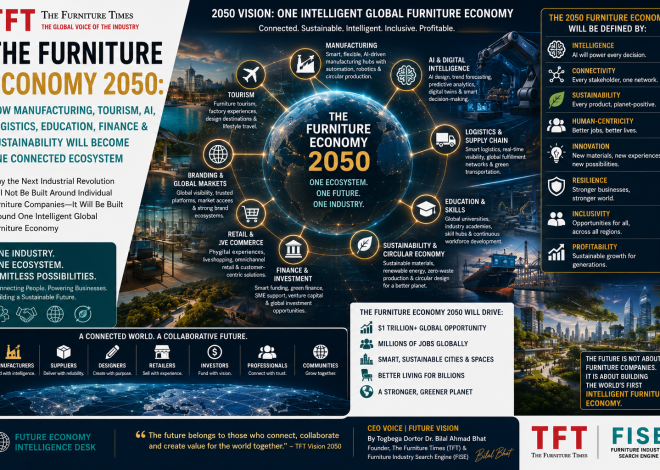
The Furniture Economy 2050: How Manufacturing, Tourism, AI, Logistics, Education, Finance & Sustainability Will Become One Connected Ecosystem
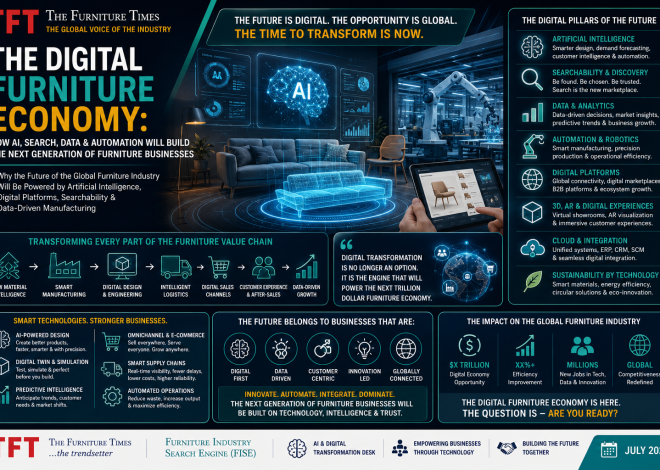
The Digital Furniture Economy: How AI, Search, Data & Automation Will Build the Next Generation of Furniture Businesses