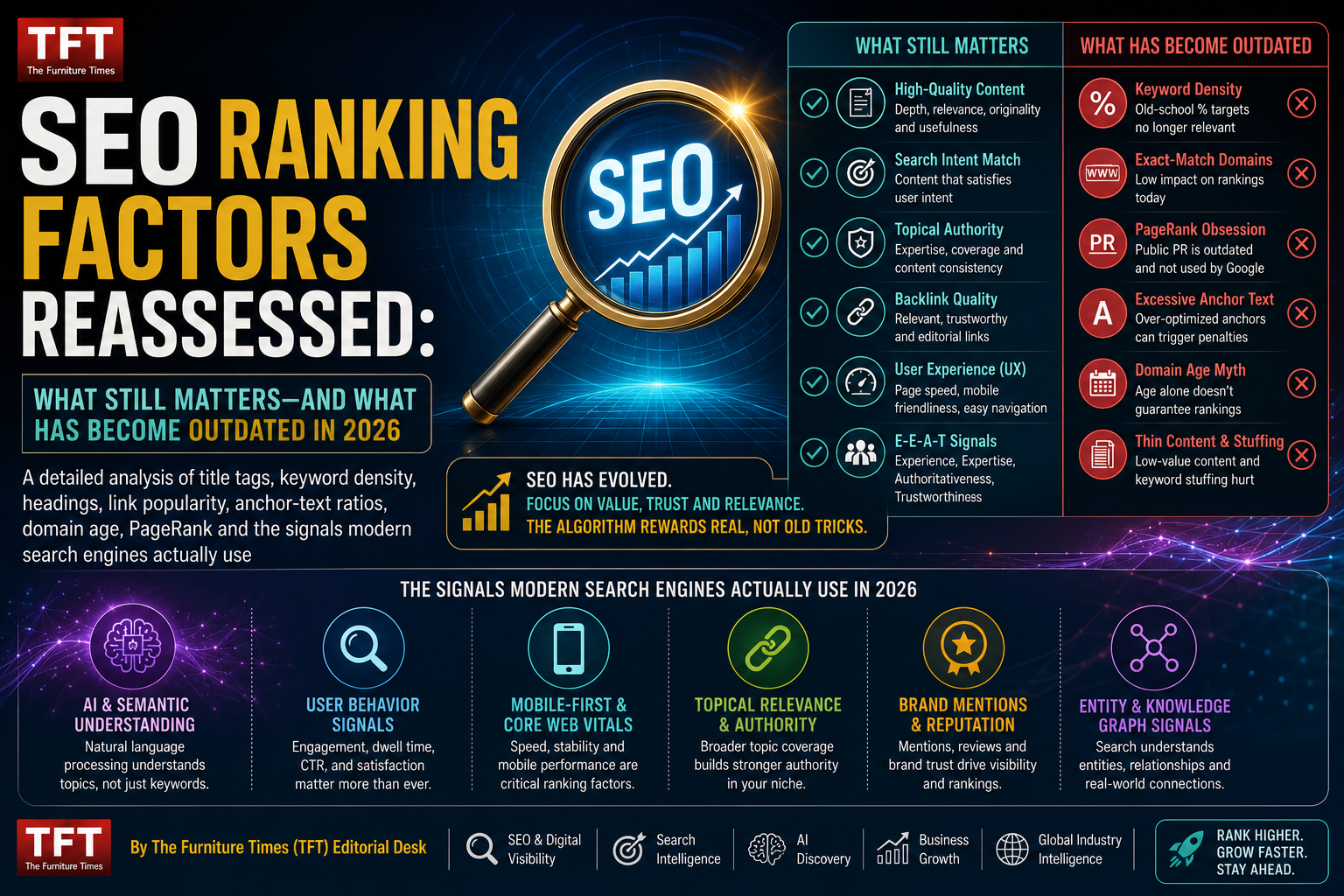
SEO Ranking Factors Reassessed: What Still Matters—and What Has Become Outdated in 2026
A detailed analysis of title tags, keyword density, headings, link popularity, anchor-text ratios, domain age, PageRank and the signals modern search engines actually use
By The Furniture Times (TFT) Editorial Desk | SEO & Digital Visibility | Search Intelligence | AI Discovery | Business Growth | Global Industry Intelligence
Search engine optimisation has changed dramatically.
Early SEO analysis often relied on a relatively simple checklist: place the target keyword in the title, repeat it a calculated number of times, add it to headings, acquire links with exact-match anchor text and compare the PageRank of linking pages.
Those practices helped create many of the metrics still found in legacy SEO-audit reports:
- Keyword density
- Keyword prominence
- Link density
- Link prominence
- Meta keywords
- Public PageRank
- Link popularity
- Anchor-text percentages
- Domain age
- Average PageRank of linking pages
Some of these concepts remain useful when interpreted correctly. Others are obsolete, unreliable or potentially dangerous when treated as direct ranking formulas.
Modern search systems evaluate far more than the number of times a phrase appears. They attempt to determine what the page is about, whether it satisfies the searcher’s intention, whether the source is credible, whether the website can be crawled and whether other reputable sources support the page’s authority.
SEO in 2026 is therefore not a keyword-counting exercise. It is the discipline of making a business technically accessible, contextually understandable, genuinely useful and independently credible.
Executive assessment of the listed factors
| Factor | 2026 assessment | Practical importance |
|---|---|---|
| Title tag | Active and important | High |
| Keyword density | No fixed ideal percentage | Low as a target; useful only for quality checks |
| Keyword prominence | Contextually useful | Medium |
| Link density | No universal ideal ratio | Low as a standalone metric |
| Link prominence | Useful for navigation and context | Medium |
| H1 | Useful for structure and clarity | Medium-high |
| H2 | Useful for organisation and topical coverage | Medium |
| Meta keywords | Not used by Google | None for Google ranking |
| Meta description | Search-presentation tool | Medium for click appeal |
| PageRank | Link analysis still exists; public score is obsolete | Important concept, unavailable as a public Google metric |
| Link popularity | Too simplistic if based only on quantity | Medium when quality and relevance are included |
| Link diversity | Useful but easy to misinterpret | Medium-high |
| Exact-match “SEO” anchors | Risky when engineered | Low as a target |
| “Services” anchor percentage | Not a ranking target | Low |
| Domain age | Not a substitute for authority | Low |
| Keywords in linking-page body | Contextually useful | Medium |
| Keywords in linking-page title | Can strengthen relevance | Medium |
| Average PR of linking pages | Obsolete as a measurable Google metric | None in its old form |
The central lesson is clear: most listed factors should not be optimised according to rigid percentages.
Part One: On-page factors
1. Title tag
The title tag remains one of the most important on-page elements because it helps search engines and users understand the page.
It appears in the HTML <head>:
<title>SEO Services for Furniture Companies | Company Name</title>Google may use the title element when generating the clickable title shown in search results. It may also rewrite the displayed title when another source—such as the visible page heading or anchor text—better represents the page.
Google advises website owners to use descriptive, concise and distinct titles while avoiding keyword stuffing and repetitive boilerplate. Google Search Central—Title Links
Good title-tag practice
A good title should:
- Describe the page accurately
- Reflect the primary search intention
- Include the main topic naturally
- Distinguish the page from other site pages
- Include the brand when useful
- Avoid unnecessary repetition
- Align with the visible content
- Remain understandable when shown independently
Weak title example
SEO | SEO Services | Best SEO | Cheap SEO Services | SEO CompanyThis is repetitive, vague and difficult to trust.
Stronger title example
SEO Services for Furniture Manufacturers and Retailers | SIB InfotechThe stronger version identifies the service, intended audience and provider without repeating the same words excessively.
Important distinction
The title tag is important, but it cannot rescue a weak page. A perfectly written title leading to thin, generic or misleading content will not create sustainable search performance.
Assessment: High importance.
2. Keyword density
Keyword density measures how frequently a word or phrase appears compared with the total number of words on the page.
A simplified formula is:
Keyword Density = Keyword Mentions ÷ Total Words × 100If “SEO services” appears 10 times in a 1,000-word page, the simple phrase density is 1%.
This number can be calculated, but it should not become a ranking target.
Google does not publish an ideal keyword-density percentage. Excessive repetition can make content unnatural and may constitute keyword stuffing. Google explicitly advises against repeatedly inserting the same words or variations in ways that harm readability. Google SEO Starter Guide
What density can tell you
Keyword-density analysis can identify:
- Accidental overuse
- Unnatural copy
- Missing topic terminology
- Repetitive headings
- Template-generated stuffing
- Competitor pages written for machines rather than users
What density cannot tell you
It cannot determine whether:
- The page answers the question well
- The information is correct
- The author has expertise
- Search engines trust the website
- The page matches user intent
- The content is original
- The page deserves to rank
A page with 0.8% density can outperform one with 2.5%. A page may also rank without using the exact phrase frequently because search systems understand related concepts and language.
Better approach
Write comprehensively about the subject and use the primary phrase where it helps users:
- Title
- Main heading
- Introduction
- Relevant subheading
- Body copy
- Internal link
- Image alternative text, when genuinely descriptive
Use synonyms and connected terminology naturally.
For a page about SEO services, related concepts might include:
- Technical SEO
- Keyword research
- Content optimisation
- Search visibility
- Local SEO
- Link acquisition
- Structured data
- Search Console
- Organic traffic
- AI search visibility
Assessment: Do not optimise toward a fixed density. Use it only as a diagnostic quality metric.
3. Keyword prominence
Keyword prominence refers to how early or visibly a topic appears on the page.
A phrase appearing in the title, main heading and opening paragraph is more prominent than one appearing once near the footer.
The idea remains useful because pages should communicate their purpose quickly. Google’s Search Essentials recommends placing words people use to find the content in prominent locations such as the title and main heading. Google Search Essentials
Prominent locations include
- Title tag
- Visible H1
- Opening paragraph
- Descriptive URL
- Important subheadings
- Relevant image captions
- Internal anchor text
- Summary or introductory section
Prominence should not become repetition
The objective is clarity, not mechanical insertion.
A page should not begin:
Our SEO services provide SEO services for companies seeking SEO services from an SEO services agency.
A clearer opening would be:
Our SEO programme helps furniture manufacturers and retailers improve technical performance, content quality, local discovery and qualified organic traffic.
The topic remains understandable without unnatural repetition.
Assessment: Contextually important, particularly for titles, headings and introductions.
4. Link density
Link density generally refers to the ratio between linked text, total text or the number of links on a page.
There is no universal ideal percentage.
A resource directory may legitimately contain hundreds of links. A detailed news article may require only a few. An e-commerce category page can link to many products, while a service landing page may require a smaller number of carefully selected navigational and supporting links.
Link density becomes problematic when
- Every other phrase is linked
- Links distract readers
- The page exists mainly to distribute ranking signals
- Large groups of keyword-rich links are inserted in footers
- Irrelevant external links are added for payment
- Internal links are generated without editorial purpose
- Navigation becomes difficult to understand
- Important links are buried among hundreds of insignificant ones
A better question
Instead of asking, “What percentage of the page should contain links?” ask:
- Does every link help the reader?
- Can search engines crawl the link?
- Is the anchor text descriptive?
- Are important pages easy to reach?
- Are external sources authoritative and relevant?
- Does the page have a clear hierarchy?
Google uses links to discover pages and understand relevance, but links should be crawlable and meaningful. Google Search Central—Link Best Practices
Assessment: No ideal ratio; evaluate usability, crawlability and purpose.
5. Link prominence
Link prominence describes where a link appears and how visible it is.
A contextual link inside the main content may carry clearer topical meaning than a repeated footer link. A navigation link can signal structural importance. A hidden or visually insignificant link provides poor user value and can raise quality concerns.
Important locations
- Main navigation
- Category hubs
- Breadcrumbs
- Contextual body content
- Related-resource sections
- Product comparisons
- Author or source references
What matters most
The link should be:
- Relevant to the surrounding text
- Useful to the visitor
- Descriptively labelled
- Technically crawlable
- Visually identifiable
- Connected to a genuine information pathway
A prominent link is not automatically more valuable simply because it appears high on a page. Context, editorial purpose and site architecture matter.
Assessment: Useful as a structural and contextual concept, not a precise ranking formula.
6. H1 heading
The H1 is generally the principal visible heading.
<h1>SEO Services for the Furniture Industry</h1>A clear H1 helps visitors confirm that they have reached the correct page. It also gives search engines an important structural clue.
Recommended practice
- Use one clearly dominant page heading
- Make it descriptive
- Align it with the title and page purpose
- Avoid stuffing multiple variations
- Ensure it is visible to users
- Do not use headings purely for visual styling
A page can technically contain more than one H1 under modern HTML, but most business websites benefit from one obvious primary heading. This reduces ambiguity for users, editors and assistive technologies.
Title tag and H1 do not need to be identical
They should remain closely aligned.
Title tag:
SEO Services for Furniture Brands | SIB InfotechH1:
Build Sustainable Search Visibility for Your Furniture BusinessThe title targets the search topic, while the H1 creates a persuasive visible message.
Assessment: Medium-high importance for clarity, accessibility and structure.
7. H2 headings
H2 headings organise major sections beneath the main heading.
For example:
<h2>Technical SEO Audit</h2>
<h2>Furniture Keyword Research</h2>
<h2>Local Search Optimisation</h2>
<h2>SEO Reporting and Measurement</h2>
H2s make long pages easier to scan and help search systems understand how subjects are organised.
They should not be treated as containers for repetitive keyword variations.
Weak structure
- Best SEO Services
- Cheap SEO Services
- Professional SEO Services
- Affordable SEO Services
- Top SEO Services
Better structure
- Technical Website Audit
- Search-Demand Research
- Content and Category Optimisation
- Local Business Visibility
- Authority and Digital PR
- Performance Reporting
The improved version covers the service comprehensively.
Assessment: Medium importance; valuable for structure, readability and topical clarity.
8. Meta keywords
The meta-keywords tag is obsolete for Google Search.
<meta name="keywords" content="SEO, SEO services, best SEO, SEO company">Google states directly that it does not use this tag and that it has no effect on indexing or ranking. Google Search Central—Supported Meta Tags
Continuing to complete this field usually wastes editorial time. It may also reveal the exact list of terms a company is targeting without providing a Google-ranking benefit.
Some internal search tools or other systems may use custom metadata, but that is separate from Google SEO.
Assessment: No value for Google Search ranking.
9. Meta description
The meta description is a short summary in the HTML:
<meta name="description" content="Improve your furniture business’s organic visibility with technical SEO, content strategy, local optimisation and measurable search intelligence.">It is not best understood as a direct ranking lever. Its main value is search presentation.
Google may use the description when it represents the page accurately, but it may instead generate a snippet from visible page content to match the specific search. Google Search Central—Search Snippets
A good description should
- Summarise the page accurately
- Be specific rather than generic
- Include a relevant topic naturally
- Give the searcher a reason to visit
- Be unique to the page
- Avoid keyword lists
- Avoid unsupported claims
- Match the actual content
Weak example
SEO, SEO services, cheap SEO, best SEO, top SEO services, SEO experts.Stronger example
Explore technical SEO, content strategy, local search and authority-building services designed for furniture manufacturers, retailers and suppliers.Meta descriptions can affect click behaviour even when they do not directly determine ranking. Better-qualified clicks can improve the commercial value of existing visibility.
Assessment: Important for search presentation and click appeal.
10. PageRank
PageRank is often misunderstood.
Google confirms that PageRank remains part of its core ranking systems, although the system has evolved substantially since Google’s early years. It is one of several link-analysis systems used to understand how pages connect and which may be useful. Google Search Central—Ranking Systems
However, the old public PageRank toolbar score is gone.
Website owners cannot obtain an official current Google PageRank score from third-party tools. Metrics such as Domain Authority, Domain Rating, Authority Score, Citation Flow and URL Rating are proprietary approximations created by SEO platforms.
They can be useful for comparative research, but they are not Google PageRank.
Modern interpretation
Links can help search engines understand:
- Page discovery
- Relationships between topics
- Relative importance
- Independent recognition
- Source authority
- Context
Yet link value is not determined only by a visible score. Relevance, trust, placement, editorial choice, destination quality and link attributes matter.
Assessment: PageRank remains a concept inside Google, but public PR scores and toolbar-style comparisons are obsolete.
Part Two: Off-page factors
11. Link popularity
Link popularity traditionally measured the number of external links pointing to a website or page.
Quantity alone is no longer a reliable quality measure.
One relevant editorial link from a respected industry publication may be more meaningful than hundreds of links from unrelated directories, automated blogs or low-quality networks.
Strong links usually have
- Topical relevance
- Editorial purpose
- A credible source
- Genuine reader value
- Natural placement
- Descriptive but unforced anchor text
- A page that is itself accessible and useful
- No obvious manipulation
Weak links may come from
- Automated directories
- Purchased sitewide placements
- Private blog networks
- Comment spam
- Irrelevant foreign-language pages
- Hacked websites
- Link exchanges created only for ranking
- Mass-produced guest posts
- Low-quality press-release duplication
Google’s spam policies prohibit link schemes and other practices intended to manipulate rankings. Google Search Central—Spam Policies
Assessment: Replace “link popularity” with relevant, editorial authority.
12. Link diversity
Link diversity asks whether backlinks come from multiple websites, industries, page types, countries and contexts.
A naturally recognised business may earn links from:
- News publications
- Industry associations
- Suppliers
- Customers
- Project partners
- Universities
- Local organisations
- Professional directories
- Government resources
- Event websites
- Interviews
- Research reports
This diversity can indicate broad recognition.
However, diversity must not become an artificial target. Acquiring one link from each of 100 unrelated websites does not create credibility.
Useful diversity dimensions
- Number of legitimate referring domains
- Topical relevance
- Geographic relevance
- Mix of brand and product references
- Links to different useful pages
- Editorial source variety
- Industry and local recognition
- New links acquired naturally over time
Misleading diversity
- Hundreds of domains under the same ownership
- Templated directory links
- Sitewide footer links
- Links from unrelated subjects
- Artificial international domains
- Links created on the same day through one campaign
Assessment: Valuable when it reflects genuine recognition, not manufactured variety.
13. “SEO” anchor percentage
Anchor text is the visible clickable wording of a link.
<a href="/seo-services/">SEO services</a>Older SEO practices attempted to calculate the ideal percentage of exact-match anchors such as “SEO,” “SEO services” or “best SEO company.”
There is no safe universal percentage.
A natural backlink profile may include:
- Company name
- Website address
- Article title
- Person’s name
- Product name
- “Learn more”
- “Source”
- Descriptive phrases
- Partial-match terminology
- Exact-match wording occasionally
Aggressively manufacturing exact-match anchors can create an unnatural pattern and fall within manipulative link-building activity.
Better principle
Do not try to force 10%, 20% or 30% of external backlinks to contain “SEO.”
Earn links because the destination provides something useful. When you control internal links, use concise descriptive anchor text. When another publisher links editorially, allow it to choose language naturally.
Assessment: Exact-match anchor percentages should be monitored for risk, not pursued as ranking targets.
14. “Services” anchor percentage
“Services” is a broad generic anchor.
On its own, it provides limited context:
<a href="/services/">Services</a>A more descriptive internal link might be:
<a href="/seo-services/">Explore our SEO services</a>Generic anchors are not inherently harmful. They commonly appear in navigation and natural writing. The problem begins when a website treats a specific percentage of “services” anchors as a ranking target.
For external links, a mixture of brand names, URLs and natural descriptions is generally more realistic than an engineered ratio.
Assessment: No ideal percentage. Evaluate whether the anchor helps users understand the destination.
15. Domain age
Domain age is often presented as an authority signal. The assumption is that an older domain should automatically rank better.
Age alone does not make a site useful or trustworthy.
An old domain may contain outdated content, weak security, poor technical architecture and no genuine audience. A newer domain can publish highly authoritative information and build recognition rapidly.
Older domains sometimes perform well because they have had more time to accumulate:
- Links
- Mentions
- Content
- Customer recognition
- Search history
- Brand demand
- Editorial authority
These accumulated assets—not age by itself—usually explain the advantage.
Buying an expired domain purely because it is old does not guarantee inherited ranking power. If the new content is unrelated, the historical value may be irrelevant. Repurposing expired domains to manipulate rankings can also intersect with spam concerns.
Assessment: Contextual historical factor, not an optimisation target or substitute for credibility.
Part Three: Factors on linking pages
16. “SEO” in the linking page’s body
A backlink from a page discussing SEO, search strategy or digital marketing generally has clearer contextual relevance to an SEO-services page than a link from an unrelated article about gardening.
Search systems can examine the surrounding content to understand the relationship.
However, merely inserting the word “SEO” into the linking page does not make the link valuable.
The page must still be:
- Genuine
- Relevant
- Useful
- Indexed or accessible
- Published by a credible source
- Editorially connected to the destination
Assessment: Context helps, but one keyword mention is not a link-quality guarantee.
17. “Services” in the linking page’s body
The word “services” is generic and carries little specific meaning by itself.
Its importance depends on context.
A page explaining how a company evaluated technical SEO services may create a meaningful relationship. A page listing hundreds of unrelated service providers may not.
The full subject of the page matters more than the presence of one broad word.
Assessment: Low standalone value; interpret the full context.
18. “SEO” in the linking page’s title tag
A link from a page with a title such as “How to Select an SEO Provider” may have strong topical relevance to an SEO-services page.
Nevertheless, relevance does not guarantee authority.
The linking page might be:
- A credible industry article
- A genuine buyer’s guide
- A low-quality affiliate page
- A sponsored placement
- A mass-produced guest post
- A hacked or repurposed page
The title is one clue among many.
Assessment: Potentially useful evidence of topical alignment, but not sufficient alone.
19. “Services” in the linking page’s title tag
Because “services” is broad, its presence in the title provides little value without a specific subject.
Compare:
Business Services Directorywith:
Technical SEO Services for Furniture E-Commerce WebsitesThe second title communicates a clear relationship. The first may cover almost anything.
Assessment: Minimal standalone significance.
20. Average PageRank of linking pages
This metric belonged to the period when Google displayed public PageRank scores.
It is no longer possible to calculate an official “average PR” for backlink sources because Google does not publish current PageRank values.
SEO tools replace this with proprietary metrics. An analyst may calculate the average Domain Rating or URL Rating of linking pages, but the result should be identified correctly as a third-party score.
Even then, an average can hide important realities.
Suppose a website has:
- One excellent editorial link
- Twenty relevant mid-level links
- Five hundred low-quality automated links
A simple average may produce a misleading result depending on how the tool handles missing or low scores.
Better backlink evaluation
Examine:
- Relevant referring domains
- Editorially earned links
- Link destination pages
- Geographic and industry alignment
- Anchor-text naturalness
- New and lost links
- Spam patterns
- Traffic or audience relevance
- Source-page quality
- Whether the link is sponsored, UGC or unqualified
- Whether the source is actually indexed and active
Assessment: Retire “average PR.” Use source-level qualitative review supported by clearly labelled third-party metrics.
What this legacy checklist is missing
The original factor list concentrates heavily on keywords and links. A modern audit must examine much more.
Technical accessibility
A page cannot perform properly if search engines cannot crawl, render or index it.
Check:
- HTTP status codes
- Robots directives
- Canonical tags
- XML sitemaps
- Internal links
- JavaScript rendering
- Mobile content parity
- Duplicate URLs
- Redirect chains
- Pagination and faceted navigation
- Server reliability
Google describes crawling, indexing and serving as three fundamental stages of Search. Google Search Central—How Search Works
Search intent
A page targeting “SEO” faces a broad and ambiguous query.
The searcher may want:
- A definition
- A tutorial
- Software
- A consultant
- An agency
- Pricing
- A course
- A job
- An audit
- Local services
A commercial services page should not assume it can satisfy every interpretation.
More specific phrases may align better:
- SEO services for furniture stores
- Furniture manufacturer SEO agency
- Local SEO for furniture retailers
- E-commerce SEO for furniture websites
- AI visibility audit for furniture brands
The page must match what the intended visitor wants to accomplish.
Helpful, reliable content
Google says its systems are designed to prioritise helpful, reliable, people-first information rather than content created mainly to manipulate rankings. Google Search Central—Helpful Content
A strong service page should explain:
- Who the service is for
- What problems it addresses
- What is included
- How the work is performed
- What information the client must provide
- What outcomes are realistic
- How performance is measured
- What the service does not guarantee
- Relevant experience and evidence
- How to contact the provider
Generic claims such as “We are the best SEO company” offer little value without evidence.
Page experience
Modern SEO audits should examine:
- Mobile usability
- Core Web Vitals
- HTTPS
- Intrusive pop-ups
- Excessive advertising
- Readability
- Navigation
- Visual stability
- Accessibility
- Clear separation of main content
Google advises businesses to evaluate the page experience as a whole rather than focusing on one score. Google Search Central—Page Experience
Structured data
Structured data can help search systems understand eligible content such as:
- Organisations
- Products
- Offers
- Articles
- Breadcrumbs
- Local businesses
- Events
- Videos
It does not guarantee a rich result or higher ranking, but it improves machine-readable clarity when implemented correctly.
For furniture retailers, valid Product and Offer information can support eligibility for merchant-listing experiences. Google Search Central—Merchant Listings
Brand and entity clarity
Search engines and AI systems need consistent information about:
- Business name
- Location
- Founders and leadership
- Products and services
- Markets served
- Contact details
- Certifications
- Industry category
- Official profiles
- Third-party coverage
Inconsistent naming makes the business harder to understand.
Brand clarity is becoming essential for both search ranking and AI recommendation.
Reviews and reputation
Reviews help customers evaluate real-world performance.
For furniture businesses, customers may discuss:
- Product quality
- Delivery
- Installation
- Warranty support
- Repair services
- Communication
- Value
- Durability
Review quantity alone is not enough. Recency, specificity, authenticity and business responses matter.
This is where FurniReviewology can become an important trust layer across the global furniture ecosystem.
A modern replacement for the old scoring model
Instead of assigning points mainly to density, PageRank and anchor percentages, a current SEO audit can use the following framework:
| Audit category | Suggested weight |
|---|---|
| Search intent and content usefulness | 20% |
| Technical crawlability and indexation | 15% |
| Topical coverage and on-page clarity | 15% |
| Website architecture and internal linking | 10% |
| Authority and relevant external recognition | 15% |
| Page experience and mobile usability | 10% |
| Brand, entity and trust signals | 10% |
| Structured data and search appearance | 5% |
| Total | 100% |
The weights should be adjusted according to the site.
A news publication, local business, online retailer and international B2B manufacturer do not require identical audits.
Recommended audit template
On-page review
Record:
- URL
- Search intent
- Primary topic
- Supporting topics
- Title tag
- H1
- H2 structure
- Opening summary
- Content completeness
- Internal links
- External citations
- Image alternative text
- Meta description
- Structured data
- Last meaningful update
Technical review
Record:
- Indexability
- Canonical URL
- HTTP status
- Mobile rendering
- Core Web Vitals
- HTTPS
- Sitemap presence
- Broken links
- Duplicate-content risks
- JavaScript dependency
Off-page review
Record:
- Relevant referring domains
- Best editorial links
- Industry mentions
- Brand anchors
- Exact-match anchor risk
- New and lost links
- Suspicious link clusters
- Geographic relevance
- Competitor authority gap
Commercial review
Record:
- Qualified organic enquiries
- Conversion rate
- Calls and messages
- RFQ submissions
- Revenue influenced by organic search
- Lead quality
- Assisted conversions
- Brand-search growth
- AI recommendation presence
SEO performance should ultimately support visibility, trust and business outcomes—not simply produce a technical score.
What furniture businesses should learn from this
Furniture manufacturers, retailers, suppliers, installers and artisans often operate websites built around outdated SEO practices.
Common problems include:
- Repeating “furniture manufacturer” on every page
- Using identical title tags
- Adding long meta-keyword lists
- Purchasing irrelevant backlinks
- Creating thin city pages
- Publishing AI-generated articles without expertise
- Hiding important products inside PDFs
- Using image-only catalogues with little readable information
- Failing to show locations and capabilities
- Having no customer reviews
- Providing no structured product specifications
These businesses do not need more keyword stuffing. They need better digital identities.
A furniture company should clearly publish:
- What it manufactures or sells
- Materials and dimensions
- Product categories
- Market segments
- Certifications
- Production capacity
- Export regions
- Customisation capabilities
- Delivery and installation coverage
- Warranty and after-sales support
- Spare-parts availability
- Projects and customer experiences
The search engine must understand the company before it can confidently present it to users.
From SEO to Searchology
SEO remains important, but visibility now extends beyond traditional blue-link rankings.
Businesses must prepare for discovery across:
- Google Search
- Google Maps
- News platforms
- Industry directories
- Marketplaces
- Reviews
- Social platforms
- AI assistants
- Conversational search
- Product-comparison systems
This broader discipline can be understood as Searchology: the study and practice of making an organisation searchable, understandable, credible and recommendable across the modern discovery ecosystem.
A business should not ask only:
“Do we rank for our keyword?”
It should also ask:
- Can search engines crawl our information?
- Can customers understand our offer?
- Can AI systems identify our expertise?
- Do trusted publications mention us?
- Are our products structured and comparable?
- Do credible reviews support our claims?
- Can international buyers discover our location and capabilities?
Ranking is one outcome. Discoverability is the larger objective.
TFT, FISE and FurniReviewology: the visibility infrastructure
The furniture industry ecosystem contains manufacturers, suppliers, retailers, designers, installers, contractors, repairers and artisans that remain difficult to discover online.
Traditional SEO alone cannot solve every visibility problem—particularly for smaller businesses unable to compete with major advertising budgets.
The Furniture Times provides media coverage, industry storytelling and authority.
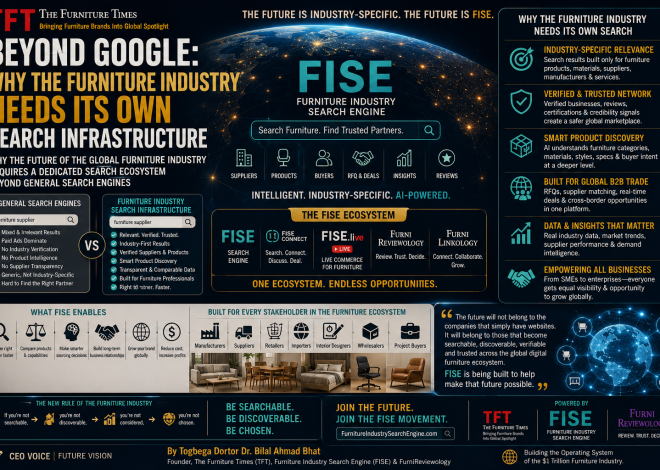
Furniture Industry Search Engine creates structured, category-based global discoverability.
FurniReviewology builds confidence through reviews, reputation and customer experience.
The Furniture Times tells their story.
Furniture Industry Search Engine helps the world find them.
FurniReviewology helps the world trust them.
The furniture industry ecosystem is a $1 trillion industry ecosystem, but opportunity depends increasingly on whether businesses can be found, understood and trusted.
Stop chasing obsolete PageRank scores. Stop calculating artificial keyword percentages. Stop manufacturing exact-match links.
Build useful content. Create clear business information. Earn relevant recognition. Make every important page accessible. Strengthen customer trust.
If you are not searchable, you do not exist.
Be the next one. Be part of the movement.
Sources:
Google Search Central—SEO Starter Guide, Google Search Essentials, Google Search Central—Title Links, Google Search Central—Meta Tags, Google Search Central—Search Snippets, Google Search Central—Ranking Systems, Google Search Central—Link Best Practices, Google Search Central—Spam Policies, Google Search Central—Helpful Content