Asia-Pacific Decking and Fencing Market: The Next Major Growth Frontier?
How urbanisation, property development, infrastructure, hospitality investment and changing outdoor lifestyles could reshape regional demand
By The Furniture Times (TFT) Editorial Desk | Decking & Fencing | Asia-Pacific | Outdoor Living | Construction | Property Development | Landscaping | Global Market Intelligence
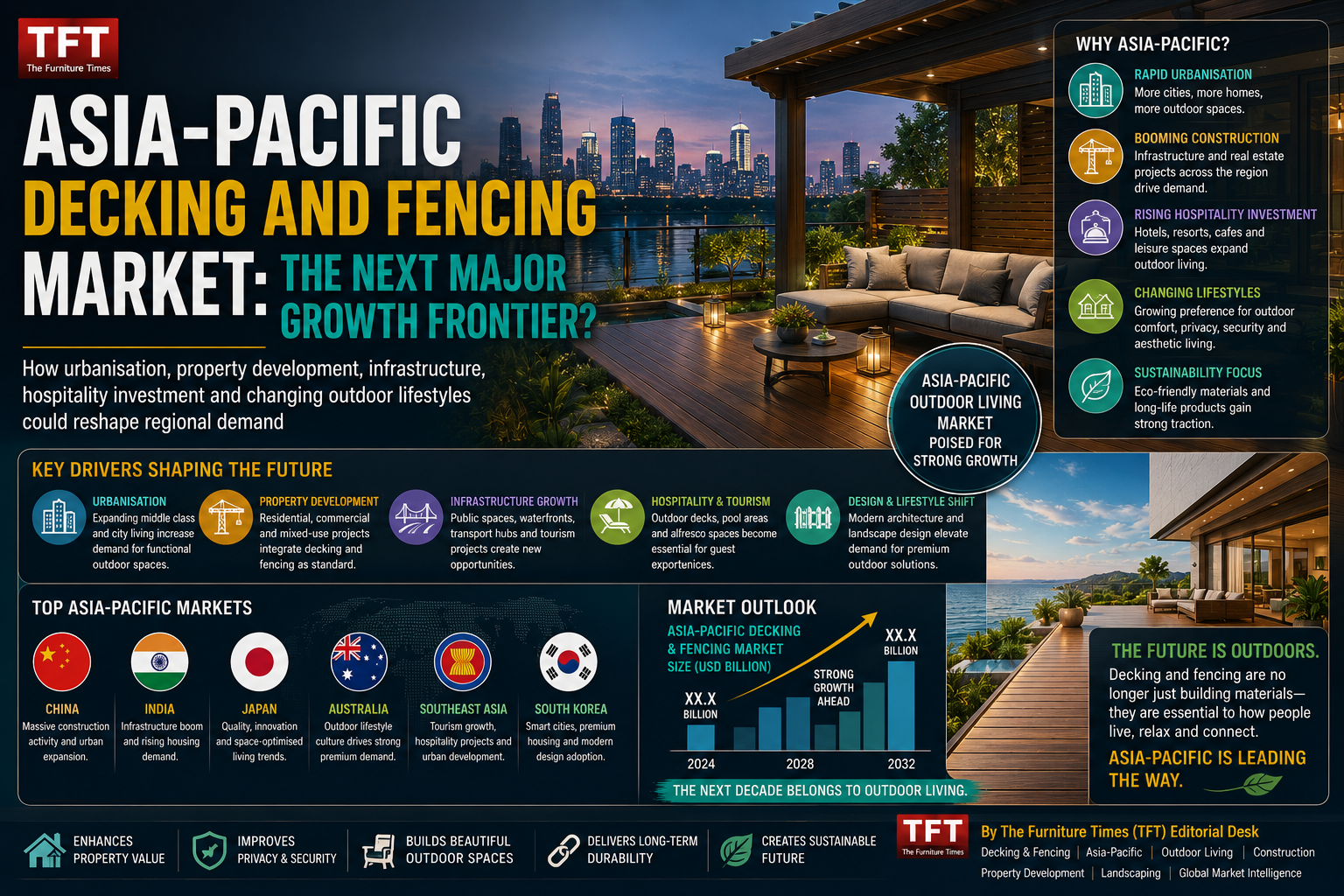
Asia-Pacific is becoming one of the most strategically important regions for the global decking and fencing industry.
The opportunity is being created by a powerful combination of urbanisation, expanding property development, infrastructure investment, hospitality growth, rising household incomes and greater attention to outdoor environments.
Yet Asia-Pacific cannot be approached as a single, uniform market.
Australia has a mature outdoor-living culture and an established market for decks, pools and residential fencing. Japan and South Korea offer design-conscious, technically demanding applications in compact urban spaces. China combines enormous manufacturing capacity with extensive public, commercial and infrastructure development.
India represents a rapidly developing market where fencing demand spans infrastructure, agriculture, industrial security and residential development. Southeast Asia offers substantial opportunities in tropical hospitality, resorts, condominiums and landscape projects. Pacific island economies present smaller but specialised requirements shaped by tourism, coastal exposure and climate resilience.
The region may become a major growth frontier, but opportunity will not be captured through one standard product or one regional sales strategy.
Manufacturers must understand climate, housing formats, price levels, regulations, cultural preferences, distribution channels and the intended use of outdoor space in each country.
Asia-Pacific’s urban transformation is changing the built environment
The fundamental demand driver is the scale of urban transformation.
Asia-Pacific is home to more than 2.2 billion urban residents, making it the world’s largest urban region. The United Nations Economic and Social Commission for Asia and the Pacific has described it as home to seven of the world’s largest megacities, while continuing urban growth is expanding the importance of resilience, housing, infrastructure and public-space planning. UN ESCAP
Urbanisation does not automatically create traditional suburban decking demand. In high-density cities, residents may have limited private gardens. However, it generates many other applications:
- Apartment balconies
- Condominium pool decks
- Rooftop gardens
- Commercial terraces
- Restaurant and café seating
- Hotel and resort landscapes
- Public parks
- Pedestrian boardwalks
- Waterfront developments
- School and university spaces
- Privacy screens
- Security fencing
- Industrial perimeters
- Transport infrastructure
- Gated residential communities
The opportunity lies not only in the quantity of buildings but in how cities use external space.
As urban land becomes more valuable, rooftops, balconies, courtyards and setback areas must perform more functions. Decking can convert difficult surfaces into usable environments, while fencing and screens provide safety, privacy, zoning and architectural character.
Why Asia-Pacific may reshape global demand
Several structural forces could make the region increasingly important.
Population scale
Asia-Pacific contains many of the world’s largest national populations and urban markets. Even relatively low per-capita consumption can create significant aggregate demand when applied across large populations.
Housing development
New apartments, gated communities, villas and mixed-use developments create opportunities for pool fencing, privacy screens, boundary systems, terraces and shared outdoor facilities.
Infrastructure expansion
Fencing is required for roads, railways, airports, ports, utilities, industrial parks, warehouses, schools and public institutions. Decking can serve boardwalks, parks, waterfronts and recreational infrastructure.
Tourism and hospitality
Thailand, Malaysia, Indonesia, Vietnam, Australia, Japan, the Maldives, Fiji and other regional destinations maintain large or growing hospitality economies.
Hotels and resorts require pool decks, beach pathways, privacy screens, landscape fencing, balustrades, outdoor dining surfaces and integrated furniture environments.
Changing lifestyles
Rising incomes and exposure to global design trends are increasing interest in balconies, gardens, pools, rooftop entertainment, outdoor kitchens and landscaped residential spaces.
Manufacturing capability
China, India, Vietnam, Malaysia, Indonesia and other regional economies have established building-material, furniture, metal, timber, plastics and composite manufacturing capabilities.
This makes Asia-Pacific both a major consumption opportunity and an important production centre.
Decking and fencing follow different demand patterns
Although the categories frequently appear together, their market structures are not identical.
Decking is strongly connected with lifestyle, leisure, hospitality, landscaping and outdoor furniture. It is most attractive where buildings have balconies, terraces, gardens, pools, roof decks or public recreational spaces.
Fencing serves a broader range of needs:
- Residential boundaries
- Privacy
- Pool safety
- Agriculture
- Industrial security
- Infrastructure protection
- Schools and institutions
- Commercial properties
- Construction sites
- High-security facilities
- Wildlife and livestock control
This means a country may have a large fencing opportunity even if conventional residential decking remains limited.
India, for example, offers substantial fencing potential through infrastructure, agriculture and industrial development, while decking remains more concentrated in premium residences, hospitality and urban landscape projects.
Singapore offers limited land area but can support high-value decking and architectural-screening projects. Australia, by contrast, provides strong opportunity across both residential decking and fencing.
The region’s leading market groups
1. China: manufacturing scale meets domestic development
China is central to the Asia-Pacific decking and fencing economy.
It is a major producer of wood-plastic composites, metals, hardware, fencing systems and outdoor products. Its manufacturing scale supports both domestic demand and exports.
Domestic opportunities are connected to:
- Residential developments
- Public parks
- Waterfront projects
- Commercial landscapes
- Resorts and tourism
- Industrial facilities
- Transport infrastructure
- Schools and institutions
- Urban beautification
- Security installations
China’s dense cities may limit the prevalence of large private residential decks. However, the scale of public and commercial development creates opportunities for boardwalks, terraces, landscape platforms, privacy systems and architectural screening.
Where opportunity is strongest
- Wood-plastic composite decking
- Public-space and landscape decking
- Aluminium fencing
- Industrial and security fencing
- Decorative screens
- Noise barriers
- Modular outdoor systems
- Smart access-control integration
Challenges
International companies face intense competition from domestic manufacturers. Commodity products are difficult to differentiate. Opportunity is more likely in advanced materials, premium design, specialist engineering, sustainability documentation or project-specific systems.
International brands must also consider local standards, tender processes, regional distribution and the need for Mandarin-language technical support.
2. India: a high-growth fencing market with emerging decking potential
India may become one of the region’s most important long-term markets, particularly for fencing.
Urban development, transportation infrastructure, logistics, industrial parks, housing, hospitality and security needs are creating wide demand.
Fencing applications include:
- Highways and railways
- Metro systems
- Airports and ports
- Industrial facilities
- Warehouses and logistics parks
- Solar farms
- Residential developments
- Agricultural land
- Schools and hospitals
- Government and defence facilities
- Sports and recreational areas
Decking remains a more specialised market but is expanding through:
- Hotels and resorts
- Premium villas
- Farmhouses
- Rooftop restaurants
- Clubhouses
- Apartment amenities
- Pool areas
- Commercial terraces
- Landscape projects
Why property development matters
New urban communities increasingly compete through amenities. Swimming pools, clubhouses, rooftop spaces and landscaped courtyards can influence property positioning.
Decking, screens and outdoor furniture therefore become part of a developer’s lifestyle proposition rather than merely a construction detail.
Challenges
India is highly price-sensitive and geographically diverse. Premium imported products may perform in selected urban and hospitality projects, but large-scale adoption requires:
- Local manufacturing or assembly
- Cost-efficient installation
- Replacement-part availability
- Installer training
- Heat and UV performance
- Clear technical documentation
- Adaptation to local procurement practices
The winning strategy may be to combine global technology with local production and service.
3. Australia: Asia-Pacific’s mature outdoor-living benchmark
Australia is the region’s most established lifestyle-oriented decking market.
Detached homes, gardens, pools, verandas, coastal properties and outdoor entertainment create broad residential demand. Hotels, restaurants, parks and commercial projects add further opportunity.
Fencing is important for boundaries, privacy, pools, farms, security and landscaping.
Key product categories
- Hardwood decking
- Treated-timber decking
- Composite decking
- Deck railings
- Glass and aluminium pool fencing
- Privacy screens
- Steel and aluminium boundary fencing
- Rural fencing
- Coastal-grade systems
Performance expectations
Australia’s conditions are demanding:
- Intense UV exposure
- High surface temperatures
- Salt air
- Termites
- Bushfire risk
- Tropical rainfall in northern regions
- Strong winds and storms
- Significant regional climate variation
Manufacturers must provide more than general claims of outdoor suitability. Products may require location-specific specifications, careful colour selection, corrosion-resistant components and clear installation guidance.
Australia offers an attractive market, but it is already competitive and technically mature.
4. Japan: compact design and demanding quality expectations
Japan presents opportunities in residential renovation, hospitality, landscaping, public space and compact urban environments.
Large suburban decks are less central than in Australia or North America. Demand can instead focus on:
- Balconies
- Small terraces
- Rooftop areas
- Courtyards
- Commercial landscapes
- Hotels and tourism
- Privacy screens
- Public pathways
- Compact modular systems
Japanese consumers and professional buyers often expect precision, consistent finishes, reliable documentation and long-term performance.
Natural timber aesthetics remain attractive, but lower-maintenance materials can appeal where they reproduce a refined appearance without requiring intensive upkeep.
Suppliers must consider typhoons, humidity, seismic conditions, snow in northern regions and limited installation space.
5. South Korea: premium urban outdoor environments
South Korea’s dense urban development limits conventional backyard demand, but creates specialised opportunities in:
- Rooftop cafés
- Apartment terraces
- Hotels and resorts
- Commercial landscapes
- Public recreation
- Garden-style retail spaces
- Premium residential projects
- Architectural screening
Customers may prefer contemporary designs, clean lines, low-maintenance surfaces and strong coordination between decking, screens, furniture and lighting.
Digital visualisation and design-led marketing can be especially useful in a sophisticated, technology-oriented consumer market.
Southeast Asia: a tropical outdoor-living growth cluster
Malaysia
Malaysia’s warm climate enables outdoor spaces to operate throughout the year, although frequent rain and strong sunlight create maintenance challenges.
Demand comes from:
- Landed homes
- Condominiums
- Hotels and resorts
- Restaurants and cafés
- Property developments
- Clubhouses
- Pool areas
- Rooftop spaces
- Public landscapes
Composite decking, aluminium screens, timber systems, privacy fencing and poolside products can all find opportunities.
However, products must address humidity, drainage, termites, mould, UV degradation and corrosion. Installation quality is critical because poor ventilation or trapped water can shorten product life.
Malaysia also has the potential to become a regional manufacturing and distribution base due to its furniture, timber, metalworking and construction-material capabilities.
Indonesia
Indonesia combines a large population, rapid urban development, tourism and a strong craft-and-timber tradition.
Bali has helped popularise tropical outdoor design internationally, but opportunity extends to Jakarta, Surabaya, new urban developments and other tourism regions.
Important applications include:
- Villas
- Resorts
- Restaurants
- Pools
- Beachfront properties
- Urban residences
- Public landscapes
- Privacy and security fencing
Humidity, termites, salt exposure and heavy rainfall require careful specification. Responsible timber sourcing and legal traceability are also important for suppliers using natural materials.
Thailand
Thailand’s tourism and hospitality sectors create considerable demand for decking, pool surrounds, boardwalks, screens and landscape fencing.
Bangkok’s rooftop and commercial spaces add urban applications, while Phuket, Pattaya, Koh Samui, Chiang Mai and other destinations support resort and villa demand.
The market values tropical aesthetics, but operators also need materials that can tolerate intensive commercial use and frequent cleaning.
Products should be assessed for:
- Slip resistance
- UV stability
- Pool-chemical exposure
- Moisture management
- Repairability
- Replacement availability
- Coastal corrosion
Vietnam
Vietnam is simultaneously a manufacturing centre and a developing domestic market.
Urban growth, tourism, resorts, residential developments and commercial construction are creating opportunities for:
- Composite decking
- Timber decking
- Aluminium screens
- Security fencing
- Landscape products
- Hospitality outdoor systems
Vietnam’s manufacturing competitiveness can support exports, but domestic buyers are also becoming more design-conscious.
International companies may find partnership opportunities with local manufacturers, architects, developers and distributors.
Singapore
Singapore is a small-volume but potentially high-value market.
Its limited land area encourages intensive use of rooftops, balconies, podiums, gardens and public spaces. Premium condominiums, hotels, restaurants and landscape projects require highly coordinated systems.
Important considerations include:
- Fire requirements
- Moisture and drainage
- Slip resistance
- High-rise wind exposure
- Heat management
- Maintenance access
- Sustainability documentation
- Architectural integration
Products must compete through quality, technical credibility and design—not low price alone.
Philippines
The Philippines presents residential, hospitality, resort and commercial opportunity across a large island market.
Warm weather supports outdoor living, while fencing demand is connected to residential security, commercial properties, agriculture and infrastructure.
Typhoons, flooding, salt air, humidity and intense rainfall create demanding conditions. Systems must be structurally appropriate, well anchored and easy to repair after localised damage.
Distribution and after-sales service across multiple islands can be challenging, making regional inventory and trained partners important.
South Asia beyond India
Bangladesh
Bangladesh’s dense cities and rapidly developing industrial economy can support fencing for factories, logistics, infrastructure and housing projects.
Decking is likely to remain concentrated in premium residential, hospitality and commercial applications.
Flood exposure, humidity, price sensitivity and land constraints will shape product selection.
Pakistan
Pakistan offers potential in residential boundary fencing, agriculture, infrastructure, industrial security and selected hospitality developments.
Traditional walls remain common, meaning lightweight or open fencing systems must demonstrate clear advantages in cost, security, speed or design.
Sri Lanka
Sri Lanka’s tourism, resorts and tropical residential architecture create opportunities for decking, privacy screens and landscape fencing. Coastal exposure, humidity and economic conditions require durable but cost-conscious solutions.
Maldives
The Maldives represents a specialised premium hospitality market. Resorts require boardwalks, villa decks, screens and outdoor furniture systems exposed to intense saltwater, UV radiation and humidity.
The volumes may be modest compared with large countries, but technical and project values can be high.
Pacific markets
New Zealand
New Zealand has an established culture of timber housing, residential decks and outdoor living.
Demand is supported by detached housing, renovation, hospitality and recreational properties. Timber and composite products must withstand moisture, UV exposure and coastal conditions.
Building compliance, structural performance and responsible material sourcing are important.
Pacific island economies
Fiji, Papua New Guinea and smaller Pacific island markets offer specialised opportunities connected to resorts, tourism, public infrastructure and coastal communities.
Products need to consider:
- Cyclones
- Salt exposure
- Humidity
- Limited maintenance capacity
- Import logistics
- Spare-parts access
- Repairability
- Climate resilience
Lightweight products are not automatically appropriate where extreme winds occur. Structural design and anchoring are essential.
How urbanisation changes decking demand
Urbanisation changes the form of decking rather than simply increasing its volume.
Traditional decking is associated with private gardens and suburban homes. In rapidly growing Asian cities, the new opportunity may be:
- Modular rooftop platforms
- Balcony flooring systems
- Pool-deck surfaces
- Raised access decks
- Landscape walkways
- Public boardwalks
- Commercial terraces
- Temporary event platforms
- Outdoor workspaces
- Integrated planter and seating systems
Compact, modular and easily maintained products may therefore perform better than systems designed only for large suburban backyards.
The market must adapt to vertical cities.
How property development changes fencing demand
Property development creates fencing demand at multiple stages.
During construction
Projects require temporary perimeter fencing, access gates, safety barriers and equipment protection.
At completion
Residential and commercial developments may require:
- Boundary fencing
- Pool barriers
- Privacy screens
- Service-area concealment
- Security gates
- Pedestrian control
- Landscape separation
- Rooftop safety systems
- Balustrades and railings
During operation
Owners require maintenance, repairs, gate automation, security upgrades and replacement components.
The lifecycle opportunity can therefore continue long after the initial construction contract.
Climate is the region’s defining technical challenge
Asia-Pacific contains almost every major climate condition:
- Tropical humidity
- Equatorial rainfall
- Coastal salt exposure
- Desert heat
- Temperate seasons
- Snow and freeze-thaw cycles
- Typhoons and cyclones
- Bushfire exposure
- Flooding
- Earthquakes
A single “Asia-Pacific product specification” is not credible.
Tropical requirements
Products may need resistance to termites, fungal growth, algae, moisture, corrosion and intense UV exposure. Drainage and ventilation are essential.
Hot-climate requirements
Surface temperature, colour, thermal movement and UV stability require attention. Dark decking may become uncomfortable in direct sunlight.
Typhoon and cyclone requirements
Fencing, screens, railings and elevated systems need suitable structural design, anchoring and wind-load consideration.
Coastal requirements
Fasteners, frames and coatings must address salt-driven corrosion. Mixed metals require careful isolation.
Cold-climate requirements
Products sold in Japan, Korea, New Zealand’s colder regions and northern China may need freeze-thaw resistance and appropriate snow-load planning.
Materials likely to gain attention
Wood-plastic composite decking
Composite systems can benefit from demand for lower routine maintenance, consistent appearance and resistance to certain biological risks.
Performance varies considerably. Buyers should examine thermal movement, surface heat, staining, fading, scratching, fire performance and repairability.
Natural timber
Timber remains attractive because of its warmth, familiarity and connection with landscape design. Regional species and supply chains can create strong domestic markets.
Legal sourcing, treatment, durability classification and maintenance communication are essential.
Aluminium
Aluminium can perform well in screens, fences, gates, railings and substructures. It offers contemporary aesthetics and can be useful in humid environments when correctly finished and installed.
Steel
Steel remains important for security, industrial, agricultural and infrastructure fencing. Protective coatings and maintenance determine long-term performance.
Vinyl and polymers
Polymer fencing can provide lower-maintenance options, but UV stability, thermal behaviour and structural capability must match regional conditions.
Hybrid systems
The region may see greater use of combinations such as aluminium frames with composite infill, steel structures with timber finishes or modular fencing incorporating plants, lighting and access technology.
Security is a major regional demand driver
In many Asia-Pacific markets, fencing is not primarily decorative. It is security infrastructure.
Residential developments, logistics facilities, data centres, factories, transport systems, utilities and government sites require controlled perimeters.
Future growth may include:
- Anti-climb fencing
- Automated gates
- Access-control integration
- Surveillance-ready systems
- Impact-resistant barriers
- Temporary construction fencing
- Solar-farm fencing
- Data-centre security
- Airport and transport fencing
- Smart perimeter monitoring
This brings the fencing industry into closer contact with cybersecurity, electronics, access-control and infrastructure companies.
Manufacturers will increasingly compete through systems rather than panels alone.
Hospitality can accelerate premium demand
Hospitality projects create some of the region’s most visible decking and fencing applications.
A resort may require:
- Arrival-area screens
- Villa privacy fencing
- Pool decking
- Beach pathways
- Restaurant terraces
- Spa enclosures
- Balustrades
- Service-area screening
- Landscape barriers
- Outdoor furniture platforms
These projects demand coordination between architects, landscape designers, furniture suppliers, decking companies, lighting specialists and contractors.
The product must contribute to the guest experience while tolerating commercial cleaning, high traffic and difficult environmental exposure.
Hospitality can also act as a showroom for the residential market. Guests experience outdoor materials at hotels and later seek similar products for their homes.
Affordability will determine the scale of adoption
Asia-Pacific includes some of the world’s wealthiest consumers and many price-sensitive households.
Premium growth may attract attention, but mass-market opportunity depends on affordability.
Manufacturers must distinguish between:
- Luxury hospitality
- Premium residential
- Middle-income housing
- Affordable housing
- Public infrastructure
- Agriculture
- Industrial security
Each segment requires a different balance of design, strength, durability, maintenance and price.
A premium composite deck designed for a Singapore rooftop does not address the same need as fencing for an Indian warehouse, a Malaysian landed home or a Philippine farm.
Localised product architecture will be essential.
Distribution and installation remain major barriers
A decking or fencing product can fail commercially even when customer demand exists.
Common barriers include:
- Limited local inventory
- High freight costs
- Poor installer training
- Inconsistent quotations
- Lack of technical documentation
- Weak after-sales service
- Unavailable replacement components
- Long project lead times
- Incorrect installation
- Insufficient local marketing
- Difficulty finding reliable contractors
Manufacturers should develop complete market systems:
- Local or regional distribution
- Installer training
- Design and specification support
- Physical samples
- Climate-specific instructions
- Warranty procedures
- Spare-part availability
- Digital product information
- Project references
- Verified customer reviews
The market will reward companies that make products easy to specify, purchase, install and maintain.
Sustainability will influence future specifications
Governments, architects, developers and institutional buyers are paying greater attention to material sourcing, embodied carbon, recycled content, lifecycle performance and end-of-life recovery.
Relevant questions include:
- Is timber legally and responsibly sourced?
- Does recycled content have credible documentation?
- Can individual boards or panels be replaced?
- Are different materials separable?
- Are coatings and preservatives appropriate?
- Can the product be reused or recycled?
- How long is the expected service life?
- What maintenance is required?
- Are spare parts available?
Sustainability should not be reduced to one material claim. A product containing recycled material but designed for premature disposal may not provide a convincing circular solution.
Durability, repairability and recovery must be considered together.
Market opportunity matrix
| Market | Decking opportunity | Fencing opportunity | Strongest demand driver |
|---|---|---|---|
| China | High and project-driven | Very high | Urban infrastructure and manufacturing |
| India | Emerging-high | Very high | Infrastructure, industrial and residential development |
| Australia | Very high | High | Established outdoor lifestyle |
| Japan | Specialist, premium | High | Renovation and compact urban design |
| South Korea | Specialist, premium | Medium-high | Rooftops and commercial design |
| Malaysia | High | High | Tropical residential and hospitality |
| Indonesia | High | High | Resorts, villas and urban growth |
| Thailand | High | High | Tourism and hospitality |
| Vietnam | Growing | High | Construction and manufacturing |
| Singapore | High-value, low-volume | Medium-high | Premium urban landscapes |
| Philippines | Growing | High | Residential, hospitality and security |
| New Zealand | High | Medium-high | Residential outdoor living |
| Maldives | Premium project market | Specialist | Luxury resorts |
| Bangladesh | Specialist | High | Industrial and urban development |
| Pakistan | Specialist | High | Boundaries, agriculture and security |
These ratings are directional assessments, not audited national market-size estimates.
What manufacturers should prepare for
Companies targeting Asia-Pacific should:
- Avoid treating the region as one sales territory
- Identify the exact application in each country
- Test products for local climate conditions
- Develop different price tiers
- Establish regional inventory
- Train installation partners
- Translate technical information
- Understand building and pool-safety requirements
- Maintain spare parts and compatible components
- Document sustainability and material sourcing
- Build relationships with architects and developers
- Create country-specific case studies
- Make the business searchable online
- Collect credible customer reviews
- Support products throughout their lifecycle
The region rewards localisation. Exporting a catalogue is not the same as building a market.
TFT, FISE and FurniReviewology: connecting Asia-Pacific’s fragmented ecosystem
Asia-Pacific contains thousands of decking manufacturers, fencing specialists, timber suppliers, composite producers, metal fabricators, contractors, architects, landscape designers and installers.
Many remain invisible outside their immediate cities or countries.
The Furniture Times can bring their innovations, projects, challenges and market stories into the global spotlight.
Furniture Industry Search Engine can organise them by country, product, material, capability and application—making it easier for customers, developers and professional buyers to find suitable suppliers.
FurniReviewology can provide the trust layer through verified information and credible customer experience.
The Furniture Times tells their story.
Furniture Industry Search Engine helps the world find them.
FurniReviewology helps the world trust them.
The furniture industry ecosystem is a $1 trillion industry ecosystem, and Asia-Pacific’s decking and fencing businesses are becoming an increasingly important part of its outdoor-living, construction and landscaping economy.
Asia-Pacific may indeed become the next major growth frontier. But growth will belong to companies that understand the region’s differences, solve real climate and installation problems, and remain visible where buyers search.
Be the next one. Be part of the movement.