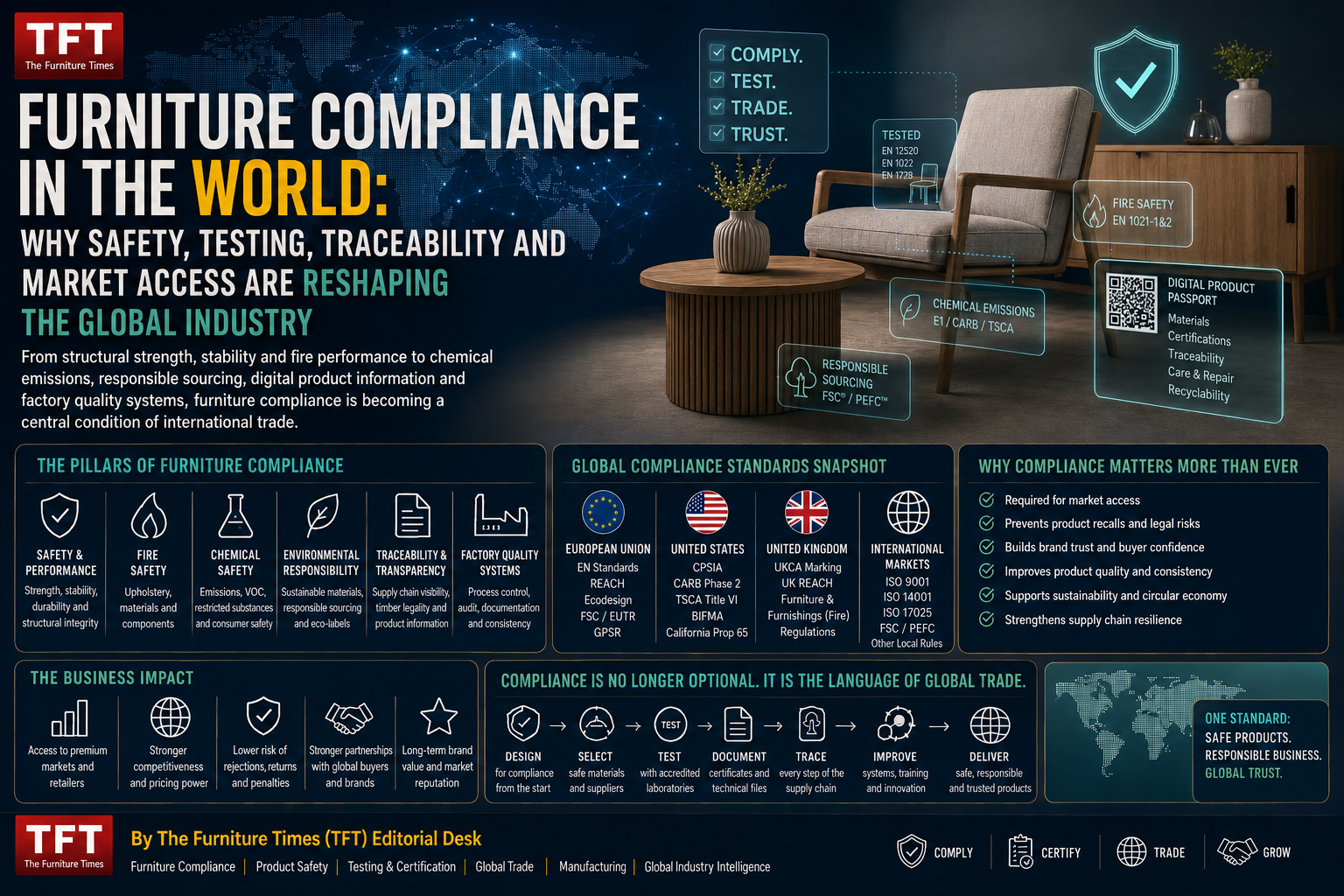
Furniture Compliance in the World
Why Safety, Testing, Traceability and Market Access Are Reshaping the Global Industry
From structural strength, stability and fire performance to chemical emissions, responsible sourcing, digital product information and factory quality systems, furniture compliance is becoming a central condition of international trade
By The Furniture Times (TFT) Editorial Desk | Furniture Compliance | Product Safety | Testing & Certification | Global Trade | Manufacturing | Global Industry Intelligence
Furniture compliance is entering a new era.
For decades, many companies regarded compliance as a technical formality completed near the end of product development. A prototype was sent to a laboratory, a report was obtained, labels were printed and the product was prepared for shipment.
That limited approach is no longer sufficient.
Across the world, governments, regulators, institutional buyers, retailers and digital marketplaces are demanding stronger evidence that furniture is safe, stable, durable, traceable, accurately labelled and suitable for its intended use. Requirements increasingly extend beyond the finished product to include components, raw materials, factory controls, supplier records, online product information and post-market responsibilities.
A dining chair may need to satisfy strength, durability and stability expectations. A chest of drawers may be subject to mandatory anti-tip requirements. An upholstered sofa may face flammability, chemical and labelling obligations. A school desk may have ergonomic and dimensional specifications. A bunk bed must address entrapment and fall hazards. Connected furniture may introduce electrical safety, radio, battery, privacy and cybersecurity obligations.
Meanwhile, wood-based furniture is increasingly affected by formaldehyde-emission controls and timber traceability rules.
The result is a new commercial reality:
Furniture compliance is no longer only about passing a laboratory test. It is about proving that the product, factory, supply chain, documentation and post-market system remain under control.
There is no single global furniture-compliance certificate
One of the greatest misunderstandings in international furniture trade is the belief that a product approved in one country is automatically acceptable everywhere.
It is not.
There is no universal furniture certificate that grants unrestricted access to every global market. Each destination can have its own:
- Product-safety legislation
- Mandatory technical regulations
- National or regional standards
- Fire-performance requirements
- Chemical restrictions
- Labelling obligations
- Importer responsibilities
- Children’s-product rules
- Environmental requirements
- Timber-origin controls
- Packaging requirements
- Product-recall procedures
- Online marketplace obligations
A chair that meets a European standard may still need additional documentation for sale in the United States. A sofa designed for the American market may not automatically comply with British domestic upholstered-furniture fire requirements. A storage unit accepted in one jurisdiction may fail another market’s stability or warning-label rules.
Compliance must therefore begin with four questions:
- What is the product?
- What is its intended use?
- Who will use it?
- In which country will it be supplied?
Without these answers, a laboratory may test the wrong product against the wrong standard.
What furniture compliance actually covers
Furniture compliance is a combination of legal, technical and commercial obligations. Depending on the product and market, it can cover several interconnected areas.
Structural safety
Furniture should withstand the loads, forces and repeated use reasonably expected during its service life.
Testing may examine:
- Seat and back strength
- Static loading
- Cyclic durability
- Impact resistance
- Leg and frame strength
- Armrest performance
- Table stability
- Drawer and door durability
- Castor performance
- Reclining-mechanism endurance
- Bed-frame strength
- Bunk-bed guardrail performance
A visually attractive product can still be unsafe if its joints, fasteners, materials or dimensions are unsuitable for the expected loads.
Stability and tip-over prevention
Storage furniture, cabinets, dressers, bookcases, television units and other tall products can cause severe injuries when they overturn.
Modern compliance programmes increasingly examine foreseeable behaviour, including:
- Several drawers being opened simultaneously
- A child climbing onto an open drawer
- Loads placed on doors or shelves
- Furniture positioned on uneven flooring
- Consumer failure to anchor the product
- Televisions or heavy objects placed on top
Stability has become one of the most visible global furniture-safety issues.
Entrapment, falls and pinch points
Bunk beds, folding products, recliners, sofa beds, height-adjustable desks and convertible furniture can expose users to openings, moving parts and shear points.
Testing and risk assessment may examine:
- Head and neck entrapment
- Finger entrapment
- Gaps around guardrails
- Accessible moving mechanisms
- Unexpected folding or collapse
- Sharp edges and projecting components
- Locking-device performance
- Mattress-to-frame gaps
Fire and flammability performance
Upholstered furniture contains combinations of covers, fillings, interliners, foams, timber structures, adhesives and decorative components.
Fire requirements vary significantly by country and by intended environment. Domestic furniture, hotels, healthcare facilities, prisons, ships, offices and public buildings may be governed by different rules or purchasing specifications.
Chemical safety and indoor-air quality
Furniture can contain substances associated with:
- Adhesives
- Coatings
- Paints
- Preservatives
- Flame retardants
- Plasticisers
- Textile treatments
- Composite wood
- Synthetic leather
- Metals and pigments
Compliance may involve formaldehyde emissions, restricted substances, heavy metals, volatile organic compounds or chemicals subject to regional controls.
Labelling and consumer information
Labels and instructions are not secondary matters. They can be mandatory parts of the compliance system.
Requirements may include:
- Manufacturer or importer identification
- Product model or batch number
- Country of origin
- Permanent fire-safety labels
- Anti-tip warnings
- Maximum load declarations
- Age restrictions
- Mattress-size information
- Assembly instructions
- Anchoring instructions
- Care and maintenance guidance
- Traceability information
Environmental and sourcing obligations
Timber legality, deforestation risk, sustainable sourcing, recycled content, product durability, repairability and end-of-life information are becoming increasingly relevant to market access and public procurement.
The European Union: compliance is moving toward lifecycle accountability
The European Union is one of the most influential regulatory markets because its requirements can affect global product development.
Furniture placed on the EU market is generally expected to comply with applicable product-safety and chemical legislation. Depending on its construction and function, additional rules may apply to electrical equipment, batteries, radio-connected devices, machinery-like mechanisms or children’s products.
The EU’s compliance direction increasingly emphasises:
- Safe products
- Responsible economic operators
- Supply-chain traceability
- Chemical transparency
- Environmental performance
- Durability and repairability
- Digital product information
- Market surveillance
- Rapid corrective action
General product safety
Furniture that is not governed by a more specific sectoral regime remains subject to general product-safety responsibilities.
Manufacturers and other economic operators must assess foreseeable risks and maintain appropriate technical information. Importers and distributors cannot simply assume that overseas factories have completed every necessary step.
Online sales are also part of the compliance environment. Product identification, economic-operator information and required warnings may need to be presented before purchase—not placed only inside the package after delivery.
Chemical compliance
Furniture companies supplying the EU must understand the substances used in boards, coatings, textiles, foams, adhesives, plastics, metal finishes and leather substitutes.
This requires more than collecting a generic declaration from a component supplier. Manufacturers need to know whether the declaration applies to:
- The exact material
- The correct colour
- The current formulation
- The correct production facility
- The relevant batch
- The finished product’s intended market
A change in adhesive, coating, foam or textile treatment can affect the compliance status of the entire finished product.
Ecodesign and the Digital Product Passport
The EU’s Ecodesign for Sustainable Products Regulation creates a framework through which product-specific requirements may be developed for characteristics such as durability, reliability, repairability, material efficiency and environmental information.
The Digital Product Passport is a core part of this direction. It is intended to make relevant product information accessible across value chains. However, obligations do not automatically apply to all furniture products in an identical form merely because the framework exists; detailed requirements depend on product-specific measures and implementation schedules.
In July 2026, the European Commission announced that the Digital Product Passport Registry had gone live with a testing environment, marking an important development in the infrastructure supporting the system. European Commission
For furniture manufacturers, the strategic signal is clear: product information will need to become more structured, reliable and connected to physical products.
Future-ready records may include:
- Product identity
- Manufacturing location
- Material composition
- Repair instructions
- Spare-part information
- Sustainability data
- Certifications
- Recycling guidance
- Restricted-substance information
- Supply-chain traceability
Timber origin and deforestation-related due diligence
Wooden furniture suppliers must also watch European timber and deforestation-related obligations carefully.
Compliance can require product classification, origin information, supplier due diligence and records connecting timber inputs with finished-product batches. The precise obligations and dates must be verified against the current rules, product codes and any amendments applicable at the time of placing goods on the market.
The key operational lesson is that timber traceability cannot be reconstructed reliably after a container has reached the port.
United Kingdom: fire safety remains a defining obligation
The United Kingdom maintains a distinctive regulatory approach to domestic upholstered furniture.
The Furniture and Furnishings (Fire) (Safety) Regulations 1988 establish flammability requirements for relevant upholstered furniture and components supplied in the UK. Requirements can involve ignition resistance for fillings and covers, along with labelling and record responsibilities.
The UK introduced amendments in 2025 while continuing a wider review of the regime. The government has also consulted on a possible future approach that responds to changing furniture construction and concerns surrounding chemical flame retardants. UK Government
Manufacturers must distinguish carefully between:
- The rules currently in force
- Published amendments
- Government consultations
- Proposed future reforms
- Commercial fire specifications imposed by buyers
A consultation document does not replace existing law until the legal change has been adopted and commenced.
Why material combinations matter
Upholstered-furniture fire performance depends on the complete construction.
A fabric that passes one test over one filling may behave differently when used with:
- Another foam
- A different interliner
- A laminated backing
- Decorative piping
- A different seam
- A timber or composite substrate
- A water-resistant surface treatment
Manufacturers should avoid assuming that a fabric supplier’s certificate automatically covers every finished sofa configuration.
United States: federal requirements coexist with state rules
Furniture compliance in the United States is complex because companies may face federal requirements, state-level regulations, voluntary standards incorporated into commercial specifications and retailer-specific programmes.
Clothing-storage-unit stability
The mandatory federal standard developed under the STURDY Act applies to covered clothing-storage units such as certain dressers and armoires. The standard, which took effect in September 2023, addresses stability and tip-over hazards.
The continuing importance of this requirement can be seen in furniture recalls. In August 2026, the US Consumer Product Safety Commission announced the recall of approximately 8,981 nine-drawer dressers that violated the mandatory standard and posed tip-over and entrapment hazards. US Consumer Product Safety Commission
A wall anchor should not be treated as a universal substitute for compliant product stability when the applicable regulation requires the unit itself to meet defined performance expectations.
Formaldehyde emissions
The US Environmental Protection Agency’s TSCA Title VI programme regulates formaldehyde emissions from hardwood plywood, medium-density fibreboard—including thin MDF—and particleboard.
Finished goods containing regulated composite wood can fall within the programme’s certification, recordkeeping and labelling framework. Products manufactured or imported after March 22, 2019, must be labelled as TSCA Title VI compliant where the rule applies. US Environmental Protection Agency
Furniture businesses must therefore confirm that boards are sourced from compliant panel producers and that required documentation flows through the supply chain.
Upholstered-furniture flammability
Residential upholstered furniture in the United States is affected by federal smouldering-ignition requirements, while state rules and commercial specifications can add further considerations.
A manufacturer should not rely on a vague declaration that a sofa is “fire resistant.” The applicable method, product category, jurisdiction and test construction must be identified precisely.
Children’s furniture
Children’s furniture can trigger more stringent responsibilities involving:
- Lead and surface coatings
- Small parts
- Phthalates where applicable
- Tracking labels
- Children’s Product Certificates
- Third-party testing
- Product-specific crib, bunk-bed or toddler-bed rules
Marketing language can affect product classification. Furniture presented through imagery, dimensions, themes or advertising as intended primarily for children may face obligations different from general adult furniture.
India: BIS certification is changing the compliance landscape
India’s furniture market is moving toward a more formal compulsory-certification structure.
Under the Furniture (Quality Control) Order, identified categories are linked to Indian Standards and the BIS Standard Mark certification system. The categories listed by BIS include:
| Furniture category | Indian Standard |
|---|---|
| Work chairs | IS 17631:2022 |
| General-purpose chairs and stools | IS 17632:2022 |
| Tables and desks | IS 17633:2022 |
| Storage units | IS 17634:2022 |
| Beds | IS 17635:2022 |
| Bunk beds | IS 17636:2022 |
The QCO has been followed by amendments and transition-related measures, making it essential for manufacturers and importers to verify the latest commencement dates, exemptions and product scope directly from BIS and the relevant government notifications. Bureau of Indian Standards
BIS is not merely a test report
BIS certification can require an evaluation of the wider manufacturing system, including:
- Product classification
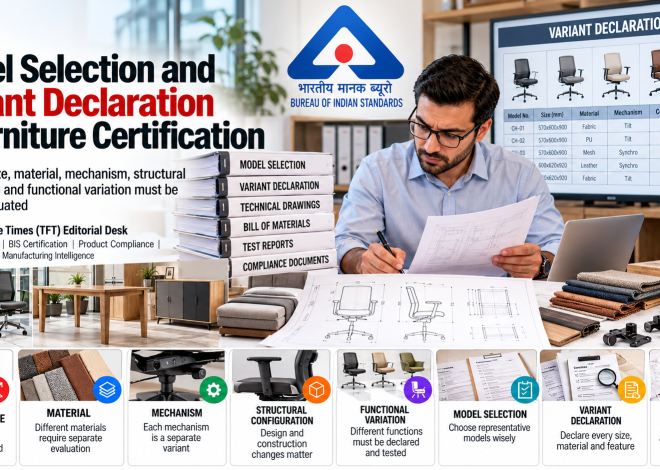
- Model and variant declarations
- Technical drawings
- Material specifications
- In-house quality control
- Test equipment
- Calibration
- Factory inspection
- Production records
- Raw-material control
- Traceability
- Marking and labelling
- Continuing surveillance
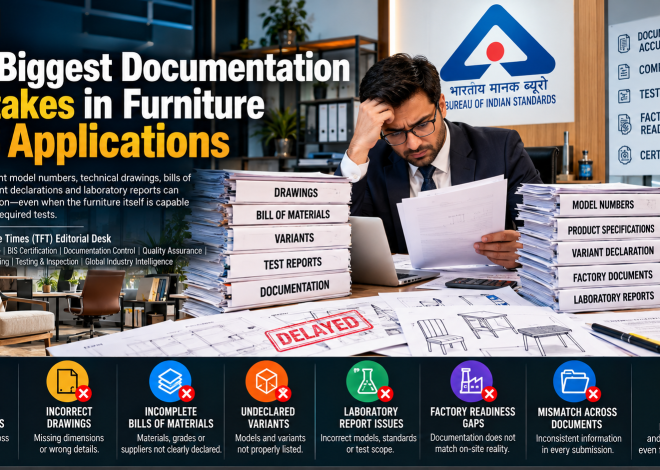
A product can be structurally strong and still encounter certification delays if the application, drawings, model grouping or factory systems are incomplete.
Foreign manufacturers may also need to follow the applicable foreign-manufacturer certification process. Importers should not assume that a report issued by an overseas laboratory replaces a BIS licence where compulsory certification applies.
Australia: furniture warnings must exist at the point of sale
Australia introduced a mandatory information standard for toppling furniture, effective May 4, 2025.
Covered suppliers must provide:
- Permanent warning labels on the furniture
- Warnings at physical and online points of sale
- Safety information in instruction manuals
The requirements apply to specified categories of freestanding household furniture. Product Safety Australia
The online requirement is especially important. A warning hidden inside a delivered carton cannot influence a customer’s decision before purchase.
In November 2025, Australia’s product-safety regulator reported that 90% of examined businesses were non-compliant with one or more aspects of the mandatory information standard, illustrating how frequently companies underestimate information and labelling obligations. Product Safety Australia
Australia also maintains mandatory standards for certain children’s products and infant-sleep products. Furniture companies must confirm whether a product falls into a regulated category rather than assuming that all furniture is covered by the same general rules.
Canada: product category determines the obligation
Canada regulates consumer products through its national product-safety framework and product-specific regulations.
Cribs, cradles, bassinets and certain other children’s products face defined mechanical, dimensional, chemical and labelling requirements. The manufacture, importation, advertisement or sale of traditional drop-side cribs has been prohibited since December 29, 2016. Health Canada
Bunk beds and children’s sleep furniture require particular attention to:
- Guardrails
- Openings
- Mattress fit
- Structural strength
- Age guidance
- Entrapment hazards
- Assembly integrity
Compliance responsibilities can also continue in the second-hand market. Used products are not automatically exempt from safety obligations simply because they have had a previous owner.
China and the wider Asian manufacturing environment
China is both a major furniture market and the world’s most important furniture-manufacturing base. Products supplied domestically may be subject to Chinese national standards, while exports must comply with destination-market rules.
This creates a dual responsibility for factories:
- Meet the applicable requirements of the manufacturing jurisdiction.
- Meet the legal and commercial requirements of the destination market.
The same principle applies throughout Vietnam, Malaysia, Indonesia, Thailand and other manufacturing economies.
An export test report does not remove local factory obligations. Similarly, local registration or certification does not automatically demonstrate compliance in Europe, the United Kingdom, the United States, India, Australia or the Middle East.
Asian manufacturers supplying several markets need controlled product versions. A single model name can conceal important regional differences in:
- Foam composition
- Fabric treatment
- Warning labels
- Wall-anchoring kits
- Electrical plugs
- Power supplies
- Instructions
- Board suppliers
- Product dimensions
- Maximum-load ratings
If these differences are not controlled, compliant and non-compliant variants can become mixed during production or shipment.
The Middle East and GCC: project specifications are as important as national rules
Furniture compliance in the Middle East is influenced by national conformity systems, customs requirements, construction regulations, fire codes and contract specifications.
Hospitality, healthcare, education, government and commercial projects may demand evidence relating to:
- Fire and smoke performance
- Structural durability
- Fabric abrasion
- Cleanability
- Antimicrobial properties
- Moisture and heat resistance
- Low chemical emissions
- Accessibility
- Electrical safety
- Installation quality
- Warranties
- After-sales service
Suppliers should not treat “GCC compliant” as a universal technical category. Saudi Arabia, the United Arab Emirates, Qatar, Kuwait, Bahrain and Oman can have different authorities, conformity routes and project requirements.
A product accepted by one hotel operator or consultant may not automatically satisfy another project.
Commercial furniture creates additional responsibilities
Residential furniture standards may not be suitable for high-frequency commercial use.
A chair used several times a day at home experiences a different duty cycle from a restaurant chair used continuously by hundreds of customers. Similarly, a hotel bed, school desk, hospital cabinet or airport seat operates under demanding conditions.
Commercial compliance and procurement may examine:
- Higher load levels
- More severe cyclic testing
- Flame and smoke behaviour
- Abrasion resistance
- Cleanability and disinfectant resistance
- Moisture performance
- Accessibility
- Ergonomics
- Floor protection
- Replaceability of components
- Warranty response
- Installation and anchoring
- Maintenance documentation
Manufacturers must classify the intended use honestly. Calling a domestic chair “contract grade” without suitable test evidence can create legal, financial and reputational exposure.
Smart furniture introduces a new compliance frontier
The integration of motors, sensors, wireless charging, USB outlets, batteries, heating systems, speakers, occupancy monitoring and connected controls changes the regulatory identity of furniture.
A connected desk may be both furniture and electrical equipment. A smart bed may also involve radio communication, software, health-related claims or personal data.
Depending on the market and features, obligations can involve:
- Electrical safety
- Electromagnetic compatibility
- Radio-equipment rules
- Battery safety
- Restricted substances
- Energy performance
- Software updates
- Cybersecurity
- Privacy and data protection
- Accessibility
- End-of-life electronic waste
Furniture businesses entering this field need expertise beyond conventional joinery and upholstery.
The company must also determine who is responsible when an embedded technology supplier changes hardware, firmware or a cloud service after the furniture has been certified.
Why manufacturers continue to fail compliance
Most failures are not caused by one dramatic defect. They emerge from a series of smaller control failures.
Testing too late
If testing begins after tooling, packaging and bulk production are complete, a failure can make redesign extremely expensive.
Testing the wrong variant
A company tests one chair but sells several versions with different frames, arms, bases, foams or fabrics without establishing whether the report covers them.
Inconsistent drawings
Dimensions shown in the application, technical drawing, assembly manual and production sample do not match.
Uncontrolled raw-material changes
Purchasing substitutes a board, adhesive, fabric, foam, coating or fastener without compliance approval.
Inadequate factory readiness
Equipment is uncalibrated, inspection records are incomplete and staff cannot demonstrate how non-conforming products are controlled.
Misleading product claims
Words such as “non-toxic,” “eco-friendly,” “fireproof,” “medical grade,” “ergonomic” and “antimicrobial” are used without sufficient evidence.
Weak traceability
The company cannot connect a failed or recalled unit to a batch, supplier, date or production line.
Incomplete online information
Required warnings are placed in manuals but omitted from e-commerce listings.
Assuming supplier certificates cover the final product
A certified component does not automatically certify the assembled furniture.
The compliance file every furniture company should maintain
A strong technical file should be created before market launch and maintained throughout the product’s commercial life.
It may contain:
- Product description and intended use
- Target countries and applicable requirements
- Model and variant matrix
- Technical drawings
- Bill of materials
- Raw-material specifications
- Supplier declarations and certificates
- Risk assessment
- Test plan
- Laboratory reports
- Product photographs
- Labels and markings
- Assembly instructions
- Installation and anchoring instructions
- Care and maintenance information
- Factory inspection records
- Calibration records
- Incoming and final inspection criteria
- Batch and serial traceability
- Change-control history
- Complaint and warranty records
- Corrective-action reports
- Recall procedure
- Responsible-person approvals
The file should reflect the product actually manufactured—not an idealised prototype that is no longer representative of production.
A practical global compliance strategy
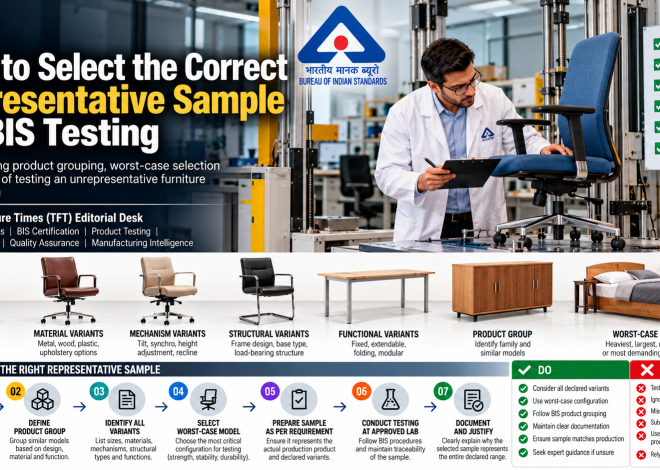
Step 1: Build a market-access matrix
List every destination country and sales channel. Identify mandatory laws, relevant standards, labelling, testing, registration and economic-operator obligations.
Step 2: Classify the product correctly
Determine its use, user group, environment and special functions. A children’s bunk bed cannot be treated like a general adult bed.
Step 3: Conduct risk assessment before design freeze
Examine misuse as well as intended use. Consumers may stand on chairs, climb drawers, overload shelves or incorrectly assemble components.
Step 4: Control product families and variants
Document which variations are technically covered and which require separate assessment or testing.
Step 5: Use competent laboratories
Confirm that the laboratory has appropriate accreditation and that the precise test method appears within its recognised scope where required.
Step 6: Prepare the factory
Production controls, equipment, staff responsibilities, inspection records and traceability must support continuing conformity.
Step 7: Verify packaging and online listings
Warnings, identifiers and instructions must remain consistent across the product, carton, manual, website and marketplace listing.
Step 8: Control every change
A change to a screw, foam, board, finish or supplier can affect safety and compliance. Establish a formal approval process.
Step 9: Monitor the market
Review complaints, returns, near misses, failures and customer misuse. These are early-warning signals.
Step 10: Maintain recall readiness
A company should know how to identify affected units, contact buyers, notify authorities where necessary and implement corrective action.
Compliance is becoming a competitive advantage
Compliance is often discussed as a cost. Poor compliance, however, is far more expensive.
A failed product can result in:
- Shipment delays
- Customs detention
- Re-testing
- Product redesign
- Retailer penalties
- Project rejection
- Marketplace removal
- Customer injury
- Legal claims
- Recalls
- Lost insurance protection
- Damaged brand reputation
- Permanent loss of a buyer
Conversely, a company with strong compliance systems can respond faster to tenders, enter new markets more confidently and provide buyers with reliable technical information.
Compliance creates commercial value because it reduces uncertainty.
The manufacturer that can immediately provide accurate drawings, test evidence, material declarations, traceability and factory records is easier to trust than one that must search through emails whenever a buyer raises a question.
SMEs must not be excluded from the compliance economy
Small manufacturers and artisans frequently produce excellent furniture but lack access to testing, certification expertise and international regulatory information.
The global industry needs:
- Shared testing facilities
- Simplified compliance guidance
- Cluster-level technical support
- Group training
- Approved-supplier directories
- Design-review services
- Affordable digital traceability
- Translation support
- Compliance grants
- Transparent laboratory pricing
Compliance should improve product safety without becoming an information barrier that automatically excludes capable small businesses.
Digital discovery platforms can help by connecting manufacturers with testing laboratories, standards specialists, material suppliers, certifiers, consultants and responsible buyers.
The future: every product will need an evidence trail
Furniture is moving from a largely anonymous product economy toward an evidence-based system.
In the future, buyers may expect to scan a product identifier and find:
- Who manufactured it
- Where it was produced
- What materials it contains
- Which standards it meets
- How it should be assembled
- How it can be repaired
- Which parts can be replaced
- Where the timber originated
- How it should be recycled
- Whether a safety notice applies
This does not mean that every jurisdiction will impose identical requirements. It means that the direction of travel is toward greater transparency, traceability and accountability.
The businesses that prepare their product data now will be better positioned for that future.
TFT conclusion: compliance is the infrastructure of trust
Furniture compliance is not a laboratory report stored in a forgotten folder. It is a living management system connecting product design, materials, suppliers, manufacturing, testing, documentation, marketing, installation and after-sales responsibility.
It protects users. It protects buyers. It protects manufacturers. It protects the reputation of the wider industry.
In the furniture industry ecosystem—a $1 trillion industry ecosystem—trust must be supported by evidence.
The Furniture Times tells their story.
Furniture Industry Search Engine helps the world find them.
FurniReviewology helps the world trust them.
Manufacturers, suppliers, importers, retailers, laboratories, consultants, standards organisations and compliance professionals must become visible and searchable across the global ecosystem.
Be the next one. Be part of the movement.
Editorial note: This report provides general industry information as of August 2026. Furniture regulations differ by jurisdiction, product type and intended use. Companies should verify current requirements with the relevant authority and qualified compliance professionals before manufacturing, importing or selling a product.