Malaysia’s Furniture Exports to Europe Fall as Mixed-Material Designs Reshape the Market
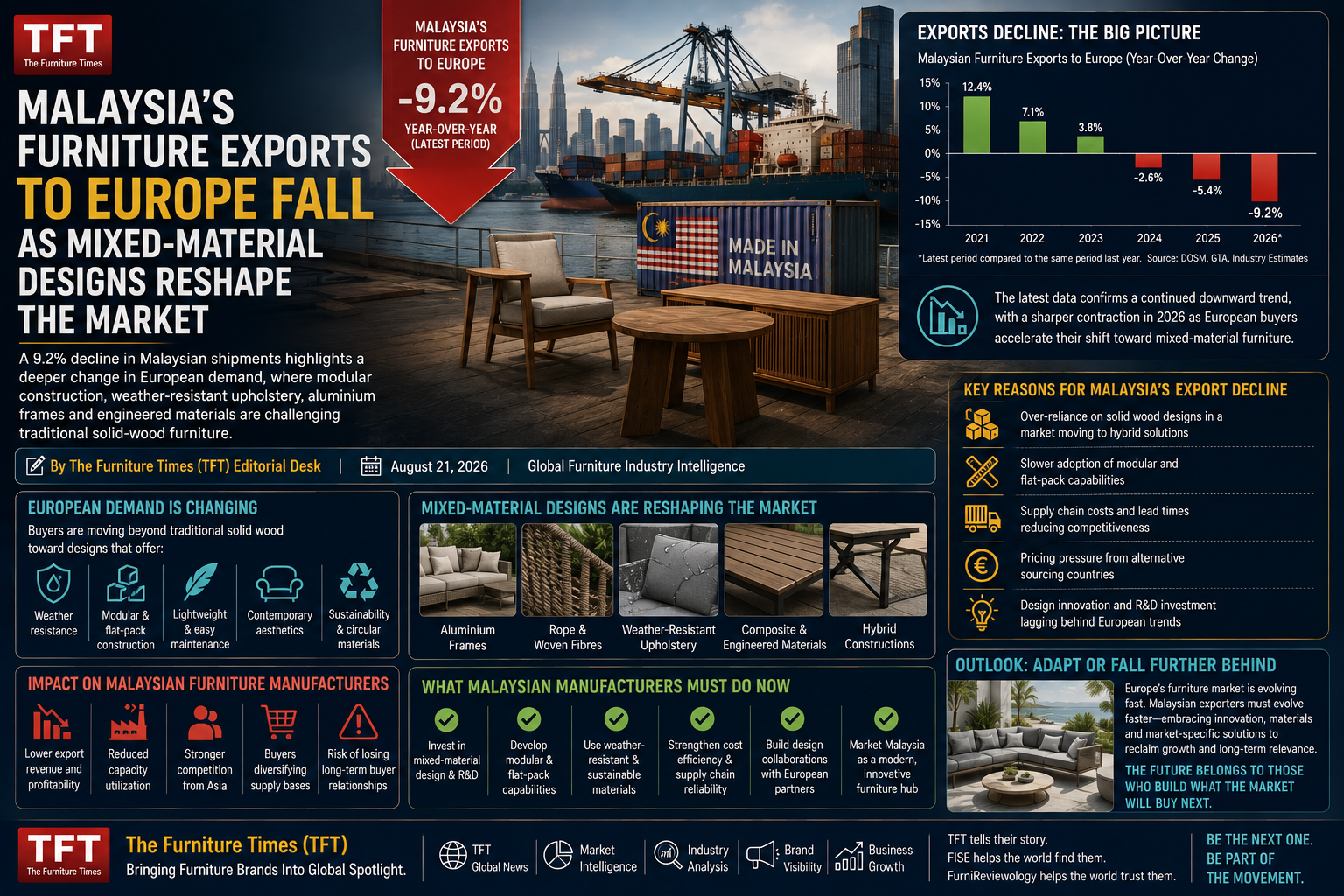
A 9.2% decline in Malaysian shipments highlights a deeper change in European demand, where modular construction, weather-resistant upholstery, aluminium frames and engineered materials are challenging traditional solid-wood furniture
By The Furniture Times (TFT) Editorial Desk | August 21, 2026 | Global Furniture Industry Intelligence
Malaysia’s furniture industry is confronting an important shift in one of the world’s most influential consumer markets. Imports of Malaysian tropical wooden furniture into Europe fell during the first four months of 2026 as European buyers increasingly moved toward modular, lightweight and mixed-material products.
The decline is not simply a short-term export fluctuation. It points to a broader transformation in the way furniture—particularly outdoor furniture—is designed, specified, manufactured, transported, maintained and marketed.
According to figures reported by the International Tropical Timber Organisation and compiled from Eurostat COMEXT and UK Customs data, European imports of tropical wooden furniture declined by 2.6% year on year to approximately 174,000 tonnes between January and April 2026. Malaysia’s shipments fell by 9.2%, while exports from Indonesia declined by 11%. Interior Daily, Sarawak Tribune
Malaysia remained Europe’s second-largest tropical wooden furniture supplier, but the fall is strategically significant. India increased its shipments by 7.8% to approximately 28,000 tonnes, bringing its export volume close to Malaysia’s, while Vietnam maintained its position as the largest tropical supplier with approximately 77,000 tonnes.
The message for Malaysian furniture manufacturers is becoming clear: Europe is not abandoning wood, but the market is redefining where and how wood is used.
Europe’s tropical furniture imports lose momentum
The combined European market—covering the European Union’s 27 member states and the United Kingdom—imported approximately 174,000 tonnes of tropical wooden furniture during the first four months of 2026.
The performance of the major supplying countries differed considerably:
| Supplying country | January–April 2026 performance |
|---|---|
| Vietnam | Approximately 77,000 tonnes; broadly stable |
| Malaysia | Down 9.2% year on year |
| India | Up 7.8% to approximately 28,000 tonnes |
| Indonesia | Down 11% |
| Brazil | Down 11% |
The decline followed a stronger period for Malaysian exporters. Malaysia’s shipments to Europe had reportedly increased by 20% during 2024 to approximately 87,000 tonnes, followed by growth of 22% in the first quarter of 2025.
That comparison makes the 2026 reversal especially important. It suggests that the recovery experienced in 2024 and early 2025 did not automatically translate into permanent market-share protection.
Demand conditions have become more selective, while the competitive definition of furniture has expanded beyond traditional wooden construction.
Different European countries are moving in different directions
The European market cannot be treated as a single, uniform destination.
The United Kingdom remained the largest European destination for tropical wooden furniture, accounting for 31.4% of total imports. UK volumes were broadly unchanged at approximately 54,600 tonnes during the January-to-April period.
Performance elsewhere was mixed:
- Imports into France declined by 9%.
- Belgium recorded a fall of 17.4%.
- Denmark declined by 16.9%.
- Poland fell by 11.8%.
- Germany and Spain each recorded declines of approximately 1%.
- Italy increased its imports by 8.6%.
- The Netherlands registered growth of 4.8%.
These differences matter for manufacturers and exporters.
A company selling one largely standardised collection across Europe may miss the distinctions between national markets. Product dimensions, architectural styles, climate, housing density, retail channels, garden ownership, hospitality investment and consumer attitudes toward maintenance can all affect furniture demand.
The Netherlands and Italy, for example, may present different opportunities from France, Denmark or Belgium. Exporters therefore need country-level product strategies rather than relying entirely on a broad “European collection.”
The deeper issue: furniture is becoming hybrid
Europe’s changing demand is particularly visible in the outdoor furniture category.
Traditional outdoor furniture was often defined by its principal material. Buyers selected wooden, metal, plastic or rattan collections, and manufacturers organised their factories around one dominant production competency.
That model is changing.
Contemporary outdoor collections increasingly combine:
- Aluminium or steel structural frames
- Visible timber arms, tops, legs or decorative details
- Weather-resistant upholstery
- Synthetic rope and woven fibres
- Engineered composite surfaces
- High-performance foams
- Powder-coated metal components
- Removable and washable fabrics
- UV-resistant finishes
- Modular connectors and replaceable components
This means that a product may still communicate the warmth and appearance of timber without being constructed principally from solid wood.
For traditional wooden furniture exporters, this is an important distinction. The market may continue to appreciate timber aesthetically while reducing the physical quantity of wood used in each product.
Wood may become an accent, tactile surface or premium visual feature within a larger mixed-material system.
Indoor and outdoor furniture are beginning to look alike
One of the strongest trends shaping the European market is the diminishing visual difference between indoor and outdoor furniture.
Consumers increasingly expect terraces, balconies, gardens, rooftop spaces and hospitality environments to offer the comfort and appearance previously associated with indoor living rooms.
Outdoor sofas now feature deeper seats, softer profiles, tailored upholstery and decorative cushions. Dining collections are becoming visually lighter. Modular lounges can be rearranged according to space and occasion. Outdoor side tables and storage units are expected to coordinate with broader interior-design themes.
Improved fabrics, foams, coatings and surface treatments have made this transition possible.
The result is a new competitive standard. Outdoor furniture must increasingly provide:
- Indoor-level comfort
- Strong weather resistance
- Low maintenance
- Lightweight handling
- Flexible configurations
- Efficient storage
- Replaceable cushions and covers
- Visual compatibility with residential interiors
- Reliable commercial performance
Solid wood can satisfy some of these requirements, especially durability, natural appearance and perceived quality. However, it can be disadvantaged when consumers or commercial buyers prioritise low weight, minimal maintenance and easy repositioning.
This does not mean the end of wooden outdoor furniture. It means that wood-focused manufacturers must reconsider the material architecture of their collections.
Why aluminium and composites are gaining ground
Aluminium has become particularly attractive to outdoor furniture manufacturers because it is relatively lightweight, corrosion resistant and adaptable to different shapes and finishes.
Powder-coated aluminium frames can support contemporary silhouettes while being easier for consumers, hospitality employees and logistics teams to handle. They can also be combined with timber slats, composite tabletops, rope weaving and upholstered cushions.
Synthetic fibres and engineered composites provide additional advantages. Depending on their formulation and construction, they can offer resistance to moisture, ultraviolet exposure, staining and temperature changes.
These materials also make it possible to standardise components across several product collections.
A manufacturer might use the same frame platform for:
- A two-seat sofa
- A three-seat sofa
- A corner module
- A lounge chair
- A daybed
- A dining bench
Different arms, cushions, panels or tabletop materials can then create multiple commercial variations.
This platform-based approach can reduce product-development time and improve flexibility. It also suits retailers that want coordinated collections without committing to very large volumes of each individual model.
Europe’s contract market is changing supplier expectations
The shift is not limited to retail consumers.
European hospitality, commercial and contract-furniture buyers increasingly require dependable specifications, shorter production runs, consistent finishes, project-based delivery and replacement availability.
A hotel, restaurant, resort or residential development may need multiple furniture categories supplied as part of one coordinated project. The buyer may want outdoor seating, dining tables, loungers, side tables, planters and accessories to follow the same design language.
Traditional commodity production is less suited to this requirement.
Contract buyers frequently expect suppliers to provide:
- Technical drawings
- Material declarations
- Fire-performance documentation
- Finish samples
- Test results
- Packaging specifications
- Installation instructions
- Replacement-part availability
- Batch consistency
- Delivery schedules linked to project phases
- Traceability and sustainability evidence
This shifts competition away from manufacturing capacity alone. Project coordination, documentation, engineering and service reliability become part of the product.
Malaysian manufacturers with strong production experience may therefore need to strengthen the commercial and technical systems surrounding their manufacturing operations.
China’s growth intensifies the pressure
While tropical-country shipments to Europe declined, European imports of wooden furniture from China increased sharply.
Imports from China rose by 23.5% to approximately 741,500 tonnes during the first four months of 2026. China supplied around two-thirds of Europe’s extra-regional wooden furniture imports and accounted for virtually all of the period’s year-on-year import growth. Sarawak Tribune
The United Kingdom imported approximately 214,200 tonnes of Chinese wooden furniture, representing an increase of 17.3%.
Other major changes included:
- Netherlands: up 44.1% to approximately 129,600 tonnes
- France: approximately 89,900 tonnes
- Germany: approximately 86,900 tonnes
- Belgium: up 72.5%
These figures demonstrate that the decline in tropical wooden furniture cannot be explained only by weak European consumption. Some suppliers and product categories are gaining even as others lose ground.
China’s advantage is not confined to price. Its manufacturing ecosystem can integrate wood, metal, plastics, glass, upholstery, electronics, hardware, packaging and accessories within extensive supply networks.
That integration is especially valuable in a mixed-material market.
A furniture company sourcing a modular outdoor collection may prefer a supplier capable of coordinating aluminium extrusion, welding, powder coating, timber machining, fabric procurement, foam production and final assembly within one connected production network.
Malaysia must therefore compete at the ecosystem level rather than relying solely on its reputation for wooden furniture.
A national export slowdown adds urgency
Malaysia’s broader furniture exports have also faced pressure.
Total furniture exports reportedly declined to RM12.53 billion in 2025 from RM12.83 billion in 2024 and from a recent peak of RM13.86 billion in 2022. These figures cover wooden, metal and plastic furniture, seats and parts, and furniture made from other materials. The Edge Malaysia
The European decline therefore arrives at a time when manufacturers are already confronting cost pressures and strong regional competition.
Malaysia retains substantial advantages:
- An established export-manufacturing base
- A concentrated furniture cluster in and around Muar
- Extensive rubberwood expertise
- Experienced manufacturers and subcontractors
- Familiarity with international quality requirements
- Access to global shipping routes
- A skilled furniture-production workforce
- Long-standing relationships with overseas retailers and importers
However, these advantages must evolve with the market.
A factory designed primarily to produce high volumes of conventional wooden dining sets cannot assume that the same product mix will remain competitive indefinitely.
Malaysia’s rubberwood strength must become a design advantage
Rubberwood has played an important role in Malaysia’s furniture-development story. Its availability, machinability and suitability for furniture production helped the country build a competitive export industry.
But material availability alone does not guarantee future demand.
The next stage must involve positioning Malaysian timber as part of a design, sustainability and performance proposition.
Instead of competing only through the quantity of wood used, manufacturers can increase value through:
- Precision-machined timber components
- Premium visible surfaces
- Distinctive edge profiles
- Tactile armrests and handles
- Interchangeable wooden panels
- Repairable components
- Certified and traceable material
- Lower-emission finishes and adhesives
- Design stories connected to Malaysian manufacturing
- Hybrid structures that reduce unnecessary material use
This strategy would allow wood to retain an important role even when aluminium, textiles or composites provide the primary structure.
The opportunity is not necessarily to defend all-solid-wood construction at any cost. It is to ensure that Malaysian wood expertise remains relevant inside the next generation of furniture.
Mixed-material production creates new operational challenges
Diversifying into hybrid furniture is not as simple as adding a metal frame or upholstered cushion to an existing wooden product.
Every additional material introduces new engineering and quality-control requirements.
Material movement
Wood responds to humidity and temperature differently from metal or composite materials. Connections must accommodate expansion and contraction without producing cracks, loosening or distortion.
Corrosion and staining
Contact between metals, coatings, fasteners, timber preservatives and moisture can create corrosion or surface staining if materials are not properly specified.
Joint performance
A hybrid product depends on the strength of the interfaces between materials. Fasteners, brackets, inserts and connectors must perform reliably throughout repeated use.
Colour consistency
Powder-coated metal, stained timber, woven fibre and upholstery fabric must remain visually coordinated across different suppliers and production batches.
Packaging
Mixed-material furniture may contain scratch-sensitive surfaces, cushions vulnerable to compression and structural parts with different protection requirements.
Repair and recycling
Combining materials can make a product more difficult to repair or recycle unless it is designed for disassembly.
The shift toward mixed materials therefore requires investment in engineering, testing, supplier management and traceability—not merely styling.
Sustainability evidence is becoming commercially essential
European buyers are placing increasing emphasis on responsible sourcing, traceability and product-level environmental information.
Furniture containing wood may fall within the scope of the European Union’s deforestation-related due-diligence framework, depending on its classification and the applicable implementation timeline. Exporters must therefore be prepared to connect finished products with credible origin and supply-chain records.
In 2025, Malaysia was classified as a standard-risk country under the EU’s country-benchmarking system, and the Malaysian government said it was developing measures to preserve export competitiveness and help affected industries comply. The regulation covers wood and certain downstream products, including furniture. Reuters
For exporters, compliance is becoming part of market access.
The necessary information may include:
- Species identification
- Country and region of harvest
- Supplier records
- Chain-of-custody documentation
- Geolocation or due-diligence information where applicable
- Product-level material breakdowns
- Evidence supporting legality and deforestation-free claims
- Records connecting purchased timber with finished-product batches
Mixed-material products make this task more complex because several supply chains converge in one finished item.
The manufacturer must understand not only where its timber came from but also the composition, origin, chemical compliance and recyclability of coatings, textiles, foams, plastics and composites.
The industry must move from OEM capacity to design-led value
Malaysia’s export industry has historically benefited from original-equipment manufacturing, producing goods to international buyers’ specifications.
That model continues to be valuable, but it places much of the intellectual property, market knowledge and brand value in the hands of the buyer.
A more resilient strategy would combine OEM capability with stronger original-design manufacturing and selective brand development.
Manufacturers should consider building internal or shared capabilities in:
- European lifestyle research
- Trend interpretation
- Industrial design
- Colour, material and finish development
- Digital prototyping
- Rapid sample production
- Furniture testing
- Product photography and visualisation
- Technical data creation
- International marketing
- Brand and design protection
The objective is not for every factory to become a consumer brand. The objective is for Malaysian suppliers to participate more deeply in product decisions and capture more value from their knowledge.
What Malaysian manufacturers should do next
1. Audit the existing product portfolio
Manufacturers should identify which products are overly dependent on traditional solid-wood formats and which can be adapted to hybrid construction.
The audit should examine sales performance, margin, material use, freight efficiency, assembly time, maintenance requirements and customer feedback.
2. Build cross-material partnerships
Not every wooden furniture company needs to establish its own metalworking, textile or composite-material facility.
Strategic partnerships with qualified suppliers may be faster and less capital-intensive. The priority should be a controlled network capable of delivering consistent specifications.
3. Develop modular product platforms
A modular system can create multiple configurations from a controlled number of components. This helps retailers manage inventory and allows contract buyers to adapt products to different spaces.
4. Improve rapid prototyping
European buyers increasingly expect quick product development and smaller initial runs. Digital design, CNC machining, 3D visualisation and disciplined sample management can shorten the development cycle.
5. Design for maintenance and replacement
Replaceable cushions, covers, glides, connectors, slats and surface panels can extend product life and improve the commercial offer.
6. Strengthen traceability
Material records should be connected with stock control, production orders and finished-product identification. Compliance cannot be assembled hurriedly after a buyer requests it.
7. Segment Europe country by country
Exporters should monitor demand in the UK, Germany, France, Italy, the Netherlands and other markets independently.
8. Sell performance, not only material
Marketing should explain durability, maintenance, testing, repairability, delivery reliability and environmental credentials rather than relying solely on “solid wood” as the principal value proposition.
Responsibilities for industry organisations and policymakers
The adjustment cannot be left entirely to individual manufacturers, particularly small and medium-sized businesses.
Industry associations, government agencies, technical institutions and export-development organisations can support the transition through:
- Shared materials and trend libraries
- European market-intelligence programmes
- Design-development grants
- Export-readiness training
- Product-testing facilities
- Traceability systems
- Collaborative supplier directories
- Contract-furniture education
- International exhibition support
- Digital cataloguing and discovery platforms
- Partnerships between timber, metal, textile and chemical industries
Malaysia’s furniture ecosystem will be stronger if manufacturers can find capable domestic partners for metal fabrication, upholstery, coatings, hardware, packaging, testing and logistics.
This is where industry visibility becomes a practical commercial tool. A searchable, verified ecosystem can help a wooden furniture producer identify a suitable metal specialist, fabric supplier, designer, testing laboratory or export partner without depending entirely on informal networks.
Opportunities for component and accessory suppliers
The transition toward mixed-material furniture can create opportunities across the components industry.
Potential growth areas include:
- Concealed modular connectors
- Corrosion-resistant fasteners
- Outdoor-grade mechanisms
- Aluminium profiles
- Adjustable feet and glides
- Replaceable furniture panels
- Weather-resistant fabrics
- Quick-dry foam
- UV-resistant synthetic rope
- Powder coatings
- Protective furniture covers
- Recyclable packaging
- Disassembly-friendly hardware
This illustrates why the furniture industry must be understood as an ecosystem. A change in European styling preferences affects timber processors, metal fabricators, coating companies, textile suppliers, hardware producers, designers, laboratories, packaging businesses and logistics providers.
What European buyers should consider
The transition to mixed materials also creates responsibilities for retailers, importers and contract buyers.
Lower-cost or lighter products should not automatically be assumed to offer better long-term value. Buyers need to examine:
- Structural durability
- Availability of replacement parts
- Corrosion resistance
- Fabric performance
- UV stability
- Repairability
- End-of-life separation
- Chemical compliance
- Material traceability
- Supplier quality systems
A complex hybrid product can perform extremely well when engineered correctly. Poorly designed mixed-material furniture, however, can fail at the joints, coatings, textiles or material interfaces.
Buyer decisions should therefore be based on evidence rather than appearance or initial price alone.
A warning—but also an opportunity
Malaysia’s 9.2% decline in European tropical wooden furniture shipments should be treated as an early strategic warning, not a verdict on the future of the industry.
European consumers have not stopped valuing wood. They are asking furniture to provide more: greater comfort, reduced maintenance, lighter construction, modularity, traceability and visual continuity between indoor and outdoor spaces.
Malaysia has the manufacturing history, supplier knowledge and export experience to respond. But success will require faster design development, deeper cross-material collaboration and stronger product-level evidence.
The companies that adapt will not necessarily use less of their timber knowledge. They will use that knowledge more intelligently—placing wood where it creates the greatest visual, tactile, structural and commercial value.
The wider furniture-industry lesson
The market is no longer organised into isolated categories of wooden, metal, plastic or upholstered furniture.
It is becoming an interconnected system in which materials, components, technology, logistics, standards, sustainability, design and digital visibility determine competitiveness together.
The wider furniture industry ecosystem—including manufacturers, artisans, suppliers, designers, retailers, machinery companies, component producers, logistics providers and service organisations—is frequently described by TFT as a $1 trillion industry ecosystem.
To participate effectively in that ecosystem, businesses must be visible, understandable and trustworthy.
The Furniture Times tells their story.
Furniture Industry Search Engine helps the world find them.
FurniReviewology helps the world trust them.
The change taking place in Europe is not merely a threat to Malaysia’s traditional furniture exports. It is an invitation to redesign the country’s value proposition for the next generation of global buyers.
Be the next one. Be part of the movement.
Sources:
Interior Daily — Malaysia furniture exports fall as Europe shifts towards mixed materials
Sarawak Tribune — Malaysia furniture exports decline in Europe
The Edge Malaysia — Furniture players flag rising costs and export pressure
Reuters — Malaysia’s preparations for EU deforestation requirements