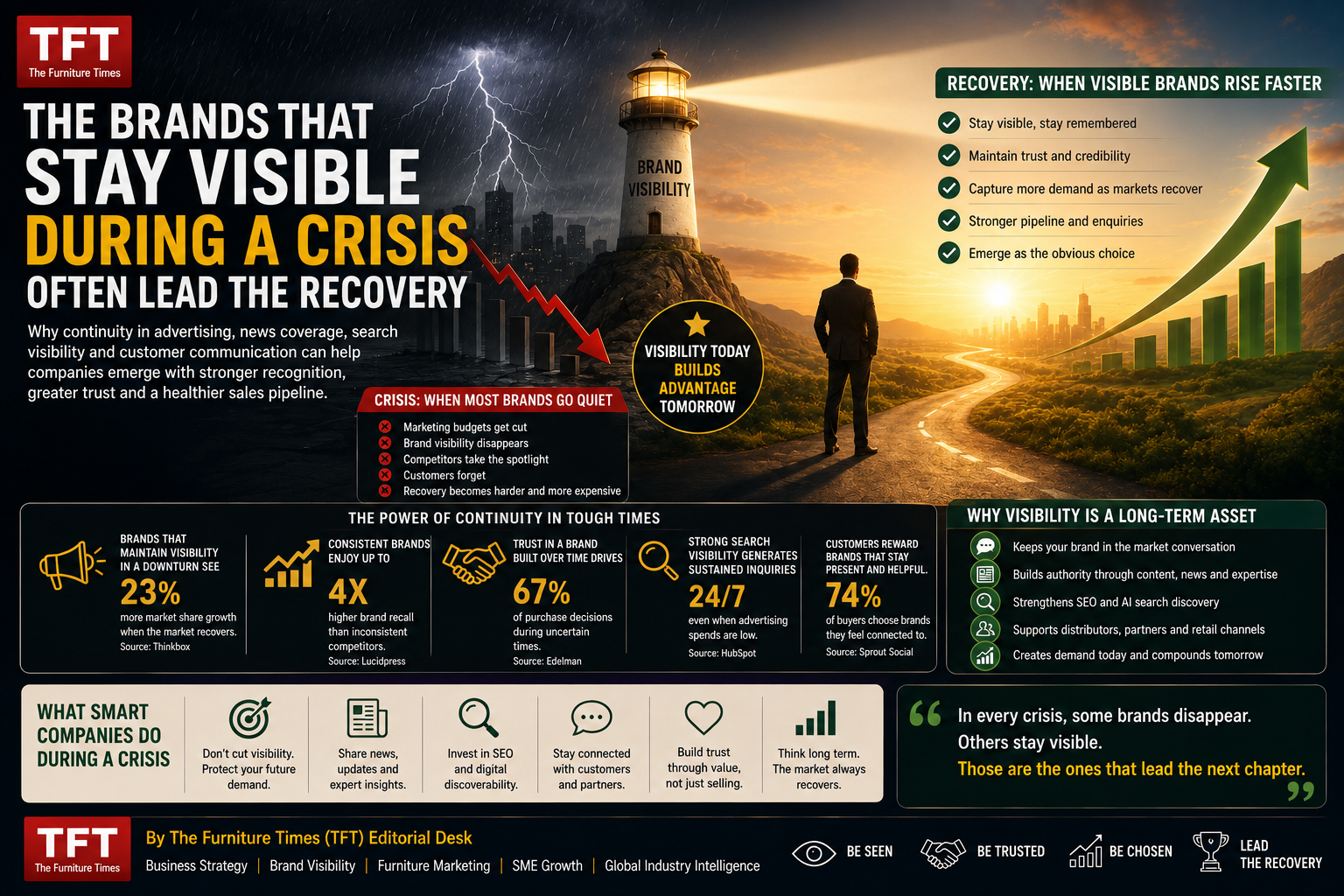
The Brands That Stay Visible During a Crisis Often Lead the Recovery
Why continuity in advertising, news coverage, search visibility and customer communication can help companies emerge with stronger recognition, greater trust and a healthier sales pipeline
By The Furniture Times (TFT) Editorial Desk | Business Strategy | Brand Visibility | Furniture Marketing | SME Growth | Global Industry Intelligence
Economic uncertainty changes the way companies behave.
As sales slow, costs rise and customers become more cautious, business leaders naturally begin reviewing expenditure. Investment decisions are delayed, recruitment is frozen, inventories are reduced and marketing budgets often become one of the first targets.
Controlling expenditure during difficult periods may be necessary. No responsible company should continue wasting money on ineffective campaigns merely to appear active. But there is an important difference between improving marketing efficiency and allowing a brand to disappear.
The first protects the business. The second can weaken its future.
A crisis does not stop customers from observing the market. It does not stop buyers from researching suppliers, architects from developing specifications, retailers from evaluating collections or distributors from searching for new partners. Demand may decline, purchasing decisions may take longer and projects may be postponed—but commercial discovery continues.
When some companies become silent, the brands that remain visible can gain a larger relative share of attention. Their names remain familiar. Their products continue appearing in searches. Their news reassures customers that they are active. Their content helps buyers make decisions. Their communication gives the market reasons to remember and trust them.
When recovery begins, these companies may not need to introduce themselves again. They are already present in the customer’s mind.
That is why the brands that maintain disciplined visibility during a crisis often enter the recovery period from a position of strength.
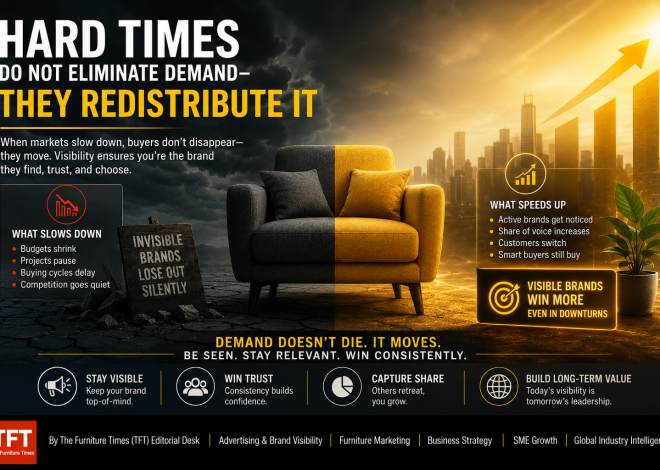
A crisis changes demand—but it does not eliminate it
One of the most damaging assumptions companies make during a downturn is that there is no demand available.
In reality, demand is rarely eliminated completely. It changes in volume, timing, geography, product category and customer priority.
Some consumers postpone major purchases. Others move toward affordable alternatives. Commercial projects may be delayed, while repair, refurbishment and replacement demand increases. Luxury purchases may remain resilient among certain customer groups even as mass-market demand weakens. Public-sector and institutional procurement may continue when residential spending slows.
Within the furniture industry, demand may redistribute across:
- Residential replacement furniture
- Hospitality refurbishment
- Office redesign and workplace adaptation
- Healthcare and senior-living furniture
- Educational furniture
- Rental and co-living accommodation
- Outdoor and leisure furniture
- Repair, restoration and reupholstery
- Affordable and multifunctional products
- Premium custom furniture
- Project and contract furniture
- Second-hand and refurbished furniture
A company that disappears from the market may miss these shifts because it is no longer communicating with customers or monitoring emerging enquiries.
A visible company has a better opportunity to recognise where demand has moved and reposition its message accordingly.
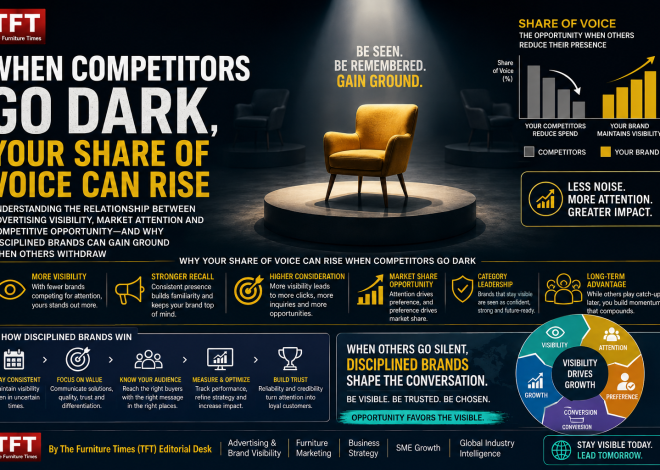
Visibility becomes relatively more powerful when competitors retreat
Brand visibility is not measured only by how much a company communicates. It is also influenced by how active its competitors remain.
In a strong market, buyers may encounter dozens of competing advertisements, articles, product launches and exhibition announcements. Capturing attention can require considerable frequency and investment.
During difficult periods, many competitors reduce communication. Some stop advertising completely. Others allow websites to become outdated, abandon content programmes and stop publishing news.
This reduction in competitive noise creates an opportunity.
A company maintaining even a carefully controlled level of activity can achieve a greater relative presence. Its voice becomes easier to hear because fewer competitors are speaking.
This is known as gaining a stronger relative share of voice—the proportion of market communication associated with one brand compared with others in the same category.
A business does not necessarily need to spend more than it did before the crisis. It may gain greater visibility simply by remaining strategically active while competitors become silent.
Customers remember the brands they continue to encounter
Brand memory is built through repetition.
Customers rarely remember a company after seeing it only once. Recognition develops when the same name appears across credible and relevant touchpoints:
- Search results
- Industry news
- Business directories
- Product listings
- Customer reviews
- Social media
- Email communication
- Dealer showrooms
- Exhibitions
- Project references
- Professional recommendations
During a crisis, continued exposure reassures the market that the company is still operating, serving customers and investing in its future.
When purchasing power returns, buyers often begin with the brands they already recognise. Familiarity reduces the perceived risk of making a decision.
A company that remained present may therefore receive the enquiry before a silent competitor has even restarted its campaign.
Silence can create doubts about business stability
Customers do not always interpret silence neutrally.
If a company’s website has not been updated for years, its latest social post is several months old and there is no recent news about its products or operations, potential buyers may wonder:
- Is the company still trading?
- Can it fulfil new orders?
- Does it still manufacture this product?
- Is the contact information current?
- Will it honour its warranty?
- Can it supply replacement parts?
- Has its dealership or showroom closed?
- Is it financially stable enough to complete a project?
These questions are particularly important in the furniture industry because customers may need long-term assurance.
A hotel purchasing hundreds of pieces needs confidence that the manufacturer can deliver. A retailer evaluating a supplier must know that inventory and service will remain available. An architect specifying furniture for a large project needs reliable technical information and continuity.
Regular, factual communication helps reduce these doubts.
Factory updates, completed projects, product developments, leadership commentary, certifications, new appointments and customer case studies all provide evidence that the business remains active.
Visibility strengthens customer confidence
Customers become more risk-conscious during uncertain periods. They examine suppliers more carefully, compare more options and search for evidence of reliability.
A visible company can continuously provide that evidence.
It can communicate:
- How it is protecting product quality
- Whether delivery schedules remain stable
- What materials and components it uses
- Which certifications it maintains
- How it supports warranties and repairs
- What projects it has completed
- How existing customers evaluate its service
- What actions it is taking to remain resilient
This creates confidence before the customer speaks to a salesperson.
Visibility therefore does more than create awareness. It can lower perceived risk, shorten the decision process and support conversion.
Staying visible protects pricing power
A company that disappears from public view may find it increasingly difficult to explain its value.
Without consistent communication, customers see less evidence of the brand’s craftsmanship, design expertise, manufacturing controls, sustainability, service and reliability. The product becomes easier to compare only by price.
This weakens pricing power.
Furniture is especially vulnerable because two products may look similar in an image while differing significantly in:
- Frame construction
- Foam density
- Timber quality
- Fabric performance
- Hardware durability
- Joinery
- Finishing processes
- Ergonomics
- Testing
- Warranty protection
- Repairability
- Delivery and installation service
Marketing and editorial communication help make these hidden differences visible.
When customers understand why a product offers better performance or lower lifetime cost, a business has a stronger basis for protecting margins.
A silent brand may be forced to rely on discounts because it has stopped communicating the reasons customers should pay more.
Continuity protects the sales pipeline
Furniture purchasing decisions often develop over long periods.
A consumer may research a sofa for several weeks. A retailer may evaluate a supplier over several months. A hotel refurbishment can take years from early planning to final installation. Architects may begin researching materials and furniture before a formal tender exists.
Marketing supports these early stages of demand.
A company may not receive an immediate order from an article, product page or industry listing. But the information can introduce the brand to a buyer who later adds it to a shortlist, requests a sample, visits a showroom or issues an enquiry.
When marketing stops, fewer new prospects enter the pipeline. Existing enquiries may temporarily conceal the problem because they were generated by earlier activity.
Sales can continue for a time, creating the impression that marketing is unnecessary. But once the inherited pipeline is consumed, the business may experience a sudden shortage of new opportunities.
Companies that maintain communication continue planting the seeds of future sales—even when immediate conversion is slower.
Recovery starts before it becomes visible in the headlines
Waiting for an official recovery announcement can be expensive.
Markets do not recover at a single moment. Improvement often begins gradually and unevenly. Certain cities, consumer groups or product categories may strengthen before national figures show a clear turnaround.
By the time economic recovery becomes obvious, customers may already have:
- Resumed research
- Restarted postponed projects
- Updated supplier lists
- Requested quotations
- Selected preferred brands
- Reserved production capacity
- Allocated marketing partnerships
- Scheduled showroom visits
- Begun negotiations
A company that waits for certainty may return too late.
Visible brands are more likely to detect early signals because they remain connected to customers, distributors, designers and industry networks. Their communication channels are already active, and their sales pipelines contain prospects at different stages.
Recovery therefore rewards preparedness rather than reaction.
The cost of restarting can exceed the cost of continuity
Marketing cannot always be switched off and restarted without consequence.
When a company withdraws for an extended period, it may lose:
- Search rankings
- Website traffic
- Media relationships
- Audience engagement
- Newsletter attention
- Customer familiarity
- Dealer enthusiasm
- Review momentum
- Sales-team confidence
- Share of voice
Restoring these assets requires time and investment.
Search authority must be rebuilt. Advertising campaigns require new testing and optimisation. Customers must see the brand repeatedly before recognition returns. Media relationships need to be renewed. Old product information must be corrected. Sales teams need fresh tools and qualified leads.
This accumulated burden is the company’s recovery debt.
A modest continuity programme during the crisis may cost less than rebuilding the entire visibility infrastructure afterwards.
Search and AI discovery make continuity more important
Today, customers do not discover brands only through traditional advertising.
They ask search engines and AI platforms questions such as:
- Which furniture manufacturers supply hotels?
- Who makes sustainable office furniture?
- Where can I buy commercial outdoor furniture?
- Which furniture companies export from Malaysia?
- Who supplies custom joinery for residential projects?
- Which furniture brands have strong customer reviews?
- What manufacturers can produce private-label collections?
To appear in these searches, businesses need accessible and credible information.
Search engines and AI systems rely on signals from websites, industry publications, business directories, product catalogues, structured data, reviews and other public sources.
If a company stops publishing and updating its information, its digital identity can become incomplete or outdated. AI systems may not understand what the business does, where it operates or why it should be recommended.
Competitors that continue producing clear, structured and authoritative information can become easier to find and recommend.
In the new discovery economy, continuity is not merely a promotional strategy. It is part of maintaining a machine-readable business identity.
Smaller brands can gain ground during difficult periods
A crisis does not automatically benefit the largest company.
Smaller businesses can gain visibility if they communicate more clearly, specialise more effectively and respond faster to changing customer needs.
A regional furniture manufacturer may not be able to match the advertising budget of a multinational brand. But it can publish detailed information about its capabilities, markets, materials, lead times and customisation.
An artisan may lack a large showroom but can present craftsmanship through credible stories and searchable portfolios.
A component supplier may be unknown to consumers but can create technical content that reaches manufacturers, designers and procurement teams.
When established competitors reduce activity, smaller businesses have an opportunity to occupy highly relevant search and editorial spaces.
The objective is not to appear everywhere. It is to become visible where the right customers are looking.
Continuous visibility does not require reckless spending
The argument for continuity is not an argument for uncontrolled marketing expenditure.
Businesses under pressure should remove waste, improve measurement and concentrate resources on activities that protect commercial relevance.
A focused visibility strategy may include:
Maintaining an accurate website
The website should clearly explain what the business sells, where it operates, who it serves and how customers can make contact.
Protecting important search positions
Businesses should preserve pages that attract qualified buyers and continue answering high-intent customer questions.
Publishing credible company news
Product launches, project completions, certifications, partnerships, appointments and market expansion can demonstrate activity and authority.
Strengthening business listings
Correct listings help buyers and digital platforms identify the company, its location, product categories and capabilities.
Collecting and responding to reviews
Recent customer feedback supports trust and gives buyers independent evidence of performance.
Communicating with existing customers
Email updates, service reminders and relevant offers can generate demand more economically than continually acquiring unfamiliar customers.
Repurposing content
A single useful story can become a news article, video, email, presentation, social post and sales document.
Supporting the sales team
Marketing should provide product information, case studies, testimonials, specifications and answers to common objections.
Measuring meaningful outcomes
Companies should monitor qualified enquiries, specification requests, branded searches, website conversion, dealer leads and repeat purchases—not only superficial engagement.
What furniture businesses should communicate during a crisis
Customers do not need exaggerated optimism. They need useful information and evidence of reliability.
Furniture companies can remain relevant by communicating:
- Product availability
- Delivery capabilities
- Updated lead times
- New materials and finishes
- Maintenance and care guidance
- Warranty processes
- Repair and replacement options
- Financing availability
- Quick-ship collections
- Project capabilities
- Export readiness
- Sustainability improvements
- Testing and certifications
- Customer success stories
- Factory and workforce developments
Communication should be consistent with the company’s operational reality. Overpromising during uncertainty can damage trust more severely than remaining silent.
Credibility must come before volume.
The internal benefits of remaining visible
External marketing also affects employees, sales representatives, dealers and business partners.
When a company continues communicating, it signals that leadership believes in the future. Sales teams receive fresh reasons to contact customers. Dealers see evidence that the supplier remains committed to supporting demand. Employees can share company achievements and feel connected to progress.
Silence can create the opposite effect.
Employees may assume that the business is in deeper difficulty than management has communicated. Salespeople may become defensive. Dealers may allocate showroom space to more active brands. Suppliers may become cautious about credit or production commitments.
Visibility therefore supports internal confidence as well as external recognition.
Who is most likely to lead the recovery?
The likely leaders are companies that combine financial discipline with market continuity.
They do not spend blindly. They identify which audiences remain commercially important and communicate with them consistently.
They use the crisis to improve:
- Customer knowledge
- Product information
- Website usability
- Search visibility
- Data quality
- Sales processes
- Reviews and reputation
- Dealer relationships
- Operational reliability
- Content efficiency
- Service standards
- Market positioning
These companies may not avoid every decline. Even strong brands can experience lower revenue during an industry downturn.
The advantage appears when demand returns.
They are more likely to possess stronger brand recall, warmer customer relationships, better digital authority, clearer market positioning and a more active sales pipeline.
A practical crisis-visibility framework
Business leaders can organise their strategy around five priorities.
1. Remain findable
Ensure that customers can discover the company through search engines, industry platforms, directories and AI-assisted research.
2. Remain understandable
Explain products, capabilities, service areas and competitive advantages in clear language.
3. Remain credible
Publish verifiable information, maintain recent reviews and demonstrate real experience.
4. Remain connected
Continue communicating with customers, dealers, designers, architects, suppliers and industry partners.
5. Remain ready
Prepare campaigns, inventory, product information and sales systems before demand accelerates.
This framework allows a company to reduce unnecessary expenditure without sacrificing its future market position.
Industry visibility must become shared infrastructure
The global furniture industry ecosystem includes far more than consumer-facing brands.
It encompasses manufacturers, component producers, textile suppliers, hardware specialists, machinery companies, logistics providers, designers, architects, retailers, dealers, installers, repairers, upholsterers, artisans, testing laboratories, trade associations and technology businesses.
Many of these participants remain difficult to discover.
A capable artisan may have no international visibility. A small manufacturer may be ready to export but absent from relevant searches. A component supplier may possess valuable technical expertise that has never been documented publicly.
During a crisis, these businesses are even more likely to reduce promotional activity because they cannot afford large advertising budgets.
The industry therefore needs discovery infrastructure that offers fair visibility, searchable information and credible trust signals—not only paid attention.
TFT, FISE and FurniReviewology: helping the industry remain visible, searchable and trusted
The Furniture Times gives businesses across the furniture ecosystem a platform through which they can tell their stories, communicate developments and demonstrate industry relevance.
The Furniture Industry Search Engine helps buyers discover manufacturers, suppliers, retailers, designers, artisans and service providers across countries and product categories.
FurniReviewology adds the essential trust layer by helping customers evaluate companies through reviews, reputation and real market experience.
Together, the three platforms support a modern journey from visibility to discovery to confidence:
TFT tells their story.
FISE helps the world find them.
FurniReviewology helps the world trust them.
The furniture industry ecosystem is a $1 trillion industry ecosystem.
Final analysis: continuity creates the conditions for recovery leadership
The companies that lead a recovery are rarely created on the day the economy improves.
Their position is built during the difficult period—when they continue serving customers, communicating value, improving operations and protecting visibility while others retreat.
A crisis can reduce immediate demand, but it also rearranges customer attention. Every competitor that becomes silent creates space. Every unanswered customer question creates an opportunity. Every outdated listing allows a more active company to become the recommended alternative.
Remaining visible does not guarantee success. Products must still perform, service must remain reliable and promises must be fulfilled.
But disappearing creates a predictable disadvantage.
The brands that maintain continuity preserve awareness. They reassure customers. They protect search authority. They keep sales pipelines alive. They retain relationships and remain present when postponed demand becomes active again.
When recovery arrives, customers will not begin with an empty memory.
They will remember the businesses that continued showing up.
Do not wait for the recovery to become visible. Stay visible now—so your brand can help lead it.