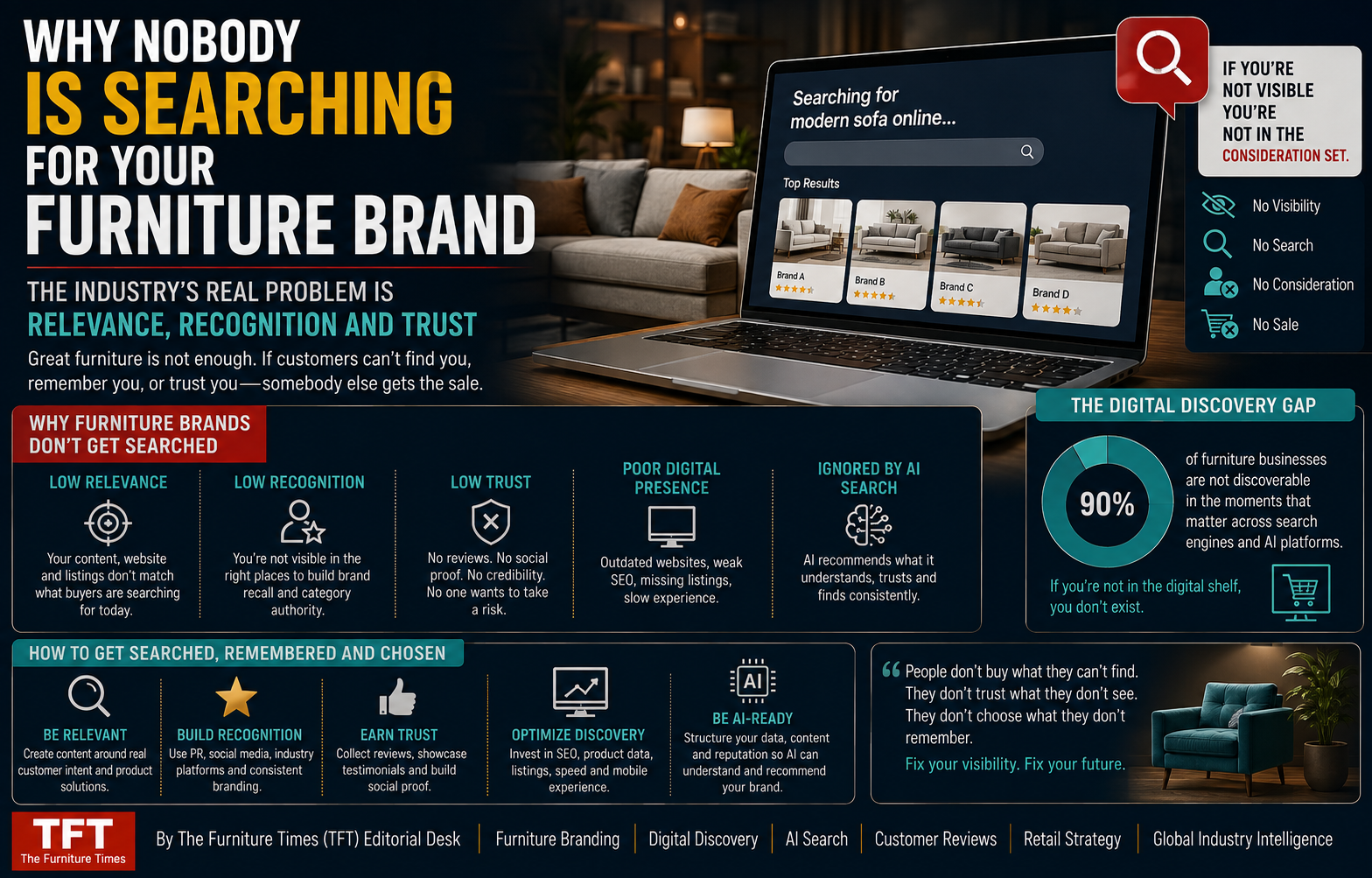
Why Nobody Is Searching for Your Furniture Brand
Why Nobody Is Searching for Your Furniture Brand: The Industry’s Real Problem Is Relevance, Recognition and Trust
Furniture companies may have good products, attractive showrooms and competitive prices—but customers cannot search for brands they do not remember, AI cannot recommend businesses it cannot understand, and buyers cannot trust companies without credible evidence
By The Furniture Times (TFT) Editorial Desk | Furniture Branding | Digital Discovery | AI Search | Customer Reviews | Retail Strategy | Global Industry Intelligence
The global furniture industry may be suffering from more than a traffic problem. It may be facing a deeper crisis of relevance.
Thousands of furniture manufacturers, retailers, suppliers, designers and independent craftspeople invest heavily in products, showrooms, machinery, inventory, catalogues and exhibitions. They tell customers that their furniture offers better quality, better comfort, better materials, better craftsmanship or better value.
Yet remarkably few furniture businesses are searched for by name.
Consumers search for “best sofa for a small apartment,” “ergonomic office chair near me,” “solid wood dining table,” “hotel furniture supplier,” “custom wardrobe manufacturer” or “affordable bedroom set.” They frequently search for a need, problem, room, style, price or location—but not necessarily for a particular furniture brand.
This gap between product availability and brand demand is at the center of the Furniture World article, “Why Nobody Is Searching For Your Furniture Brand,” published by Furniture World Magazine and attributed to furniture-industry brand strategist Bill Napier.
The article argues that the furniture sector has more of a relevance issue than a traffic issue. Consumers have changed how they discover, investigate, validate and purchase products, but many furniture companies continue operating as though the old purchasing funnel remains intact.
It does not.
Discovery now happens across social videos, creator content, online marketplaces, design platforms, search engines, AI assistants and retailer advertising. Validation happens through customer reviews, community discussions, comparison content and third-party media. The website may appear only near the end of the journey—as a confirmation layer, store locator or checkout utility.
This transformation has major consequences for the entire furniture industry ecosystem.
Having a website is no longer enough. Ranking for a few keywords is no longer enough. Publishing attractive room photography is no longer enough. Offering another discount is no longer enough.
A brand must be discoverable, relevant, understandable, differentiated, verifiable and trusted across every environment in which consumers make decisions.
The furniture industry has mistaken availability for demand
Furniture companies often assume that if products are available in stores or listed online, customers will eventually discover them.
But availability is not the same as demand.
A customer may see twenty similar sofas, ten comparable bedroom collections or dozens of dining tables within the same price range. If every company uses the same words—“quality,” “comfort,” “style,” “luxury,” “value” and “timeless design”—the products become difficult to distinguish.
The customer may recognize the category without remembering any of the brands.
This creates a commoditization problem. When buyers cannot identify a meaningful difference, they compare the factors that remain easiest to understand:
- Price
- Promotion
- Delivery speed
- Financing
- Star rating
- Availability
- Return conditions
Furniture brands then respond by offering larger discounts. Competitors match the discounts, and the market enters a cycle in which everyone becomes louder but few become more memorable.
The industry’s problem is not always that customers cannot see the products. It is that customers do not receive a compelling reason to search for the company again.
What does it mean when nobody searches for your brand?
Branded search occurs when a customer specifically looks for a company, retailer, manufacturer or collection by name.
It is an important signal because it suggests that the brand has already earned a position in the customer’s mind.
A person searching for “oak dining table” is exploring a category. A person searching for a specific furniture company followed by “oak dining table,” “reviews,” “warranty” or “near me” is investigating a known option.
Branded search can indicate:
- Awareness
- Recall
- Recommendation
- Previous experience
- Word-of-mouth interest
- Advertising impact
- Media exposure
- Retailer confidence
- Customer curiosity
- Purchase intent
Low branded-search volume does not automatically mean that a company has no value. A specialist contract manufacturer, component supplier or local craft workshop may serve an important market without generating large consumer search volumes.
But if a company wants to build brand equity and direct demand, an absence of branded search should be treated as a warning.
It may mean the business is visible only when it pays for an advertisement, appears on a marketplace or receives shelf space from a retailer. When the spending or placement stops, demand disappears.
That is not a strong brand. It is rented visibility.
The traditional furniture-purchasing funnel has fragmented
For many years, the assumed digital journey was relatively straightforward:
- The customer searches on Google.
- The customer clicks a website.
- The customer explores products.
- The customer visits a store or adds an item to the cart.
- The customer purchases.
Today, the path may look very different:
- The customer sees a room transformation on TikTok or Instagram.
- A creator discusses a furniture product on YouTube.
- The customer searches for related ideas on Pinterest.
- An AI assistant produces a shortlist.
- The customer reads reviews on a marketplace or independent platform.
- The customer examines Reddit or community discussions.
- The customer visits the brand’s website to confirm specifications.
- The transaction happens through a retailer, marketplace or physical store.
In some cases, the customer never visits the manufacturer’s website.
As Napier explained when introducing the Furniture World article, consumers now move through social platforms, review ecosystems, online communities, AI tools, creator content and retail touchpoints in a far less linear way. Discovery, validation and decision support can occur before a brand’s website becomes involved.
The website remains important, but its role is changing. It must confirm the credibility and relevance established elsewhere.
A polished website cannot compensate for a weak reputation across the rest of the internet.
Furniture brands are still communicating like product catalogues
Many furniture websites contain extensive lists of features but provide few meaningful answers.
A sofa page may mention hardwood framing, premium foam, imported fabric and multiple configurations. These facts may be useful, but they do not automatically address the customer’s practical concerns:
- Will it fit through my doorway?
- Is it suitable for children and pets?
- Will the cushions lose their shape?
- Is the cover removable?
- How firm is the seating?
- What happens if a component breaks?
- How long will delivery take?
- Can replacement parts be obtained?
- Does the color match what appears online?
- What do previous customers say after six months?
The company is describing the product while the customer is trying to solve a problem.
This is why answer-first content is becoming more valuable. Instead of starting with what the company wants to say, the content begins with what the customer wants to know.
Search engines and AI assistants also respond well to clear, useful answers. A company that publishes complete, well-structured information is easier for both people and machines to understand.
Discounting has become the furniture industry’s default language
One of the article’s central recommendations is to stop using discounts as the primary language of the brand.
Furniture promotions are so common that customers can struggle to distinguish between a genuine limited offer and the continuation of everyday pricing under a new sales-event name.
When every message focuses on percentages, clearance, lowest prices and final days, the brand teaches customers three things:
- The regular price may not be credible.
- The product is interchangeable with competing products.
- Waiting may produce a better offer.
Discounts can be useful for clearing aged inventory, stimulating seasonal demand or acquiring customers. But they should support the strategy—not become the entire strategy.
A strong furniture brand should communicate why it exists, whom it serves and what outcome it delivers.
That difference might be:
- Furniture specifically designed for compact urban homes
- Commercial seating engineered for intensive hospitality use
- Locally manufactured furniture with rapid delivery
- Custom furniture made for difficult room dimensions
- Repairable furniture supported by replacement components
- Certified low-emission furniture for health-conscious homes
- Ergonomic products for hybrid workers
- Senior-friendly furniture designed for accessibility
- Children’s furniture designed for safety and adaptability
- Durable outdoor furniture created for extreme climates
The clearer the relevance, the less dependent the company becomes on price promotions.
Better products are not automatically better brands
The furniture industry frequently assumes that product quality will eventually speak for itself.
Quality matters, but it cannot literally speak. It must be documented, demonstrated and validated.
A manufacturer may use stronger frames, better hinges, higher-density foam or more durable finishes than its competitors. If those differences are not explained in terms customers understand, they remain invisible.
Claims such as “premium construction” or “superior quality” are too broad. Customers need proof.
Proof may include:
- Material specifications
- Product-testing results
- Certifications
- Construction demonstrations
- Warranty terms
- Factory photographs
- Designer or engineer explanations
- Repair information
- Real customer experiences
- Long-term product reviews
- Commercial project references
- Replacement-part availability
“Better” is a claim. Evidence turns it into a reason to believe.
This transition from brand poetry to product proof is essential for furniture companies seeking relevance with more informed and skeptical consumers.
Brand relevance begins with a defined customer
Many furniture businesses attempt to appeal to everyone. Their products are described as suitable for every home, every style and every lifestyle.
This often produces generic positioning.
A brand becomes more relevant when it makes clear choices:
- Who is the primary customer?
- What problem does the company understand better than others?
- What products should the company be known for?
- What should customers remember after encountering it?
- Why would someone recommend it?
- What should appear when an AI system summarizes the business?
A company does not need to sell only one type of furniture, but it should own a clear idea.
A retailer might become known for solving small-space furnishing challenges. A manufacturer might be recognized for durable hotel casegoods. A supplier might specialize in tested furniture hardware. A designer might focus on accessible furniture for aging populations.
Relevance grows when customers can describe the company in a simple, meaningful sentence.
Search has changed from links to answers
The rise of AI-generated answers is transforming digital discovery.
Traditional search engines presented lists of websites. Consumers opened several pages and compared the information themselves. AI search and recommendation systems increasingly summarize the options, explain differences and propose a shortlist.
This creates a new question for furniture companies:
Can AI find, understand and confidently recommend the brand?
An AI system may look for information about:
- Product categories
- Materials
- Dimensions
- Price positioning
- Delivery regions
- Warranty policies
- Certifications
- Customer reviews
- Retail locations
- Company history
- Specializations
- Independent media coverage
- Comparisons with other brands
When this information is missing, inconsistent or scattered across unreliable sources, the system may ignore the company or recommend a competitor with clearer data.
The company may exist physically but remain invisible computationally.
This is why discoverability must now include both conventional search visibility and AI visibility.
The furniture industry has a data problem
A significant portion of the furniture ecosystem remains difficult to search because business and product information is incomplete.
Common issues include:
- Inconsistent company names
- Outdated addresses
- Missing product specifications
- Unclear material descriptions
- Duplicate listings
- Limited regional information
- Poorly organized catalogues
- Missing certifications
- Unstructured PDF files
- Few credible third-party references
- Inconsistent social profiles
- No accessible review history
These weaknesses prevent customers from understanding the business. They also prevent search engines, marketplaces and AI systems from connecting the company with relevant enquiries.
A furniture manufacturer may be highly capable but digitally appear as little more than a company name and telephone number.
In the AI discovery economy, that is insufficient.
FurniReviewology: visibility is not enough without trust
The transformation described in the Furniture World article makes a dedicated review-intelligence layer increasingly important.
A customer may discover a furniture company through TFT, locate it through FISE and still hesitate before purchasing. Discovery answers the question, “Who exists?” Trust answers a different question:
“Who should I choose?”
That is where FurniReviewology becomes central.
FurniReviewology represents more than the collection of star ratings. It is a proposed trust and reputation layer for the furniture industry ecosystem—helping consumers, retailers, specifiers and business buyers understand the experiences associated with brands, products and services.
Its role can be expressed through the complete ecosystem statement:
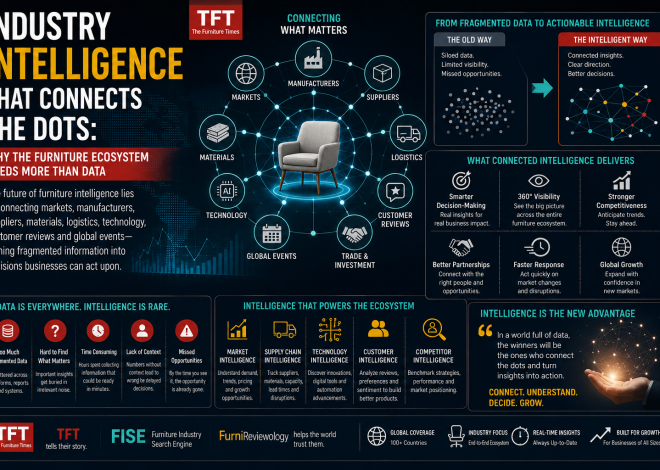
TFT tells their story. FISE helps the world find them. FurniReviewology helps the world trust them.
Together, these functions support the three stages every furniture business must master:
- Visibility: The market becomes aware of the company.
- Discoverability: Customers and AI systems can find and understand it.
- Trust: Buyers can evaluate whether it fulfils its promises.
Without visibility, the company remains unknown.
Without discoverability, the company remains difficult to find.
Without trust, the company may be found but not selected.
Furniture reviews require deeper analysis
A conventional five-star rating does not capture the complexity of a furniture purchase.
Furniture performance develops over time. A sofa may look excellent on delivery but show cushion or fabric problems after several months. A dining chair may arrive undamaged but become unstable through repeated use. A wardrobe may have good materials but poor assembly instructions.
Furniture reviews should therefore be evaluated across several dimensions.
Product quality
- Construction strength
- Material accuracy
- Finish consistency
- Comfort
- Stability
- Durability
- Hardware performance
Product accuracy
- Dimensions
- Color representation
- Material description
- Product photography
- Configuration
- Features
Delivery performance
- Lead-time accuracy
- Communication
- Product handling
- Damage prevention
- Room-of-choice delivery
- Packaging removal
Assembly and installation
- Instruction quality
- Missing components
- Installation accuracy
- Assembly time
- Installer professionalism
Customer service
- Response speed
- Complaint handling
- Warranty support
- Replacement parts
- Refunds and exchanges
- Repair coordination
Long-term ownership
- Fabric wear
- Foam resilience
- Mechanism performance
- Finish durability
- Maintenance difficulty
- Repairability
This deeper approach helps distinguish meaningful furniture reviews from superficial first impressions.
Reviews are becoming part of AI visibility
Reviews no longer influence only human buyers. They also contribute to the body of information that AI systems use to understand brands.
When an AI assistant is asked to recommend a reliable sofa brand, office chair manufacturer or hotel furniture supplier, it may consider review volume, sentiment, recurring complaints, third-party mentions and consistency across sources.
A company with many authentic, detailed reviews can provide stronger evidence of market performance. A company with no reviews, suspicious review patterns or unresolved complaints may be treated as uncertain.
The important issue is not simply obtaining more positive ratings. It is building a credible and transparent reputation.
A trustworthy review ecosystem should help identify:
- Whether the reviewer actually purchased the product
- Which product or project was involved
- When the experience occurred
- Whether the company responded
- Whether a complaint was resolved
- Whether the review concerns delivery, product quality or service
- Whether patterns appear across multiple customers
This is the difference between review collection and review intelligence.
Negative reviews are not always the enemy
Furniture companies often fear negative reviews. But a completely perfect rating can appear less credible than a realistic profile containing detailed feedback and professional responses.
The greater danger is often silence.
When a customer reports a problem and the company does not respond, potential buyers see evidence of risk. When the company acknowledges the issue, explains the remedy and follows through, it demonstrates accountability.
Negative reviews can also identify operational weaknesses before they become larger problems.
A recurring complaint about damaged corners may reveal packaging failure. Complaints about color variation may indicate inaccurate photography. Reports of loose chairs may reveal a component or assembly problem. Repeated delivery delays may expose weaknesses in logistics coordination.
FurniReviewology can help transform customer feedback into industry intelligence that supports:
- Product improvement
- Supplier assessment
- Packaging redesign
- Delivery training
- Warranty planning
- Quality control
- Customer-service development
Reviews should not sit isolated inside a marketing department. They should feed manufacturing, logistics, design and management decisions.
The furniture industry needs “proof over poetry”
The discussion surrounding the Furniture World article highlights an important principle: proof over poetry.
Furniture brands have traditionally relied on storytelling about heritage, craft, inspiration and lifestyle. These narratives remain valuable, particularly for businesses built on design and craftsmanship.
But stories should be supported by evidence.
A heritage brand might demonstrate:
- How products are constructed
- Which techniques have been preserved
- Where materials are sourced
- How long products remain in use
- Whether replacement parts are available
- What customers say after years of ownership
A sustainability-focused brand might disclose:
- Certified material sources
- Recycled content
- Chemical-emission information
- Repair programs
- Packaging composition
- Take-back arrangements
A comfort-focused seating brand might provide:
- Foam density
- Seat-depth options
- Cushion construction
- Ergonomic information
- Testing results
- Reviews from customers with different needs
The future belongs neither to storytelling without evidence nor to technical data without emotion. Strong furniture brands will combine both.
Ten ways furniture brands can become searchable, relevant and trusted
Building on the issues raised by the Furniture World article, the following TFT editorial framework offers ten practical priorities.
1. Stop making discounts the primary brand message
Use promotions selectively. Build the brand around a distinctive customer outcome, specialization or value proposition.
2. Publish answer-first content
Create content that addresses the actual questions customers ask before, during and after a furniture purchase.
3. Turn reviews into a discovery and trust system
Collect authentic feedback, organize it by product and experience, respond to problems and use FurniReviewology-style intelligence to identify recurring patterns.
4. Define what the brand should be known for
Choose a clear area of relevance rather than relying on broad claims about quality and value.
5. Demonstrate proof
Use specifications, testing, certifications, project references, construction details and verified customer experiences.
6. Build structured product information
Make dimensions, materials, functions, warranties, finishes and delivery regions readable by search engines and AI systems.
7. Create content beyond the company website
Earn visibility through credible media, industry directories, design platforms, customer communities, video and relevant third-party coverage.
8. Connect physical and digital experiences
Ensure that showrooms, websites, marketplaces, catalogues and customer service communicate consistent information.
9. Measure relevance—not just traffic
Track branded searches, review sentiment, share of search, repeat visitors, direct traffic, mentions, saved products, enquiries and recommendation frequency.
10. Build long-term authority
Visibility created by one campaign can disappear. Authority is accumulated through consistent expertise, evidence, media coverage, customer experiences and reliable business information.
What manufacturers need to do
Manufacturers often depend on retailers to communicate their brands, but retailers may carry competing products and have limited time to explain technical differences.
Manufacturers should provide partners with:
- Clear positioning
- Accurate product data
- Sales education
- Product demonstration videos
- Construction details
- Testing and certification records
- Comparison tools
- Customer-review evidence
- Delivery and warranty information
- Consistent digital assets
A retailer is more likely to support a manufacturer whose value can be clearly explained.
The manufacturer must give retailers a compelling reason to floor the brand—not only another product to display.
What retailers need to do
Retailers face their own relevance challenge. Customers can often find similar products across marketplaces and competing stores.
A retailer must create value beyond access to inventory.
That value may include:
- Expert product selection
- Interior-design guidance
- Measurement support
- Local delivery
- Reliable installation
- Service after the sale
- Customization
- Transparent reviews
- Repair coordination
- Community reputation
The strongest furniture stores will become trusted decision-support businesses, not merely buildings containing products.
What suppliers and component companies need to do
The relevance problem extends beyond consumer brands.
Hardware manufacturers, textile suppliers, foam producers, machinery companies, logistics providers and independent workshops may also be difficult to find.
Their customers search for capabilities and solutions:
- Soft-close hinge supplier
- Fire-resistant upholstery fabric
- High-density furniture foam
- CNC furniture machinery
- Hotel furniture installation
- Drawer slides for heavy loads
- Sustainable wood panel supplier
These businesses need detailed capability profiles, technical documentation, service regions, certifications, application examples and credible business reviews.
B2B visibility is not less important than consumer visibility. It is simply built around different questions.
The role of TFT, FISE and FurniReviewology
The furniture industry ecosystem includes millions of businesses, craftspeople, professionals and specialists. Many produce valuable work but cannot afford large advertising campaigns or compete for the most expensive keywords.
This creates a visibility imbalance. Large companies dominate search results and media exposure, while smaller but capable businesses remain hidden.
An industry-specific discovery infrastructure can help create a fairer opportunity.
The Furniture Times tells their story
TFT brings manufacturers, retailers, suppliers, designers, craftspeople and industry developments into the global spotlight through reporting, analysis and professional storytelling.
FISE helps the world find them
The Furniture Industry Search Engine organizes the ecosystem so businesses can become searchable by category, capability, product, service and location.
FurniReviewology helps the world trust them
FurniReviewology adds evidence from customer and market experiences, helping users evaluate reputation, performance and accountability.
This is not merely a media strategy. It is an information architecture for a highly fragmented global industry.
The final question every furniture brand must answer
If a competitor offered a similar product at the same price, why would the customer still choose your company?
If the answer depends only on a discount, the brand is vulnerable.
If the answer is hidden inside the founder’s mind, the market cannot understand it.
If the answer is not documented online, AI cannot recommend it.
If the answer is unsupported by customer experience, buyers may not trust it.
The future furniture market will reward companies that connect relevance with evidence.
A brand becomes searchable when people remember what it stands for. It becomes discoverable when its information is clear. It becomes recommendable when trusted sources understand it. It becomes sustainable when its promises are confirmed by real customer experiences.
The furniture industry does not merely need more traffic.
It needs clearer positioning, better information, stronger proof, wider visibility and credible trust.
That is how an unknown furniture company becomes a recognized brand—and how a recognized brand becomes a preferred choice.
Editorial note
This report is inspired by and expands upon the themes presented in Furniture World Magazine’s “Why Nobody Is Searching For Your Furniture Brand”, attributed to Bill Napier and dated June 28, 2026 in Furniture World’s published listings.
The linked page was intermittently unavailable during verification. The article’s title, publication listing and central themes were confirmed through indexed search results and the author’s public summary of the article. The FurniReviewology analysis, TFT/FISE framework and strategic recommendations are original editorial analysis by The Furniture Times.
The Furniture Times (TFT) & Furniture Industry Search Engine (FISE)
“TFT tells their story. FISE helps the world find them.”
FurniReviewology helps the world trust them.
The furniture industry ecosystem is a $1 trillion industry ecosystem.
Do not remain another invisible furniture business. Become relevant, searchable, recommendable and trusted.