What Happens to Furniture After a Hotel Renovates 500 Rooms?
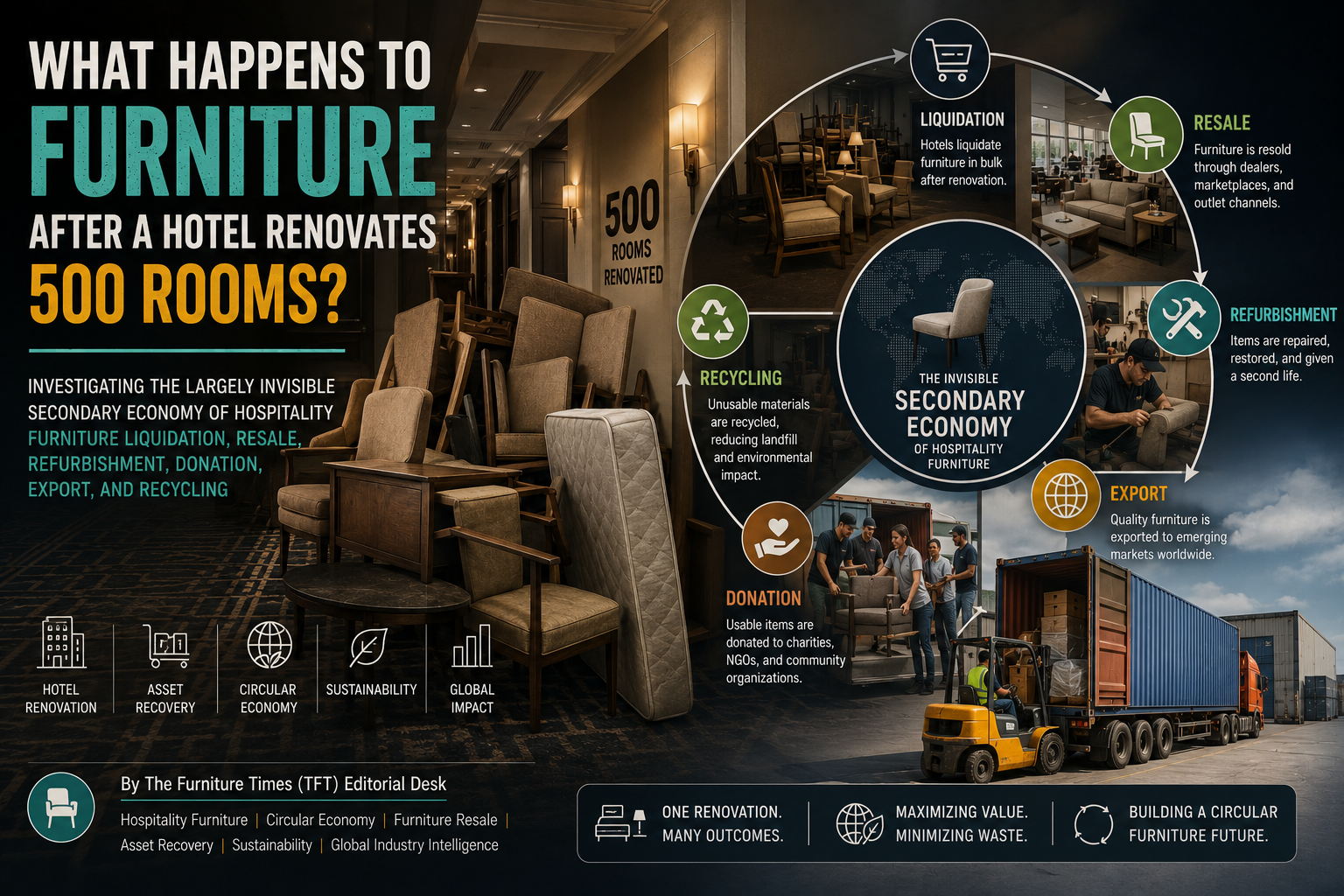
Investigating the Largely Invisible Secondary Economy of Hospitality Furniture Liquidation, Resale, Refurbishment, Donation, Export, and Recycling
By The Furniture Times (TFT) Editorial Desk | Hospitality Furniture | Circular Economy | Furniture Resale | Asset Recovery | Sustainability | Global Industry Intelligence
A hotel renovation is usually presented as a story of renewal.
New rooms.
New beds.
New headboards.
New desks.
New chairs.
New wardrobes.
New lighting.
New finishes.
New guest experiences.
But behind every major hotel refurbishment lies another story that is rarely discussed.
What happens to the furniture that was already there?
If a 500-room hotel replaces its:
beds,
nightstands,
desks,
chairs,
sofas,
headboards,
wardrobes,
tables,
mirrors,
luggage benches,
restaurant furniture,
lobby furniture,
and outdoor pieces,
the renovation can release thousands of individual furniture assets into the market almost overnight.
Some may be only five or seven years old.
Some may still be structurally sound.
Some may require minor repairs.
Some may be commercially outdated but functionally useful.
Some may have genuine resale value.
Some may be suitable for donation.
Some may be exported.
Some may be stripped for parts.
And some may eventually be recycled or discarded.
This creates an enormous but poorly measured secondary economy operating behind the global hospitality sector.
The hotel renovation economy is therefore not simply about buying new furniture.
It is also about managing what happens to the old.
A 500-Room Renovation Can Release Thousands of Assets
Consider a simplified example.
A 500-room hotel may contain, per room:
one bed frame,
one headboard,
two bedside tables,
one desk,
one desk chair,
one lounge chair,
one luggage bench,
one television unit,
one wardrobe or storage system,
one coffee table or side table,
and several decorative furnishings.
Even before considering public areas, restaurants, meeting spaces, bars, lobbies, pools, spas, staff areas, and outdoor spaces, the number of furniture pieces can easily reach into the thousands.
Now imagine that entire property undergoing a major refurbishment.
The hotel may need to remove old furniture quickly so contractors can begin work.
Suddenly, management faces a logistical question:
Where does all this furniture go?
This is where the hidden hospitality furniture afterlife begins.
The First Destination: Liquidation
One of the most common routes is liquidation.
Hotels may work with:
asset recovery companies,
liquidators,
used furniture dealers,
auction houses,
hospitality furniture brokers,
or specialized resale businesses.
These companies may purchase furniture in bulk and remove it from the property.
For the hotel, the attraction is speed.
A renovation schedule can be extremely tight.
The hotel may care less about maximizing the value of every chair and more about clearing rooms efficiently.
A liquidator can:
inventory items,
price them,
remove them,
store them,
and resell them through secondary channels.
This creates a business model built around one simple reality:
Hotel furniture still has value after the hotel no longer wants it.
Why Hotels Replace Furniture That Still Works
Consumers often assume that furniture is replaced because it is broken.
In hospitality, that is not always true.
Hotels renovate for many reasons:
brand standards,
design refreshes,
ownership changes,
repositioning,
star-rating upgrades,
franchise requirements,
competitive pressure,
new guest expectations,
technology integration,
or property modernization.
A chair may still work perfectly but no longer match the new interior concept.
A headboard may be structurally sound but visually dated.
A desk may function well but feel too traditional.
A lobby sofa may still have years of life left but clash with a new branding direction.
This means hospitality renovations can create a large volume of usable furniture long before the end of its physical lifespan.
That is what makes the secondary hospitality furniture economy so important.
Resale: From Five-Star Hotel to Second-Life Market
Some hotel furniture enters local resale markets.
It may be sold to:
smaller hotels,
budget accommodations,
guesthouses,
hostels,
serviced apartments,
student residences,
rental properties,
restaurants,
offices,
or private buyers.
Furniture from established hotels may carry perceived value because it was originally produced for commercial use.
Commercial furniture is often designed for:
durability,
frequent use,
easy maintenance,
and hospitality standards.
That does not mean every piece is automatically high quality.
But well-maintained hotel furniture can sometimes offer attractive value in secondary markets.
For smaller hospitality businesses, buying used commercial furniture can significantly reduce fit-out costs.
Refurbishment Can Create a Second Commercial Life
Many furniture assets do not need replacement.
They need refurbishment.
An armchair may require:
new upholstery,
new foam,
minor structural repair,
polishing,
or new legs.
A wooden table may only need:
sanding,
refinishing,
or hardware replacement.
A metal base may be perfectly usable once refinished.
A desk chair may need new casters or fabric.
This creates opportunities for:
upholsterers,
carpenters,
restorers,
refinishers,
repair technicians,
and furniture refurbishment companies.
Instead of treating used hotel furniture as waste, refurbishment can restore commercial value.
This is where circular economy principles become highly practical.
The product already exists.
The material has already been extracted.
The manufacturing energy has already been spent.
The logistics have already happened.
Extending the life of that product can often make more environmental sense than immediately replacing it.
Donation: A Social Value Route
Some hotels choose to donate furniture.
Potential recipients may include:
charities,
schools,
community organizations,
shelters,
religious institutions,
social enterprises,
low-income housing programs,
disaster-relief organizations,
or nonprofit accommodation providers.
Donation can turn renovation waste into social value.
But donation is not always operationally simple.
Furniture must still be:
sorted,
moved,
transported,
stored,
and potentially repaired.
Large quantities can overwhelm small organizations.
This is why successful donation programs often require coordination with:
logistics providers,
social enterprises,
or structured redistribution networks.
The challenge is not simply finding people who need furniture.
It is moving thousands of bulky items efficiently.
Export: The Cross-Border Second Life of Hotel Furniture
In some markets, used hospitality furniture may be exported.
Furniture removed from hotels in wealthier markets can enter secondary markets elsewhere.
For example, commercial furniture may find buyers among:
budget hotels,
small resorts,
rental accommodations,
student housing,
or commercial operators in emerging markets.
This creates another layer of the secondary furniture economy.
But export raises important questions.
Is the furniture still safe?
Does it meet the destination market’s requirements?
Is it economically viable to ship bulky used furniture?
Does the environmental impact of long-distance transport outweigh the benefit of reuse?
These questions need serious evaluation.
Reuse is not automatically sustainable if the logistics model is inefficient.
Recycling: The Final Route
When furniture cannot be reused, repaired, refurbished, donated, or resold, recycling may become the final option.
But furniture recycling is difficult because products often contain multiple materials.
A hotel chair may include:
wood,
metal,
foam,
fabric,
adhesives,
plastic,
and fasteners.
A mattress can contain:
foam,
springs,
fabric,
and synthetic components.
A sofa may contain even more mixed materials.
Without disassembly, much of this becomes difficult to recycle efficiently.
This is why circular design matters.
Furniture designed for easy separation has a much better chance of entering meaningful recycling systems.
Furniture glued together with complex mixed materials may be far harder to recover.
The Biggest Problem: Hotels Often Do Not Know What They Own
One of the most surprising problems in large hospitality assets is weak furniture inventory data.
A hotel may know approximately when rooms were refurbished.
But it may not have detailed records showing:
manufacturer,
model,
material,
installation date,
original purchase price,
repair history,
remaining warranty,
or component specifications.
This makes asset recovery more difficult.
If furniture lacks documented identity, it becomes harder to:
value,
resell,
repair,
or recycle.
A digital furniture passport could transform this process.
Imagine every hotel asset carrying a persistent record of:
origin,
materials,
age,
maintenance,
repair history,
and condition.
That would make renovation liquidation far more intelligent.
Asset Recovery Should Start Before Renovation Begins
Hotels often think about disposal too late.
The better approach is to plan furniture recovery before contractors arrive.
A professional asset recovery strategy could begin months before renovation.
The property could classify furniture into categories such as:
Category A — Reuse Internally
Furniture that can move to another property or operational area.
Category B — Refurbish
Furniture that has strong structural value but needs restoration.
Category C — Resell
Furniture suitable for secondary commercial markets.
Category D — Donate
Furniture that may have social value.
Category E — Parts Recovery
Items that are not viable as whole products but contain useful components.
Category F — Recycle
Products suitable for material recovery.
Category G — Disposal
The final option for items with no economically or technically viable recovery route.
This turns disposal from an afterthought into an asset-management strategy.
A Hotel Renovation Is Also a Reverse Logistics Project
Furniture logistics usually move in one direction:
factory → warehouse → project → hotel.
Renovation creates the opposite challenge.
hotel → sorting → storage → resale/refurbishment/donation/recycling.
This is reverse logistics.
And it can be complicated.
A hotel may need to remove thousands of items while:
remaining operational,
protecting guests,
maintaining safety,
coordinating contractors,
and meeting renovation deadlines.
This requires careful sequencing.
Furniture cannot simply be piled in a loading bay.
It needs:
inventory,
labelling,
sorting,
transport,
temporary storage,
and destination planning.
Reverse logistics is therefore a major part of the hospitality furniture afterlife.
The Financial Opportunity Is Larger Than It Looks
Hotels often focus on the cost of new furniture.
But the outgoing furniture also has financial value.
Recovered value may come from:
resale,
auction,
refurbishment,
parts harvesting,
material recycling,
or avoided disposal fees.
Imagine a 500-room property recovering even a modest average amount per room from old furniture.
Across a large hotel group, the numbers can become significant.
Asset recovery should therefore be treated as a financial opportunity, not simply a sustainability initiative.
The question should not be:
“How much will it cost to remove this furniture?”
It should also be:
“How much value can we recover from it?”
Procurement Should Consider the End of Life Before the Beginning
The most powerful change would happen before furniture is purchased.
Hotels should begin asking suppliers:
Can this product be repaired?
Can upholstery be replaced?
Are spare parts available?
Can the product be disassembled?
Can components be separated?
Can materials be recycled?
Will you take it back?
Do you offer refurbishment?
Can it be resold?
This changes procurement thinking.
Instead of evaluating only:
purchase price,
design,
delivery,
and warranty,
buyers begin evaluating:
Lifecycle Value.
A slightly more expensive product may be cheaper over ten years if it:
lasts longer,
is easier to repair,
has replaceable parts,
and retains resale value.
Furniture Manufacturers Could Offer Take-Back Programs
A hotel renovation could create new business opportunities for manufacturers.
Instead of losing contact with products after the initial sale, manufacturers could offer:
take-back programs,
refurbishment,
buy-back,
trade-in,
parts harvesting,
certified resale,
or recycling.
This would create a closed-loop model.
Manufacturer sells furniture.
Hotel uses it.
Furniture returns to the manufacturer.
Product is:
refurbished,
resold,
remanufactured,
or recycled.
This could become an important circular business model for contract furniture.
Certified Pre-Owned Hospitality Furniture Could Emerge
The automotive industry has normalized certified pre-owned vehicles.
Why not furniture?
Imagine a manufacturer-certified used hotel chair.
It has been:
inspected,
repaired,
reupholstered,
tested,
and documented.
It comes with:
known origin,
known materials,
verified condition,
and limited warranty.
This could create a much more trusted secondary furniture market.
It would be especially useful for:
SME hotels,
start-up restaurants,
coworking spaces,
rental properties,
and budget accommodation operators.
Certified pre-owned furniture could become a new revenue stream.
The Refurbishment Economy Could Create Jobs
Hospitality furniture recovery is labour-intensive.
It requires:
inspection,
sorting,
repair,
upholstery,
cleaning,
transport,
resale,
warehousing,
and recycling.
This creates economic opportunities for local SMEs.
Furniture refurbishment can support:
craftsmanship,
technical repair skills,
upholstery businesses,
logistics providers,
and circular economy enterprises.
Hotel renovation therefore has the potential to stimulate local economic activity beyond the new-furniture purchase itself.
Repairability Will Become Increasingly Valuable
A commercial chair that can be repaired in 20 minutes has different lifecycle economics from a chair that must be discarded when one component fails.
Likewise, a sofa with replaceable covers may have a longer commercial life than one with fixed upholstery.
Furniture designed for:
maintenance,
refurbishment,
and part replacement
has greater secondary-market potential.
This should become part of product specification.
Hospitality buyers increasingly need furniture that performs not just during the first ownership cycle, but across multiple lifecycle stages.
The Secondary Market Needs Better Quality Grading
One challenge in used hospitality furniture is inconsistent condition descriptions.
Terms such as:
good condition,
used,
refurbished,
excellent,
or commercial grade
can mean very different things.
The industry could benefit from standardized grading.
For example:
Grade A
Minimal wear, ready for immediate reuse.
Grade B
Moderate cosmetic wear, structurally sound.
Grade C
Requires refurbishment or repair.
Parts Grade
Suitable primarily for component recovery.
Recycling Grade
Not viable for continued furniture use.
A standardized condition system could improve transparency and buyer confidence.
Data Could Transform Hotel Furniture Liquidation
Imagine a liquidation platform where every furniture item contains:
product ID,
manufacturer,
age,
dimensions,
materials,
original use,
condition,
repair history,
location,
quantity,
and estimated residual value.
Buyers could search:
500 matching dining chairs,
200 commercial desks,
150 upholstered armchairs,
or 400 nightstands
before the renovation even begins.
This could dramatically improve asset recovery.
The secondary furniture economy is currently limited partly because supply is fragmented and poorly documented.
Better data could make it more efficient.
FISE-Style Search Could Become Crucial for Secondary Furniture
The global furniture market is highly fragmented.
Used hospitality furniture is even more fragmented.
Supply may exist, but potential buyers often cannot find it.
A digital search infrastructure could allow businesses to discover:
available hotel furniture,
regional liquidation stock,
refurbished furniture,
spare components,
used contract furniture,
and recycling partners.
Searchability is therefore just as important in secondary markets as it is in new furniture.
A product that cannot be found is difficult to reuse.
The Carbon Question
Furniture contains embedded environmental impact from:
raw materials,
manufacturing,
energy use,
packaging,
transport,
and finishing.
When usable furniture is discarded prematurely, much of that embedded value is lost.
Extending product life can help spread that impact across more years of use.
But environmental decisions must still be practical.
Shipping a low-value used chair thousands of kilometres may not always make sense.
The industry needs better lifecycle calculations to decide:
reuse locally,
refurbish,
export,
recycle,
or dispose.
Circularity should be data-driven, not symbolic.
Hotel Groups Could Create Internal Furniture Exchanges
Large hospitality groups operate many properties.
One hotel may renovate while another requires furniture.
Why should usable assets automatically leave the group?
Hotel groups could create internal digital marketplaces.
A property undergoing renovation could list:
chairs,
tables,
desks,
outdoor furniture,
back-of-house furniture,
and other assets.
Other properties within the group could claim them.
This could reduce:
procurement costs,
disposal,
and unnecessary manufacturing.
It would also improve asset utilization.
Developers Could Include Furniture Recovery in Renovation Contracts
Major refurbishments involve:
owners,
developers,
designers,
contractors,
procurement companies,
and project managers.
Furniture recovery should be included in contract planning.
Instead of simply specifying:
“remove existing furniture,”
contracts could specify:
inventory,
condition assessment,
reuse targets,
resale targets,
donation requirements,
recycling documentation,
and waste reporting.
This would make furniture recovery measurable.
A New KPI: Furniture Recovery Rate
Hotels could begin reporting:
Furniture Recovery Rate
This could measure what percentage of outgoing furniture was:
reused,
resold,
refurbished,
donated,
recycled,
or diverted from landfill.
For example:
35% resold.
20% refurbished.
15% donated.
20% recycled.
10% disposed.
This creates accountability.
It also gives management a clearer picture of renovation waste.
Another KPI: Residual Value Recovered
A second metric could be:
Residual Value Recovered.
How much value did the hotel recover from outgoing furniture compared with its original cost or estimated secondary-market value?
This would turn sustainability into measurable financial performance.
A hotel that recovers substantial value from outgoing assets is managing capital more intelligently.
Hospitality Furniture Should Be Designed for Multiple Lives
The long-term goal should be bigger than better liquidation.
Furniture itself should be designed with multiple lives in mind.
Imagine a hotel chair designed so that:
fabric can be replaced,
foam can be renewed,
legs can be changed,
fasteners are accessible,
materials are separable,
and parts remain available for 15 years.
That chair could potentially serve:
one luxury hotel,
then a mid-market hotel,
then a guesthouse,
then a community facility,
before finally being recycled.
That is very different from a product designed for one ownership cycle.
The Role of Manufacturers Will Change
Manufacturers could move from being simple product suppliers to lifecycle partners.
Their responsibilities could eventually include:
design,
manufacturing,
installation,
maintenance,
repair,
refurbishment,
resale,
take-back,
and recycling.
This changes the economics of furniture.
Revenue no longer comes only from the first sale.
It can come from multiple stages of the product’s life.
That is the foundation of a circular furniture business model.
The Hotel Renovation Economy Is Bigger Than Furniture Disposal
A renovation can activate an entire ecosystem:
liquidators,
auction houses,
used furniture dealers,
refurbishers,
upholsterers,
repair specialists,
logistics companies,
storage providers,
charities,
exporters,
recyclers,
and digital marketplaces.
This is not a small side activity.
It is an entire secondary industry.
Yet it remains largely invisible in mainstream furniture reporting.
The Industry Needs Better Statistics
How much hotel furniture is removed every year globally?
How much is resold?
How much is refurbished?
How much is exported?
How much is donated?
How much is recycled?
How much goes to landfill?
Reliable global answers are difficult to find.
That itself reveals a major intelligence gap.
The hospitality furniture ecosystem needs better data on the afterlife of products.
Without measurement, the scale of lost economic and material value remains hidden.
Furniture Renovation Waste Should Become an Intelligence Category
The furniture industry measures:
production,
sales,
imports,
exports,
and market size.
It should also begin measuring:
furniture removed from service,
furniture recovered,
furniture refurbished,
furniture resold,
and furniture recycled.
This would create a more complete picture of the furniture economy.
Because furniture does not stop being economically relevant simply because its first buyer no longer wants it.
A 500-Room Hotel Is a Powerful Example
The reason a 500-room renovation matters is scale.
One chair is a product.
Five hundred chairs become inventory.
One nightstand is furniture.
One thousand nightstands become a supply chain.
One sofa is used furniture.
Hundreds of sofas become a secondary market.
Large hospitality renovations reveal that furniture afterlife is not a household issue.
It is an industrial issue.
From Renovation Waste to Furniture Assets
Language matters.
If hotels call outgoing furniture:
waste,
they are more likely to dispose of it.
If they call it:
surplus assets,
recoverable inventory,
secondary-market stock,
or refurbishment candidates,
management behaviour changes.
Much of the furniture leaving hotels is not waste.
It is an asset entering another stage of its life.
The Digital Passport Could Complete the System
This is where digital furniture passports could become transformative.
Each item could carry:
manufacturer,
model,
materials,
age,
certifications,
maintenance history,
repair history,
condition,
and recycling instructions.
When the hotel renovates, the product’s data moves with it.
The liquidator understands it.
The buyer understands it.
The repairer understands it.
The recycler understands it.
Information would no longer disappear when ownership changes.
That could create a much more efficient secondary economy.
TFT Industry Perspective
The furniture industry has traditionally focused on the beginning of a product’s life.
Design it.
Manufacture it.
Sell it.
Install it.
But the future furniture economy must pay equal attention to what happens next.
Use.
Maintain.
Repair.
Refurbish.
Resell.
Reuse.
Recycle.
A 500-room hotel renovation demonstrates the scale of this opportunity better than almost anything else.
Thousands of furniture products can suddenly leave one commercial environment at the same time.
If the industry has no recovery infrastructure, they become a disposal problem.
If the industry has:
data,
repair networks,
liquidation channels,
resale platforms,
refurbishment capacity,
digital product identities,
and recycling systems,
they become economic assets.
That is the shift the hospitality furniture industry needs to make.
From:
“How do we get rid of the old furniture?”
to:
“How do we recover the maximum value from everything leaving the property?”
The answer matters financially.
It matters environmentally.
It matters socially.
And it matters for the future competitiveness of the furniture ecosystem.
Hotel furniture does not necessarily reach the end of its life when a hotel decides to renovate.
Often, it is only reaching the end of its first life.
The invisible opportunity lies in everything that happens next.
The Furniture Times (TFT) — Global Furniture Industry Media & Intelligence
TFT tells their story. FISE helps the world find them. FurniReviewology helps the world trust them.