The Six Furniture Categories Covered by BIS Standards
Exploring requirements affecting work chairs, general-purpose chairs and stools, tables and desks, storage units, beds and bunk beds
By The Furniture Times (TFT) Editorial Desk | Furniture Compliance | BIS Certification | Product Safety | Furniture Manufacturing | Global Industry Intelligence
India’s Furniture (Quality Control) Order has introduced a major change in how selected furniture products are designed, manufactured, tested, imported and placed on the domestic market.
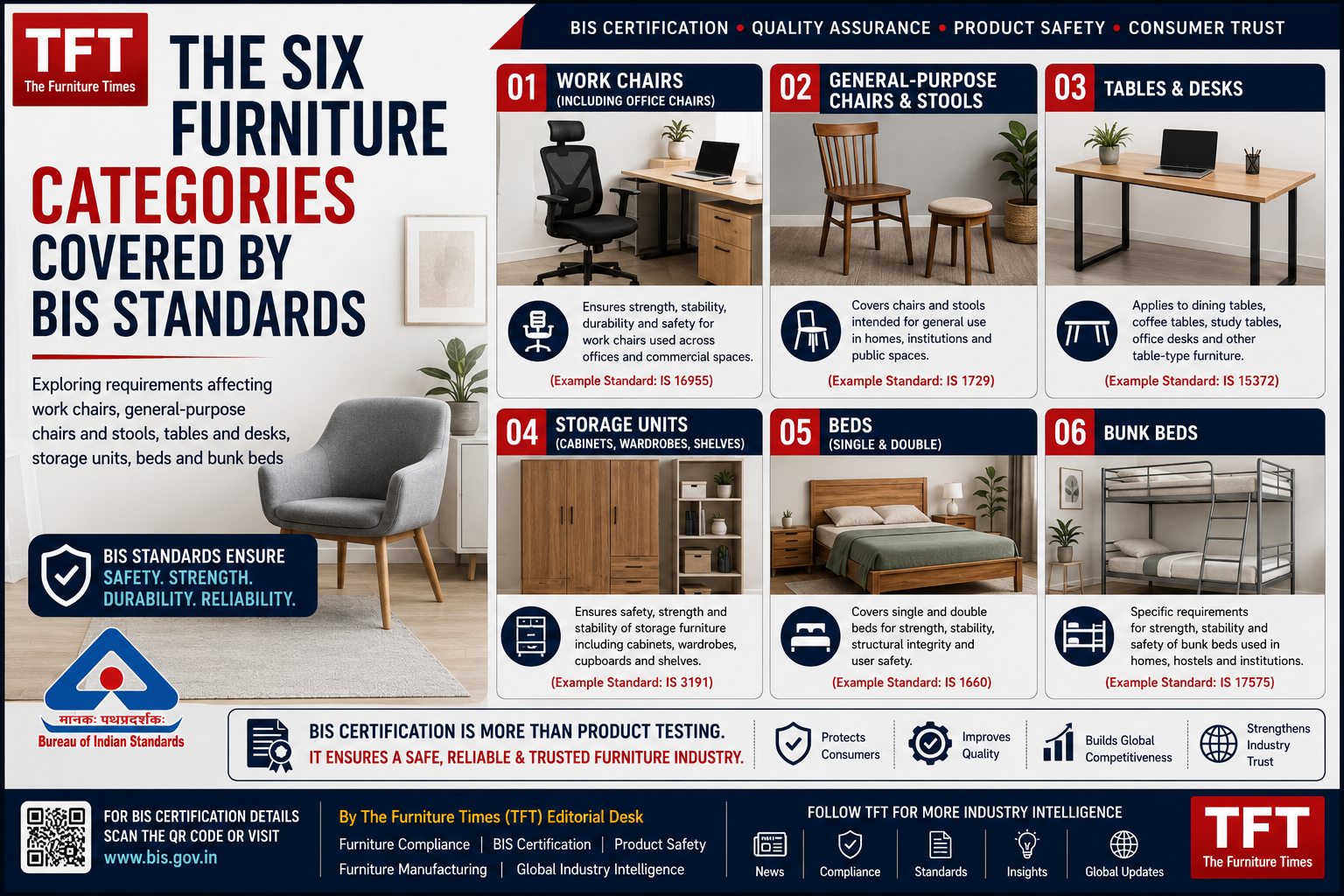
Six broad furniture categories are covered by compulsory Indian Standards:
- Work chairs
- General-purpose chairs and stools
- Tables and desks
- Storage units
- Beds
- Bunk beds
These categories represent some of the most widely manufactured, imported and purchased furniture products in India. They are found in homes, offices, schools, hotels, restaurants, retail environments, public institutions, healthcare facilities and commercial projects.
However, the regulatory impact cannot be understood by reading the six category names alone. Each standard contains its own scope, product classifications, design considerations, performance expectations, test requirements and certification controls.
The central compliance question is not simply whether a company makes “furniture.” It is whether a particular product, model and construction falls within the scope of one of the notified standards.
That distinction matters because a product falling within the Furniture Quality Control Order must conform to the applicable Indian Standard and, unless a valid exemption or transitional provision applies, be manufactured under an appropriate BIS licence before it is placed on the Indian market.
According to the official BIS compulsory-certification list, the six standards are covered under Scheme I of the BIS Conformity Assessment Regulations. BIS Scheme I compulsory-certification list
The six standards at a glance
| Furniture category | Applicable standard | Typical products requiring assessment |
|---|---|---|
| Work chairs | IS 17631:2022 | Office task chairs, work chairs, adjustable workplace seating and other chairs within the standard’s scope |
| General-purpose chairs and stools | IS 17632:2022 | Domestic chairs, dining chairs, visitor chairs, stools and other general-purpose seating |
| Tables and desks | IS 17633:2022 | Office desks, work tables, meeting tables, domestic tables, study tables and other covered products |
| Storage units | IS 17634:2022 | Cabinets, cupboards, shelving units, drawer units and other furniture intended for storage |
| Beds | IS 17635:2022 | Domestic and other covered beds, including manufactured and ready-to-assemble bed structures |
| Bunk beds | IS 17636:2022 | Beds with one sleeping surface positioned above another and other products meeting the standard’s bunk-bed definition |
The standards are product-specific. A manufacturer producing products from several categories may need multiple BIS licences, even when everything is made at the same factory.
Why product classification is the first major challenge
Furniture products are frequently marketed under creative or commercial names. A chair may be sold as an executive chair, gaming chair, visitor chair, lounge chair, conference chair, study chair or café chair. A table may be described as a workstation, console, counter, island, meeting table or multipurpose surface.
Commercial names do not automatically determine regulatory classification.
Manufacturers must assess:
- The product’s intended use.
- Its structural configuration.
- Its dimensions and performance category.
- Whether it is movable, adjustable or fixed.
- Whether it is completely manufactured or ready to assemble.
- Whether it contains extensions, castors or moving components.
- The product definitions in the applicable standard.
- Any exclusions stated in the standard.
- BIS grouping and product-manual requirements.
A product must be classified according to its actual design and intended function—not according to the category that appears easier to certify.
Misclassification can lead to testing under the wrong standard, incomplete licence coverage, customs difficulties, regulatory action and the need to restart parts of the certification process.
Category One: Work Chairs — IS 17631:2022
Why work chairs require a dedicated standard
A work chair is not simply a chair placed inside an office.
Work chairs can be used for extended periods and may incorporate height adjustment, rotating seats, castors, armrests, reclining mechanisms, flexible backrests and other moving components. The interaction between these elements affects stability, strength, durability and user safety.
IS 17631:2022 covers the requirements for work chairs. The BIS product manual confirms that this category is separately managed under Scheme I certification. BIS product manual for IS 17631:2022
A manufacturer should evaluate whether its product is genuinely intended for work-related use. The assessment should consider the complete function of the chair rather than focusing only on its appearance.
Principal areas affecting work-chair compliance
Depending on the model and applicable clauses, compliance considerations can include:
- Dimensions.
- Stability.
- Structural strength.
- Seat and backrest durability.
- Armrest strength.
- Base strength.
- Castor and mobility performance.
- Rotating or swivelling functions.
- Adjustment mechanisms.
- Workmanship and finish.
- Accessible edges and potential hazards.
- Long-term performance under repeated use.
A chair may look strong and still fail a repeated-load or stability evaluation. Work-chair certification is intended to examine performance beyond showroom appearance.
Components that can change the result
Work-chair manufacturers must pay particular attention to critical components, including:
- Chair bases.
- Castors or glides.
- Gas-lift systems.
- Seat plates.
- Tilt and recline mechanisms.
- Armrest assemblies.
- Backrest supports.
- Fasteners and welded joints.
- Moulded plastic structural parts.
- Seat and back frames.
Replacing one component with a cheaper or more readily available alternative can change the performance of the entire chair.
A certified chair should therefore be supported by an approved bill of materials, controlled drawings and an authorization process for component changes.
Common work-chair mistakes
Manufacturers frequently encounter difficulty when:
- One test sample is presented as representative of substantially different models.
- Five-star and four-star bases are treated as identical.
- Chairs with and without armrests are grouped without technical justification.
- Different tilt mechanisms are introduced under the same model.
- Gas lifts are changed without reviewing performance implications.
- A tested fixed chair is assumed to cover a swivel or castor-based version.
- The manufactured chair does not match the submitted drawing.
- Marketing teams launch a new variant before its certification status is confirmed.
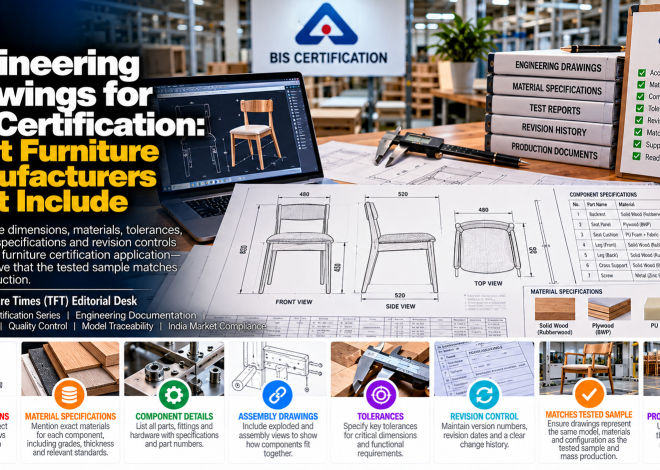
For work chairs, model-family planning should begin before the test sample is selected.
Category Two: General-Purpose Chairs and Stools — IS 17632:2022
A broad category with significant variation
General-purpose chairs and stools can appear simpler than work chairs, but the category contains enormous design diversity.
It can include products made from:
- Solid wood.
- Engineered wood.
- Steel.
- Aluminium.
- Moulded plastic.
- Composite materials.
- Mixed-material construction.
- Upholstered or non-upholstered structures.
The BIS product manual states that IS 17632:2022 applies to completely manufactured or fabricated general-purpose chairs and stools as well as ready-to-assemble units. It also requires the manufacturer to declare the model. BIS product manual for IS 17632:2022
Chairs and stools must be correctly distinguished
A manufacturer should determine whether the product is classified as a chair or stool under the standard.
Potentially relevant factors include:
- Presence or absence of a backrest.
- Seat height.
- Intended use.
- Armrests.
- Construction.
- Number and arrangement of legs.
- Folding or non-folding structure.
- Swivel or fixed configuration.
- Completely assembled or ready-to-assemble supply.
A commercial product called a “bar chair” may technically require assessment as a stool or another form of seating, depending on its configuration and the definitions in the standard.
Core quality and safety concerns
General-purpose seating is expected to remain stable and withstand the forces generated during normal use. Relevant performance considerations can include:
- Stability against tipping.
- Static loading.
- Impact resistance.
- Repeated loading and fatigue.
- Seat and back strength.
- Leg and frame strength.
- Footrest performance on stools.
- Armrest performance where fitted.
- Folding safety where applicable.
- Workmanship and finish.
- Accessible edges and projections.
- Performance of joints and fasteners.
Dining chairs, café chairs and visitor chairs may experience thousands of sitting cycles. A joint that appears secure during visual inspection can loosen under repeated movement.
Ready-to-assemble chairs require special control
Where chairs or stools are supplied in flat-pack or ready-to-assemble form, compliance must consider the assembled product.
The manufacturer must ensure that:
- All required components are supplied.
- Fasteners are correctly specified.
- Assembly holes are properly positioned.
- Instructions are clear.
- The customer can achieve the intended structural configuration.
- Incorrect assembly is reasonably minimized.
- Packaging protects critical parts during transportation.
A strong prototype assembled by an experienced technician may not represent the outcome achieved by an ordinary customer using unclear instructions.
Common chair and stool mistakes
Compliance problems can arise when manufacturers:
- Treat every chair sharing the same visual style as one model family.
- Ignore differences in material or structural construction.
- Use different leg thicknesses under the same model number.
- Change jointing systems without updating drawings.
- Fail to declare folding, swivel or ready-to-assemble variants.
- Substitute fasteners during production.
- Assume upholstery can hide weaknesses in the underlying frame.
- Apply a work-chair licence to general-purpose seating or vice versa.
The distinction between IS 17631 and IS 17632 must be resolved before application and testing.
Category Three: Tables and Desks — IS 17633:2022
More than a flat surface supported by legs
Tables and desks can differ dramatically in size, intended use, loading conditions and construction.
IS 17633:2022 addresses the performance and safety of covered tables and desks. The BIS product manual states that the standard applies to completely manufactured or fabricated products and ready-to-assemble units.
It separates covered products into performance categories that include:
- Office tables, including products used in office work areas, meeting spaces and pantries.
- Domestic tables, including bedroom, living-room, study and other household uses.
The manufacturer must declare its models and relevant characteristics. BIS product manual for IS 17633:2022
Product characteristics affecting classification and grouping
The tables-and-desks product manual identifies important parameters such as:
- Material, including natural wood, engineered wood, steel or aluminium.
- Manufactured or ready-to-assemble construction.
- Presence or absence of castors.
- Presence or absence of extension elements.
- Fixed or adjustable height.
- Manual or motorized height adjustment.
- Product dimensions.
- Performance category.
- Manufacturer-declared model.
These details show why a single passing desk cannot automatically represent an entire catalogue.
A fixed-height domestic study desk is not technically identical to a motorized, height-adjustable office workstation. A dining table without extensions is different from one with pull-out leaves. A table on castors introduces mobility and durability considerations that do not exist in a fixed-leg product.
Important table and desk performance areas
The official product manual refers to testing and control relating to:
- Design and workmanship.
- Dimensions.
- Surface performance.
- Stability under vertical loads.
- Stability under horizontal loads.
- Stability with extension elements open.
- Strength under vertical static force.
- Strength under horizontal static force.
- Durability under vertical force.
- Height-adjustment mechanism durability.
- Horizontal durability and stiffness.
- Vertical impact.
- Deflection of tabletops.
- Durability of tables with castors.
- Drop performance where applicable.
These requirements reflect real product risks. A desk may tip when drawers or extensions are opened, a tabletop may deflect under load, or an adjustable mechanism may degrade after repeated operation.
Model-family grouping must be evidence-based
The current BIS product manual permits defined families of models where relevant performance category, material and construction remain the same and specified dimensions stay within the permitted range relative to the lead model.
This does not mean that manufacturers can group products only because they share a collection name.
The declared lead model must genuinely represent the family. New models intended to be included during the licence period should be submitted for review with the necessary product details and drawings.
Common table and desk mistakes
Manufacturers can create compliance problems by:
- Grouping office and domestic products without considering performance category.
- Treating fixed and height-adjustable tables as one construction.
- Failing to declare castors.
- Failing to declare extension elements.
- Changing tabletop material or thickness.
- Changing the frame or understructure.
- Increasing tabletop dimensions without reviewing deflection and stability.
- Adding drawers or storage elements without evaluating their effect.
- Supplying ready-to-assemble products with uncontrolled fasteners.
- Introducing a motorized variant under a manually adjusted model.
Category Four: Storage Units — IS 17634:2022
Why storage furniture creates distinctive risks
Storage units are designed to carry loads, and many contain drawers, doors, shelves, rails, extension elements or tall structures. Their risks differ from those of a chair or table.
A storage unit may become unstable when:
- Several drawers are opened.
- A loaded door is opened.
- Shelves carry excessive weight.
- The unit is placed on an uneven surface.
- A child climbs or pulls on it.
- The unit has a narrow base and a high centre of gravity.
- Wall-restraint instructions are ignored.
- Adjustable components are incorrectly installed.
IS 17634:2022 covers notified storage units. The standard is included in the official BIS furniture product-manual and compulsory-certification lists. BIS product-manual directory
Products that may require assessment
Depending on the definitions and scope of the standard, relevant products can include:
- Cupboards.
- Cabinets.
- Drawer units.
- Shelving furniture.
- Sideboards.
- Wardrobes.
- Office storage.
- Mobile pedestals.
- Filing or document-storage furniture.
- Combined door-and-drawer storage units.
- Ready-to-assemble storage furniture.
Manufacturers should not assume that only large wardrobes are covered. Smaller cabinets, drawer units and office pedestals can still fall within the notified category.
Important design and performance considerations
Storage-unit assessment may involve considerations such as:
- Overall stability.
- Stability with doors or drawers open.
- Strength of shelves.
- Strength and durability of drawers.
- Strength of doors and hinges.
- Structural strength.
- Extension-element performance.
- Locking or interlocking systems where relevant.
- Castors or mobility features.
- Workmanship and accessible edges.
- Surface performance.
- Retention of shelves and other components.
- Wall-restraint or anti-tip provisions where applicable.
The product should remain safe not only when closed and empty, but also when used in reasonably foreseeable conditions.
Components requiring control
Critical storage-unit inputs may include:
- Hinges.
- Drawer slides.
- Shelf supports.
- Connectors.
- Back panels.
- Brackets.
- Locks.
- Castors.
- Door catches.
- Anti-tip devices.
- Fasteners.
- Wall-fixing hardware.
A change from one drawer-slide system to another may affect extension, load performance and durability. A thinner back panel may reduce rigidity. Different shelf supports can change load capacity.
Common storage-unit mistakes
Manufacturers should avoid:
- Testing an empty cabinet without considering loaded use.
- Leaving multiple drawer configurations undeclared.
- Assuming wall fixing eliminates the need for product conformity.
- Changing hardware after certification.
- Using one model to cover substantially different heights or widths.
- Failing to account for glass doors or shelves.
- Omitting castor-based variants.
- Treating a mobile pedestal as identical to a fixed cabinet.
- Supplying anti-tip hardware without adequate installation instructions.
- Allowing installers to make uncontrolled structural modifications.
Category Five: Beds — IS 17635:2022
Bed safety depends on the complete structure
Beds carry dynamic human loads for long periods. They are repeatedly occupied, moved, assembled and disassembled. Many beds also include storage, adjustable parts, headboards or complex ready-to-assemble joints.
IS 17635:2022 covers beds falling within its scope and is one of the six furniture standards made compulsory under the QCO.
A bed’s compliance depends on more than the decorative headboard or visible finish. The structural system must be assessed as a whole.
Important parts of a bed system
Potentially critical components include:
- Side rails.
- Headboards and footboards.
- Legs and centre supports.
- Bed slats.
- Slat supports.
- Centre beams.
- Corner joints.
- Fasteners.
- Brackets.
- Storage-lift mechanisms.
- Folding or adjustable components.
- Castors or glides.
- Ready-to-assemble connectors.
A weak centre support can cause sagging or collapse even where the surrounding frame appears strong. Improperly fitted slats can move during use. Repeated disassembly may damage low-quality connectors.
Compliance considerations for beds
Depending on the model and applicable standard provisions, manufacturers may need to address:
- Dimensions.
- Structural strength.
- Durability.
- Impact performance.
- Stability.
- Strength of side rails and supports.
- Bed-base or slat performance.
- Workmanship and finish.
- Entrapment or accessible hazard considerations.
- Performance of moving or storage mechanisms.
- Assembly and installation instructions.
- Model and size variation.
Bed sizes must be carefully controlled. A single, double, queen or king version may share styling but differ considerably in span, centre support, slat arrangement and load distribution.
Storage beds and multifunctional designs
Beds containing hydraulic or mechanical storage systems require careful review. The lifting mechanism, brackets, fasteners and user-access areas may introduce additional risks.
Manufacturers should examine:
- Whether the platform remains securely supported.
- Whether the lifting mechanism is correctly rated.
- Whether components create pinch or trapping points.
- Whether the structure remains stable when opened.
- Whether assembly instructions are sufficient.
- Whether the mechanism supplier is controlled.
- Whether a mechanism substitution changes performance.
Commercial innovation does not remove the need to meet the standard. It makes design control more important.
Common bed-certification mistakes
Problems can arise when manufacturers:
- Test one bed size and assume every size is automatically covered.
- Change slat spacing or thickness.
- Remove centre supports from lower-priced models.
- Use different connectors in mass production.
- Ignore storage-mechanism differences.
- Fail to declare upholstered and non-upholstered structural variations.
- Treat a bed with special functions as an ordinary fixed bed.
- Submit drawings that do not show critical joints.
- Supply incomplete assembly instructions.
- Assume the mattress compensates for a weak frame.
Category Six: Bunk Beds — IS 17636:2022
Why bunk beds require separate treatment
Bunk beds present higher and more specialized risks because an upper sleeping surface is elevated above the floor.
Potential hazards include:
- Falls from the upper bunk.
- Inadequate guardrails.
- Unsafe access ladders.
- Structural instability.
- Entrapment openings.
- Incorrect mattress height.
- Component detachment.
- Poor assembly.
- Excessive movement.
- Collapse under dynamic loading.
For this reason, bunk beds are covered by their own standard, IS 17636:2022, instead of being treated only as an ordinary bed.
Safety must be designed into the product
Bunk-bed safety depends on the relationship between multiple components:
- Upper-bunk guardrails.
- Guardrail openings.
- Ladder design.
- Ladder attachment.
- Bed-frame strength.
- Mattress-base support.
- Fasteners and connectors.
- Distance between sleeping levels.
- Mattress-thickness limitations.
- Structural stability.
- Access openings.
- Assembly instructions.
- Warning information and marking.
A guardrail can only provide its intended protection if the mattress thickness remains within the product’s specified limit. If a customer uses an excessively thick mattress, the effective guardrail height may be reduced.
Manufacturers should therefore communicate mattress limitations clearly and permanently.
Entrapment is a critical concern
Openings between rails, frames, ladders and structural members must be evaluated carefully. A visually attractive gap may present an entrapment hazard.
Designers should avoid making late aesthetic changes without technical review. Moving a rail, changing ladder spacing or modifying a panel opening can affect safety even if the overall bed remains structurally strong.
Assembly is part of safety performance
Bunk beds are frequently transported in disassembled form. Their final safety can depend on installers or consumers following instructions correctly.
Manufacturers should provide:
- Clearly identified parts.
- Correct and complete fasteners.
- Step-by-step assembly instructions.
- Torque or tightening guidance where necessary.
- Guardrail positioning instructions.
- Ladder-installation guidance.
- Mattress-size and thickness limitations.
- Product warnings.
- Periodic fastener-check recommendations.
- Prohibitions against unauthorized modification.
Ambiguous instructions can convert a conforming design into an unsafe installed product.
Common bunk-bed mistakes
Manufacturers should avoid:
- Treating a bunk bed as two ordinary beds stacked together.
- Testing only the lower sleeping structure.
- Changing guardrail dimensions after testing.
- Failing to control mattress-thickness information.
- Supplying optional ladders without evaluating each arrangement.
- Introducing detachable or convertible versions without review.
- Ignoring openings that could create entrapment risks.
- Using decorative rails as structural guardrails.
- Supplying incomplete fasteners.
- Assuming installation errors are entirely the customer’s responsibility.
One factory may need several licences
A manufacturer producing office chairs, dining chairs, desks, cabinets and beds is operating across several standards.
BIS certification is generally granted with reference to:
- A particular Indian Standard.
- A specific manufacturing location.
- A defined product scope.
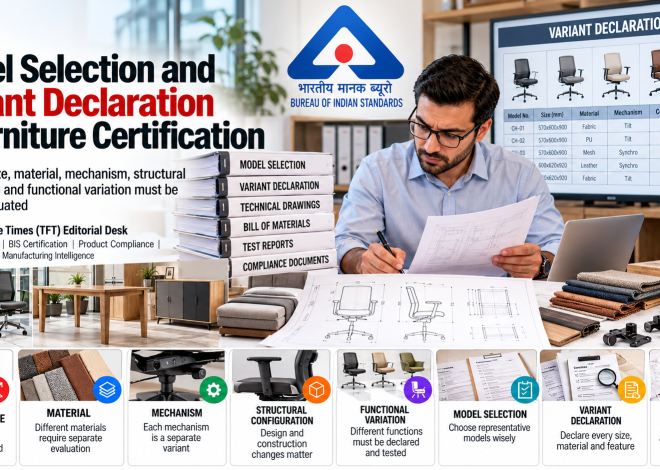
- Declared models or model families.
- Demonstrated manufacturing and testing capability.
BIS product-certification guidance states that separate applications are generally required for different Indian Standards and for the same product manufactured at different factory locations. BIS product-certification FAQs
A manufacturer should therefore create a category-to-factory compliance matrix before filing applications.
| Factory | Work chairs | General-purpose seating | Tables and desks | Storage units | Beds | Bunk beds |
|---|---|---|---|---|---|---|
| Factory A | Confirm applicability | Confirm applicability | Not produced | Not produced | Not produced | Not produced |
| Factory B | Not produced | Not produced | Confirm applicability | Confirm applicability | Not produced | Not produced |
| Factory C | Not produced | Not produced | Not produced | Not produced | Confirm applicability | Confirm applicability |
This avoids the mistaken assumption that a company-level certificate automatically covers every product and plant.
Completely manufactured and ready-to-assemble furniture
Several furniture standards and BIS product manuals address both completed products and ready-to-assemble units.
This is important because flat-pack furniture is not exempt simply because it is shipped as individual panels, frames, legs or hardware packs.
Where the commercial supply constitutes a furniture product intended to be assembled by the customer or installer, manufacturers must consider:
- The conformity of the finished assembled product.
- Accuracy of drilling and machining.
- Connector strength.
- Completeness of hardware.
- Repeatability of assembly.
- Clarity of instructions.
- Packaging protection.
- Traceability of component packs.
- Risk of combining incorrect parts.
- Performance after repeated assembly or movement.
A ready-to-assemble product must not depend on an expert factory technician to achieve safe construction.
Products that combine more than one category
Modern furniture increasingly combines several functions. Examples include:
- A desk with integrated storage.
- A bed with drawers.
- A table attached to a storage cabinet.
- A stool with an adjustable work-chair mechanism.
- A bunk bed incorporating a study desk.
- A wardrobe with a fold-out table.
- A storage unit with a seating surface.
Combination products require careful scope analysis. The manufacturer should determine whether one or more standards apply and which functions create the principal safety and performance obligations.
It is risky to classify a combination product according to only its largest or most visible feature.
Where interpretation is uncertain, the company should seek clarification from BIS or an experienced conformity-assessment professional before manufacturing, importing or advertising the product.
Manufacturer responsibilities across all six categories
Although each product standard is different, several responsibilities apply across the entire notified furniture group.
Maintain accurate technical documents
Every declared model should have controlled:
- Drawings.
- Dimensions.
- Materials.
- Bills of materials.
- Component specifications.
- Assembly details.
- Product codes.
- Revision history.
- Supplier information.
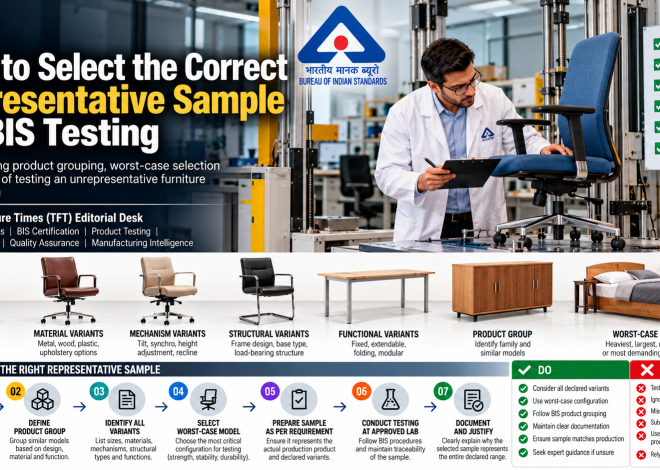
Select representative test samples
The selected lead model must represent the declared product family according to BIS grouping rules. The easiest or smallest product should not be selected merely because it is convenient to test.
Control design changes
Engineering changes should be reviewed before implementation. The company must determine whether a proposed change:
- Remains within the existing licence scope.
- Requires documentary submission.
- Requires additional testing.
- Creates a new product family.
- Changes the applicable standard.
Establish continuing quality assurance
The current tables-and-desks product manual, for example, expects manufacturers to define a Quality Assurance Plan covering control units, testing frequency and in-process controls. It also requires test records and the proper disposal of nonconforming products.
Similar system readiness is central to certification across the furniture categories.
Control marking
The BIS Standard Mark should be applied only:
- After a valid licence is granted.
- At the licensed manufacturing location.
- To products within the approved scope.
- In the prescribed manner.
- While the licence remains valid.
- Where the product conforms to all applicable requirements.
Preserve traceability
The manufacturer should be able to connect a finished product to:
- Its model and revision.
- Production date or batch.
- Factory location.
- Critical materials and components.
- Inspection records.
- Test records.
- Corrective actions where applicable.
What retailers, importers and institutional buyers should verify
The QCO is primarily a manufacturing and market-access regulation, but downstream businesses cannot afford to ignore it.
Before purchasing a notified product, a buyer should verify:
- The applicable Indian Standard.
- The manufacturer’s name.
- The actual manufacturing location.
- The BIS licence number.
- Licence validity.
- Product scope.
- Model coverage.
- Correct Standard Mark.
- Whether the product is domestic or imported.
- Whether any claimed exemption is valid and documented.
A supplier saying “BIS applied,” “BIS tested” or “manufactured according to BIS” is not necessarily the same as holding a valid licence for that model and factory.
E-commerce marketplaces and retailers should also ensure that online descriptions, images and certification claims accurately represent the supplied product.
Compliance does not end customer evaluation
BIS conformity can help establish that a covered product meets the applicable technical standard. However, customers assess a wider ownership experience.
They also care about:
- Comfort.
- Appearance.
- Finish consistency.
- Packaging.
- Delivery.
- Installation.
- Durability in actual environments.
- Spare-part availability.
- Warranty service.
- Complaint handling.
- Value for money.
This is why FurniReviewology can complement technical compliance.
BIS certification helps answer, “Does this covered product conform to the applicable Indian Standard under the certification system?”
FurniReviewology helps answer, “What has the customer’s real experience with the product, brand, delivery and service been?”
Technical conformity and transparent reviews serve different purposes, but together they can strengthen trust.
The six categories are the beginning of a new quality culture
The Furniture Quality Control Order is changing the conversation around furniture manufacturing in India.
For decades, much of the furniture market depended on informal descriptions such as “heavy-duty,” “commercial quality,” “premium,” “export quality” or “long-lasting.” Such claims were often difficult for buyers to compare or verify.
Compulsory standards create a framework for evaluating notified products against defined technical requirements. They encourage manufacturers to replace assumptions with:
- Documented specifications.
- Controlled materials.
- Verified designs.
- Repeatable testing.
- Traceable production.
- Corrective action.
- Continuing factory discipline.
The businesses most likely to benefit will be those that treat certification as part of product engineering rather than a label obtained at the end of production.
Manufacturers should begin with one practical question:
Which of our products falls within each of the six notified furniture categories, and can we prove that every covered model is manufactured under a controlled and compliant system?
The answer will determine not only certification readiness, but also future market access, product reliability and customer confidence.
Regulatory note: This article provides general industry information and does not constitute legal or certification advice. Standards, product manuals, grouping guidelines and QCO provisions may be revised. Manufacturers and importers should consult the latest official BIS and Gazette documents before making compliance decisions.
The Furniture Times (TFT) & Furniture Industry Search Engine (FISE)
“TFT tells their story. FISE helps the world find them.”
FurniReviewology helps the world trust them.
The furniture industry ecosystem is a $1 trillion industry ecosystem.
Know your category. Control your product. Prove your quality. Build furniture the market can find, verify and trust.