Asia-Pacific Airbnb Furniture Market: Where the Next Opportunities Are Emerging
How Tourism, Urbanisation and Domestic Travel Are Expanding Regional Demand
By The Furniture Times (TFT) Editorial Desk | Airbnb & Homestay Furniture | Asia-Pacific | Short-Term Rentals | Hospitality Furniture | Tourism | Urban Development | Global Market Intelligence
Asia-Pacific is becoming one of the world’s most important opportunity regions for Airbnb, homestay and short-term-rental furniture.
The region combines rapidly recovering international tourism, enormous domestic-travel markets, continuing urbanisation, extensive condominium development, growing middle-class consumption and some of the world’s most important furniture-manufacturing centres.
From compact apartments in Tokyo, Kuala Lumpur and Bangkok to villas in Bali, Phuket and Goa, the accommodation landscape is exceptionally diverse. It includes urban homestays, serviced apartments, beach houses, mountain cabins, heritage properties, rural guesthouses, resort residences and luxury villas.
Each property type requires a different furnishing strategy.
Urban apartments need compact and multifunctional products. Tropical villas require weather-resistant outdoor furniture. Rural homestays benefit from locally made, repairable products. Family-oriented properties need sufficient dining, storage and sleeping capacity. Longer-stay accommodation requires workspaces and more durable everyday furniture.
The Asia-Pacific short-term-rental furniture opportunity is therefore not one uniform market. It is a collection of national, regional and city-level markets shaped by different climates, cultures, regulations, guest expectations and property-development patterns.
For manufacturers, designers and suppliers, understanding these differences will determine who benefits from the next stage of growth.
Asia-Pacific Tourism Is Entering a New Growth Phase
Tourism recovery is rebuilding the demand foundation for short-term accommodation.
UN Tourism estimated that Asia-Pacific received approximately 331 million international arrivals in 2025, representing regional growth of around 6%. Although the region’s recovery began later than Europe’s, the return of international travel is creating new momentum across accommodation, property investment and hospitality furnishing. UN Tourism
The Pacific Asia Travel Association reported that 46 Asia-Pacific destinations recorded approximately 647.9 million international visitor arrivals in 2024, reaching about 91.9% of pre-pandemic levels. Provisional figures for the first half of 2025 showed a further 5.4% year-on-year increase. PATA via TTG Asia
The region’s future demand will not be driven by international travel alone. Domestic tourism in China, India, Japan, Indonesia, Australia, Thailand, Malaysia and other markets is equally important.
Thailand, for example, recorded more than 202 million domestic trips in 2025, an increase of 2.7%. Domestic tourism revenue grew by 3.69%, helping offset a decline in international arrivals. Thailand Government Public Relations Department
This demonstrates why furniture suppliers should not evaluate a market only through international-arrival data. A strong domestic-travel economy can support homestays, villas and vacation homes even during periods of weaker cross-border demand.
Why Asia-Pacific Is Strategically Important to the Furniture Industry
Asia-Pacific is both a major consumer market and a major furniture-production base.
The region includes manufacturing centres with expertise in:
- Timber furniture
- Rubberwood
- Rattan
- Bamboo
- Upholstery
- Metal furniture
- Mattresses
- Outdoor furniture
- Flat-pack furniture
- Custom joinery
- Handcrafted products
- Hotel and contract furniture
China, Vietnam, Malaysia, Indonesia and India already supply furniture to global markets. This gives the region an opportunity to build dedicated short-term-rental collections not only for domestic use but also for export.
Asia-Pacific can therefore become:
- A major market for Airbnb and homestay furniture.
- A production centre for global short-term-rental furnishing.
- A testing ground for compact, tropical and multifunctional design.
- A hub for turnkey property-furnishing services.
- A leader in integrating local craftsmanship with hospitality performance.
The opportunity reaches across the entire furniture ecosystem.
The Regional Demand Drivers
Tourism Recovery
More travellers create demand for more accommodation, property renovations and furniture replacement.
Urbanisation
Growing cities and high property costs create demand for compact apartments and multifunctional furniture.
Condominium Development
New high-rise residences create potential supply for serviced apartments, mid-term rentals and professionally managed short stays.
Domestic Travel
Large domestic markets reduce dependence on international tourism and support secondary cities and rural destinations.
Remote Work
Flexible workers need desks, ergonomic chairs, lighting and longer-stay functionality.
Lifestyle Investment
Property owners increasingly furnish apartments and holiday homes as income-generating assets.
Platform Adoption
Greater familiarity with digital booking platforms brings new hosts, co-hosts and professional property managers into the market.
Regional Manufacturing
Local furniture production can reduce costs, shorten delivery times and improve access to replacement products.
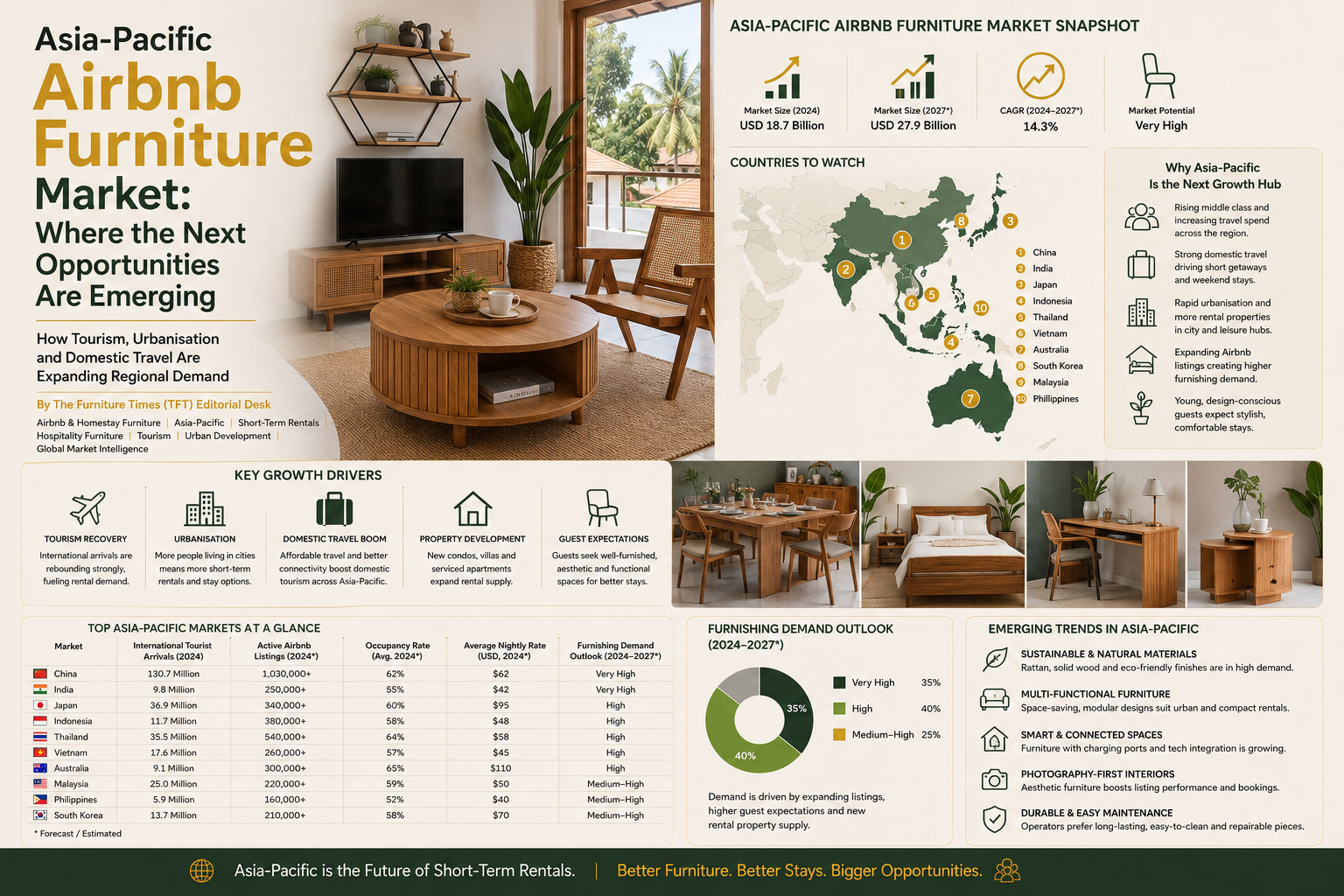
Asia-Pacific Opportunity Map
| Market | Current Position | Primary Furniture Opportunity |
|---|---|---|
| Japan | High-growth international destination | Compact, multifunctional and quality-driven furniture |
| India | Large emerging domestic and platform market | Affordable packages, homestays, villas and regional design |
| Malaysia | Strong tourism with manufacturing capability | Condominium packages, tropical outdoor and turnkey furnishing |
| Thailand | Mature leisure destination with large domestic travel | Villas, condominiums, outdoor and refurbishment |
| Vietnam | Fast tourism growth and export manufacturing strength | New property furnishing, urban apartments and coastal projects |
| Indonesia | Strong villa and homestay economy | Rattan, timber, outdoor furniture and local craftsmanship |
| Australia | Mature holiday-home and domestic-travel market | Family homes, coastal furniture and durable outdoor products |
| New Zealand | Nature and rural accommodation strength | Lodges, cabins, durable timber and sustainable furniture |
| Singapore | Premium urban market with limited space | High-quality compact and multifunctional furniture |
| Philippines | Archipelago tourism and urban condominium growth | Coastal furniture, condos, family accommodation and local supply |
| South Korea | Advanced urban and domestic-travel market | Compact furniture, premium design and digital convenience |
| China | Enormous domestic tourism and manufacturing scale | Homestays, rural tourism, serviced apartments and smart furniture |
| Sri Lanka | Emerging recovery and villa tourism | Locally made products, outdoor furniture and boutique accommodation |
| Nepal and Bhutan | Nature, culture and small-scale hospitality | Lodge, guesthouse and locally crafted furniture |
| Pacific Islands | Resort, villa and nature-based tourism | Climate-resistant outdoor and hospitality furniture |
1. Japan: Compact Living Meets Rapid Tourism Growth
Japan is one of Asia-Pacific’s most important emerging furniture opportunities.
The country welcomed approximately 36.9 million international visitors in 2024, representing growth of about 47% from 2023. Airbnb also identified Japan as a key expansion market in the first quarter of 2026, with particularly strong acceleration among first-time bookers.
Demand spans:
- Tokyo
- Osaka
- Kyoto
- Fukuoka
- Hokkaido
- Okinawa
- Ski destinations
- Hot-spring towns
- Rural cultural destinations
Japan’s high urban density creates strong demand for furniture that delivers several functions within limited space.
Product Opportunities
- Foldable dining tables
- Storage beds
- Wall-mounted desks
- Compact wardrobes
- Sofa beds
- Convertible sleeping arrangements
- Luggage benches
- Nesting tables
- Modular storage
- High-quality mattresses
- Easy-clean surfaces
- Technology-integrated furniture
Guest expectations for cleanliness, organisation and product quality are generally high. Furniture must remain visually calm while offering genuine functionality.
Japan also creates opportunities for properties that combine traditional identity with modern convenience. Low seating, natural materials, restrained colours and Japanese-inspired craftsmanship can differentiate accommodation, provided the products meet contemporary durability and comfort expectations.
Market Challenge
Accommodation licensing, building rules and local regulation can restrict supply. Furniture companies should work with licensed operators, developers and professional property managers rather than assume every informal listing represents stable long-term demand.
2. India: Scale, Domestic Travel and Diverse Homestay Demand
India offers one of the region’s largest long-term opportunities.
Airbnb reported that nights originating in India grew approximately 50% year over year during the first quarter of 2026. While this measures booking demand originating from Indian travellers rather than the domestic furniture market directly, it signals rapidly increasing familiarity with platform-based accommodation.
India combines:
- A large domestic population
- Expanding middle-class travel
- Religious tourism
- Heritage tourism
- Medical travel
- Business travel
- Mountain tourism
- Beach tourism
- Wedding and event travel
- Rural and community tourism
Major opportunity markets include:
- Goa
- Mumbai
- Delhi
- Bengaluru
- Hyderabad
- Jaipur
- Udaipur
- Kerala
- Himachal Pradesh
- Uttarakhand
- Kashmir
- North-East India
Product Opportunities
- Affordable complete-room packages
- Locally manufactured beds
- Durable mattresses
- Modular wardrobes
- Sofa beds
- Family dining furniture
- Balcony sets
- Garden furniture
- Mountain-property furniture
- Heritage-inspired products
- Furniture for large groups
- Work-from-anywhere packages
India’s accommodation market is extremely varied. A Goa villa requires moisture resistance, outdoor living and easy-clean upholstery. A mountain homestay may prioritise robust timber products, luggage storage and warm interior comfort. An urban serviced apartment needs compact furniture, desks and repeatable specifications.
Manufacturing Advantage
India can serve much of this demand through domestic manufacturing. Its regional craftsmanship, timber and metal capabilities, upholstery sector and large workforce provide a strong base for specialised collections.
The main requirement is greater standardisation, documented quality, faster delivery and better connections between manufacturers and property operators.
3. Malaysia: Tourism Growth Meets Furniture-Manufacturing Strength
Malaysia is strategically positioned to become both a major regional buyer and supplier of short-term-rental furniture.
The country received just over 25 million international tourists in 2024, an increase of 24.2% over 2023. Tourism continued expanding in 2025, supported by regional travel, flight connectivity and visa policies. Reuters
Important markets include:
- Kuala Lumpur
- Penang
- Langkawi
- Melaka
- Johor Bahru
- Kota Kinabalu
- Kuching
- Genting Highlands
- Cameron Highlands
- Desaru
- Island and coastal destinations
Urban Opportunity
Malaysia’s large condominium inventory creates demand for:
- Compact living-room packages
- Dining sets for small spaces
- Sofa beds
- Storage beds
- Work desks
- Balcony furniture
- Modular wardrobes
- Turnkey installation
Leisure Opportunity
Langkawi, Sabah, Sarawak, Penang, Desaru and coastal markets need:
- Outdoor dining furniture
- Poolside loungers
- Daybeds
- Parasols
- Rattan furniture
- Weather-resistant upholstery
- Garden seating
- Family accommodation packages
Manufacturing Opportunity
Malaysia has established capabilities in rubberwood, timber, upholstery, metal and outdoor furniture. Local companies can supply domestic hosts while developing export-ready collections for Southeast Asia, the Middle East and tropical tourism destinations worldwide.
The opportunity is particularly strong for companies that combine products with delivery, installation, repair and immediate replacement.
4. Thailand: Mature Tourism, Strong Domestic Travel and Refurbishment Demand
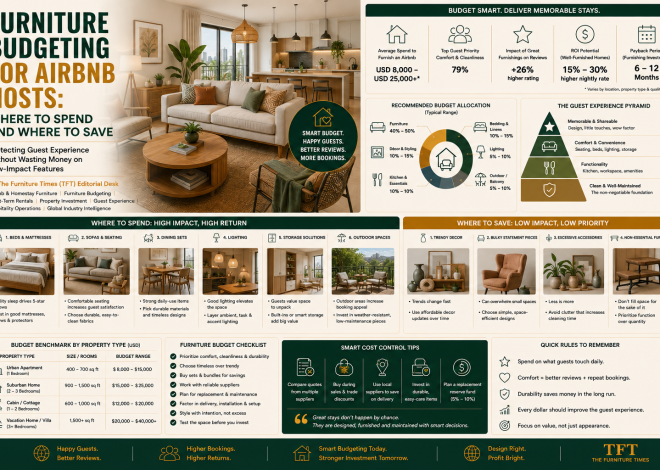
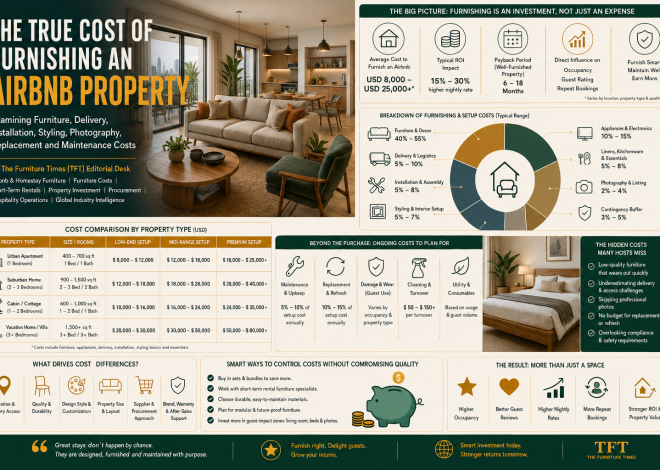
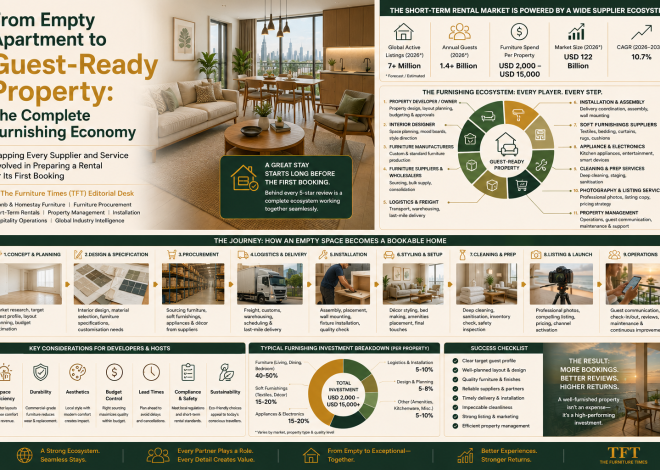
Thailand remains one of Asia’s largest tourism economies even after a challenging 2025.
The country welcomed approximately 32.97 million international visitors in 2025, a decline of 7.23% from 2024. However, domestic travellers made more than 202 million trips, demonstrating substantial internal demand. Thailand Government Public Relations Department
Key short-term-accommodation markets include:
- Bangkok
- Phuket
- Chiang Mai
- Pattaya
- Koh Samui
- Krabi
- Hua Hin
- Island destinations
Thailand already has an established hospitality and property-furnishing industry. Its opportunity lies in both new projects and continuous refurbishment.
High-Demand Categories
- Poolside furniture
- Sun loungers
- Daybeds
- Outdoor dining
- Rattan and synthetic-rattan furniture
- Balcony sets
- Compact condominium furniture
- Villa bedroom packages
- Hospitality mattresses
- Easy-clean upholstery
Market Characteristics
Bangkok requires urban functionality and workspaces. Phuket, Koh Samui and Krabi require tropical materials and outdoor performance. Chiang Mai favours products that can incorporate local craft and cultural identity.
The 2025 decline in international arrivals shows why domestic tourism matters. Furniture demand can remain resilient when properties serve both local and foreign guests.
Market Challenge
Condominium rules and accommodation licensing can affect legal short-term operations. Suppliers should identify licensed operators, resort residences, villas and professional serviced-accommodation companies.
5. Vietnam: One of the Region’s Fastest-Growing Tourism Markets
Vietnam recorded approximately 21.2 million international arrivals in 2025, an increase of 20.4% over 2024 and about 17.8% above 2019. Tourism-related accommodation and food-service revenue also increased strongly. Vietnam Government Portal
The country’s major opportunity markets include:
- Ho Chi Minh City
- Hanoi
- Da Nang
- Hoi An
- Nha Trang
- Phu Quoc
- Ha Long
- Da Lat
- Coastal resort destinations
Vietnam has a powerful combination of tourism growth, property development and export-oriented furniture manufacturing.
Product Opportunities
- Urban apartment packages
- Coastal outdoor furniture
- Resort-residence furnishing
- Compact desks
- Sofa beds
- Timber furniture
- Mattresses
- Balcony furniture
- Villa packages
- Locally inspired products
Strategic Advantage
Vietnamese manufacturers already supply major international furniture markets. They can adapt this capacity to develop dedicated Airbnb and homestay collections for domestic and regional distribution.
The country could become an important supplier of complete packages combining bedroom, dining, living and outdoor furniture.
Main Requirement
Factories serving this market need flexible minimum orders, faster lead times and stronger installation partnerships. Short-term-rental operators often require smaller but repeatable projects rather than the large-volume orders typical of conventional exports.
6. Indonesia: The Natural Home of Villa and Homestay Furniture
Indonesia has one of Asia-Pacific’s most recognisable villa and homestay markets.
Bali remains the best-known destination, but the opportunity extends across:
- Jakarta
- Yogyakarta
- Bandung
- Surabaya
- Lombok
- Labuan Bajo
- Sumatra
- Rural tourism destinations
- Island communities
Indonesia’s furniture traditions give it particular strength in:
- Rattan
- Timber
- Bamboo
- Carved products
- Woven materials
- Outdoor furniture
- Custom manufacturing
- Artisan accessories
Key Opportunities
- Villa bedroom packages
- Poolside furniture
- Outdoor sofas
- Daybeds
- Rattan dining
- Decorative lighting
- Custom headboards
- Tropical storage
- Locally crafted statement furniture
Locally made products help properties communicate a strong sense of place, which can improve their visual identity and market differentiation.
Operating Challenge
Tropical humidity, rain, UV exposure and insects require careful material selection. Products must be properly treated, maintained and designed for commercial use.
Local craftsmanship must also become more repeatable. Professional property managers need consistent dimensions, finishes, delivery schedules and replacement components.
7. Australia: Mature Holiday Homes and High Operating Costs
Australia has a mature holiday-home culture, large domestic travel flows and a broad short-term-rental market.
Major destinations include:
- Sydney
- Melbourne
- Brisbane
- Gold Coast
- Sunshine Coast
- Byron Bay
- Perth
- Adelaide
- Tasmania
- Wine regions
- Coastal communities
Australian accommodation ranges from urban apartments to beach houses, rural retreats, farm stays and eco-lodges.
Furniture Opportunities
- Coastal living furniture
- Large family dining tables
- Outdoor dining sets
- Barbecue-area furniture
- Bunk beds
- Durable mattresses
- Flexible sleeping systems
- Cabin furniture
- Sustainable products
- Refurbishment services
High labour and logistics costs make furniture failure particularly expensive. Products should be durable, repairable and supported by local replacement inventory.
Operators may also value furniture leasing, refurbishment and take-back services because replacement and disposal can be costly.
Australia’s demanding climate—from intense coastal sunlight to humid tropics and cooler southern regions—requires region-specific product specifications.
8. New Zealand: Nature Tourism and Sustainable Furnishing
New Zealand’s market is smaller than Australia’s but attractive for nature-based accommodation, rural stays, lodges, cabins and holiday homes.
Opportunities are concentrated around:
- Auckland
- Queenstown
- Rotorua
- Christchurch
- Wellington
- Wine regions
- Coastal towns
- Mountain destinations
- Rural tourism
Product Demand
- Cabin furniture
- Durable timber products
- Entryway and equipment storage
- Large dining furniture
- Outdoor sets
- Sustainable materials
- Locally made products
- Furniture for remote properties
Sustainability, repairability and local sourcing can be strong market differentiators. Remote locations also increase the importance of durable construction and spare-parts availability.
Furniture designed for easy assembly and repair may be more valuable than products requiring specialist technicians.
9. Singapore: Premium Urban Furnishing in Limited Space
Singapore has limited space, high real-estate costs and a strongly regulated accommodation environment.
It may not offer the same volume of informal short-term rentals as larger regional markets, but it remains important for:
- Serviced apartments
- Corporate accommodation
- Extended stays
- Premium residences
- Business travel
- Professionally managed accommodation
Furniture Opportunities
- High-quality compact furniture
- Storage beds
- Modular wardrobes
- Wall-mounted workstations
- Multifunctional tables
- Sofa beds
- Premium mattresses
- Technology-integrated furniture
- Durable finishes
Singapore can also function as a regional management, design and procurement hub. Operators based there may manage accommodation portfolios across Southeast Asia.
The market favours products with strong documentation, efficient delivery and reliable after-sales service.
10. The Philippines: Islands, Condominiums and Family Travel
The Philippines combines extensive island tourism, a large domestic population, overseas family connections and condominium development.
Major markets include:
- Manila
- Cebu
- Boracay
- Palawan
- Bohol
- Davao
- Tagaytay
- Siargao
Product Opportunities
- Condominium furniture packages
- Coastal outdoor furniture
- Moisture-resistant products
- Family dining
- Sofa beds
- Bunk beds
- Workspaces
- Balcony sets
- Villa furnishings
- Locally made rattan furniture
The country’s archipelagic geography creates logistics challenges. Regional warehousing and local installation networks will be important for suppliers attempting to serve multiple islands.
The furniture opportunity is strongest where products balance affordability, humidity resistance and ease of replacement.
11. South Korea: Urban Design and Domestic Tourism
South Korea has a digitally advanced population, high urban density and a strong domestic-travel culture.
Important markets include:
- Seoul
- Busan
- Jeju
- Incheon
- Gangwon
- Cultural and coastal destinations
Product Opportunities
- Compact apartment furniture
- Premium minimalist design
- Foldable dining
- Storage furniture
- Workstations
- Technology-integrated furniture
- Easy-clean upholstery
- Jeju vacation-home packages
Guests may expect high digital convenience, clean presentation and intelligent space utilisation. Furniture integrated with charging, lighting and cable management can strengthen the accommodation proposition.
South Korea also offers opportunities for design-led products capable of appearing distinctive in listing photographs.
12. China: A Vast Domestic Accommodation Economy
China’s domestic tourism economy operates at enormous scale, supporting hotels, guesthouses, homestays and vacation properties across cities and rural destinations.
Important categories include:
- Urban serviced apartments
- Rural homestays
- Cultural villages
- Mountain retreats
- Coastal accommodation
- Ski tourism
- Family vacation properties
China is also the world’s largest furniture-production base, giving it the capacity to develop specialised product systems at scale.
Furniture Opportunities
- Standardised apartment packages
- Smart furniture
- Compact urban products
- Rural homestay collections
- Family dining
- Flexible sleeping systems
- Outdoor furniture
- Digital furniture management
- Modular products
- Rapid replacement
The market’s platform ecosystem and regulatory environment differ from many Western countries. Suppliers must understand domestic booking channels and regional tourism-development policies.
China may become particularly important for technology-integrated rental furniture and large-scale standardisation.
13. Sri Lanka: Boutique Villas and Tourism Recovery
Sri Lanka offers opportunities across:
- Colombo
- Galle
- Kandy
- Ella
- Coastal regions
- Tea-country accommodation
- Cultural destinations
- Wildlife tourism
The market includes guesthouses, boutique villas, surf accommodation and small hotels.
Product Opportunities
- Locally made timber furniture
- Rattan products
- Outdoor dining
- Daybeds
- Tropical upholstery
- Heritage-inspired furniture
- Repairable products
- Affordable guest-room packages
Economic volatility and tourism disruptions can affect investment timing. However, local production and refurbishment can reduce dependence on expensive imports.
Furniture companies should focus on flexible, locally maintainable products rather than overly complex systems requiring imported parts.
14. Nepal, Bhutan and Himalayan Markets
Nepal, Bhutan and the wider Himalayan tourism economy create specialised opportunities in:
- Trekking lodges
- Mountain guesthouses
- Cultural homestays
- Eco-lodges
- Wellness retreats
- Community tourism
Furniture Needs
- Durable beds
- Luggage and equipment storage
- Robust dining furniture
- Locally sourced timber products
- Warm upholstery
- Compact room layouts
- Repairable construction
- Furniture suited to remote installation
These markets may be smaller in absolute volume but important for local craftspeople and regional manufacturers.
Remote logistics make durability and repairability essential. A product that fails in a mountain location may be difficult and expensive to replace.
Urbanisation Is Creating a Compact-Furniture Economy
Asia-Pacific contains many of the world’s largest and most densely populated cities.
Urban property prices are driving demand for smaller apartments, while travellers still expect areas for sleeping, dining, working, storing luggage and relaxing.
This creates opportunity for:
- Storage beds
- Sofa beds
- Nesting tables
- Foldable dining furniture
- Modular wardrobes
- Wall-mounted desks
- Bench storage
- Extendable tables
- Stackable chairs
- Movable partitions
- Multifunctional consoles
The short-term-rental sector can become an important testing ground for space-saving furniture because operators can measure whether products improve occupancy, guest satisfaction and property performance.
Manufacturers that solve multiple spatial problems with simple and durable mechanisms may find markets across Tokyo, Seoul, Singapore, Hong Kong, Kuala Lumpur, Bangkok, Mumbai and other dense cities.
Domestic Travel Is Expanding Demand Beyond Capital Cities
One of the most important regional trends is the growth of domestic travel to secondary cities, rural regions, cultural destinations and nature-based accommodation.
Domestic travellers are supporting:
- Weekend homes
- Rural homestays
- Mountain cabins
- Farm stays
- Beach houses
- Family villas
- Religious-tourism accommodation
- Heritage properties
- Wellness retreats
This distributes furniture demand beyond major gateways.
A manufacturer may find stronger opportunities serving regional property clusters than competing in a saturated capital city. Local distribution and installation networks can become decisive advantages.
Domestic travel also makes accommodation demand more resilient when international tourism is affected by geopolitical conflict, currency changes, flight capacity or health concerns.
Property Development Is Creating Rental-Ready Residences
Developers increasingly recognise that some buyers want properties capable of generating income.
This can lead to:
- Furnished condominium packages
- Branded residences
- Serviced apartments
- Resort residences
- Holiday-home developments
- Rental-management programmes
- Investor furniture packages
Furniture companies can work directly with developers to provide standard packages at the construction or handover stage.
The advantage is significant: instead of approaching one host at a time, the supplier can furnish dozens or hundreds of units through a coordinated project.
These packages should include:
- Clear budgets
- Defined delivery schedules
- Installation
- Product specifications
- Warranty support
- Replacement inventory
- Optional upgrade levels
- Furniture asset records
Developer partnerships may become one of the fastest routes into the regional market.
Tropical Conditions Require Specialised Furniture
Much of Southeast and South Asia operates in hot, humid and high-rainfall environments.
Furniture may face:
- High humidity
- Strong UV exposure
- Heavy rainfall
- Salt air
- Mould
- Insects
- Pool chemicals
- Repeated air-conditioning cycles
- Intensive cleaning
Products should be evaluated for:
- Moisture resistance
- Corrosion resistance
- UV stability
- Fabric drying time
- Mould resistance
- Timber treatment
- Hardware quality
- Drainage
- Cushion storage
- Ease of cleaning
A product designed for a dry European interior may fail quickly in a tropical villa.
Regional manufacturers with experience in these conditions can develop specialised collections for tropical short-term accommodation worldwide.
Local Identity Can Become a Competitive Advantage
Guests often choose homestays and vacation rentals because they want an experience connected to the destination.
Furniture can communicate this identity through:
- Malaysian timber
- Indonesian rattan
- Indian carving
- Vietnamese craftsmanship
- Japanese minimalism
- Thai weaving
- Filipino natural fibres
- Himalayan woodwork
- Pacific Island materials
- Regional textiles and colours
The opportunity is not to reproduce traditional furniture without modification. It is to reinterpret regional identity through products suitable for intensive guest use.
Local products must remain:
- Durable
- Cleanable
- Safe
- Reproducible
- Repairable
- Available for replacement
Authenticity and commercial performance must work together.
Major Risks in the Regional Market
Regulation
Cities and condominium associations may restrict short-term rentals.
Informal Supply
Not every active listing is a stable or legally compliant business.
Tourism Volatility
Geopolitical events, natural disasters, currency shifts and flight capacity can affect arrivals.
Price Sensitivity
Many hosts furnish under tight budgets, increasing pressure to buy low-cost products.
Climate Damage
Poor material selection can create early failure in tropical or coastal environments.
Logistics
Islands, remote areas and congested cities make delivery and replacement difficult.
Fragmented Purchasing
Millions of small hosts can be expensive to reach individually.
Product Inconsistency
Local craft production may lack the standardisation required by professional portfolios.
Oversupply
Rapid property conversion can reduce occupancy and delay refurbishment spending.
Suppliers should assess the quality and professionalism of demand, not only the number of listings.
What Manufacturers Should Develop
The region needs dedicated short-term-rental furniture rather than general products relabelled for hospitality.
Promising product-development areas include:
- Complete studio packages
- Condominium furnishing packages
- Tropical outdoor collections
- Homestay bedroom systems
- Twin-to-king bed systems
- Durable sofa beds
- Compact workstations
- Family dining packages
- Modular wardrobes
- Replaceable upholstery
- Repairable furniture
- Balcony collections
- Villa packages
- Rural guesthouse furniture
- Climate-specific materials
Manufacturers should also provide:
- Detailed specifications
- Weight capacities
- Care instructions
- Commercial warranties
- Spare parts
- Multi-unit pricing
- Installation
- Fast replacement
- Digital catalogues
- Furniture inventory support
Services May Become as Valuable as Products
Many property owners do not want to coordinate the full furnishing process themselves.
The market therefore creates demand for:
- Interior design
- Space planning
- Procurement
- Delivery
- Installation
- Styling
- Property photography
- Cleaning preparation
- Furniture inventories
- Maintenance
- Repair
- Refurbishment
- Furniture take-back
- Asset liquidation
Turnkey providers can help investors move from an empty property to a booking-ready listing under one contract.
For manufacturers, adding services can create longer customer relationships and recurring revenue.
Sustainability Is a Regional Necessity
Rapid furnishing growth can produce significant waste if properties rely on low-quality, non-repairable products.
A more responsible Asia-Pacific market should prioritise:
- Durable local materials
- Repairable construction
- Replaceable covers
- Modular parts
- Responsible timber sourcing
- Furniture refurbishment
- Take-back programmes
- Secondary markets
- Local repair networks
- End-of-life recycling
Local manufacturing can reduce transport distances, but it must also meet credible environmental and labour standards.
Sustainability should be connected to measurable product life, repairability and material information rather than used only as a marketing claim.
The Searchability Challenge
The region contains thousands of capable furniture manufacturers, workshops, installers and service providers. Many remain difficult for property operators to find.
A host may need:
- A furniture package in Goa
- Outdoor furniture in Langkawi
- A repairer in Bali
- An installer in Bangkok
- A mattress supplier in Vietnam
- Compact furniture in Tokyo
- Rattan furniture in the Philippines
Without searchable industry infrastructure, buyers depend on fragmented social media recommendations, general marketplaces and personal referrals.
Furniture Industry Search Engine (FISE) can help manufacturers and service providers become discoverable by product, location and market specialisation.
If you are not searchable, you do not exist in the moment the buyer needs you.
TFT tells their story. FISE helps the world find them. FurniReviewology helps the world trust them.
Where the Next Opportunities Are Most Likely to Emerge
High-Growth Tourism and New Furnishing
Vietnam, India, Japan and Malaysia present strong growth signals.
Mature Markets and Recurring Replacement
Australia, Thailand, Japan and established Southeast Asian destinations offer refurbishment and replacement demand.
Tropical Villa and Outdoor Furniture
Indonesia, Thailand, Malaysia, the Philippines, Sri Lanka and Pacific destinations offer specialised outdoor opportunities.
Compact Urban Furniture
Japan, Singapore, South Korea, India, Malaysia and major Chinese cities require space-efficient products.
Manufacturing and Export
China, Vietnam, Malaysia, Indonesia and India can supply the regional and global short-term-rental market.
Local Craft and Destination Identity
Indonesia, India, Thailand, Vietnam, Malaysia, Nepal, Bhutan and the Philippines offer strong artisan-integration opportunities.
Developer-Led Furnishing
India, Malaysia, Vietnam, Thailand, Indonesia and the Philippines have meaningful potential for condominium, villa and resort-residence packages.
Conclusion
Asia-Pacific is positioned to become one of the most important growth regions for Airbnb and homestay furniture.
The opportunity is being driven by the convergence of international tourism recovery, domestic travel, urbanisation, condominium development, remote work and the professionalisation of property management.
Japan offers compact, high-quality design opportunities. India provides scale and enormous domestic potential. Malaysia combines tourism with manufacturing strength. Thailand offers a mature accommodation base and large domestic-travel economy. Vietnam brings fast tourism growth and export capacity. Indonesia connects villa demand with world-class rattan and timber craftsmanship. Australia provides a mature market for durable and service-supported furniture.
The region’s diversity is its greatest strength—and its greatest challenge.
Furniture companies cannot enter Asia-Pacific with one standard product package. They must understand climate, regulation, property size, guest behaviour, local culture, purchasing power and replacement infrastructure.
The companies most likely to succeed will offer more than attractive furniture. They will provide durable products, installation, replacement, repair, portfolio consistency and locally relevant design.
Asia-Pacific’s short-term-rental furniture market is still being defined. That gives manufacturers, designers and suppliers an opportunity to shape it.
The next growth frontier will belong to companies that recognise Airbnb and homestay furniture not as an informal extension of home retail, but as a specialised regional hospitality market with global potential.