Indonesia Furniture Industry News: Timber, Craftsmanship and Export Opportunity
Indonesia Furniture Industry News: Timber, Craftsmanship and Export Opportunity
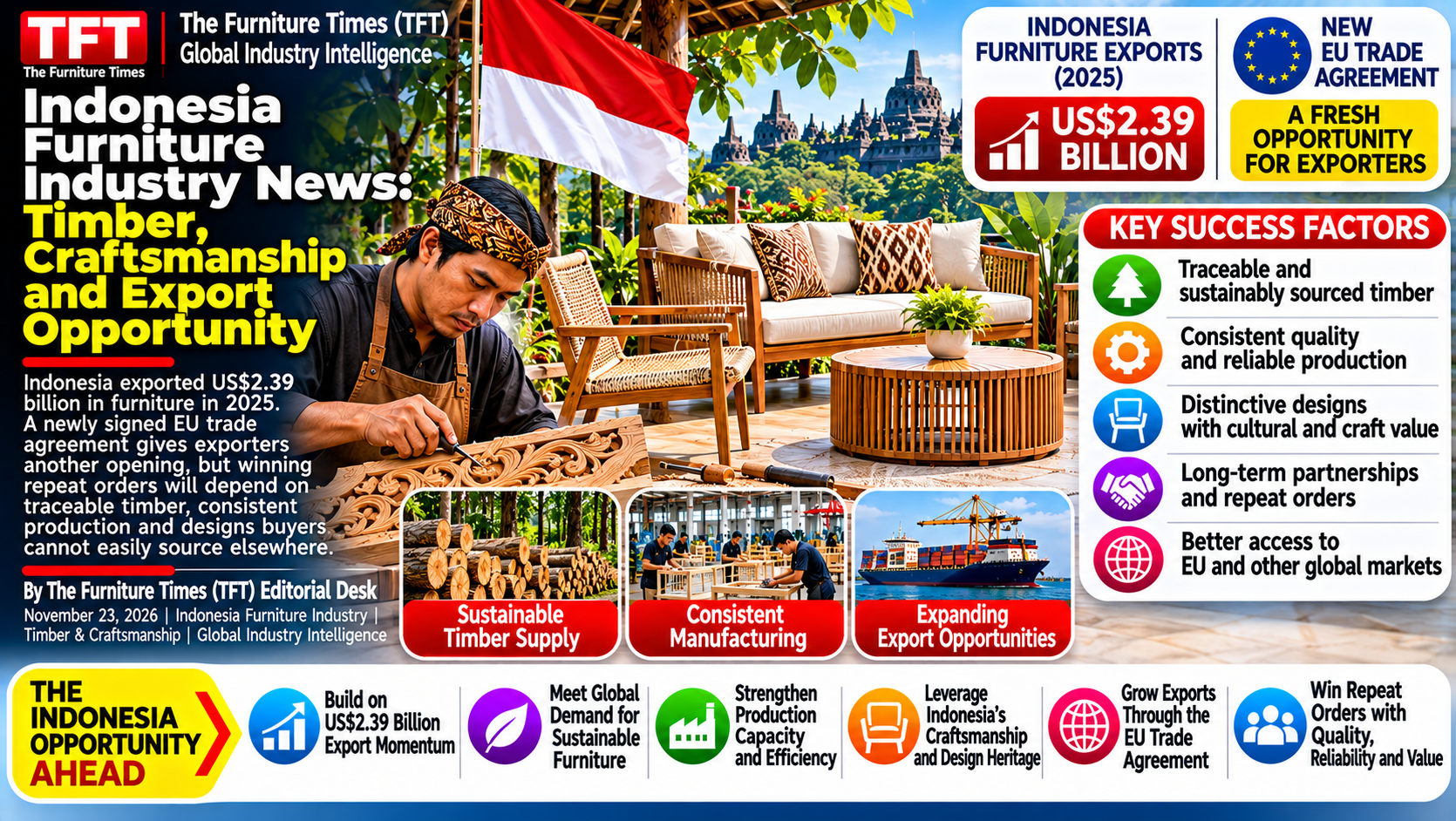
Indonesia exported US$2.39 billion in furniture in 2025. A newly signed EU trade agreement gives exporters another opening, but winning repeat orders will depend on traceable timber, consistent production and designs buyers cannot easily source elsewhere.
By The Furniture Times (TFT) Editorial Desk | November 23, 2026 | Indonesia Furniture Industry | Timber & Craftsmanship | Global Industry Intelligence
Indonesia and the European Union signed their Comprehensive Economic Partnership Agreement (CEPA) on November 21, creating a potential new route to preferential trade for Indonesian exporters. The European Commission expects provisional application likely in early 2027, once the necessary internal procedures are completed. Signing is not the same as implementation: furniture suppliers should not price an order on the assumption that preferential duties already apply. Press release
The agreement comes as Indonesia looks to expand its position in global furniture trade. The country’s Coordinating Ministry for Economic Affairs reports US$2.39 billion in furniture exports and US$1.92 billion in imports in 2025, leaving a surplus of about US$473 million. In the ministry’s comparison, Indonesia ranked 25th among furniture exporters, with a 0.77% share of world exports. Those are 2025 figures, not evidence that shipments have risen in 2026. They show an established export industry with room to win more business. ekon.go.id
The opportunity is not simply to ship more timber furniture. Indonesia can compete by combining woodworking and weaving skills with original design, credible sourcing records and production that matches the approved sample. A buyer may discover a supplier because of its hand-carved teak or woven rattan. The second order depends on whether the pieces fit, the finishes match and the documentation holds up.
Certified materials: Know what each document proves
Indonesia has a national timber verification system, SVLK, which supports legality verification. Its timber partnership with the EU provides the framework for FLEGT licensing for covered shipments. For buyers, that framework is useful, but it does not turn every supplier document into a blanket claim about every product in a catalogue. The practical question is whether the evidence covers the materials and shipment being purchased. eur-lex.europa.eu
The EU Deforestation Regulation, or EUDR, is a separate issue. Under the regulation, a valid FLEGT licence addresses the legality condition for covered wood products. It does not by itself establish that a product meets the separate deforestation-free condition or remove the applicable due-diligence obligations. Likewise, a sustainability certificate should not be presented as the same thing as customs origin or automatic market access. EUR-Lex
| Evidence | What it helps establish | What it does not establish on its own |
|---|---|---|
| SVLK-related records or applicable FLEGT licence | Timber legality evidence within the relevant scope | Full EUDR compliance or eligibility for a preferential duty |
| Forest-management or chain-of-custody certification | A specific sourcing claim within the certificate and transaction scope | That every timber input or model in the collection is covered |
| Proof of preferential origin | Whether goods qualify for a tariff preference when the relevant agreement applies | Timber legality, deforestation-free status or finished-product quality |
| Product specifications and test evidence | What the declared product is made of and how it performs under stated conditions | That materials in a later shipment are the same unless production records link them |
Consider a dining chair sold as solid teak with a woven seat. If a repeat order uses a different timber source, changes a hidden component or substitutes synthetic weave for natural rattan, the piece can look similar while no longer matching the original specification or supporting records. Exporters should link the model, bill of materials, supplier records and production batch before shipment, rather than trying to reconstruct that chain when an importer asks for proof.
Jepara and artisan production: Preserve the craft, specify the construction
Indonesia’s Ministry of Trade has documented work with local authorities in Jepara to coordinate furniture export promotion and showcase carving. The cluster offers a useful example of how a distinctive craft can put a supplier on an international shortlist. The challenge is converting that interest into an order that dispersed workshops can fulfil consistently. ditjenpen.kemendag.go.id
A hand-carved panel does not need to look identical to the next one. Natural grain and small variations in carving can be part of what the buyer is paying for. But a hotel buying 80 units cannot have large differences in dimensions, unstable joints or finishes that look as though they came from different collections. The exporter needs to define where variation is welcome and where it is not.
For a workshop network, that may mean using an approved reference sample, controlling essential dimensions and joinery, keeping finish samples with each participating workshop, and bringing pieces together for inspection before packing. Specialist artisans can retain the work that gives a collection its character. Shared controls can handle the parts that must repeat: seat height, frame alignment, hardware, labels and carton protection.
The same distinction applies to woven furniture. A buyer needs to know whether the product uses natural rattan, cane or synthetic weaving material, whether that material is decorative or load-bearing, and where the piece is intended to be used. A woven chair designed for a covered interior should not be marketed as suitable for an exposed resort terrace simply because it has a tropical look. For a hospitality order, it is also worth establishing whether a damaged panel can be rewoven or replaced locally.
Original design: A reason to choose the supplier, not just the product
An export programme built around a buyer’s drawing can keep a workshop busy, but the next tender may turn mainly on price. A recognisable collection gives the buyer another reason to return: the supplier offers a design, finish or construction that is harder to replace. That is the opportunity in adapting Indonesian craft to contemporary interiors without reducing it to a decorative motif.
A carved furniture maker might develop a restrained hotel collection where the carving appears only on replaceable panels, keeping the visual identity while making repeat procurement easier. A rattan specialist might build a family of dining chairs, lounge chairs and headboards around a recognisable weave. An outdoor timber manufacturer might offer a coordinated range with separately orderable slings or fittings, making it easier for resorts to refurbish individual pieces instead of replacing entire sets.
The design also has to work commercially. Before presenting a range overseas, settle design ownership, permissible variations, order minimums, packed dimensions and replacement-part availability. A design that attracts attention at a fair but cannot survive export packaging or be reproduced at the agreed price is not yet an export-ready product.
International market access: Where to look for repeat business
- European Union: The signed CEPA gives exporters a reason to prepare now, but preferences depend on implementation and eligibility. Ask the importer which product classification, origin documents and timber records it will require. Quote the business under the terms actually available for the expected entry date. Press release
- United States: The United States and Indonesia have a reciprocal trade agreement text published by the U.S. Trade Representative. Exporters should still verify the applicable treatment by product and entry date rather than assume that an agreement means all furniture ships duty-free. For a retailer or distributor, consistent replenishment and clear defect handling matter alongside any tariff advantage. ustr.gov
- Japan and other Asian markets: Compact collections, controlled finishes and smaller repeat batches are propositions worth testing with specific importers. Validate dimensions and packaging against the buyer’s needs instead of sending an export range designed for a different market.
- Australia, New Zealand and Gulf hospitality: Resort and commercial outdoor furniture are opportunities to investigate project by project. Start with funded procurement and an identifiable local partner. Before accepting an order, agree on exposure conditions, maintenance, installation and who stocks replacement parts.
These are routes to investigate, not market-growth forecasts. A distributor signing up for one container is a useful start. A distributor reordering the same collection without renegotiating away the margin is evidence of durable demand.
What exporters should prepare before the next buying cycle
- Choose a focused export range. Start with products that show a distinctive capability and can be made repeatedly at a known cost.
- Build a sourcing file for each model. Record timber species and suppliers, approved alternatives and the documents that connect inputs to the finished batch.
- Show buyers what will vary. Use reference photographs and approved samples to distinguish acceptable hand-finished variation from defects.
- Quote for the shipment and the reorder. Include packing, inspection and the real cost of smaller replenishment orders. Agree on who bears changes in freight or duties.
- Make the workshop discoverable. Publish specifications, production capabilities, representative photographs and relevant project references. Name the processes performed in-house and explain how work across partner workshops is controlled.
The TFT outlook
The EU agreement is the immediate news. The longer-term opportunity is to make Indonesia’s craftsmanship easier for international buyers to specify and buy again. Preferential access, where available, can improve the landed price; it cannot rescue an inconsistent finish, an undocumented timber batch or a collection that is too expensive to replenish.
For 2027, watch when the EU agreement starts applying, which furniture categories convert enquiries into orders, and whether those buyers come back. That will show whether Indonesia is gaining lasting business from its materials and design strengths, rather than simply generating more leads.
TFT tells their story. FISE helps the world find them. FurniReviewology helps the world trust them.