
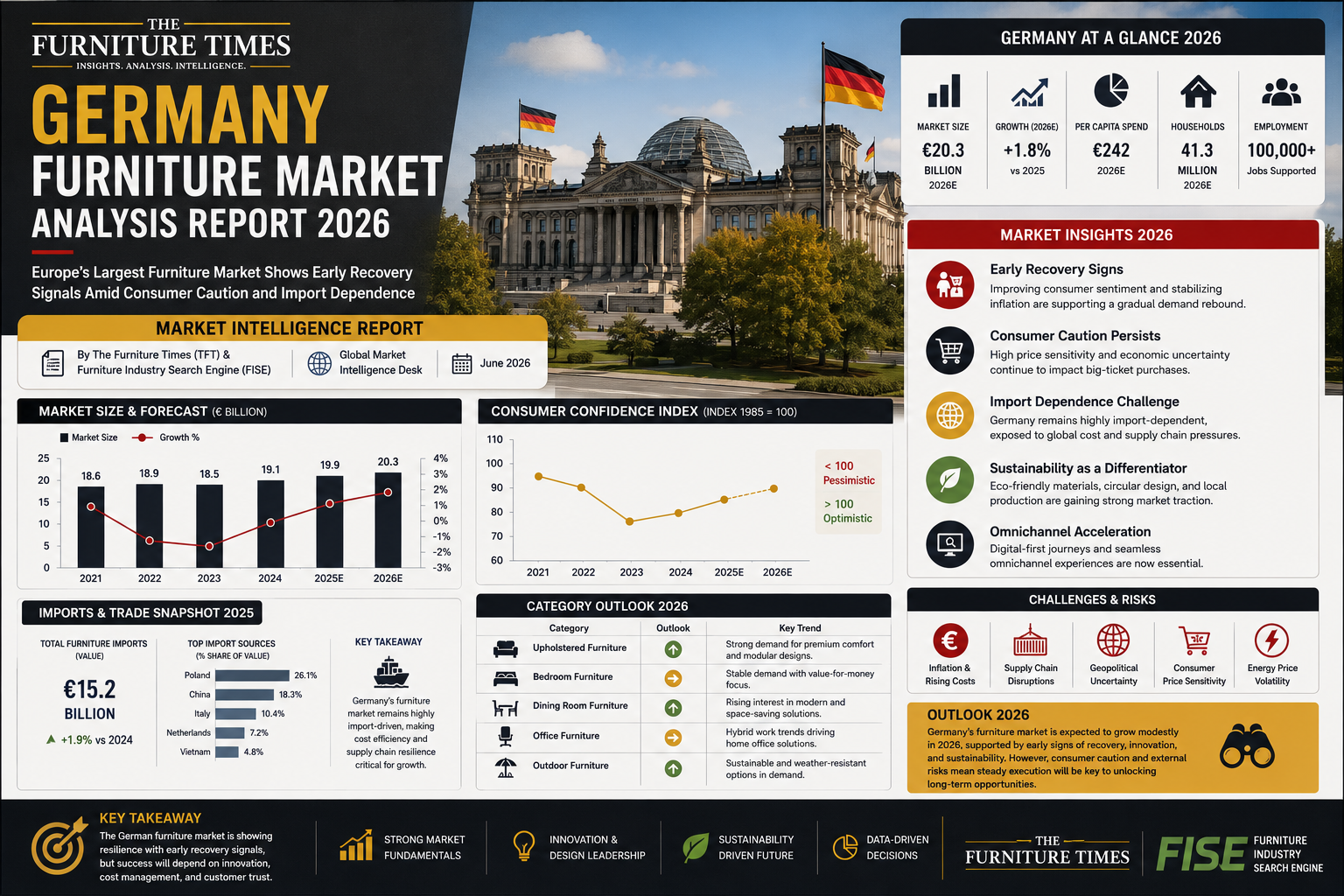
Germany Furniture Market Analysis Report 2026
Europe’s Largest Furniture Market Shows Early Recovery Signals Amid Consumer Caution and Import Dependence
Market Intelligence Report | By The Furniture Times (TFT) & Furniture Industry Search Engine (FISE) | Global Market Intelligence Desk | June 2026
Germany remains the largest furniture market in Europe and continues to serve as a key indicator for the overall health of the European furniture industry. What happens in Germany often influences manufacturers, suppliers, exporters, retailers, logistics providers, and investors across the continent.
After experiencing strong demand during the pandemic years, Germany’s furniture sector entered a period of correction as inflation, higher interest rates, weaker housing activity, and cautious consumer spending affected demand for home furnishings. However, recent market indicators suggest the decline may be stabilizing, with early signs of recovery beginning to emerge.
Germany Furniture Industry Health Check 2026
Consumer Demand Health
6.8 / 10
Retail Market Health
6.5 / 10
Manufacturing Health
7.2 / 10
Housing-Driven Demand
6.0 / 10
Export & Import Ecosystem
7.5 / 10
Digital Transformation
8.0 / 10
Overall Industry Health Score
7.0 / 10
Germany remains fundamentally strong, but growth remains selective and recovery is gradual.
Germany: The Backbone of European Furniture Consumption
Germany is not only Europe’s largest economy but also its largest furniture consumption market.
The country serves as a major destination for:
Home furniture
Kitchen furniture
Office furniture
Contract furniture
Hospitality furniture
Sustainable furniture solutions
For many global manufacturers from Poland, Vietnam, China, Turkey, India, Indonesia, and Malaysia, Germany remains one of the most important export destinations in Europe.
Retail Sales Remain Under Pressure
German furniture retail turnover weakened after the extraordinary pandemic boom.
Recent analysis shows furniture retail turnover declined approximately 1.6% year-over-year and 1.4% over the last six months, indicating that demand remains below peak levels seen during the pandemic period.
Several factors continue to influence purchasing behavior:
Higher Living Costs
Consumers remain cautious about discretionary spending.
Elevated Interest Rates
Housing activity and major purchases remain affected.
Inflationary Pressure
Households continue prioritizing essential spending.
Delayed Replacement Cycles
Consumers are extending the lifespan of furniture products.
Despite these pressures, the pace of decline has moderated significantly, suggesting the market may be approaching stabilization.
Housing Recovery Offers Hope
The German housing market plays a crucial role in furniture demand.
Furniture spending is closely linked to:
Home purchases
Residential construction
Renovations
Relocations
After a significant downturn between 2022 and 2024, Germany’s housing cycle is showing early signs of recovery.
Mortgage activity has begun increasing while residential building permits appear to have stabilized after a prolonged decline. These developments suggest the housing sector may be gradually finding a bottom.
For furniture manufacturers and retailers, this could become one of the most important positive indicators heading into 2027.
Consumer Interest Is Returning
One encouraging sign is the recovery in online furniture search activity.
Research indicates that consumer interest in furniture products has strengthened through 2024 and 2025, with online search demand reaching some of the strongest levels in recent years.
Interestingly, consumers are increasingly searching for products rather than retailer brands.
This shift suggests:
Product discovery is becoming more important
Search visibility matters more than ever
Digital marketing effectiveness is increasing
AI and search platforms are influencing buying behavior
For furniture companies, this reinforces the growing importance of discoverability and digital presence.
Germany Is Becoming More Import Dependent
One of the most significant structural shifts in the German furniture market is increasing reliance on imported furniture.
Recent Furnilytics-based analysis shows import penetration has risen from approximately 55% in 2018 to nearly 68% today, making Germany one of Europe’s most import-dependent furniture markets.
Key supplier countries include:
Poland
Czech Republic
China
Netherlands
Other European manufacturing hubs
This trend reflects changing economics within European furniture production and increasing international sourcing strategies.
For exporters, Germany remains one of Europe’s most attractive opportunities.
Sustainability Is Reshaping Purchasing Decisions
German consumers and institutional buyers continue to lead Europe in sustainability-focused purchasing behavior.
Increasing demand exists for:
FSC-certified wood
Circular furniture systems
Repairable products
Recyclable materials
Sustainable manufacturing
Low-carbon supply chains
European regulations are accelerating this trend, encouraging manufacturers to integrate sustainability into product development and sourcing decisions.
For furniture suppliers, sustainability is no longer a marketing advantage.
It is becoming a market-entry requirement.
Office Furniture Shows Resilience
Germany’s office furniture sector continues demonstrating steady growth.
The market is being supported by:
Hybrid workplace redesigns
Ergonomic furniture demand
Acoustic solutions
Modular workspaces
Sustainable procurement initiatives
Corporate offices remain the largest end-user segment, while acoustic booths, office pods, and flexible workspace solutions are among the fastest-growing categories.
This presents opportunities for manufacturers serving commercial and contract furniture sectors.
The Rise of the Visibility Economy
One of the most important developments in Germany is how consumers increasingly discover furniture products.
Today’s buyers begin their journey through:
Search engines
AI assistants
Product platforms
Review sites
Social media
Digital catalogs
This is creating what TFT and FISE describe as the Visibility Economy.
The companies winning attention are often the companies winning sales.
For furniture brands entering Germany, digital discoverability is becoming just as important as manufacturing capability.
Key Opportunities for Global Furniture Suppliers
Sustainable Furniture
Germany remains one of Europe’s strongest sustainability-driven markets.
Home Office Furniture
Hybrid work continues supporting demand.
Modular Furniture
Urban living trends favor flexible solutions.
Hospitality & Contract Furniture
Commercial projects continue generating opportunities.
Smart Furniture
Technology-enabled furniture categories continue gaining traction.
Outdoor Furniture
Consumers continue investing in lifestyle-oriented home improvements.
TFT & FISE Analysis
Germany is not currently experiencing a furniture boom.
However, it is experiencing something potentially more important:
A market reset.
The industry is moving away from pandemic-era demand spikes and toward a more sustainable growth pattern.
The strongest companies in Germany will likely be those that:
Invest in digital visibility
Build trust
Embrace sustainability
Improve supply chain resilience
Focus on customer experience
Prepare for AI-driven discovery
Germany remains Europe’s most important furniture market.
The challenge is no longer simply producing furniture.
The challenge is being found by increasingly digital buyers.
Final Verdict
Germany’s furniture market in 2026 can best be described as cautiously stabilizing.
Retail remains under pressure.
Consumers remain careful.
Housing activity is recovering.
Import dependence continues rising.
Digital discovery is accelerating.
Despite short-term challenges, Germany remains one of the most attractive and strategically important furniture markets in the world.
The future winners will not necessarily be the cheapest suppliers.
They will be the most trusted, sustainable, visible, and adaptable businesses operating within Europe’s largest furniture economy.
By The Furniture Times (TFT) & Furniture Industry Search Engine (FISE)
Global Market Intelligence Desk | June 2026
“TFT tells their story. FISE helps the world find them.”
