
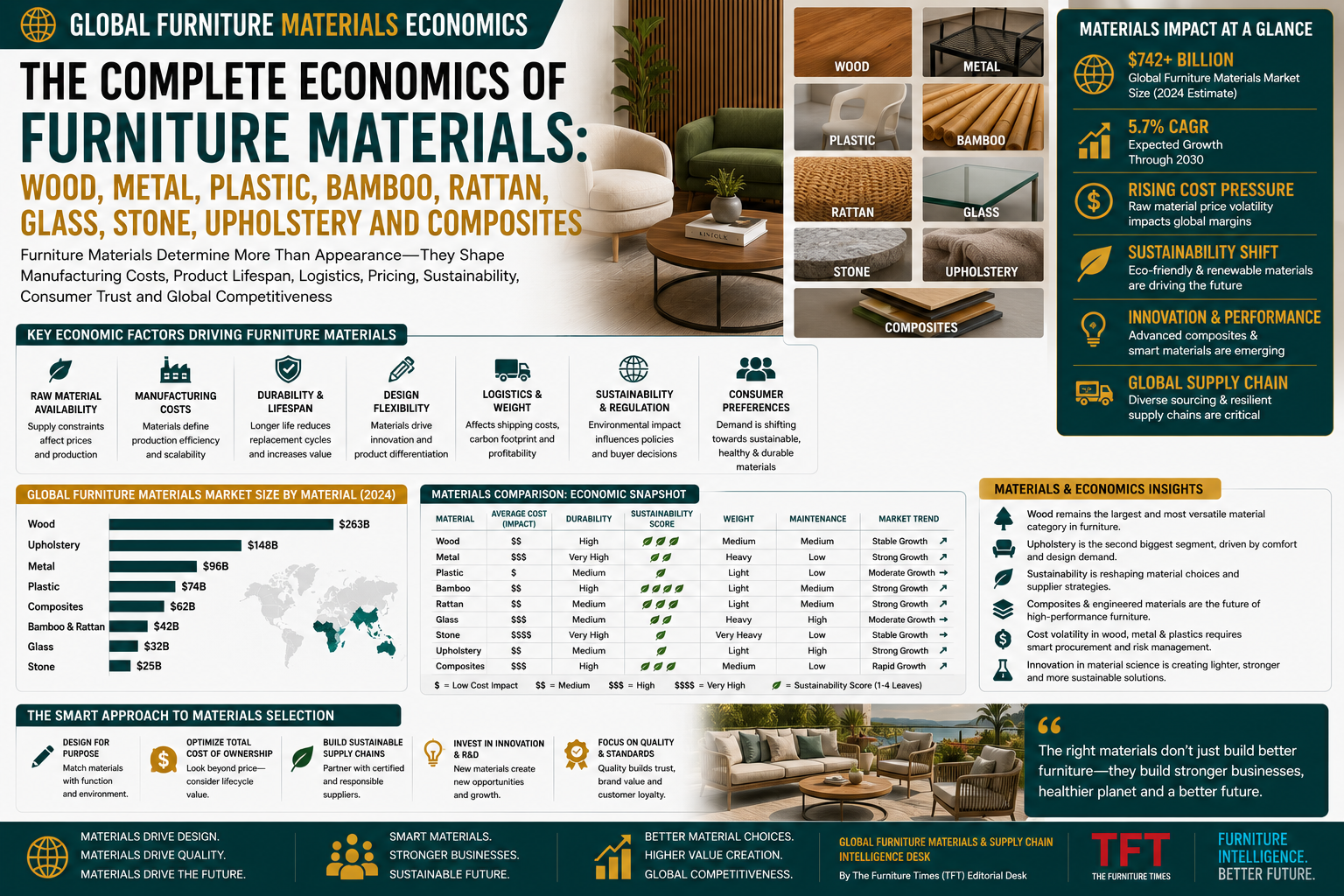
The Complete Economics of Furniture Materials: Wood, Metal, Plastic, Bamboo, Rattan, Glass, Stone, Upholstery and Composites
Furniture Materials Determine More Than Appearance—They Shape Manufacturing Costs, Product Lifespan, Logistics, Pricing, Sustainability, Consumer Trust and Global Competitiveness
Global Furniture Materials & Supply Chain Intelligence Desk
By The Furniture Times (TFT) Editorial Desk
Every piece of furniture begins with a material decision.
Before a sofa reaches a living room, a dining table enters a restaurant, or a sun lounger is installed beside a hotel pool, manufacturers must decide what the product will be made from, where those materials will come from, how they will be processed and whether the finished product can perform reliably throughout its intended life.
These decisions determine far more than design.
Furniture materials influence:
- Raw-material expenditure
- Machinery requirements
- Labour and craftsmanship
- Production speed
- Product weight
- Packaging costs
- Freight and warehousing
- Maintenance requirements
- Repairability
- Selling price
- Brand positioning
- Environmental performance
- Regulatory compliance
- Customer satisfaction
- End-of-life value
A poorly selected material can cause premature failure, excessive maintenance, damaged brand trust and costly replacements. A well-selected material can create durability, visual distinction, efficient production and stronger profit margins.
The global furniture market was valued at approximately US$786.1 billion in 2025 and is projected by one major estimate to increase from about US$831.6 billion in 2026 to US$1.33 trillion by 2033. The same assessment divides the market into major material categories including wood, metal, plastic and glass, while recognising the growing importance of modular, sustainable and technology-enabled products.
Wood remains the dominant material in many furniture markets. For example, an Asia-Pacific home-furniture assessment estimated that wood accounted for approximately 54.6% of that regional market in 2025, while plastic and polymer furniture was projected to record comparatively faster growth through 2031.
However, the furniture economy is not built around a single material.
Modern products increasingly combine several materials:
- Timber frames with upholstered cushions
- Metal structures with glass tops
- Engineered panels with decorative veneers
- Aluminium frames with rope or synthetic weaving
- Stone tables supported by steel bases
- Plastic shells with wooden legs
- Composite panels with recycled content
- Bamboo structures combined with fabric or rattan
The future of furniture materials will therefore be shaped not only by which material is cheapest, but by how intelligently different materials are selected, combined, maintained, recovered and communicated to buyers.
Understanding Material Economics
The purchase price of a raw material is only one part of its true economic cost.
A complete material assessment should include:
1. Material Acquisition Cost
This includes the price of timber, metal, polymer, stone, glass, fabric, foam or composite materials before manufacturing begins.
Prices can be affected by:
- Global commodity markets
- Energy costs
- Exchange rates
- Harvesting or mining conditions
- Trade restrictions
- Transportation
- Certification requirements
- Seasonal availability
- Geopolitical disruptions
2. Processing Cost
Different materials require different machinery, skills and production environments.
Wood may require kilns, moulders, saws, sanding and finishing equipment. Metal may require cutting, bending, welding, polishing or powder coating. Stone may require specialised cutting, reinforcement and lifting. Upholstery requires frame construction, foam shaping, sewing and skilled covering.
A low-cost raw material can become expensive when it requires intensive processing.
3. Yield and Waste
Manufacturers rarely convert 100% of the purchased material into saleable furniture.
Wood cutting produces offcuts and sawdust. Fabric cutting creates leftover pieces. Stone slabs may crack or contain unusable sections. Glass can break during processing. Metal sheets and tubes leave scrap.
The true cost depends on usable yield:
Effective material cost = purchase cost divided by usable output.
Manufacturers that improve nesting, cutting plans, standardisation and waste recovery can protect margins without reducing product quality.
4. Labour Requirements
Craft-intensive materials may generate higher-value products but require more skilled workers and longer production times.
Hand-woven rattan, solid-wood joinery, stone finishing and detailed upholstery can support premium pricing. However, labour shortages, inconsistent workmanship and long training periods can restrict production capacity.
5. Machinery and Capital Investment
Materials determine factory infrastructure.
A company producing panel furniture requires different machinery from a company producing upholstered sofas, metal chairs or stone tables.
Capital costs may include:
- CNC machines
- Panel saws
- Edge banders
- Kilns
- Sanders
- Spray booths
- Welding systems
- Powder-coating lines
- Injection-moulding machines
- Glass-processing equipment
- Stone-cutting machinery
- Sewing machines
- Foam-cutting equipment
- Dust and emission controls
6. Logistics and Weight
Furniture economics are strongly affected by product volume and weight.
Heavy materials increase:
- Factory handling
- Packaging requirements
- Container weight
- Freight costs
- Delivery labour
- Installation complexity
- Product-damage risk
Flat-pack and knock-down designs can reduce shipping volume, but only when connections remain durable and assembly is manageable.
7. Product Lifespan
A material that performs for 20 years may create greater lifecycle value than a cheaper material that fails after three years.
However, long life alone does not guarantee commercial success. Customers must recognise and be willing to pay for that value.
8. Repairability and Replacement
Furniture becomes more economically sustainable when components can be repaired or replaced.
Replaceable cushions, table surfaces, chair glides, hardware, covers, panels and woven sections can extend product life and create after-sales revenue.
9. End-of-Life Value
Some materials retain recycling or resale value. Others become difficult waste because several substances are permanently bonded together.
Material separation is therefore becoming an important design and economic consideration.
Wood: The Economic Foundation of Furniture Manufacturing
Wood has been central to furniture production for centuries and remains the material most closely associated with warmth, craftsmanship, durability and natural character.
The wider forest-products economy is enormous. Global exports of wood and paper products reached approximately US$486 billion in 2024, increasing by about 1.4% after a substantial decline in the previous year. FAO reporting also tracks wooden furniture as an important secondary processed wood product within global trade.
Major Wood Categories
Furniture manufacturers use:
- Solid hardwood
- Solid softwood
- Plywood
- Particleboard
- Medium-density fibreboard
- High-density fibreboard
- Laminated boards
- Veneers
- Oriented strand board
- Finger-jointed wood
- Laminated timber
- Reclaimed wood
Each serves a different economic position.
Solid Wood Economics
Solid wood is commonly used in dining tables, chairs, beds, cabinets, outdoor furniture and premium joinery.
Advantages
- Strong consumer recognition
- Natural variation and character
- Repairability
- Refinishing potential
- Long service life when properly designed
- Strong premium positioning
- Suitability for craftsmanship
Economic Challenges
- Greater material variability
- Moisture movement
- Drying requirements
- Defects and yield losses
- Higher labour needs
- Species-dependent availability
- Certification and traceability costs
- Price volatility
- Heavier construction in some products
Solid wood is economically attractive when manufacturers convert natural character, craftsmanship and longevity into visible customer value.
It becomes less attractive when high-grade material is used inefficiently or when customers cannot distinguish it from cheaper alternatives.
Engineered Wood Economics
Engineered panels transformed the furniture industry by enabling mass production, standardisation and affordable pricing.
Medium-density fibreboard, particleboard and laminated panels support:
- Automated cutting
- Consistent dimensions
- Flat-pack production
- Modular cabinets
- High-volume manufacturing
- Decorative surface variety
- Efficient material utilisation
Their economics depend heavily on scale.
A factory with advanced panel-processing machinery can produce large quantities quickly and consistently. Smaller manufacturers may struggle to compete if they rely on manual processes while purchasing the same boards at higher prices.
Challenges
- Edge vulnerability
- Moisture sensitivity in lower-grade products
- Difficult repair
- Adhesive and emission concerns
- Lower consumer perception in some markets
- Limited end-of-life separation
- High dependence on consistent hardware and edge finishing
The future of engineered wood will depend on lower-emission binders, improved moisture resistance, recycled fibre, better durability and designs that allow components to be separated.
Veneer Economics
Veneer allows manufacturers to create the appearance of valuable timber while using a thin layer of natural wood over a more stable substrate.
This can:
- Improve yield from premium logs
- Reduce material cost
- Support consistent surfaces
- Create large matching panels
- Reduce movement compared with some solid constructions
However, veneer quality varies. Thin decorative surfaces can be damaged by aggressive sanding or moisture, and poor bonding may lead to delamination.
Clear product communication is essential. Veneered furniture should not be misrepresented as solid wood.
Regional Wood Economies
China remains a major manufacturing and consumption centre. Vietnam, Malaysia, Indonesia, Poland, Italy, Germany, India, Türkiye, the United States and several other countries occupy important positions in wood furniture production and trade.
Regional competitiveness depends on access to:
- Legal and sustainable timber
- Panel manufacturing
- Skilled workers
- Machinery
- Export infrastructure
- Product design
- Finishing technology
- Market access
Countries that export raw timber without developing higher-value manufacturing may capture less economic value than countries that convert timber into branded, designed and finished furniture.
Metal: Strength, Precision and Scalable Structure
Metal is essential to residential, office, hospitality, education, healthcare and outdoor furniture.
Common furniture metals include:
- Carbon steel
- Stainless steel
- Aluminium
- Brass
- Bronze
- Cast iron
- Zinc alloys
Steel Economics
Steel offers high structural strength and is widely available.
It is commonly used for:
- Chair frames
- Table bases
- Beds
- Shelving
- Office furniture
- Storage cabinets
- School furniture
- Restaurant seating
- Mechanisms and hardware
Advantages
- Strong load-bearing performance
- Efficient tubular construction
- High manufacturing precision
- Weldability
- Recyclability
- Suitability for automation
- Broad global supply
Economic Challenges
- Corrosion protection
- Energy-intensive production
- Welding labour
- Surface-finishing costs
- Product weight
- Commodity-price volatility
- Scratching and coating damage
Steel furniture can compete successfully in high-volume institutional and commercial markets because of repeatability and durability.
However, weak welds, thin material and poor coating can reduce lifespan dramatically.
Aluminium Economics
Aluminium is especially important in outdoor, hospitality and contemporary furniture.
Advantages
- Low weight
- Corrosion resistance
- Suitability for extrusion and casting
- Modern appearance
- Recyclability
- Easier handling and delivery
Challenges
- Higher raw-material cost than ordinary steel in many applications
- Welding and finishing requirements
- Denting risk in thin sections
- Wind instability in very lightweight outdoor products
- Quality differences between alloys
The economics of aluminium are strongest where low weight, corrosion resistance and long-term outdoor performance justify the higher material cost.
Stainless Steel
Stainless steel supports premium, architectural and coastal applications.
Its value depends on selecting an appropriate grade, surface finish and construction method. Merely labelling a product “stainless steel” does not explain its corrosion performance.
The material can support premium pricing, but it requires careful fabrication because polishing, welding and surface restoration can be labour-intensive.
Metal and the Circular Economy
Metal scrap generally has established collection and recycling value.
This gives metal furniture an economic advantage at end of life—provided metal components can be separated from upholstery, plastics, wood and adhesives.
Designing with mechanical fasteners instead of permanent bonding can improve recovery.
Plastic and Polymer Furniture: Affordability, Scale and Environmental Pressure
Plastic furniture ranges from inexpensive monobloc chairs to premium moulded products designed by leading international brands.
Materials include:
- Polypropylene
- Polyethylene
- Polycarbonate
- Acrylic
- Nylon
- Polyvinyl chloride
- Recycled polymers
- Fibre-reinforced plastics
Why Plastic Became Economically Important
Plastic can offer:
- Low unit cost at scale
- Lightweight products
- Colour integration
- Complex moulded forms
- Rapid production
- Water resistance
- Easy cleaning
- Stackability
- Reduced assembly
- Suitability for indoor and outdoor use
The economics are particularly strong when production volumes are high enough to recover the cost of injection moulds and tooling.
A manufacturer may face high initial investment but very low marginal costs after production reaches scale.
Plastic’s Market Position
Plastic and polymer furniture is expected to grow in several price-sensitive and fast-developing markets because it supports affordability, portability and mass availability. One Asia-Pacific assessment projects polymer-based furniture to grow faster than wood-based furniture between 2026 and 2031, although wood remains the region’s largest material category.
Economic Weaknesses
- High tooling cost
- Dependence on petroleum or polymer markets
- UV degradation in poor-quality products
- Weak repairability
- Consumer perception of low value
- Potential brittleness
- Limited recycling for mixed or contaminated products
- Environmental criticism
- Rapid commoditisation
Plastic waste could nearly triple globally by 2060 under a business-as-usual scenario, increasing pressure on manufacturers to reduce unnecessary virgin plastic and design products for reuse and recycling.
UNEP advocates eliminating unnecessary plastic use, improving product design and keeping necessary plastics circulating through reuse and recycling rather than disposal.
The Future Economics of Plastic Furniture
Plastic furniture will not disappear.
Its future will depend on:
- Higher recycled content
- Better UV stability
- Longer product life
- Material identification
- Take-back systems
- Single-polymer construction
- Replaceable components
- Higher design value
- Reduced unnecessary material use
Circular plastic design principles emphasise durability, reusability, repairability and the ability to upgrade products.
The commercial opportunity lies in moving away from disposable plastic furniture toward durable, traceable and recoverable products.
Bamboo: Renewable Potential with Industrial Challenges
Bamboo is increasingly discussed as a future furniture material because of its rapid growth, visual appeal and cultural significance.
It can be used as:
- Whole structural poles
- Laminated boards
- Veneers
- Woven surfaces
- Decorative elements
- Composite fibres
- Engineered panels
Economic Advantages
- Rapid biological growth
- Strong regional availability in parts of Asia, Africa and Latin America
- Distinctive natural identity
- Potential for rural employment
- Suitability for craft and engineered production
- Growing sustainability appeal
Economic Challenges
- Inconsistent grading
- Treatment requirements
- Jointing difficulties
- Moisture movement
- Insect vulnerability if untreated
- Limited industrial standardisation
- Transport inefficiency for whole poles
- Consumer uncertainty about quality
- Dependence on skilled processing
Raw bamboo is not automatically a high-performance furniture material.
Its success depends on correct species selection, harvesting age, drying, treatment, lamination, adhesive quality and structural design.
Value-Addition Opportunity
Countries with substantial bamboo resources can capture greater economic value by moving from raw-pole supply toward:
- Laminated furniture components
- Engineered boards
- Modular furniture
- Hospitality collections
- Woven panels
- Branded lifestyle products
The strongest business models will combine local material supply with modern engineering, certification, design and global market access.
Rattan and Cane: Craftsmanship, Culture and Premium Natural Value
Natural rattan is a climbing palm widely associated with woven furniture and traditional craftsmanship.
Rattan furniture connects material economics with rural livelihoods, artisanal skills and cultural design.
Economic Advantages
- Lightweight construction
- Flexibility
- Handcrafted value
- Distinct visual identity
- Suitability for indoor and sheltered outdoor use
- Strong hospitality and resort appeal
- Repair potential through reweaving
Economic Challenges
- Labour-intensive weaving
- Skilled-worker shortages
- Variable raw-material quality
- Moisture sensitivity
- Treatment requirements
- Slow production
- Difficulty maintaining consistency
- Competition from synthetic weaving
Rattan is economically strongest when positioned as skilled, culturally meaningful and design-led furniture rather than as a low-cost substitute.
Contemporary design trends are helping move rattan, cane and bamboo beyond informal or traditional applications. Coverage of Milan Design Week 2026 highlighted refined uses of weaving, bamboo and rattan across luxury furniture, lighting and architectural installations.
Natural vs Synthetic Rattan
Synthetic rattan can offer greater consistency and outdoor resistance, while natural rattan provides authenticity and craftsmanship.
The two materials should not be treated as identical.
Synthetic weaving depends on polymer quality, UV stabilisation and frame construction. Natural rattan depends on harvesting, treatment, weaving and environmental conditions.
Clear labelling protects customer trust.
Glass: Transparency, Design and Processing Risk
Glass is widely used in:
- Dining tables
- Coffee tables
- Office desks
- Cabinets
- Shelving
- Consoles
- Display furniture
- Decorative elements
Types include:
- Annealed glass
- Tempered glass
- Laminated glass
- Coloured glass
- Frosted glass
- Textured glass
- Curved glass
- Recycled glass
Economic Advantages
- Visual lightness
- Premium appearance
- Easy surface cleaning
- Resistance to moisture
- Compatibility with metal, wood and stone
- Ability to create transparent spaces
- Broad design flexibility
Economic Challenges
- Breakage risk
- Heavy packaging
- Specialist transport
- Edge-processing costs
- Safety requirements
- Fingerprints and visible marks
- Difficult repair
- Replacement complications
- High damage cost during delivery
Glass furniture requires strong packaging and logistics discipline.
A manufacturer may produce a table profitably but lose the margin if the glass breaks during delivery or installation.
Tempered and Laminated Glass
Safety processing increases cost but reduces risk.
Tempered glass is designed to break differently from ordinary glass, while laminated products can retain fragments through an interlayer.
The correct specification depends on product type, thickness, support conditions, edge quality and local safety requirements.
Future Opportunities
Glass is being explored as more than a transparent tabletop. Contemporary design increasingly uses coloured, cast, recycled, textured and imperfect glass as an expressive furniture material. Milan Design Week 2026 coverage described glass as an important medium for exploring light, colour and material character.
Stone and Mineral Surfaces: Luxury, Permanence and Logistics
Furniture manufacturers use:
- Marble
- Granite
- Travertine
- Quartzite
- Slate
- Onyx
- Engineered quartz
- Sintered stone
- Terrazzo
- Concrete
- Ceramic slabs
Stone is common in dining tables, coffee tables, consoles, counters and luxury furniture.
Economic Advantages
- Strong premium perception
- Unique patterns
- Heat resistance in certain materials
- Visual permanence
- Compatibility with luxury interiors
- High perceived value
- Architectural character
Economic Challenges
- High weight
- Breakage and cracking
- Slab variation
- Reinforcement requirements
- Difficult handling
- Expensive shipping
- Specialist installation
- Surface staining or etching
- High replacement costs
- Floor-loading concerns
A stone table may appear simple, but its economics include quarrying, slab selection, cutting, polishing, reinforcement, crating, transportation and installation.
The material cost may be only one part of the final price.
Natural vs Engineered Stone
Natural stone offers individuality but creates variation.
Engineered and sintered materials can provide more consistency, larger formats and improved technical performance, but they may involve energy-intensive manufacturing and complex compositions.
Customers should receive accurate information about material type and maintenance.
Stone as a Current Design Trend
Recent global design coverage has highlighted increased use of stone textures and sculptural mineral forms, particularly in premium furniture and interiors.
This creates opportunities for furniture brands that can combine stone expertise with lighter structural engineering and safer logistics.
Upholstery: A Multilayer Economy Hidden Inside Furniture
Upholstered furniture is not built from one material.
A sofa may contain:
- Timber or metal framing
- Springs or webbing
- Foam
- Fibre
- Fabric or leather
- Adhesives
- Thread
- Zippers
- Mechanisms
- Feet
- Fasteners
This complexity creates both economic value and end-of-life challenges.
Upholstery Cost Structure
The final price depends on:
- Frame material
- Foam density and resilience
- Fabric consumption
- Pattern matching
- Sewing complexity
- Cushion construction
- Labour skill
- Mechanisms
- Packaging volume
- Delivery requirements
Fabric may appear inexpensive per metre, but large repeats, directional patterns and poor cutting efficiency can increase consumption significantly.
Foam Economics
Foam quality strongly affects comfort and lifespan.
Low-density foam can reduce initial cost but may soften or lose shape more quickly. High-performance foams increase cost but can support stronger warranties and longer use.
The manufacturer must balance:
- Comfort
- Density
- Resilience
- Weight
- Fire requirements
- Emissions
- Price
Textile Economics
Furniture fabrics include:
- Cotton
- Linen
- Wool
- Polyester
- Acrylic
- Nylon
- Velvet
- Microfibre
- Outdoor performance textiles
- Recycled fabrics
Performance requirements may include:
- Abrasion resistance
- Colourfastness
- Stain resistance
- UV resistance
- Cleanability
- Fire performance
- Moisture management
- Pilling resistance
The cheapest fabric is not necessarily the most economical when replacement, complaints and reupholstery are considered.
Leather and Leather Alternatives
Natural leather supports premium positioning and can develop character over time.
However, quality, tanning, grading and origin vary widely.
Synthetic leather and coated fabrics can provide consistency and easier cleaning but may crack, peel or delaminate when poor materials are used.
New alternatives made from agricultural waste, recycled content and bio-based materials are gaining design attention, but their long-term durability and scalability must be assessed carefully.
Designers are experimenting with seaweed, plant fibres, agricultural by-products and other unconventional materials for interiors and furnishings.
The Circularity Challenge
Upholstered furniture is difficult to recycle because many materials are bonded together.
The economic future of upholstery will depend on:
- Removable covers
- Replaceable cushions
- Mechanical fasteners
- Reduced adhesive use
- Identifiable materials
- Standardised components
- Reupholstery services
- Take-back programmes
- Recyclable foam and textiles
Composite Materials: Engineering Performance and End-of-Life Complexity
Composite materials combine two or more substances to achieve properties that a single material may not provide.
Furniture composites include:
- Fibreglass-reinforced plastic
- Wood-plastic composites
- Fibre-cement materials
- Carbon-fibre components
- Recycled plastic and fibre boards
- Resin-bound natural fibres
- Honeycomb panels
- Paper composites
- Bio-based composite panels
Economic Advantages
- High strength-to-weight ratios
- Mouldability
- Weather resistance
- Consistency
- Material efficiency
- Ability to use recycled or agricultural waste
- New design possibilities
- Reduced dependence on premium solid materials
Economic Challenges
- Higher research and tooling costs
- Uncertain repair methods
- Difficult recycling
- Material-separation problems
- Limited consumer understanding
- Certification requirements
- Dependence on specialised suppliers
- Unproven long-term performance for newer materials
Composite materials can solve engineering problems but may create end-of-life problems.
A product that combines several materials permanently may be durable but difficult to recover once discarded.
Future Composite Opportunities
The strongest opportunities include:
- Agricultural-waste panels
- Recycled polymer boards
- Lightweight furniture cores
- Bio-based resins
- Natural-fibre composites
- Waste-wood composites
- Mycelium and plant-based materials
- Recycled textile panels
Success will depend on proving durability, safety, consistency, repairability and commercial scale.
Comparing Furniture Materials Economically
Lowest Entry Cost
Plastic and basic engineered boards often support lower-cost mass production, particularly at high volumes.
Highest Premium Potential
Solid wood, natural stone, premium metal, leather, handwoven rattan and artisanal upholstery can support higher retail prices when design and craftsmanship are strong.
Best Strength-to-Weight Potential
Aluminium and advanced composites can provide strong performance with reduced weight.
Strongest Repair Potential
Solid wood, certain metal structures, natural rattan and traditionally upholstered furniture can often be repaired when components remain accessible.
Most Difficult to Recycle
Permanently bonded combinations of foam, textiles, adhesives, wood, plastics and composites are among the most challenging.
Most Logistics-Intensive
Stone, glass, large solid-wood products and fully assembled upholstered furniture generate high shipping, packaging and handling costs.
Most Scale-Dependent
Injection-moulded plastic, engineered-panel furniture and standardised metal systems become more economical as production volume increases.
Most Craft-Dependent
Handwoven rattan, carved wood, detailed upholstery, stone finishing and speciality metalwork rely heavily on skilled labour.
Regional Material Preferences
Asia-Pacific
Asia-Pacific combines major timber, bamboo, rattan, metal, plastic and upholstered-furniture industries.
Wood remains strongly associated with quality, while rapid urbanisation supports demand for affordable engineered-board and polymer furniture.
Southeast Asia has particular opportunities in:
- Teak
- Rubberwood
- Acacia
- Rattan
- Bamboo
- Upholstery
- Aluminium outdoor furniture
- Hospitality furniture
Europe
European markets place growing emphasis on:
- Certified timber
- Material traceability
- Recycled content
- Repairability
- Low-emission materials
- Circular procurement
- Durable construction
EU ecodesign policy is moving toward products that are more durable, repairable, resource-efficient and circular, with tools such as Digital Product Passports expected to increase material transparency.
North America
North American demand supports:
- Upholstery
- Solid-wood dining and bedroom furniture
- Engineered-panel furniture
- Metal office systems
- Outdoor aluminium and polymer products
- Stone and glass statement pieces
Convenience, delivery, warranty and maintenance strongly influence material selection.
Middle East
The Middle East generates demand for:
- Marble and stone
- Luxury upholstery
- Metal and glass
- Premium timber
- Hospitality-grade outdoor materials
- Decorative composites
Heat, ultraviolet exposure, dust and coastal corrosion must be considered.
Africa
Africa has significant potential in:
- Local timber processing
- Bamboo
- Rattan
- Metal furniture
- Recycled plastic furniture
- Institutional products
- Affordable engineered materials
Investment in treatment, machinery, training and certification can increase local value creation.
Latin America
Latin America offers strong timber, metal, leather and natural-fibre traditions.
Local manufacturing can benefit from material availability, but currency volatility and machinery-import costs can affect competitiveness.
Sustainability Is Becoming an Economic Requirement
Furniture sustainability is moving from a marketing claim toward a commercial and regulatory requirement.
The European furniture sector alone is estimated to discard approximately 10 million tonnes of furniture annually, much of which is landfilled or incinerated.
Circularity seeks to retain material and product value through:
- Reduced material use
- Longer product life
- Reuse
- Repair
- Refurbishment
- Remanufacturing
- Recycling
UNEP describes circularity as an economic strategy that can improve resilience, reduce costs and unlock innovation by shifting value creation away from extraction and disposal.
Public and corporate procurement can accelerate this transition by purchasing reused furniture, requiring recycled materials and supporting products with longer lifecycles.
Material Transparency and Digital Product Information
Furniture buyers increasingly want to know:
- What material is this?
- Where did it come from?
- Is it solid wood or veneer?
- Is the plastic recycled?
- What metal grade is used?
- Can the fabric be removed?
- Is the foam replaceable?
- Can the product be repaired?
- How should it be maintained?
- What happens at the end of its life?
Digital Product Passports and traceability systems may eventually allow products to carry structured information about materials, repair, environmental performance and recovery.
A European circular-furniture initiative launched in 2026 is exploring digital solutions, eco-labelling and Digital Product Passports across the furniture lifecycle.
Furniture companies should begin organising material information now rather than waiting for regulation or large buyers to demand it.
Strategic Priorities for Furniture Manufacturers
Furniture businesses should:
- Calculate total material cost rather than purchase price alone.
- Track yield, offcuts, defects and production waste.
- Select materials according to climate and application.
- Avoid vague material descriptions.
- Separate residential and commercial specifications.
- Design products for repair and component replacement.
- Reduce unnecessary material combinations.
- Use mechanical fasteners where practical.
- Build supplier traceability systems.
- Improve packaging for heavy or fragile materials.
- Recover metal, wood, fabric and plastic waste.
- Train sales teams to explain material value.
- Offer maintenance and care guidance.
- Develop replacement-part programmes.
- Prepare for sustainability documentation.
- Evaluate recycled and bio-based alternatives carefully.
- Avoid unverified environmental claims.
- Invest in material research and testing.
- Collaborate with designers early in development.
- Treat end-of-life planning as part of product design.
The Most Successful Material Is the One That Delivers the Right Value
There is no universally superior furniture material.
Wood provides warmth, repairability and natural value.
Metal provides strength, precision and scalable structure.
Plastic provides affordability, lightness and manufacturing efficiency.
Bamboo provides renewable potential and regional development opportunities.
Rattan provides craftsmanship, culture and visual identity.
Glass provides transparency and modern expression.
Stone provides permanence, luxury and architectural character.
Upholstery provides comfort and emotional connection.
Composites provide engineering performance and material innovation.
Each also carries limitations.
The economic question is not simply:
Which material is cheapest?
The better questions are:
- Which material is suitable for the intended use?
- How long will it perform?
- How much processing does it require?
- What is its freight impact?
- Can it be repaired?
- Can components be replaced?
- Will buyers understand its value?
- Can it meet future environmental requirements?
- What happens when the product is no longer needed?
The furniture industry must move beyond selling surface appearance.
It must explain material origin, construction, performance, maintenance and lifecycle value.
Companies that understand material economics will be able to reduce waste, protect margins, build stronger products and communicate more honestly with buyers.
The next generation of global furniture leaders will not succeed by using only one material.
They will succeed by knowing exactly when, where and why each material should be used.
Furniture materials are not merely production inputs. They are the economic, functional and environmental foundation of the entire global furniture industry ecosystem.
