
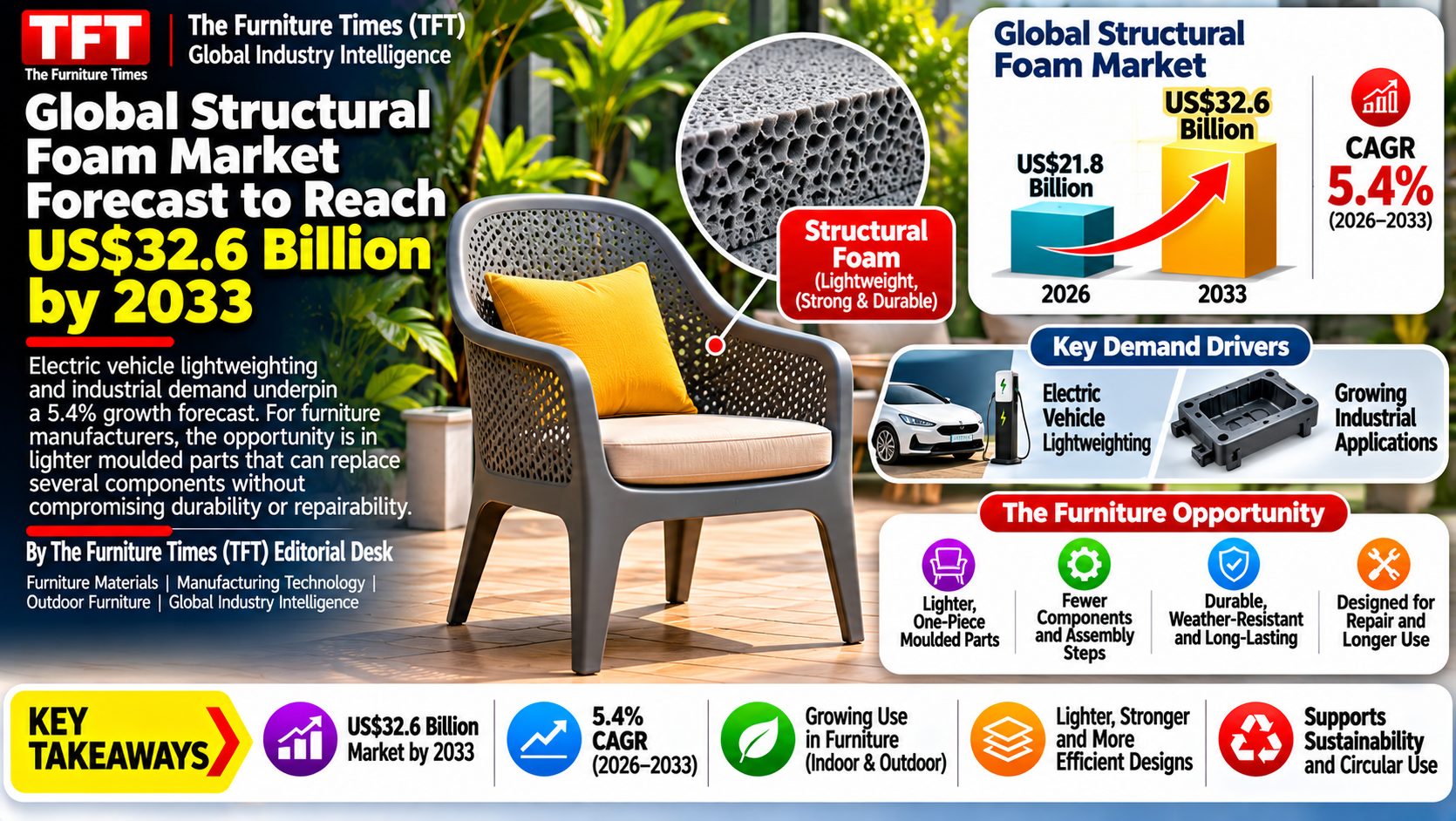
Global Structural Foam Market Forecast to Reach US$32.6 Billion by 2033
Electric vehicle lightweighting and industrial demand underpin a 5.4% growth forecast. For furniture manufacturers, the opportunity is in lighter moulded parts that can replace several components without compromising durability or repairability.
By The Furniture Times (TFT) Editorial Desk | Furniture Materials | Manufacturing Technology | Outdoor Furniture | Global Industry Intelligence
The global structural foam market is projected to reach US$32.6 billion by 2033, up from an estimated US$21.5 billion in 2025, according to Grand View Research. Research and Markets announced on November 17 that it had added the study to its catalogue. The report estimates the market at US$22.6 billion in 2026 and forecasts 5.4% compound annual growth from 2026 to 2033.
Demand for lighter components in automotive manufacturing, including electric vehicles, is one driver. But the biggest application in the study’s 2025 estimates was material handling, at 33.3% of global revenue. Outdoor furniture is among the uses identified in the release, but the public summary does not provide a furniture-only market value or growth rate. The US$32.6 billion figure is a cross-industry forecast, not a projection for furniture foam alone.
What the forecast says
| Indicator | Grand View Research estimate |
|---|---|
| Global market in 2025 | US$21.5 billion |
| Global market in 2026 | US$22.6 billion |
| Projected global market in 2033 | US$32.6 billion |
| Compound annual growth, 2026–2033 | 5.4% |
| Largest regional market in 2025 | Asia-Pacific, 36.1% of global revenue |
| Largest material segment in 2025 | Polypropylene, 29.4% |
| Largest application segment in 2025 | Material handling, 33.3% |
Grand View Research identifies China as the largest country market in 2025. The study covers polypropylene, polyethylene, polyurethane, polystyrene and other materials across applications including material handling, building and construction, automotive, and electrical and electronics. These figures are commercial research estimates, not official production or sales totals. grandviewresearch.com
Why structural foam is attracting manufacturers
The common thread between a vehicle component, a reusable pallet and an outdoor furniture part is the need to make a rigid component without adding unnecessary weight. The report identifies lightweighting, reduced material use and the ability to combine several parts into one moulded component as reasons manufacturers are evaluating structural foam in place of some metal or solid plastic parts. It also points to construction and infrastructure activity as sources of demand. globenewswire.com
For furniture buyers, structural foam is not the soft foam used to make a seat cushion comfortable. In this context, the term refers to foamed materials designed to perform a structural or rigid component function. The distinction is important when specifying a product: a lightweight moulded panel, for example, must be evaluated for how it attaches to the frame and behaves in use, not by the criteria used to select lounge cushions.
Where furniture manufacturers could use it
The most useful place to start is with a part that already creates a production or service problem. A bulky outdoor storage panel may be awkward to handle. A seat shell assembled from several pieces may take too long to build. A patio product may rely on a bracket that is difficult to align consistently. In each case, the question is whether a moulded redesign solves enough of the problem to justify tooling and qualification.
| Potential furniture application | What to evaluate before switching |
|---|---|
| Outdoor storage panels or cabinet housings | Panel stiffness, hinge retention, drainage, appearance and weathering |
| Seat shells or backrest components | Load transfer at mounting points, repeated loading, impact and replacement options |
| Table or bench subassemblies | Deflection across the span, support geometry and fastener retention |
| Protective covers or non-load-bearing housings | Fit, impact resistance, finish quality and access for maintenance |
| Reusable handling trays for factory or warehouse use | Repeated handling damage, nesting, cleaning and compatibility with existing equipment |
These are candidate applications, not findings that the report establishes for each product. A sample panel that feels rigid in the hand does not establish that a complete chair, table or storage unit will meet its applicable performance requirements.
Part consolidation can save assembly time—and make repairs harder
The report highlights part consolidation as a potential manufacturing advantage. A moulded component can be designed to incorporate features that would otherwise require separate brackets, fixings or assembly steps. Whether that reduces cost depends on the volumes, tooling, reject rates and assembly savings of the specific product.
The trade-off is especially relevant in hospitality. If a small mounting feature is integrated into a large moulded panel, damage to that feature may require replacing the entire panel. A resort that could previously replace a bracket may now need to carry a much larger spare part. A better design may retain separate, replaceable hardware at points that are likely to wear or take impact.
A lighter part is not necessarily cheaper to ship
Weight reduction is valuable when furniture must be handled frequently or when freight charges depend on weight. But a bulky outdoor component can take up the same space in a carton even after its mass falls. A redesign that nests or packs flat may therefore deliver a larger logistics saving than a lighter part with the same external dimensions.
Manufacturers should compare cost per finished unit delivered, including tooling, moulding, finishing, inserts, assembly, packaging, freight and expected warranty costs. Compare a conservative order volume as well as the planned volume. The economics can look very different if repeat orders are smaller than expected.
Outdoor performance must be demonstrated on the finished product
The release points to resistance to moisture and harsh environments as reasons structural foam is used in outdoor and industrial applications. That is a category-level observation, not a performance guarantee for a particular resin, finish or assembled product.
For outdoor furniture, define the service environment first. A shaded residential terrace, exposed resort pool deck and coastal restaurant place different demands on the product. Review colour change, cracking, impact damage, water entry and attachment-point performance under conditions relevant to the intended use. Consider long-term deformation under sustained load, particularly on panels or supports that must remain aligned with doors, hinges or adjacent parts.
Most importantly, evaluate the assembled product, not only the resin data sheet. A supplier’s material information may describe the grade accurately without telling the furniture maker how the moulded part will behave at an insert, hinge or frame connection.
Sustainability claims need a clear comparison
The report identifies material efficiency as a growth driver, pointing to the potential to use less raw material than comparable solid moulding and reduce waste. For a furniture manufacturer, that is a case to investigate—not enough on its own to claim that a redesigned product has a lower environmental impact.
The useful comparison is between two products that do the same job for a comparable service life. Record how much material the redesign saves, whether assembly and transport change, what can be repaired, and what happens at end of life. Coatings, metal inserts and bonded materials can complicate separation. If the new design uses less polymer but requires a whole assembly to be replaced when one feature fails, the environmental case is less clear.
What furniture companies should watch next
- Manufacturers: Pilot one component with a measurable problem. Compare the prototype with the existing part for weight, assembly time, service performance and delivered cost before committing to production tooling.
- Component suppliers: Document the resin grade, finish, critical dimensions and attachment details. Agree in advance on what changes require notification or requalification.
- Retailers and distributors: Check whether a lighter design actually reduces delivery and handling costs, and confirm how replacement parts will be stocked.
- Hotels and commercial buyers: Ask which parts can be replaced on-site and what they cost. For a property operating through peak season, time out of service can matter more than a small difference in unit price.
The TFT takeaway: The structural foam forecast gives furniture manufacturers a reason to look more closely at moulded component design, not a reason to replace proven materials across a collection. The strongest candidate is a part that becomes easier to make, ship or handle and remains durable and serviceable once the furniture is in use.
