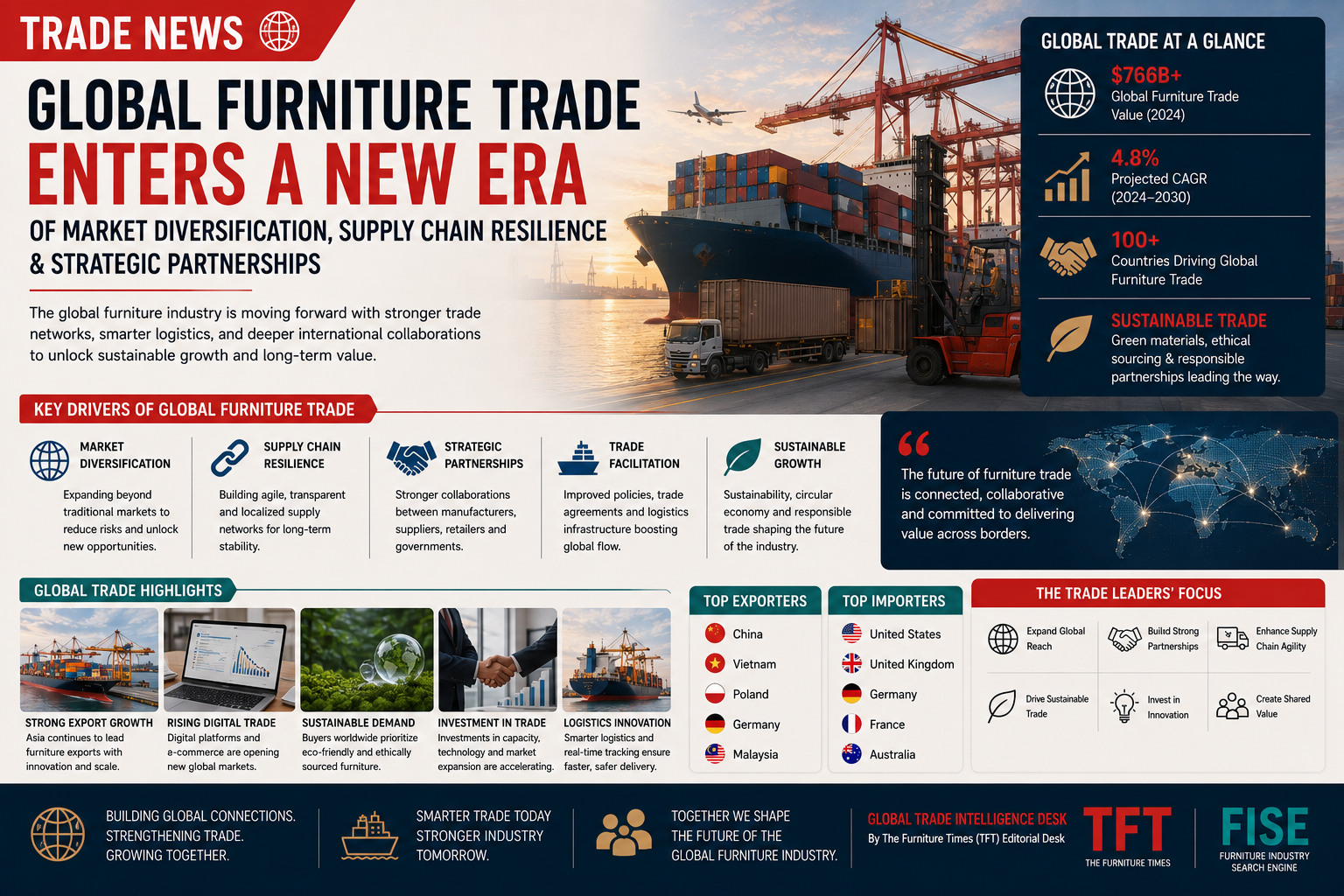
Global Furniture Trade Enters a New Era of Market Diversification, Supply Chain Resilience & Strategic Partnerships
Global Trade Intelligence Desk
By The Furniture Times (TFT) Editorial Desk
Executive Summary
The global furniture trade is undergoing one of its most significant transformations in modern history.
For decades, international furniture trade was largely driven by cost advantages, large-scale manufacturing and established export markets. Today, however, the landscape is changing rapidly.
Manufacturers, exporters, importers and retailers are navigating a world shaped by:
- Diversified supply chains
- Geopolitical developments
- Trade agreements
- Digital commerce
- Sustainability
- Artificial Intelligence (AI)
- Evolving consumer demand
Rather than relying on a small number of export destinations, furniture companies are expanding into new markets while strengthening long-term international partnerships.
Global trade institutions continue to highlight that international commerce is adapting rather than disappearing, with businesses reorganising supply chains to improve resilience amid geopolitical and economic uncertainty.
According to The Furniture Times (TFT), the future of furniture trade will belong to businesses that combine manufacturing excellence with global market intelligence, digital visibility, logistics efficiency and trusted international relationships.
Global Furniture Trade Continues to Evolve
International furniture trade remains one of the largest contributors to the global furniture industry ecosystem.
Every day, millions of furniture products move across borders, connecting manufacturers with retailers, distributors, hospitality projects and consumers around the world.
The industry continues supporting:
Manufacturing.
Shipping.
Warehousing.
Retail.
Interior design.
Construction.
Hospitality.
Logistics.
Digital commerce.
Despite global uncertainties, international trade continues adapting through diversification and stronger regional cooperation.
Market Diversification Is Becoming Essential
One of the biggest changes in global trade is market diversification.
Manufacturers increasingly recognise the importance of expanding into multiple international markets rather than depending heavily on a limited number of export destinations.
Diversification helps businesses reduce exposure to:
Economic slowdowns.
Trade policy changes.
Currency fluctuations.
Supply chain disruptions.
Regional demand shifts.
This strategy is strengthening long-term business resilience.
Supply Chains Are Being Redesigned
The furniture industry has learned valuable lessons from recent global disruptions.
Businesses are investing in:
Multiple sourcing partners.
Regional manufacturing.
Inventory optimisation.
Digital logistics.
Alternative shipping routes.
Supply chain visibility.
Rather than pursuing the lowest cost alone, companies increasingly seek balance between efficiency and resilience.
Trade Agreements Continue Opening Opportunities
International trade agreements remain important drivers of furniture exports.
Reduced tariffs.
Simplified customs procedures.
Investment cooperation.
Market access.
Cross-border partnerships.
These initiatives create opportunities for manufacturers seeking new international customers.
Countries are increasingly strengthening bilateral and regional trade cooperation to support long-term economic growth.
Asia Continues Leading Global Furniture Exports
Asia remains the world’s largest furniture manufacturing and export region.
Key exporting nations include:
Thailand.
These countries continue investing in:
Manufacturing technology.
Export infrastructure.
Product innovation.
Sustainability.
International marketing.
Digital transformation.
Their global influence continues expanding.
Europe Remains a Premium Market
European markets continue demanding:
High-quality craftsmanship.
Sustainable products.
Luxury furniture.
Contemporary design.
Certified materials.
Circular manufacturing.
European buyers increasingly value long-term supplier relationships built on quality and reliability.
North America Continues Investing
The North American furniture market remains one of the world’s largest import destinations.
Demand continues across:
Residential furniture.
Office furniture.
Healthcare.
Hospitality.
Outdoor furniture.
Home improvement.
Importers increasingly seek dependable global manufacturing partners capable of consistent quality and timely delivery.
The Middle East Creates New Trade Opportunities
Major investments across the Middle East continue generating demand for:
Hotels.
Luxury residences.
Commercial developments.
Healthcare facilities.
Tourism infrastructure.
Furniture exporters increasingly view the region as a strategic long-term growth market.
Africa Is Becoming an Emerging Trade Market
Africa’s growing population, urbanisation and housing development continue creating opportunities for:
Furniture imports.
Local manufacturing.
Regional partnerships.
Skills development.
Industrial investment.
The continent represents one of the industry’s long-term growth frontiers.
Sustainability Influences International Trade
Global buyers increasingly evaluate suppliers based on:
Environmental responsibility.
Responsible sourcing.
Low-carbon manufacturing.
Recyclable materials.
Circular economy practices.
Sustainability is becoming an important competitive advantage in international procurement.
Digital Trade Is Expanding
International buyers increasingly begin supplier searches online.
They compare:
Manufacturers.
Products.
Certifications.
Customer reviews.
Factory capabilities.
Project portfolios.
Digital discoverability has become an essential part of international trade success.
Artificial Intelligence Is Supporting Trade
AI increasingly assists businesses with:
Market research.
Demand forecasting.
Translation.
Customer communication.
Export planning.
Supply chain optimisation.
Product recommendations.
These tools improve efficiency while supporting faster business decisions.
Logistics Remains a Strategic Priority
Efficient logistics continues influencing trade competitiveness.
Businesses focus on:
Container optimisation.
Warehouse management.
Cross-border distribution.
Last-mile delivery.
Real-time shipment tracking.
Customs efficiency.
Reliable logistics strengthens customer satisfaction while reducing operational risks.
SMEs Have New Global Opportunities
Digital technologies have reduced barriers for small and medium-sized manufacturers.
SMEs can increasingly reach international buyers through:
Professional websites.
Digital catalogues.
Online trade platforms.
Virtual meetings.
Industry publications.
Export promotion programmes.
Technology enables smaller businesses to compete globally.
Customer Trust Drives International Business
International buyers increasingly evaluate suppliers using:
Business reputation.
Manufacturing capability.
Customer reviews.
Professional communication.
Industry recognition.
Long-term partnerships continue growing through trust rather than price alone.
Challenges Continue
Despite positive developments, global furniture trade continues facing:
Trade uncertainty.
Shipping costs.
Energy prices.
Currency fluctuations.
Labour shortages.
Regulatory changes.
Businesses that remain adaptable continue strengthening their competitive positions.
The Furniture Times Analysis
Global furniture trade is no longer driven solely by manufacturing capacity.
Future success depends on:
Market intelligence.
Supply chain resilience.
Digital visibility.
Sustainability.
Innovation.
Customer trust.
International collaboration.
The strongest exporters will combine operational excellence with strategic adaptability.
Final Verdict
The global furniture trade is entering a new chapter.
One built upon:
Diversification.
Technology.
Resilience.
Strategic partnerships.
Digital transformation.
Businesses that embrace these changes will be better positioned to expand internationally while navigating an increasingly dynamic global marketplace.
The future of furniture trade will not simply be measured by export volumes.
It will be measured by the strength of international relationships, the intelligence of supply chains, the quality of products and the ability to adapt to an ever-changing global economy.
By The Furniture Times (TFT) Editorial Desk
Global Trade Intelligence Desk | July 2026
“TFT tells their story. FISE helps the world find them.”
The furniture industry ecosystem is a $1 Trillion Dollar Industry.