
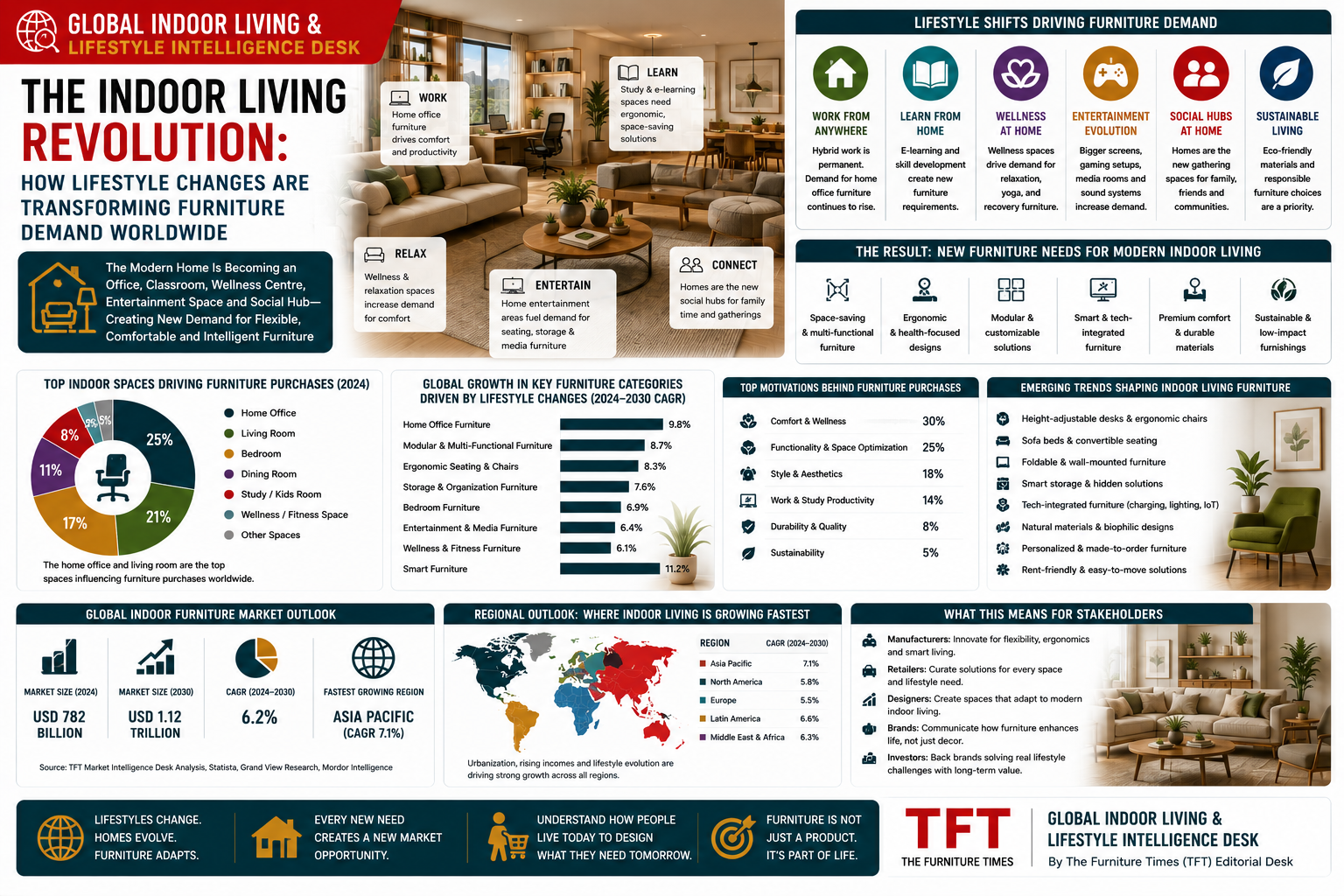
The Indoor Living Revolution: How Lifestyle Changes Are Transforming Furniture Demand Worldwide
The Modern Home Is Becoming an Office, Classroom, Wellness Centre, Entertainment Space and Social Hub—Creating New Demand for Flexible, Comfortable and Intelligent Furniture
Global Indoor Living & Lifestyle Intelligence Desk
By The Furniture Times (TFT) Editorial Desk
Indoor living is undergoing one of the most important transformations in the history of the global furniture industry.
For generations, residential interiors were organised around relatively fixed functions.
The bedroom was used for sleeping.
The dining room was used for meals.
The living room was used for relaxation and receiving guests.
The office was located outside the home.
Exercise took place in a gym.
Education took place in schools and universities.
Entertainment was largely connected to cinemas, television rooms and public venues.
Care was delivered primarily through hospitals and specialised facilities.
Those boundaries are becoming less distinct.
A modern bedroom may also function as a study area, home office, content-production studio and private entertainment zone. A dining table may support meals, homework, video meetings, crafts and business planning. A living room may become a cinema, gaming environment, exercise area and guest room. A spare bedroom may become an office, nursery, caregiver’s room or income-generating rental space.
The home is becoming a multifunctional platform for daily life.
This transformation is creating what can be described as the indoor living revolution—a worldwide shift in how people use rooms, evaluate comfort, organise possessions and purchase furniture.
The movement is being accelerated by:
- Urbanisation
- Smaller residential properties
- Hybrid and remote work
- Digital education
- Ageing populations
- Multigenerational households
- Rising housing costs
- Wellness awareness
- Entertainment technology
- E-commerce
- Social-media influence
- Sustainability concerns
- AI-enabled living
- Greater time spent inside homes
These changes are not temporary.
They are reshaping furniture demand across residential, rental, hospitality, healthcare, student-living and senior-living markets.
One current market estimate values the global furniture industry at approximately US$786.1 billion in 2025, rising from about US$831.6 billion in 2026 to US$1.33 trillion by 2033. The same assessment identifies evolving demand for modular, sustainable and technology-enabled furniture as an important market driver. Asia-Pacific accounted for the largest regional share at approximately 38.5% in 2025.
The indoor living revolution will influence where much of that future growth occurs.
The Home Is Becoming the Centre of Everyday Life
The home was once viewed mainly as a place to return to after work, education, shopping, exercise and entertainment.
Today, many of those activities can take place indoors.
People can:
- Work remotely
- Attend online classes
- Shop through digital platforms
- Exercise through connected equipment
- Watch films on demand
- Create digital content
- Run businesses
- Receive virtual medical consultations
- Socialise through video platforms
- Order meals and household products
- Manage finances and administration
This does not mean public spaces, workplaces, schools or retail environments will disappear.
It means the home must support a broader range of activities than it did previously.
Furniture is the physical infrastructure that makes these activities possible.
A room without the correct furniture may exist architecturally but fail functionally.
A home office requires a desk, supportive seating, storage and technology management.
A home-learning environment requires an appropriate work surface, lighting and organisation.
A wellness area requires open space, adaptable furniture and storage.
A multigenerational home requires furniture suitable for children, working adults and older family members.
The furniture industry must therefore stop designing rooms around one fixed activity.
It must design around changing patterns of use.
Urbanisation Is Increasing Indoor Furniture Demand
The world is becoming increasingly urban.
The United Nations’ World Urbanization Prospects 2025 reports that cities are now home to approximately 45% of the global population of 8.2 billion—more than double the urban share recorded in 1950. The number of cities worldwide has also expanded substantially, and further urban growth is expected through 2050.
Urbanisation increases furniture demand because cities create:
- Apartments
- Condominiums
- Rental housing
- Student residences
- Worker accommodation
- Serviced apartments
- Senior-living developments
- Mixed-use properties
- New household formation
However, urbanisation also makes residential space more expensive.
This creates one of the defining furniture challenges of the coming decade:
People need their homes to perform more functions while having less space available.
A conventional product that performs only one task may become less attractive than a product that provides several forms of value.
Smaller Homes Are Creating a Function-per-Square-Metre Economy
In compact homes, every square metre has economic value.
Furniture can no longer be evaluated only by appearance or purchase price. Buyers increasingly evaluate how much functionality a product provides relative to the space it occupies.
This creates demand for:
- Storage beds
- Sofa beds
- Extendable dining tables
- Folding desks
- Nesting tables
- Modular sofas
- Stackable chairs
- Wall-mounted workstations
- Movable room dividers
- Floor-to-ceiling wardrobes
- Storage benches
- Convertible guest-room furniture
- Furniture on wheels
- Integrated seating and storage
The strongest small-space products do not merely become smaller.
They are redesigned around different behaviour.
A reduced version of an oversized sofa may still have arms that consume valuable space. A properly designed apartment sofa may use narrower arms, shallower depth, detachable sections and hidden storage.
The difference is not cosmetic.
It is a different product strategy.
Multifunctional Furniture Is Becoming a Mainstream Requirement
Multifunctional furniture was once associated mainly with temporary accommodation, budget housing or exceptionally small apartments.
It is now entering mainstream residential design.
Customers may seek:
- A dining table that becomes a work desk
- A sofa that becomes a guest bed
- A bed containing storage
- A coffee table that rises for working or dining
- A bench that provides seating and organisation
- A wardrobe that includes a workstation
- A wall unit containing storage, entertainment and display functions
- A room divider with shelves
- A desk that can disappear after working hours
Multifunctionality is attractive for several reasons.
Space Efficiency
One product can replace two or more separate items.
Financial Efficiency
The household may avoid purchasing several pieces.
Visual Simplicity
Fewer products can make compact rooms feel calmer.
Flexibility
The room can change according to the time of day or household activity.
Mobility
Convertible and modular products may be easier to adapt when the customer moves.
Manufacturers must ensure that added functionality does not create excessive complexity.
A mechanism that fails quickly can destroy the economic value of a multifunctional product. Reliability, safety, ease of operation and replacement components are therefore essential.
Hybrid Work Has Permanently Changed Residential Furniture
Remote work expanded rapidly during the pandemic period, but evidence suggests that home-based work has remained structurally more important than it was before.
Research examining Australian working patterns found that workers exposed to intensive lockdowns sustained significantly higher work-from-home levels through 2023. The research linked that persistence to both employer adjustments and employee investments in home offices and technology.
Commercial workplace research also indicates that structured hybrid work has become an established global model rather than a temporary emergency arrangement. JLL reported in 2026 that organisations are increasingly focused on structured hybrid policies, office utilisation and AI readiness.
The consequence for residential furniture is significant.
Millions of homes now require permanent or semi-permanent work settings.
The Temporary Setup Is Becoming Permanent
During the early shift to remote work, many people used:
- Dining chairs
- Kitchen tables
- Sofas
- Beds
- Temporary folding tables
Long-term use exposed problems involving:
- Poor posture
- Insufficient storage
- Visual clutter
- Inadequate video-call backgrounds
- Cable management
- Lack of privacy
- Difficulty separating work and personal life
Consumers are now seeking more deliberate solutions.
Home-Office Furniture Demand Includes
- Compact desks
- Height-adjustable desks
- Ergonomic chairs
- Wall-mounted workstations
- Mobile drawers
- Cable-management systems
- Shelving
- Acoustic screens
- Fold-away desks
- Work cabinets
- Video-call background storage
- Integrated charging
The Home Office Must Often Disappear
Many customers do not have a separate room available.
The workplace may be located in:
- A bedroom
- Living room
- Dining area
- Hallway
- Landing
- Kitchen corner
- Under-stair space
This creates demand for furniture that transforms when the workday ends.
A desk may fold into a cabinet.
A screen may hide work equipment.
A console may extend into a work surface.
A dining table may incorporate cable management.
The future home office will increasingly be integrated into residential furniture rather than treated as a smaller version of a corporate workstation.
Digital Education Is Changing Children’s and Student Furniture
Education is also becoming more flexible.
Students may learn through a combination of:
- Physical classrooms
- Online courses
- Recorded lessons
- Private tutoring
- Independent research
- Collaborative digital projects
- Home assignments
This increases demand for dedicated study furniture.
Children’s bedrooms must increasingly support:
- Sleeping
- Storage
- Study
- Reading
- Creativity
- Digital activity
- Social interaction
Growth Categories Include
- Adjustable study desks
- Age-appropriate chairs
- Book and device storage
- Cable management
- Modular shelving
- Bunk beds with workstations
- Compact desks
- Mobile storage
- Shared sibling work areas
Furniture should adapt as the child grows.
A fixed desk suitable for a young child may become unusable after only a few years. Adjustable furniture can extend useful life and reduce replacement.
The design should also support healthy behaviour without turning the child’s room into an institutional classroom.
The Living Room Is Becoming a Flexible Lifestyle Platform
The living room remains one of the most important residential spaces, but its role is expanding.
It may function as:
- Family lounge
- Entertainment centre
- Social space
- Home cinema
- Gaming environment
- Informal office
- Exercise area
- Children’s play space
- Guest sleeping area
- Content-creation background
This changes the demand for sofas, tables, storage and media furniture.
Sofas Are Becoming More Modular
Fixed sofa arrangements are less adaptable when households move, families grow or room use changes.
Modular sofas allow customers to:
- Add sections
- Remove sections
- Rearrange seating
- Create separate chairs
- Adapt to a new property
- Replace one damaged component
Recent design reporting has highlighted continued consumer interest in modular, lounge-oriented and personality-driven sofas, reflecting a wider preference for relaxed and expressive living spaces.
Modularity should be supported by:
- Secure connectors
- Consistent dimensions
- Long-term fabric availability
- Replacement cushions
- Additional modules
- Clear reconfiguration instructions
Without continuity, modularity becomes a marketing claim rather than a long-term benefit.
Comfort Is Becoming More Emotional and Social
Consumers increasingly want living rooms that feel less formal and more welcoming.
Curved and rounded furniture has gained renewed attention because it can soften interiors and support more conversational seating arrangements. Recent 2026 design coverage notes increased visibility of curved sofas and rounded furniture across major retailers and design collections.
The commercial significance is broader than one visual trend.
Customers are moving away from furniture that looks impressive but feels untouchable.
They increasingly want homes that support:
- Informal gathering
- Relaxation
- Family interaction
- Physical comfort
- Emotional warmth
The strongest living-room furniture will balance visual identity with real everyday usability.
Entertainment Technology Is Reshaping Media Furniture
Televisions, gaming systems, speakers, streaming devices and smart-home equipment have transformed the living room.
Traditional television cabinets may no longer suit wall-mounted screens and wireless systems.
Demand is shifting toward:
- Low media consoles
- Concealed cable systems
- Ventilated cabinets
- Gaming storage
- Speaker integration
- Charging drawers
- Adjustable screen furniture
- Modular wall systems
- Furniture compatible with smart lighting
Furniture must support technology without becoming obsolete as devices change.
This creates a design challenge.
Permanently integrating a specific device may shorten the useful life of the furniture. Adaptable compartments, removable panels and accessible cable routes can provide greater longevity.
Gaming Is Creating a Major Indoor Furniture Category
Gaming has moved from a niche activity into mainstream entertainment and social interaction.
Gaming furniture includes:
- Gaming chairs
- Desks
- Monitor stands
- Storage
- Shelving
- Console units
- LED-compatible furniture
- Acoustic products
- Reclining seating
However, the category should move beyond aggressive styling and superficial branding.
Long-term users require:
- Ergonomic support
- Heat management
- Cable organisation
- Adjustable components
- Durable materials
- Space for several devices
- Furniture that also suits study or work
A gaming desk may serve as a student workstation, creative studio and home office.
This reflects the larger indoor living trend: one piece of furniture must support several identities.
Wellness Is Entering Furniture Purchasing Decisions
Consumers increasingly connect the home with mental and physical wellbeing.
Furniture contributes to wellness through:
- Comfort
- Posture
- Sleep
- Organisation
- Movement
- Privacy
- Visual calm
- Connection with natural materials
- Reduced clutter
Sleep Furniture
Beds and mattresses are increasingly marketed as complete sleep systems.
Demand is growing for:
- Adjustable beds
- Supportive mattresses
- Temperature-management materials
- Storage beds
- Smart sleep products
- Upholstered headboards
- Blackout-compatible bedroom planning
CIFF’s 2026 industry analysis highlighted smart sleep and AI-enabled furniture as important innovation areas, including a dedicated Smart Sleep Ecosystem Pavilion at its Guangzhou event.
Ergonomic Furniture
Ergonomics is becoming relevant beyond corporate offices.
Residential buyers increasingly assess:
- Chair support
- Desk height
- Sofa seat depth
- Mattress firmness
- Bed entry height
- Dining-chair comfort
Clutter Reduction
Storage furniture has psychological as well as practical value.
A well-organised environment can feel calmer and more manageable.
Demand is increasing for furniture that hides:
- Work equipment
- Toys
- Clothing
- Cables
- Household supplies
- Exercise equipment
- Digital devices
The future storage market is not simply about creating larger cabinets.
It is about understanding how people use and organise their possessions.
Indoor Exercise Is Affecting Furniture Layouts
Home exercise expanded as digital fitness platforms and compact equipment became more accessible.
Even households without dedicated gyms may need space for:
- Yoga
- Stretching
- Exercise bikes
- Weights
- Rehabilitation
- Meditation
Furniture can support this through:
- Movable coffee tables
- Lightweight chairs
- Wall storage
- Benches with exercise-equipment compartments
- Fold-away furniture
- Open modular layouts
Heavy furniture that cannot be moved may reduce room flexibility.
This creates opportunities for products that are stable during use but manageable when the room needs to change.
Multigenerational Living Is Transforming Home Design
Housing affordability, family support, ageing and cultural traditions are increasing the importance of multigenerational households in many markets.
A 2026 home-design trends report identified multigenerational living, adaptable layouts and technology integration as important forces influencing residential renovation.
A multigenerational home may include:
- Children
- Working-age adults
- Older parents
- Extended family
- Caregivers
Furniture must support users with different:
- Heights
- Strength
- Mobility
- Privacy needs
- Storage requirements
- Working schedules
- Comfort preferences
Furniture Opportunities Include
- Adjustable dining furniture
- Supportive chairs with arms
- Modular bedrooms
- Flexible guest beds
- Shared storage
- Private workstations
- Accessible wardrobes
- Furniture with rounded edges
- Higher seating positions
- Expandable dining tables
A sofa that is extremely low may suit one household member but be difficult for another.
A dining chair without arms may save space but provide insufficient support for an older adult.
Multigenerational design requires a wider understanding of inclusion.
Ageing Populations Will Reshape Indoor Furniture Demand
Many countries are experiencing rapid population ageing.
This creates demand for furniture that helps people remain comfortable and independent in their homes.
Age-inclusive furniture may include:
- Higher seat heights
- Stable armrests
- Supportive backrests
- Adjustable beds
- Easy-open drawers
- Pull-down wardrobe systems
- Rounded corners
- High-contrast handles
- Lightweight occasional tables
- Easy-clean surfaces
- Bedside furniture with accessible storage
The strongest products will provide these benefits without looking medical or institutional.
Older consumers remain design-conscious.
They want attractive homes, not environments that constantly remind them of physical limitations.
Age-inclusive furniture should therefore be part of mainstream collections rather than isolated in unattractive specialist ranges.
Family Structure Is Becoming More Diverse
The traditional furniture showroom often presents one assumed household:
Two parents, several children and a permanent family home.
Real households are more varied.
They may include:
- Single adults
- Couples without children
- Single parents
- Blended families
- Multigenerational households
- Shared apartments
- Retired couples
- Older adults living alone
- Remote workers
- International students
- Expatriates
Each household creates different furniture requirements.
Single-Person Households
May prioritise:
- Compact products
- Easy delivery
- Portability
- Multifunctionality
- Lower total cost
Shared Households
May require:
- Private bedroom storage
- Durable common-area furniture
- Flexible dining
- Furniture that is easy to replace
- Individual work areas
Families With Children
Need:
- Durable upholstery
- Easy-clean surfaces
- Storage
- Flexible dining
- Safe edges
- Expandable furniture
Couples Without Children
May invest more in:
- Premium materials
- Home entertainment
- Dining
- Workspaces
- Travel-inspired interiors
Furniture companies should stop treating the “family home” as one standard design category.
Rising Housing Costs Are Changing Furniture Budgets
Housing consumes a large share of household income in many cities.
High mortgage payments, rent, deposits, legal fees and moving costs can reduce immediate furniture spending.
Customers may respond by:
- Furnishing gradually
- Buying essential items first
- Choosing second-hand products
- Using instalments
- Purchasing modular systems
- Mixing premium and affordable items
- Delaying decorative products
- Renting furniture
This strengthens the opportunity for staged furnishing.
A brand can help the customer create a complete home over several years rather than demanding one large purchase.
Collections can be designed so customers can later add:
- Sofa modules
- Wardrobe sections
- Dining chairs
- Shelving
- Bedroom storage
- Matching finishes
Furniture businesses should see affordability as a product-development challenge—not only a discounting challenge.
Rental Living Is Creating a Portable Furniture Economy
Urban mobility and delayed homeownership are increasing the number of consumers living in rented properties.
Renters often avoid products that are:
- Extremely heavy
- Built for one precise room
- Permanently installed
- Difficult to dismantle
- Expensive to transport
- Vulnerable during relocation
They seek:
- Flat-pack systems
- Modular furniture
- Lightweight materials
- Reusable connections
- Neutral dimensions
- Portable storage
- Sofa beds
- Rental and subscription services
The traditional ready-to-assemble product is often designed for one assembly.
Future renter furniture must be designed for repeated assembly, transport and reconfiguration.
Hardware must survive several moves.
Instructions must remain available digitally.
Replacement components must be obtainable.
Furniture Rental and Subscription Models Will Expand
Furniture ownership may become less important for households that relocate frequently.
Potential customers include:
- Students
- Young professionals
- Expatriates
- Temporary workers
- Short-term residents
- Corporate tenants
- Rental-property operators
Rental and subscription systems can provide:
- Lower initial cost
- Delivery
- Installation
- Product exchange
- Maintenance
- Collection after use
These models also encourage circular business practices because the provider retains ownership and economic interest in the product’s durability.
Furniture designed for rental must be:
- Strong
- Repairable
- Easy to clean
- Modular
- Transport-efficient
- Supported by replacement parts
E-Commerce Has Changed Furniture Expectations
Consumers increasingly expect to discover and compare indoor furniture digitally.
The online journey may include:
- Search engines
- AI assistants
- Marketplaces
- Social platforms
- Brand websites
- Reviews
- Visual search
- Video demonstrations
Furniture e-commerce is difficult because customers cannot easily test comfort, colour, material or scale.
Successful sellers reduce uncertainty through:
- Exact dimensions
- Product videos
- Real-room photography
- Augmented-reality placement
- Material samples
- Customer photographs
- Clear return conditions
- Delivery tracking
- Assembly guidance
The website must help the customer imagine how the furniture will perform in real life.
Social Media Is Making Interiors More Expressive
Digital platforms expose consumers to a continuous stream of homes, hotels, restaurants and designer interiors.
This has increased visual awareness and accelerated trend cycles.
Customers are more likely to encounter:
- Bold colours
- Sculptural furniture
- Vintage products
- Mixed materials
- Curved forms
- Handcrafted pieces
- Global styles
- Personal collections
Minimal interiors remain important, but many consumers are moving toward homes that feel more individual and emotionally meaningful.
Recent 2026 design reporting has highlighted greater interest in character, texture, vintage influence, modular comfort and expressive upholstery.
This creates opportunities for:
- Independent designers
- Local craftspeople
- Vintage retailers
- Custom manufacturers
- Small-batch brands
- Reupholstery businesses
The challenge is balancing individuality with long-term relevance.
Furniture purchased for one short trend may become undesirable quickly. Brands can create stronger value by combining expressive details with durable construction and replaceable finishes.
The Rise of Personalisation
Consumers increasingly want furniture adapted to their:
- Room dimensions
- Preferred fabric
- Colour
- Lifestyle
- Storage needs
- Family structure
- Comfort preferences
Personalisation can include:
- Modular configurations
- Fabric selection
- Leg finishes
- Cushion firmness
- Wardrobe interiors
- Table dimensions
- Storage accessories
- Headboard sizes
Digital design systems and flexible manufacturing are making customisation more scalable.
However, unlimited choice can overwhelm buyers.
The most effective personalisation systems guide the customer through a controlled set of meaningful options.
Smart Furniture Is Moving Toward Practical Use
Technology-enabled furniture is often discussed through futuristic concepts, but the strongest near-term demand will come from simple, useful functions.
These include:
- Integrated charging
- Cable management
- Adjustable desks
- Sensor-enabled beds
- Lighting integration
- Connected storage
- Occupancy information
- Automated mechanisms
The smart furniture market is expected to expand as sleep technology, connected devices and AI-enabled living enter more products. CIFF’s 2026 outlook identifies smart furniture and intelligent sleep as prominent growth areas.
The industry must avoid adding technology only for novelty.
Smart features should be:
- Easy to use
- Repairable
- Upgradeable
- Safe
- Compatible with changing devices
- Supported after purchase
A charging port that becomes technologically obsolete should not make the entire product obsolete.
Sustainability Is Becoming Part of Indoor Lifestyle Demand
Consumers increasingly want homes that feel responsible as well as attractive.
The global eco-friendly furniture market was valued at approximately US$53.7 billion in 2025 and is projected to increase from about US$58.3 billion in 2026 to US$113.9 billion by 2033, according to one market estimate.
Demand is growing for:
- Certified timber
- Recycled materials
- Natural fibres
- Low-emission finishes
- Repairable products
- Removable covers
- Replaceable components
- Reclaimed wood
- Vintage furniture
- Refurbished furniture
However, customers may interpret sustainability differently.
Some focus on recycled content.
Others focus on local production.
Others believe the most sustainable product is one that lasts for decades.
The strongest furniture companies will communicate specific evidence rather than relying on vague terms such as “green” or “eco.”
Second-Hand and Vintage Furniture Are Becoming Mainstream
The indoor living revolution includes a growing willingness to mix:
- New furniture
- Vintage pieces
- Inherited items
- Restored products
- Marketplace purchases
- Custom products
Second-hand buying offers:
- Lower prices
- Individual character
- Immediate availability
- Reduced demand for new materials
- Access to discontinued design
This creates opportunities for traditional furniture companies to develop:
- Trade-in programmes
- Certified resale
- Refurbishment
- Cleaning
- Reupholstery
- Buy-back systems
- Authentication
Circular furniture does not need to remain separate from mainstream retail.
Kitchens Are Becoming Social and Work Spaces
The kitchen is increasingly more than a food-preparation area.
It may also function as:
- Dining space
- Family gathering area
- Homework area
- Video-call location
- Entertainment zone
- Informal office
- Storage centre
This creates demand for:
- Kitchen islands
- Breakfast counters
- Integrated seating
- Charging points
- Drawer organisation
- Tall storage
- Hidden appliances
- Durable work surfaces
- Flexible lighting
Kitchen furniture must support social interaction while remaining practical and easy to maintain.
Hardware quality, moisture resistance and installation accuracy remain central because kitchens are costly and difficult to replace.
Bedrooms Are Becoming Private Lifestyle Zones
The bedroom was once designed almost entirely around sleeping and clothing storage.
It now may include:
- Workstation
- Entertainment
- Exercise
- Reading
- Beauty and personal care
- Private relaxation
- Content creation
This creates demand for:
- Storage beds
- Compact desks
- Dressing units
- Lounge chairs
- Media storage
- Integrated lighting
- Charging points
- Acoustic products
- Modular wardrobes
The challenge is preventing the bedroom from becoming visually overcrowded.
Furniture systems that conceal work and technology after use can help preserve a calmer sleep environment.
Dining Furniture Must Support Flexible Households
The dining table has become one of the most versatile products in the home.
It may support:
- Meals
- Remote work
- Children’s education
- Crafts
- Meetings
- Celebrations
- Food preparation
Customers increasingly seek:
- Extendable tables
- Durable surfaces
- Round tables for circulation
- Compact dining sets
- Benches
- Stackable chairs
- Integrated storage
- Tables with cable access
Dining furniture must tolerate more intensive daily use than before.
Surface resistance, stability, comfort and easy cleaning are becoming more important.
Storage Is Becoming One of the Largest Lifestyle Opportunities
Modern households own:
- Clothing
- Technology
- Sports equipment
- Children’s items
- Work equipment
- Household supplies
- Entertainment devices
- Seasonal products
Poor storage can make even a large home feel inadequate.
Future storage furniture will need to become:
- More vertical
- More configurable
- More accessible
- Better organised internally
- Integrated into unused spaces
- Suitable for changing needs
Opportunities include:
- Modular wardrobes
- Under-bed storage
- Entryway systems
- Utility-room furniture
- Wall storage
- Concealed workstations
- Pantry systems
- Furniture-integrated charging
Manufacturers should study what customers store—not simply how cabinets are traditionally constructed.
Indoor Furniture Materials Are Changing With Lifestyle
Lifestyle change affects material selection.
Performance Upholstery
Families, pet owners and heavy users seek:
- Stain resistance
- Washable covers
- Abrasion resistance
- Replaceable cushions
- Easy cleaning
Engineered Wood
Remains central to affordable, modular and automated production.
Future growth will depend on improved moisture resistance, lower emissions and stronger connections.
Solid Wood
Retains premium value through durability, repairability and natural character.
Metal
Supports slim structures, modularity, home-office products and mixed-material designs.
Bamboo and Rattan
Benefit from demand for natural texture, craft and biophilic interiors.
Recycled Materials
May expand as consumers and institutions seek lower-waste solutions.
Material selection must match actual household behaviour.
A visually attractive material that cannot tolerate daily cleaning or high humidity will create disappointment.
Regional Indoor Living Trends
Asia-Pacific
Asia-Pacific will remain the largest furniture-growth and production region.
Key demand drivers include:
- Urban apartment development
- Middle-class growth
- Multigenerational households
- Mobile commerce
- Hybrid work
- Compact housing
- Hospitality-inspired residential design
Important products include:
- Modular wardrobes
- Storage beds
- Compact dining sets
- Home-office furniture
- Smart sleep products
- Children’s study furniture
- Multifunctional sofas
North America
North American demand is influenced by:
- Larger homes
- Home renovation
- Replacement purchases
- Home offices
- Entertainment
- Outdoor-to-indoor lifestyle integration
- Ageing in place
Strong categories include:
- Sofas and sectionals
- Mattresses
- Home offices
- Storage
- Media furniture
- Accessible seating
- Multifunctional guest-room products
Europe
European indoor living is shaped by:
- Smaller urban properties
- High rental participation
- Sustainability expectations
- Design awareness
- Ageing populations
- Repair and circularity
Demand is likely to favour:
- Compact modular furniture
- Certified timber
- Repairable upholstery
- Multifunctional dining
- Reclaimed products
- Age-inclusive design
Middle East
The Middle East combines:
- Large family households
- Luxury villas
- Urban apartments
- Expatriate mobility
- Home entertaining
- Premium interior design
Demand ranges from affordable furniture packages to bespoke luxury interiors.
Furniture supporting family gatherings, guest accommodation, home offices and premium storage will remain important.
Africa
Africa has enormous long-term potential because of:
- Young populations
- Urbanisation
- Household formation
- Housing demand
- Digital commerce
The market requires:
- Affordable furniture
- Durable materials
- Local manufacturing
- Repairability
- Compact transport
- Modular household packages
Latin America
Latin American demand is influenced by:
- Urban living
- Strong family culture
- Local manufacturing
- Housing development
- Social commerce
- Flexible payment
Products must balance design, affordability, climatic performance and local dimensions.
Search Behaviour During the Indoor Living Revolution
Consumers increasingly search according to activity rather than traditional room category.
Instead of searching only for “desk,” they may search:
- Desk that can disappear after work
- Home office in living room
- Workstation inside wardrobe
- Small desk for bedroom
Instead of searching only for “sofa,” they may search:
- Modular sofa for growing family
- Sofa bed with storage
- Easy-clean sofa for pets
- Sofa for small apartment
Instead of searching only for “dining table,” they may search:
- Dining table that can be used as desk
- Extendable table for apartment
- Round table for small room
- Durable table for children
Furniture websites should organise products around:
- Lifestyle
- Activity
- Household type
- Space
- Problem
- Material
- Budget
AI Search Will Accelerate Lifestyle-Based Discovery
AI-assisted search allows customers to describe a complete living situation.
A customer may ask:
I live in a small two-bedroom apartment, work from home three days a week and need space for visiting parents. Which furniture should I choose?
This type of request combines:
- Property size
- Work pattern
- Family requirement
- Guest accommodation
- Storage
- Budget
Brands with detailed product data and problem-solving content will be easier for AI systems to understand and recommend.
Furniture companies should publish:
- Exact dimensions
- Configurations
- Use cases
- Material details
- Comfort information
- Maintenance
- Delivery
- Replacement parts
- Suitable room sizes
Risks Facing the Indoor Furniture Market
Overconsumption
Constant trend cycles may encourage households to replace usable furniture unnecessarily.
Low-Quality Multifunctional Products
Complex mechanisms may fail if poorly engineered.
Technology Obsolescence
Integrated electronics can become outdated faster than the furniture.
Housing Affordability
High housing costs can reduce furniture budgets.
Small-Space Discomfort
Compact furniture may sacrifice comfort if dimensions are reduced carelessly.
Greenwashing
Vague environmental claims can damage trust.
Digital Misrepresentation
Online images may make furniture appear larger, softer or more premium than it is.
Delivery Complexity
Urban apartments create lift, access, parking and assembly challenges.
Loss of Repair Skills
Products may be discarded because local repair services and spare components are unavailable.
Future Growth Opportunities
Transformable Furniture
Products that change according to activity or time of day.
Modular Systems
Furniture that expands, contracts and moves between homes.
Integrated Home Offices
Residential furniture containing concealed work functions.
Smart Sleep Systems
Beds and furniture connected with wellness technology.
Multigenerational Furniture
Products suitable for children, adults and older users.
Rental and Subscription Furniture
Flexible ownership for mobile households.
Repair and Refurbishment
Services that extend product life.
Climate-Specific Indoor Furniture
Materials adapted to humidity, heat, cold or dry indoor environments.
Storage Intelligence
Products designed around real household possessions.
AI-Assisted Space Planning
Digital systems that match furniture to dimensions and lifestyle requirements.
Strategic Priorities for Furniture Manufacturers
Manufacturers should:
- Study activities rather than only rooms.
- Design for more than one use.
- Improve mechanisms and moving components.
- Develop modular product families.
- Offer replacement modules and hardware.
- Design for repeated assembly.
- Integrate work functions into residential furniture.
- Build age-inclusive comfort into mainstream collections.
- Improve storage interiors.
- Use durable, easy-clean materials.
- Avoid permanently embedding short-life technology.
- Provide exact dimensions and use cases.
- Create products for renters and mobile households.
- Explore refurbishment and take-back.
- Prepare product data for AI-assisted discovery.
Strategic Priorities for Furniture Retailers
Retailers should:
- Organise products by lifestyle problem.
- Create small-space displays.
- Demonstrate furniture transformations.
- Build home-office zones.
- Offer room-planning services.
- Provide material samples.
- Show products in realistic homes.
- Explain furniture care clearly.
- Offer delivery, installation and removal.
- Provide flexible payment.
- Create multigenerational room solutions.
- Promote repair and replacement components.
- Develop rental or subscription partnerships.
- Build search content around complete questions.
- Connect digital research with showroom service.
The Future Home Will Be Flexible Rather Than Fixed
The home of the future will not necessarily contain more rooms.
It will contain rooms capable of doing more.
A living room will transform between family relaxation, work, entertainment and guest accommodation.
A bedroom will support sleep, storage, study and privacy.
A kitchen will support cooking, conversation and work.
A dining table will serve several household activities.
Furniture will need to change with these moments.
The most successful products will provide flexibility without creating visual confusion.
They will make transformation easy.
They will hide functions when they are not needed.
They will remain comfortable during everyday use.
They will survive repeated movement and reconfiguration.
Indoor Living Is Becoming a Complete Economy
The indoor living revolution extends beyond furniture manufacturing.
It connects:
- Housing
- Architecture
- Interior design
- Consumer technology
- Wellness
- Education
- Entertainment
- Healthcare
- E-commerce
- Logistics
- Repair
- Resale
- Artificial intelligence
Every lifestyle shift creates a corresponding furniture requirement.
Hybrid work creates home-office demand.
Smaller apartments create multifunctional demand.
Ageing creates accessible-furniture demand.
Digital entertainment creates media and gaming demand.
Multigenerational living creates adaptable household demand.
Sustainability creates repair and circularity demand.
The furniture industry must learn to identify these connections.
Furniture Must Follow Life, Not Force Life to Follow Furniture
Traditional furniture often assumes that a room will remain unchanged for years.
Modern life is less predictable.
People move.
Families grow.
Children leave home.
Jobs become remote.
Parents age.
Rooms change function.
Technology evolves.
Furniture must be capable of changing with these realities.
The future belongs to products that provide:
- Flexibility
- Comfort
- Storage
- Adaptability
- Repairability
- Digital compatibility
- Long-term value
The indoor living revolution is not simply a design trend.
It is a structural change in how people organise their lives.
The companies that recognise this will stop selling isolated chairs, tables, beds and cabinets.
They will begin creating systems that help people work, learn, rest, connect, care and adapt inside the same limited space.
The future of furniture will be shaped by one essential principle: as life becomes more flexible, the home—and everything placed inside it—must become flexible too.
