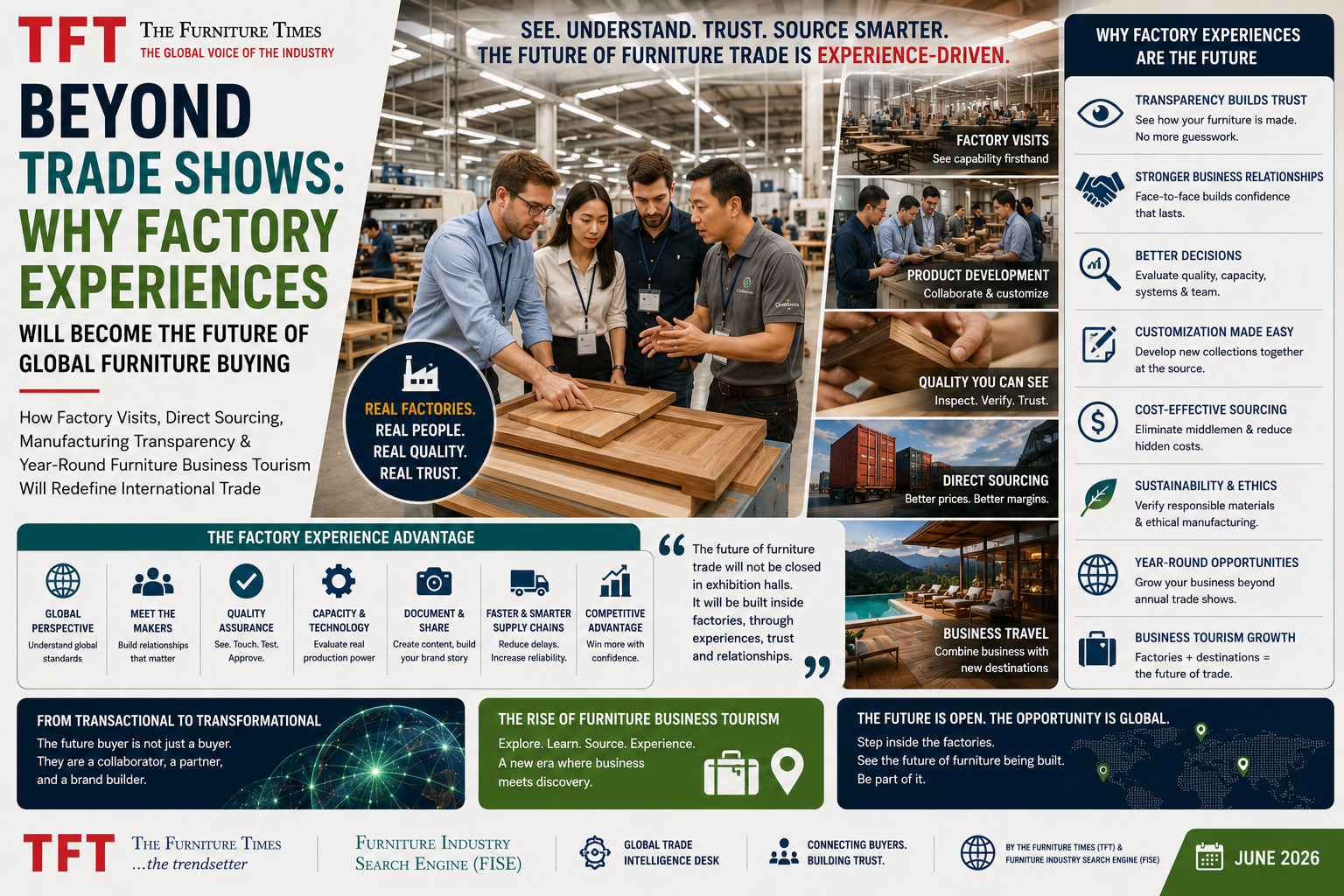
Beyond Trade Shows: Why Factory Experiences Will Become the Future of Global Furniture Buying
How Factory Visits, Direct Sourcing, Manufacturing Transparency & Year-Round Furniture Business Tourism Will Redefine International Trade
Global Trade Intelligence Desk
By The Furniture Times (TFT) & Furniture Industry Search Engine (FISE)
June 2026
For decades, international furniture trade has revolved around exhibitions.
Manufacturers prepared for months.
Buyers travelled across continents.
Products were launched.
Deals were negotiated.
Orders were placed.
Relationships were formed.
Trade fairs have played an extraordinary role in the development of the global furniture industry.
Events in Milan.
High Point.
Shanghai.
Guangzhou.
Kuala Lumpur.
Cologne.
Jakarta.
Dubai.
Singapore.
And many others have connected manufacturers with buyers for generations.
However, global buying behaviour is changing.
Today’s buyers want more than seeing products inside exhibition halls.
They want to understand where products are made.
How they are manufactured.
Who makes them.
What materials are used.
How quality is controlled.
How sustainable production really is.
The future of furniture buying is moving beyond exhibition booths.
It is moving inside factories.
According to The Furniture Times (TFT), the next evolution of international sourcing will be driven by Factory Experiences through Furniture Business Tourism.
Trade exhibitions will remain important.
But they will no longer be enough.
The future belongs to manufacturers that invite buyers into their world.
Trade Shows Built the Industry
Trade fairs transformed global furniture commerce.
They created opportunities for:
Manufacturers.
Retailers.
Importers.
Exporters.
Interior designers.
Architects.
Hospitality buyers.
Property developers.
Government trade agencies.
For many businesses, exhibitions remain one of the fastest ways to meet international customers.
Trade shows will continue playing an important role.
But they represent only one stage of the buying journey.
Buyers Have Changed
The modern buyer is more informed than ever.
Before attending an exhibition, buyers often research:
Company history.
Manufacturing capability.
Customer reviews.
Factory certifications.
Sustainability practices.
Product quality.
Digital catalogues.
Videos.
Artificial Intelligence.
By the time they arrive at an exhibition, they already know much about the supplier.
The next question becomes:
Can I visit your factory?
The Exhibition Hall Has Limits
Trade exhibitions are powerful.
But they have limitations.
Visitors often experience:
Crowded halls.
Limited meeting time.
Product samples only.
Temporary displays.
High pressure schedules.
Short conversations.
Manufacturers cannot fully demonstrate:
Production systems.
Quality control.
Workforce expertise.
Material handling.
Machinery.
Innovation.
Research facilities.
These experiences require factory visits.
Factory Experiences Build Buyer Confidence
Nothing creates trust faster than transparency.
When buyers visit manufacturing facilities, they gain confidence.
They see:
Production lines.
Raw materials.
Craftsmanship.
Skilled workers.
Testing laboratories.
Packaging.
Warehousing.
Quality inspections.
Environmental practices.
Factory visits remove uncertainty.
Confidence leads to purchasing decisions.
Manufacturing Transparency Has Become a Competitive Advantage
Global buyers increasingly ask difficult questions.
Where does the timber come from?
How is quality maintained?
Are workers properly trained?
How sustainable is production?
What technology is being used?
Can production scale?
Can quality remain consistent?
Factories that openly answer these questions strengthen buyer relationships.
Transparency has become a competitive advantage.
Direct Sourcing Creates Better Business
Traditional supply chains often involve multiple intermediaries.
Manufacturer.
Distributor.
Agent.
Importer.
Retailer.
Direct factory engagement shortens this process.
Benefits include:
Better communication.
Greater customisation.
Faster problem solving.
Improved pricing transparency.
Long-term cooperation.
Direct sourcing creates stronger partnerships because both parties understand one another better.
Long-Term Partnerships Begin Inside Factories
Large international furniture relationships rarely begin with one purchase.
They begin with trust.
Buyers visiting factories understand:
Company culture.
Leadership.
Manufacturing philosophy.
Innovation capability.
Business ethics.
Production consistency.
These relationships often continue for many years.
Factory visits transform transactions into partnerships.
Furniture Business Tourism Creates Year-Round Opportunities
Trade exhibitions last only a few days.
Factory experiences can happen throughout the year.
This creates continuous economic activity.
Manufacturers no longer depend entirely on exhibition calendars.
Visitors can schedule:
Factory tours.
Product development meetings.
Quality inspections.
Supplier evaluations.
Innovation workshops.
Training programmes.
Business matching sessions.
Furniture Business Tourism transforms sourcing into a year-round activity.
SMEs Benefit Even More
Many SMEs cannot afford expensive exhibition participation every year.
Furniture Business Tourism creates an alternative.
Instead of travelling to buyers…
Buyers travel to manufacturers.
Small companies gain opportunities to showcase:
Craftsmanship.
Innovation.
Flexibility.
Customisation.
Quality.
Without requiring massive marketing budgets.
Factory experiences democratise international trade.
Furniture Cities Become Living Showrooms
A factory visit rarely involves only one factory.
Visitors often explore:
Multiple manufacturers.
Material suppliers.
Design studios.
Furniture malls.
Innovation centres.
Logistics facilities.
Furniture museums.
Training academies.
Entire cities become living showrooms.
This strengthens local economies far beyond manufacturing.
Artificial Intelligence Will Improve Factory Experiences
AI will simplify business travel.
Visitors will receive:
Personalised factory recommendations.
Smart travel schedules.
Real-time translation.
Supplier matching.
Digital production information.
Virtual factory previews.
Meeting coordination.
Artificial Intelligence will make international sourcing faster, smarter and more efficient.
Sustainability Must Be Seen
Sustainability claims are increasingly important.
Buyers want evidence.
Factory visits allow visitors to observe:
Responsible timber sourcing.
Waste reduction.
Energy efficiency.
Recycling systems.
Circular manufacturing.
Water management.
Environmental responsibility becomes visible.
Seeing creates trust.
Governments Should Support Factory Tourism
National trade agencies can strengthen exports by supporting:
Certified factory tours.
Buyer missions.
Furniture tourism routes.
Business visitor programmes.
Regional furniture clusters.
Export-ready SMEs.
Furniture cities become national economic assets.
Business tourism becomes export promotion.
Hotels, Airlines & Local Businesses Benefit
Factory experiences create spending across multiple sectors.
Visitors require:
Hotels.
Restaurants.
Transportation.
Business lounges.
Conference rooms.
Local guides.
Translation services.
Freight companies.
Retail shopping.
The economic benefits extend throughout the community.
Furniture Business Tourism supports complete local ecosystems.
Why Searchability Matters
Factory experiences begin online.
Buyers first search.
Then compare.
Then contact.
Then visit.
Manufacturers therefore require:
Searchability.
Digital listings.
Factory profiles.
Virtual tours.
Business credentials.
Customer reviews.
This is where Furniture Industry Search Engine (FISE) becomes critical.
FISE helps manufacturers become discoverable long before buyers board an airplane.
The Role of The Furniture Times
The Furniture Times believes international furniture trade is entering a new era.
Trade exhibitions remain essential.
But they should become the beginning of relationships.
Not the end.
Furniture Business Tourism extends business throughout the year.
It creates stronger partnerships.
Greater transparency.
More confident buyers.
And more sustainable international trade.
TFT & FISE Analysis
The global furniture industry is moving from transactional buying toward relationship-based sourcing.
Trade fairs introduce businesses.
Factory experiences build trust.
Transparency strengthens confidence.
Confidence creates partnerships.
Partnerships create long-term business.
The future belongs to manufacturers willing to open their doors.
Not only their catalogues.
Final Verdict
Trade exhibitions will always remain an important part of the furniture industry.
But the future will belong to manufacturers that go beyond exhibitions.
Factories will become experience centres.
Production will become storytelling.
Manufacturing will become education.
Cities will become destinations.
Buyers will become long-term partners.
Furniture Business Tourism represents the natural evolution of international sourcing.
Because people no longer buy only products.
They buy confidence.
They buy relationships.
They buy trust.
And there is no better place to build trust than inside the factory where every product begins.
The future of global furniture buying is not only inside exhibition halls.
It is inside the factories that build the world’s furniture.
By The Furniture Times (TFT) & Furniture Industry Search Engine (FISE)
Global Trade Intelligence Desk | June 2026
“TFT tells their story. FISE helps the world find them.”
The furniture industry ecosystem is a $1 Trillion Dollar Industry.

Related Posts
Foshan’s Furniture Economy Draws Global Buyers—and Reveals the Growing Potential of Furniture Tourism
Global Furniture Trade Enters a New Era of Market Diversification, Supply Chain Resilience & Strategic Partnerships