Asia-Pacific Furniture Industry News
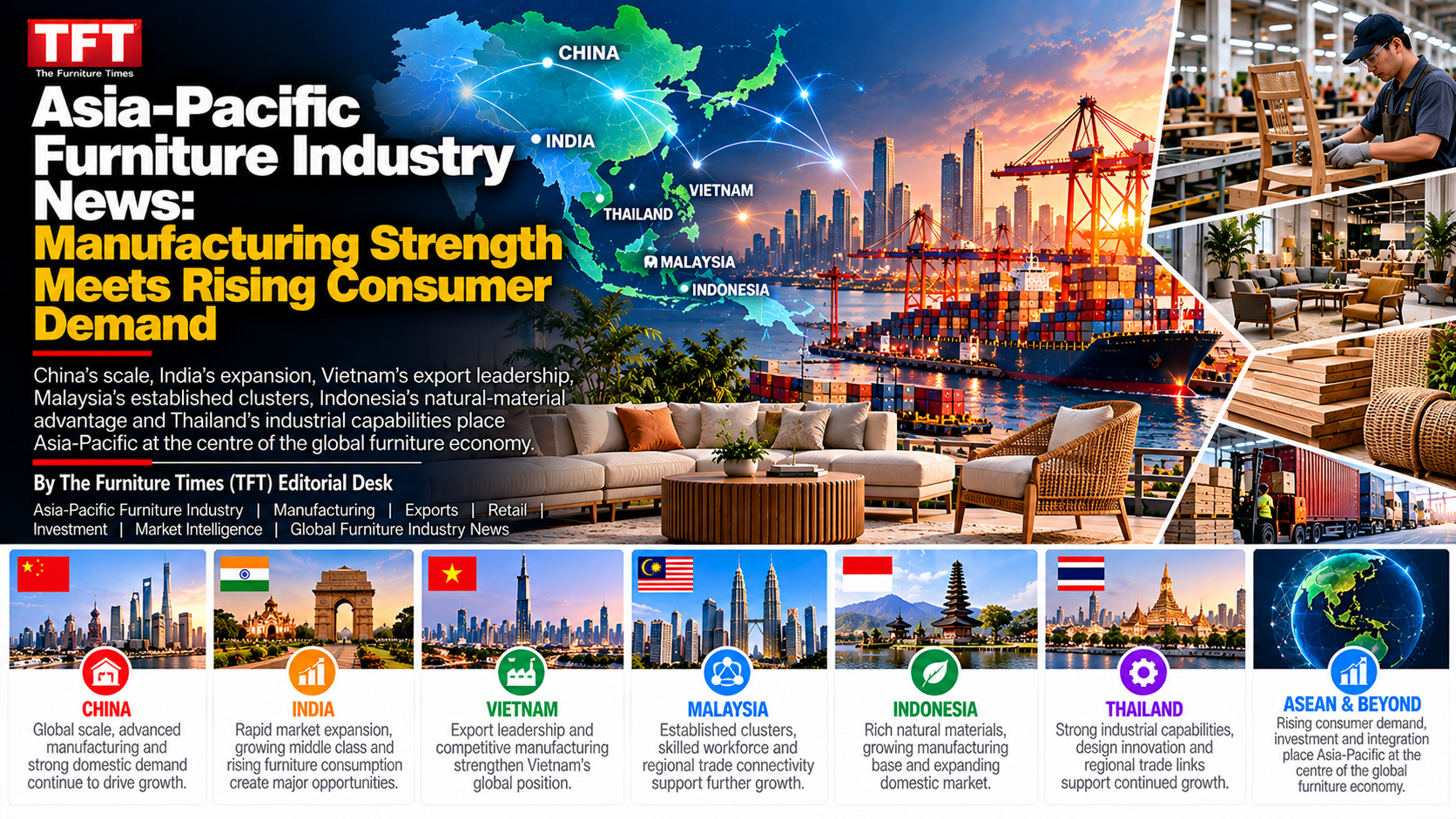
Asia-Pacific Furniture Industry News: Manufacturing Strength Meets Rising Consumer Demand
China’s scale, India’s expansion, Vietnam’s export leadership, Malaysia’s established clusters, Indonesia’s natural-material advantage and Thailand’s industrial capabilities place Asia-Pacific at the centre of the global furniture economy
By The Furniture Times (TFT) Editorial Desk | Asia-Pacific Furniture Industry | Manufacturing | Exports | Retail | Investment | Market Intelligence | Global Furniture Industry News
Asia-Pacific has become the strategic centre of gravity for the global furniture industry.
The region combines enormous manufacturing capacity, extensive raw-material and component networks, rapidly growing cities, expanding middle-income populations, digital-commerce adoption and some of the world’s most important furniture-export economies.
China remains the region’s industrial giant. Vietnam has developed into an internationally established wood-furniture production base. Malaysia retains respected export clusters and strong rubberwood capabilities. Indonesia brings rattan, timber, craftsmanship and distinctive natural materials. Thailand contributes manufacturing experience and regional connectivity. India is developing into both a major consumer market and an increasingly important production destination.
Japan, South Korea, Australia, New Zealand, the Philippines, Bangladesh, Pakistan and other regional markets add further layers of demand, design, materials, technology and investment.
The region, however, should not be described as experiencing one uncomplicated furniture boom.
China’s property weakness is limiting domestic furniture demand. Vietnam’s export momentum has slowed. Malaysian manufacturers face cost and scale pressures. Indonesian exporters are being urged to diversify beyond the United States. India’s energy costs and fragmented manufacturing base present operational challenges. Thailand must compete against larger and lower-cost production centres.
Geopolitical tension, high energy prices, US tariffs, shipping disruption and European sustainability regulation affect every major exporting country.
Asia-Pacific’s furniture story is therefore one of both strength and transition.
The region has the factories, suppliers, labour, materials and customers. Its next challenge is to move further into design, branding, technology, traceability, service and international visibility.
Asia-Pacific Furniture Industry Dashboard
| Market | Principal industry strength | Main opportunity | Immediate challenge |
|---|---|---|---|
| China | Scale and integrated manufacturing | Smart, customised and higher-value furniture | Property weakness and trade restrictions |
| India | Domestic growth and emerging manufacturing | Modular, organised retail, hospitality and exports | Fragmentation, energy costs and quality consistency |
| Vietnam | Export-oriented wood furniture | ODM, branded products and new markets | Slower orders and US dependence |
| Malaysia | Rubberwood, OEM/ODM and export experience | Contract, hospitality and branded manufacturing | Costs, labour and weak differentiation |
| Indonesia | Rattan, timber and craftsmanship | Sustainable natural-material furniture | Scale, documentation and market concentration |
| Thailand | Industrial capability and regional connectivity | Design-led exports and contract furniture | Intense regional competition |
| Japan | Design, technology and ageing-related demand | Inclusive, compact and premium furniture | Mature population and subdued volume growth |
| South Korea | Technology and design culture | Smart furniture and premium interiors | High costs and mature domestic demand |
| Australia | Large consumer market | Premium, outdoor and sustainable furniture | Housing turnover and discretionary spending |
| Philippines | Craft, natural materials and English capability | Hospitality, artisan and export furniture | Infrastructure and scale |
| Bangladesh | Competitive labour and developing production | Entry-level and export manufacturing | Compliance, skills and logistics |
| Pakistan | Woodcraft and domestic market potential | Artisan, solid-wood and export niches | Economic and energy instability |
Asia-Pacific’s Economic Foundation Remains Strong
The Asian Development Bank’s September 2026 outlook forecasts growth of 5% across developing Asia and the Pacific in 2026, followed by 5.1% in 2027. This is slower than the 5.5% recorded in 2025, but it still leaves the region growing faster than much of the global economy.
The outlook remains exposed to:
- Prolonged Middle East conflict
- Higher and volatile energy prices
- Renewed disruption from Russia’s war in Ukraine
- Severe weather and El Niño
- Trade restrictions
- Currency volatility
- Weak property markets
These risks are important because furniture depends on energy, shipping, housing and consumer confidence.
Nevertheless, the region’s structural drivers remain substantial:
- Urbanisation
- Household formation
- Residential construction
- Tourism development
- Office investment
- Growing digital commerce
- Expanding middle-income populations
- Regional manufacturing diversification
Commercial market estimates vary, but one 2026 assessment values the Asia-Pacific home-furniture market at approximately US$157 billion and projects continued expansion through 2031. Another estimates the region’s wooden-furniture segment at more than US$71 billion in 2026. These estimates use different methodologies, but both point toward long-term regional growth.
China: The Industrial Giant Faces a Two-Speed Furniture Economy
China remains the most complete furniture-manufacturing ecosystem in the world.
Its strength goes far beyond finished products. China supplies:
- Furniture hardware
- Recliner mechanisms
- Drawer slides
- Hinges and connectors
- Upholstery fabrics
- Synthetic leather
- Foam and fillings
- Metal components
- Woodworking machinery
- Packaging
- Lighting
- Decorative accessories
- Digital manufacturing systems
This depth allows Chinese factories to develop and scale products with remarkable speed.
Export strength remains formidable
China’s total merchandise exports increased by 36.3% year over year in September 2026, while imports rose by 31%. Technology and AI-related equipment drove much of that exceptional growth rather than furniture, but the figures demonstrate the resilience of China’s industrial and logistics system.
The furniture sector itself has been far more restrained. Earlier 2026 data showed furniture exports growing only 1.9% year over year while data-processing-equipment exports increased by 60%.
The contrast demonstrates China’s two-speed industrial economy:
- High-technology exports are booming.
- Conventional consumer-goods categories face slower demand and stronger competition.
China’s domestic property problem
Furniture demand is closely connected to home purchases, construction and renovation.
China’s prolonged property downturn has reduced:
- New-home furnishing
- Developer procurement
- Household confidence
- Premium discretionary spending
- Furniture-replacement activity
Manufacturing clusters heavily dependent on residential development have been forced to seek new export markets and customer segments.
Foshan illustrates the transition
Foshan remains one of the world’s most important furniture centres. It combines manufacturing, wholesale markets, materials, machinery, showrooms and design.
Yet the city’s factories face:
- Weaker domestic orders
- Tariff pressure
- Rising labour costs
- Production moving to Southeast Asia
- Aggressive price competition
- Reduced US demand
Manufacturers are responding through:
- Smart furniture
- Custom production
- Original designs
- Direct-to-consumer sales
- Social commerce
- Expansion into Europe and the Middle East
- Higher-value materials and finishes
China’s future advantage
China is unlikely to disappear from global furniture sourcing.
Its next competitive phase will depend less on being the cheapest source and more on:
- Automation
- Fast product development
- Integrated supply chains
- Smart furniture
- Mass customisation
- Original brands
- Digital selling
- Global after-sales systems
TFT assessment: China remains Asia-Pacific’s dominant furniture-production power, but its furniture sector must move from volume dependence toward design, technology and international brand development.
India: The Region’s Most Important Emerging Growth Story
India combines several developments rarely found in one furniture market:
- A vast domestic population
- Rapid urbanisation
- Expanding organised retail
- Growing hospitality investment
- Office development
- Modular interiors
- Traditional craftsmanship
- Emerging export manufacturing
- Digital-commerce adoption
The country is both a consumption opportunity and a manufacturing opportunity.
Smaller homes support modular furniture
India’s major cities are experiencing demand for:
- Modular kitchens
- Wardrobes
- Storage beds
- Compact dining furniture
- Sofa beds
- Work-from-home furniture
- MDF and particleboard products
- Space-efficient fittings
This benefits panel producers, hardware suppliers, interior contractors and modular-furniture manufacturers.
Organised manufacturing is gaining momentum
Fabience recently announced a greenfield premium furniture-manufacturing facility near Hyderabad as part of its production-expansion and export-growth strategy. The investment demonstrates confidence in India’s ability to serve domestic and international customers.
India also offers an important combination of industrial and craft production.
It can supply:
- Mass-produced modular furniture
- Metal furniture
- Solid-wood furniture
- Carved and handcrafted products
- Cane and natural-material collections
- Hospitality furnishings
- Custom project furniture
India’s export opportunity
Global buyers seeking diversified sourcing increasingly examine India as an alternative or complement to China and Southeast Asia.
However, export success requires more than competitive labour.
Factories must demonstrate:
- Consistent quality
- Controlled moisture content
- Accurate drawings
- Reliable bills of materials
- Tested products
- Packaging engineering
- Timely delivery
- Traceable materials
- Professional communication
- Spare-parts support
Challenges to growth
India continues to face:
- A fragmented informal sector
- Inconsistent quality systems
- Infrastructure differences between regions
- High logistics costs
- Dependence on imported machinery and components
- Energy-price exposure
- Limited international visibility for SMEs
The wider economy is also affected by expensive oil. India’s September merchandise deficit widened as imports rose more rapidly than exports, with geopolitical conflict contributing to energy and inflation risks. www.reuters.com
TFT assessment: India has one of the region’s strongest long-term furniture opportunities, but manufacturing discipline, certification, standardisation and global visibility will determine whether it achieves its potential.
Vietnam: An Export Powerhouse Entering a More Competitive Phase
Vietnam has become one of the world’s leading furniture and wood-product exporters.
Its rise has been supported by:
- Export-oriented factories
- Skilled woodworking labour
- Foreign investment
- Established relationships with US and European buyers
- Large production clusters
- Access to Asian component networks
- Experience with international compliance
Vietnamese furniture and wood-product exports reportedly increased from approximately US$200 million in 2000 to around US$17.3 billion in 2025.
2026 export momentum has weakened
Recent analysis estimates that Vietnam’s furniture exports during January–July 2026 were approximately 10% lower than in the corresponding 2025 period.
This does not mean Vietnam has lost its position. It means the industry is facing a more difficult phase.
Contributing pressures include
- Slower US residential demand
- Retail inventory caution
- Tariff uncertainty
- Higher shipping costs
- Currency movements
- Competition from other Asian producers
- Timber-traceability requirements
Vietnam’s next transformation
Vietnam has historically performed strongly as an OEM manufacturing base. Future growth will require greater participation in:
- Original design manufacturing
- International branding
- E-commerce
- Direct-to-consumer retail
- Contract furniture
- Sustainable materials
- Digital product documentation
- Non-US export markets
EUDR preparation
Vietnamese manufacturers serving Europe must prepare for stronger timber-origin and due-diligence requirements under the EU Deforestation Regulation.
A certificate alone may not be sufficient. Businesses will need product-level connections between materials, suppliers, production and shipment records.
TFT assessment: Vietnam remains an essential furniture-sourcing destination, but the industry must diversify customers and capture more value through design, brands and documented sustainability.
Malaysia: Established Manufacturing Strength Needs a New Growth Model
Malaysia has long been respected as an international furniture-export base.
Its strengths include:
- Rubberwood furniture
- Bedroom and dining furniture
- Upholstery
- OEM and ODM manufacturing
- Skilled production clusters
- International ports
- English-language business capability
- Established trade fairs
- Access to regional markets
Malaysia offers buyers an alternative within Asia without requiring them to abandon the region’s broader supplier ecosystem.
Export performance shows pressure
Malaysia’s furniture exports declined from RM12.83 billion in 2024 to RM12.53 billion in 2025, remaining below the RM13.86 billion recorded in 2022. Manufacturers have faced stagnant export growth, margin pressure and competition from China and Vietnam.
Monthly trade data can still show improvements in specific categories and periods—for example, “other furniture” exports rose between June and July 2026—but this does not remove the larger strategic challenge. oec.world
Malaysia’s core challenge
The country risks becoming caught between:
- China’s scale and integrated supply network
- Vietnam’s export volumes
- Indonesia’s natural materials
- India’s cost and market potential
- Europe’s premium design positioning
Competing only through price will become increasingly difficult.
Where Malaysia can win
Malaysia should develop stronger positions in:
- Hospitality furniture
- Outdoor furniture
- Contract manufacturing
- Senior-living furniture
- Modular collections
- Fast customisation
- Original design
- Regional distribution
- Sustainable rubberwood products
- Branded manufacturing
Trade fairs remain valuable
The Malaysian International Furniture Fair and Export Furniture Exhibition provide important buyer access. However, exhibition visibility must be connected to year-round digital discovery.
A buyer who meets a Malaysian factory at an exhibition should later be able to find:
- Verified company information
- Product capabilities
- Certifications
- News
- Reviews
- Contact details
- RFQ facilities
TFT assessment: Malaysia possesses a strong industrial foundation but requires greater differentiation, branding and continuous global visibility.
Indonesia: Natural Materials, Craftsmanship and the Need for Market Diversification
Indonesia holds a distinctive position in the Asia-Pacific furniture economy.
It is internationally associated with:
- Rattan
- Teak
- Mahogany
- Natural fibres
- Handcraft
- Carving
- Woven furniture
- Outdoor products
- Resort furniture
Manufacturing centres such as Jepara demonstrate how local skill, community production and export networks can create globally recognised furniture clusters.
Export position
Indonesia recorded approximately US$2.39 billion in furniture exports during 2025, compared with US$1.92 billion in imports, producing a trade surplus of about US$473 million.
However, the government has urged the industry to reduce excessive dependence on the United States and develop additional export markets.
Indonesia’s strategic advantages
- Rattan availability
- Tropical timber capabilities
- Skilled artisan communities
- Cultural design identity
- Hospitality and resort relevance
- Growing domestic middle class
- Potential for sustainable natural-material branding
Barriers
- Fragmented workshops
- Inconsistent standardisation
- Certification costs
- Shipping from dispersed production centres
- Limited working capital
- Difficulty scaling handmade production
- Uneven digital visibility
The value-capture opportunity
Indonesia often exports manufacturing skill while overseas brands capture the greatest margin.
The industry can retain more value through:
- Indonesian brands
- Designer collaborations
- Geographical craft identity
- Verified timber and rattan sourcing
- Premium storytelling
- International media visibility
- Direct buyer connections
Furniture was also included among sectors represented in the US–Indonesia trade and investment agreements announced in February 2026, reflecting its place within the wider bilateral commercial relationship. reuters.com
TFT assessment: Indonesia should not compete only as a low-cost supplier. Its strongest advantage is the combination of materials, craftsmanship, cultural identity and hospitality relevance.
Thailand: Industrial Capability With Regional Positioning
Thailand occupies an important position between advanced industrial manufacturing and Southeast Asian craft production.
Its furniture ecosystem includes:
- Wooden furniture
- Upholstery
- Metal furniture
- Parts and components
- Hospitality products
- Home accessories
- Interior contracting
- Rubberwood processing
Historical trade reporting showed double-digit growth in Thai furniture and parts exports during the first seven months of 2025, demonstrating the sector’s export potential.
Thailand’s advantages
- Established manufacturing infrastructure
- Automotive and metalworking capability
- Tourism and hospitality experience
- Regional connectivity
- Material-processing knowledge
- Strong design culture
- Access to ASEAN markets
The hospitality opportunity
Thailand’s hotel, resort, restaurant and wellness sectors provide an important domestic testing ground.
Manufacturers can develop capabilities in:
- Guest-room furniture
- Pool and outdoor furniture
- Restaurant seating
- Spa furniture
- Decorative furnishings
- Custom joinery
- Replacement programmes
Competitive pressure
Thailand must compete with:
- China on scale
- Vietnam on export manufacturing
- Malaysia on established furniture sourcing
- Indonesia on natural materials
- India on emerging production costs
The industry’s opportunity lies in reliable mid-to-high-value manufacturing rather than commodity production alone.
TFT assessment: Thailand can expand through hospitality expertise, design, components and regional contract manufacturing.
Japan: Design, Technology and the Ageing-Society Opportunity
Japan is a mature furniture market with strong influence in:
- Minimalist design
- Compact living
- Wood craftsmanship
- Ergonomics
- Manufacturing technology
- Retail presentation
- Age-inclusive products
Japan’s population structure limits broad volume growth, but creates specialised demand.
High-potential categories
- Furniture for smaller homes
- Accessible seating
- Adjustable products
- Senior-living furniture
- Compact storage
- Premium craftsmanship
- Smart furniture
- Home wellness products
Japanese knowledge of compact urban living can be commercialised internationally as more cities confront limited residential space.
The country can also export expertise in:
- Precision manufacturing
- Joinery
- Machinery
- Quality control
- Material efficiency
- Inclusive design
TFT assessment: Japan’s future opportunity is value, technology and demographic innovation rather than mass-market volume.
South Korea: Digital Lifestyle Meets Design-Led Furniture
South Korea combines advanced digital commerce, high urban density, design awareness and sophisticated manufacturing.
Its consumers are familiar with:
- Online furniture discovery
- Mobile commerce
- Smart-home products
- Compact apartments
- Branded interiors
- Rapid design cycles
Opportunities
- Smart desks and beds
- Integrated charging
- Connected storage
- Gaming furniture
- Compact modular systems
- Premium mattresses
- Design-led home furniture
- Furniture technology
South Korean companies also bring experience in electronics, appliances and digital platforms that can support connected-furniture development.
Challenges
- High property costs
- Mature demand
- High production expenses
- Competition from imported furniture
- Fast-changing consumer preferences
TFT assessment: South Korea is an important laboratory for digitally integrated and lifestyle-driven furniture.
Australia and New Zealand: Attractive Consumer Markets Under Housing Pressure
Australia and New Zealand remain important destinations for furniture exported from China and Southeast Asia.
Demand categories include:
- Residential furniture
- Mattresses
- Outdoor furniture
- Home offices
- Hospitality products
- Sustainable and natural-material furniture
Australia’s housing slowdown, however, has affected furniture-linked spending.
Housing transactions fell sharply during 2026, reducing expenditure across furniture retail, property styling, removal services and related industries. Reuters estimated that the decline in turnover was removing between A$355 million and A$710 million per month from the wider property-connected economy.
Opportunities remain in
- Premium furniture
- Outdoor living
- Replacement products
- Sustainable materials
- Commercial interiors
- Hospitality
- Senior living
- Repair and refurbishment
TFT assessment: Australia remains commercially attractive but should not be treated as an automatic growth market while housing activity is weak.
The Philippines: Craftsmanship and Hospitality Potential
The Philippines offers furniture capabilities in:
- Rattan
- Bamboo
- Natural fibres
- Shell and mixed materials
- Carved wood
- Handwoven products
- Hospitality interiors
English-language capability and a strong creative community provide advantages for international collaboration.
Growth opportunities
- Resort furniture
- Boutique hospitality
- Artisan collections
- Outdoor furniture
- Designer partnerships
- Small-batch production
- US and regional exports
Constraints
- Fragmented production
- Inter-island logistics
- Scale limitations
- Material consistency
- Factory modernisation
- International visibility
The Philippines can compete most effectively through distinctive design and craftsmanship rather than standardised volume products.
Bangladesh and Pakistan: Emerging Production Possibilities
Bangladesh possesses competitive labour and experience in export manufacturing, particularly textiles. This creates possible connections with upholstered furniture, home furnishings and soft-interior products.
However, furniture exports require investments in:
- Wood drying
- Machinery
- Compliance
- Product testing
- Packaging
- Logistics
- International sales
Pakistan offers:
- Solid-wood craftsmanship
- Carved furniture
- Upholstery
- Domestic-market demand
- Artisan skills
Its challenges include energy reliability, financing, currency instability and limited global marketing.
These countries should be viewed as emerging rather than mature furniture-export centres.
Singapore: A Regional Headquarters and Design Hub
Singapore’s role is different from that of large manufacturing economies.
It functions as a centre for:
- Regional headquarters
- Design
- Finance
- Procurement
- Logistics management
- Technology
- Trade and professional services
Singaporean companies can coordinate multi-country sourcing across Malaysia, Indonesia, Vietnam, Thailand, China and India.
Its domestic market also creates demand for:
- Compact furniture
- Premium interiors
- Smart-home products
- Hospitality furniture
- Office solutions
- Sustainable products
Singapore’s opportunity is to become a furniture-intelligence and transaction hub rather than a mass-production base.
Regional Demand Patterns Reshaping Furniture
Smaller urban homes
Growing cities are increasing demand for:
- Storage beds
- Extendable tables
- Modular wardrobes
- Sofa beds
- Folding desks
- Stackable seating
- Compact outdoor furniture
Hospitality and tourism
Asia-Pacific’s travel economy supports:
- Hotel furniture
- Resort collections
- Restaurant seating
- Outdoor furniture
- Serviced-apartment packages
- Airbnb and homestay furniture
Hybrid work
Offices increasingly require:
- Ergonomic chairs
- Height-adjustable desks
- Acoustic furniture
- Collaborative seating
- Flexible partitions
- Technology-integrated tables
Ageing populations
Japan, South Korea, China, Singapore, Australia and other markets need:
- Stable seating
- Accessible storage
- Senior-living furniture
- Healthcare furniture
- Adjustable beds
- Inclusive public furniture
E-commerce
Digital commerce is expanding product discovery and cross-border selling, but requires:
- Accurate specifications
- High-quality images
- Packaging engineering
- Delivery visibility
- Assembly support
- Reviews
- Reverse logistics
Asia-Pacific’s Supply-Chain Advantage
The region’s greatest advantage is not any single country.
It is the interconnection among countries.
A furniture product might involve:
- Design from Japan or South Korea
- Hardware from China
- Timber from Malaysia or Indonesia
- Upholstery fabric from China or India
- Manufacturing in Vietnam
- Regional management in Singapore
- Retail sale in Australia
- Installation by a local service provider
This interconnected production system is difficult for other regions to replicate quickly.
However, it also creates dependencies.
A disruption in one component, port or country can affect factories across the region.
The next sourcing strategy is therefore not simply “China plus one.” It is a managed regional network with:
- Alternative suppliers
- Transparent component origins
- Multiple transport routes
- Standardised product information
- Regional inventory
- Digital visibility
Tariffs Are Redrawing Export Strategies
US tariffs affecting upholstered furniture, cabinets and vanities have altered the commercial calculations of Asian exporters.
China, Vietnam, Malaysia, Indonesia, India and Thailand may all be affected differently depending on:
- Product classification
- Country of origin
- Material
- Manufacturing process
- Existing duties
- Customer contracts
Factories may respond through:
- Market diversification
- Product redesign
- Local assembly
- Nearshoring
- Higher-value products
- Reduced dependency on the US
- New distribution partnerships
Companies must obtain specialist customs advice before changing assembly locations or assuming that a new production country changes origin automatically.
EUDR Will Test Asian Furniture Documentation
The European Union Deforestation Regulation is scheduled to apply from 30 December 2026 to large and medium operators, with later application for many micro and small operators.
Asian furniture exporters using wood, plywood, veneer or other relevant timber-derived inputs must be prepared to support buyer due diligence.
This requires stronger records concerning:
- Timber species
- Country of harvest
- Supplier identity
- Geolocation where required
- Production batch
- Product model
- Shipment
- Risk assessment
Countries with large numbers of small workshops may face particular difficulties.
The issue is not necessarily unlawful timber. The issue may be the inability to prove origin through a consistent documentary chain.
From OEM to ODM and OBM
Much of Asia-Pacific’s furniture success has been based on OEM production.
The factory manufactures a product under another company’s brand.
This model can deliver:
- Factory utilisation
- Export revenue
- Buyer relationships
- Production knowledge
But it may also result in:
- Thin margins
- Buyer dependence
- Weak brand recognition
- Limited access to end customers
- Little ownership of market data
The next stage
Regional manufacturers increasingly need:
- ODM: original design manufacturing
- OBM: original brand manufacturing
- Product development
- International storytelling
- Direct digital visibility
- After-sales systems
Not every factory needs to become a consumer brand. However, every factory needs a visible and credible business identity.
Why Asia-Pacific Furniture SMEs Remain Difficult to Find
Despite the region’s manufacturing power, thousands of businesses remain hidden.
Common problems include:
- No current website
- Image-only catalogues
- Inconsistent company names
- No structured product categories
- Outdated contact details
- Limited English-language information
- No independent media coverage
- No verified reviews
- No search visibility
This creates an industry paradox:
Asia-Pacific may contain the right supplier, but the international buyer cannot find it.
The region needs a searchable infrastructure connecting:
- Factories
- Materials suppliers
- Hardware companies
- Designers
- Importers
- Exporters
- Retailers
- Logistics providers
- Installers
- Repairers
- Technology businesses
TFT, FISE and FurniReviewology: Connecting Asia-Pacific With the World
Asia-Pacific does not lack manufacturers.
It lacks complete visibility, structured discovery and cross-border trust.
This is where The Furniture Times, Furniture Industry Search Engine and FurniReviewology can play complementary roles.
The Furniture Times
TFT provides:
- Industry news
- Factory announcements
- Investment reporting
- Market intelligence
- Trade-policy analysis
- Company stories
- Regional coverage
It helps bring Asian furniture companies into the global spotlight.
Furniture Industry Search Engine
FISE can make businesses searchable by:
- Country
- Product
- Material
- Capability
- Application
- Certification
- Service
Its objective is:
Search. Connect. Discuss. Deal.
FurniReviewology
FurniReviewology can organise trust around:
- Product quality
- Supplier reliability
- Retail experience
- Delivery
- Installation
- Project performance
- After-sales service
Together:
The Furniture Times tells their story.
Furniture Industry Search Engine helps the world find them.
FurniReviewology helps the world trust them.
Strategic Recommendations for Regional Businesses
Manufacturers
- Diversify export markets.
- Develop original designs.
- Standardise product documentation.
- Prepare EUDR evidence.
- Reduce packaging volume.
- Strengthen quality control.
- Build spare-parts systems.
- Publish verified capabilities.
Retailers
- Match assortments to smaller homes.
- Improve online product information.
- Build omnichannel experiences.
- Collect independent reviews.
- Offer assembly and repair.
- Avoid permanent discount dependence.
Governments and associations
- Create accurate manufacturer maps.
- Support testing and certification.
- Help SMEs digitalise.
- Encourage design development.
- Improve export intelligence.
- Build repair and circular-economy networks.
- Promote regional collaboration.
Buyers
- Assess the full landed cost.
- Verify the actual factory.
- Review component origins.
- Examine capacity and quality systems.
- Avoid superficial supplier diversification.
- Confirm documentation before ordering.
Outlook: Asia-Pacific Will Remain the Industry’s Centre of Gravity
Asia-Pacific’s position rests on an exceptional combination of assets:
- China’s manufacturing infrastructure
- India’s growth potential
- Vietnam’s export capabilities
- Malaysia’s established furniture clusters
- Indonesia’s natural materials and craftsmanship
- Thailand’s industrial base
- Japan and South Korea’s design and technology
- Singapore’s regional coordination
- Australia’s consumer demand
- The emerging potential of the Philippines, Bangladesh and Pakistan
The region’s challenge is no longer simply producing more furniture.
It must produce furniture that is:
- Better designed
- Better documented
- Easier to transport
- More sustainable
- More repairable
- Digitally discoverable
- Supported by credible reviews
- Connected to international buyers
Asia-Pacific has manufacturing strength and rising consumer demand.
Its next frontier is value, visibility and trust.
The Global Furniture Ecosystem
The Furniture Industry is a $1 Trillion USD Ecosystem in the world.
Furniture Industry Search Engine – FISE helps the world find them.
The Furniture Times – TFT tells their story.
FurniReviewology helps the world trust them.
If you are not searchable, you do not exist.
Be the next one. Be part of the movement.