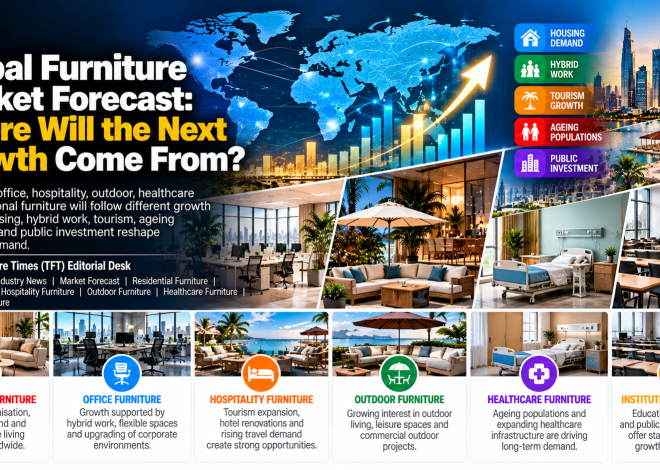

Global Furniture Industry News Roundup
Global Furniture Industry News Roundup: The Developments Businesses Cannot Ignore
Trade growth improves, geopolitical risks remain elevated, furniture tariffs reshape sourcing, Europe approaches a major timber-compliance deadline, factories invest in new capacity and digital product records move closer to becoming a commercial necessity
By The Furniture Times (TFT) Editorial Desk
The global furniture industry entered the final quarter of 2026 with a seemingly contradictory combination of improving international trade, continuing geopolitical instability, cautious consumers, changing sourcing patterns and intensifying regulatory requirements.
World merchandise trade has performed better than many organisations expected earlier in the year. However, furniture businesses are not experiencing that improvement evenly.
Manufacturers exposed to expanding hospitality, contract, institutional and export markets may see growing opportunities. Retailers dependent on housing transactions and discretionary household spending face a more difficult environment. Importers must contend with tariffs and unstable landed costs, while exporters confront changing due-diligence, sustainability and product-information requirements.
The result is not one global furniture market moving in a single direction. It is a fragmented industry in which growth, restructuring and financial pressure are occurring simultaneously.
For furniture manufacturers, component suppliers, retailers, interior contractors, designers, logistics companies and technology providers, the developments that matter most are no longer confined to furniture exhibitions or product launches. Energy markets, shipping routes, environmental regulation, tariffs, housing activity, hotel investment, workplace transformation and artificial intelligence are becoming equally important sources of industry intelligence.
This edition of the Global Furniture Industry News Roundup examines the company, policy, investment and market developments businesses cannot afford to ignore.
Executive industry briefing
The most important developments for furniture companies as of mid-October 2026 are:
| Development | Why it matters to furniture businesses |
|---|---|
| World trade outlook improves | Export opportunities may strengthen, but gains will remain uneven |
| Global growth remains modest | Consumers and businesses are still highly selective about major purchases |
| Middle East disruptions continue affecting costs | Energy, insurance, freight and delivery reliability remain exposed |
| Furniture tariffs reshape US sourcing | Importers face higher costs while regional manufacturing gains strategic value |
| EUDR deadline approaches | Timber traceability must move from policy discussion to operational readiness |
| Digital Product Passports advance | Product data, material records and repair information will become more important |
| Manufacturing investment continues | India and Southeast Asia are attracting capacity and export-oriented investment |
| Contract furniture gains prominence | Hospitality, offices and institutional projects offer alternatives to weak residential demand |
| Trade-fair models are changing | Events must increasingly create measurable commercial connections |
| Furniture market estimates remain inconsistent | The industry needs better, more transparent and ecosystem-wide measurement |
The central message is clear: furniture companies should not interpret an improving global trade forecast as evidence that every furniture segment is recovering.
Growth is available—but it is moving toward businesses that can document their products, control logistics, diversify markets, deliver reliably and demonstrate commercial relevance.
1. World trade improves—but furniture demand remains uneven
The World Trade Organization’s October 2026 update projects global merchandise-trade volume growth of 3.9% in 2026 and 4.1% in 2027. The 2026 projection represents a substantial improvement over the WTO’s earlier forecast.
The organisation attributed the stronger outlook partly to better-than-expected trade during the first half of 2026 and continuing investment connected with artificial intelligence and technology infrastructure. However, it also warned that the gains would be uneven.
For the furniture industry, the improved trade outlook is encouraging but requires careful interpretation.
Furniture is a bulky, freight-sensitive and comparatively discretionary product category. It does not necessarily benefit from the same forces driving semiconductor, data-centre or advanced-technology trade. A rise in overall merchandise trade may therefore coexist with weak demand for residential furniture in individual markets.
What the trade recovery could support
A stronger global trading environment may create opportunities for:
- Export-oriented manufacturers
- Furniture components and hardware suppliers
- Contract furniture producers
- Hospitality and hotel furniture companies
- Shopfitting and commercial-interior contractors
- Warehousing and fulfilment providers
- Packaging and knock-down furniture specialists
- Cross-border e-commerce sellers
- Machinery and woodworking-technology suppliers
Why businesses should remain cautious
Furniture orders may still be restrained by:
- Weak housing transactions
- High mortgage costs
- Cautious discretionary spending
- Excess inventory at retailers
- Currency fluctuations
- Tariffs and customs changes
- Uncertain freight and insurance costs
- Delayed real-estate projects
- Aggressive promotional competition
The correct conclusion is not that the furniture market has returned to uncomplicated growth. Instead, global commerce has become more supportive while industry-specific pressures remain.
2. The global economy is resilient—but resilience is under strain
The International Monetary Fund’s October 2026 briefing projected global growth of approximately 3.1% in 2026 and 3.4% in 2027. The IMF described the world economy as resilient while warning that risks remain tilted to the downside. It also highlighted higher energy and food prices as contributors to near-term inflation.
This matters directly to furniture.
Furniture demand normally responds to a combination of:
- Household income
- Consumer confidence
- Residential construction
- Property transactions
- Credit availability
- Business investment
- Tourism and hotel development
- Public infrastructure spending
Modest global growth can sustain furniture demand, but it does not guarantee a powerful replacement cycle. Many households can postpone buying a sofa, dining set, bed or wardrobe when economic confidence deteriorates.
Companies should therefore distinguish between economic resilience and consumer enthusiasm.
A two-speed furniture market
The market increasingly appears divided between:
Value-driven customers, who are highly sensitive to price, financing, delivery fees and promotional offers.
Premium and project-driven customers, who may continue spending but expect design distinction, material transparency, personalisation and reliable service.
The middle of the market is particularly exposed. Furniture that is neither inexpensive nor meaningfully differentiated may struggle to justify its price.
This is why permanent discounting is becoming dangerous. Discounts may move stock temporarily, but they cannot correct weak product positioning, poor availability, limited customer trust or an undistinguished brand.
3. Middle East conflict continues to influence the furniture cost structure
The ongoing conflict affecting the Middle East has implications extending far beyond the region’s immediate furniture markets.
Furniture manufacturing depends on energy at almost every stage:
- Timber harvesting and processing
- Metal fabrication
- Glass production
- Foam manufacturing
- Textile production
- Panel-board manufacturing
- Finishing and coating
- Packaging
- Road transportation
- Ocean freight
- Warehousing and installation
Disruption around critical maritime routes can increase fuel costs, marine-insurance premiums, voyage times and delivery uncertainty.
UN Trade and Development reported that disruption around the Strait of Hormuz had caused sharp declines in ship transits during the most intense phase of the crisis while increasing tanker rates, marine-fuel costs and war-risk insurance premiums. Although reopening and normalisation can calm markets, UNCTAD warned that freight contracts and broader economic effects can take time to reset.
Why this is especially important for furniture
Furniture has a low-to-moderate value relative to the space it occupies. Shipping inefficiency can therefore alter the commercial viability of a product quickly.
A freight increase that has limited effect on a small electronic device can destroy the margin on:
- A ready-assembled sofa
- A large wardrobe
- A dining table
- Outdoor furniture
- Mattresses
- Hotel room packages
- Low-priced bedroom furniture
Regional implications
Middle Eastern importers may face higher landed costs and longer replenishment times.
Asian exporters may need to reconsider routes, buffer inventory and quotation validity.
European buyers may face delays or surcharges on products moving through affected corridors.
African markets dependent on imported furniture, panels, foam or hardware may experience intensified cost pressure.
Global retailers may shift more inventory closer to major consumer markets, increasing demand for regional warehousing and multi-country sourcing.
The strategic lesson is that logistics cannot remain a back-office purchasing function. It has become part of product design, pricing and market strategy.
4. Furniture tariffs are restructuring the United States market
Furniture-specific tariffs have become one of the most consequential policy developments affecting global sourcing.
Previously announced US measures included a 30% tariff on imported upholstered furniture and a 50% tariff on imported kitchen cabinets and vanities. These measures created uncertainty for import-dependent retailers and suppliers while improving the strategic position of companies with substantial North American manufacturing capacity.
The effects extend beyond the United States.
Exporters in China, Vietnam, India, Malaysia, Thailand, Turkey, Mexico and Europe must reconsider:
- Product pricing
- US market profitability
- Factory utilisation
- Country-of-origin rules
- Alternative export markets
- Final assembly locations
- Component sourcing
- Customs classifications
- Customer contracts
Tariffs do not automatically restore domestic production
Furniture production cannot be relocated overnight.
Domestic expansion requires:
- Industrial land
- Machinery
- Skilled labour
- Component suppliers
- Foam and fabric availability
- Timber and panel capacity
- Compliance systems
- Working capital
- Warehousing
- Reliable order volumes
Tariffs may create an incentive for regional manufacturing, but they can also result in higher retail prices, delayed purchasing and compressed margins before new capacity becomes available.
The likely industry response
Furniture companies are expected to pursue a combination of:
- Nearshoring
- Dual sourcing
- Product redesign
- Flat-pack engineering
- Greater local assembly
- Supplier renegotiation
- Price increases
- Reduced product variety
- Increased inventory buffers
- Investment in US and North American production
Manufacturers should not assume that changing the final assembly location automatically changes the product’s origin for customs purposes. Substantial-transformation rules, component origins and classification decisions require specialist advice.
5. EUDR moves from distant regulation to immediate operational deadline
The European Union Deforestation Regulation is approaching a critical implementation stage.
According to the European Commission, the regulation applies from:
- 30 December 2026 for large and medium operators
- 30 June 2027 for most micro and small operators
- 30 December 2026 for certain micro and small operators already covered by the former EU Timber Regulation framework
The regulation requires covered products placed on or exported from the EU market to be deforestation-free and supported by the required due diligence.
For furniture businesses, this is not merely a forestry issue.
It is a data-management and supply-chain governance issue.
Information furniture companies may need to connect
Depending on the product and regulatory scope, businesses may require:
- Timber species
- Country of harvest
- Geolocation information
- Supplier identity
- Chain-of-custody documentation
- Production dates
- Product classification
- Due-diligence references
- Risk assessments
- Risk-mitigation evidence
- Purchase and shipment records
The documentation challenge
A finished item may contain wood from several origins:
- Solid-wood frame
- Veneer
- Plywood
- Particleboard
- MDF component
- Drawer base
- Packaging material
- Decorative trim
If product records, bills of materials and supplier declarations are inconsistent, completing due diligence becomes significantly more difficult.
The companies most exposed are not necessarily those using illegal materials. They may be legitimate businesses unable to assemble the required evidence quickly enough.
Immediate priorities
Furniture exporters and European importers should:
- Identify products potentially within scope.
- Map every timber-containing component.
- Request missing supplier evidence.
- Standardise species and material descriptions.
- Connect purchase orders to production batches.
- Test their ability to retrieve records.
- Assign clear internal responsibility.
- Avoid waiting until a shipment is already at the border.
EUDR readiness should now be treated as a commercial-access requirement rather than a sustainability-marketing exercise.
6. Digital Product Passports advance toward the furniture sector
Product information is becoming a strategic infrastructure layer.
In July 2026, the European Commission launched a central Digital Product Passport information resource and announced that the DPP Registry had become operational. The registry sits within the Ecodesign for Sustainable Products Regulation framework and is intended to support transparent, accessible product information throughout a product’s lifecycle. Furniture is among the priority groups identified for future implementation work.
A Digital Product Passport could eventually connect a furniture item with information such as:
- Manufacturer
- Product identifier
- Materials and composition
- Country of production
- Repair instructions
- Spare parts
- Disassembly guidance
- Sustainability information
- Compliance documentation
- Recycling routes
- Product warnings
- Warranty information
Furniture companies should not wait for every technical requirement to be finalised before improving their product data.
Why early preparation matters
Many manufacturers still manage vital product information across disconnected systems:
- Printed catalogues
- PDF specification sheets
- Emails
- Spreadsheets
- Factory drawings
- Laboratory reports
- Enterprise-resource-planning software
- Supplier declarations
These records may use different model numbers or product descriptions.
A dining chair called “DC-118” in the factory may appear under a retailer’s private-label code, an internal export code and several colour-specific SKU numbers. If these identities are not connected, traceability becomes fragile.
The industry’s future will require a persistent digital identity for each product family and declared variant.
7. New furniture manufacturing capacity signals confidence in India
India continues to attract furniture manufacturing investment.
One recent announcement concerns premium furniture manufacturer Fabience, which is establishing a greenfield manufacturing facility near Hyderabad as part of a capacity-expansion and export-growth strategy.
The significance extends beyond a single factory.
India offers a combination of:
- Large domestic consumption potential
- Expanding real-estate markets
- Hospitality investment
- Office and institutional demand
- Engineering and design talent
- Timber, metal, textile and craft capabilities
- Export connectivity
- Government interest in manufacturing growth
However, India’s opportunity will depend on whether manufacturers can scale without sacrificing consistency.
What international buyers will expect
Export-oriented factories require more than production capacity. They need:
- Repeatable quality
- Reliable tolerances
- Document control
- Social and environmental compliance
- Accurate bills of materials
- Laboratory testing
- Packaging engineering
- On-time delivery
- Replacement-part continuity
- Professional after-sales communication
India’s furniture opportunity will be won not only through lower costs but through dependable industrial execution.
8. Southeast Asia strengthens its position in global sourcing
Vietnam, Malaysia and other Southeast Asian economies continue to benefit as buyers diversify their supply chains.
Vietnam’s furniture industry remains attractive because of its manufacturing base, export experience and connection to international buyers. Nevertheless, businesses operating there must manage geopolitical risks, exchange-rate pressure, changing tariffs and increasing demands for timber traceability. Industry analysis published in September described the outlook as broadly favourable while acknowledging near-term pressure from global uncertainty and fluctuating residential investment.
Malaysia continues to build its position through established manufacturing clusters and international sourcing events.
These markets are not simply replacements for Chinese manufacturing. Each has different strengths, cost structures, material ecosystems and capacity limitations.
Buyers are moving from “China plus one” to network sourcing
The next phase of furniture procurement is likely to involve:
- China for scale, technology and integrated supplier networks
- Vietnam for export manufacturing and wood furniture
- Malaysia for established furniture production and international trade access
- India for market scale, craft capability and emerging industrial capacity
- Indonesia for wood, rattan and artisan-linked production
- Eastern Europe for proximity to EU buyers
- Turkey for access to European, Middle Eastern and regional markets
- Mexico for proximity to North America
The winning sourcing model may no longer be one country producing everything. It may be a connected network capable of shifting volume when tariffs, shipping or demand conditions change.
9. Contract furniture moves closer to the centre of industry strategy
Residential furniture remains essential, but contract furniture is becoming increasingly important.
Contract markets include:
- Hotels
- Restaurants
- Offices
- Healthcare facilities
- Educational institutions
- Student accommodation
- Senior living
- Retail interiors
- Airports
- Public buildings
- Serviced apartments
- Co-living projects
Salone del Mobile announced an enhanced contract-sector initiative designed to transform the exhibition from a product showcase into a more market-oriented platform. The programme recognises that contract furniture requires integrated expertise across design, compliance, production, logistics and long-term project delivery.
Why manufacturers are interested
Contract orders can provide:
- Higher production volumes
- Repeat specifications
- Multi-location projects
- Longer order pipelines
- Opportunities for customisation
- Stronger relationships with architects and developers
But contract furniture also demands:
- Fire and safety documentation
- Performance testing
- Precise project coordination
- Approved material substitutions
- Installation planning
- Mock-ups and prototypes
- Replacement availability
- Warranty support
- Strict delivery sequencing
A manufacturer cannot enter contract markets successfully by placing a residential product into a project catalogue. The entire operating system must be project-ready.
10. Furniture trade fairs are being forced to prove their commercial value
The international furniture exhibition calendar is changing.
Some traditional exhibitions have been cancelled, paused or moved to less frequent schedules. At the same time, specialised events, regional platforms, design weeks and collectible-design fairs are gaining attention.
The 2026 design calendar demonstrated increased interest in curated experiences, regional identity and smaller formats, while established fairs expanded cultural and sector-specific programming.
This reflects a broader question:
What should a furniture trade fair deliver that cannot be achieved through digital sourcing, online meetings or direct factory visits?
Exhibitors increasingly require measurable outcomes
Furniture businesses want:
- Qualified buyers
- Verified project leads
- Distributor connections
- Export-market intelligence
- Architect and designer engagement
- Media visibility
- Competitor analysis
- Product feedback
- Regulatory information
- Post-event follow-up systems
The future exhibition is likely to operate as a year-round business network rather than a temporary hall containing product displays.
Trade fairs that cannot demonstrate buyer quality, lead conversion and continuing industry engagement may face increasing pressure.
11. Artificial intelligence is entering the furniture value chain
AI investment is contributing to global trade resilience, according to the WTO, but its effect on furniture is wider than macroeconomic demand. wto.org
Furniture companies are applying AI to:
- Product visualisation
- Room staging
- Demand forecasting
- Inventory planning
- Customer-service automation
- Product recommendations
- Search and discovery
- Manufacturing optimisation
- Defect detection
- Catalogue enrichment
- Translation
- Marketing-content production
The opportunity is significant, but so is the risk of low-quality deployment.
Where businesses may go wrong
AI-generated product images can misrepresent materials or dimensions.
Automated descriptions can invent specifications.
Design-generation tools may create intellectual-property questions.
Customer-service systems may promise unavailable delivery dates.
Forecasting models may fail when geopolitical shocks alter demand suddenly.
The correct strategy is to use AI as an operational assistant connected to verified product data—not as a substitute for technical knowledge and human accountability.
12. Furniture market estimates still vary too widely
Commercial reports continue to publish substantially different estimates of the global furniture market.
Examples for 2026 range from approximately US$729.6 billion in one report to US$775.2 billion, US$783.1 billion and more than US$833 billion in others.
These differences do not necessarily mean that one organisation is intentionally misleading readers.
They may reflect different definitions of:
- Furniture
- Geographic coverage
- Manufacturer sales versus retail value
- Residential versus commercial categories
- Indoor versus outdoor products
- Mattresses
- Kitchen furniture
- Built-in furniture
- Office systems
- Installation and delivery
- Used and refurbished furniture
- Informal production
- Online marketplace revenue
This is precisely why The Furniture Times describes furniture as a broader $1 trillion industry ecosystem, rather than claiming that every source calculates a single audited furniture-product market of exactly $1 trillion.
Once the industry includes materials, machinery, logistics, retail, installation, technology, repair, refurbishment, design, media, finance and professional services, its total economic footprint becomes far larger than product sales alone.
The real problem is not a shortage of forecasts. It is the absence of an agreed global measurement framework.
What these developments mean for furniture businesses
Manufacturers
Manufacturers should prioritise:
- Multi-market export strategies
- Complete product documentation
- EUDR and traceability preparation
- Product-family and variant control
- Packaging optimisation
- Energy-efficiency planning
- Contract-market capabilities
- Digital product records
- Supplier-risk mapping
Retailers
Retailers should focus on:
- Inventory discipline
- Clear value positioning
- Accurate delivery promises
- Supplier diversification
- Product reviews
- Customer retention
- Private-label traceability
- Repair and spare-parts services
- Reduced dependence on permanent discounting
Suppliers
Material, hardware and component suppliers should provide:
- Consistent product codes
- Technical data sheets
- Origin information
- Test evidence
- Chemical and material declarations
- Batch traceability
- Stable replacement specifications
- Digital records compatible with customer systems
Logistics providers
Furniture logistics companies must develop specialised capabilities in:
- Bulky-goods handling
- Protective packaging
- Consolidation
- Customs documentation
- Route-risk management
- Warehousing
- Last-mile delivery
- Installation coordination
- Reverse logistics
- Damage reporting
Designers and consultants
Design professionals must consider:
- Repairability
- Disassembly
- Material traceability
- Packaging volume
- Transport efficiency
- Product safety
- Cleaning and maintenance
- Component replacement
- Commercial compliance
A visually successful product that cannot be manufactured, documented, shipped or repaired economically is not a fully resolved furniture product.
TFT Global Furniture Industry Watchlist
Furniture businesses should monitor the following indicators during the remaining months of 2026 and into 2027:
| Indicator | What a material change could mean |
|---|---|
| Middle East conflict and shipping security | Freight, fuel and insurance volatility |
| US tariff implementation | Price changes and sourcing relocation |
| EUDR operational guidance | New evidence and data obligations |
| Housing transactions | Residential furniture demand |
| Interest-rate direction | Consumer credit and property investment |
| Hotel-development pipelines | Hospitality furniture orders |
| Office leasing and refurbishment | Workplace furniture opportunities |
| Retail inventories | New-order timing and discount pressure |
| Timber, steel, aluminium and foam prices | Manufacturing-margin changes |
| Currency movements | Export competitiveness and import costs |
| Digital Product Passport implementation | Product-data investment requirements |
| Factory announcements | Shifting production geography |
| Trade-fair attendance and buyer quality | Commercial confidence and sourcing activity |
| Insolvencies and consolidation | Credit and supplier-continuity risks |
The missing infrastructure: visibility, searchability and trust
The furniture industry remains fragmented across thousands of manufacturers, suppliers, retailers, designers, installers, logistics operators, repairers, artisans and technology businesses.
Many capable businesses remain invisible outside their immediate region.
A manufacturer may possess excellent production capabilities but lack international media coverage.
A supplier may offer reliable components but remain absent from professional search systems.
A logistics company may understand furniture handling better than a general freight provider but have little industry recognition.
A retailer may provide excellent service without collecting credible customer feedback.
This is where an integrated industry ecosystem becomes essential.
The Furniture Times tells their story.
Furniture Industry Search Engine helps the world find them.
FurniReviewology helps the world trust them.
Together, TFT, FISE and FurniReviewology can help transform isolated announcements into searchable, verifiable industry intelligence.
News creates visibility.
Structured search creates discoverability.
Reviews create confidence.
The objective is not simply to publish more information. It is to help the global furniture industry identify who manufactures, who supplies, who delivers, who installs, who innovates and who can be trusted.
Editorial conclusion
The global furniture industry is not entering a period of simple recovery. It is entering a period of selective opportunity and accelerated restructuring.
Trade is growing, but not every furniture category will benefit equally.
Manufacturing investment is continuing, but new factories must meet increasingly demanding documentation and compliance standards.
Sourcing is diversifying, but tariffs and geopolitical risks can quickly change the economics of a supply route.
Digital systems are advancing, but their value will depend on accurate underlying product information.
Sustainability requirements are expanding, but businesses will need evidence rather than general claims.
The companies most likely to succeed will be those that combine five capabilities:
- Reliable products
- Accurate documentation
- Flexible supply chains
- Strong market visibility
- Verifiable customer trust
The furniture industry ecosystem is a $1 trillion industry ecosystem, but its economic importance remains inadequately measured and many of its participants remain insufficiently visible.
The industry does not need more isolated data. It needs connected intelligence.
If you are not searchable, you do not exist.
Be the next one. Be part of the movement.
Sources:
World Trade Organization—Global Trade Outlook and Statistics, International Monetary Fund—World Economic Outlook, UN Trade and Development—Transport and Trade Logistics, European Commission—Deforestation Regulation, European Commission—Digital Product Passport