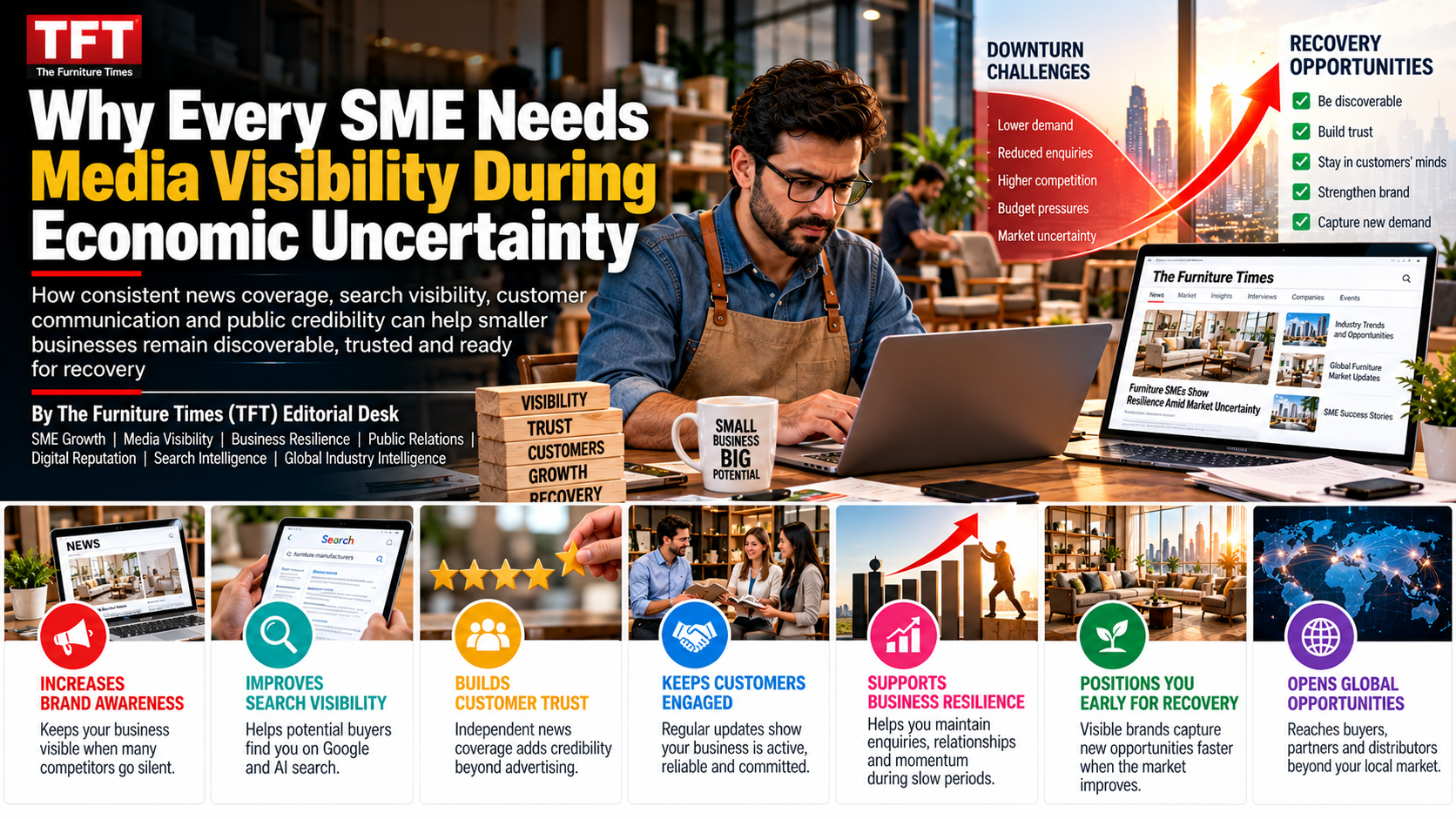
Why Every SME Needs Media Visibility During Economic Uncertainty
How consistent news coverage, search visibility, customer communication and public credibility can help smaller businesses remain discoverable, trusted and ready for recovery
By The Furniture Times (TFT) Editorial Desk | SME Growth | Media Visibility | Business Resilience | Public Relations | Digital Reputation | Search Intelligence | Global Industry Intelligence
Economic uncertainty forces every small and medium-sized enterprise to examine its expenses carefully.
When customers delay purchases, financing becomes more expensive, operating costs rise and cash flow tightens, business owners naturally prioritise survival. Marketing campaigns may be reduced, events cancelled, content postponed and public-relations budgets frozen.
Cost discipline is necessary. Wasteful spending should be challenged.
But abandoning media visibility is not the same as eliminating waste.
For an SME with limited brand recognition, prolonged silence can create a second crisis on top of the economic slowdown: the business becomes harder to find, easier to forget and more difficult to trust.
Large corporations often have years of accumulated visibility. Their names remain familiar even when advertising decreases. They may also possess extensive distribution, large customer databases, physical locations, media relationships and branded search demand.
Most SMEs do not have those protections.
Their next customer may know what product or service is needed without knowing the company’s name. That customer will search, compare, read reviews, examine news coverage and assess whether each supplier appears credible and active.
If the SME has disappeared from public view, it may never enter the shortlist.
During economic uncertainty, media visibility is not about looking successful. It is about remaining commercially present.
Economic uncertainty changes how customers buy
Uncertain conditions do not eliminate demand. They change customer behaviour.
Buyers may:
- Postpone discretionary purchases
- Compare more suppliers
- Request additional quotations
- Negotiate more carefully
- Demand clearer warranties
- Investigate company credibility
- Reduce order quantities
- Extend approval processes
- Seek evidence of stability
- Prioritise long-term value
- Avoid businesses that appear inactive
The buying decision becomes more cautious.
This means trust carries greater commercial weight.
When customers feel economically secure, they may experiment with an unfamiliar company. When conditions are uncertain, they may prefer a supplier with visible evidence of:
- Experience
- Reliability
- Expertise
- Customer satisfaction
- Industry recognition
- Current operations
- Responsive leadership
- Financial and operational continuity
Media visibility helps create this evidence.
What media visibility actually means
Media visibility is broader than appearing in a newspaper.
For an SME, it may include:
- News articles
- Industry-media coverage
- Founder interviews
- Expert commentary
- Press releases
- Project case studies
- Product announcements
- Research and market insights
- Trade-platform profiles
- Local-media stories
- Awards and recognition
- Podcast appearances
- Video interviews
- Business-directory listings
- Searchable editorial content
The objective is not publicity for its own sake.
The objective is to create an accurate, credible and searchable public record of:
- Who the business is
- What it offers
- Where it operates
- Who it serves
- What it has achieved
- Why it is relevant
- Why customers should trust it
- How it is responding to changing conditions
Advertising and media visibility perform different jobs
Advertising is valuable. It can create immediate reach, promote products and capture active demand.
However, customers recognise advertising as paid communication controlled by the advertiser.
Media visibility provides a different type of value.
| Advertising | Media visibility |
|---|---|
| Buys audience attention | Builds public credibility |
| Promotes an offer | Explains why the business matters |
| Controlled by the advertiser | Strengthened by editorial context |
| Often ends when spending stops | Can remain searchable for years |
| Supports immediate conversion | Supports long-term authority |
| Highlights benefits | Documents activity and expertise |
| Creates reach | Creates evidence |
| Tells customers what to buy | Helps customers decide whom to trust |
A resilient SME needs both, but they should not be confused.
Advertising may introduce the company.
Credible media visibility can help customers believe in it.
Silence is not a neutral business position
When an SME stops communicating, the market does not pause.
Competitors continue to:
- Publish articles
- Announce projects
- Collect reviews
- Improve their websites
- Run search campaigns
- Build industry partnerships
- Participate in events
- Release new products
- Strengthen their digital profiles
An SME may believe that reducing visibility for six months simply preserves cash until conditions improve.
But during those six months:
- Customers may forget the brand.
- Search rankings may decline.
- Business information may become outdated.
- Competitors may occupy valuable search positions.
- Media relationships may weaken.
- The customer database may become inactive.
- New buyers may never discover the company.
- AI systems may find more information about competitors.
- Previous customers may assume the company is no longer active.
The SME does not remain in the same market position. It can lose ground quietly.
Limited awareness makes SMEs especially vulnerable
Large businesses often possess an accumulated awareness reserve.
They may have:
- Decades of advertising
- Thousands of customer reviews
- High branded-search volume
- Multiple stores
- Established distributors
- Frequent media coverage
- Recognisable leadership
- Large social audiences
An SME may have none of these at scale.
Its visibility may depend on a small number of recent touchpoints:
- A current Google Business Profile
- A few news articles
- Customer reviews
- Local-search rankings
- Active social channels
- Direct customer communication
- Industry-directory listings
If those touchpoints disappear, the brand can rapidly become commercially invisible.
This is why the same marketing reduction can affect an SME more severely than a multinational corporation.
Media coverage creates a searchable history
A strong business should have a public timeline.
That timeline may document:
- Company formation
- Founder background
- New products
- Important projects
- Market expansion
- Certifications
- Technology investments
- Employment growth
- Awards
- Partnerships
- Community contributions
- Sustainability initiatives
- New facilities
- Export activity
- Customer-service improvements
This history helps customers and partners understand that the company is not an anonymous or temporary operation.
It can support:
- Sales conversations
- Supplier negotiations
- Dealer recruitment
- Investor discussions
- Bank applications
- Employee recruitment
- Export development
- Customer due diligence
- AI discovery
- Search credibility
A company with no visible history may appear less established than it actually is.
Public visibility reassures customers that the business remains active
During uncertain periods, customers worry about business continuity.
They may ask:
- Will the company still be operating next year?
- Will it honour the warranty?
- Can it complete the project?
- Will replacement components remain available?
- Can it deliver on time?
- Is the supplier financially and operationally stable?
An active media presence does not guarantee stability, but it can demonstrate continued activity.
Recent coverage may show that the company is:
- Completing projects
- Launching products
- Serving customers
- Hiring or training employees
- Entering partnerships
- Improving operations
- Participating in the industry
- Responding to market changes
Silence can create uncertainty even when the business remains operational.
News coverage helps reduce sales friction
SME sales teams frequently spend time proving basic credibility.
Potential customers ask:
- Who are you?
- How long have you operated?
- Have you completed similar work?
- Who is behind the business?
- Can I see evidence?
- Why should I trust you?
Credible media articles can help answer these questions before a sales meeting begins.
A prospect who finds:
- A founder interview
- A project case study
- A product-development story
- An industry analysis
- Customer reviews
- A clear company profile
enters the sales conversation with more context.
Media coverage does not replace contracts, samples, references or due diligence. It strengthens the evidence surrounding them.
Media visibility supports search discovery
Many customer journeys begin with a search.
Customers may search for:
- Local suppliers
- Manufacturers
- Service providers
- Product specialists
- Company reviews
- Founder names
- Industry recommendations
- Project examples
- Market expertise
Search engines need accessible information to understand a business.
News articles can create additional pages connecting the company with:
- Its products
- Industry
- Location
- Leadership
- Projects
- Capabilities
- Specialisations
- Markets served
This does not guarantee higher search rankings. But without sufficient public information, search engines have less evidence to interpret and present the company accurately.
Media visibility increasingly affects AI discovery
Business discovery is expanding beyond conventional search results.
Customers now ask AI systems:
- Which suppliers operate in my region?
- Who manufactures this product?
- Which companies specialise in this sector?
- Which SME has relevant experience?
- Which businesses have completed similar projects?
- Who are the recognised leaders in this field?
AI systems rely on available digital information.
If an SME has little public documentation, AI systems may:
- Fail to identify it
- Confuse it with another organisation
- Provide incomplete information
- Lack confidence in mentioning it
- Recommend a more visible competitor
Media coverage adds structured, contextual information that can help machines understand the company.
A clear article should identify:
- Official business name
- Location
- Leadership
- Products and services
- Industry category
- Markets served
- Evidence supporting major claims
- Official website
- Relevant contact information
In the AI-discovery era, a company’s public information is becoming part of its commercial infrastructure.
Media visibility helps customers understand value
Economic uncertainty increases price sensitivity.
When SMEs reduce communication, customers see fewer reasons to choose them beyond price.
A furniture manufacturer, for example, may possess advantages such as:
- Better material selection
- Skilled craftsmanship
- Stronger joints
- Greater customisation
- Reliable quality control
- Hospitality-project experience
- Responsible sourcing
- Replacement support
If these strengths are not communicated, buyers may compare only quotations.
Media content can explain:
- Why the product lasts longer
- How the business controls quality
- Why a service is more dependable
- How the company solved a difficult customer problem
- What makes its process different
- Why its pricing reflects genuine value
Price becomes less dominant when value is clearly documented.
Economic uncertainty creates a trust competition
In a growing market, several businesses may win.
In a slowdown, customers become more selective. Fewer orders are distributed among more competitors.
The market becomes a competition for confidence.
Businesses that appear active and credible may gain an advantage because customers want to reduce risk.
Media visibility contributes to this confidence when it is supported by:
- Accurate company information
- Genuine reviews
- Detailed product content
- Visible leadership
- Case studies
- Professional communication
- Responsive service
A news article alone cannot create trust. It forms part of a wider trust system.
The strongest media stories during uncertain periods
Businesses should not manufacture artificial announcements merely to appear active.
Effective stories have genuine relevance.
How the company is helping customers manage costs
Examples include:
- Repair programmes
- Flexible order sizes
- More efficient products
- Financing options
- Maintenance services
- Lifecycle-cost education
How the company is improving operations
Examples include:
- New machinery
- Faster delivery systems
- Better quality control
- Digital ordering
- Improved customer service
- Staff training
How the company is adapting products
Examples include:
- Space-saving designs
- Modular products
- Affordable product lines
- Durable commercial options
- Sustainable materials
- Replacement-ready components
How the company supports its community
Examples include:
- Employment
- Apprenticeships
- Local sourcing
- Social initiatives
- Small-supplier partnerships
How the company sees the market
Founder and leadership commentary can address:
- Customer trends
- Industry challenges
- Technology
- Supply chains
- Export opportunities
- Future investment
Useful stories demonstrate action, not empty optimism.
Honesty builds more trust than exaggerated confidence
Economic uncertainty should not be answered with unrealistic claims.
Businesses can acknowledge:
- Reduced demand
- Higher costs
- Longer buying cycles
- Supply uncertainty
- Customer affordability concerns
They can then explain their response.
For example:
“Demand from residential buyers has slowed, but the company is expanding repair services and strengthening its hospitality-project division.”
This is more credible than claiming that the company is experiencing extraordinary growth without evidence.
Trust requires accuracy.
Media visibility should never become a performance in which every development is described as:
- Revolutionary
- Unprecedented
- Market-leading
- World-class
- Number one
- Guaranteed
Substance is more persuasive than exaggeration.
Sponsored coverage must be transparent
Media visibility may include earned coverage, contributed articles and paid placements.
Each can provide value when handled responsibly.
However, businesses and publishers should distinguish clearly between:
- Independent editorial coverage
- Press releases
- Sponsored content
- Advertorials
- Partner content
- Company-authored opinion
A sponsored article can still build understanding if it is:
- Clearly disclosed
- Factually accurate
- Useful
- Substantial
- Free from misleading claims
Trust is damaged when advertising is disguised as independent reporting.
Transparency strengthens the long-term value of media coverage.
Media visibility does not require an enormous budget
Many SMEs assume public relations is affordable only for large corporations.
A practical programme can begin with:
- One credible company profile
- One founder interview
- One project case study
- One useful expert article
- Regular business updates
- Accurate industry listings
- A quarterly press release
- Consistent sharing through owned channels
The objective is not to publish everywhere every day.
It is to create a steady record of meaningful activity.
A smaller number of strong articles is more valuable than a large volume of empty promotional content.
The minimum viable media programme
During financial pressure, SMEs can protect a simple programme.
Every month
- Publish one meaningful company or industry article.
- Update major business information.
- Share a completed project, customer success or operational development.
- Distribute the article to the company’s database and relevant channels.
Every quarter
- Publish one substantial case study.
- Provide expert commentary on an industry issue.
- Review company search results.
- Update the media profile.
- Examine which articles generated interest or enquiries.
Every year
- Publish an annual progress report.
- Update the founder and leadership profiles.
- Review major projects, lessons and achievements.
- Create an editorial plan for the next 12 months.
- Refresh company photographs and capability information.
Consistency creates a cumulative advantage.
A practical SME media budget
The correct amount depends on the business, but the budget should protect several functions.
| Media activity | Suggested share |
|---|---|
| Company news and press releases | 25% |
| Case studies and customer stories | 20% |
| Founder and expert positioning | 15% |
| Photography and visual evidence | 15% |
| Distribution and industry platforms | 15% |
| Monitoring and measurement | 10% |
| Total | 100% |
This is a suggested allocation of the protected media budget—not total marketing expenditure.
Businesses may adapt it according to their sector and audience.
What SMEs should measure
Media visibility should connect to business outcomes.
Useful indicators include:
- Branded search growth
- Website referral traffic
- Article readership
- Qualified enquiries
- Media mentions
- Backlinks
- Sales-team usage
- Dealer or partner interest
- Founder-profile views
- Newsletter engagement
- Search-result coverage
- Customer references to articles
- AI-generated brand mentions
- Recruitment enquiries
Not every article produces an immediate sale.
Some improve:
- Familiarity
- Credibility
- Search presence
- Sales confidence
- Partnership opportunities
The programme should be evaluated across both immediate and cumulative outcomes.
Turn every article into a business asset
One strong article can support several functions.
Website
Publish or reference it within the company’s news section.
Sales
Include it in proposals and prospect follow-ups.
Social media
Create short extracts, quotations and visual summaries.
Share it with customers, dealers and partners.
Recruitment
Use company-development stories to attract employees.
Investors and banks
Include relevant coverage in business presentations.
Search
Connect the story to accurate company, product and location information.
AI discovery
Ensure names, capabilities and facts are clearly written and publicly accessible.
The article should remain informative rather than being reduced to repetitive self-promotion.
Media visibility can protect supplier and partner confidence
Customers are not the only audience.
During uncertainty, suppliers, banks, dealers, distributors, employees and project partners also assess whether a business appears stable and active.
Consistent communication can demonstrate:
- Leadership engagement
- Operational continuity
- Market awareness
- Customer activity
- Strategic direction
- Investment
- Adaptability
Silence may create unnecessary questions.
Stakeholders may wonder whether the company is:
- Reducing operations
- Experiencing financial trouble
- Losing customers
- Exiting a market
- Unable to fulfil orders
Media visibility cannot replace honest direct communication with stakeholders, but it can support broader confidence.
Furniture SMEs face a particularly urgent need
The global furniture industry is highly fragmented.
It includes:
- Manufacturers
- Retailers
- Wholesalers
- Component suppliers
- Designers
- Importers
- Exporters
- Installers
- Repairers
- Restorers
- Artisans
- Hospitality suppliers
- Outdoor-furniture specialists
Many have strong capabilities but limited public visibility.
They may rely on:
- Personal relationships
- Trade fairs
- Existing distributors
- Local reputation
- Printed catalogues
- Word of mouth
These channels remain useful, but they may not reach buyers searching online across regions and countries.
Furniture SMEs should publish:
- Factory capabilities
- Product categories
- Materials
- Certifications
- Projects
- Export markets
- Minimum order quantities
- Customisation
- Delivery
- Installation
- Warranty
- Repair and replacement services
A furniture company cannot be considered for an opportunity if the buyer does not know it exists.
The danger of communicating only discounts
During economic uncertainty, businesses often replace media visibility with promotions.
Their public communication becomes:
- Sale
- Clearance
- Discount
- Limited offer
- Final price
- Buy now
Price campaigns can generate transactions, but they do not necessarily build authority.
Constant discounts may:
- Weaken margins
- Reduce perceived value
- Train customers to wait
- Attract low-loyalty buyers
- Make the company appear distressed
- Replace brand identity with price
A balanced communication programme should include:
- News
- Expertise
- Product education
- Projects
- Reviews
- Customer value
- Genuine promotions
An SME should remain visible for what it knows and delivers—not only for what it discounts.
The cost of disappearing often appears later
When a business stops media activity, nothing dramatic may happen immediately.
The consequences tend to emerge gradually:
- Fewer people encounter the brand.
- Search presence weakens.
- Customer recall declines.
- Sales teams have less supporting evidence.
- Competitors accumulate more visibility.
- New customers choose better-documented companies.
- The enquiry pipeline becomes thinner.
- Recovery requires higher spending.
This delay makes silence deceptively attractive.
The company records the saving today but experiences the lost opportunity months later.
A 90-day media-visibility plan for SMEs
Days 1–30: Establish the public foundation
- Audit company search results.
- Correct business information.
- Update the company profile.
- Publish leadership details.
- Identify three credible story opportunities.
- Collect project photographs and supporting evidence.
Days 31–60: Build authority
- Publish a founder or expert interview.
- Release a detailed project case study.
- Share customer results where permission is available.
- Distribute content across relevant industry channels.
- Connect articles to product and service pages.
Days 61–90: Strengthen continuity
- Publish a market insight or educational article.
- Create a media page on the company website.
- Review enquiries influenced by coverage.
- Build a six-month editorial calendar.
- Approach relevant journalists and trade publications.
- Update the sales team with reusable media assets.
The programme should continue beyond 90 days. The initial period establishes the foundation.
Five principles for credible SME media visibility
1. Publish facts, not slogans
Specific evidence is stronger than unsupported superlatives.
2. Connect the company story to a wider issue
Explain why the development matters to customers or the industry.
3. Remain consistent
One article followed by a year of silence will have limited impact.
4. Be transparent
Disclose sponsored content and commercial relationships.
5. Support visibility with operational quality
Media coverage cannot permanently protect poor products or service.
The role of TFT, FISE and FurniReviewology
The furniture industry ecosystem is a $1 trillion industry ecosystem, but thousands of participating companies remain difficult to discover and evaluate.
A connected visibility infrastructure can address three separate needs.
The Furniture Times—story and authority
TFT helps furniture businesses publish their news, expertise, projects, leadership and industry contribution.
Furniture Industry Search Engine—structured discovery
FISE helps buyers search for furniture companies, products, categories, locations and capabilities.
FurniReviewology—reputation and experience
FurniReviewology helps the industry organise reviews and customer-experience information around products, businesses and services.
The Furniture Times tells their story.
Furniture Industry Search Engine helps the world find them.
FurniReviewology helps the world trust them.
Media builds understanding. Search creates discovery. Reviews strengthen confidence.
Together, they provide SMEs with a more complete path from invisibility to opportunity.
The Global Furniture Ecosystem
The Furniture Industry is a $1 Trillion USD Ecosystem in the world.
Furniture Industry Search Engine – FISE helps the world find them.
The Furniture Times – TFT tells their story.
FurniReviewology helps the world trust them.
The TFT conclusion
Economic uncertainty is the time to make marketing more disciplined—not to erase the business from public view.
Every SME should protect a minimum level of media visibility that keeps the organisation:
- Searchable
- Understandable
- Credible
- Current
- Connected
- Ready for enquiries
This does not require pretending that market conditions are easy.
It requires communicating honestly about:
- What the company is doing
- How it is adapting
- What value it creates
- Which customers it serves
- Why it remains relevant
SMEs should reduce waste, improve measurement and prioritise the channels that matter most.
But they should not allow silence to create a larger future problem.
When recovery begins, customers will not automatically search for every company that survived. They will approach the businesses they can find, recognise and trust.
Visibility maintained during uncertainty becomes an advantage during recovery.
The SME that continues documenting its work, sharing its expertise and strengthening its public credibility is not merely promoting itself.
It is protecting tomorrow’s market position.