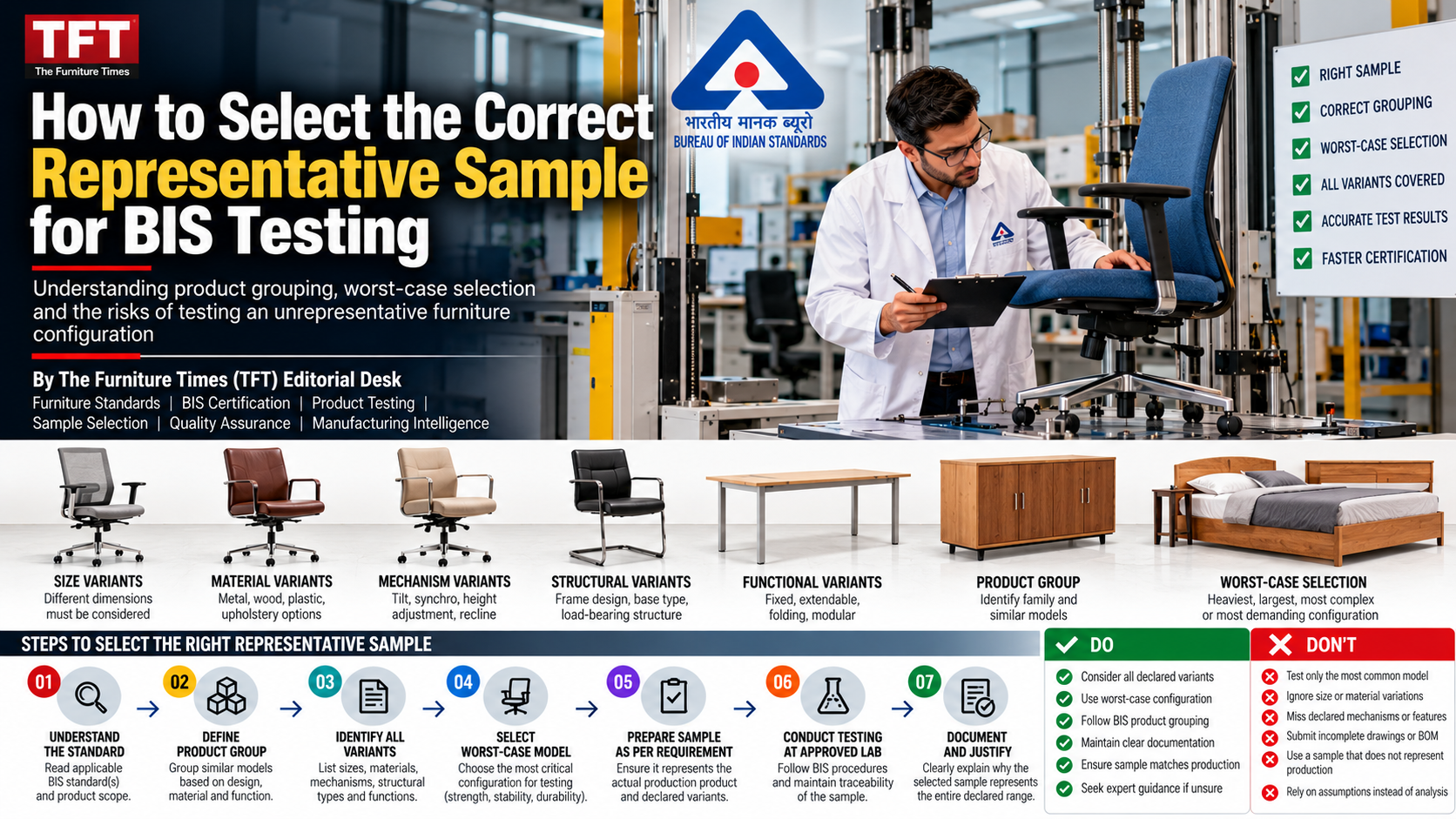
How to Select the Correct Representative Sample for BIS Testing
Understanding product grouping, worst-case selection and the risks of testing an unrepresentative furniture configuration
By The Furniture Times (TFT) Editorial Desk | Furniture Standards | BIS Certification | Product Testing | Sample Selection | Quality Assurance | Manufacturing Intelligence
Selecting a furniture sample for Bureau of Indian Standards testing is not simply a matter of sending whichever product is available in the factory or showroom.
The sample must appropriately represent the model, variants and configurations that the manufacturer proposes to include within the certification scope. If the selected sample does not reflect the most demanding or compliance-critical configuration, a satisfactory laboratory report may still fail to support the complete product range.
This is where many furniture certification applications encounter difficulties.
A manufacturer may produce one chair design in five sizes, three frame materials, two upholstery systems and several functional configurations. The commercial team may consider these products part of one collection. From a certification perspective, however, they may not all have the same strength, stability, durability, safety characteristics or failure risks.
The correct representative sample should therefore be selected only after examining:
- Product category
- Applicable Indian Standard
- Intended use
- Size range
- Structural design
- Load-bearing arrangement
- Material specifications
- Jointing method
- Number of users
- Moving mechanisms
- Adjustability
- Stability characteristics
- Rated load
- Manufacturing process
- Environmental exposure
- Model-specific safety features
The core principle is:
The test sample must represent the products for which certification is being claimed—not merely the easiest product to submit.
Manufacturers should never assume that passing one configuration automatically provides evidence for every product carrying a similar name, appearance or catalogue code.
What is a representative sample?
A representative sample is a product configuration selected for evaluation because its materials, dimensions, construction, function and performance characteristics appropriately represent one or more declared models.
In a simple application involving one product with no variants, sample selection may be straightforward.
For example, a manufacturer may produce only one fixed wooden dining chair with:
- One size
- One frame construction
- One jointing system
- One seat material
- One intended use
- One manufacturing process
The submitted chair may directly represent the production model.
The situation becomes more complex when the range includes:
- Dining chairs and armchairs
- Fixed and folding versions
- Steel and aluminium frames
- Solid-wood and plywood seats
- Upholstered and non-upholstered versions
- Different frame thicknesses
- Different backrest heights
- Domestic and commercial versions
- Chairs with and without castors
- Chairs with gas lifts or reclining mechanisms
In such a range, one product may not adequately represent all variants.
The manufacturer may need:
- One worst-case sample
- Several boundary samples
- Separate samples for different structural families
- Additional component or material tests
- Separate certification treatment for fundamentally different products
Representative selection is therefore a technical determination, not merely an administrative decision.
Product grouping must come before sample selection
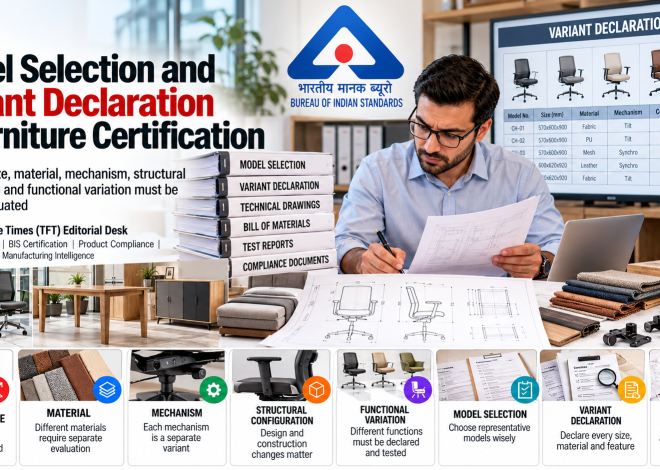
Before choosing a test sample, the manufacturer should identify which models can reasonably be grouped.
Product grouping means organising models into technically coherent families based on common characteristics.
A valid furniture group may share:
- The same product category
- The same applicable standard
- The same intended use
- The same principal construction
- The same load-bearing materials
- The same jointing system
- The same manufacturing process
- The same performance rating
- The same critical components
- The same factory and quality controls
Products should not be grouped merely because they:
- Share a brand name
- Belong to the same catalogue collection
- Have a similar appearance
- Use the same colour palette
- Are sold at the same price level
- Have related marketing names
- Are manufactured in the same building
Commercial similarity is not the same as technical equivalence.
A fixed dining chair, folding chair, swivel chair and height-adjustable office chair may all be called chairs, but they involve very different structures, mechanisms and failure modes.
A practical product-grouping hierarchy
Manufacturers can begin by dividing their range through several levels.
Level 1: Product category
Separate products according to their fundamental type, such as:
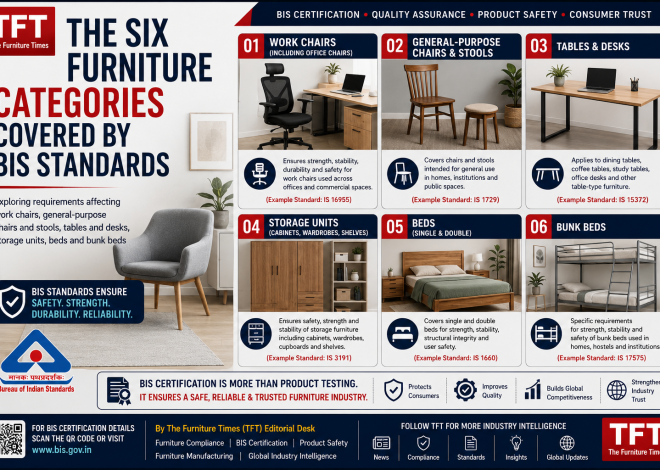
- Work chairs
- General-purpose chairs and stools
- Tables and desks
- Storage furniture
- Beds
- Bunk beds
A bed cannot represent a table, and a general-purpose dining chair should not automatically represent an adjustable work chair.
Level 2: Intended use
Within the product category, separate products intended for different environments:
- Domestic
- Office
- Educational
- Hospitality
- Institutional
- Healthcare
- Public-area
- Outdoor
- Children’s use
Different intended uses may involve different loading patterns, safety expectations and performance classifications.
Level 3: Structural configuration
Separate models with fundamentally different load paths or construction:
- Four-legged chair
- Sled-base chair
- Cantilever chair
- Pedestal chair
- Five-star castor-base chair
- Folding chair
- Wall-mounted seat
Even when the seat and backrest are identical, the supporting structure may behave differently during testing.
Level 4: Materials
Identify changes in critical materials:
- Solid wood
- Engineered wood
- Steel
- Aluminium
- Plastic
- Composite
- Upholstered frame
- Mixed-material construction
Material grade, density, section size, thickness and method of connection must also be considered.
Level 5: Dimensions and capacity
Record:
- Minimum and maximum dimensions
- Seat or sleeping capacity
- Unsupported spans
- Product height
- Base footprint
- Number of storage units
- Number of shelves
- Rated load
- Number of users
Level 6: Mechanisms and functions
Separate or specifically evaluate products with:
- Folding mechanisms
- Reclining systems
- Extension systems
- Gas lifts
- Swivel bases
- Height adjustment
- Powered adjustment
- Drawer slides
- Locking systems
- Castors
- Convertible sleeping systems
Once the range has been divided into technically meaningful groups, representative-sample selection becomes much clearer.
What does “worst-case sample” mean?
A worst-case sample is the configuration expected to experience the most demanding condition for a particular requirement.
It does not necessarily mean:
- The largest model
- The heaviest model
- The most expensive model
- The model with the highest sales volume
- The most complicated-looking model
The worst case depends on the test and the potential failure mode.
A model that is worst for strength may not be worst for stability. A model that is worst for durability may not be worst for entrapment or mechanism safety.
For this reason, a furniture family may have more than one worst-case configuration.
Different tests can produce different worst cases
| Performance consideration | Configuration that may be most demanding |
|---|---|
| Vertical strength | Product with the largest supported area or highest declared load |
| Horizontal strength | Tallest product or model with the greatest leverage |
| Bending and deflection | Longest unsupported span |
| Overturning stability | Tallest, shallowest or narrowest configuration |
| Chair rearward stability | Model with the shortest rear support projection or highest back |
| Seating durability | Model with weaker joints, thinner members or higher rated capacity |
| Drawer stability | Cabinet with the largest or heaviest extendable drawers |
| Shelf strength | Widest shelf or greatest unsupported span |
| Table stability | Narrowest base relative to top dimensions |
| Folding safety | Variant with folding joints and locking devices |
| Extension durability | Model with the longest or most complex extension system |
| Castor performance | Heaviest mobile configuration |
| Joint strength | Variant with smallest joint area or most highly stressed connection |
| Bunk-bed safety | Configuration with the greatest fall, access or entrapment exposure |
| Outdoor durability | Variant exposed to moisture, heat, ultraviolet radiation or corrosion |
| Mechanism endurance | Product containing the highest number of moving interfaces |
This matrix is illustrative. The applicable Indian Standard, product manual, certification requirements and laboratory instructions determine the actual evaluation.
Manufacturers should consult the current editions of relevant standards and official BIS certification information before finalising a testing programme. BIS maintains its standards and conformity-assessment resources through its official platforms. Bureau of Indian Standards
Why the largest product is not always the correct sample
One of the most common assumptions is that testing the largest product covers all smaller products.
Sometimes the largest model is more demanding. Sometimes it is not.
Consider a family of storage cabinets:
| Model | Height | Width | Depth | Possible concern |
|---|---|---|---|---|
| SC-120 | 1,200 mm | 900 mm | 500 mm | Lower stability risk |
| SC-180 | 1,800 mm | 900 mm | 450 mm | Taller centre of gravity |
| SC-200N | 2,000 mm | 600 mm | 350 mm | Tall, narrow and shallow |
| SC-180D | 1,800 mm | 1,000 mm | 500 mm | Heavy drawers extending forward |
The largest cabinet by volume may not be the least stable. The tall, narrow and shallow configuration could present the most severe overturning condition.
The drawer model may create another worst case when several loaded drawers are opened.
A proper sampling plan could therefore require:
- One configuration for strength
- One configuration for overturning stability
- One configuration for drawer-related performance
Selecting only the largest cabinet could leave important risks unevaluated.
Representative-sample selection for chairs and stools
Chair ranges can contain substantial hidden variation.
The manufacturer should compare:
- Seat height
- Seat width and depth
- Backrest height
- Armrest construction
- Leg spacing
- Frame material
- Member thickness
- Joint type
- Number of legs
- Base geometry
- Upholstery
- Swivel function
- Tilting or reclining function
- Castors
- Gas lift
- Folding mechanism
- Rated user mass
- Domestic or non-domestic use
Potential worst cases
The widest seat may create more stress in the seat panel or rails.
The tallest backrest may create greater leverage at back-post joints.
The narrowest leg arrangement may be critical for stability.
The thinnest frame members may be critical for strength.
A folding chair may introduce locking and entrapment risks absent from the fixed version.
A swivel chair with castors has a fundamentally different base and mobility system from a four-legged chair.
One basic chair should not be expected to represent all these configurations merely because the seat shape is similar.
Representative-sample selection for tables and desks
Important variables include:
- Length
- Width
- Height
- Top material
- Top thickness
- Unsupported span
- Number and location of legs
- Frame and apron dimensions
- Pedestal design
- Extension mechanism
- Folding structure
- Height-adjustment mechanism
- Drawer or storage unit
- Rated load
- Number of users
- Indoor or outdoor use
Potential worst cases
The longest table may be critical for top deflection.
The widest top may create greater loads on frame joints.
A narrow pedestal-base table may be critical for overturning.
An extendable table may be critical for joint and mechanism durability.
A height-adjustable desk may require evaluation at more than one height because its stability and rigidity can change as it rises.
A table family might therefore require more than one sample or testing in multiple configurations.
Representative-sample selection for storage furniture
Storage products can present significant stability risks, especially when doors, drawers or loaded elements move away from the main structure.
Consider:
- Overall height
- Width and depth
- Base construction
- Number of shelves
- Shelf span
- Drawer dimensions
- Drawer mass
- Door type and mass
- Extension distance
- Wall-anchoring system
- Mobile or stationary base
- Castors
- Expected stored load
- Modular stacking
- Glass components
Potential worst cases
The tallest and shallowest cabinet may be critical for stability.
The widest shelf may be critical for deflection.
The cabinet with the largest drawers may be critical when loaded drawers are opened.
The mobile unit may require separate evaluation because castors affect stability, movement and load distribution.
A wall-mounted cabinet should not automatically be grouped with a floor-standing version.
Representative-sample selection for beds and bunk beds
Bed sampling should consider:
- Single, double or larger sleeping size
- Frame span
- Centre supports
- Side-rail construction
- Slat spacing
- Slat dimensions
- Jointing system
- Headboard and footboard
- Storage mechanism
- Folding or lifting mechanism
- Rated user load
- Bed height
- Guarding
- Ladder arrangement
- Number of sleeping levels
A single bed may not represent a double bed if the larger model has greater unsupported spans or different centre supports.
A storage bed with a lifting mechanism introduces hazards and structural demands not present in a fixed bed.
A bunk bed involves upper-level guarding, access, openings, entrapment considerations and elevated fall risks. It should not be treated simply as two ordinary beds placed together.
Size-range sampling and boundary models
When a product is manufactured across a dimensional range, engineers should consider testing at the boundaries.
A boundary-model strategy may examine:
- Minimum width
- Maximum width
- Minimum height
- Maximum height
- Minimum depth
- Maximum depth
- Lowest rated load
- Highest rated load
- Narrowest base
- Longest unsupported span
The purpose is to identify whether a single model represents the complete envelope.
For example, a range of tables may have:
- A short model with a narrow base
- A long model with a large unsupported span
- A tall model with higher overturning leverage
No single table may represent all three risk conditions.
Boundary testing can therefore be more defensible than selecting a middle-sized model.
A middle model is often the least informative configuration because it may not represent either extreme.
Material variation and sample selection
Products that appear dimensionally identical may perform differently because of material changes.
Wood and engineered board
Review:
- Wood species
- Density
- Grade
- Moisture condition
- Board type
- Board thickness
- Lamination
- Veneer construction
- Screw-holding capability
- Adhesive
- Edge construction
A chair made from a dense hardwood may not represent one made from a lower-density timber if the member sizes and joints remain unchanged.
A thick tabletop should not automatically represent a thinner variant.
Particleboard, fibreboard, plywood and solid wood are not interchangeable simply because the nominal dimensions match.
Metal
Review:
- Metal grade
- Profile shape
- Tube dimensions
- Wall thickness
- Welding arrangement
- Heat treatment
- Fastener grade
- Corrosion protection
A sample manufactured with thicker tubes or additional welds may be stronger than normal production and therefore unrepresentative.
Plastic
Review:
- Polymer type
- Material grade
- Reinforcement
- Recycled-content level
- Wall thickness
- Moulding parameters
- Rib structure
- UV stabilisation
- Impact resistance
A specially prepared virgin-material sample may not represent regular production containing a different recycled-material proportion.
Upholstery
Review:
- Foam type and density
- Cushion dimensions
- Fabric or covering
- Webbing
- Springs
- Seams
- Adhesives
- Backing materials
Where upholstery affects the applicable performance or safety requirements, differences should be incorporated into the grouping decision.
Mechanisms often require separate representation
A fixed configuration will usually not represent an adjustable or moving configuration.
Mechanisms create their own potential failures, including:
- Locking failure
- Fatigue
- Unexpected movement
- Pinching
- Shearing
- Entrapment
- Component detachment
- Instability in an extended position
- Power-system failure
- Loss of adjustment
- Excessive play after repeated use
Mechanism-dependent variants may include:
- Reclining chairs
- Folding chairs
- Sofa beds
- Extendable tables
- Height-adjustable desks
- Lift-up storage beds
- Swivel chairs
- Tilting work chairs
- Mobile cabinets
- Drop-leaf tables
Testing the fixed version may say little about the safety and durability of the moving version.
The test sample must match normal production
A representative sample must represent not only the declared design but also routine factory production.
Manufacturers should not submit a “golden sample” that has been specially strengthened, carefully hand-finished or produced using components better than those used in ordinary manufacturing.
Potentially misleading sample preparation includes:
- Adding hidden reinforcement
- Using thicker material
- Increasing the number of screws
- Using a stronger adhesive
- Selecting unusually defect-free timber
- Installing higher-grade hardware
- Adding extra welds
- Using a specially calibrated mechanism
- Tightening joints beyond normal assembly controls
- Replacing standard components with premium ones
- Producing the sample outside the normal production line
A laboratory may report that the submitted sample passed. But the result relates to the tested sample—not automatically to weaker production units.
Certification credibility depends on consistency between:
- Approved design
- Test sample
- Technical documentation
- Factory process
- Routine production
- Market product
Risks of testing an unrepresentative configuration
1. Incomplete scope coverage
The laboratory report may support only the tested model, leaving other catalogue variants without adequate evidence.
2. Application queries
BIS or the reviewing authority may request additional explanations, drawings, samples or reports.
3. Additional testing
If the wrong sample has been tested, another model may need to be manufactured, sealed, transported and tested.
4. Certification delay
The application may stop progressing while model-family questions are resolved.
5. Increased cost
The manufacturer may incur repeated laboratory, consulting, logistics and production expenses.
6. Unsupported marking
Products outside the approved or evaluated scope could incorrectly carry the Standard Mark or certification claim.
7. Factory-inspection nonconformity
Inspectors may find that certified production differs from the tested configuration.
8. Market-surveillance failure
A market sample may contain weaker materials, different mechanisms or an undeclared structure.
9. Safety exposure
An untested variant could fail in use even though another member of the product family passed.
10. Reputational damage
Buyers may lose confidence if certification claims do not match actual product configurations.
Common sample-selection mistakes
Sending the model that is immediately available
Availability does not establish representativeness.
Testing the best-built model
A stronger premium model may not represent lower-cost variants.
Selecting the smallest product to reduce logistics costs
The smallest product may avoid the structural demands of longer or wider versions.
Selecting a mid-range configuration
A middle-sized model may represent neither dimensional boundary.
Ignoring the weakest material
The sample may use the strongest material in a multi-material range.
Omitting moving mechanisms
Manufacturers may test a fixed product and later add folding, reclining or extension variants.
Treating all base designs as equivalent
Four-leg, sled, cantilever, pedestal and castor bases distribute loads differently.
Mixing domestic and commercial use
A domestic model may not represent products promoted for schools, offices, restaurants, hotels or public spaces.
Using prototype construction
The tested prototype may not match the final production drawing, tooling or BOM.
Failing to record the sample configuration
Without model numbers, photographs, dimensions and component traceability, it may be difficult to prove what was actually tested.
A representative-sample selection matrix
Manufacturers should prepare a comparison matrix before approaching the laboratory.
| Model | Dimensions | Structural material | Base/frame | Mechanism | Intended use | Rated load | Critical risk | Proposed decision |
|---|---|---|---|---|---|---|---|---|
| CH-100 | Standard | Hardwood | Four-leg | Fixed | Domestic | 110 kg | Basic configuration | Group reference |
| CH-110 | Wide seat | Hardwood | Four-leg | Fixed | Domestic | 110 kg | Increased seat span | Consider as strength worst case |
| CH-120 | Standard | Hardwood | Folding frame | Folding lock | Domestic | 110 kg | Mechanism and entrapment | Separate test/evaluation |
| CH-130 | Standard | Steel tube | Sled base | Fixed | Commercial | 130 kg | Different structure and use | Separate family |
| CH-140 | Standard | Plastic shell | Five-star base | Gas lift/swivel | Office | 120 kg | Stability and mechanism | Separate product group |
This matrix allows manufacturers, laboratories and technical reviewers to see why a model has been included, grouped or separated.
Recommended sample-selection process
Step 1: Identify the applicable standard
Confirm the standard that applies to the product category and intended use.
Use the current standard edition, applicable amendments, BIS product manual where available and relevant certification instructions.
Step 2: Prepare the complete model list
Include every model intended to carry the certification claim.
Do not limit the list to products currently in production if additional variants are intended for immediate launch.
Step 3: Create a variant matrix
Compare:
- Sizes
- Materials
- Member thicknesses
- Joints
- Supports
- mechanisms
- Functions
- Rated loads
- Intended environments
Step 4: Divide models into technical families
Separate products with different standards, functions, structural arrangements or critical materials.
Step 5: Identify failure modes
Ask how each variant could fail:
- Fracture
- Excessive deflection
- Joint loosening
- Instability
- Mechanism failure
- Entrapment
- Detachment
- Fatigue
- Surface or material deterioration
Step 6: Select worst cases by requirement
Do not rely on one universal worst-case label. Identify the most demanding model for each relevant characteristic.
Step 7: Determine whether one or several samples are required
If different models govern different risks, multiple samples or supplementary testing may be necessary.
Step 8: Obtain technical confirmation
Before manufacturing or dispatching samples, confirm the proposed grouping and selection approach with the responsible BIS office, certification authority or recognised laboratory, as applicable.
Step 9: Manufacture through the normal process
The sample should be produced using:
- Approved drawings
- Normal materials
- Normal machinery
- Normal operators
- Normal assembly controls
- Normal quality inspections
Step 10: Record and preserve sample identity
Retain:
- Model number
- Serial or batch number
- Manufacturing date
- Drawing revision
- BOM revision
- Material records
- Production record
- Inspection results
- Photographs
- Sample-sealing information
- Dispatch documents
- Laboratory identification
Questions manufacturers should ask before testing
Before approving the sample, the technical team should answer:
- Does this model belong to the correct product category?
- Does it match the intended certification scope?
- Is it produced at the declared factory?
- Does it represent normal production?
- Is it built to the current controlled drawing?
- Does its BOM match the application?
- Does it contain the weakest approved material?
- Does it contain the longest unsupported span?
- Does it have the least favourable base geometry?
- Is it the tallest or shallowest stability-critical version?
- Does it include the most demanding mechanism?
- Does it represent the highest declared user or storage load?
- Are other configurations worse for different tests?
- Will multiple samples be necessary?
- Can every claimed variant be traced back to the tested evidence?
- Has the grouping rationale been documented?
- Has the proposed selection been confirmed with the appropriate authority or laboratory?
If these questions cannot be answered, the sample should not yet be dispatched.
The role of drawings, BOMs and photographs
Representative-sample selection cannot be proven through a model name alone.
The sample should be connected to a controlled technical package.
Drawings should show
- Overall dimensions
- Critical cross-sections
- Material specifications
- Joint locations
- Fasteners
- Reinforcement
- Mechanisms
- Support positions
- Moving parts
- Model-specific differences
- Drawing number and revision
Bills of materials should show
- Component description
- Part number
- Material and grade
- Dimensions
- Thickness
- Quantity
- Approved supplier or alternatives
- Relevant drawing reference
Photographs should show
- Complete product
- Front, rear and side views
- Base or support arrangement
- Underside construction
- Joints
- Mechanisms
- Labels
- Model identification
- Critical internal details where visible
This package enables reviewers to determine whether the tested sample actually corresponds to the declared model family.
Sample selection should be controlled across departments
The product chosen for testing should not be selected by one department working alone.
Design and engineering
Identify critical dimensions, materials, load paths and potential failure modes.
Quality assurance
Confirm that the sample represents controlled production and that inspection records are complete.
Production
Manufacture the sample using standard processes rather than special prototype practices.
Procurement
Confirm that the components and materials match the approved specifications.
Compliance team
Check the certification scope, model list, applicable standards and documentation.
Laboratory coordinator
Ensure that sample identity and requested tests are correctly communicated.
Sales and marketing
Confirm that commercial claims, model codes and intended uses match the certification application.
Cross-functional review prevents a common failure: the laboratory tests one product while sales, production and certification records describe different products.
Representative sampling does not mean minimum testing at any cost
Manufacturers naturally want to avoid unnecessary duplicate testing. Proper grouping can reduce cost when products are genuinely equivalent.
However, the purpose of representative sampling is not to find the smallest possible testing programme regardless of risk.
The objective is to obtain sufficient evidence for the proposed certification scope.
An overextended grouping strategy can ultimately cost more through:
- Rejected justifications
- Additional sample preparation
- Repeat laboratory charges
- Application delays
- Factory-inspection findings
- Redesign
- Certification-scope restrictions
- Withdrawal of unsupported models
Testing two well-selected boundary configurations may be more economical than testing one convenient sample and repeating the entire process later.
A practical worst-case justification template
Manufacturers can document each selection using a short technical statement:
Product family:
Fixed four-leg wooden dining chairs
Models included:
CH-100, CH-110 and CH-120
Common characteristics:
Same intended use, timber specification, leg construction, jointing method, seat-panel material, manufacturing process and rated user load.
Declared differences:
Seat widths of 420 mm, 460 mm and 500 mm.
Selected representative model:
CH-120
Technical basis:
CH-120 has the widest seat and longest unsupported rail span while using the same member sections and joints. It is expected to impose the greatest bending demand on the seat rails.
Additional consideration:
CH-100 has the narrowest support footprint and will be separately assessed for stability if engineering review shows it to be more demanding.
Supporting documents:
Variant matrix, controlled drawings, BOMs, calculations and sample photographs.
This is far stronger than simply writing:
“CH-120 selected because it is the biggest model.”
Final warning: do not extend the result beyond the evidence
A laboratory report confirms the results obtained for the sample described in that report under the stated test conditions.
It should not automatically be interpreted as approval for:
- Every catalogue product
- Every material option
- Every size
- Every mechanism
- Every factory
- Every rated load
- Every intended environment
- Every future design revision
The manufacturer must establish a defensible connection between the tested sample and every model included in the proposed certification scope.
Where that connection cannot be demonstrated, the variant may require:
- Additional technical justification
- Supplementary testing
- A separate sample
- A separate model family
- Revised certification treatment
The TFT conclusion
Correct sample selection is one of the most important decisions in furniture BIS certification.
The right sample provides reliable evidence for a clearly defined product family. The wrong sample can create a misleading pass result, leave important variants unsupported and delay the entire certification process.
Manufacturers should remember:
- Group products according to technical equivalence—not marketing convenience.
- Evaluate dimensions, materials, structures, mechanisms and intended use.
- Identify the worst case separately for each performance requirement.
- Do not assume that the largest model represents every risk.
- Use boundary samples when one configuration cannot represent the entire range.
- Test products manufactured through the normal production process.
- Maintain complete traceability between the sample, drawing, BOM, model code and laboratory report.
- Confirm the sampling approach before committing to laboratory testing.
- Reassess certification whenever the design, material or mechanism changes.
A representative sample should answer one question without ambiguity:
If this product passes, what other models does the evidence genuinely support—and why?
If the manufacturer cannot provide a technically sound answer, the sample is not yet representative.
Important Compliance Note
This report provides general industry guidance and should not be treated as a substitute for the applicable Indian Standard, amendments, BIS product manual, Quality Control Order, Scheme of Inspection and Testing, certification instructions or formal advice from BIS and the recognised laboratory.
Sampling and product-grouping decisions can differ according to the furniture category, construction, intended use and current regulatory requirements. Manufacturers should verify the latest official requirements before submitting an application or test sample.