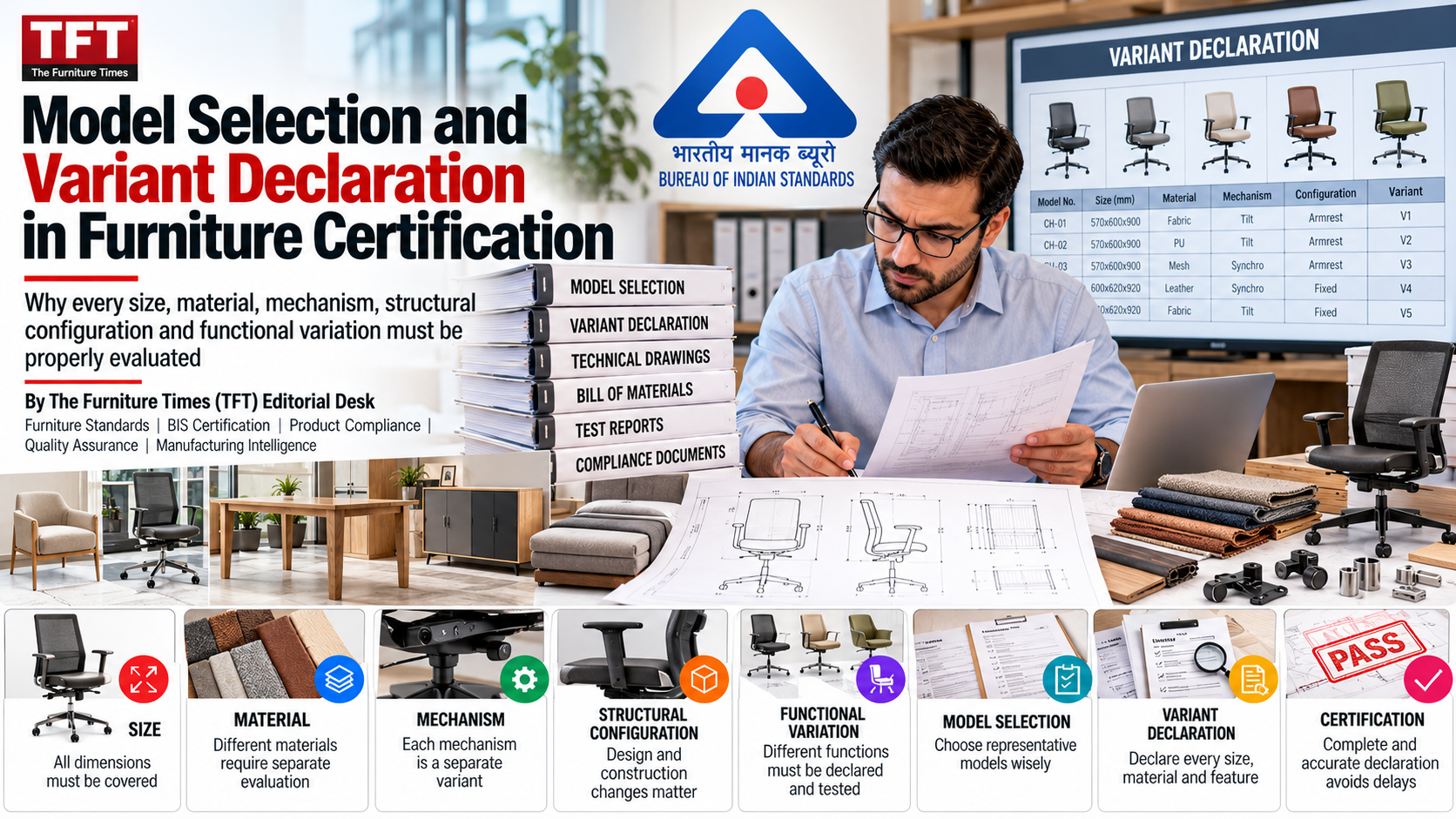
Model Selection and Variant Declaration in Furniture Certification
Why every size, material, mechanism, structural configuration and functional variation must be properly evaluated
By The Furniture Times (TFT) Editorial Desk | Furniture Standards | BIS Certification | Product Compliance | Quality Assurance | Manufacturing Intelligence
Furniture certification is not granted merely because a manufacturer submits one attractive sample, obtains a favourable laboratory report and places the same certification mark across an entire catalogue.
The product tested by the laboratory must accurately represent the models that the manufacturer intends to produce and sell under the certification scope. When a furniture family includes different sizes, materials, mechanisms, load-bearing arrangements or functional features, those variations can alter the product’s strength, stability, durability, safety and overall compliance.
This makes model selection and variant declaration one of the most technically important parts of a furniture certification application.
A weak declaration can create several problems:
- The sample may not represent the riskiest model.
- A test report may cover only one configuration.
- The factory may produce variants that were never evaluated.
- Model numbers may not match drawings or bills of materials.
- Inspectors may find undeclared components during surveillance.
- Certification scope may become ambiguous.
- Product labels and sales literature may make broader claims than the evidence supports.
- A design change may silently create a product outside the approved family.
The central principle is simple:
Certification evidence must represent the actual products placed on the market.
For furniture manufacturers preparing applications under Bureau of Indian Standards requirements—or any comparable product-certification system—model grouping cannot be treated as an administrative shortcut. It must be supported by technical reasoning.
What is a furniture model?
A model is an identifiable product configuration sold, manufactured or catalogued under a particular name, number or code.
A furniture model may be distinguished by:
- Product type
- Dimensions
- Intended use
- Number of seats
- Number of drawers or shelves
- Frame construction
- Structural material
- Panel material
- Upholstery system
- Mechanism
- Load-bearing capacity
- Folding or adjustment function
- Mounting arrangement
- Leg or base design
- Hardware system
- Surface finish
- Assembly method
- Installation environment
A change in colour alone may sometimes have little structural significance. A change from a fixed chair to a folding chair, however, introduces joints, moving components, locking systems and new failure modes.
Both products may be described commercially as “chairs,” but they should not automatically be treated as technically equivalent.
The proper question is not:
Do these products look similar?
It is:
Do these products have equivalent construction, materials, functions, risks and performance characteristics?
What is a variant?
A variant is a version of a basic model that differs in one or more declared characteristics.
For example, a table range may include:
- 900 mm, 1,200 mm and 1,800 mm lengths
- Solid-wood and engineered-wood tops
- Four-leg and pedestal bases
- Fixed and extendable versions
- Indoor and outdoor finishes
- Different edge profiles
- Different load ratings
These products may share a design language, brand name or collection name. That commercial relationship does not prove that one tested model can represent every version.
A variant may be structurally more demanding than the base model. The longest table may experience greater bending. The narrowest cabinet may have different overturning behaviour. The tallest shelving unit may create a higher stability risk. The extendable version may introduce joints and mechanisms absent from the fixed model.
Certification therefore requires a disciplined understanding of which differences are cosmetic and which can affect compliance.
Why model selection matters
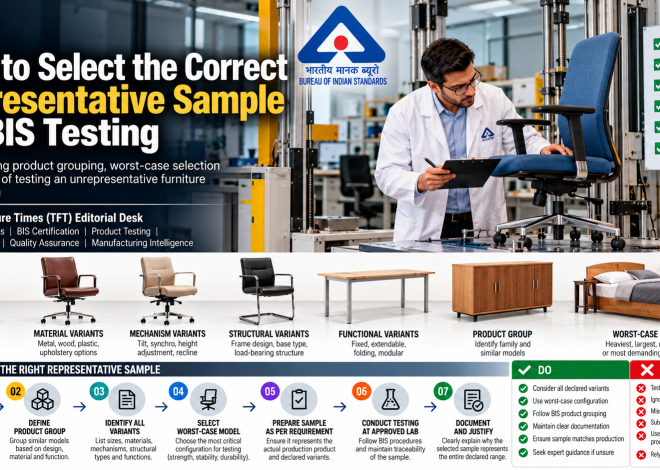
Testing every colour, catalogue number and decorative finish may be unnecessary where those differences do not affect the applicable requirements. On the other hand, testing an easy or unusually strong sample while extending the result to weaker configurations can undermine the entire certification process.
Representative model selection has three objectives:
- To identify the products included in the intended certification scope.
- To determine which variations can influence test results.
- To select samples that adequately represent the most demanding conditions.
A representative sample is not always the best-selling model, the easiest model to manufacture or the product currently available in the showroom.
It should be selected through technical evaluation.
Depending on the product and applicable standard, the representative model may be:
- The largest configuration
- The smallest configuration
- The tallest product
- The narrowest product
- The heaviest version
- The lightest version
- The model with the longest unsupported span
- The version with the greatest number of moving parts
- The model with the weakest material specification
- The version with the highest declared load
- The model with the most complex joints
- The configuration most vulnerable to instability
- A combination of boundary models rather than one single sample
In some product families, no single model represents every worst case. One version may be critical for strength, while another is critical for stability.
Size differences are not merely dimensional
Furniture manufacturers frequently assume that one tested size covers every other size in the range. That assumption can be unsafe.
Dimensions influence how loads travel through a product.
Tables and desks
Increasing the distance between supports can increase bending stress in:
- Table tops
- Aprons
- Rails
- Cross-members
- Frames
- Extension mechanisms
A 900 mm table and a 2,400 mm table may use the same material and visual design, but their structural behaviour can be substantially different.
The longer model may experience:
- Greater deflection
- Higher stress at joints
- Increased vibration
- Reduced lateral rigidity
- Greater risk of connection failure
Cabinets and storage furniture
Height, width and depth influence stability.
A tall, shallow cabinet may be more vulnerable to overturning than a short, deep cabinet. Drawer extension can shift the centre of gravity forward. Doors can create additional overturning forces when opened.
Relevant variables include:
- Overall height
- Base footprint
- Cabinet depth
- Centre of gravity
- Number and position of drawers
- Door mass
- Shelf loading
- Wall-anchoring arrangement
Chairs and stools
Seat height, backrest height, leg spacing and frame geometry affect:
- Stability
- Load distribution
- Joint stress
- User posture
- Risk of tipping
A bar stool should not automatically be grouped with a lower stool simply because both use the same seat and leg material.
Beds and bunk beds
Length, width, deck construction and number of sleepers can change:
- Bending loads
- Joint forces
- Guarding requirements
- Access risks
- Stability
- Entrapment considerations
A single bed, double bed, loft bed and bunk bed are not simply size variations. They can represent fundamentally different risk profiles.
Material substitutions can change performance
Material descriptions must be sufficiently precise to establish what was evaluated.
Terms such as “wood,” “metal,” “foam,” “fabric” and “board” are often too broad for certification documentation.
Wood and engineered wood
Performance may vary according to:
- Species
- Density
- Moisture content
- Grade
- Thickness
- Lamination
- Grain direction
- Adhesive system
- Veneer construction
- Treatment
- Defect allowance
Solid hardwood, softwood, plywood, particleboard, medium-density fibreboard and laminated board cannot automatically be treated as interchangeable.
Even two boards of the same nominal thickness may differ in:
- Internal bond strength
- Screw-holding ability
- Moisture resistance
- Density
- edge performance
- Formaldehyde classification
- Surface bonding
Metals
Metal furniture performance can be affected by:
- Alloy or steel grade
- Tube profile
- Wall thickness
- Sheet thickness
- Heat treatment
- Welding process
- Joint design
- Fastener grade
- Corrosion protection
- Coating system
A change from a 1.5 mm tube wall to 1.0 mm may not be visually apparent, but it can materially alter strength and fatigue resistance.
Plastics and polymers
Plastic components can differ according to:
- Polymer type
- Reinforcement
- Recycled content
- Wall thickness
- Moulding process
- UV resistance
- Temperature performance
- Colour additives
- Impact modifiers
A material substitution should not be accepted merely because the replacement component fits the same mould or performs the same apparent function.
Upholstery materials
Changes to foam, fabric, leather, webbing, springs or cushioning systems may affect:
- Seat durability
- Compression performance
- Flammability characteristics
- Seam strength
- Hygiene
- Chemical compliance
- User comfort
- Product dimensions
An upholstered chair with one covering material may not represent all coverings if the applicable requirements include material-specific safety or performance characteristics.
Mechanisms introduce distinct failure modes
Moving furniture requires particular attention because each mechanism adds components, interfaces and potential hazards.
Mechanised or adjustable furniture may include:
- Reclining systems
- Height-adjustment systems
- Tilting mechanisms
- Folding joints
- Extension slides
- Swivel bases
- Locking devices
- Gas lifts
- Spring systems
- Powered actuators
- Bed-conversion mechanisms
- Drawer runners
- Door hinges
- Castors and braking systems
A fixed sofa and a reclining sofa may share the same upholstery and frame style, but the reclining version introduces:
- Moving pinch points
- Linkages
- locking behaviour
- Cyclic durability demands
- Mechanism attachment loads
- Possible entrapment zones
- Additional maintenance requirements
Likewise, a fixed-height desk and an electrically adjustable desk should not be treated as equivalent variants merely because they have an identical worktop.
Powered furniture may require evaluation of both furniture performance and applicable electrical or mechanical safety considerations.
Structural configuration is more important than appearance
Two products can appear almost identical while using different internal structures.
A chair may use:
- Mortise-and-tenon joints
- Dowels
- Screws
- Welded connections
- Bolted brackets
- Moulded one-piece construction
- Knock-down connectors
- Adhesive bonding
Each system has different performance characteristics.
Similarly, changing from four legs to a sled base, cantilever base, pedestal or castor base can affect the way forces are transferred through the product.
Structural configuration includes:
- Number and location of supports
- Cross-bracing
- Frame geometry
- Load paths
- Joint type
- Fastener type and quantity
- Reinforcement plates
- Rail dimensions
- Anchorage
- Connection to walls or floors
- Modular connection systems
- Knock-down assembly details
If a structural element differs, the manufacturer should assess whether the new configuration remains within the tested family.
A shared external silhouette is not enough.
Functional variation must be declared
The function claimed for a product determines how it is expected to be used.
A bench intended for occasional hallway seating may face different demands from a bench marketed for public waiting areas. A desk intended for home use may not be technically equivalent to one sold for continuous commercial use.
Functional declarations may include:
- Domestic use
- Office use
- School use
- Institutional use
- Hospitality use
- Outdoor use
- Healthcare use
- Public-area use
- Children’s use
- Storage of specific loads
- Sleeping use
- Standing work
- Folding and portable use
- Height-adjustable use
Misclassification can result in an unsuitable standard, incorrect test severity or unsupported marketing claim.
Manufacturers must align:
- Intended use
- Product literature
- Test programme
- Model declaration
- Certification scope
- Marking and instructions
If the laboratory report describes a product as domestic furniture while the catalogue promotes it for restaurants, schools or airports, the evidence may not support the marketed application.
The “worst-case model” must be technically justified
The expression “worst case” is frequently used in certification, but it can be misleading when applied without explanation.
A worst case is the variant expected to face the most demanding condition for a particular requirement.
There may be several worst cases within one family.
| Compliance consideration | Potentially critical variant |
|---|---|
| Horizontal strength | Widest product or longest unsupported span |
| Vertical loading | Largest load-bearing surface |
| Overturning stability | Tallest, shallowest or narrowest configuration |
| Drawer stability | Model with the greatest number or mass of extendable units |
| Joint durability | Variant with the smallest joint section or most complex connection |
| Folding safety | Product with a locking or folding mechanism |
| Corrosion resistance | Outdoor or high-moisture version |
| User capacity | Multi-seat or highest-load model |
| Backrest performance | Highest or most flexible backrest |
| Castor performance | Mobile variant with the greatest rated load |
Selecting only the physically largest model may overlook the fact that a smaller variant has a narrower support base and is less stable.
The technical file should therefore explain why a selected model represents other declared variants.
A useful justification should identify:
- The variable being considered
- The expected effect on performance
- The model selected for testing
- The models represented
- The engineering basis for grouping
- Any supplementary tests required
- Any variants excluded from the group
Model families require clear boundaries
A manufacturer may seek to group similar products into a family to avoid unnecessary duplicate testing. That can be reasonable when supported by evidence.
A technically coherent model family commonly shares:
- Product category
- Intended use
- Applicable standard
- Basic construction
- Structural materials
- Jointing principles
- Critical dimensions or defined dimensional limits
- Manufacturing process
- Factory location
- Quality controls
- Performance rating
- Safety features
Grouping becomes questionable when the family combines products with substantially different:
- Functions
- Load paths
- Mechanisms
- Materials
- user populations
- Mounting methods
- Environments
- Risk profiles
A certification family should not become a commercial umbrella for everything sold under one collection name.
Model numbers must carry meaning
Model identification is the bridge between the factory, laboratory, certification authority, distributor, inspector and customer.
A model code should consistently identify the evaluated product.
Problems arise when:
- The test report uses an internal factory code.
- The catalogue uses a marketing name.
- The application uses a shortened code.
- The label uses a series name.
- The invoice uses a stock-keeping unit.
- The drawing uses a revision number mistaken for a model.
- The same code is assigned to structurally different products.
A manufacturer may legitimately use several identifiers, but the relationships must be documented.
For example:
| Identifier type | Example |
|---|---|
| Certification model | CH-420 |
| Commercial name | Arc Visitor Chair |
| SKU | CH-420-BLK-FAB |
| Drawing reference | DRG-CH420-REV03 |
| Bill of materials | BOM-CH420-REV03 |
| Laboratory sample ID | LAB/26/1847 |
| Label designation | CH-420 |
The technical file should make it possible to trace all identifiers back to the same physical configuration.
Suffixes used for colour or finish should also be defined. If CH-420-BLK and CH-420-BLU differ only by colour, that should be stated. If another suffix denotes a material, base or mechanism change, it must not be dismissed as decorative.
Drawings must distinguish every critical configuration
Drawings are essential evidence because photographs cannot reveal every structural difference.
A certification drawing should normally identify, as relevant:
- Overall dimensions
- Critical cross-sections
- Material specifications
- Panel thicknesses
- Tube dimensions
- Wall thicknesses
- Joint locations
- Weld details
- Fastener types
- Reinforcement
- Mechanisms
- Moving clearances
- Mounting points
- Load-bearing components
- Model-specific differences
- Drawing number
- Revision status
- Approval date
Where several models share a common drawing, a variant table can identify which dimensions or components change.
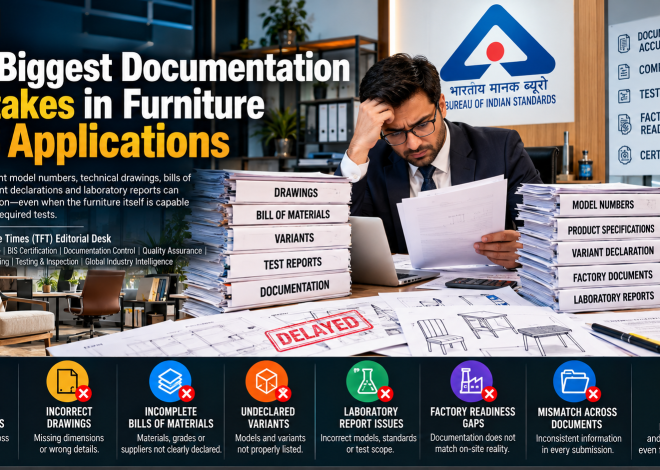
Uncontrolled drawings create serious ambiguity. If the sample was built to Revision 2 but the factory now manufactures Revision 5, the manufacturer must establish whether the change affects certification.
Bills of materials must reflect the tested product
The bill of materials, or BOM, should provide a controlled description of the components used in the evaluated product.
It may include:
- Component name
- Part number
- Material
- Grade
- Dimensions
- Thickness
- Quantity
- Supplier
- Approved alternative
- Drawing reference
- Applicable inspection requirement
A vague entry such as “metal frame—one unit” may be insufficient when tube grade, dimensions and wall thickness are performance-critical.
Alternative suppliers can sometimes be managed within a controlled quality system, but the manufacturer must demonstrate that substitute components meet the same approved specifications.
An alternative should not silently change:
- Material grade
- Geometry
- Thickness
- coating performance
- Fastener strength
- Adhesive classification
- Foam density
- Hardware capacity
- Mechanism performance
Procurement flexibility cannot come at the cost of product identity.
Laboratory reports must match the declared family
A laboratory report should be read as technical evidence, not merely as a pass certificate.
Before it is submitted, the manufacturer should confirm that it correctly records:
- Manufacturer name
- Factory address
- Product category
- Model number
- Sample identification
- Intended use
- Dimensions
- Materials
- Construction
- Applicable standard
- Test methods
- Test conditions
- Results
- Photographs
- Dates
- Laboratory authorisation
- Deviations or limitations
The report should allow a reviewer to understand exactly what was tested.
If the report covers model TB-1000, it should not automatically be used for TB-1800, TB-EXT and TB-OUT without a documented technical relationship.
A photograph showing a visually similar product is not enough to establish coverage.
Common mistakes in variant declarations
Declaring only a series name
A company may submit “Executive Chair Series” without identifying each model, base type, mechanism or upholstery construction.
A series name is a marketing category, not a technical definition.
Testing the easiest model
Manufacturers sometimes send the smallest, strongest or simplest configuration because it is readily available. That sample may not represent the more demanding variants.
Treating all dimensions as cosmetic
Changes in height, width, depth, span or support spacing can affect performance.
Describing materials generically
Entries such as “wooden chair,” “steel table” or “plastic cabinet” provide inadequate control over critical specifications.
Omitting optional mechanisms
A basic chair may be tested without armrests, castors, reclining controls or height-adjustment systems even though those features appear in the commercial range.
Adding variants after testing
Commercial teams may expand a collection after the laboratory work is complete and assume that the new models are automatically covered.
Confusing colour variants with construction variants
A suffix system may include colours, materials and mechanisms without explaining which changes are non-structural.
Using outdated drawings
The report, BOM and current production drawing may represent different revisions.
Hiding imported subassemblies
Gas lifts, runners, hinges, actuators and reclining mechanisms may be critical to performance and must be properly identified and controlled.
Declaring a load capacity unsupported by testing
Marketing claims should align with the configuration and conditions evaluated.
Variant-selection matrix for manufacturers
Before submitting samples, manufacturers can build a variant matrix.
| Model | Size | Main material | Base/frame | Mechanism | Intended use | Critical distinction | Test decision |
|---|---|---|---|---|---|---|---|
| CH-100 | Standard | Moulded plastic | Four-leg steel | Fixed | Domestic | Basic configuration | Representative test |
| CH-110 | Standard | Moulded plastic | Sled steel | Fixed | Domestic | Different load path | Separate evaluation |
| CH-120 | Standard | Moulded plastic | Five-star base | Swivel/gas lift | Office | Moving mechanism | Separate test |
| CH-130 | Wide | Moulded plastic | Four-leg steel | Fixed | Domestic | Greater seat span | Engineering review/test |
| CH-100-B | Standard | Moulded plastic | Four-leg steel | Fixed | Domestic | Colour only | May be grouped if material is equivalent |
This matrix does not itself establish certification coverage. It helps expose the variables that the certification body and laboratory may need to assess.
Design changes after certification
Certification control must continue after the licence or approval is obtained.
Furniture manufacturers regularly change products because of:
- Supplier discontinuation
- Cost reduction
- New machinery
- Component shortages
- Sustainability objectives
- Customer requests
- Quality improvements
- Packaging changes
- Design modernisation
Some changes may be minor. Others may invalidate the basis on which the product was evaluated.
A controlled change process should ask:
- What has changed?
- Which models are affected?
- Does the change alter a critical material or dimension?
- Does it affect strength, stability, durability or safety?
- Does it alter the intended use?
- Are drawings and BOMs being revised?
- Is additional testing required?
- Must the certification body be informed or approval obtained?
- When will the revised product enter production?
- How will old and new stock be distinguished?
Production should not be changed first and documented later.
The certification status of a modified product should be established before it is represented as certified.
Factory surveillance can reveal undeclared variants
Initial testing is only one part of certification. During factory inspection or market surveillance, reviewers may compare actual products against the approved technical file.
Potential nonconformities include:
- Unlisted model numbers carrying the certification mark
- Different tube thicknesses
- Alternative board materials
- Changed fasteners
- Unapproved mechanisms
- Revised dimensions
- Missing reinforcements
- New suppliers with different specifications
- Catalogue variants absent from the scope
- Certification marks on products produced at an undeclared location
An undeclared difference does not become acceptable merely because the product continues to pass internal inspection.
The issue is traceability: the certified configuration and the manufactured configuration must remain aligned.
How manufacturers should prepare a model-declaration dossier
A strong submission can include:
1. Master model list
Record every model proposed for coverage, including:
- Full model number
- Commercial name
- Product type
- Intended use
- Dimensions
- Rated load
- Key materials
- Mechanisms
- Manufacturing location
2. Model-family rationale
Explain why particular products are grouped and identify their common technical characteristics.
3. Variant comparison table
Show every difference between the models, including structural and functional variations.
4. Worst-case assessment
Identify the model or models selected for each applicable compliance consideration.
5. Controlled drawings
Submit current, approved drawings with revision numbers and dates.
6. Bills of materials
Connect each tested configuration with a controlled component list.
7. Sample traceability record
Document how the sample was selected, produced, sealed, transported and identified.
8. Laboratory-report cross-reference
Map each tested model to the variants it is intended to represent.
9. Product marking proposal
Show how each model number, licence reference and required information will appear on the product or packaging.
10. Change-control procedure
Explain how new variants and design changes will be assessed before production.
Responsibilities across the organisation
Variant control cannot be left entirely to the certification manager.
Design and engineering
They must identify critical dimensions, materials, joints and mechanisms.
Production
The factory must manufacture according to the approved specifications and revisions.
Procurement
Purchasing teams must not introduce unapproved substitutes merely because they are cheaper or readily available.
Quality control
Inspectors must verify model-specific requirements and retain traceable records.
Laboratory coordination
The submitted sample must match the application, drawing and BOM.
Sales and marketing
Commercial teams must not extend certification claims to undeclared products or uses.
Senior management
Management must ensure that certification decisions are not overridden by delivery pressure or cost-cutting.
The greatest variant-control failures often occur when departments use different product lists.
A practical pre-submission checklist
Before sending an application or test sample, ask:
- Is every commercial model listed?
- Are all suffixes and model-number rules explained?
- Are size ranges fully declared?
- Are the smallest and largest configurations evaluated?
- Are all structural materials identified?
- Are approved alternatives controlled?
- Does each mechanism appear in the declaration?
- Are fixed, folding, adjustable and powered versions separated?
- Are domestic, commercial and institutional uses correctly identified?
- Do drawings match the physical samples?
- Do BOMs match the drawings?
- Do laboratory photographs match the submitted model?
- Are multiple worst-case configurations required?
- Are rated-load claims supported?
- Are current production revisions being used?
- Can each certified unit be traced to the approved technical file?
- Is there a formal process for adding future variants?
If any answer is uncertain, the application may not yet be ready.
Certification is about controlled equivalence
Model grouping can reduce testing cost and administrative duplication, but only when the products are demonstrably equivalent for the relevant requirements.
The objective is not to test every decorative difference. Nor is it to force a technically diverse catalogue into one convenient family.
The objective is controlled equivalence.
Products can be grouped when their similarities are technically meaningful and their differences do not create unassessed risks. Where differences affect performance, supplementary evaluation or separate testing may be required.
The final determination will depend on the applicable Indian Standard, the relevant BIS product-certification scheme, the certification body’s instructions, laboratory requirements and the construction of the product concerned.
Manufacturers should therefore confirm the accepted grouping and sampling approach with BIS and the recognised laboratory before finalising samples or claiming coverage.
The larger lesson for the furniture industry
Furniture manufacturers often manage products through visual collections and commercial catalogues. Certification systems manage them through evidence, specifications and traceability.
Those two systems must connect.
A dining collection may contain chairs, benches, fixed tables and extendable tables with a common aesthetic. For certification purposes, however, each product may present a different structural and functional case.
A carefully prepared model declaration helps:
- Reduce repeated questions
- Avoid incorrect sample selection
- Prevent unnecessary retesting
- Accelerate technical review
- Protect certification scope
- Improve factory control
- Support market surveillance
- Reduce misleading claims
- Strengthen product safety
- Build buyer confidence
The cost of declaring variants correctly is small compared with the cost of delayed certification, rejected reports, withdrawn products or nonconforming market stock.
Every size matters when it changes the load path.
Every material matters when it changes performance.
Every mechanism matters when it creates a new hazard.
Every structural configuration matters when it affects strength or stability.
Every functional claim matters when it changes how the product will be used.
Furniture certification begins with one essential question:
Is the product being manufactured and sold truly represented by the product that was evaluated?
If that question cannot be answered confidently, the certification file remains incomplete.