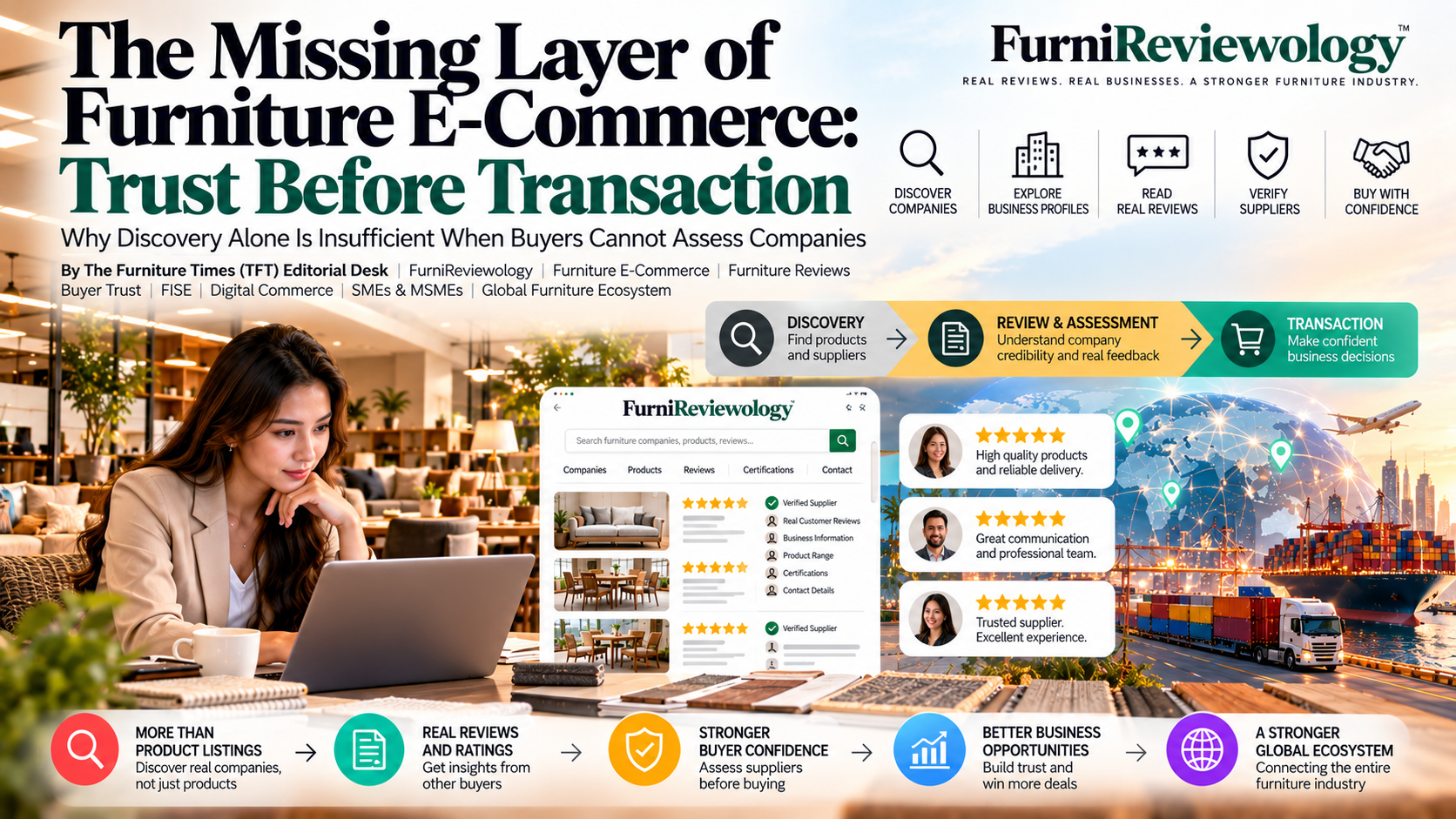
The Missing Layer of Furniture E-Commerce: Trust Before Transaction
Why Discovery Alone Is Insufficient When Buyers Cannot Assess Companies
By The Furniture Times (TFT) Editorial Desk | FurniReviewology | Furniture E-Commerce | Furniture Reviews | Buyer Trust | FISE | Digital Commerce | SMEs & MSMEs | Global Furniture Ecosystem
Furniture e-commerce has solved one enormous problem:
Discovery.
A buyer can now sit in Kuala Lumpur, London, Dubai, New York, Delhi or Sydney and discover furniture from companies located thousands of kilometers away.
A homeowner can compare hundreds of sofas without visiting a showroom.
An interior designer can research suppliers from multiple countries.
A hotel procurement team can discover manufacturers it has never previously encountered.
A retailer can identify new factories.
An importer can explore new sourcing markets.
An architect can browse products from brands that may not even have a physical presence in the local market.
Digital commerce has dramatically expanded access.
But after discovery comes a much harder question:
“Can I Trust This Company Enough to Do Business With It?”
That question represents one of the most important missing layers in furniture e-commerce.
A search result can create visibility.
A product page can create interest.
A beautiful photograph can create desire.
A competitive price can create attention.
But none of those automatically creates trust.
And without sufficient trust, discovery may never become a transaction.
Furniture Is Not an Ordinary E-Commerce Purchase
Furniture presents challenges that are very different from many small consumer products.
It can be:
expensive,
large,
heavy,
difficult to return,
customized,
made to order,
material-sensitive,
dimension-sensitive,
color-sensitive,
comfort-dependent,
installation-dependent,
and expected to last for years.
For professional buyers, the complexity increases further.
A hospitality furniture order may involve hundreds of rooms.
An office project may require large quantities of desks, chairs and storage systems.
An importer may purchase containers of furniture from a manufacturer it has never previously worked with.
A developer may require customized furniture for an entire property.
A retailer may place significant deposits months before goods arrive.
The transaction therefore involves more than:
“Do I like this product?”
It may also involve:
“Do I trust the company behind this product?”
Discovery Is Only the First Step
The furniture industry has invested heavily in discovery.
Search engines.
Marketplaces.
Social media.
Online catalogues.
E-commerce stores.
Digital advertising.
Influencer marketing.
Product feeds.
Visual search.
Trade directories.
Online exhibitions.
All of these can help buyers find products.
But what happens after a buyer finds something interesting?
A second journey begins.
The buyer may ask:
Who is selling this?
How long has the company operated?
Where is it located?
What do other customers say?
Is the product description accurate?
Does the company deliver reliably?
How does it handle complaints?
Can I find independent information about it?
Does the company have a wider industry presence?
Does the business appear active?
Can I verify enough information to feel comfortable proceeding?
That is the trust journey.
Furniture e-commerce cannot focus only on the discovery journey and ignore it.
Between the Search Result and the Checkout Button Sits Trust
Consider the digital buying funnel.
Search
A buyer discovers a furniture product.
↓
Interest
The design, specification or price looks attractive.
↓
Investigation
The buyer researches the company.
↓
Trust Assessment
The buyer looks for reviews, business information and reputation signals.
↓
Confidence
Enough uncertainty has been reduced to continue.
↓
Transaction
The buyer purchases, sends an enquiry or requests a quotation.
The critical stage is in the middle.
A furniture company can spend heavily getting buyers to the top of the funnel.
But if the trust layer is weak, those buyers may disappear before conversion.
This means reputation is not separate from e-commerce.
Reputation can be part of the conversion infrastructure.
A Beautiful Product Page Cannot Answer Every Question
Furniture brands invest significantly in product presentation.
And rightly so.
Good photography matters.
Accurate dimensions matter.
Material descriptions matter.
Specifications matter.
Videos matter.
Lifestyle images matter.
Product configurators matter.
But product information answers questions about the product.
Buyers may also have questions about the company.
A beautiful sofa photograph cannot tell a customer how the company handles damaged deliveries.
A product specification cannot explain the quality of after-sales service.
A polished website cannot independently confirm previous customer experiences.
A low price cannot explain whether delivery promises are consistently met.
That is why furniture e-commerce needs information beyond the product page.
The Company Behind the Product Is Part of the Product Experience
This is particularly important in furniture.
Customers do not experience only the physical object.
They experience the entire transaction.
They experience:
the website,
communication,
payment,
order confirmation,
production updates,
delivery,
packaging,
assembly,
installation,
customer service,
warranty support,
returns,
replacements,
and problem resolution.
A beautiful dining table delivered damaged and followed by poor customer service creates a bad experience.
A sofa arriving late without communication creates frustration.
A hotel furniture project with excellent products but poor installation coordination can still create serious problems.
Therefore, furniture reputation cannot be separated from operational performance.
The transaction experience becomes part of the product experience.
Why Reviews Matter Before the Transaction
Reviews allow previous customer experiences to become visible to future customers.
That can help buyers investigate questions such as:
Was the product as described?
Was delivery handled well?
How was communication?
Was assembly straightforward?
How did the company respond to a problem?
Did the product meet expectations?
Was the supplier professional?
Would customers buy again?
In B2B situations, reviews and references may also provide useful context around:
manufacturing consistency,
project management,
lead times,
customization,
quality,
packaging,
export communication,
and after-sales support.
Reviews do not eliminate risk.
But they can reduce information asymmetry.
The seller knows its business.
The new buyer does not.
Previous customer experiences can help narrow that knowledge gap.
Trust Signals Reduce Uncertainty
A buyer rarely develops confidence from one piece of information.
Trust is usually cumulative.
One signal reinforces another.
A complete company profile.
A functioning website.
Clear contact information.
Genuine reviews.
Consistent company details.
Industry references.
Company news.
Project information.
Professional responses to customer concerns.
Relevant certifications.
An established business history.
None of these alone guarantees reliability.
Together, they can make a company easier to assess.
This is particularly important when the buyer and seller have never met.
The Problem Becomes Bigger in Cross-Border Furniture E-Commerce
Cross-border commerce expands opportunity.
It also expands uncertainty.
Imagine purchasing furniture from a company located in another country.
The buyer may face:
different consumer laws,
different currencies,
international freight,
customs,
longer delivery periods,
language differences,
return complexity,
payment risk,
and greater difficulty resolving disputes.
For B2B furniture transactions, the financial exposure may be substantial.
This makes company research even more important.
The future of global furniture e-commerce therefore cannot be built only around showing buyers more products.
It must also help buyers understand who is behind those products.
The Trust Gap Hurts Good Companies Too
The lack of trust infrastructure does not only hurt buyers.
It hurts legitimate businesses.
Imagine two furniture manufacturers.
Manufacturer A
Has operated successfully for 25 years.
Produces excellent furniture.
Has loyal customers.
Has a capable factory.
But has very little searchable information, few reviews and limited digital visibility.
Manufacturer B
Has comparable capabilities.
But its company information is structured.
Its business profile is discoverable.
Customers have shared genuine experiences.
Its activities have received industry coverage.
Which company is easier for a new buyer to investigate?
Again, this does not automatically make Manufacturer B better.
But it may make Manufacturer B easier to trust enough to contact.
That difference can affect commercial opportunity.
FurniReviewology Can Help Build the Missing Trust Layer
This is where FurniReviewology becomes relevant.
FurniReviewology is focused on the furniture industry and the relationship between:
company listings,
business profiles,
customer reviews,
digital reputation,
and industry discovery.
Its purpose is not to tell buyers:
“Buy from this company because it has a listing.”
Nor should any review platform be treated as a substitute for due diligence.
Instead, the objective is to give buyers another source of furniture-specific information during the research process.
For companies, it creates another opportunity to establish a discoverable reputation.
A Free Listing Can Be the First Trust Building Block
Furniture companies do not need to begin with a massive digital marketing campaign.
Start with identity.
Who are you?
What do you do?
Which furniture categories do you serve?
Where do you operate?
How can buyers find you?
A free FurniReviewology listing can help establish this foundation.
For SMEs and MSMEs in particular, this is important.
Many small furniture companies have excellent products but limited marketing resources.
They may not rank highly in conventional search.
They may not receive regular media coverage.
They may not have thousands of social-media followers.
But they can still begin building a structured digital identity.
E-Commerce Should Not Become a Visibility Contest Won Only by Large Brands
Digital commerce promised to democratize access.
But there is a risk.
As e-commerce becomes more competitive, companies with the largest advertising budgets can dominate visibility.
They buy more traffic.
They run more campaigns.
They employ larger marketing teams.
They produce more content.
They accumulate more reviews simply because they have more transactions.
Where does that leave the small manufacturer?
The regional retailer?
The artisan?
The specialized component supplier?
The family-owned furniture business?
The MSME?
Industry-specific discovery can help create additional pathways.
A small business should not have to become famous before it can become discoverable.
FISE Addresses Discovery — FurniReviewology Adds Reputation
This distinction is fundamental.
FISE — Furniture Industry Search Engine focuses on furniture-industry discovery.
Its role is to help make companies, products and ecosystem participants easier to find.
But discovery creates the next question:
“Now that I found this company, what can I learn about it?”
That is where FurniReviewology adds another layer.
Think of the relationship as:
FISE = Find
FurniReviewology = Research + Reputation
And then another layer enters.
TFT Adds Context Through Industry Visibility
Suppose a buyer discovers a manufacturer.
The company has a profile.
Reviews provide customer perspectives.
Then the buyer discovers that the company:
recently expanded production,
introduced a sustainable collection,
participated in a major exhibition,
entered a new market,
completed a significant hospitality project,
or invested in manufacturing technology.
This information adds context.
The Furniture Times — TFT provides the industry news and storytelling layer.
The ecosystem therefore begins to connect:
Search → Company → Reviews → Industry Context → Enquiry
Or more simply:
FISE helps the world find them.
The Furniture Times tells their story.
FurniReviewology helps the world trust them.
The Future Furniture E-Commerce Journey Could Look Very Different
Imagine a buyer searching for a dining set.
The journey may eventually become:
Discover
The buyer finds products and companies through search or FISE.
Compare
Several suitable products are shortlisted.
Investigate
The buyer opens company profiles.
Review
Customer experiences are examined through FurniReviewology and other credible review sources.
Understand
Relevant company developments or industry stories are discovered through TFT.
Verify
The buyer checks specifications, business information and other appropriate evidence.
Decide
The buyer chooses whether to proceed.
Transact
The purchase, enquiry or RFQ takes place.
The transaction is the final step.
Trust develops before it.
Reviews Are Not a Guarantee — Due Diligence Still Matters
This principle must remain clear.
A positive review does not guarantee future performance.
A high rating does not eliminate commercial risk.
A business listing does not certify a company.
A media article is not a substitute for legal, financial or technical verification.
For substantial furniture transactions, buyers may still need:
samples,
factory audits,
business registration checks,
references,
product testing,
certification verification,
quality inspections,
contracts,
payment protections,
and appropriate professional advice.
Reviews are one input into research.
They should strengthen informed decision-making, not replace it.
Furniture Companies Should Stop Thinking About Reviews Only After the Sale
Many companies treat reviews as an afterthought.
The sale happens.
The furniture is delivered.
Then somebody from marketing asks:
“Can you give us five stars?”
That approach underestimates the strategic value of customer experience.
Reviews are not merely trophies collected after transactions.
They become information for future transactions.
Today’s customer experience can influence tomorrow’s buyer.
That makes reputation management an operational responsibility.
Production affects reviews.
Packaging affects reviews.
Delivery affects reviews.
Installation affects reviews.
Communication affects reviews.
Customer service affects reviews.
After-sales support affects reviews.
Marketing cannot manufacture a strong reputation indefinitely if operations continuously create poor experiences.
The Best Review Strategy Starts in the Factory
For manufacturers, the review journey may begin long before delivery.
It begins with:
material selection,
engineering,
quality control,
production consistency,
finishing,
inspection,
packaging,
documentation,
and communication.
For retailers, it begins with:
accurate product information,
inventory management,
sales advice,
delivery coordination,
assembly,
and customer support.
For e-commerce brands, it begins with:
accurate photography,
honest descriptions,
clear dimensions,
transparent policies,
secure payment,
delivery communication,
and responsive support.
The strongest review strategy is therefore not:
“How do we get more five-star reviews?”
It is:
“How Do We Create Experiences Worth Reviewing Positively?”
AI Commerce Will Make Trust Infrastructure Even More Important
Furniture e-commerce is entering another transformation.
AI may increasingly help consumers and professional buyers search, compare and shortlist products.
A buyer may ask:
“Find a durable outdoor dining set suitable for a coastal hotel.”
“Which manufacturers produce commercial-grade furniture in Southeast Asia?”
“Compare furniture suppliers for a 100-room hotel.”
AI systems can potentially reduce thousands of options into a much smaller recommendation set.
This makes structured digital information increasingly important.
Businesses need clear identities.
Products need understandable categories.
Company information needs consistency.
Reputation signals need to exist.
Relevant industry information needs to be discoverable.
If AI becomes part of the buying journey, furniture businesses will increasingly compete not only for human attention but also for machine understanding.
From Product Search to Company Confidence
The next generation of furniture e-commerce should therefore solve two problems.
The first:
Help me find what I want.
The second:
Help me understand who I am buying it from.
The industry has invested heavily in the first.
It now needs stronger infrastructure around the second.
That is the missing layer.
SMEs and MSMEs Should Build Trust Before Scaling E-Commerce
For smaller furniture businesses, this is especially urgent.
Do not wait until you launch international e-commerce before thinking about reputation.
Do not wait until you begin exporting.
Do not wait until you need distributors.
Do not wait until advertising starts bringing unfamiliar buyers to your website.
Build the trust layer early.
Establish your company profile.
Keep your business information accurate.
Get listed on FurniReviewology.
Encourage genuine customer reviews.
Build your FISE discoverability.
Share meaningful company developments with TFT.
Maintain your website.
Document your products and capabilities.
Let your digital reputation grow alongside your business.
A Transaction Begins Long Before Payment
Furniture businesses sometimes measure e-commerce from the moment somebody clicks:
Add to Cart.
But the real transaction journey begins earlier.
It begins when the buyer first discovers the company.
Then comes curiosity.
Research.
Comparison.
Reputation checking.
Risk assessment.
Confidence.
And finally, action.
That action might be:
Add to Cart.
Buy Now.
Request a Quote.
Send Enquiry.
Contact Supplier.
Book a Consultation.
Request Sample.
Visit Showroom.
Schedule Factory Visit.
Different furniture sectors have different conversion points.
But they share one fundamental requirement:
Buyers Need Enough Confidence to Take the Next Step.
Discovery Without Trust Creates Traffic — Not Necessarily Business
Millions of impressions do not guarantee sales.
Thousands of website visitors do not guarantee enquiries.
Hundreds of product views do not guarantee transactions.
Visibility brings people to the door.
Trust helps them decide whether to enter.
That is why furniture companies should stop separating:
search,
reviews,
company information,
media visibility,
and e-commerce.
They increasingly form one connected customer journey.
The Missing Layer Is Becoming the Competitive Layer
As furniture discovery becomes easier, differentiation becomes harder.
Thousands of businesses can publish attractive product photographs.
Thousands can build e-commerce websites.
Thousands can advertise.
Thousands can appear on marketplaces.
Thousands can compete on price.
But buyers still need to decide:
Who deserves my money?
Who deserves my enquiry?
Who deserves my project?
Who deserves further investigation?
That is where trust becomes commercially powerful.
Not manufactured trust.
Not fake reviews.
Not artificial ratings.
Earned, documented, discoverable trust.
Get Found — Then Give Buyers Reasons to Continue
The future furniture company should think beyond discovery.
Being found is the beginning.
Being understood is the next step.
Being researched comes after that.
Being trusted enough to continue creates the opportunity.
And only then comes the transaction.
So build every layer.
Get listed.
Become searchable.
Complete your company profile.
Encourage genuine customer experiences.
Respond professionally to reviews.
Share your business developments.
Maintain accurate information.
Build a reputation that reflects the company behind the product.
Because the future of furniture e-commerce will not belong simply to the businesses with the most products online.
It will increasingly belong to businesses that can connect:
Discovery → Information → Reputation → Confidence → Transaction.
And between discovery and transaction, the missing layer is clear:
Trust.
The Global Furniture Ecosystem
The Furniture Industry is a $1 Trillion USD Ecosystem in the world
Furniture Industry Search Engine – FISE helps the world find them.
The Furniture Times – TFT tells their story.
FurniReviewology helps the world trust them.