Africa’s Emerging Homestay Furniture Economy
How Lodges, Coastal Rentals, Safari Destinations and Urban Apartments Create Opportunities for Local Suppliers
By The Furniture Times (TFT) Editorial Desk | Airbnb & Homestay Furniture | Africa | Short-Term Rentals | Hospitality Furniture | Local Manufacturing | Tourism Development | Global Market Intelligence
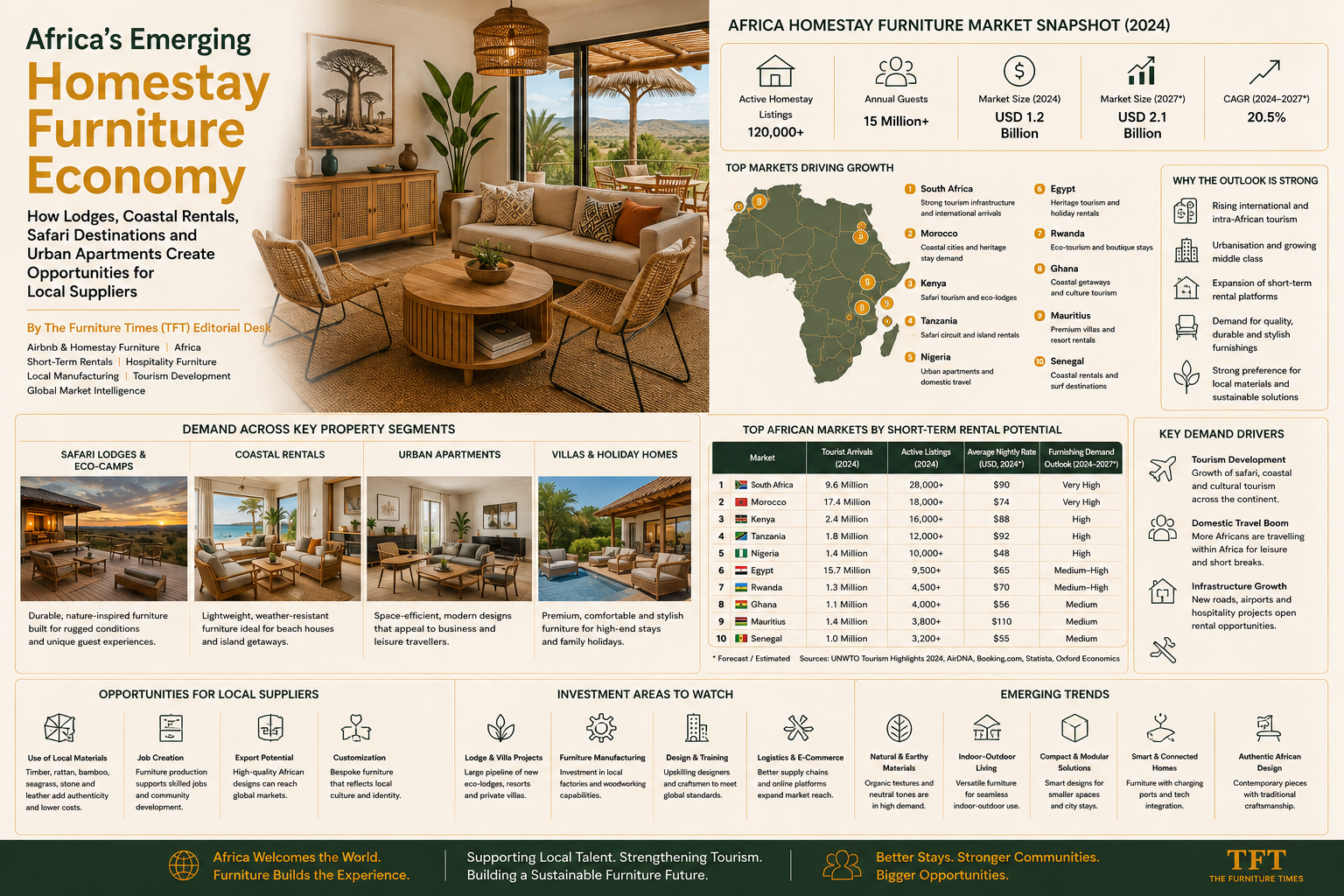
Africa’s expanding tourism and short-term-accommodation economy is creating a significant but still underrecognised market for furniture manufacturers, craftspeople, interior designers, installers, repairers and local suppliers.
Across Cape Town apartments, Marrakech riads, Kenyan safari lodges, Zanzibar villas, Egyptian coastal rentals, Accra residences, Lagos business apartments and Rwandan eco-retreats, furniture forms part of the experience travellers come to discover.
The opportunity extends far beyond supplying beds and chairs.
African accommodation properties need furniture that can communicate local identity, tolerate demanding climates, support efficient operations and remain repairable in markets where imported replacement products may be costly or slow to obtain.
This creates a powerful case for local and regional sourcing.
A locally made bed can be repaired by a nearby workshop. A regional rattan producer can supply replacement weaving. An upholsterer can renew a lodge’s seating without requiring a complete replacement. A craft cooperative can give a property a cultural identity that imported generic furniture cannot reproduce.
If developed responsibly, Africa’s homestay furniture economy could help keep more tourism expenditure within local communities while strengthening the continent’s furniture-manufacturing and creative sectors.
African Tourism Growth Is Expanding the Accommodation Base
Africa entered 2026 with continued tourism momentum.
UN Tourism reported that international arrivals across Africa increased by approximately 4% during the first quarter of 2026. North Africa and Sub-Saharan Africa both recorded growth, despite wider geopolitical and economic uncertainty. UN Tourism
During 2025, several major African destinations recorded especially strong international-arrival growth:
- Egypt increased by approximately 20%
- Morocco increased by approximately 14%
- Seychelles increased by approximately 13%
These results helped Africa remain one of the stronger-performing global tourism regions. UN Tourism
International hospitality companies are responding to the opportunity. In 2025, Hilton announced plans to more than triple its African presence to more than 160 hotels, while Marriott said it aimed to add 50 properties by 2027. Reuters
Although hotel growth is not the same as homestay growth, it strengthens the wider furniture ecosystem by supporting:
- Hospitality-furniture manufacturing
- Mattress production
- Upholstery
- Interior-design expertise
- Installation
- Logistics
- Procurement
- Maintenance
- Refurbishment
- Workforce training
These capabilities can also serve independent lodges, guesthouses, vacation rentals and professionally managed apartments.
Africa Is Not One Furniture Market
The continent contains more than 50 countries, enormous climatic variation and very different levels of tourism infrastructure.
Africa’s short-term-accommodation furniture opportunity can be divided into several major environments:
| Accommodation Market | Typical Destinations | Primary Furniture Requirement |
|---|---|---|
| Urban apartments | Cape Town, Johannesburg, Nairobi, Lagos, Accra, Cairo, Casablanca, Kigali | Compact, durable and work-friendly furniture |
| Coastal rentals | Morocco, Egypt, Kenya, Tanzania, Mozambique, South Africa, Ghana, Senegal | Moisture-resistant and outdoor furniture |
| Safari destinations | Kenya, Tanzania, South Africa, Botswana, Namibia, Zambia, Zimbabwe, Rwanda, Uganda | Durable lodge furniture and local craft integration |
| Heritage accommodation | Morocco, Egypt, Ethiopia, Tunisia, Ghana, Senegal, Zanzibar | Historically and culturally sensitive furnishing |
| Island properties | Seychelles, Mauritius, Zanzibar, Cape Verde, Madagascar | Climate-resistant premium and outdoor furniture |
| Rural homestays | Across East, West, Southern and North Africa | Locally repairable and community-produced furniture |
| Business accommodation | Nairobi, Lagos, Accra, Johannesburg, Cairo, Kigali, Casablanca | Serviced-apartment and extended-stay furniture |
| Eco-lodges | Safari, forest, coastal and mountain destinations | Sustainable, low-impact and repairable products |
Each segment requires its own materials, price positioning, operational system and design language.
South Africa: The Continent’s Most Developed Short-Term-Rental Furniture Market
South Africa has one of Africa’s largest and most professionally developed short-term-rental economies.
Its major markets include:
- Cape Town
- Johannesburg
- Durban
- Pretoria
- Stellenbosch
- Franschhoek
- Garden Route
- Western Cape coastal towns
- Kruger gateway destinations
- Drakensberg
- Safari regions
Airbnb-commissioned analysis estimated that Airbnb stays contributed approximately R14.4 billion to Cape Town’s gross domestic product and supported around 42,000 jobs during 2023. Airbnb Newsroom
Earlier research estimated that activity connected with Airbnb contributed more than R23.5 billion to South Africa’s economy in 2022 and supported almost 50,000 jobs. The figures include broader guest spending and should not be interpreted as furniture-market revenue, but they demonstrate the platform economy’s ability to generate activity across local services and supply chains. Airbnb Newsroom
Cape Town
Cape Town combines:
- Urban apartments
- Luxury villas
- Coastal homes
- Wine-region properties
- Business accommodation
- Longer-stay rentals
- Design-led boutique properties
Furniture opportunities include:
- Premium apartment packages
- Outdoor lounge furniture
- Coastal dining sets
- Workstations
- Villa bedroom packages
- Pool furniture
- Locally designed products
- Refurbishment
- Mobile repair
Safari and Nature Tourism
South African safari accommodation ranges from modest guest lodges to ultra-luxury private properties.
Furniture needs include:
- Robust bed frames
- High-quality mattresses
- Timber dining furniture
- Lounge seating
- Outdoor decks
- Luggage benches
- Writing desks
- Mosquito-net structures
- Equipment storage
- Furniture suited to remote repair
South Africa’s established manufacturing, design and upholstery sectors give it the potential to become a regional supplier for neighbouring safari and hospitality markets.
Morocco: Riads, Coastal Homes and Artisan Identity
Morocco is one of Africa’s leading tourism destinations.
UN Tourism’s investment material notes that Morocco welcomed approximately 17.4 million international visitors in 2024, about 35% more than in 2019. International arrivals continued growing strongly in 2025. UN Tourism Investment
The Moroccan accommodation market includes:
- Marrakech riads
- Casablanca apartments
- Rabat properties
- Fez heritage homes
- Essaouira coastal rentals
- Agadir accommodation
- Atlas Mountain retreats
- Desert camps
- Rural guesthouses
Morocco’s craft traditions create a strong foundation for distinctive homestay furniture.
Local Product Opportunities
- Carved timber
- Metal lanterns
- Woven seating
- Berber textiles
- Low lounge furniture
- Handcrafted tables
- Decorative screens
- Ceramic accessories
- Upholstered benches
- Courtyard furniture
The strongest opportunity lies in adapting traditional craft for commercial accommodation.
A handcrafted product should also be:
- Structurally stable
- Easy to clean
- Repairable
- Repeatable when required
- Suitable for guest use
- Available within reliable lead times
Riads and heritage properties require furniture that respects architecture while introducing modern comfort, especially through good mattresses, lighting, charging access and practical luggage storage.
Egypt: Scale, Cultural Tourism and Coastal Rentals
Egypt’s approximately 20% growth in international arrivals during 2025 strengthens its position as one of Africa’s largest tourism markets.
Demand is distributed across:
- Cairo
- Giza
- Alexandria
- Luxor
- Aswan
- Sharm El-Sheikh
- Hurghada
- Red Sea destinations
- North Coast
- Heritage and river destinations
Urban Opportunity
Cairo and Alexandria need:
- Apartment furniture packages
- Sofa beds
- Compact dining furniture
- Workstations
- Durable mattresses
- Storage
- Longer-stay furnishing
Coastal Opportunity
Red Sea and Mediterranean properties require:
- Poolside loungers
- Outdoor dining
- Balcony furniture
- UV-resistant materials
- Corrosion-resistant frames
- Easy-clean upholstery
- Villa bedroom packages
Egypt also has a significant domestic furniture-manufacturing base capable of supporting local accommodation projects and regional exports.
The challenge is providing consistent quality across different price segments—from modest family apartments to premium coastal villas.
Kenya: Safari Tourism, Coastal Rentals and Urban Growth
Kenya combines one of Africa’s best-known safari economies with coastal tourism and a rapidly developing urban business market.
Important destinations include:
- Nairobi
- Mombasa
- Diani Beach
- Malindi
- Lamu
- Maasai Mara
- Amboseli
- Nakuru
- Mount Kenya
- Naivasha
Kenya’s official tourism-investment platform describes the country as a multi-dimensional destination with growing demand across international and domestic markets. Kenya Tourism Investment
Nairobi
Nairobi’s furnished-apartment market serves:
- Business travellers
- Development organisations
- Diplomats
- Conference guests
- Relocating professionals
- Longer-stay visitors
- Safari transit passengers
Furniture needs include:
- Ergonomic desks
- Durable sofas
- Premium mattresses
- Dining sets
- Storage
- Modular apartment packages
- Integrated charging
- Luggage furniture
Safari Lodges
Safari properties require furniture capable of operating in remote locations.
Priorities include:
- Strong timber frames
- Replaceable upholstery
- Easy-to-repair construction
- Dust-resistant surfaces
- Outdoor deck furniture
- Luggage benches
- Writing desks
- Dining furniture
- Locally inspired accents
Coastal Kenya
Mombasa, Diani, Malindi and Lamu require products suited to salt air, humidity, UV exposure and tropical rainfall.
Rattan, woven fibres, treated timber and corrosion-resistant metal can be valuable when properly specified.
Safari Development Must Respect Ecology and Communities
Safari tourism can create valuable local furniture demand, but development must be environmentally responsible.
Controversy around a luxury lodge in Kenya’s Maasai Mara during 2025 highlighted concerns about wildlife migration, environmental assessment, land use and community involvement.
This matters to the furniture industry.
A project cannot credibly present itself as sustainable because it uses natural-looking furniture while ignoring ecological or community impacts.
Responsible safari furnishing should consider:
- Verified local sourcing
- Responsible timber
- Low-impact logistics
- Repairability
- Community employment
- Artisan participation
- Waste reduction
- Cultural attribution
- Long product life
- End-of-life recovery
Sustainability must extend beyond appearance to the entire project system.
Tanzania and Zanzibar: Safari Meets Coastal Hospitality
Tanzania combines major safari destinations with Zanzibar’s coastal and cultural tourism.
Important markets include:
- Dar es Salaam
- Zanzibar
- Arusha
- Serengeti
- Ngorongoro
- Kilimanjaro
- Nyerere
- Coastal regions
Safari Furniture
- Lodge beds
- Timber seating
- Luggage benches
- Dining furniture
- Outdoor deck furniture
- Writing desks
- Mosquito-net structures
- Portable or modular products
Zanzibar Furniture
- Rattan seating
- Outdoor dining
- Daybeds
- Sun loungers
- Coastal bedroom furniture
- Carved timber
- Woven lighting
- Heritage-sensitive furniture
The island environment requires careful attention to salt, humidity and insects.
Furniture should be treated appropriately, but finishes and treatments must also be suitable for guest environments and clearly documented.
Botswana, Namibia, Zambia and Zimbabwe: Remote Lodge Opportunities
Southern Africa’s safari markets create specialised demand across lodges, camps and private nature properties.
Furniture Priorities
- Flat-pack or modular transport
- Durable beds
- Luggage racks
- Writing desks
- Deck furniture
- Strong dining chairs
- Communal tables
- Weather-resistant seating
- Products repairable by local teams
Remote properties face higher logistics costs. A broken chair or bed component cannot always be replaced quickly from a distant city.
Furniture should therefore be designed for:
- Simple maintenance
- Interchangeable parts
- Local repair
- Efficient transport
- Low packaging waste
- Long service life
Local and regional workshops can create a major competitive advantage by providing after-sales support that overseas manufacturers cannot deliver quickly.
Rwanda and Uganda: Eco-Tourism and High-Value Nature Travel
Rwanda and Uganda attract visitors for gorilla tourism, wildlife, culture, lakes and business travel.
Relevant markets include:
- Kigali
- Entebbe
- Kampala
- Lake regions
- National-park gateways
- Eco-lodges
- Community tourism
Furniture Opportunities
- Boutique lodge furniture
- Locally crafted seating
- Compact city apartments
- Durable mattresses
- Outdoor decks
- Natural-material design
- Workspaces
- Repairable products
Rwanda’s emphasis on organised, higher-value tourism may support smaller-volume but higher-quality furniture projects.
Local suppliers need product documentation, reliable delivery and the ability to coordinate complete room packages.
Ghana: Heritage, Business and Coastal Accommodation
Ghana’s short-term-accommodation market benefits from:
- Accra business travel
- Diaspora tourism
- Cultural festivals
- Coastal tourism
- Heritage sites
- Family visits
- Longer stays
Furniture demand includes:
- Urban apartment packages
- Large family dining
- Workstations
- Durable upholstery
- Bedroom storage
- Coastal outdoor furniture
- Locally inspired products
Ghana’s timber, textiles, weaving and craft traditions can help build distinctive accommodation identities.
The opportunity is especially important for small workshops that can transition from informal custom work to more standardised hospitality supply.
Nigeria: Urban Scale and Business Accommodation
Nigeria’s large population and major cities create significant potential for furnished apartments, corporate accommodation and domestic travel.
Important markets include:
- Lagos
- Abuja
- Port Harcourt
- Business and event destinations
- Coastal properties
- Cultural centres
Furniture Requirements
- Durable urban apartment packages
- Work desks
- Premium mattresses
- Strong sofas
- Dining furniture
- Storage
- Flexible sleeping capacity
- Power-integrated furniture
- Easy-clean materials
Operational reliability is critical. Furniture should remain repairable locally, particularly where importing replacement parts may be expensive or delayed.
Nigeria’s large manufacturing and artisan base could support a domestic short-term-rental furniture category if quality, standardisation and supplier visibility improve.
Senegal and West Africa’s Coastal Markets
Senegal, Côte d’Ivoire, Cape Verde, The Gambia and other West African destinations offer opportunities across coastal, cultural and business travel.
Product Opportunities
- Outdoor dining
- Coastal lounge furniture
- Urban apartment packages
- Locally woven seating
- Villa furniture
- Boutique hotel and guesthouse furniture
- Refurbishment
- Climate-resistant products
Cape Verde’s island tourism creates particular demand for durable outdoor furniture and efficient imported-product logistics. Dakar and Abidjan require more urban and business-oriented furnishing.
Regional distribution centres could help suppliers serve several West African markets more efficiently.
Indian Ocean Islands: Premium Coastal Furniture Demand
Mauritius, Seychelles and Madagascar create opportunities for:
- Villas
- Beach houses
- Eco-lodges
- Serviced residences
- Boutique guesthouses
- Luxury holiday homes
Seychelles recorded international-arrival growth of approximately 13% in 2025, according to UN Tourism. UN Tourism
Product Requirements
- Premium outdoor lounges
- Sun loungers
- Daybeds
- Outdoor dining
- Corrosion-resistant furniture
- Quick-drying upholstery
- Villa bedroom packages
- Natural-material furniture
- Climate-resistant storage
Island logistics make durability particularly important. Replacing a damaged product may involve ocean freight, customs and long lead times.
Local repair capability and replaceable components can significantly reduce lifecycle costs.
Urbanisation Is Creating a Furnished-Apartment Economy
Africa’s rapidly growing cities are creating demand for furnished accommodation that serves more than tourists.
Guests may include:
- Consultants
- Healthcare professionals
- Development workers
- Corporate travellers
- Relocating employees
- Diaspora families
- Students
- Conference participants
- Digital professionals
- Medical travellers
These guests often stay longer than conventional tourists and require more residential functionality.
Urban Furniture Opportunities
- Storage beds
- Modular wardrobes
- Ergonomic desks
- Comfortable sofas
- Dining furniture
- Sofa beds
- Luggage benches
- Charging access
- Compact furniture
- Longer-stay packages
The urban market may offer more consistent year-round demand than highly seasonal safari or coastal destinations.
Domestic Travel Can Reduce Tourism Volatility
African homestays are not supported solely by foreign visitors.
Domestic travellers book accommodation for:
- Family events
- Business
- Education
- Religious travel
- Weddings
- Festivals
- Weekend leisure
- Medical appointments
- Government work
- Sporting events
Airbnb reported that domestic travel on its platform in South Africa increased by more than one-third between 2019 and 2022, with particularly fast growth outside traditional tourism centres. Airbnb Newsroom
This creates opportunities in secondary cities and regional destinations, not only internationally recognised tourism centres.
Furniture packages for domestic-travel markets may need to prioritise affordability, family capacity and durability over luxury styling.
Local Suppliers Can Capture More Tourism Value
Tourism properties often import furniture because developers believe international sourcing guarantees quality or prestige.
However, excessive import dependence can create:
- Long lead times
- High freight costs
- Currency risk
- Difficult replacement
- Limited spare parts
- Poor climate suitability
- Weak local economic participation
- Higher embodied transport emissions
Local sourcing can improve:
- Delivery speed
- Customisation
- Repair
- Replacement
- Cultural relevance
- Local employment
- Skills development
- Community acceptance
The goal should not be to exclude imports entirely. It should be to identify which products can be produced locally at the required quality and which specialised items genuinely need international sourcing.
What Local Manufacturers Must Improve
Local opportunity will not be captured through cultural identity alone.
Professional operators need suppliers who can deliver:
- Consistent dimensions
- Reliable lead times
- Stable quality
- Commercial durability
- Accurate pricing
- Written specifications
- Material information
- Warranties
- Installation
- Replacement parts
- Repeatable finishes
- After-sales service
A beautifully handcrafted chair may still be unsuitable if every unit differs structurally or if the supplier cannot reproduce it six months later.
Artisans and small factories may need support in:
- Product standardisation
- Quality control
- Moisture measurement
- Timber treatment
- Commercial upholstery
- Packaging
- Digital catalogues
- Costing
- Production planning
- Compliance
- Export readiness
This is where industry development programmes, design partnerships and manufacturing clusters can make a significant difference.
Local Craft Should Be Integrated Responsibly
African cultural design is one of the continent’s strongest accommodation advantages.
Furniture and furnishings can incorporate:
- Weaving
- Carving
- Basketry
- Metalwork
- Leather
- Regional textiles
- Ceramics
- Indigenous patterns
- Local timber
- Recycled materials
But cultural products should be sourced and presented responsibly.
Properties should avoid anonymous cultural decoration that removes the craft from its community and meaning. Better models can include:
- Named artisan partnerships
- Fair purchasing
- Repeat orders
- Product attribution
- Community cooperatives
- Skills training
- Long-term supplier relationships
- Authentic storytelling
Guests increasingly value knowing who made an object and where it came from.
Furniture can become a bridge between tourism spending and local creative economies.
Climate-Specific Furniture Is Essential
Africa contains tropical, coastal, desert, mountain and temperate climates.
Furniture must be specified according to location.
Coastal Markets
Require corrosion resistance, UV stability, moisture resistance and quick-drying textiles.
Tropical Regions
Require ventilation, mould resistance, treated timber and pest-aware construction.
Desert Destinations
Require protection from heat, dust, intense sunlight and large temperature variations.
Mountain Regions
Require insulation-supporting layouts, warm upholstery and durable moisture management.
Safari Locations
Require dust-resistant surfaces, repairable construction and robust outdoor performance.
A generic imported furniture package may perform poorly if it was developed for a different climate.
African manufacturers can turn local environmental knowledge into a commercial advantage.
Off-Grid and Remote Properties Need Different Furniture
Many safari camps, eco-lodges and rural homestays operate far from major logistics and service centres.
Furniture for these properties should be:
- Easy to transport
- Modular where necessary
- Repairable with basic tools
- Constructed with replaceable components
- Lightweight without becoming unstable
- Resistant to moisture and dust
- Efficiently packaged
- Suitable for local maintenance
Products that depend on proprietary imported hardware may become unusable when one component fails.
Design simplicity can be a high-value commercial feature in remote accommodation.
Outdoor Furniture Is a Major Opportunity
Africa’s climate and tourism geography make outdoor areas central to many properties.
Demand includes:
- Terrace dining
- Pool loungers
- Safari-deck seating
- Courtyard furniture
- Rooftop lounges
- Beach furniture
- Parasols
- Daybeds
- Outdoor sofas
- Balcony sets
- Garden seating
Outdoor furniture should be tested for:
- UV exposure
- Rain
- Humidity
- Dust
- Wind
- Salt air
- Pool chemicals
- Insects
- Temperature change
Products should also be safe for guests and stable on uneven outdoor surfaces.
Furniture Maintenance Can Become a Local Service Industry
The installed furniture base creates recurring work for:
- Carpenters
- Upholsterers
- Rattan repairers
- Metalworkers
- Finishers
- Mattress suppliers
- Cleaning specialists
- Installation teams
- Furniture inspectors
- Refurbishers
Tourism properties should establish local maintenance relationships before products fail.
A local repair completed in one day can protect bookings. Waiting weeks for a replacement can lead to lost revenue and guest complaints.
Mobile repair services designed specifically for lodges, apartments and vacation properties could become an important SME opportunity.
Turnkey Furnishing Can Accelerate Property Launches
Many property investors need complete furnishing support rather than individual products.
Turnkey providers can offer:
- Space planning
- Interior design
- Furniture packages
- Mattresses
- Lighting
- Curtains
- Bedding
- Accessories
- Delivery
- Installation
- Styling
- Photography preparation
- Furniture inventories
- Maintenance support
Packages can be developed for:
- Urban studios
- One-bedroom apartments
- Family apartments
- Coastal villas
- Safari lodges
- Rural homestays
- Guesthouses
- Serviced residences
Standardised packages can reduce complexity while allowing local colours, materials and craft to provide identity.
Sustainability Must Include Community Benefit
Sustainable tourism furniture should not be defined only by using natural-looking materials.
A credible strategy should consider:
- Responsible timber sourcing
- Fair artisan payment
- Local employment
- Repairability
- Product life
- Waste reduction
- Transport distance
- Material safety
- Community participation
- End-of-life recovery
Furniture manufactured locally but made from illegally sourced timber is not sustainable. Imported furniture that lasts twenty years may sometimes perform better than a poorly constructed local product replaced every two years.
The objective is informed lifecycle decision-making rather than simplistic labels.
The Secondary Furniture Economy
When lodges, apartments and vacation homes renovate, their old furniture may still have value.
Products can be:
- Repaired
- Reupholstered
- Refinished
- Resold
- Donated
- Transferred to another property
- Used in staff housing
- Broken down for components
- Recycled
Africa’s strong repair culture provides a foundation for a circular hospitality-furniture economy.
Formalising this economy through furniture inventories, condition grading and searchable resale platforms could prevent waste and create new business opportunities.
Regulation and Professionalisation
As short-term rentals grow, governments and cities are likely to introduce greater oversight.
Rules may address:
- Registration
- Tax
- Zoning
- Safety
- Insurance
- Building use
- Neighbourhood impact
- Platform reporting
- Foreign property ownership
- Environmental protection
Airbnb has publicly supported a registration system for South Africa, arguing that better data could help policymakers understand the sector’s scale and housing impact. Airbnb Newsroom
Professionalisation can benefit responsible furniture suppliers because legal operators are more likely to invest in documented, safe and durable products.
However, manufacturers should avoid assuming that every online listing represents stable long-term demand.
The Searchability Challenge
Africa’s furniture supply is highly fragmented.
A property operator may struggle to find:
- A furniture manufacturer near a safari destination
- Outdoor furniture suitable for a coastal climate
- A reliable upholsterer
- Commercial mattresses
- A turnkey apartment supplier
- An installer in a secondary city
- Replacement rattan weaving
- Sustainable local furniture
- A rapid-response repairer
Many capable businesses exist but remain digitally invisible.
Furniture Industry Search Engine (FISE) can help organise and connect this fragmented ecosystem by making manufacturers, artisans, suppliers and service providers searchable by product, location and capability.
If you are not searchable, you do not exist in the moment the buyer needs you.
TFT tells their story. FISE helps the world find them. FurniReviewology helps the world trust them.
Where the Strongest Opportunities Are Emerging
Urban Apartments
Cape Town, Nairobi, Lagos, Accra, Cairo, Casablanca and Kigali require durable furnished-apartment packages.
Safari Lodges
Kenya, Tanzania, South Africa, Botswana, Namibia, Zambia, Zimbabwe, Rwanda and Uganda need robust, repairable and locally relevant furniture.
Coastal Rentals
Morocco, Egypt, Kenya, Tanzania, Mozambique, South Africa, Ghana and Senegal create outdoor and climate-resistant demand.
Island Properties
Seychelles, Mauritius, Zanzibar, Cape Verde and Madagascar require premium coastal furniture with dependable maintenance.
Heritage Accommodation
Morocco, Egypt, Ethiopia, Tunisia, Ghana and Senegal offer opportunities for culturally sensitive design.
Local Manufacturing
South Africa, Egypt, Morocco, Nigeria, Kenya, Ghana and other manufacturing centres can supply domestic and regional markets.
Repair and Refurbishment
Every established tourism market needs carpentry, upholstery, outdoor-furniture restoration and rapid replacement.
Turnkey Packages
Investors across the continent require complete, budget-controlled and booking-ready furnishing solutions.
What Manufacturers and Local Suppliers Should Prepare For
Companies entering this market should consider developing:
- Urban apartment collections
- Safari lodge furniture
- Coastal villa packages
- Outdoor furniture
- Durable bedroom systems
- Commercial mattresses
- Luggage benches
- Family dining furniture
- Compact workstations
- Locally inspired accent collections
- Modular products for remote transport
- Replaceable upholstery
They should also provide:
- Accurate specifications
- Commercial-use guidance
- Care instructions
- Spare parts
- Installation
- Repair
- Regional delivery
- Warranty support
- Repeatable finishes
- Digital catalogues
- Climate-performance information
The strongest suppliers will combine local identity with professional operational standards.
Conclusion
Africa’s emerging homestay furniture economy is being shaped by tourism growth, urbanisation, safari travel, coastal development, domestic mobility and increasing platform adoption.
The opportunity reaches far beyond luxury lodges.
It includes apartments, family homes, guesthouses, villas, eco-retreats, rural homestays, serviced residences and professionally managed vacation properties.
For local suppliers, the market offers a chance to capture more of tourism’s economic value through:
- Furniture manufacturing
- Craft production
- Installation
- Repair
- Upholstery
- Refurbishment
- Logistics
- Interior design
- Asset recovery
Africa’s advantage is not simply lower production cost. It is proximity, cultural knowledge, climate understanding, repair capacity and the ability to create furniture connected authentically to place.
To capture the opportunity, local businesses must combine these strengths with consistent quality, dependable delivery, commercial durability and digital visibility.
The future of Africa’s homestay furniture market should not be built entirely from imported catalogues. It can be built through African materials, African skills, African design intelligence and stronger connections between tourism properties and local furniture ecosystems.
When local suppliers become part of the accommodation value chain, tourism does more than bring visitors. It creates manufacturing, employment, skills and long-term economic opportunity.