Asia-Pacific Furniture Market Projected to Reach $13.78 Billion by 2034 as Urbanization
Digital Commerce and Project Demand Accelerate
Market Data Forecast expects the market within its defined scope to grow at an 8.33% CAGR, but raw-material volatility, regulatory pressure, intense competition and fragmented digital visibility remain major industry challenges
By The Furniture Times (TFT) Editorial Desk | Asia-Pacific Furniture Market | Manufacturing | Retail | Trade & Investment | Global Industry Intelligence
The Asia-Pacific furniture market is entering a new phase of expansion as urbanization, housing development, e-commerce, workplace modernization and hospitality investment reshape demand across the world’s most populous and industrially diverse region.
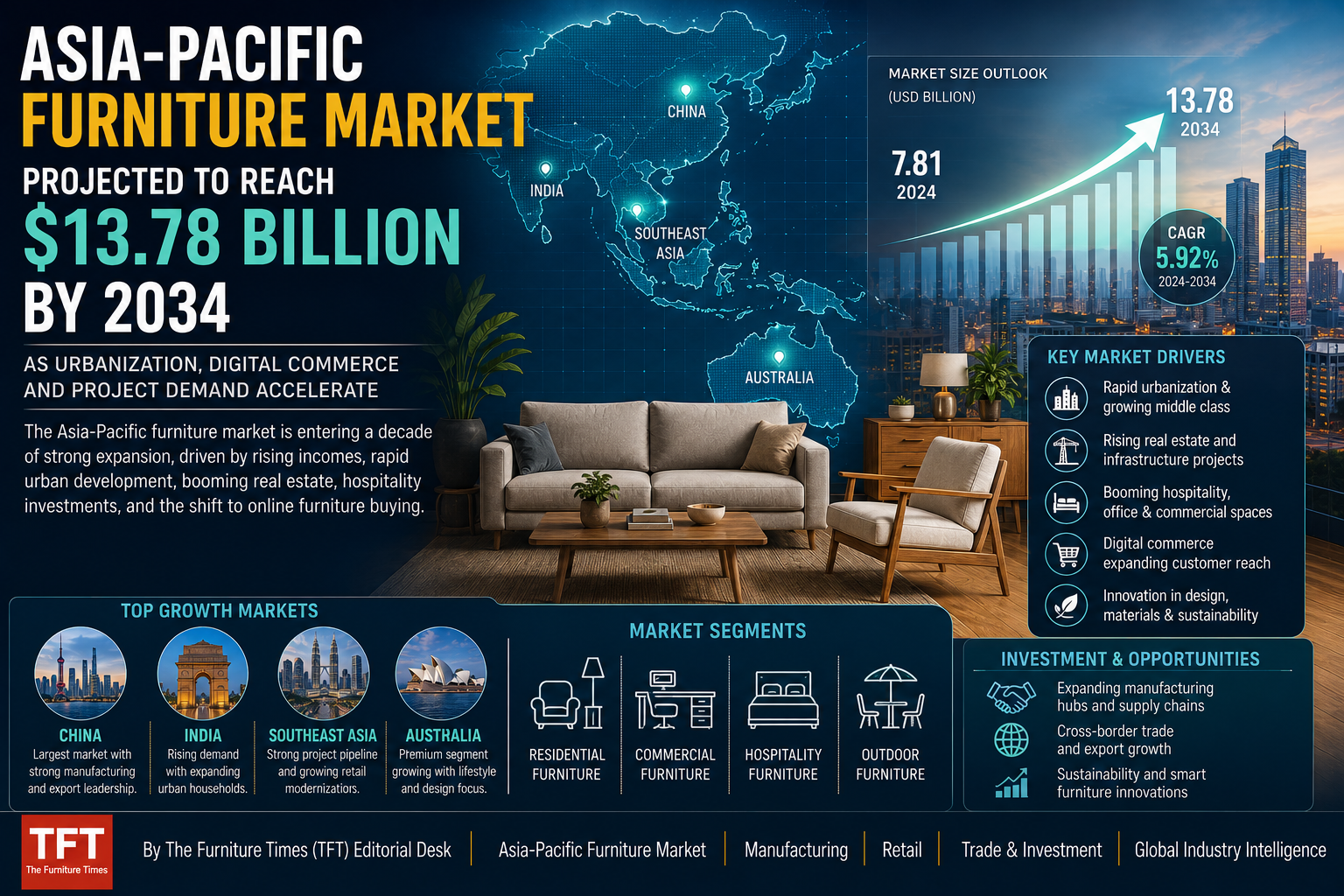
A new market assessment published by Market Data Forecast values the Asia-Pacific furniture market within its defined research scope at approximately $6.71 billion in 2025. The report estimates the market will reach $7.26 billion in 2026 and projects it to expand to $13.78 billion by 2034, representing a compound annual growth rate of 8.33% between 2026 and 2034.
The report examines furniture across residential, office, hospitality and educational applications, together with material, price-range, distribution-channel and country-level segmentation. It covers China, India, Japan, South Korea, Australia, New Zealand, Thailand, Malaysia, Vietnam, the Philippines, Indonesia, Singapore and the rest of Asia-Pacific.
The forecast presents an optimistic long-term trajectory for the region, supported by:
- Rapid urbanization.
- New household formation.
- Residential construction.
- Expansion of organized retail.
- Growth of e-commerce.
- Demand for modular furniture.
- Smart-home adoption.
- Office modernization.
- Hospitality investment.
- Education and healthcare infrastructure.
- Rising interest in sustainable products.
- Expansion into tier-II and tier-III cities.
However, the growth story is not uniform.
Asia-Pacific includes highly mature markets such as Japan and Australia, vast manufacturing economies such as China, fast-growing consumer markets such as India and Indonesia, major export centres such as Vietnam and Malaysia, and smaller high-income markets such as Singapore.
Each market has a different relationship with housing, furniture manufacturing, imports, exports, retail channels, sustainability and consumer purchasing power.
The headline opportunity is therefore substantial, but companies will need country-specific strategies rather than one general Asia strategy.
Asia-Pacific is not one furniture market. It is a network of interconnected manufacturing, retail, design, construction and export economies moving at different speeds.
A necessary note on market definitions
Market values can differ significantly between research providers because they may include different:
- Product categories.
- Applications.
- Geographic boundaries.
- Retail values.
- Factory-gate values.
- Import and export activity.
- Formal and informal manufacturers.
- Outdoor furniture.
- Components.
- Mattresses.
- Kitchen furniture.
- Contract furniture.
- Services.
Market Data Forecast’s headline valuation should therefore be understood according to the scope and methodology of its report—not automatically interpreted as the value of every furniture product manufactured, sold or exported throughout Asia-Pacific.
This distinction is important because some national trade totals can exceed the reported regional market figure when broader wood-product or furniture-export definitions are used.
For example, Vietnam’s exports of timber and wood products alone reached approximately $17.2 billion in 2025, according to Vietnam Customs data reported by Ho Chi Minh City’s Investment and Trade Promotion Centre. That wider export category includes furniture and other wood products and is methodologically different from Market Data Forecast’s defined market. Vietnam’s official investment and trade portal reported that wooden furniture remained the country’s leading wood-export category.
Readers should therefore avoid combining figures from different datasets without reconciling definitions, categories, geographic scope and valuation methods.
The value of the Market Data Forecast report lies primarily in its directional analysis, segmentation and forecast assumptions.
Market forecast at a glance
| Market indicator | Market Data Forecast estimate |
|---|---|
| Market value in 2025 | $6.71 billion |
| Estimated value in 2026 | $7.26 billion |
| Forecast value in 2034 | $13.78 billion |
| Forecast CAGR | 8.33% |
| Forecast period | 2026–2034 |
| Leading application | Home furniture |
| Dominant material | Wood |
| Largest price category | Mid-range furniture |
| Leading channel | B2C/retail |
| Fast-growing channel | B2B/project sales |
Source: Market Data Forecast’s Asia-Pacific Furniture Market report.
Urbanization remains the most powerful structural driver
Asia’s cities continue to expand in population, economic importance and physical scale.
This creates furniture demand through:
- New homes.
- Apartment developments.
- Rental housing.
- Student accommodation.
- Offices.
- Hotels.
- Restaurants.
- Schools.
- Hospitals.
- Retail spaces.
- Government buildings.
Market Data Forecast identifies urbanization and housing demand as central forces supporting the regional market. The report notes that approximately half of Asia’s population currently lives in urban areas and that the proportion is expected to rise further by 2040.
Urbanization does not simply increase the number of furniture customers. It changes the kinds of furniture those customers need.
Densely populated cities create demand for:
- Compact furniture.
- Modular storage.
- Folding tables.
- Extendable dining products.
- Sofa beds.
- Nesting furniture.
- Multifunctional workstations.
- Wall-mounted solutions.
- Lightweight furniture.
- Products designed for rental apartments.
- Easy-to-assemble products.
A design created for a large suburban house may not suit an apartment in Tokyo, Singapore, Seoul, Mumbai, Manila or Jakarta.
Manufacturers that understand spatial constraints can capture a growing urban customer base.
Home furniture retains the largest share
According to the report, home furniture represented more than 45% of total market revenue in 2025, making it the largest application segment.
This position is supported by:
- New home construction.
- Household formation.
- Rising middle-class incomes.
- Renovation.
- Social-media influence.
- Growing interest in interior design.
- E-commerce.
- Greater attention to home comfort.
- Expansion of organized retail.
The residential segment includes furniture for:
- Living rooms.
- Bedrooms.
- Dining rooms.
- Kitchens.
- Home offices.
- Children’s rooms.
- Outdoor residential areas.
- Storage.
The category’s size does not mean every residential product will grow at the same rate.
Consumers are becoming more selective. In many markets, they seek a balance between:
- Price.
- Quality.
- Design.
- Delivery.
- Durability.
- Space efficiency.
- Warranty.
- Sustainability.
- Ease of assembly.
This gives mid-market brands an opportunity, but also creates intense competition.
Office furniture emerges as a high-growth segment
The Market Data Forecast analysis identifies office furniture as one of the faster-growing applications, supported by:
- Hybrid work.
- Co-working spaces.
- Office renovation.
- Ergonomic awareness.
- Flexible workplace design.
- Start-up growth.
- Corporate expansion.
- Technology-sector development.
The post-pandemic office is not simply restoring old furniture layouts.
Employers are redesigning workplaces around:
- Collaboration.
- Focus work.
- Video meetings.
- Flexible occupancy.
- Employee wellbeing.
- Shared workstations.
- Informal meeting spaces.
- Adaptable rooms.
This creates demand for:
- Ergonomic task chairs.
- Height-adjustable desks.
- Modular workstations.
- Mobile partitions.
- Acoustic pods.
- Collaborative seating.
- Technology-integrated tables.
- Lockers.
- Flexible meeting furniture.
- Lounge-style work settings.
Furniture manufacturers should avoid assuming that hybrid work has permanently reduced office-furniture demand.
In many markets, hybrid work is changing the product mix rather than eliminating the category.
Companies may use less conventional workstation furniture but invest more in ergonomic, collaborative and technology-enabled products.
B2B and project furniture could outpace traditional channels
The report projects B2B and project sales as the fastest-growing distribution channel, with an indicated CAGR of approximately 10.2% in its cited forecast window.
Project demand is supported by:
- Hotels.
- Resorts.
- Offices.
- Schools.
- Universities.
- Hospitals.
- Restaurants.
- Airports.
- Public infrastructure.
- Residential developments.
- Co-working facilities.
- Serviced apartments.
Project furniture offers attractive order values, but it carries greater operational complexity.
Suppliers must manage:
- Tender requirements.
- Sample approval.
- Technical specifications.
- Customization.
- Value engineering.
- Production schedules.
- Mock-up rooms.
- Delivery sequencing.
- Installation.
- Defect rectification.
- Warranty.
- Retention payments.
- Project delays.
A factory capable of manufacturing furniture is not automatically ready to manage a large contract project.
The most successful project suppliers combine production with:
- Design support.
- Documentation.
- Financial capacity.
- Local coordination.
- Installation.
- After-sales service.
Hospitality growth creates a regional furniture economy
Tourism is helping drive furniture demand throughout Asia-Pacific.
Countries such as:
- Thailand.
- Vietnam.
- Indonesia.
- Malaysia.
- Japan.
- Australia.
- India.
- Singapore.
- The Philippines.
continue investing in tourism, hotels, serviced apartments, resorts, restaurants and mixed-use destinations.
Hospitality demand extends far beyond beds and bedside tables.
It includes:
- Guest-room furniture.
- Lobby furniture.
- Restaurant seating.
- Bar furniture.
- Outdoor furniture.
- Poolside furniture.
- Conference furniture.
- Banqueting furniture.
- Back-of-house storage.
- Staff accommodation.
- Spa furniture.
- Decorative accessories.
- Lighting and window treatments.
Hotel renovation also creates a significant secondary market involving:
- Liquidation.
- Resale.
- Refurbishment.
- Reupholstery.
- Donation.
- Export.
- Recycling.
Manufacturers should consider the full hospitality furniture life cycle—not only the initial project sale.
Educational furniture is becoming a strategic category
The report includes educational furniture as one of its key application segments.
Asia-Pacific’s large and youthful population creates continuing requirements for:
- School desks.
- Classroom chairs.
- Laboratory furniture.
- Library shelving.
- Teacher workstations.
- Dormitory furniture.
- Training-room furniture.
- Early-learning furniture.
- University furniture.
- Digital-learning spaces.
Educational furniture must increasingly address:
- Ergonomics.
- Safety.
- Durability.
- Easy maintenance.
- Flexible classroom layouts.
- Technology integration.
- Accessibility.
- Standardization.
- Cost efficiency.
Institutional purchasing may be price-sensitive, but product failure can create serious safety, operational and reputational consequences.
Suppliers should compete through life-cycle value rather than initial price alone.
Wood remains the dominant furniture material
Market Data Forecast identifies wood as the leading material category, while referencing an approximately 58% share in 2025.
Wood retains its appeal because of:
- Cultural familiarity.
- Natural appearance.
- Durability.
- Craft traditions.
- Broad design flexibility.
- Availability of solid and engineered formats.
- Established manufacturing ecosystems.
- Consumer perception of quality.
Asia-Pacific contains extensive wood-processing and furniture clusters, including:
- China.
- Vietnam.
- Malaysia.
- Indonesia.
- India.
- Thailand.
However, wooden furniture faces growing pressure around:
- Legal sourcing.
- Deforestation.
- Chain of custody.
- Moisture control.
- Emissions.
- Adhesives.
- Finishes.
- Waste.
- Export documentation.
- EU market-access requirements.
Manufacturers selling into Europe must prepare for the EU Deforestation Regulation where applicable. The regulation’s broader application is scheduled for the end of 2026 under the revised timetable, subject to company classification and product scope.
Traceability is becoming a commercial requirement, not merely an environmental message.
Metal furniture records strong momentum
The report identifies metal furniture as a fast-growing material segment, citing an indicated CAGR of 9.2% for its referenced forecast period.
Metal is gaining relevance across:
- Offices.
- Schools.
- Healthcare.
- Hospitality.
- Warehousing.
- Retail.
- Outdoor spaces.
- Public infrastructure.
- Industrial applications.
Its advantages may include:
- Structural strength.
- Durability.
- Fire-performance characteristics depending on the complete product.
- Recyclability.
- Slim profiles.
- Ease of standardization.
- Suitability for high-use settings.
But metal furniture also faces challenges:
- Steel and aluminium price volatility.
- Corrosion.
- Welding quality.
- Coating durability.
- High energy requirements.
- Transport weight.
- Component consistency.
The fastest-growing products may combine materials—for example, metal structures with wood, fabric, glass or composite surfaces.
Mid-range furniture dominates mass-market demand
The report describes mid-range furniture as the largest price segment, with an estimated share of approximately 42% in 2025.
This reflects the purchasing priorities of Asia-Pacific’s expanding middle class.
These customers are usually not looking for the cheapest product available. They are seeking acceptable quality, style and durability within a manageable budget.
They compare:
- Material.
- Appearance.
- Warranty.
- Reviews.
- Delivery.
- Brand reputation.
- Financing.
- Assembly.
- After-sales service.
Mid-range brands face pressure from both directions.
Economy sellers compete aggressively on price, while premium companies use design, materials and storytelling to justify higher value.
To succeed, mid-range manufacturers need a clear proposition built around:
- Dependable construction.
- Attractive design.
- Accurate product information.
- Consistent delivery.
- Visible warranties.
- Honest materials.
- Strong reviews.
- Accessible customer support.
Premium furniture could grow faster than the mass market
The report identifies premium furniture as one of the faster-growing price categories, supported by rising wealth in cities such as:
- Singapore.
- Tokyo.
- Seoul.
- Sydney.
- Melbourne.
- Shanghai.
- Beijing.
- Mumbai.
- Delhi.
- Kuala Lumpur.
- Bangkok.
Premium customers increasingly look for:
- Bespoke design.
- High-quality materials.
- Craftsmanship.
- Provenance.
- Limited production.
- International design.
- Custom finishes.
- White-glove delivery.
- Strong after-sales service.
- Sustainability evidence.
Premium companies cannot rely on appearance alone.
Customers increasingly want to understand:
- Where the product was made.
- Who designed it.
- Which materials were used.
- How long it will last.
- Whether it can be repaired.
- Whether replacement components are available.
- Whether environmental claims can be verified.
Luxury furniture is becoming an experience, service and information business—not merely a product category.
B2C retail remains dominant, but the channel is changing
Market Data Forecast estimates that B2C and retail channels accounted for approximately 60% of sales in 2025.
Physical furniture stores remain important because customers want to:
- Sit on chairs.
- Test sofas.
- Lie on mattresses.
- Feel fabrics.
- Examine finishes.
- Check storage mechanisms.
- Understand scale.
However, even customers who buy in stores often begin their journey online.
They may research:
- Prices.
- Dimensions.
- Reviews.
- Delivery.
- Materials.
- Showroom locations.
- Stock availability.
- Alternatives.
- Promotions.
This means the modern B2C journey is neither purely online nor purely offline.
It is omnichannel.
Retailers need to connect:
- Website.
- Showroom.
- Mobile.
- Social media.
- Marketplace listings.
- Customer service.
- Inventory.
- Delivery.
- Returns.
- Reviews.
If the price, specification or availability differs across these channels, customer trust declines.
E-commerce expands access beyond major cities
Digital commerce is one of the strongest themes in the report.
Online furniture retail has become more practical through:
- Improved logistics.
- Better product photography.
- 3D models.
- Augmented reality.
- Virtual showrooms.
- Online financing.
- Customer reviews.
- Live shopping.
- Video consultations.
- Easier payment systems.
This development is particularly important for customers in smaller cities where branded furniture showrooms may be limited.
E-commerce allows regional manufacturers to reach national audiences without building extensive store networks.
But furniture remains one of the most difficult categories to sell online because:
- Products are bulky.
- Delivery is expensive.
- Returns are complicated.
- Comfort is subjective.
- Colours may appear different on screens.
- Dimensions are often misunderstood.
- Damage can occur in transport.
- Installation may be required.
E-commerce growth therefore depends on operational excellence—not website traffic alone.
AI-assisted shopping is arriving in Southeast Asia
The next phase of e-commerce is AI-assisted discovery and agentic shopping.
In February 2026, Google and Sea, the parent company of Shopee, announced plans to explore an AI agentic-shopping prototype. Shopee has a major share of Southeast Asian e-commerce, making the initiative relevant to how consumers throughout the region may discover and evaluate products. Reuters’ report on the Google–Sea partnership shows that AI is moving closer to transactional retail.
Furniture companies should prepare by improving:
- Product names.
- Categories.
- Dimensions.
- Materials.
- Prices.
- Availability.
- Delivery areas.
- Warranty information.
- Reviews.
- Structured product data.
AI cannot confidently recommend a product it cannot understand.
Smart and modular furniture create major opportunities
The report identifies smart and modular furniture as an important growth opportunity.
Modular furniture
Modular furniture supports:
- Small apartments.
- Rental homes.
- Flexible offices.
- Changing family needs.
- Easy relocation.
- Incremental purchasing.
- Replacement of individual sections.
Smart furniture
Smart products may include:
- Height-adjustable desks.
- Charging furniture.
- Sensor-enabled seating.
- Posture-monitoring chairs.
- App-controlled mechanisms.
- Integrated lighting.
- Connected storage.
- Voice-controlled functions.
The success of smart furniture will depend on more than novelty.
Manufacturers must consider:
- Product safety.
- Electrical compliance.
- Cybersecurity.
- Repairability.
- Software support.
- Component replacement.
- Privacy.
- Long-term compatibility.
A smart table that becomes unusable after software support ends may have a shorter practical life than a conventional table.
Country analysis
China: the region’s manufacturing and consumption heavyweight
Market Data Forecast describes China as the largest national market within its regional analysis, estimating a share of approximately 32% in 2025.
China’s advantages include:
- Massive manufacturing capacity.
- Integrated supply chains.
- Furniture hardware.
- Panel production.
- Machinery.
- Skilled industrial clusters.
- Large domestic demand.
- Export infrastructure.
- E-commerce scale.
China is also moving toward:
- Smart furniture.
- Customized production.
- AI-enabled retail.
- Original brands.
- Sustainable materials.
- Automated factories.
- Premium domestic design.
Its challenges include:
- Property-sector weakness.
- Trade barriers.
- Export investigations.
- Labour costs.
- Environmental regulation.
- Competition from Vietnam and other Asian producers.
China will remain central to the global furniture economy, but its growth model is shifting from pure manufacturing scale toward technology, domestic brands and higher-value products.
India: one of the region’s most important growth engines
The report positions India as the region’s second-largest contributor within its defined scope, with an estimated share of approximately 14% in 2025.
India’s growth is supported by:
- Urbanization.
- Young consumers.
- Housing.
- Organized retail.
- E-commerce.
- Hospitality.
- Offices.
- Infrastructure.
- Growing middle-class income.
- Tier-II and tier-III city demand.
India is also entering a new compliance environment.
The Furniture Quality Control Order covers notified categories under six Indian Standards involving work chairs, general-purpose chairs and stools, tables and desks, storage units, beds and bunk beds.
This shift may:
- Improve product consistency.
- Formalize testing.
- Strengthen certified factories.
- Increase compliance costs.
- Challenge SMEs.
- Affect imports.
- Encourage engineering documentation.
India’s opportunity is enormous, but growth must be supported by safe products, efficient certification, skilled manufacturing and a stronger component supply chain.
Japan: premium, compact and sustainability-focused
The report estimates Japan’s share at approximately 10% within the regional market scope.
Japan’s mature market is shaped by:
- Smaller living spaces.
- High quality expectations.
- Ageing consumers.
- Ergonomics.
- Minimalist design.
- Premium materials.
- Sustainability.
- Smart-home integration.
Opportunities include:
- Compact modular furniture.
- Accessible furniture.
- Senior-friendly products.
- Ergonomic seating.
- High-quality storage.
- Premium imported furniture.
- Repairable products.
- Smart furniture.
Japan may not deliver the fastest volume growth, but it remains influential in design, quality and product innovation.
Vietnam: export powerhouse facing concentration risk
Market Data Forecast identifies Vietnam as an important regional market and export location.
The country’s broader timber and wood-product exports reached approximately $17.2 billion in 2025, with the United States accounting for about 55% of the total. This demonstrates Vietnam’s manufacturing success but also its exposure to U.S. demand and trade policy.
Vietnam’s strengths include:
- Skilled furniture manufacturing.
- Export experience.
- Competitive production.
- Trade agreements.
- Growing industrial capacity.
- Established U.S. buyer relationships.
Its challenges include:
- Market concentration.
- Tariffs.
- Anti-dumping scrutiny.
- Timber traceability.
- EUDR preparation.
- Rising costs.
- Need for domestic brands and design ownership.
Vietnam’s next stage should focus on export diversification and value creation beyond contract manufacturing.
Malaysia: manufacturing strength needs global brand development
Malaysia remains important in:
- Wooden furniture.
- Rubberwood products.
- Dining furniture.
- Bedroom furniture.
- OEM manufacturing.
- Export logistics.
Muar is a major regional furniture cluster with deep manufacturing knowledge.
Malaysia’s strategic opportunity lies in:
- Original brand development.
- Product innovation.
- Sustainability documentation.
- Automated production.
- Digital catalogues.
- AI search readiness.
- Furniture tourism.
- Global media visibility.
Many Malaysian factories manufacture for well-known brands but remain invisible under their own names. Building searchable identities could unlock new buyers and improve margins.
Indonesia: natural materials and craftsmanship
Indonesia’s furniture strengths include:
- Teak.
- Rattan.
- Natural fibres.
- Outdoor furniture.
- Handcraft.
- Carving.
- Jepara’s furniture cluster.
Its opportunity is to combine cultural identity with:
- Consistent quality.
- Product standardization.
- Traceability.
- Digital product data.
- Moisture control.
- Reliable delivery.
- Contemporary design.
Global customers value authentic craft, but export buyers also require documentation and repeatability.
South Korea: digitally mature and design-conscious
South Korea is an advanced digital retail market with consumers accustomed to:
- Mobile commerce.
- Fast delivery.
- Online comparison.
- Digital payments.
- Technology-integrated homes.
Opportunities include:
- Smart furniture.
- Compact living solutions.
- Premium design.
- Children’s furniture.
- Home-office products.
- AI-assisted shopping.
Furniture brands entering South Korea require strong localization, digital customer service and high-quality product presentation.
Australia and New Zealand: sustainability and omnichannel retail
Australia and New Zealand are mature furniture markets influenced by:
- Residential renovation.
- Outdoor living.
- Sustainability.
- Ethical sourcing.
- Imported products.
- E-commerce.
- Premium interior design.
Opportunities include:
- Sustainable furniture.
- Outdoor products.
- Modular living.
- Premium materials.
- Commercial fit-outs.
- Circular furniture services.
Importers must manage long distances, freight costs, warehousing and inventory carefully.
Thailand: tourism and domestic consumption
Thailand benefits from:
- Hospitality.
- Residential development.
- Tourism.
- Retail investment.
- Woodworking traditions.
- Export capability.
Furniture suppliers can target:
- Hotels.
- Resorts.
- Restaurants.
- Condominiums.
- Wellness destinations.
- Outdoor environments.
Thailand’s design identity and tourism economy provide opportunities for stronger international branding.
The Philippines: housing, business services and young consumers
Demand in the Philippines is supported by:
- Urban development.
- Residential construction.
- Business-process outsourcing.
- Office demand.
- Young households.
- Digital commerce.
Logistics across an island geography remains a major challenge. Retailers require regional warehousing, strong delivery planning and damage control.
Singapore: small market, high strategic value
Singapore is geographically small but commercially influential.
It offers opportunities in:
- Premium residential furniture.
- Offices.
- Hospitality.
- Smart furniture.
- Sustainable products.
- Regional headquarters.
- Design services.
- E-commerce.
Singapore can function as a regional brand, design and business-development hub even when products are manufactured elsewhere.
Raw-material volatility remains a major restraint
The report identifies fluctuating prices for:
- Timber.
- Steel.
- Aluminium.
- Polymers.
- Components.
- Freight.
as an important challenge.
Furniture manufacturers often quote products months before materials are purchased or production begins. Sudden cost increases can destroy project margins.
Businesses need:
- Supplier diversification.
- Contract price-adjustment clauses.
- Alternative material specifications.
- Inventory planning.
- Currency-risk management.
- Long-term supplier relationships.
- Accurate costing.
Substituting cheaper materials without engineering review can create quality and compliance problems.
Supply-chain disruption is not over
Asia-Pacific furniture exporters remain exposed to:
- Red Sea insecurity.
- Middle East conflict.
- Port congestion.
- Fuel prices.
- Container shortages.
- Changing tariffs.
- Customs delays.
- Extreme weather.
- Natural disasters.
Furniture is particularly sensitive because it occupies large container volumes.
Manufacturers should consider:
- Multiple shipping routes.
- Buffer periods.
- Alternative ports.
- Regional warehouses.
- Better packaging.
- Cargo insurance.
- Customer communication.
- Contingency clauses.
A delayed shipment can postpone the opening of a hotel, restaurant, office or residential project.
Logistics is therefore part of the product promise.
Local and global competition is intensifying
The report highlights growing competition between multinational brands, regional companies and local manufacturers.
Global companies benefit from:
- Brand awareness.
- Procurement scale.
- Technology.
- Supply-chain systems.
- Retail experience.
- Advertising budgets.
Local businesses often compete through:
- Price.
- Customization.
- Craftsmanship.
- Local knowledge.
- Faster response.
- Smaller orders.
- Personal service.
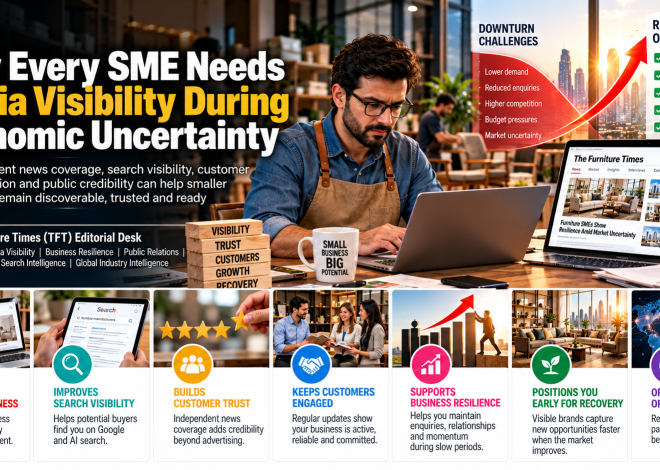
The greatest weakness among SMEs is frequently not product capability but visibility.
A highly skilled manufacturer may be invisible in search results. An artisan may have no digital catalogue. A component supplier may be absent from international directories. Buyers cannot enquire about companies they cannot find.
This is why furniture-industry search infrastructure matters.
Strategic priorities for manufacturers
Asia-Pacific manufacturers should focus on:
Product specialization
Avoid trying to serve every category. Build authority in selected applications, materials or customer segments.
Compliance
Prepare for BIS, EUDR and destination-market product requirements where applicable.
Product data
Create consistent dimensions, materials, certifications, images and model codes.
Design ownership
Move beyond contract manufacturing by developing original collections and intellectual property.
Digital discovery
Improve websites, industry listings, news coverage and AI visibility.
Flexible manufacturing
Support smaller orders, customization and phased projects.
Sustainability evidence
Document material origin, factory processes and product longevity.
Market diversification
Reduce dependence on one country or customer.
What retailers should prioritize
Retailers need to:
- Connect physical and digital channels.
- Improve delivery accuracy.
- Use genuine reviews.
- Offer clear warranties.
- Add visualization.
- Maintain live inventory.
- Provide accurate dimensions.
- Support financing.
- Build faster customer service.
- Prepare product data for AI-assisted discovery.
The future furniture retailer will be less like a simple store and more like a connected decision platform helping customers choose, visualize, finance, receive, assemble, maintain and eventually resell or recycle furniture.
Outlook to 2034
Market Data Forecast’s projected 8.33% CAGR suggests meaningful long-term expansion within the report’s defined scope.
Growth is likely to be strongest where multiple drivers overlap:
- Urbanization.
- Housing.
- Digital commerce.
- Middle-class income.
- Hospitality.
- Office modernization.
- Infrastructure.
- Smart-home adoption.
The most promising categories may include:
- Modular furniture.
- Compact furniture.
- Smart furniture.
- Ergonomic office furniture.
- Hospitality furniture.
- Educational furniture.
- Sustainable furniture.
- Premium personalized products.
- Repairable furniture.
- Furniture-as-a-service.
But growth will not be automatic.
The companies that capture it will be those capable of combining:
- Manufacturing.
- Design.
- Compliance.
- Data.
- Logistics.
- Digital visibility.
- Customer trust.
Conclusion: Asia-Pacific is becoming the centre of the furniture industry’s next transformation
Asia-Pacific is already central to global furniture manufacturing. It is now becoming equally important as a consumer, retail, design, technology and project market.
China provides manufacturing scale. India offers demographic and consumption growth. Japan and Australia influence premium and sustainable design. Vietnam and Malaysia connect the region to global exports. Indonesia and Thailand offer materials, craft and hospitality opportunities. South Korea and Singapore demonstrate advanced digital retail. The Philippines and other emerging markets contribute young consumers and urban growth.
Market Data Forecast’s projection to $13.78 billion by 2034 within its stated scope captures the direction of this transformation, even though readers must carefully compare market definitions before combining its figures with wider trade or national data.
The central message is larger than one forecast:
Asia-Pacific’s furniture future will be built at the intersection of urban living, digital commerce, manufacturing scale, product intelligence, sustainability and regional diversity.
Manufacturers can no longer rely solely on production capacity. Retailers can no longer rely solely on store locations. Exporters can no longer rely solely on low costs.
The next winners will be visible, compliant, adaptable and trusted.
Editorial note: This article is based primarily on the publicly available summary of Market Data Forecast’s Asia-Pacific Furniture Market report and supplements it with wider industry context. Market forecasts are estimates, not guarantees. Values can differ among research firms because of variations in methodology, category definitions, geographic scope and valuation methods.
Source: Market Data Forecast – Asia-Pacific Furniture Market
The Furniture Times (TFT) & Furniture Industry Search Engine (FISE)
“TFT tells their story. FISE helps the world find them.”
FurniReviewology helps the world trust them.
The furniture industry ecosystem is a $1 trillion industry ecosystem.
Asia manufactures. Asia innovates. The world is watching.