Why Furniture Manufacturers Fail BIS Certification,How incomplete preparation,
documentation inconsistencies, undeclared variants, testing weaknesses and uncontrolled production systems create avoidable certification problems
By The Furniture Times (TFT) Editorial Desk | Furniture Compliance | BIS Certification | Quality Assurance | Manufacturing | Global Industry Intelligence
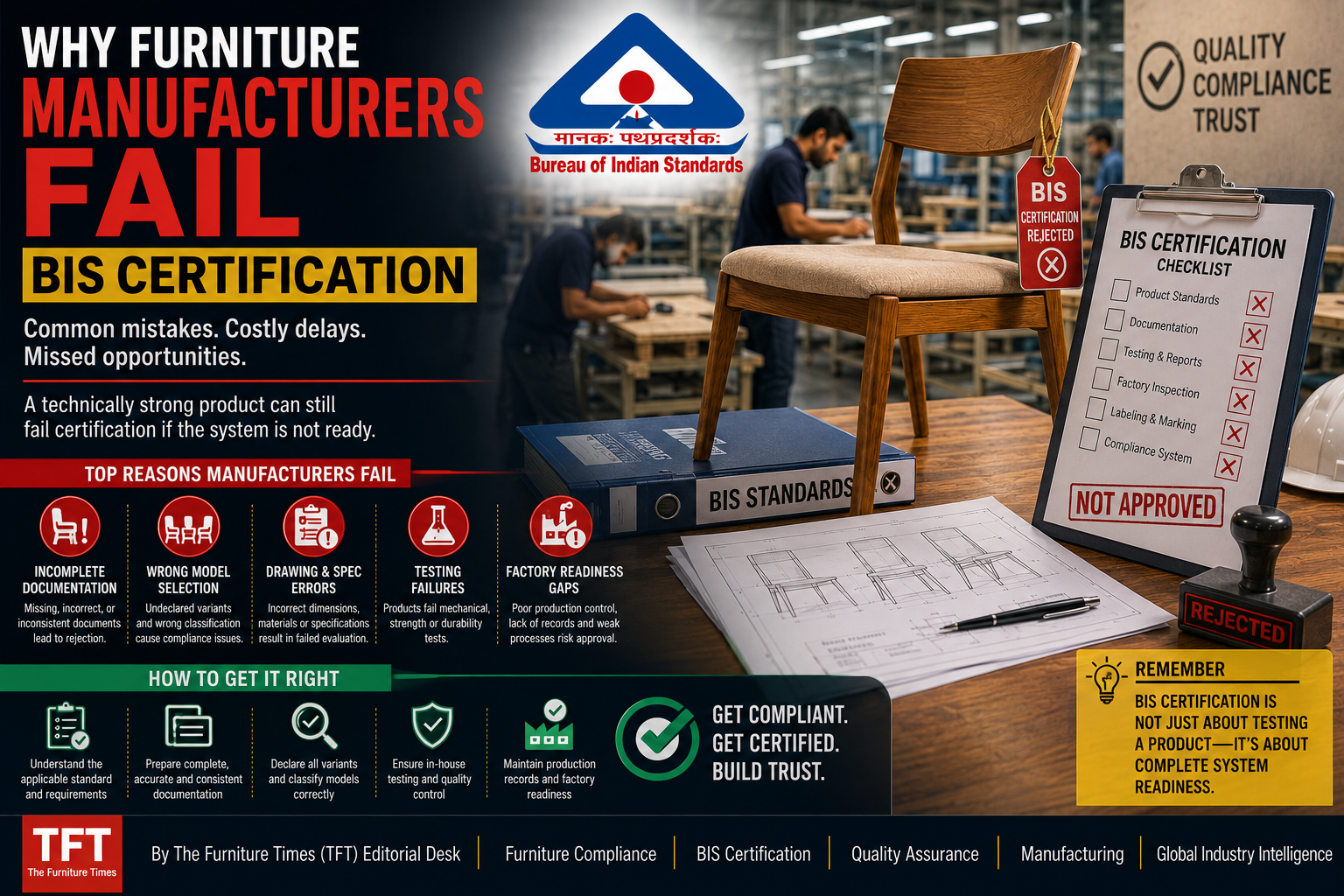
Furniture manufacturers often approach BIS certification with confidence in the physical strength of their products.
They may have manufactured chairs, tables, storage units or beds for many years. Their furniture may already be used in homes, offices, hotels, schools and commercial projects. Customer complaints may be limited, and the factory team may believe that a strong product should pass certification without difficulty.
Yet a technically capable product can still encounter delays, retesting, restricted scope or an unsuccessful certification outcome.
The reason is simple:
BIS certification does not examine only whether one prepared sample is strong. It evaluates whether a clearly defined product is manufactured through a controlled system capable of maintaining conformity.
A furniture factory may produce a chair that passes mechanical testing while its application remains incomplete. A laboratory report may be satisfactory while the tested configuration does not represent the requested variants. A bed may meet performance requirements while its drawings contradict the bill of materials. A storage unit may be well constructed while the factory cannot demonstrate calibrated testing equipment, traceable components or consistent production records.
Many furniture certification problems are therefore not caused by one dramatic product failure. They result from small inconsistencies accumulating across the application.
These weaknesses commonly include:
- Selecting the wrong Indian Standard.
- Misclassifying the product.
- Declaring an incomplete model range.
- Grouping technically different products together.
- Choosing an unrepresentative test sample.
- Submitting outdated drawings.
- Using inconsistent model numbers.
- Changing materials after testing.
- Failing to control critical suppliers.
- Missing calibration records.
- Inadequate factory testing.
- Unprepared employees.
- Incorrect Standard Mark proposals.
- Poor post-certification change control.
Furniture companies can avoid many of these failures by treating BIS certification as an engineering and manufacturing-readiness programme—not as a one-time laboratory exercise.
Furniture is now part of India’s compulsory certification framework
Notified furniture categories are listed by the Bureau of Indian Standards under Scheme-I, commonly associated with the ISI Mark.
The principal categories include:
| Furniture category | Indian Standard |
|---|---|
| Work chairs | IS 17631:2022 |
| General-purpose chairs and stools | IS 17632:2022 |
| Tables and desks | IS 17633:2022 |
| Storage units | IS 17634:2022 |
| Beds | IS 17635:2022 |
| Bunk beds | IS 17636:2022 |
The current BIS Scheme-I compulsory certification listing links these standards to the Furniture Quality Control Order, its 2026 amendments and the Transition Facilitation Order issued in June 2026.
Manufacturers, importers and brand owners must review the latest consolidated regulatory position before making production, import, stock or sales decisions. Applicability, transition provisions and exemptions should never be determined from an old online summary alone.
The technical foundation should include:
- The current Indian Standard.
- Applicable amendments.
- Current product manual.
- Scheme of Inspection and Testing.
- Product-grouping guidelines.
- Sampling guidelines.
- Test-equipment requirements.
- Current application instructions.
- Applicable Quality Control Order and amendments.
Certification failure does not always mean the furniture is unsafe
The word “failure” is frequently used too broadly.
A furniture BIS application can encounter different kinds of problems.
Product nonconformity
The tested product does not meet one or more applicable requirements.
This may involve:
- Stability.
- Strength.
- Durability.
- Impact performance.
- Safety dimensions.
- Structural integrity.
- Entrapment considerations.
- Functional performance.
- Product-specific marking.
Application deficiency
The product may be capable of conforming, but the submitted application is incomplete, unclear or inconsistent.
Scope deficiency
The tested evidence does not support every model, size, material or variant requested.
Factory-readiness deficiency
The manufacturer cannot demonstrate the required production controls, testing facilities, trained personnel, calibration or records.
Continuing-compliance deficiency
A licensed manufacturer fails to maintain conformity, control marking or manage product changes after the licence is granted.
These situations are different and may lead to different actions. Depending on the facts and applicable procedures, BIS may request clarification, corrective action, additional evidence, further testing, scope limitation, retesting or other measures.
BIS publishes separate guidance for matters such as product nonconformity, retesting, scope changes, factory surveillance and market surveillance through its Product Certification Process.
Failure Point 1: Applying under the wrong standard
The first major risk appears before the product reaches a laboratory.
Furniture businesses commonly classify products using commercial descriptions. However, a marketing name does not always determine the correct Indian Standard.
A chair might be described as:
- Executive chair.
- Study chair.
- Task chair.
- Visitor chair.
- Dining chair.
- Training chair.
- Multipurpose chair.
The applicable standard depends on the product’s intended function, construction and the formal scope of the relevant Indian Standard.
Similarly, terms such as “cabinet,” “console,” “sideboard,” “locker,” “wardrobe” and “shelf” can overlap commercially while requiring more careful technical classification.
Why misclassification is serious
Choosing the wrong standard can affect:
- Test methods.
- Sample selection.
- Required test equipment.
- Product grouping.
- Factory inspection.
- Marking.
- Certification scope.
- Legal compliance.
A manufacturer can spend considerable money testing a product only to discover that the report does not support the correct category.
How to prevent it
Before testing:
- Obtain the full current standard.
- Read its scope and definitions.
- Compare the product’s intended use with the standard.
- Review exclusions.
- Examine multifunctional features.
- Seek written product-specific clarification where uncertainty remains.
Classification should be resolved before the test sample is finalized.
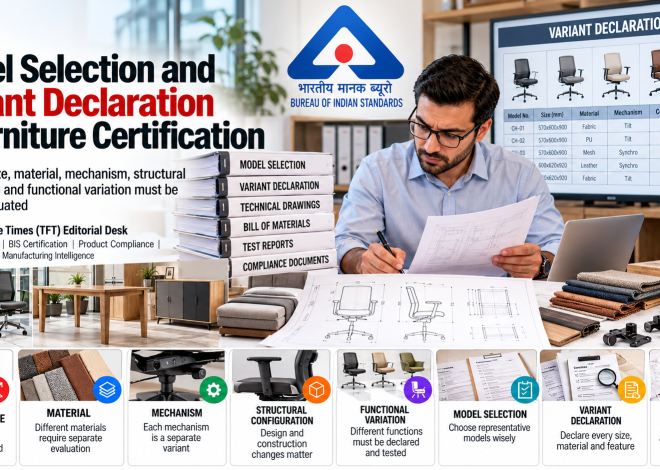
Failure Point 2: Treating a furniture collection as one technical model
Marketing teams sell collections. Certification systems evaluate defined products and configurations.
A company may sell one office-chair family containing:
- Mesh and upholstered backs.
- Nylon and aluminium bases.
- Fixed and adjustable armrests.
- Several castor types.
- Two gas-lift specifications.
- Standard and heavy-duty mechanisms.
- Mid-back and high-back versions.
- Headrest and non-headrest configurations.
The company may consider all these products one collection because they share the same brand name and visual language.
Technically, however, changes to the base, structure, mechanism, dimensions or load-bearing components may affect performance.
What goes wrong
Manufacturers sometimes:
- Test one convenient configuration.
- Request approval for the entire family.
- Fail to declare all alternatives.
- Submit one vague drawing.
- Omit important component differences.
- Assume stronger models automatically cover weaker ones.
- Add variants after the report is issued.
The evidence may support only the tested configuration—not the entire commercial collection.
The solution: a model and variant matrix
Every requested configuration should be mapped.
| Technical field | Information to record |
|---|---|
| Commercial name | Name used in the market |
| Internal model code | Factory-controlled identification |
| Intended use | Work, general-purpose or other use |
| Dimensions | Width, height, depth and critical dimensions |
| Structural material | Wood, metal, panel, plastic or combination |
| Structural sections | Thicknesses and profile sizes |
| Joints | Welding, screws, dowels, connectors or other methods |
| Hardware | Hinges, slides, fasteners and mechanisms |
| Functional options | Adjustable, folding, extending or storage features |
| Differences | Exact variation from the representative model |
| Drawing reference | Controlled document number and revision |
| BOM reference | Controlled bill-of-material number |
| Sample rationale | Why the model represents the requested group |
The goal is not to create paperwork for its own sake. It is to prove exactly what has been tested and what the manufacturer wants included in the licence.
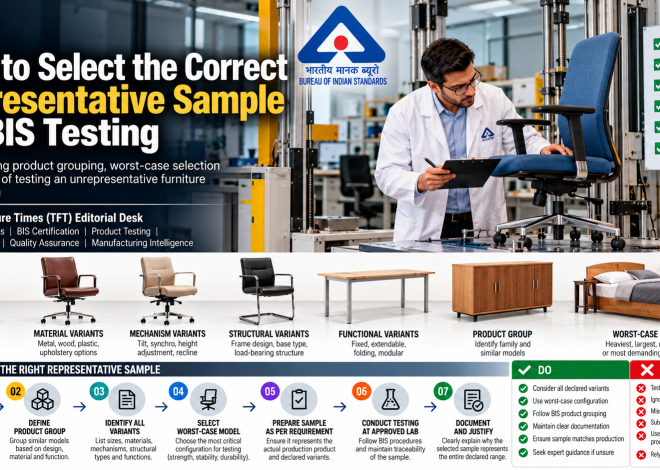
Failure Point 3: Selecting the wrong representative sample
The most convenient sample is not necessarily the correct sample.
A manufacturer may select:
- The smallest table because it is easier to transport.
- The strongest chair because it is most likely to pass.
- The shortest cabinet because it is easier to handle.
- A specially reinforced prototype.
- The model already available in the showroom.
But product grouping may require a technically representative or demanding configuration.
The worst-case model depends on the relevant requirement.
Examples may include:
- A taller storage unit presenting a greater stability challenge.
- A wider table creating a longer unsupported span.
- An adjustable chair containing more moving components.
- A larger bed creating different frame-loading conditions.
- A bunk bed with a particular access or guard configuration.
- A product using the lowest structural thickness within the requested family.
The manufacturer should document why the selected sample covers the requested scope.
If no defensible technical explanation exists, additional samples may be necessary.
Failure Point 4: Testing a product that is not normal production
A hand-prepared prototype can create misleading confidence.
For the formal sample, a manufacturer may:
- Add extra welding.
- Use thicker material.
- Select premium hardware.
- Increase the number of fasteners.
- Use higher-density panels.
- Reinforce joints.
- Choose unusually good timber.
- Add adhesive not used in ordinary production.
The sample may pass, but the factory’s commercial product may not match it.
Certification is intended to support continuing conformity. The tested construction must be translated into controlled normal production.
If testing reveals that reinforcement is needed, the manufacturer should update:
- Engineering drawings.
- Bill of materials.
- Work instructions.
- Inspection criteria.
- Supplier specifications.
- Production tooling.
- Training.
- Finished-product testing.
An improvement used only in the laboratory sample is not a sustainable compliance solution.
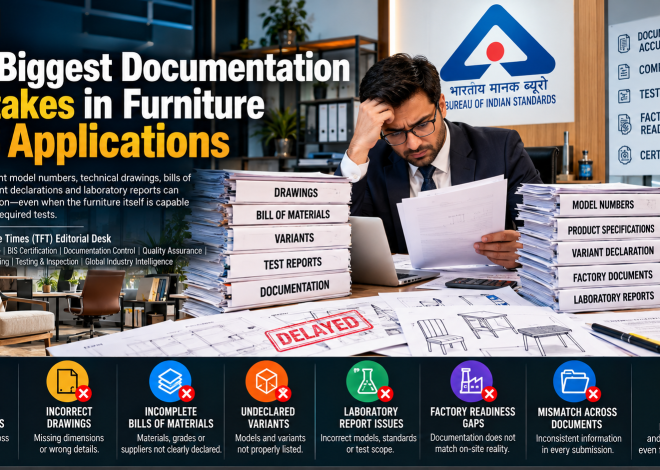
Failure Point 5: Drawings that contradict the product
Furniture companies often operate with drawings created for different purposes.
One drawing may have been prepared for:
- Customer approval.
- Production.
- Costing.
- CNC programming.
- Installation.
- Marketing.
- Packaging.
These documents may not contain the same details.
Frequent drawing problems
- Missing dimensions.
- No material identification.
- No component thickness.
- Missing joint details.
- Hardware shown without specification.
- No drawing number.
- No revision history.
- Old drawings remaining in circulation.
- Drawing dimensions differing from the sample.
- Product code differing from the application.
- Alternative constructions shown on one page without explanation.
A certification-ready drawing should identify the product clearly enough to connect the application, test sample, factory process and requested licence scope.
Document control is essential
Every controlled drawing should include:
- Document number.
- Model code.
- Revision.
- Issue date.
- Approval.
- Material details.
- Critical dimensions.
- Relevant construction information.
When a revision is issued, obsolete copies should be withdrawn from production.
Failure Point 6: An inaccurate bill of materials
The bill of materials defines what the product is made from.
For furniture, it may include:
- Timber.
- Engineered panels.
- Metal sections.
- Plastics.
- Foam.
- Upholstery.
- Adhesives.
- Fasteners.
- Hinges.
- Drawer slides.
- Castors.
- Chair mechanisms.
- Gas lifts.
- Connectors.
- Slats.
- Coatings.
- Glass.
- Functional accessories.
Problems arise when the bill of materials does not match the sample or factory production.
A common example
The tested chair contains Mechanism A from Supplier X.
The submitted bill of materials lists Mechanism B from Supplier Y.
The factory alternates between both based on price and availability.
The commercial catalogue does not distinguish the configurations.
Even if both mechanisms appear similar, their performance and construction may differ. The manufacturer cannot assume equivalence without technical control and appropriate evidence.
Prevention
- Assign codes to critical components.
- Define technical specifications.
- Approve suppliers.
- Link purchase orders to the controlled BOM.
- Inspect incoming materials.
- Record substitutions.
- Evaluate changes before use.
- Maintain traceability.
Failure Point 7: Uncontrolled supplier changes
Furniture factories frequently change suppliers to reduce cost, address shortages or improve lead times.
A supplier change is not automatically prohibited, but uncontrolled substitution creates certification risk.
Critical changes can involve:
- Panel grade or thickness.
- Metal-section thickness.
- Fastener strength.
- Hinge type.
- Drawer-slide capacity.
- Chair mechanism.
- Gas lift.
- Castor.
- Plastic base.
- Adhesive.
- Structural connector.
- Mattress support.
- Bunk-bed fastener.
Procurement teams should not make these changes independently.
A formal change review should ask:
- Is the new component technically equivalent?
- Does it change dimensions?
- Does it affect loading?
- Does it affect assembly?
- Does it require testing?
- Does it remain within the approved scope?
- Must BIS be informed or approval obtained?
- Are drawings and bills of materials updated?
The lowest-cost component can become very expensive if it triggers failure, retesting or market action.
Failure Point 8: Laboratory reports that do not support the application
A test report can contain a passing result yet remain unsuitable for the requested certification scope.
Possible problems include:
- Laboratory not recognized for the relevant standard.
- Report does not cover all required tests.
- Sample description is vague.
- Model code is missing.
- Dimensions are incomplete.
- Material construction is unclear.
- Photographs do not identify the product.
- Manufacturer or factory details are incorrect.
- Report refers to an obsolete product revision.
- Tested configuration differs from the application.
- Report validity or procedural acceptability is uncertain.
Before commissioning testing, confirm that the laboratory is currently recognized for the applicable standard and required test programme.
The manufacturer should also provide a sample-identification document connecting:
- Model code.
- Drawing.
- Bill of materials.
- Dimensions.
- Photographs.
- Factory.
- Sample date.
- Variant group.
A report describing the sample only as “office chair” or “wooden table” may not provide sufficient clarity.
Failure Point 9: Mechanical testing exposes hidden weakness
Furniture can look strong but still fail standardized performance testing.
Visual inspection cannot always reveal:
- Progressive joint loosening.
- Structural fatigue.
- Instability.
- Deflection.
- Weak fasteners.
- Brittle plastic components.
- Weld failure.
- Panel pull-out.
- Mechanism wear.
- Guard or access weaknesses.
- Failure under repeated loading.
Depending on the applicable standard, testing may evaluate requirements related to:
- Stability.
- Static strength.
- Durability.
- Impact resistance.
- Structural integrity.
- Functional performance.
- Safety dimensions.
- Openings and gaps.
- Entrapment risks.
- Guarding.
- Product-specific instructions and marking.
The exact test programme must come from the applicable Indian Standard and current certification instructions.
Why pre-compliance testing matters
The official certification test should not be the first serious engineering evaluation of the product.
Pre-testing allows the manufacturer to:
- Identify weak joints.
- Compare variants.
- Validate design calculations.
- Correct dimensions.
- Improve components.
- Train quality staff.
- Verify factory test arrangements.
- Reduce retesting risk.
If a test fails, the manufacturer should investigate the root cause—not merely repair the tested unit.
Failure Point 10: Missing or inadequate factory testing facilities
Manufacturers sometimes assume that external laboratory testing removes the need for factory testing.
However, BIS certification is based on continuing conformity. The factory may be required to maintain specified testing capabilities and conduct tests according to the current Scheme of Inspection and Testing.
Common weaknesses include:
- Required equipment is absent.
- Equipment capacity is inadequate.
- Equipment cannot perform the specified method.
- Fixtures are incomplete.
- Measuring instruments are unsuitable.
- Staff do not understand the procedure.
- Tests are conducted but not recorded.
- Acceptance criteria are undefined.
- Failed results are ignored.
- External arrangements are not properly documented.
Manufacturers should prepare an equipment matrix showing:
| Requirement | Factory equipment | Capacity | Calibration status | Responsible person |
|---|---|---|---|---|
| Applicable test or measurement | Identified equipment | Relevant range | Valid/expired | Named employee |
This matrix should be reviewed against the current product manual and Scheme of Inspection and Testing.
Failure Point 11: Expired or incomplete calibration
Calibration problems are among the most avoidable factory-readiness failures.
Typical issues include:
- Certificate expired days before inspection.
- Equipment serial number does not match the certificate.
- Certificate covers a different measuring range.
- Instrument is damaged.
- Equipment has no identification label.
- No recall system exists.
- Calibration provider’s status has not been checked.
- New equipment has never been verified.
- Factory personnel cannot locate the record.
A simple calibration register should record:
- Equipment identification number.
- Description.
- Location.
- Range.
- Calibration date.
- Next due date.
- Certificate number.
- Status.
- Responsible person.
Management should review upcoming dates monthly rather than preparing records only when an inspection is announced.
Failure Point 12: The factory is not inspection-ready
A factory inspection can expose the difference between declared procedures and actual practice.
The application may state that the factory:
- Uses a particular machine.
- Performs specific tests.
- Maintains traceability.
- Controls rejected products.
- Uses approved drawings.
- Inspects incoming materials.
During assessment, inspectors may find that:
- The machine is not installed.
- The testing equipment is incomplete.
- Operators use old drawings.
- Raw materials are unidentified.
- Rejected products are mixed with approved stock.
- Production records use different model codes.
- The quality manager is unavailable.
- The declared product is not in production.
- Staff cannot demonstrate the test method.
- The sample cannot be connected to a production record.
These issues create doubts about the factory’s ability to maintain conformity.
Conduct a mock inspection
Before the formal assessment, an internal team should examine:
- Factory legal documents.
- Production flow.
- Machinery.
- Product drawings.
- Bills of materials.
- Supplier controls.
- Incoming inspection.
- Test facilities.
- Calibration.
- Production records.
- Rejection controls.
- Marking plans.
- Staff competency.
- Sample availability.
The mock inspection should follow the actual product path from receipt of materials to final dispatch.
Failure Point 13: Outsourced processes are poorly controlled
Furniture manufacturing frequently involves subcontractors.
Processes may include:
- Powder coating.
- Plating.
- Upholstery.
- Wood machining.
- Moulding.
- Welding.
- Glass processing.
- Surface finishing.
- Hardware manufacturing.
- Testing.
Outsourcing a process does not outsource the licensed manufacturer’s responsibility for conformity.
The factory should define:
- Which processes are outsourced.
- Who performs them.
- What specification applies.
- How suppliers are approved.
- How output is inspected.
- How failed work is handled.
- What records are retained.
- How changes are controlled.
A subcontractor should not be free to change a coating, component, material or process without the manufacturer’s approval.
Failure Point 14: Commercial names and factory codes do not match
A product may have several identities:
- Customer-facing model name.
- Factory code.
- Drawing number.
- Bill-of-material number.
- ERP stock code.
- Laboratory sample code.
- E-commerce SKU.
- Packaging code.
If these identities are not connected, the certification scope becomes difficult to understand.
For example:
- Catalogue: “Regal Executive Chair”
- Factory: “OC-216”
- Drawing: “CH-14”
- Laboratory report: “Model A”
- Application: “Executive Chair Series”
These may all describe the same chair, but the relationship is not obvious.
A product-master register should map every identity to one controlled model.
Failure Point 15: The application was prepared without involving the factory
Some companies outsource the entire application to a consultant.
Consultants can assist with:
- Procedure.
- Documentation.
- Application preparation.
- Coordination.
- Readiness assessment.
- Regulatory interpretation.
However, they cannot replace:
- Manufacturing capability.
- Product knowledge.
- Factory testing.
- Trained staff.
- Management responsibility.
- Continuing conformity.
Problems arise when a consultant writes procedures the factory has never used or declares equipment the manufacturer does not own.
On inspection day, employees may see the documentation for the first time.
The manufacturer must own the certification system. External assistance should strengthen internal capability, not create a paper system disconnected from production.
Failure Point 16: Management treats certification as a quality-department problem
BIS certification affects multiple departments.
| Department | Typical certification risk |
|---|---|
| Design | Uncontrolled product changes |
| Procurement | Supplier substitutions |
| Production | Deviation from drawings |
| Quality | Missing tests or records |
| Maintenance | Unavailable equipment |
| Stores | Poor identification and traceability |
| Sales | Offering unapproved variants |
| Marketing | Incorrect certification claims |
| Finance | Delayed fees, testing or equipment investment |
| Management | Lack of resources and accountability |
A cross-functional team should meet regularly during preparation.
If quality approves a controlled product but sales continues selling custom variations without review, the conformity system remains exposed.
Failure Point 17: Incorrect Standard Mark usage
The BIS Standard Mark is connected to:
- A licensed manufacturer.
- A manufacturing location.
- An Indian Standard.
- An approved scope.
- Licence conditions.
It is not a general corporate quality symbol.
Common mistakes include:
- Printing the mark before the licence is granted.
- Marking a model outside the approved scope.
- Using another factory’s licence number.
- Showing the wrong Indian Standard.
- Advertising an entire collection as certified.
- Continuing marking during a suspension.
- Allowing dealers to alter the label.
- Using the mark on imported products from an unlicensed factory.
Manufacturers should create a marking-control procedure covering:
- Artwork approval.
- Label procurement.
- Storage.
- Issue to production.
- Product verification.
- Packaging.
- Website claims.
- Dealer communication.
- Obsolete label destruction.
Failure Point 18: Post-certification changes are not controlled
Some manufacturers prepare carefully, receive the licence and then gradually move away from the approved construction.
Changes may include:
- Cheaper panel.
- Different fastener.
- New hinge.
- Alternative chair base.
- New gas lift.
- Reduced metal thickness.
- Revised dimensions.
- Different supplier.
- New factory.
- Additional storage feature.
- New product size.
Management may view each change as minor. Together, they can produce a materially different product.
BIS provides guidance on changes to licence scope as part of its certification framework. Manufacturers should determine whether a proposed change:
- Remains within the approved scope.
- Requires internal verification.
- Requires additional testing.
- Requires formal inclusion.
- Requires BIS approval.
- Should not be implemented until reviewed.
Certification must be integrated with engineering change control.
A practical example: how five small mistakes create one major delay
Consider a hypothetical manufacturer called Horizon Workspace.
Horizon produces the “FlexPro” work-chair family with:
- Nylon and aluminium bases.
- Fixed and adjustable arms.
- Two mechanisms.
- Two gas-lift options.
- Mesh and upholstered backs.
- Headrest and non-headrest versions.
The company submits a mesh-back chair with:
- Nylon base.
- Fixed arms.
- Standard mechanism.
- No headrest.
The sample passes testing.
However, the company requests coverage for every FlexPro model.
During evaluation, the following problems appear:
- The aluminium-base variant is absent from the model matrix.
- The drawing shows adjustable arms, while the sample has fixed arms.
- The mechanism code in the BOM differs from the laboratory sample.
- The gas-lift supplier changed after testing.
- Factory personnel use a different internal model code.
Individually, each problem may appear administrative. Together, they create uncertainty about what was tested and what the factory intends to manufacture.
Possible consequences may include:
- Clarification requests.
- Revised documentation.
- Additional samples.
- Further testing.
- Scope reduction.
- Deferred processing.
- Other action under applicable procedures.
The chair itself may be strong. The certification evidence is not.
The financial cost of avoidable certification failure
An unsuccessful or delayed certification programme can create costs far beyond the laboratory fee.
Direct costs
- Testing.
- Retesting.
- Sample production.
- Transport.
- Inspection-related expenditure.
- Consultancy.
- Documentation.
- Calibration.
- Equipment.
- Redesign.
Commercial costs
- Delayed product launch.
- Lost retail season.
- Cancelled orders.
- Missed tenders.
- Import disruption.
- Idle stock.
- Warehousing.
- Dealer frustration.
- Customer refunds.
- Lost market share.
Reputational costs
- Questions from customers.
- Loss of retailer confidence.
- Negative publicity.
- Uncertainty among distributors.
- Damage to the brand’s quality claims.
Management costs
- Senior time diverted from operations.
- Emergency meetings.
- Supplier disputes.
- Production rescheduling.
- Sales and factory conflict.
The cheapest certification strategy is not the one involving the least preparation. It is the one that minimizes preventable errors.
A four-stage prevention framework
Stage 1 — Technical readiness
Confirm:
- Correct Indian Standard.
- Product classification.
- Model grouping.
- Variant declaration.
- Representative sample.
- Drawings.
- Bill of materials.
- Critical components.
- Pre-compliance results.
Stage 2 — Documentation readiness
Align:
- Application.
- Model list.
- Drawings.
- BOM.
- Laboratory report.
- Manufacturing-process description.
- Machinery list.
- Test-equipment list.
- Marking proposal.
- Factory records.
Stage 3 — Factory readiness
Verify:
- Production capability.
- Operational machinery.
- Testing facilities.
- Calibration.
- Trained personnel.
- Incoming inspection.
- Traceability.
- Nonconforming-product control.
- Outsourced-process control.
- Sample availability.
Stage 4 — Continuing-compliance readiness
Establish:
- Change control.
- Supplier monitoring.
- Routine testing.
- Record retention.
- Marking control.
- Complaint investigation.
- Internal audit.
- Management review.
- Renewal monitoring.
- Surveillance readiness.
Final pre-application checklist
01 — Have we confirmed the correct Indian Standard?
02 — Are we using the latest standard, product manual and certification instructions?
03 — Have we reviewed the current QCO and all amendments?
04 — Is the product design frozen?
05 — Are all models and variants declared?
06 — Is the grouping technically justified?
07 — Is the selected sample representative?
08 — Do drawings match the actual sample?
09 — Does the BOM match the sample and production?
10 — Are critical components controlled?
11 — Are suppliers approved?
12 — Has meaningful pre-compliance testing been completed?
13 — Is the laboratory recognized for the relevant work?
14 — Does the report clearly identify the product?
15 — Is all factory machinery operational?
16 — Are required test facilities available?
17 — Is calibration valid?
18 — Can personnel demonstrate the tests?
19 — Are production records current?
20 — Is traceability functioning?
21 — Are rejected products controlled?
22 — Are outsourced processes documented?
23 — Has a mock inspection been conducted?
24 — Is the marking plan accurate?
25 — Is post-certification change control established?
If the answer to several questions is “no,” the application is not ready—even if the product appears strong.
Conclusion: Most failures begin before the official test
Furniture manufacturers often focus on whether the product will survive laboratory loading.
That question matters, but it is only one part of certification readiness.
The larger question is whether the manufacturer can demonstrate that:
- The correct product was classified.
- Every requested variant was declared.
- The representative sample was justified.
- Drawings match production.
- Materials are controlled.
- Suppliers are monitored.
- Testing is repeatable.
- Equipment is calibrated.
- Employees understand their responsibilities.
- The Standard Mark will be controlled.
- Future changes will be reviewed.
Certification becomes difficult when product design, factory practice and documentation tell different stories.
It becomes more predictable when they tell the same story.
Furniture manufacturers should therefore stop asking only:
“Will our sample pass?”
They should also ask:
“Can our complete manufacturing system prove that every approved product will continue to conform?”
That is the difference between preparing a sample and preparing a factory.
Many furniture manufacturers do not fail because they cannot build strong furniture. They fail because they cannot consistently define, document, test and reproduce what they built.
Regulatory notice: This article is intended for general industry information and does not constitute legal or certification advice. Quality Control Orders, amendments, Indian Standards, product manuals, grouping instructions, certification procedures and exemptions may change. Manufacturers should consult current official BIS documents, the responsible certification authority and a recognized laboratory before taking compliance decisions.
The Furniture Times (TFT) & Furniture Industry Search Engine (FISE)
“TFT tells their story. FISE helps the world find them.”
FurniReviewology helps the world trust them.
The furniture industry ecosystem is a $1 trillion industry ecosystem.
Prepare the product. Prepare the documents. Prepare the factory. Protect the licence.