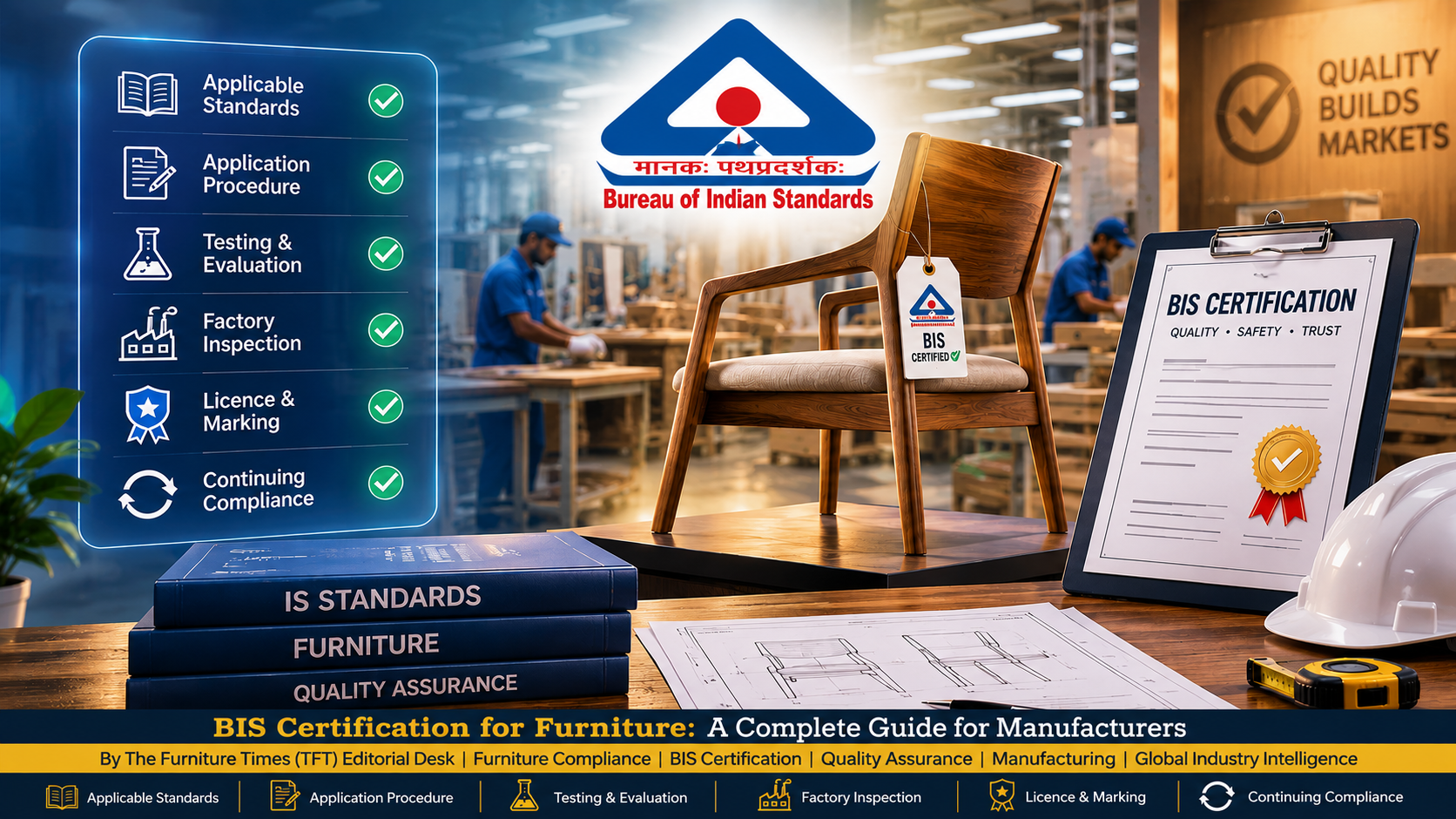
BIS Certification for Furniture: A Complete Guide for Manufacturers
Understanding applicable furniture standards, regulatory coverage, application procedures, model grouping, product testing, factory inspection, licensing, marking, surveillance and continuing compliance
By The Furniture Times (TFT) Editorial Desk | Furniture Compliance | BIS Certification | Quality Assurance | Manufacturing | Global Industry Intelligence
India’s furniture industry is entering a more structured era of product standardization, safety assurance and manufacturing accountability.
For decades, many furniture businesses evaluated quality through craftsmanship, appearance, customer feedback and their own internal specifications. Those factors remain important, but manufacturers of notified furniture categories must now consider a formal conformity-assessment framework involving applicable Indian Standards, product testing, factory capability, documentation, licensing and continuing compliance.
The introduction of the Furniture (Quality Control) Order, 2025, followed by multiple amendments and transition-related measures during 2026, has made BIS preparedness a strategic responsibility for furniture manufacturers, importers, foreign suppliers, brand owners and retailers.
The process cannot be reduced to sending one carefully prepared sample to a laboratory.
A manufacturer seeking a BIS licence must establish that the product conforms to the applicable Indian Standard and that the licensed factory can consistently manufacture conforming products within the approved scope.
This means aligning:
- The product design.
- Commercial model names.
- Engineering drawings.
- Bills of materials.
- Variants and configurations.
- Manufacturing processes.
- Raw-material controls.
- Testing arrangements.
- Inspection records.
- Product marking.
- Factory quality systems.
- Post-certification change controls.
For manufacturers, the most important principle is therefore:
BIS certification is not merely approval of a sample. It is recognition of a factory’s capability to continuously manufacture a defined product in conformity with an applicable Indian Standard.
1. What is BIS certification?
The Bureau of Indian Standards is India’s national standards body. Its responsibilities include developing and publishing Indian Standards, operating conformity-assessment schemes, recognizing laboratories and granting licences for the use of the BIS Standard Mark.
Many BIS certification schemes are voluntary. However, the Central Government may make compliance with particular Indian Standards compulsory through Quality Control Orders when considerations such as public interest, safety, consumer protection, prevention of unfair trade practices or environmental protection require mandatory conformity.
Notified furniture categories are listed under BIS Scheme-I, commonly known as the ISI Mark Scheme.
Under this framework, applicable furniture must conform to the relevant Indian Standard and bear the Standard Mark under a valid BIS licence, subject to the applicable Quality Control Order, amendments, transition provisions and exemptions.
A laboratory test report alone is not the BIS licence. A licence is granted to the manufacturer after the prescribed conformity-assessment process has been completed satisfactorily.
2. The furniture regulatory framework as of August 2026
The official BIS compulsory-certification listing currently links furniture to several regulatory instruments, including:
- Furniture (Quality Control) Order, 2025 — S.O. 801(E), dated 14 February 2025.
- Furniture (Quality Control) Amendment Order, 2026 — S.O. 774(E), dated 13 February 2026.
- A related amendment in the Quality Control Order — S.O. 777(E), dated 13 February 2026.
- Furniture (Quality Control) Second Amendment Order, 2026 — S.O. 1125(E), dated 2 March 2026.
- Transition Facilitation (Quality Control) Order, 2026 — S.O. 3417(E), dated 25 June 2026.
Manufacturers should not rely on an old summary, social-media post or unofficial checklist to determine whether a particular product, stock consignment, import, research sample or enterprise qualifies for an exemption or transitional arrangement.
Applicability must be checked against:
- The original Quality Control Order.
- Every subsequent amendment.
- The Transition Facilitation Order.
- The current version of the Indian Standard.
- The current product manual.
- The Scheme of Inspection and Testing.
- Product-grouping and sampling guidelines.
- Current directions published by BIS or the relevant ministry.
Regulatory status can change. The latest consolidated position should be confirmed before importing, producing, marking, dispatching or selling affected furniture.
3. Which furniture categories are covered?
The principal notified furniture categories and standards listed by BIS are:
| Furniture category | Applicable Indian Standard |
|---|---|
| Work chairs | IS 17631:2022 |
| General-purpose chairs and stools | IS 17632:2022 |
| Tables and desks | IS 17633:2022 |
| Storage units | IS 17634:2022 |
| Beds | IS 17635:2022 |
| Bunk beds | IS 17636:2022 |
The standards apply according to their respective scopes, definitions and exclusions. A commercial product name does not by itself determine classification.
For example, terms such as “executive chair,” “study chair,” “task chair,” “visitor chair,” “café stool,” “console,” “workstation,” “sideboard” or “hostel bed” may be marketing descriptions. The manufacturer must determine the correct technical category according to the product’s intended use, construction and the scope of the relevant Indian Standard.
Product classification questions manufacturers should ask
- What is the product’s primary intended function?
- Who is expected to use it?
- Is it designed for work, general, domestic, institutional or another application?
- Does it contain storage, seating, sleeping or work-surface functions?
- Is it a standard product or a multifunctional system?
- Does it have powered or motorized elements?
- Does another compulsory standard apply to a component or function?
- Does the applicable Indian Standard expressly include or exclude the product?
- Is the product sold assembled, knock-down or as a modular system?
- Do different configurations fall into different technical categories?
Multifunctional and electrically operated furniture may involve requirements beyond the six basic furniture standards. Manufacturers should obtain product-specific guidance when classification is unclear.
4. Understanding the six furniture standards
The complete technical requirements must be obtained from the official standard and current product manual. The following overview is intended only to explain the broad product areas.
IS 17631:2022 — Work chairs
This category concerns chairs intended for work-related activities.
Products may include different combinations of:
- Seat and back structures.
- Bases.
- Columns or gas lifts.
- Castors.
- Armrests.
- Mechanisms.
- Headrests.
- Height and tilt adjustments.
- Upholstery or mesh systems.
A chair collection can contain substantial technical variation. A change from a nylon base to an aluminium base, fixed arms to adjustable arms or one mechanism to another may affect the product’s configuration and certification scope.
IS 17632:2022 — General-purpose chairs and stools
This category may cover furniture intended for a range of ordinary seating applications, subject to the standard’s scope.
Manufacturers may need to evaluate differences involving:
- Chair and stool construction.
- With-arm and armless versions.
- Frame material.
- Seat and back materials.
- Stackable construction.
- Upholstered and non-upholstered versions.
- Folding or fixed structures where covered.
- Dimensions and intended usage.
IS 17633:2022 — Tables and desks
This standard covers applicable tables and desks according to its scope.
A furniture range may contain:
- Dining tables.
- Work desks.
- Meeting tables.
- Study tables.
- Side tables.
- Modular workstations.
- Height-adjustable structures.
- Folding or extendable configurations.
Manufacturers should carefully examine whether differences in length, width, height, top material, leg position, frame section or extension mechanism require separate consideration.
IS 17634:2022 — Storage units
Applicable storage products can differ greatly in size, function and construction.
Possible product families may include:
- Cabinets.
- Cupboards.
- Wardrobes.
- Drawer units.
- Shelving units.
- Bookcases.
- Lockers.
- Filing systems.
- Sideboards.
- Other storage furniture within the standard’s scope.
Height, depth, loading, door configuration, drawer extension, base design and wall-fixing provisions can influence performance and safety.
IS 17635:2022 — Beds
Bed construction may vary through:
- Overall size.
- Frame material.
- Side rails.
- Headboards and footboards.
- Centre supports.
- Slat systems.
- Platform construction.
- Storage mechanisms.
- Knock-down joints.
A king-size, queen-size and single bed may share a design language but present different structural conditions.
IS 17636:2022 — Bunk beds
Bunk beds require particular attention because failure may expose children or other users to serious risk.
Important design areas may include:
- Structural integrity.
- Access systems.
- Guarding.
- Openings and gaps.
- Mattress support.
- Fasteners.
- Stability.
- Safety information.
- Intended mattress dimensions.
- Assembly accuracy.
Manufacturers should not treat a bunk bed as merely two conventional beds placed vertically. It is a safety-sensitive furniture system requiring close compliance with the applicable standard.
5. Who must obtain the BIS licence?
The manufacturer is normally the party that applies for and holds the BIS licence for the specified product and manufacturing location.
This distinction is important.
A brand owner may design the product and sell it under its own name, but another factory may physically manufacture it. An importer may distribute the product in India, but the overseas factory remains the manufacturer.
The relevant parties may include:
- Indian manufacturers.
- Contract manufacturers.
- Original equipment manufacturers.
- Private-label furniture factories.
- Foreign manufacturers supplying India.
- Importers.
- Indian brand owners.
- E-commerce sellers.
- Institutional suppliers.
- Retailers and distributors.
The legal and certification responsibilities of each party should be defined before production or importation begins.
A BIS licence should not be assumed to cover:
- A different manufacturing location.
- An unrelated factory.
- Every product sold by the brand.
- All models in a catalogue.
- Undeclared variants.
- A changed construction.
- Products made by subcontractors not included within the controlled arrangement.
- A different Indian Standard.
- A newly introduced product family.
The licence scope, factory address, Indian Standard and approved product range should always be checked.
6. BIS certification for foreign manufacturers
Foreign manufacturers seeking to supply regulated furniture to India generally need to follow the applicable Foreign Manufacturers Certification Scheme process.
An importer cannot ordinarily treat its own business registration as a substitute for certification of the overseas manufacturing facility.
The foreign manufacturer may need to:
- Apply under the relevant foreign-manufacturer process.
- Identify the overseas factory.
- Nominate an Authorized Indian Representative where required.
- Submit corporate and manufacturing documents.
- Demonstrate factory capability.
- Provide testing and inspection arrangements.
- Pay applicable fees and charges.
- Facilitate factory assessment.
- Comply with marking and surveillance obligations.
- Maintain communication with BIS through the authorized representative.
The Authorized Indian Representative performs important liaison and compliance functions, but does not replace the foreign manufacturer’s responsibility for conformity.
International brands sourcing the same model from multiple countries should evaluate every manufacturing location separately. A model made in one certified factory should not automatically be assumed to cover production from another facility.
7. Start with the latest standard and product manual
A manufacturer should not begin certification preparation using only a general online article.
The technical foundation should include:
- The current Indian Standard.
- Applicable amendments to the standard.
- Current product manual.
- Scheme of Inspection and Testing.
- Sampling guidelines.
- Grouping guidelines.
- List of required test equipment.
- Marking requirements.
- Current application guidelines.
- Applicable Quality Control Order and amendments.
Product manuals help translate the standard into certification operations. They may contain information relating to:
- Product grouping.
- Sampling.
- Scope of licence.
- Testing arrangements.
- Required factory test equipment.
- Scheme of Inspection and Testing.
- Marking.
- Raw-material controls.
- Records.
- Certification considerations.
Manufacturers must ensure they are using the current manual rather than a superseded archive copy. BIS maintains product-specific information and an archive of previous manuals, but an archived manual should not be treated as the current instruction.
8. Build a cross-functional certification team
BIS certification should not be left entirely to a consultant or one quality-control employee.
A furniture company should establish a team involving:
| Department | Principal responsibility |
|---|---|
| Management | Resources, accountability and final decisions |
| Design and engineering | Drawings, specifications and change control |
| Production | Repeatable manufacturing and process discipline |
| Procurement | Supplier approval and material conformity |
| Quality assurance | Inspection, testing, records and corrective action |
| Maintenance | Machinery and test-equipment readiness |
| Stores | Material identification and traceability |
| Sales and marketing | Accurate model names and certification claims |
| Legal or compliance | Regulatory applicability and licence conditions |
| Authorized representative | Liaison for foreign manufacturers, where applicable |
Certification problems often arise when these departments work from different information.
The catalogue may call a chair “Model Royal,” while the factory calls it “CH-08.” The drawing may show an aluminium base, the purchasing department may buy nylon bases and the laboratory report may describe the base only as “five-star.”
A certification-ready company must establish one controlled product identity.
9. Freeze the product before applying
A product under continuous informal development is not ready for certification.
Before application, the manufacturer should freeze:
- Model designation.
- Dimensions.
- Structural materials.
- Section sizes and thicknesses.
- Joint construction.
- Fittings and fasteners.
- Functional hardware.
- Load-bearing components.
- Mechanisms.
- Surface finishes where relevant.
- Assembly instructions.
- Product markings.
- Declared variants.
Freezing the design does not mean it can never change. It means any future change must pass through a documented review process.
Production workers should not add, remove or substitute structural components without approval. Procurement teams should not change critical hardware solely because a cheaper supplier becomes available.
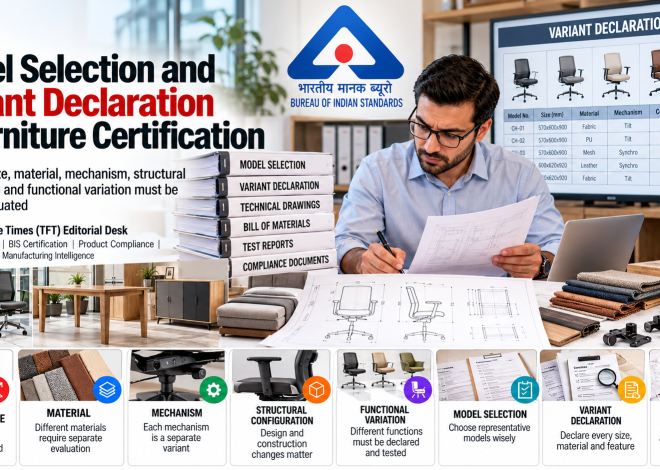
10. Prepare a model and variant matrix
Furniture companies frequently sell collections rather than individual products. Certification requires those collections to be translated into technically defined configurations.
A model matrix could include:
| Controlled field | Example |
|---|---|
| Commercial model | Axis Work Chair |
| Internal model code | WC-AX-01 |
| Product category | Work chair |
| Back type | Mesh |
| Base | Nylon, five-star |
| Armrests | Height adjustable |
| Mechanism | Synchro-tilt |
| Column | Declared gas-lift specification |
| Castors | Declared size and material |
| Seat construction | Moulded foam on defined support |
| Dimensions | Controlled drawing reference |
| Factory | Named manufacturing location |
| Drawing revision | Rev. 03 |
| Bill-of-material revision | BOM-AX-03 |
| Requested certification scope | Precisely defined models and variants |
Why variants matter
The following changes may affect product performance:
- Metal versus wooden frame.
- Nylon versus aluminium base.
- Fixed versus adjustable armrests.
- Four-leg versus cantilever construction.
- Small versus large table spans.
- Open shelving versus drawer storage.
- Standard versus storage bed.
- Fixed versus folding structure.
- Different joints or fasteners.
- Alternative gas lifts or mechanisms.
- Different panel grades or thicknesses.
The manufacturer should identify whether variants may be grouped and which representative samples are required under the current BIS product-specific instructions.
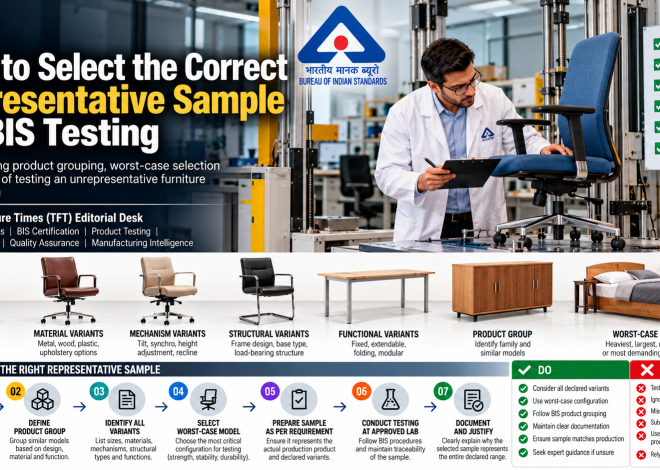
11. Select the representative sample carefully
Testing the easiest or strongest product is not necessarily sufficient.
The selected sample should represent the requested certification scope. Depending on the applicable grouping guidelines, BIS may require a representative or technically demanding configuration.
The most challenging configuration may be influenced by:
- Size.
- Unsupported span.
- Height.
- Width.
- Slenderness.
- Joint design.
- Adjustment mechanism.
- Material thickness.
- Number of moving components.
- Structural loading path.
- Intended use.
- Stability characteristics.
A taller storage unit may present a different condition from a shorter version. A larger table may place greater demand on the frame. A chair with multiple adjustments may not be adequately represented by a fixed configuration.
The rationale for sample selection should be documented.
12. Prepare controlled engineering drawings
A certification drawing should be more than an attractive visual.
It should enable the manufacturer, laboratory and inspecting authority to identify the product and understand its critical construction.
Depending on the product, controlled drawings may need to show:
- Overall dimensions.
- Component dimensions.
- Material descriptions.
- Section sizes.
- Material thicknesses.
- Joint locations.
- Fastener types.
- Mechanisms.
- Load-bearing members.
- Guardrails or access systems.
- Drawer and door arrangements.
- Relevant gaps and openings.
- Product codes.
- Drawing number.
- Revision number.
- Approval date.
Drawings should match the submitted sample and actual factory production.
A revision-control system should prevent outdated drawings from remaining on the production floor.
13. Create an accurate bill of materials
The bill of materials connects the product design to the purchased components and factory production.
It should identify critical inputs such as:
- Timber species or grade where relevant.
- Engineered-wood panel type and thickness.
- Metal material and section.
- Plastic components.
- Adhesives.
- Welding consumables.
- Fasteners.
- Hinges.
- Drawer slides.
- Castors.
- Gas lifts.
- Chair mechanisms.
- Foam specifications.
- Upholstery materials.
- Mattress-support components.
- Surface treatments.
- Coatings.
- Glass or other functional materials.
The bill of materials should use traceable internal codes and controlled revisions.
If the laboratory sample contains a particular mechanism, but the bill of materials permits several technically different mechanisms without documented equivalence, the requested scope may become unclear.
14. Control suppliers and incoming materials
The quality of finished furniture depends on the consistency of its components.
Manufacturers should establish:
- Approved-supplier lists.
- Purchase specifications.
- Supplier evaluation criteria.
- Incoming inspection plans.
- Material identification.
- Batch or lot traceability where appropriate.
- Procedures for rejected materials.
- Controls over supplier changes.
- Periodic verification of critical inputs.
- Storage and handling requirements.
A supplier catalogue is not a substitute for incoming control.
For critical components, the manufacturer should know exactly what specification was ordered, what was received, how it was inspected and where it was used.
15. Understand Normal and Simplified Procedures
BIS Scheme-I certification guidance has historically provided application routes commonly described as the Normal Procedure and the Simplified Procedure. Availability and product eligibility must be confirmed against current BIS directions.
Normal Procedure
Under the Normal Procedure, BIS processes the application through the prescribed evaluation route, including factory assessment and product testing or sampling as applicable.
The applicant should be ready with:
- Complete documents.
- Available production.
- Operational machinery.
- Required testing facilities.
- Calibrated equipment.
- Competent staff.
- Representative samples.
- Quality-control records.
Simplified Procedure
Under the Simplified Procedure, an eligible applicant generally submits an acceptable conforming test report from a BIS-recognized third-party laboratory with the application.
However, simplified does not mean reduced compliance.
It does not automatically remove:
- Factory assessment.
- Document verification.
- Manufacturing-capability requirements.
- Testing-facility obligations.
- Product-grouping requirements.
- Continuing conformity.
- Surveillance.
- Licence conditions.
The applicant should confirm:
- Whether the furniture standard is currently eligible.
- Whether the laboratory is recognized for the relevant standard and tests.
- Whether the report remains acceptable and valid.
- Whether the tested sample represents the requested scope.
- Whether all model details agree with the application.
The current BIS Product Certification Process should be reviewed before choosing an application route.
16. Apply through the official BIS system
Applications are generally submitted through the official BIS online platform.
Before submission, the manufacturer should organize the required information and documents. The precise list depends on the applicant, product, scheme and factory location, but preparation may include:
- Legal identity of the applicant.
- Factory address.
- Registration documents.
- Manufacturing-process description.
- Factory layout.
- Machinery list.
- Test-equipment list.
- Calibration records.
- Quality-control personnel details.
- Product description.
- Model and variant list.
- Engineering drawings.
- Bill of materials.
- Raw-material information.
- Test report, where applicable.
- Marking details.
- Authorization documents.
- Authorized Indian Representative documents for foreign applicants, where applicable.
- Applicable fees.
Documents should be reviewed for consistency before upload.
An accurately completed application can reduce clarification cycles. An application containing vague or contradictory information may create delays even when the underlying product is capable of passing the technical requirements.
17. Laboratory testing
Furniture testing assesses performance under standardized conditions. It may reveal weaknesses that ordinary visual inspection cannot detect.
Depending on the product and applicable standard, testing may examine requirements involving:
- Dimensions.
- Stability.
- Static strength.
- Durability.
- Impact resistance.
- Structural integrity.
- Functional performance.
- Safety-related construction.
- Openings and gaps.
- Entrapment risks where applicable.
- Guarding for bunk beds.
- Performance of supports, joints or mechanisms.
- Product-specific marking and instructions.
The exact tests, loads, cycles, conditioning and acceptance criteria are determined by the applicable Indian Standard and certification instructions.
Choosing a laboratory
Before sending a sample, confirm that the laboratory:
- Is recognized by BIS.
- Has recognition for the relevant Indian Standard.
- Can perform the complete required test programme.
- Can accommodate the product’s dimensions.
- Understands the sampling and identification requirements.
- Can clearly describe the sample in the report.
- Will issue the report in the required format.
Recognition for one product does not automatically mean recognition for every furniture standard or test.
Sample identification
The test sample should be connected to:
- Model code.
- Drawing number.
- Drawing revision.
- Bill-of-material revision.
- Construction details.
- Dimensions.
- Photographs.
- Factory.
- Sample-selection record.
If the report says only “office chair” without adequately identifying the certified configuration, questions may arise regarding the scope it supports.
18. Pre-compliance testing
Official testing should not be the first time a manufacturer evaluates the product against the standard.
Pre-compliance testing allows the company to:
- Detect structural weaknesses.
- Identify instability.
- Verify dimensions.
- Evaluate joints.
- Compare variants.
- Improve assembly instructions.
- Confirm test-equipment readiness.
- Train quality personnel.
- Correct documentation.
- Reduce the probability of formal test failure.
If a product fails internally, the company should not merely reinforce the test sample. It should identify the root cause and update:
- The design.
- Drawing.
- Bill of materials.
- Work instruction.
- Inspection plan.
- Supplier specification.
- Production tooling.
- Training programme.
The improved design must become the normal production design.
19. Factory inspection and assessment
The factory assessment verifies whether the manufacturer can consistently produce the declared product in conformity with the applicable standard and BIS requirements.
The assessment may include examination of:
- Manufacturing operations.
- Production machinery.
- Process controls.
- Raw-material receipt and inspection.
- In-process inspection.
- Finished-product testing.
- Testing facilities.
- Calibration.
- Quality-control staff.
- Technical documentation.
- Production records.
- Rejection controls.
- Product traceability.
- Storage.
- Marking arrangements.
- Sample availability.
- Compliance with the Scheme of Inspection and Testing.
What inspectors may expect to see
The factory should be able to demonstrate a complete path from incoming materials to the finished product.
For example:
- A purchase specification identifies a chair mechanism.
- The incoming material is checked against that specification.
- The approved mechanism is recorded in the bill of materials.
- Production uses the current drawing and work instruction.
- The finished chair is inspected and tested.
- Records identify the product and result.
- Nonconforming units are segregated.
- Only conforming products are released.
- Marking is applied under controlled conditions after licensing.
The system should function in practice. A quality manual written solely for inspection, but not followed by the factory, is unlikely to provide reliable conformity.
20. Factory test facilities and calibration
Manufacturers must review the current product manual and Scheme of Inspection and Testing to determine what testing facilities are required.
The factory should maintain an equipment register showing:
- Equipment name.
- Identification number.
- Range and capacity.
- Location.
- Calibration status.
- Calibration date.
- Next due date.
- Maintenance history.
- Operating instructions.
- Responsible person.
Equipment must be suitable for the intended measurement or test.
Calibration certificates should correspond to the actual equipment in use. Serial numbers, ranges and dates should be checked before inspection.
Staff members conducting tests should understand:
- The test method.
- Sample preparation.
- Equipment setup.
- Acceptance criteria.
- Recording requirements.
- Actions following failure.
21. Scheme of Inspection and Testing
The Scheme of Inspection and Testing is central to continuing conformity.
It can prescribe or guide matters such as:
- Levels of control.
- Frequency of testing.
- Factory testing.
- External laboratory testing.
- Record maintenance.
- Control of nonconforming production.
- Marking.
- Product release.
The manufacturer should translate these requirements into operational documents that factory personnel can follow.
These may include:
- Incoming-material inspection formats.
- In-process inspection sheets.
- Finished-product inspection records.
- Test registers.
- Calibration registers.
- Rejection reports.
- Corrective-action records.
- Marking-control records.
- Production batch records.
- Complaint registers.
Records should show real activity. Identical results repeated without variation can raise questions about whether meaningful testing was conducted.
22. Grant of the BIS licence
A BIS licence may be granted after BIS is satisfied that the applicable requirements have been met.
The licence identifies important information such as:
- The licensee.
- Manufacturing location.
- Applicable Indian Standard.
- Approved product scope.
- Licence number.
- Validity or renewal conditions.
Manufacturers should review the granted scope carefully.
If a model, material, size or variant is not covered, it should not be presented as certified merely because it resembles an approved product.
A business should establish internal controls to ensure that sales, dealers, retailers, packaging teams and e-commerce managers use the certification claim accurately.
23. Using the BIS Standard Mark
The Standard Mark is not a general company-quality logo. Its use is connected to the licence, applicable standard and certified product scope.
Manufacturers should control:
- The approved artwork.
- Licence number.
- Indian Standard number.
- Product label.
- Packaging.
- Product literature.
- Website claims.
- Dealer advertisements.
- Online marketplace listings.
- Catalogues.
- Social-media promotions.
Common marking risks
- Printing the mark before a licence is granted.
- Applying it to an unapproved model.
- Using the wrong standard number.
- Using another factory’s licence.
- Omitting required information.
- Continuing to mark during suspension.
- Allowing distributors to modify the marking.
- Advertising an entire collection as certified when only selected models are covered.
Only products manufactured under the approved scope and conformity system should bear the mark.
24. Scope extension and new variants
Furniture companies continuously introduce new sizes, materials, mechanisms and finishes.
A new colour may be primarily aesthetic, while a new frame, joint, base or mechanism may materially affect conformity. The manufacturer must determine whether a proposed change remains within the approved scope or requires formal inclusion, additional testing or a scope extension.
Changes that require careful review include:
- New model families.
- Larger or smaller dimensions.
- New structural materials.
- Alternative panel thickness.
- Different leg or base design.
- New gas lift.
- New chair mechanism.
- Different fasteners.
- New drawer system.
- Storage additions.
- Folding or adjustment mechanisms.
- Major supplier changes.
- New manufacturing location.
BIS publishes guidelines dealing with changes to licence scope as part of its product-certification framework. Manufacturers should obtain approval where required rather than assuming that a commercially related product is automatically covered.
25. Continuing compliance after licensing
The licence is the beginning of an ongoing conformity obligation.
The manufacturer must continue producing within the approved scope and complying with applicable requirements.
Continuing compliance may involve:
- Routine inspections.
- Factory testing.
- Periodic external testing.
- Record maintenance.
- Calibration.
- Supplier control.
- Complaint investigation.
- Corrective action.
- Control of nonconforming products.
- Marking control.
- Licence renewal.
- Factory surveillance.
- Market surveillance.
- Sample testing.
- Scope management.
The official BIS certification-process resources include guidance addressing renewal, surveillance, retesting, scope changes and nonconformity.
A company that performs well only during the initial inspection is not operating a sustainable conformity system.
26. Surveillance and market samples
BIS may monitor licensed products through factory or market surveillance in accordance with applicable procedures.
A sample may therefore be evaluated after the licence has been granted.
This means the product sold through normal commercial channels must match the approved construction—not a specially prepared certification sample.
Manufacturers should maintain readiness for:
- Inspection of production.
- Review of records.
- Sample selection.
- Market sampling.
- Testing.
- Investigation of complaints.
- Corrective action.
- Verification of marking.
Failure to maintain conformity may lead to regulatory and licensing consequences under applicable rules and procedures.
27. Managing nonconforming products
Every manufacturer will eventually encounter defects or unusual results. A strong quality system does not pretend that failures never occur. It identifies and controls them.
The procedure should define:
- How nonconforming material is identified.
- Where it is segregated.
- Who can authorize rework.
- How reworked products are re-inspected.
- How scrap is controlled.
- How root causes are investigated.
- How corrective action is verified.
- Whether previously dispatched products may be affected.
- Whether BIS notification or other action is required.
Products that fail applicable requirements should not bear the Standard Mark or enter the market as conforming goods.
28. Complaint and warranty intelligence
Customer complaints should be treated as compliance information.
Manufacturers should analyze:
- Structural breakage.
- Instability.
- Joint loosening.
- Mechanism failure.
- Castor or base failure.
- Drawer malfunction.
- Bed-support failure.
- Bunk-bed safety concerns.
- Assembly errors.
- Missing fasteners.
- Incorrect instructions.
- Labelling problems.
- Repeated component defects.
A complaint register should record:
- Product and model.
- Manufacturing date or batch.
- Nature of failure.
- Customer location.
- Investigation.
- Root cause.
- Corrective action.
- Replacement or repair.
- Wider risk assessment.
Warranty data can reveal a conformity problem before it becomes a major market issue.
29. Internal audits and management review
A certification-ready company should conduct periodic internal audits.
The audit should verify whether:
- Current standards and manuals are available.
- Approved drawings are being used.
- Bills of materials match production.
- Suppliers remain controlled.
- Test equipment is calibrated.
- Required tests are conducted.
- Records are complete.
- Marking is correct.
- Complaints are investigated.
- Previous corrective actions remain effective.
- New variants have been reviewed.
- The licence scope matches commercial claims.
Management should review compliance performance, not leave it entirely at the factory floor.
Senior leadership should understand:
- Upcoming calibration dates.
- Test failures.
- Product changes.
- Supplier risks.
- Surveillance findings.
- Customer complaints.
- Scope-extension needs.
- Renewal status.
- Training needs.
- Resources required for compliance.
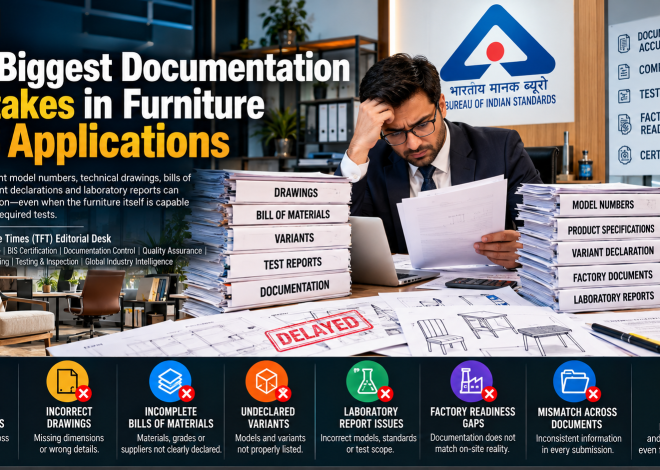
30. Common reasons certification applications are delayed
Manufacturers frequently encounter delays because of preparation gaps rather than fundamental product weakness.
Common problems include:
- Incorrect standard selection.
- Incomplete application.
- Undeclared variants.
- Unclear product grouping.
- Unrepresentative sample.
- Inconsistent model codes.
- Drawings that do not match production.
- Missing material specifications.
- Uncontrolled component substitutions.
- Incomplete laboratory reports.
- Test failures.
- Missing machinery.
- Inadequate testing facilities.
- Expired calibration.
- Untrained factory personnel.
- Missing production records.
- Poor traceability.
- Incorrect marking proposals.
- Unclear outsourcing.
- Unprepared factory inspection.
The best way to reduce delay is to conduct a serious readiness audit before submitting the application.
31. A hypothetical certification example
Consider an Indian manufacturer producing the “Prime Office Chair” collection.
The range includes:
- Nylon and aluminium bases.
- Fixed and adjustable armrests.
- Mesh and upholstered backs.
- Two mechanisms.
- Two gas-lift specifications.
- With-headrest and without-headrest options.
The company tests only one configuration: mesh back, fixed arms, nylon base and standard mechanism.
It then requests certification for the entire collection.
During document review or factory assessment, BIS may find that:
- The aluminium base is not declared.
- The adjustable armrest drawing is missing.
- The heavy-duty mechanism uses another supplier.
- The gas-lift code differs from the test sample.
- The headrest model has different dimensions.
- Factory records do not distinguish the variants.
Even if the tested chair passed, the evidence may not support every requested configuration.
The company may need to:
- Clarify the scope.
- Correct the model matrix.
- Update drawings.
- Provide additional technical evidence.
- Submit more samples.
- Undertake further testing.
- Exclude unsupported variants.
The lesson is that certification begins with product-definition discipline.
32. A manufacturer’s BIS readiness checklist
Regulatory readiness
01 — Confirm the product is covered by the relevant QCO.
02 — Obtain the original order and every applicable amendment.
03 — Review the Transition Facilitation Order and current exemptions.
04 — Confirm the correct Indian Standard.
05 — Obtain the latest standard, amendments and product manual.
06 — Review the current Scheme of Inspection and Testing.
Product readiness
07 — Freeze the production design.
08 — Prepare a complete model and variant matrix.
09 — Create controlled engineering drawings.
10 — Create a controlled bill of materials.
11 — Identify critical components and suppliers.
12 — Select technically representative samples.
13 — Conduct pre-compliance testing.
Factory readiness
14 — Verify that all declared machinery is operational.
15 — Install required testing facilities.
16 — Calibrate all relevant equipment.
17 — Train quality and production personnel.
18 — Prepare current production and inspection records.
19 — Establish traceability.
20 — Control nonconforming products.
21 — Document outsourced processes.
22 — Conduct a mock factory inspection.
Application readiness
23 — Confirm the correct application route.
24 — Verify laboratory recognition and report coverage.
25 — Align all legal, factory and product documents.
26 — Upload accurate information through the official system.
27 — Keep personnel and production available for assessment.
Post-licence readiness
28 — Control use of the Standard Mark.
29 — Maintain testing and inspection records.
30 — Manage design and supplier changes.
31 — Prepare for surveillance and market sampling.
32 — Monitor licence validity and renewal requirements.
33. What small furniture manufacturers should do
BIS compliance may feel particularly demanding for micro, small and medium-sized furniture manufacturers.
Many SMEs have strong craftsmanship but limited formal documentation. They may depend on experienced workers whose knowledge is not recorded. Product changes may be communicated verbally. Materials may be purchased from familiar suppliers without detailed specifications.
The transition to formal compliance should begin with basic discipline:
- Give every model a code.
- Prepare a controlled drawing.
- Record the bill of materials.
- Define acceptable components.
- Document production steps.
- Identify critical inspections.
- Maintain calibration records.
- Record test results.
- Separate rejected products.
- Train at least two responsible employees.
- Conduct internal audits.
- Seek product-specific guidance early.
SMEs should avoid copying a large company’s quality manual without understanding it. A smaller but genuinely followed system is more valuable than a large collection of unused documents.
Where applicable, manufacturers may also explore recognized cluster-based or shared testing arrangements permitted under current BIS guidance, but eligibility and conditions must be confirmed officially.
34. The strategic business value of certification
BIS certification should not be viewed only as a compliance cost.
A well-implemented system can help a manufacturer:
- Improve product consistency.
- Reduce avoidable failures.
- Control suppliers.
- Strengthen engineering documentation.
- Reduce warranty claims.
- Improve traceability.
- Support institutional sales.
- Increase retailer confidence.
- Demonstrate manufacturing discipline.
- Protect brand reputation.
- Prepare for exports and other market requirements.
- Build consumer trust.
Certification cannot guarantee that every customer will prefer the product, but it can strengthen the foundation on which quality and trust are built.
For India’s fragmented furniture industry, formal standards can also encourage companies to move from informal product knowledge toward documented engineering and repeatable production.
Conclusion: Treat BIS certification as a permanent manufacturing system
The most successful furniture manufacturers will not approach BIS certification as a short project ending with a licence.
They will integrate conformity into:
- Product development.
- Procurement.
- Factory operations.
- Quality control.
- Supplier management.
- Marketing.
- Customer service.
- Management review.
A test report answers an important question: did the tested sample meet the evaluated requirements?
A continuing certification system answers a larger question: can the factory repeatedly manufacture the approved product in conformity with the applicable standard?
That second question is what manufacturers must prepare to answer.
The furniture may be beautifully designed. The components may be strong. The factory may employ experienced craftspeople. But successful certification depends on connecting those strengths through accurate documents, representative testing, controlled production and verifiable evidence.
BIS certification is not simply permission to place a mark on furniture. It is a continuing commitment to manufacture what was declared, test what is produced and supply what was approved.
Regulatory notice: This article provides general editorial information and does not constitute legal, regulatory or certification advice. The Furniture Quality Control Order, amendments, transition provisions, Indian Standards, product manuals, application procedures and exemptions may change. Before making production, import, inventory or sales decisions, consult the latest official BIS documents, the responsible certification authority and an appropriately recognized laboratory.
The Furniture Times (TFT) & Furniture Industry Search Engine (FISE)
“TFT tells their story. FISE helps the world find them.”
FurniReviewology helps the world trust them.
The furniture industry ecosystem is a $1 trillion industry ecosystem.
Be compliant. Be visible. Be searchable. Be trusted.