
Top 8 SEO Services Every Furniture Store Should Consider
Why technical performance, local visibility, product optimization, trusted content and AI discoverability are becoming essential for furniture retailers competing in the digital marketplace
By The Furniture Times (TFT) Editorial Desk | Digital Visibility Intelligence | Furniture Retail & E-Commerce
The furniture-buying journey increasingly begins long before a customer enters a showroom.
Consumers search for sofas that fit small apartments, dining tables suitable for large families, ergonomic office chairs, outdoor furniture capable of withstanding local weather and mattresses that match specific comfort preferences. They compare dimensions, materials, prices, delivery times, warranties, customer reviews and store locations before contacting a retailer.
For furniture stores, this creates an enormous opportunity—but also a serious visibility challenge.
A retailer may have excellent products, competitive prices and decades of industry experience, yet remain invisible when customers search online. A beautifully designed website does not automatically attract qualified visitors. Publishing hundreds of products does not guarantee that search engines will index or understand them. Even a well-known local showroom can lose potential customers if its location, opening hours, inventory and reputation are not presented correctly across digital platforms.
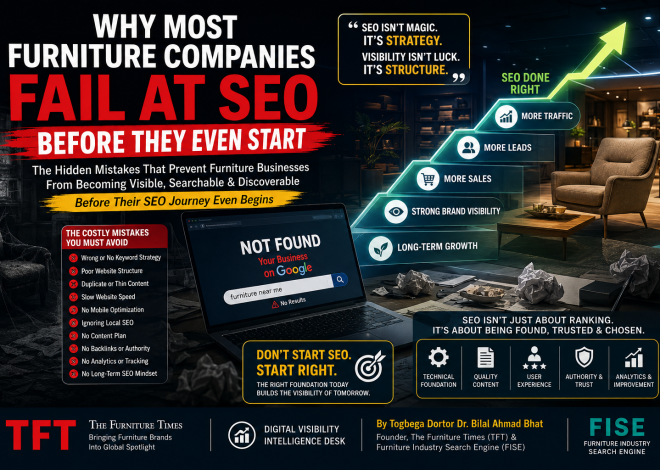
Search engine optimization, commonly known as SEO, is therefore no longer an optional promotional activity. It is part of the commercial infrastructure of a modern furniture business.
However, SEO is not one service. It is a coordinated system covering website health, product information, local discovery, content, reputation, authority, data and increasingly artificial-intelligence visibility.
The following eight SEO services should form the foundation of a serious furniture-store visibility strategy.
1. Comprehensive SEO Audit and Search Strategy
The first service every furniture retailer should consider is a comprehensive SEO audit.
An audit examines the present condition of a website before money is spent on content, links or advertising. Without this assessment, a retailer may invest heavily in marketing while technical errors continue preventing important pages from being crawled, indexed or ranked.
A furniture-store audit should evaluate more than homepage titles and keyword usage. It should investigate the entire commercial structure of the website.
What a furniture SEO audit should examine
A professional audit should review:
- Website crawling and indexing
- XML sitemaps
- Robots.txt instructions
- Broken links and error pages
- Duplicate product and category pages
- Canonical tags
- Mobile usability
- Page speed and Core Web Vitals
- Navigation and internal linking
- Category hierarchy
- Product-page quality
- Location-page quality
- Structured data
- Image optimization
- Backlink quality
- Search visibility
- Competitor performance
- Google Search Console data
- Analytics and conversion tracking
This investigation should reveal which pages are generating impressions, which search terms are bringing visitors and where users abandon the buying journey.
For example, a store may discover that its “outdoor dining sets” category receives significant visibility but poor click-through rates. The problem could be a weak page title, an unclear description or prices that are missing from search displays.
Another retailer may learn that search engines are indexing thousands of filter combinations—such as color, size, material and price variations—while overlooking important category pages.
Strategy must follow diagnosis
An audit has little value if it ends with a long list of technical problems and no commercial priorities. The service should translate findings into a clear strategy.
The strategy should identify:
- The store’s most valuable product categories
- Priority geographic markets
- High-intent customer searches
- Seasonal opportunities
- Commercial pages requiring improvement
- Informational content gaps
- Technical corrections
- Authority-building opportunities
- Measurable performance targets
Furniture businesses should insist on an implementation roadmap divided into urgent, short-term and long-term actions.
The objective is not simply to “get more traffic.” The objective is to attract people who are likely to visit a showroom, request a quotation, call the sales team or purchase furniture online.
2. Technical SEO and Website Performance Optimization
Technical SEO helps search engines access, render, understand and index a website correctly.
This service is particularly important for furniture retailers because their websites often contain large product catalogs, high-resolution images, multiple product variations and complex filters. These features can create crawling, speed and duplication problems.
Google advises website owners to ensure that sites are secure, fast, accessible and functional across devices. It also recommends using tools such as URL Inspection to understand how Google views individual pages. Google’s SEO guide for web developers
Technical problems common to furniture websites
Furniture retailers frequently encounter:
- Product pages that cannot be crawled
- Incorrect
noindexinstructions - Important content hidden behind JavaScript
- Duplicate URLs created by filters
- Discontinued products returning confusing errors
- Slow-loading galleries
- Oversized image files
- Missing canonical tags
- Broken internal links
- Incorrect website migrations
- Poor mobile navigation
- Incomplete XML sitemaps
- Unnecessary redirect chains
- Category pages buried too deeply in the site
A website can look attractive to a customer and still be difficult for a search engine to process.
Page performance matters
Furniture websites rely heavily on visual presentation. Customers want to see upholstery, wood grain, finishes, mechanisms and room settings. Retailers consequently upload numerous large images and videos, sometimes without compression or modern delivery formats.
The result may be a visually impressive but painfully slow website.
Technical optimization should include:
- Proper image dimensions
- Modern image formats
- Responsive images
- Lazy loading where appropriate
- Browser caching
- Content-delivery optimization
- Reduced script loading
- Stable page layouts
- Improved server response
- Mobile-first testing
Performance must be balanced with presentation. The answer is not to remove every product image; it is to deliver essential visual content efficiently.
Managing discontinued furniture products
Furniture collections change regularly. Finishes are replaced, seasonal lines end and suppliers discontinue models. Simply deleting every unavailable product page can waste the authority and traffic that page has accumulated.
Depending on the situation, an SEO service may recommend:
- Keeping the page live and marking the product unavailable
- Suggesting close alternatives
- Redirecting to a genuine replacement
- Redirecting to the most relevant category
- Returning the correct status when no replacement exists
The chosen action should serve customers honestly. Redirecting every discontinued sofa to the homepage, for example, usually creates a poor experience.
Technical SEO may not be the most visible marketing activity, but it provides the foundation on which every other search initiative depends.
3. Local SEO and Showroom Visibility
Most furniture purchases still have an important local dimension. Even when customers begin online, many want to see, touch or test furniture before making a decision.
That makes local SEO essential for retailers operating showrooms, warehouses, studios, galleries or regional delivery services.
Local optimization helps a store appear when people search for phrases such as:
- Furniture store near me
- Sofa showroom in Kuala Lumpur
- Office furniture supplier in Johor
- Outdoor furniture shop in Penang
- Custom wardrobe company near me
- Dining-table showroom open today
Google identifies Business Profiles and Google Maps as important surfaces through which e-commerce and local business information can appear. Google’s guidance on where e-commerce content can appear
What local SEO should include
A complete local SEO service should cover:
- Google Business Profile optimization
- Accurate business name, address and telephone details
- Correct business categories
- Showroom opening hours
- Holiday-hour updates
- Product and showroom photographs
- Service-area information
- Map accuracy
- Local landing pages
- Customer-review management
- Local citations
- Location-specific content
- Questions and answers
- Tracking of calls, directions and enquiries
Each showroom should have a dedicated webpage containing useful information rather than only a location name and map.
A strong location page may include:
- Full address
- Telephone number
- Opening hours
- Parking information
- Available product categories
- Showroom photographs
- Public-transport directions
- Delivery areas
- Nearby landmarks
- Appointment options
- Customer reviews
- Frequently asked questions
Multiple showrooms require separate optimization
Furniture chains should not place every branch on one overcrowded “Contact Us” page. Each location should be discoverable individually.
A customer searching in Shah Alam has different needs from someone searching in Johor Bahru. Separate location pages help search engines associate each showroom with its geographic market and available services.
Retailers should avoid producing dozens of almost identical city pages with only the location name changed. Every page should contain genuine information about that showroom or service area.
Reviews influence trust
Local SEO is closely connected with reputation. Customers use reviews to evaluate delivery reliability, assembly quality, product durability and after-sales service.
Furniture retailers should establish a responsible system to:
- Request honest reviews after completed purchases
- Respond professionally to positive and negative feedback
- Investigate recurring service complaints
- Avoid purchasing fabricated reviews
- Avoid offering rewards for positive-only ratings
- Use feedback to improve operations
A strong local presence can transform search activity into showroom visits, telephone calls and consultation bookings.
4. On-Page SEO for Categories and Product Pages
On-page SEO improves the visible content and underlying information of individual webpages.
For furniture stores, the most commercially important pages are usually category, subcategory, collection and product pages. These pages must communicate clearly to customers and search systems.
Category pages need more than product grids
A category page containing only product photographs and prices may provide insufficient context.
An optimized category page should clearly explain:
- What products are included
- Available materials
- Common sizes and configurations
- Style choices
- Intended applications
- Delivery considerations
- Customization options
- Relevant warranties
- Links to related categories
A “modular sofa” category, for example, could explain configuration options, room-measurement considerations, upholstery choices and how additional modules can be added.
The content should help customers make decisions. It should not be a repetitive paragraph created solely to insert keywords.
Product pages require complete information
Furniture is a considered purchase. Customers need more information than they would for a small, inexpensive item.
A strong product page should contain:
- Clear product name
- Accurate description
- Dimensions
- Materials
- Available colors and finishes
- Product photographs
- Close-up images
- Care instructions
- Assembly requirements
- Weight or load information where relevant
- Delivery estimates
- Warranty details
- Return information
- Price and availability
- Product variations
- Customer reviews
- Related products
- Frequently asked questions
Descriptions should be original. Copying the manufacturer’s description across multiple retailer websites makes it difficult for one store to demonstrate unique value.
Retailers can add useful information based on their own experience, such as room suitability, styling possibilities, maintenance requirements and common customer questions.
Search intent must guide optimization
Not every search has the same purpose.
A person searching for “how to choose a dining-table size” is researching. Someone searching for “six-seater solid-wood dining table price” may be closer to purchasing.
SEO specialists should map different search intentions to appropriate pages:
- Educational searches → guides and articles
- Broad commercial searches → category pages
- Specific product searches → product pages
- Geographic searches → location pages
- Brand searches → brand or collection pages
- Comparison searches → buying guides
- Service searches → delivery, restoration or customization pages
This prevents multiple pages from competing unnecessarily for the same query and creates a more coherent buying journey.
5. E-Commerce SEO, Product Data and Structured Markup
E-commerce SEO helps product information appear accurately across search, image and shopping-related environments.
Furniture retailers must provide product data in formats that machines can understand. A customer can interpret a photograph and a promotional sentence, but a search system needs clearly structured information about the product, offer, price, availability and seller.
Product structured data
Google explains that Product structured data can make pages eligible for richer search appearances containing information such as price, availability, ratings, shipping and returns. It distinguishes between product snippets and merchant listings, depending on whether the product can be purchased directly from the page. Google’s Product structured-data documentation
Relevant structured-data types may include:
- Product
- Offer
- AggregateRating
- Review
- Organization
- LocalBusiness
- BreadcrumbList
- MerchantReturnPolicy
- OfferShippingDetails
Markup must match visible page content. A store should never mark an unavailable product as being in stock or display review data in code that customers cannot see.
Google also warns that valid structured data does not guarantee a rich result. It establishes eligibility, but search systems still decide how a page will appear. Google’s structured-data guidelines
Google Merchant Center and product feeds
For retailers selling online, product-feed management should be included in the service.
Google recommends using both on-page structured data and Merchant Center feeds where possible. This can improve Google’s understanding of products and increase eligibility across relevant shopping experiences. Google’s guidance on sharing product data
A furniture product feed may contain:
- Product identification
- Product title
- Description
- Landing-page URL
- Image URL
- Price
- Availability
- Brand
- Condition
- Shipping information
- Product category
- Variants
- Store-level inventory where supported
Prices and availability must remain synchronized between the website and feed. A customer who sees one price in search and another on the website may lose trust immediately.
Furniture variants require careful management
Furniture products often come in different:
- Upholstery fabrics
- Leather grades
- Wood finishes
- Dimensions
- Configurations
- Leg colors
- Orientation options
- Cushion types
The SEO service should determine whether variants require individual URLs, one configurable page or a combined product-group structure.
Creating separate pages for every minor color difference can produce duplication. Combining all materially different versions into a confusing single page can also reduce discoverability. The correct structure depends on inventory, customer demand and how independently each variation is sold.
6. Furniture Content Strategy and Editorial SEO
Content SEO helps furniture stores reach customers before they have selected a specific product.
The strongest furniture content answers real questions encountered during planning, purchasing, delivery, use and maintenance.
Valuable content opportunities
A furniture retailer might publish:
- Sofa-size selection guides
- Dining-table measurement guides
- Material comparisons
- Leather-care advice
- Outdoor-furniture maintenance guides
- Office ergonomics articles
- Small-apartment furniture ideas
- Room-planning resources
- Mattress comparison guides
- Commercial-furniture buying guides
- Delivery and access checklists
- Furniture assembly guidance
- Trend analysis
- Manufacturer profiles
- Sustainability information
- Product-care videos
A customer asking how to measure a doorway before ordering a sofa presents a meaningful commercial opportunity. A useful article can answer the question and guide that reader toward suitable products.
Content should connect to products
Many retailers publish articles that receive traffic but contribute little to business outcomes because the articles are disconnected from the catalog.
Editorial content should link naturally to:
- Relevant categories
- Suitable products
- Measurement tools
- Showroom appointments
- Material samples
- Design consultations
- Delivery information
Product and category pages should also link back to useful guides.
This internal linking helps customers move from education to consideration and eventually to purchase.
Original expertise matters
Furniture retailers possess valuable knowledge that generic content producers often lack. Salespeople understand common customer objections. Delivery teams know which access problems occur most frequently. Designers recognize layout errors, while after-sales teams know which maintenance questions appear after purchase.
An effective SEO service should capture this internal expertise.
The result should be content based on genuine experience, not large volumes of generic text. Original photographs, diagrams, measurements, demonstrations and case studies can make content significantly more useful and credible.
Google’s e-commerce guidance specifically identifies company stories, product descriptions, category descriptions, customer reviews, return information and service touchpoints as useful forms of content for shoppers. Google’s e-commerce content guidance
7. Authority Building, Digital PR and Ethical Link Acquisition
Search visibility is influenced not only by what a furniture store says about itself but also by whether other credible sources mention or reference it.
Authority-building services seek to earn legitimate coverage, citations and links from relevant websites.
Potential sources include:
- Furniture publications
- Interior-design media
- Architecture websites
- Local news organizations
- Trade associations
- Manufacturers
- Property publications
- Hospitality media
- Sustainability platforms
- Business directories
- Design-event websites
- Supplier partner pages
Digital PR creates search and brand value
A furniture store may earn coverage by publishing or contributing:
- Original market research
- Consumer buying insights
- New showroom announcements
- Product launches
- Sustainability initiatives
- Local employment stories
- Design collaborations
- Community projects
- Expert commentary
- Trend reports
- Case studies
- Awards and certifications
The purpose is not to distribute empty promotional announcements across hundreds of low-quality websites. Effective digital PR gives publishers a genuine reason to discuss the company.
Link-building warning signs
Furniture businesses should be cautious when agencies promise:
- Hundreds of backlinks within days
- Guaranteed first-page rankings
- Links from unrelated websites
- Secret ranking methods
- Automated directory submissions
- Paid links disguised as independent editorial coverage
- Large-scale guest posting with duplicate content
- Private networks created only to manipulate rankings
Google’s Search Essentials state that complying with technical requirements and best practices does not guarantee crawling, indexing or ranking. Any agency guaranteeing a specific position is therefore making a promise it cannot control. Google Search Essentials
A smaller number of relevant, editorially earned links can be more valuable than thousands of artificial ones.
Digital PR also delivers value beyond rankings. It builds recognition, referral traffic, credibility and evidence that AI systems may use when understanding a business.
8. AI Search Optimization, Brand Entity Building and Reputation SEO
The newest service furniture stores should consider is optimization for AI-assisted discovery.
Consumers increasingly ask conversational systems questions such as:
- Which furniture stores offer durable outdoor sets in Malaysia?
- What are the best sofa brands for small apartments?
- Which office-furniture suppliers provide installation?
- Where can I buy sustainable teak furniture?
- Which furniture retailer has reliable delivery and after-sales support?
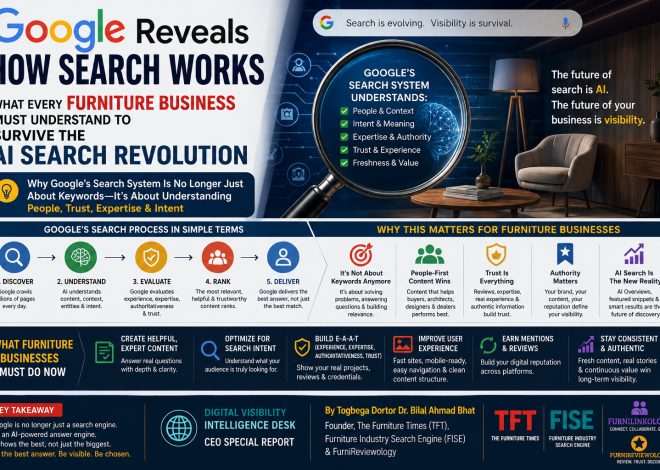
In these environments, visibility is no longer limited to ranking as one blue link. A brand must be understandable enough to be included in summaries, comparisons and recommendations.
AI visibility begins with clear business information
AI optimization is not achieved through a single special tag. It depends on creating a consistent, evidence-supported digital identity.
Furniture retailers should clearly publish:
- Official business name
- Location and service areas
- Product categories
- Brand relationships
- Delivery capabilities
- Warranty policies
- Return procedures
- Contact details
- Company history
- Leadership and editorial accountability where relevant
- Customer-support channels
- Certifications
- Independent media coverage
- Authentic customer reviews
This information should remain consistent across the company website, business profiles, industry directories, media coverage and trusted external platforms.
Searchable does not always mean recommendable
A brand may be indexed but still lack sufficient evidence to be confidently recommended.
Recommendation requires trust signals such as:
- Detailed product information
- Transparent pricing
- Verifiable reviews
- Clear policies
- Recognized industry listings
- Credible external mentions
- Consistent business information
- Demonstrated expertise
- Responsive customer service
- Accurate availability data
This is where traditional SEO, public relations, product data and review management converge.
Reputation SEO must be authentic
Agencies offering AI visibility should not create fake awards, fabricated reviews or misleading comparison articles. Such practices can create legal, ethical and reputational risks.
Instead, stores should develop a transparent review strategy, respond to customer concerns and document improvements. Platforms such as FurniReviewology can contribute to this wider trust ecosystem by helping consumers evaluate furniture brands through structured and meaningful feedback.
AI search optimization should be treated as an extension of strong digital fundamentals—not as a shortcut around them.
SEO Measurement: What Furniture Stores Should Track
Every SEO service should be connected to measurable commercial outcomes.
Traffic alone does not reveal whether a strategy is working. A furniture retailer needs to distinguish between general visitors and potential customers.
Important indicators include:
- Organic-search impressions
- Search-result clicks
- Visibility for priority categories
- Indexed product pages
- Non-brand search traffic
- Local map visibility
- Calls from search
- Direction requests
- Showroom appointment bookings
- Product enquiries
- Quotation requests
- Sample requests
- Add-to-cart activity
- Completed purchases
- Revenue from organic search
- Assisted conversions
- Returning visitors
- Product-feed errors
- Review volume and sentiment
- Referral traffic from media coverage
- AI referral traffic where identifiable
Retailers should establish a baseline before work begins. Reports should then explain what changed, why it changed and what actions will follow.
A monthly report filled with ranking charts but no connection to enquiries, showroom visits or sales provides an incomplete picture.
How to Choose the Right Furniture SEO Provider
Furniture SEO requires an understanding of both search technology and the furniture-buying journey.
Before hiring an agency or consultant, retailers should ask:
- Have you worked with e-commerce, furniture or other high-consideration products?
- Will you audit the website before proposing a campaign?
- Who will implement the technical changes?
- How will you optimize category and product pages?
- How will you manage discontinued products and variants?
- Can you support Merchant Center and product feeds?
- What is your approach to local showroom visibility?
- How do you earn backlinks and media coverage?
- How will success be measured?
- Who owns the content, accounts and data?
- How do you use artificial intelligence in content production?
- Can we review examples of reporting and previous work?
A professional provider should be willing to explain its process in understandable language. SEO is complex, but it should not be deliberately mysterious.
The furniture store should retain ownership of its:
- Domain
- Website
- Google Search Console account
- Analytics account
- Business Profile
- Merchant Center account
- Content
- Product data
- Advertising accounts
- Reporting history
A business should not become digitally dependent on an agency that controls its essential accounts.
A Practical 12-Month SEO Roadmap
SEO is usually most effective when implemented in a logical sequence.
Months 1–2: Audit and Measurement
- Complete technical and content audit
- Establish analytics and conversion tracking
- Connect Search Console
- Review Merchant Center
- Evaluate Business Profiles
- Benchmark priority search visibility
- Identify critical technical problems
- Map products, categories and locations
Months 3–4: Technical Foundation
- Correct crawling and indexing problems
- Improve sitemaps
- Resolve important duplicate pages
- Repair broken links
- Improve mobile usability
- Optimize page performance
- Correct redirects
- Establish discontinued-product procedures
Months 5–6: Commercial-Page Optimization
- Improve major category pages
- Rewrite priority product information
- Strengthen titles and descriptions
- Add internal links
- Improve product photography delivery
- Implement accurate structured data
- Correct product-feed errors
Months 7–8: Local and Reputation Growth
- Optimize showroom profiles
- Build complete location pages
- Standardize business information
- Begin an ethical review program
- Respond systematically to feedback
- Publish delivery and service policies
Months 9–10: Editorial Authority
- Produce buying guides
- Publish expert comparisons
- Answer recurring customer questions
- Develop original research or reports
- Create media-ready company stories
- Begin digital PR outreach
Months 11–12: AI Visibility and Expansion
- Audit brand information across the web
- Improve organizational and product clarity
- Strengthen independent citations
- Analyze emerging AI referrals
- Refresh high-performing content
- Expand into new product and location opportunities
- Review commercial results and set the next strategy
The roadmap should remain flexible. A website with severe indexing problems must address those issues before investing heavily in content promotion.
How Much Should a Furniture Store Invest in SEO?
There is no universal budget because furniture businesses vary widely. A single showroom with 200 products has different needs from a national retailer operating dozens of locations and thousands of product variations.
The required investment depends on:
- Website size
- Technical condition
- Number of products
- Number of showrooms
- Geographic competition
- Content requirements
- Platform complexity
- Internal staff availability
- Link and media competition
- International ambitions
- E-commerce functionality
The correct question is not simply, “How cheap is SEO?”
The more useful questions are:
- What is invisibility costing the business?
- How many customers search for our products?
- What is the value of one qualified enquiry?
- Which categories generate the greatest margin?
- How much authority do our competitors possess?
- Which improvements will continue delivering value?
Search presence is a long-term business asset. Pages, product data, reviews, media mentions and technical improvements can continue supporting discovery after the initial work is completed.
SEO Should Support the Entire Furniture-Buying Journey
Furniture is not always an immediate purchase. A customer may research for weeks or months, visit a showroom, request fabric samples, compare prices, consult family members and return later to complete the purchase.
SEO should support every stage:
Discovery:
The customer finds a guide, category, showroom or product.
Education:
The customer learns about size, materials, care, comfort and quality.
Comparison:
The customer evaluates products, brands, prices, reviews and warranties.
Trust:
The customer verifies the store’s identity, reputation and policies.
Action:
The customer calls, visits, requests a quotation or purchases.
After-sales:
The customer finds delivery, assembly, care and warranty information.
A furniture website that supports only the final transaction misses many earlier opportunities to influence the decision.
Final Analysis: Furniture Stores Cannot Afford Digital Invisibility
The furniture retail market is becoming more searchable, measurable and recommendation-driven.
Consumers do not limit themselves to one discovery channel. They move between Google Search, Maps, Images, Shopping, social platforms, industry directories, news coverage, reviews and AI-generated answers.
A furniture store must therefore become visible as a complete business entity—not merely as a website containing products.
The eight essential SEO services are:
- Comprehensive SEO audit and strategy
- Technical SEO and website performance
- Local SEO and showroom visibility
- Category and product-page optimization
- E-commerce SEO and structured product data
- Furniture content strategy
- Authority building and digital PR
- AI search optimization and reputation SEO
These services work best as an integrated system. Technical SEO makes the website accessible. Product optimization explains what the store sells. Local SEO connects shoppers to showrooms. Content answers customer questions. Structured data communicates with machines. Digital PR builds authority. Reviews create trust, while AI optimization prepares the brand for the next generation of discovery.
For furniture retailers, the greatest digital risk is not necessarily poor ranking. It is being absent when a ready-to-buy customer asks for exactly what the store provides.
If the business cannot be found, understood and trusted, competitors will receive the enquiry.
The time to build search visibility is before sales decline—not after the brand has disappeared from the customer’s consideration.
The Furniture Times (TFT) & Furniture Industry Search Engine (FISE)
“TFT tells their story. FISE helps the world find them.”
FurniReviewology helps the world trust them.
The furniture industry ecosystem is a $1 trillion industry ecosystem.