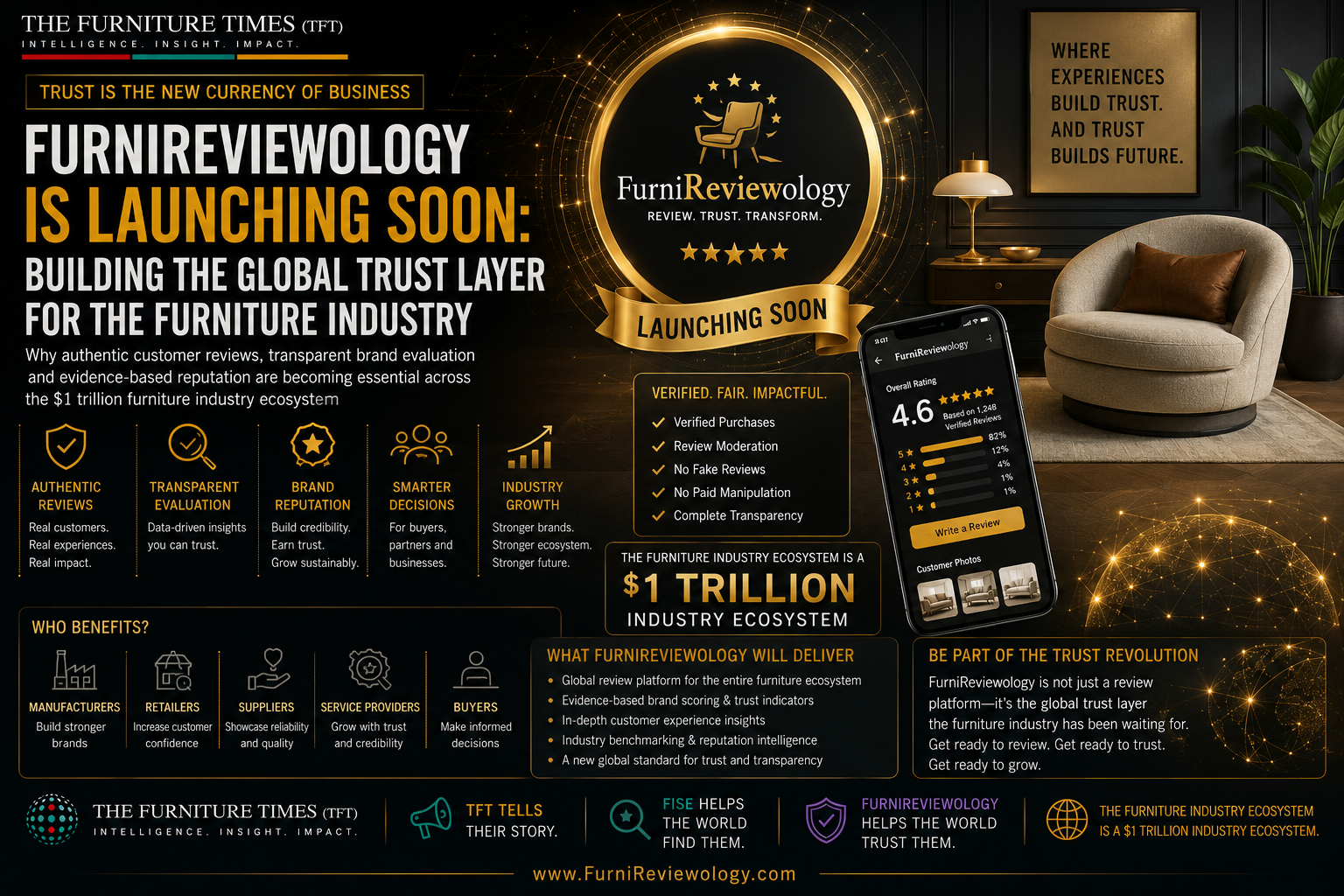
FurniReviewology Is Launching Soon Building the Global Trust Layer for the Furniture Industry
Why authentic customer reviews, transparent brand evaluation and evidence-based reputation are becoming essential across the $1 trillion furniture industry ecosystem
By The Furniture Times (TFT) Editorial Desk | FurniReviewology | Customer Experience, Brand Trust & Furniture Industry Intelligence
The global furniture industry has built remarkable capabilities in design, manufacturing, materials, technology, retail, logistics and interior development. Yet one of its most important pieces of infrastructure remains fragmented: trustworthy, furniture-specific customer reviews.
Consumers can discover thousands of furniture products online, but they often struggle to determine which brands provide reliable quality, accurate descriptions, professional delivery, responsive customer service and dependable warranties.
Commercial buyers face an even more complicated challenge. A hotel owner, interior designer, architect, property developer, retailer or procurement manager may need to evaluate a furniture supplier before awarding a substantial order. Company websites and catalogues can explain products, but they rarely provide an independent view of the complete customer experience.
This is the gap that FurniReviewology is preparing to address.
FurniReviewology is launching soon as a specialized review, reputation and trust platform for the global furniture industry ecosystem.
Its purpose is not simply to collect star ratings. Its wider ambition is to help customers make better decisions, help responsible furniture businesses demonstrate their credibility and help the industry improve through structured, transparent feedback.
The platform will form the trust layer within a connected furniture-industry discovery ecosystem:
- The Furniture Times (TFT) tells their story.
- Furniture Industry Search Engine (FISE) helps the world find them.
- FurniReviewology helps the world trust them.
Together, these platforms can help furniture businesses become visible, searchable, understandable and trusted.
The Missing Trust Infrastructure
Furniture is one of the world’s most diverse and interconnected industries.
The ecosystem includes:
- Furniture manufacturers
- Retailers and showrooms
- Wholesalers and distributors
- E-commerce platforms
- Interior designers
- Architects
- Furniture-component suppliers
- Hardware and fittings manufacturers
- Timber, panel, textile and leather suppliers
- Machinery and technology companies
- Logistics providers
- Delivery and installation teams
- Repair and restoration specialists
- Hospitality and contract-furniture businesses
- Testing and certification organizations
- Trade exhibitions and associations
Across this ecosystem, reputation has traditionally depended heavily on personal networks, agents, exhibitions and word-of-mouth recommendations.
Those channels remain important. However, global commerce requires trust that can travel across borders.
A buyer in the United Kingdom may need to evaluate a manufacturer in Malaysia. A hotel developer in the United Arab Emirates may be considering suppliers in Italy, Turkey, China or Vietnam. A consumer may purchase a sofa online without visiting a showroom.
In each case, the buyer wants answers:
- Is the company genuine?
- Is the product accurately described?
- Does the furniture arrive in good condition?
- Does the brand meet its delivery promises?
- Does it respond when something goes wrong?
- Are warranty claims handled fairly?
- Do previous customers recommend it?
FurniReviewology aims to organize these questions into a furniture-specific trust system.
Why Furniture Reviews Matter More Than Ordinary Product Ratings
Furniture is not a simple, standardized purchase.
A chair, table, sofa, mattress or wardrobe may be evaluated over months or years. The customer experience can involve product selection, customization, manufacturing, transport, delivery, assembly, installation, maintenance and warranty service.
A review submitted immediately after delivery may capture packaging and customer service but reveal little about long-term durability.
A complete furniture review should therefore examine several dimensions.
| Review dimension | What customers may evaluate |
|---|---|
| Product quality | Construction, finish, materials and stability |
| Design accuracy | Whether the product matches its description and images |
| Comfort | Seating, sleeping or ergonomic experience |
| Value | Whether quality and service justify the price |
| Delivery | Timeliness, communication and handling |
| Assembly | Instructions, missing components and ease of installation |
| Installation | Professionalism, accuracy and site care |
| Customer service | Responsiveness and problem resolution |
| Warranty | Clarity, fairness and claim handling |
| Durability | Performance after extended use |
| Sustainability | Evidence supporting environmental claims |
| Recommendation | Whether the customer would purchase again |
This richer evaluation is one reason a specialist platform is necessary.
A generic five-star score cannot explain the full furniture experience.
Reviews Turn Customer Experience Into Visible Evidence
A furniture business can describe itself as reliable, premium or customer-focused. Reviews provide evidence of whether customers experience those qualities in practice.
Authentic feedback can demonstrate:
- Consistent manufacturing quality
- Accurate product descriptions
- Reliable delivery
- Helpful sales teams
- Professional installation
- Effective problem-solving
- Fair warranty procedures
- Long-term product performance
Reviews can also reveal weaknesses.
A brand may discover recurring complaints about:
- Delayed delivery
- Packaging damage
- Missing hardware
- Difficult assembly
- Color differences
- Slow communication
- Unclear warranty terms
- Replacement-part delays
These patterns provide operational intelligence.
A review platform should not be treated only as a marketing channel. It can become an early-warning system that helps companies identify and correct customer-experience failures.
Reputation Is Becoming Part of AI Discovery
Customers increasingly use AI-powered systems to research products, compare companies and request brand recommendations.
They may ask:
- What are the best furniture brands based on customer reviews?
- Which sofa companies have reliable warranties?
- What furniture retailers provide good delivery service?
- Which outdoor furniture brands are known for durability?
- What companies receive positive feedback from hotel buyers?
- Which furniture suppliers respond well to complaints?
AI systems may evaluate accessible information from company websites, news coverage, directories and reviews.
This means structured and authentic review information can become part of a brand’s wider digital reputation.
FurniReviewology’s role is therefore larger than displaying ratings. The platform can help make furniture customer experience more understandable to buyers, search engines and AI-powered discovery systems.
What “Best Furniture Brands Based on Customer Reviews” Should Mean
Lists of the “best furniture brands” are common online, but their methodologies are often unclear.
Some lists may be influenced by advertising relationships, affiliate commissions, popularity or editorial preference. Others combine brands serving completely different markets and price levels.
A small custom manufacturer should not be evaluated using exactly the same expectations as a mass-market flat-pack retailer. A luxury sofa brand should not automatically rank above an affordable brand merely because its products are more expensive.
FurniReviewology should define “best” through transparent, category-relevant evidence.
A fair evaluation may consider:
- Average customer rating
- Number of eligible reviews
- Review recency
- Rating consistency
- Verified transaction indicators
- Detailed review quality
- Brand response rate
- Complaint-resolution performance
- Product-return experience
- Warranty satisfaction
- Long-term ownership feedback
- Evidence of manipulation or suspicious activity
The strongest brands should not simply be those with the highest raw star score. They should demonstrate consistent, credible and accountable performance.
Best Must Be Evaluated by Category
Furniture brands should be recognized within meaningful categories.
Potential categories could include:
- Best Residential Furniture Brands
- Best Outdoor Furniture Brands
- Best Office Furniture Brands
- Best Hospitality Furniture Brands
- Best Mattress Brands
- Best Sofa Brands
- Best Kitchen Furniture Brands
- Best Children’s Furniture Brands
- Best Sustainable Furniture Brands
- Best Luxury Furniture Brands
- Best Affordable Furniture Brands
- Best Furniture Retailers
- Best E-Commerce Furniture Brands
- Best Furniture Delivery Experience
- Best Furniture Warranty Service
- Best Furniture Repair Companies
- Best Furniture Component Brands
- Best Furniture Logistics Providers
Geographic categories may also be necessary:
- Best Furniture Brands in Malaysia
- Best Furniture Manufacturers in Vietnam
- Best Furniture Retailers in India
- Best Outdoor Furniture Suppliers in Indonesia
- Best Office Furniture Brands in Europe
- Best Hospitality Furniture Suppliers in the Middle East
This allows customers to compare businesses with similar products, markets and customer expectations.
A Proposed FurniReviewology Trust Framework
For FurniReviewology to create lasting industry value, its review architecture should reflect the complexity of furniture purchasing.
A possible framework could include five major trust areas.
1. Product trust
This area would examine:
- Quality
- Materials
- Finish
- Design accuracy
- Comfort
- Durability
- Value
2. Transaction trust
This area would consider:
- Pricing transparency
- Quotation accuracy
- Payment communication
- Order confirmation
- Lead-time accuracy
3. Delivery trust
Customers could assess:
- Delivery punctuality
- Packaging
- Product condition
- Tracking and communication
- Delivery-team professionalism
4. Service trust
This area would cover:
- Responsiveness
- Product knowledge
- Problem resolution
- Installation
- Replacement parts
- Warranty handling
5. Reputation trust
This could incorporate:
- Verified business information
- Review consistency
- Brand responsiveness
- Complaint patterns
- Evidence of review manipulation
- Updated company details
A final score should be accompanied by an explanation rather than appearing as an unexplained number.
Reviews Must Be Genuine
The value of FurniReviewology will depend on review integrity.
A review platform loses credibility when ratings can be purchased, fabricated or manipulated.
Strong safeguards should therefore be central to the platform.
These may include:
- Transaction or project verification
- Email and account verification
- Automated spam detection
- Duplicate-review monitoring
- Suspicious-rating-pattern analysis
- Reviewer-history assessment
- Human moderation
- Clear conflict-of-interest disclosures
- Reporting and appeal systems
- Penalties for manipulated reviews
A verified purchase or project indicator can help users distinguish between confirmed transactions and general opinions.
However, verification should not automatically invalidate every review without a receipt. Some customers receive furniture as gifts, purchase through distributors or work with brands through commercial projects.
The system should accommodate legitimate experiences while clearly explaining the level of verification.
Brands Deserve the Right to Respond
Trust must work in both directions.
Customers need the freedom to describe genuine experiences. Businesses need a fair opportunity to respond, clarify and resolve disputes.
A responsible brand-response system should allow companies to:
- Thank customers for feedback
- Explain relevant circumstances
- Request additional information
- Offer a resolution
- Correct factual inaccuracies
- Report abusive or fraudulent content
- Demonstrate that a complaint was resolved
Responses should remain professional. Brands should never threaten, intimidate or expose a reviewer’s private information.
A thoughtful response to a negative review can strengthen trust. It shows that the company listens, accepts responsibility where appropriate and works toward solutions.
Negative Reviews Are Not Automatically Bad for Business
No genuine business receives perfect customer experiences forever.
Furniture transactions can involve delays, customization differences, access problems, transport damage or misunderstandings. What matters is how the company responds.
A page containing only flawless ratings may appear less credible than a realistic review profile with occasional criticism and visible resolution.
Negative reviews can help companies:
- Identify repeated product failures
- Improve packaging
- Strengthen delivery communication
- Rewrite assembly instructions
- Train customer-service teams
- Clarify warranty conditions
- Improve quality control
- Remove unreliable suppliers
The goal should not be to silence criticism. It should be to learn from valid criticism while protecting brands from fraudulent or abusive content.
Review Manipulation Harms the Entire Ecosystem
Fake reviews do more than mislead one customer.
They disadvantage responsible companies, distort competition and weaken public confidence in review platforms.
Common manipulation risks include:
- Businesses reviewing themselves
- Employees posting undisclosed praise
- Competitors submitting false complaints
- Incentives tied only to positive ratings
- Review farms
- Duplicate accounts
- AI-generated review spam
- Threats against dissatisfied customers
- Selectively inviting only happy customers
FurniReviewology should publish clear rules explaining prohibited behavior and enforcement procedures.
Paid advertising must also remain separate from review scores. A brand should never be able to purchase a higher trust rating.
Transparency Must Apply to Rankings
If FurniReviewology publishes “Best Furniture Brands Based on Customer Reviews,” the ranking methodology should be publicly explained.
Users should know:
- Which reviews were eligible
- What period was assessed
- How verified and unverified reviews were handled
- Whether minimum review volumes applied
- How recent reviews were weighted
- Whether complaint resolution affected the score
- How suspicious activity was excluded
- Whether commercial relationships existed
- When the ranking was last updated
Transparency prevents rankings from becoming unexplained popularity contests.
It also gives brands a clear understanding of how to improve through better customer experience—not through payment or manipulation.
Review Volume Must Be Interpreted Carefully
A business with a 5.0 rating from three reviews should not necessarily rank above a business with a 4.7 rating from 5,000 reviews.
The larger review profile may provide more reliable evidence.
At the same time, smaller brands should not be permanently disadvantaged merely because they serve specialized markets or produce fewer high-value orders.
A balanced system could consider:
- Average score
- Review volume
- Confidence level
- Review recency
- Customer detail
- Business category
- Transaction type
- Complaint resolution
- Consistency over time
The platform could recognize both large-scale leaders and high-performing specialists.
Long-Term Furniture Reviews Are Especially Valuable
Furniture is designed to remain in use for years.
Reviews submitted immediately after delivery cannot fully assess durability.
FurniReviewology could encourage staged feedback:
- Initial purchase experience
- Delivery and installation
- Three-month experience
- One-year ownership
- Longer-term durability update
Long-term reviews can reveal whether:
- Foam retains its support
- Fabric resists wear
- Mechanisms continue functioning
- Outdoor finishes withstand weather
- Joints remain stable
- Surfaces resist scratching
- Warranty service remains available
This information can be extremely valuable to future buyers.
Commercial and Project Reviews Need Their Own Structure
A consumer buying one dining table has a different experience from a developer purchasing furniture for 300 hotel rooms.
Commercial reviews may need to evaluate:
- Quotation accuracy
- Design coordination
- Samples and approvals
- Manufacturing quality
- Project scheduling
- Delivery phasing
- Site installation
- Defect management
- Replacement parts
- Contract compliance
- Post-handover support
Architects, designers, procurement managers, dealers and developers should be able to review businesses through criteria relevant to professional projects.
Sensitive commercial information should remain protected. Reviews should focus on legitimate performance without disclosing confidential pricing, personal data or protected contract details.
Furniture Components Also Need Reviews
Customer-review infrastructure should not stop at finished furniture.
Component quality can determine the performance of the entire product.
Relevant categories include:
- Hinges
- Drawer slides
- Connectors
- Fasteners
- Furniture legs
- Casters
- Handles
- Recliner mechanisms
- Bed mechanisms
- Lighting accessories
- Locks
- Upholstery materials
- Foam
- Fabrics
- Leather
- Adhesives and finishes
Manufacturers could provide feedback on component consistency, technical support, availability, ease of installation and long-term performance.
This would help buyers identify suppliers whose products perform reliably inside finished furniture.
Logistics and Delivery Providers Should Be Reviewed
A customer may blame a furniture brand for damage caused during delivery. The retailer may blame the carrier. The carrier may argue that the product was inadequately packaged.
A furniture-specific review ecosystem can help distinguish between:
- Manufacturing defects
- Packaging failures
- Warehouse damage
- Transport damage
- Installation errors
- Customer misuse
Furniture-logistics reviews could evaluate:
- Handling
- Scheduling
- Tracking
- Communication
- Product condition
- Assembly
- Installation
- Packaging removal
- Complaint resolution
This creates accountability across the complete value chain.
Reviews Can Improve Sustainability
Durability is an environmental issue as well as a quality issue.
Furniture that fails prematurely may need repair, replacement or disposal. Reviews can identify products that perform well over time and expose repeated weaknesses.
Review data can support sustainability by highlighting:
- Long-lasting products
- Repairable designs
- Replaceable components
- Effective warranties
- Take-back programs
- Refurbishment services
- Recyclable packaging
- Accurate environmental claims
A product should not receive a strong sustainability reputation merely because its marketing uses words such as “green” or “eco-friendly.”
Customers need evidence relating to materials, product life, repair and end-of-life options.
Reviews Can Protect Furniture SMEs
SMEs often struggle to compete with large brands in advertising, showrooms and search rankings.
Authentic customer satisfaction can give smaller companies another route to credibility.
A local manufacturer may not have a global marketing budget, but it may provide:
- Better customization
- More responsive service
- Stronger craftsmanship
- Faster problem resolution
- Closer customer relationships
- Greater repairability
When these strengths are documented through genuine reviews, the company can build trust beyond its immediate network.
FurniReviewology can help move word-of-mouth reputation into a searchable and structured format.
Reviews Support AI Search Visibility
AI-powered platforms increasingly help users compare brands.
Structured review information may help answer questions such as:
- Which furniture brands have the strongest delivery ratings?
- What manufacturers are trusted for hospitality projects?
- Which companies respond effectively to warranty claims?
- What outdoor furniture brands receive good durability reviews?
- Which retailers provide reliable assembly services?
Review information should not be manipulated specifically to influence AI. Its purpose is to capture genuine customer experience.
When authentic information is publicly available, customers and AI systems can make better-informed assessments.
The FurniReviewology Customer Journey
A future user experience could follow several stages:
- Search for a company, product or category.
- Review the overall rating and trust profile.
- Examine ratings by quality, delivery and service.
- Filter reviews by date, location or transaction type.
- Identify verified purchases or projects.
- Read company responses.
- Compare similar businesses.
- Visit the company listing or website.
- Make an informed decision.
- Return later to share an experience.
This journey turns isolated customer opinions into useful decision intelligence.
The FurniReviewology Brand Journey
Furniture businesses could use the platform to:
- Claim or verify their profile.
- Confirm company information.
- Identify product and service categories.
- Invite customers to submit honest feedback.
- Respond to reviews.
- Track recurring issues.
- Demonstrate successful resolution.
- Improve operations.
- Build a trustworthy reputation over time.
- Become more discoverable through the wider TFT and FISE ecosystem.
The platform should reward accountability, not perfection.
A Proposed FurniReviewology Brand Trust Score
A future trust score could combine several dimensions rather than relying only on stars.
| Trust dimension | Possible consideration |
|---|---|
| Product experience | Quality, comfort, accuracy and durability |
| Service experience | Communication, expertise and responsiveness |
| Fulfillment | Delivery, assembly and installation |
| After-sales support | Warranty, repairs and replacement parts |
| Review integrity | Verification, consistency and suspicious activity |
| Brand accountability | Response rate and complaint resolution |
| Information quality | Accurate profile, policies and contact information |
| Long-term trust | Performance across time |
The exact methodology should be tested carefully and published transparently before formal rankings are released.
FurniReviewology Must Protect Customer and Business Rights
A trusted review platform requires balanced governance.
Customers should have the right to:
- Share honest experiences
- Explain problems
- Update reviews after resolution
- Understand moderation decisions
- Protect personal information
Businesses should have the right to:
- Respond
- Report suspected fraud
- Correct factual inaccuracies
- Present evidence
- Appeal moderation decisions
- Protect confidential information
Neither party should be permitted to abuse the system.
A clear code of conduct will be essential.
Best Furniture Brands Based on Customer Reviews
One of FurniReviewology’s most valuable future features could be the publication of carefully researched brand rankings based on eligible customer feedback.
These rankings should recognize brands that perform consistently across the complete customer journey—not simply those with the largest advertising budgets.
Potential recognition areas include:
- Highest Customer Satisfaction
- Best Product Quality
- Best Delivery Experience
- Best Warranty Support
- Best Complaint Resolution
- Best Long-Term Durability
- Best Value Furniture Brand
- Best Sustainable Furniture Experience
- Best Hospitality Supplier
- Best Furniture SME
- Most Improved Furniture Brand
- Customers’ Choice Award
Recognition should be based on published rules, sufficient evidence and ongoing monitoring.
A brand should be able to earn trust, lose trust and rebuild trust through measurable customer experience.
The Connected TFT–FISE–FurniReviewology Ecosystem
The three platforms serve different but complementary purposes.
The Furniture Times
TFT provides news, market intelligence, company stories, interviews, industry analysis and educational content.
It helps explain:
- Who the businesses are
- What they have achieved
- How the industry is changing
- What innovations deserve attention
Furniture Industry Search Engine
FISE helps users discover furniture-industry businesses through categories, locations, products and capabilities.
It helps answer:
- Who manufactures this product?
- Where is the supplier located?
- What services does the company provide?
- How can the buyer contact it?
FurniReviewology
FurniReviewology helps customers evaluate reputation and experience.
It helps answer:
- Can the company be trusted?
- What did previous customers experience?
- How does the brand respond to problems?
- Would customers recommend it?
Together, the ecosystem creates a complete path:
Story → Search → Trust → Decision
A $1 Trillion Ecosystem Needs a Dedicated Trust Platform
The wider furniture industry ecosystem—encompassing furniture, materials, components, machinery, design, retail, logistics, technology, services and related economic activity—is a $1 trillion industry ecosystem.
An economy of this scale requires more than marketplaces and media. It requires trusted information that helps buyers make decisions.
The industry needs:
- Searchable company identities
- Accurate business classifications
- Transparent customer feedback
- Evidence-based brand comparisons
- Review integrity
- Accountability
- Complaint-resolution visibility
- AI-readable trust information
FurniReviewology is being developed to help provide that missing layer.
Get Ready: FurniReviewology Is Launching Soon
FurniReviewology’s upcoming launch signals an important development for furniture brands and customers.
Manufacturers, retailers, suppliers and service providers should begin preparing by:
- Confirming accurate company information
- Publishing clear warranty policies
- Improving product descriptions
- Organizing customer-service records
- Developing fair review-request processes
- Training teams to respond professionally
- Investigating recurring complaints
- Avoiding fake or incentivized positive reviews
- Strengthening delivery and after-sales support
- Treating every customer interaction as part of reputation building
Customers should prepare to share honest, useful and responsible feedback.
A helpful review should explain:
- What was purchased
- When and where it was purchased
- What worked well
- What went wrong
- Whether the brand responded
- Whether the problem was resolved
- Whether the product would be recommended
Specific, factual reviews provide more value than insults, exaggeration or unsupported accusations.
Final Analysis: Trust Is the Future of Furniture Discovery
Furniture companies have traditionally invested in manufacturing, design, showrooms, exhibitions, websites and advertising.
These investments create capability and visibility. Reviews create evidence of experience.
A brand may have a powerful story, but customers still want proof.
A company may be searchable, but buyers still need confidence.
A product may look attractive, but customers want to know how it performs.
A warranty may exist, but buyers want to know whether it is honored.
This is why reviews have become commercial infrastructure.
FurniReviewology is preparing to help the furniture industry move from scattered opinions toward structured, category-specific and transparent reputation intelligence.
Its ambition should not be to create winners and losers through unexplained ratings. Its purpose should be to help customers decide, help responsible companies demonstrate trust and help the entire industry improve.
The future furniture customer will not ask only:
“Who sells this product?”
The customer will also ask:
“Who can I trust?”
TFT tells their story.
FISE helps the world find them.
FurniReviewology helps the world trust them.
Get ready—FurniReviewology is launching soon.
Editorial note: Any future rankings, badges or trust scores should be governed by published methodologies, review-integrity protections, minimum evidence requirements and transparent commercial disclosures. Paid participation should never guarantee a positive rating or higher review score.
Get ready—FurniReviewology is launching soon. Review. Trust. Decide.
The Furniture Times (TFT) & Furniture Industry Search Engine (FISE)
“TFT tells their story. FISE helps the world find them.”
FurniReviewology helps the world trust them.
The furniture industry ecosystem is a $1 trillion industry ecosystem.
