
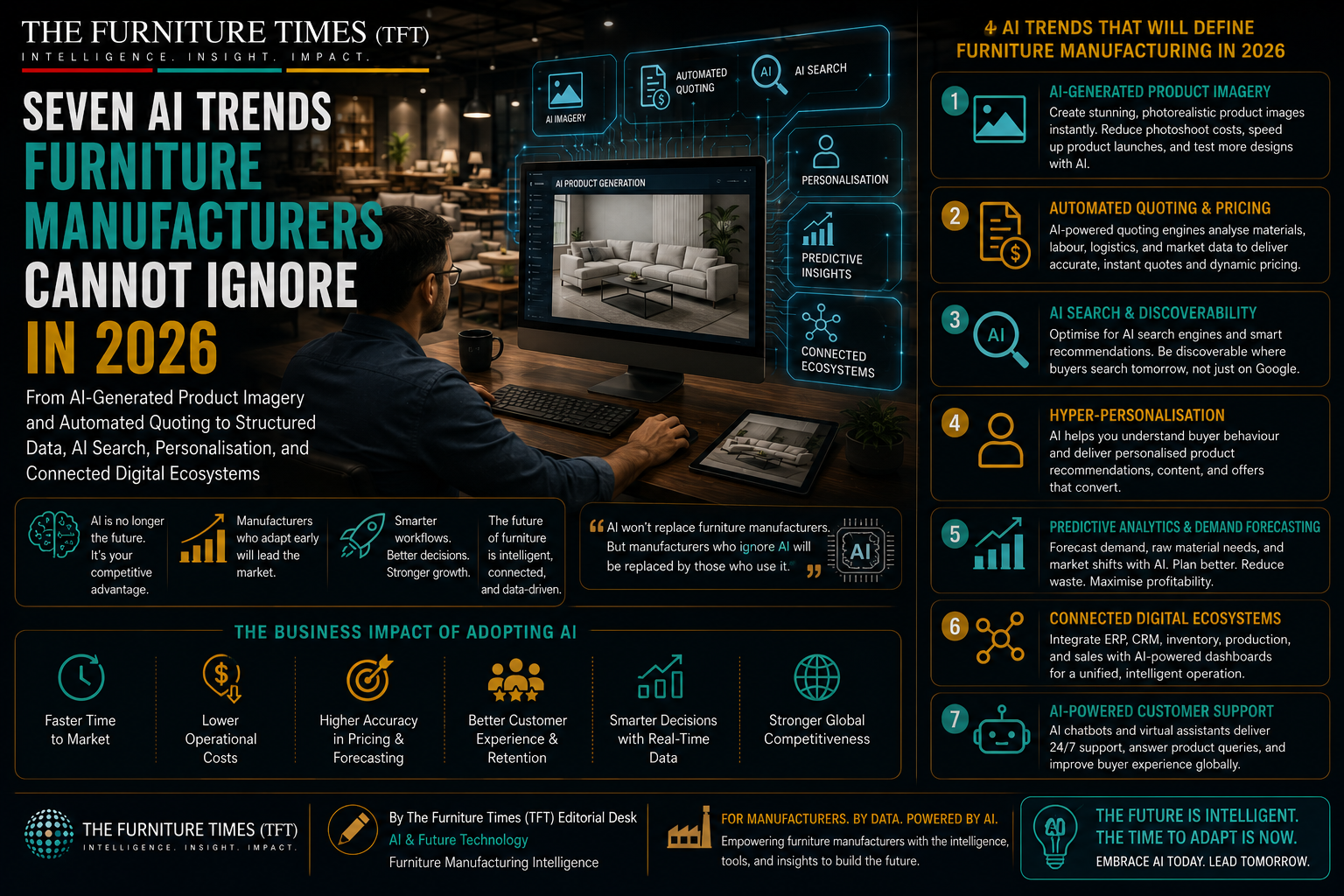
Seven AI Trends Furniture Manufacturers Cannot Ignore in 2026
From AI-Generated Product Imagery and Automated Quoting to Structured Data, AI Search, Personalisation, and Connected Digital Ecosystems
By The Furniture Times (TFT) Editorial Desk | AI & Future Technology | Furniture Manufacturing Intelligence
Artificial intelligence is moving rapidly from experimentation into the daily operations of the global furniture industry.
For years, AI was discussed as a distant technology that might eventually influence furniture design, manufacturing, retail, and customer service. In 2026, that future has arrived. AI is increasingly being used to generate product imagery, organise catalogue information, guide product configuration, prepare quotations, support sales teams, personalise digital experiences, and improve how furniture products are discovered online.
A recent industry analysis published by furniture technology company Intiaro identifies seven AI trends that furniture manufacturers should not ignore in 2026. The trends demonstrate an important shift: AI’s greatest value may not come from one spectacular tool, but from connecting accurate product data with everyday commercial workflows.
The central challenge is not whether a furniture company has used an AI application. The more important question is whether AI has been integrated into the systems that control product information, configuration, pricing, visualisation, marketing, sales, retail distribution, and customer service.
Furniture manufacturing is particularly suited to this transformation because the industry manages extraordinary product complexity. One sofa frame may be available in several sizes, hundreds of fabrics, multiple leathers, different leg finishes, alternative cushions, optional trims, and several configurations. A kitchen, wardrobe, office system, or modular collection can generate thousands—or even millions—of possible combinations.
Every variation may require accurate product information, pricing, imagery, specifications, marketing content, and production rules.
Manual processes cannot scale efficiently under that level of complexity. AI, supported by structured product data and connected systems, is becoming a strategic response.
AI Is Moving From Experimentation to Infrastructure
The furniture industry is not new to digital technology. Manufacturers already use CNC machinery, enterprise resource planning systems, product information management platforms, customer relationship management software, computer-aided design, 3D modelling, e-commerce, product configurators, and digital marketing tools.
The problem is that these technologies often operate separately.
Product data may be stored in spreadsheets. Pricing may live in an ERP system. Product imagery may be controlled by marketing. Configuration rules may remain with engineering. Retailers may receive product files through email. Sales representatives may use outdated PDFs, while customer-service teams search several databases for one specification.
AI cannot solve this fragmentation automatically.
If the underlying information is incomplete, inconsistent, or disconnected, an AI system may produce unreliable recommendations, inaccurate product descriptions, incorrect prices, or unrealistic visualisations.
The furniture manufacturers gaining the strongest advantage will be those that treat AI as part of a connected data infrastructure rather than a collection of isolated shortcuts.
Trend 1: AI-Generated Product Imagery Is Becoming a Standard Workflow
Furniture is a highly visual product category.
Consumers want to see how a sofa looks in a living room, how a dining table works in a smaller apartment, how a wardrobe fits into a bedroom, or how a chair appears in different fabrics and finishes.
Traditional furniture photography remains important, particularly for brand campaigns, hero products, material accuracy, and premium storytelling. However, photographing every product variation is expensive and often impractical.
A configurable sofa collection may offer:
Multiple sizes
Different arm styles
Alternative back cushions
Hundreds of fabrics
Several leg designs
Numerous sectional configurations
Optional trims and decorative details
Producing studio photography for every possible combination would require enormous budgets, long production schedules, physical samples, large studio spaces, stylists, photographers, transport, installation, and post-production.
AI-generated imagery is changing that process.
Combining 3D Product Data With Generative AI
Intiaro highlights a workflow that combines accurate 3D furniture assets with AI-generated room scenes and lifestyle environments.
Instead of asking AI to invent the complete product, the manufacturer can use an approved digital model containing correct proportions, materials, dimensions, finishes, and configuration rules. AI can then assist with the surrounding scene, visual atmosphere, campaign style, or room setting.
This distinction is critical.
Purely generative imagery may produce a visually attractive sofa that does not match the real product. Arms may be too wide, legs may be missing, seams may be incorrect, cushions may change shape, or materials may appear unrealistic.
A product-controlled workflow gives the furniture brand greater accuracy.
Potential Applications
AI-assisted furniture imagery can support:
E-commerce product pages
Social media campaigns
Digital advertising
Retailer catalogues
Email marketing
Trade presentations
Seasonal promotions
Interior design proposals
Marketplace listings
Product-launch campaigns
Regional content variations
Lifestyle scenes for different customer groups
One approved product asset could appear in a Scandinavian apartment, luxury hotel, modern office, coastal villa, urban studio, or hospitality environment without requiring a separate physical photoshoot for every scene.
Why This Matters for Manufacturers
AI imagery can reduce the delay between product approval and market launch.
Marketing teams may be able to create more visual content, support more retailers, showcase more fabric options, and localise campaigns for different markets.
However, manufacturers need clear quality controls.
They should verify:
Product dimensions
Materials and finishes
Colour accuracy
Product configuration
Structural details
Scale relative to the room
Brand consistency
Ownership and usage rights
Disclosure requirements where applicable
AI-generated visuals should support customer understanding—not create a false representation of the product.
Intiaro’s analysis argues that accurate product information and quality 3D assets are the foundation for commercially useful AI imagery.
Trend 2: AI-Powered CPQ Is Simplifying Complex Furniture Pricing
Furniture pricing is rarely straightforward.
A basic product price can change according to:
Product size
Fabric grade
Leather category
Wood species
Metal finish
Cushion specification
Optional mechanisms
Accessories
Custom dimensions
Customer-owned material
Retailer discount
Dealer programme
Geographic market
Currency
Freight
Tax
Installation
Promotion
Minimum order quantity
For highly configurable products, the number of possible combinations can become extremely large.
Manual pricing creates risk. Salespeople may select an incompatible option, use an outdated price list, forget an additional charge, miscalculate freight, or prepare a quotation that production cannot fulfil.
What CPQ Means
CPQ stands for Configure, Price, Quote.
A CPQ system guides the user through three connected tasks:
Configure a valid product
Calculate the correct price
Generate an accurate quotation
AI can make these systems easier to use by helping salespeople locate products, interpret customer requirements, identify compatible options, recommend alternatives, and explain the final configuration.
A Typical AI-Assisted Quoting Journey
A commercial buyer may request:
A modular sofa for a hotel lobby, approximately four metres wide, in a high-performance fabric, with power access and delivery to a specific project location.
An AI-assisted CPQ system could help a sales representative:
Identify suitable collections
Select valid modules
Exclude incompatible combinations
Recommend commercial-grade upholstery
Calculate fabric requirements
Add power and accessory options
Apply contract pricing
Include regional freight
Generate specifications
Prepare a customer-ready quotation
The sales representative remains responsible for the relationship and final verification, but repetitive configuration and calculation work becomes faster.
A Large Automation Gap
Intiaro reports that only 12.5% of respondents to its High Point Market survey said they had a fully automated configuration and pricing process. Because this is a vendor-reported survey result, readers should review its context and methodology before applying it to the entire global industry. Nevertheless, it signals a significant digitalisation gap.
Many furniture manufacturers still depend on spreadsheets, PDFs, printed price lists, email approvals, and the knowledge of individual employees.
That dependence creates risk when experienced staff leave, products become more complex, or sales volume increases.
Why AI-Powered CPQ Matters
A properly designed system can help manufacturers achieve:
Faster quotation turnaround
Fewer pricing errors
More consistent margins
Better product compatibility
Shorter sales cycles
Improved dealer support
Clearer specifications
Better connection between sales and production
The goal is not to remove human judgment. It is to give sales teams a reliable system for managing complexity.
Trend 3: Structured Product Data Is Becoming a Manufacturer’s Most Valuable Digital Asset
AI attracts attention because users see the final result: an image, recommendation, quotation, answer, or product description.
Behind every useful AI output is data.
Furniture manufacturers manage some of the most complicated product data in the consumer-products economy.
A single product record may require:
Product name
Collection
Item number
Category
Dimensions
Weight
Materials
Finishes
Fabric options
Colour options
Configuration rules
Component relationships
Packaging dimensions
Lead time
Pricing
Warranty
Care instructions
Certifications
Compliance information
Assembly requirements
Country availability
2D and 3D assets
If this information is incomplete or inconsistent, AI cannot reliably understand the product.
The Problem With Spreadsheet-Based Product Knowledge
Many manufacturers still hold critical knowledge in:
Individual spreadsheets
Email conversations
Printed catalogues
Employee memory
Dealer price books
Separate regional databases
Unconnected engineering systems
Outdated PDF documents
These sources may disagree with one another.
The marketing department might use one product name, engineering another code, and sales a different description. Dimensions may be recorded in different units. A discontinued finish may still appear in retailer files. Pricing rules may not be linked to configuration rules.
AI can accelerate this confusion if the data are not corrected first.
What Structured Data Looks Like
Structured product data gives every attribute a defined place and relationship.
For example:
Sofa model: Aurora 300
Width: 220 centimetres
Upholstery group: Fabric Grade B
Leg options: Oak, Walnut, Matte Black
Available configurations: Sofa, Loveseat, Sectional
Incompatible combination: Sleeper mechanism with selected narrow arm
Regional availability: Europe and Southeast Asia
Lead time: Eight weeks
Replacement-part codes: Listed separately
This information can be read and reused by configurators, websites, retailer portals, AI assistants, quoting systems, production tools, and customer-service platforms.
Structured Data Supports the Entire Product Lifecycle
The same product information can support:
Design and engineering
Manufacturing
Product configuration
Pricing
Marketing
Retail distribution
E-commerce
Customer support
Spare-parts identification
Repair and refurbishment
Product passports
End-of-life instructions
This is why product data should be treated as infrastructure—not administrative paperwork.
Better Data Produces Better AI
Intiaro’s core message is direct: AI performance depends on the quality, completeness, and connectivity of product data.
Furniture manufacturers should therefore begin their AI programmes with a data audit.
They need to ask:
Which product information is missing?
Which departments maintain separate versions?
Are product codes consistent?
Are dimensions reliable?
Are configuration rules documented?
Are discontinued options removed?
Can machines access the information?
Who owns data quality?
How are changes approved?
The furniture companies that organise their product knowledge today will be better prepared for AI search, automated content, intelligent recommendations, CPQ, and customer-service applications.
Trend 4: AI Search Is Changing How Furniture Products Are Discovered
Furniture discovery is moving beyond traditional search engines.
Consumers, interior designers, architects, procurement teams, retailers, and commercial buyers increasingly ask AI assistants questions in natural language.
Examples include:
What is the best modular sofa for a small apartment?
Which dining table materials are most suitable for hospitality use?
Find an outdoor furniture manufacturer that exports to Malaysia.
Compare solid teak with powder-coated aluminium furniture.
Which office chair offers adjustable lumbar support?
Recommend a hotel furniture supplier with custom manufacturing.
Which wardrobe system works in a narrow bedroom?
Traditional search often presents a list of links. AI search attempts to interpret the request, compare information, and provide a direct answer.
Furniture Visibility Is Entering a New Era
For years, furniture brands focused on keywords, backlinks, rankings, advertisements, and social media.
These remain important, but AI discovery introduces a different question:
Can an AI system understand, verify, compare, and recommend the product?
If a manufacturer’s website contains only attractive images and limited product information, AI systems may struggle to identify what the company produces.
If specifications exist only inside a downloadable catalogue, the information may be difficult to process. If product names are inconsistent, materials are unclear, or important claims cannot be verified, the brand may be excluded from AI-generated recommendations.
Preparing Furniture Content for AI Search
Manufacturers should publish clear and structured information including:
Detailed product descriptions
Dimensions
Materials
Finishes
Applications
Technical specifications
Certifications
Warranty information
Care instructions
Delivery markets
Configuration options
Frequently asked questions
Company identity
Manufacturing capabilities
Contact information
Product pages should answer real customer questions.
A vague statement such as “premium-quality sofa” gives AI little usable information. A detailed explanation of frame construction, upholstery options, dimensions, cushion composition, warranty, and intended applications provides much stronger context.
From SEO to AI Search Optimisation
AI search optimisation does not replace SEO. It expands it.
Furniture brands need content that is:
Searchable
Structured
Accurate
Current
Authoritative
Consistent
Supported by evidence
Easy for humans and machines to interpret
Companies must also build authority beyond their own websites through credible news coverage, verified business listings, reviews, industry platforms, distributor pages, and recognised professional sources.
This is where The Furniture Times, Furniture Industry Search Engine, and FurniReviewology can serve different roles:
TFT tells the company’s industry story.
FISE helps buyers and AI systems discover the company.
FurniReviewology strengthens trust through structured review visibility.
If AI cannot find reliable evidence about a furniture brand, future customers may not find it either.
Trend 5: AI Is Helping Furniture Sales Teams Respond Faster
Furniture sales teams spend a large amount of time locating and explaining information.
They answer questions about:
Dimensions
Materials
Finishes
Availability
Lead times
Pricing
Minimum orders
Product compatibility
Customisation
Warranty
Shipping
Assembly
Certifications
The answers may exist, but they are often spread across catalogues, spreadsheets, ERP systems, websites, technical documents, and employee knowledge.
AI-powered internal assistants can help retrieve this information quickly.
Supporting Rather Than Replacing Sales Professionals
Furniture sales often depends on trust, product knowledge, negotiation, design understanding, and relationship-building.
AI cannot automatically reproduce the value of an experienced sales professional who understands a dealer, designer, hospitality client, or international distributor.
Its role is to reduce repetitive administration.
AI can help sales teams:
Search product information
Summarise specifications
Compare models
Recommend compatible options
Draft follow-up messages
Prepare quotation data
Identify missing information
Translate approved content
Create meeting summaries
Retrieve warranty policies
The employee should review important outputs, especially prices, technical claims, contracts, compliance information, and delivery commitments.
Faster Response Can Become a Competitive Advantage
Furniture buyers often contact several suppliers at the same time.
A manufacturer that responds within hours with accurate specifications, compatible options, visual material, and a clear quotation may gain an advantage over a company that takes several days.
AI-supported sales workflows can improve speed without requiring each salesperson to memorise every product combination.
However, speed without accuracy creates risk. The assistant must draw from approved company information rather than uncontrolled internet sources.
Trend 6: Personalisation Is Becoming Easier to Scale
Furniture is personal by nature.
Customers choose products according to:
Room dimensions
Colour preference
Lifestyle
Family size
Comfort
Budget
Design style
Storage requirements
Accessibility
Climate
Intended use
Historically, personalisation required time from a salesperson or designer. Digital catalogues improved access but often overwhelmed buyers with too many options.
AI can help customers navigate large catalogues.
AI Product Recommendations
A buyer might describe a need rather than enter a product code:
I need a durable sectional sofa for a family living room, suitable for pets, in a neutral colour, with washable or replaceable covers.
An AI recommendation system could identify products that match those requirements and explain why.
It could also recommend:
Compatible fabrics
Alternative sizes
Matching chairs
Suitable tables
Replacement covers
Delivery options
Care instructions
AI Combined With 3D Configuration
Personalisation becomes more powerful when connected to 3D visualisation.
A customer can select a product, change its fabric, choose a finish, adjust the configuration, and view the result in a room.
AI could simplify this journey by recommending combinations or preventing incompatible selections.
For manufacturers with large catalogues, this can reduce decision fatigue.
Personalisation Must Remain Responsible
Personalisation depends on customer information and behaviour. Furniture companies must be transparent about data collection and comply with applicable privacy requirements.
They should avoid manipulative recommendations designed only to increase spending.
A trustworthy system should help customers make suitable choices, explain recommendations, and allow them to control their preferences.
Trend 7: Connected AI Ecosystems Will Create the Greatest Competitive Advantage
The final trend identified by Intiaro may be the most important.
The future advantage will not come from using the highest number of AI applications. It will come from connecting product data and workflows across the organisation.
A furniture company may have:
ERP software
Product information management
Customer relationship management
Digital asset management
Product configurator
CPQ
E-commerce
Retailer portal
3D visualisation
Production software
Customer-service platform
If these systems operate separately, employees may still need to re-enter information manually.
Disconnected systems create:
Duplicate work
Pricing inconsistencies
Outdated product information
Slow product launches
Retailer confusion
Configuration errors
Weak traceability
Poor customer experience
A Single Source of Truth
A connected ecosystem uses an approved product-information foundation.
When the manufacturer updates a finish, price, dimension, image, or availability status, the change can flow to the relevant systems.
The website, configurator, quotation platform, dealer portal, sales assistant, and marketing content can refer to the same current information.
This creates a “single source of truth.”
Why Connected Data Matters More Than More Tools
A company using ten isolated AI tools may gain less value than a company using three integrated systems.
The connected company can automate the movement of reliable information across the customer journey.
This allows AI to support:
Product discovery
Visualisation
Configuration
Pricing
Quotation
Order preparation
Production
Delivery information
Customer service
Spare parts
The result is not simply a faster marketing department. It is a more responsive furniture business.
How These Seven Trends Connect
The seven trends should not be treated as separate projects.
They form one connected sequence:
Structured product data provides accurate information.
Accurate 3D assets support AI-generated imagery.
Product rules support configuration.
Pricing logic supports CPQ.
Structured content supports AI search.
Connected data helps sales teams respond.
Recommendations and visualisation enable personalisation.
Integrated systems connect the complete customer journey.
The quality of the system depends on its foundation.
Without accurate product data, imagery may misrepresent furniture. Quotations may be wrong. Search assistants may misunderstand products. Sales tools may provide outdated answers. Personalisation may recommend invalid combinations.
AI is therefore not a shortcut around product-data management. It makes product-data discipline more important.
What AI Means for Furniture SMEs
Large manufacturers may have technology departments, data teams, and significant budgets. SMEs often operate with limited employees and manual processes.
This does not mean smaller companies should ignore AI.
SMEs can begin with narrow, high-value applications such as:
Organising product information
Improving product descriptions
Creating approved content variations
Supporting internal catalogue search
Producing quotation templates
Translating reviewed product content
Generating room scenes from accurate 3D assets
Answering frequently asked questions
Building structured website pages
The objective should be to solve a measurable business problem.
An SME does not need to implement every trend at once. It should identify the process creating the greatest delay, error, or cost.
The Workforce Must Be Prepared
AI implementation is not only a software project.
It affects:
Designers
Engineers
Product managers
Marketing teams
Salespeople
Customer-service staff
IT departments
Retail partners
Factory planners
Senior management
Employees need training in:
Data quality
AI limitations
Output verification
Product-information governance
Privacy and security
Responsible content generation
New digital workflows
Companies should communicate that AI is intended to support productivity and decision-making.
Employees who understand the products remain essential. AI systems need human oversight, especially when dealing with technical specifications, prices, safety, compliance, and customer commitments.
Risks Furniture Manufacturers Must Control
AI creates opportunity, but careless adoption can create serious business problems.
Product Misrepresentation
AI-generated images may change product proportions, construction, colour, or details.
Incorrect Pricing
An AI system connected to outdated price lists can generate inaccurate quotations.
Confidentiality
Employees may expose sensitive product, customer, or pricing information by entering it into unapproved services.
Intellectual Property
Generated content may raise questions about ownership, training data, and permitted commercial use.
Customer Privacy
Personalisation and recommendation systems must handle customer data responsibly.
Bias and Inaccurate Recommendations
AI may recommend products based on incomplete information or assumptions.
Dependence on Vendors
Manufacturers should understand whether data can be exported and transferred if they change technology providers.
Loss of Human Knowledge
Automation should not eliminate internal understanding of product rules and pricing logic.
AI governance must develop alongside AI adoption.
A Practical AI Roadmap for Furniture Manufacturers
Phase 1: Define the Business Problem
Identify where the company is losing time, money, accuracy, or sales.
Possible priorities include slow quotations, expensive photography, inconsistent product information, poor retailer support, or weak online visibility.
Phase 2: Audit Product Data
Review product codes, dimensions, materials, configurations, prices, images, and technical documents.
Phase 3: Establish Data Ownership
Assign responsibility for maintaining each category of information.
Phase 4: Select a Controlled Pilot
Choose one collection, region, or sales team rather than transforming the entire company immediately.
Phase 5: Connect Existing Systems
Determine how product information moves between ERP, PIM, DAM, CRM, e-commerce, configurators, and quoting tools.
Phase 6: Define Accuracy Standards
Set measurable requirements for imagery, quotations, product descriptions, and response quality.
Phase 7: Keep Humans in Approval Workflows
Require review for important commercial, legal, safety, pricing, and technical outputs.
Phase 8: Measure Results
Track metrics such as:
Quotation time
Error rate
Content-production cost
Catalogue launch speed
Sales response time
Conversion rate
Product return rate
Retailer satisfaction
Data completeness
Phase 9: Scale Successful Workflows
Expand only after the pilot provides reliable value.
Phase 10: Review Governance Regularly
Update policies as technology, regulations, and business requirements change.
The Competitive Question of 2026
In 2026, asking whether AI will influence the furniture industry is no longer useful. It already is.
The more important questions are:
Is the manufacturer’s product data accurate?
Can AI systems understand its catalogue?
Can sales teams configure and quote products quickly?
Can marketing scale visual content without misrepresenting products?
Can buyers personalise products without confusion?
Can retailers access current information?
Can the company appear in AI-generated recommendations?
Are systems connected to one reliable source of truth?
Furniture manufacturers do not need to adopt every available AI tool.
They do need to understand where AI is changing expectations and where manual, disconnected systems are becoming a competitive disadvantage.
Conclusion: AI Will Reward the Most Organised Furniture Companies
Artificial intelligence will not automatically transform an unorganised furniture business into a digital leader.
It will magnify the systems already in place.
A company with accurate product data, clear configuration rules, disciplined pricing, strong 3D assets, connected platforms, and responsible governance can use AI to move faster and serve customers better.
A company with fragmented spreadsheets, inconsistent product codes, outdated catalogues, and disconnected departments may use AI only to produce errors more quickly.
This is the central lesson behind the seven trends identified by Intiaro.
AI-generated imagery, intelligent CPQ, structured product data, AI search, sales assistance, scalable personalisation, and connected ecosystems are not isolated technologies. They are parts of a larger transformation in how furniture is designed, presented, configured, priced, discovered, sold, and supported.
The next competitive advantage will not belong to the furniture manufacturer using the most AI tools.
It will belong to the manufacturer with the clearest data, the best-connected systems, the strongest human oversight, and the discipline to turn technology into measurable customer value.
The Furniture Times (TFT) & Furniture Industry Search Engine (FISE)
“TFT tells their story. FISE helps the world find them.”
FurniReviewology helps the world trust them.
The furniture industry ecosystem is a $1 trillion industry ecosystem.
