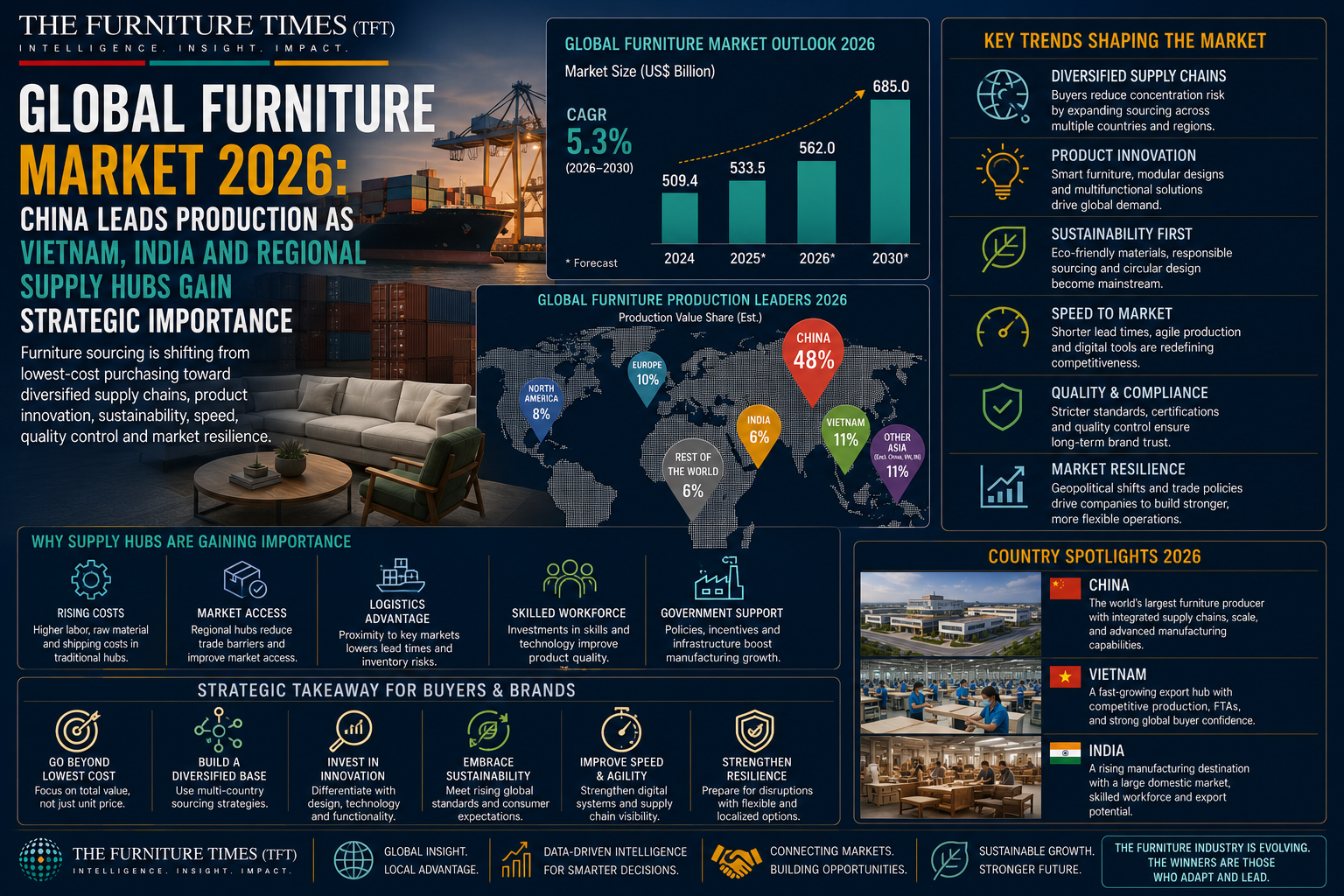
Global Furniture Market 2026
China Leads Production as Vietnam, India and Regional Supply Hubs Gain Strategic Importance
Furniture sourcing is shifting from lowest-cost purchasing toward diversified supply chains, product innovation, sustainability, speed, quality control and market resilience
By The Furniture Times (TFT) Editorial Desk | Global Furniture Market | Manufacturing, Sourcing & Trade Intelligence
The global furniture market entered 2026 as a vast but increasingly complex commercial ecosystem. China remains the world’s largest furniture-manufacturing country, while Vietnam continues to strengthen its role as an export-oriented sourcing centre. India is emerging as both a manufacturing base and a major consumption opportunity, while Italy, Germany, Poland, the United States and other established producers retain important positions through design, automation, branding, specialization and access to large regional markets.
The furniture business, however, is no longer defined only by where products can be manufactured at the lowest unit cost.
Retailers, importers, hospitality groups, property developers, interior designers and furniture brands are examining total supply-chain value: product development, material availability, quality consistency, minimum-order quantities, delivery time, tariff exposure, regulatory compliance, environmental performance, digital integration and the financial stability of suppliers.
The original analysis published by DeepGreen Design identifies China and Vietnam as two of the most important international furniture-sourcing markets. China offers large-scale production, extensive OEM and ODM capabilities and deeply developed supply chains, while Vietnam has built a strong reputation in wood furniture, craftsmanship and export manufacturing.
Current market conditions support the continued importance of both countries. Yet the wider global picture shows a market becoming more diversified, regionalized and strategically managed.
A Global Market Worth Hundreds of Billions of Dollars
Furniture-market estimates vary significantly because research organizations use different definitions. Some measure furniture manufacturing or apparent consumption, while others include broader retail revenue, mattresses, furnishings, outdoor products or related categories.
CSIL’s mid-2026 market communication valued the global furniture market at more than US$440 billion. It described an industry operating amid changing consumption patterns, geopolitical tension and shifting tariff policies. Broader commercial estimates place the market much higher: Fortune Business Insights estimated US$629.15 billion for 2026, while Grand View Research projected approximately US$831.6 billion.
These figures should not be treated as directly interchangeable. Their differences reflect contrasting methodologies and market boundaries, not necessarily errors.
What remains consistent across the research is the direction of travel: furniture represents one of the world’s largest consumer-durable industries, with Asia-Pacific holding the leading position in manufacturing and a substantial share of global demand.
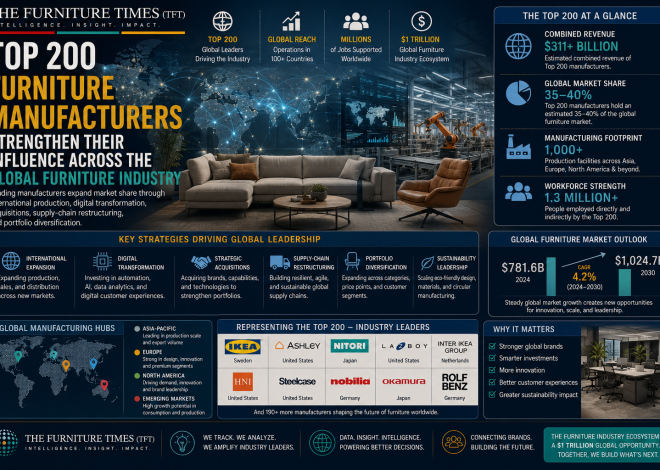
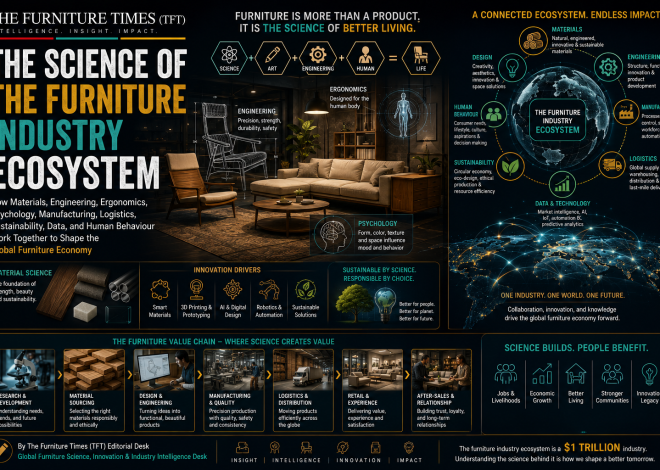
The wider furniture industry ecosystem—including timber, panels, components, textiles, leather, chemicals, machinery, design, logistics, retail, software, exhibitions, testing, installation, repair and recycling—can reasonably be viewed as an economic network approaching US$1 trillion.
Furniture Market Snapshot for 2026
| Market indicator | Current industry picture |
| Largest furniture-producing country | China |
| China’s estimated share of global production | Approximately 36%, based on CSIL’s 2025/2026 outlook |
| Leading production region | Asia-Pacific, accounting for more than half of worldwide furniture production in 2024 |
| Other major producers | United States, India, Italy, Germany, Vietnam and Poland |
| Leading importing markets | United States, Germany, United Kingdom, France and the Netherlands |
| Major sourcing strengths | Scale, cost, craftsmanship, OEM/ODM capability, component access and logistics |
| Important growth drivers | Urbanization, housing, hospitality, renovation, e-commerce, modularity and sustainability |
| Major business risks | Tariffs, freight volatility, weak housing activity, currency movements and geopolitical disruption |
The market is large, but it is not moving uniformly. Some countries lead in production, others in imports and consumption, and still others in design, machinery, components or premium manufacturing.
China Remains the Centre of Global Furniture Production
China continues to occupy the central position in the international furniture supply chain.
According to CSIL’s 2025/2026 outlook, China represented approximately 36% of global furniture production. The country’s advantage extends far beyond lower-cost manufacturing. China has built one of the deepest and most complete furniture ecosystems in the world.
Its manufacturing regions give buyers access to:
Residential and commercial furniture
Upholstered furniture and mattresses
Outdoor and garden furniture
Metal, glass and mixed-material products
Ready-to-assemble and flat-pack furniture
Kitchen cabinets and wardrobes
Office furniture and ergonomic seating
Lighting and decorative accessories
Furniture hardware and mechanisms
Packaging, testing and logistics services
Major production centres such as Guangdong, Zhejiang, Jiangsu, Shandong, Fujian and Jiangxi provide specialized industrial clusters. Within these clusters, manufacturers can obtain timber products, panels, foam, textiles, hardware, metal fabrication, glass, coatings, packaging and export services.
This concentration reduces product-development time and makes it possible to manufacture complicated collections that combine several materials and processes.
China’s OEM and ODM advantage
China is particularly competitive in original equipment manufacturing and original design manufacturing.
An OEM supplier manufactures products according to a customer’s design, specifications and branding. An ODM supplier may contribute more substantially to concept development, engineering, prototyping and design before producing the finished collection under the buyer’s brand.
For global retailers and furniture companies, this capability can shorten the journey from a commercial idea to a market-ready product.
Chinese manufacturers have also invested substantially in computer-controlled machinery, robotics, digital production management, product visualization and automated finishing. The belief that China competes only through inexpensive labor is increasingly outdated.
In many categories, China now competes through engineering, scale, speed and supply-chain integration.
Challenges affecting Chinese sourcing
China’s position remains powerful, but buyers face several considerations:
Rising labor and operating costs
Tariff exposure in important export destinations
Longer shipping distances to Western markets
Geopolitical and trade-policy uncertainty
Intellectual-property protection requirements
Pressure to document environmental and social compliance
Competition for specialized factory capacity
For this reason, many international buyers are keeping strategic suppliers in China while adding factories in other countries. This “China-plus-one” model is designed to diversify risk without abandoning China’s manufacturing depth.
Vietnam Strengthens Its Position as an Export Powerhouse
Vietnam has become one of the world’s most important furniture-exporting countries and a leading alternative or complement to Chinese sourcing.
Its reputation is particularly strong in wood furniture, including dining sets, bedroom collections, cabinets, occasional furniture, outdoor furniture and upholstered frames. The country combines woodworking skills with an expanding industrial manufacturing base.
Production is concentrated around major furniture clusters in southern Vietnam, including Binh Duong, Dong Nai and the Ho Chi Minh City region. Important activity also exists around Binh Dinh and other provinces with established wood-processing capabilities.
Why global buyers are choosing Vietnam
Vietnam provides several important advantages:
Strong experience in export furniture
Skilled woodworking and finishing
Competitive manufacturing costs
Access to international shipping routes
Established relationships with American, European and Asian buyers
Capability in indoor and outdoor wooden furniture
Expanding upholstery and mixed-material production
Participation in international trade agreements
The country has benefited from global companies seeking to diversify production away from excessive dependence on one sourcing market.
Vietnamese factories have also improved their product development, compliance management and manufacturing technology. Many can now support international brands with engineering, samples, packaging development and testing.
Vietnam’s growing constraints
Rapid expansion is creating pressure on the Vietnamese industry.
Factory capacity can tighten during strong demand periods, while labor and land costs may rise as more international businesses enter the market. Vietnam also depends on imported machinery, materials and components for certain categories.
Timber legality and chain-of-custody documentation are especially important. Buyers need to verify wood origins, certification claims and regulatory compliance rather than assuming that every supplier operates to the same standard.
Vietnam should therefore be viewed as a sophisticated production market that requires careful supplier selection—not simply as a cheaper substitute for China.
India Emerges as a Manufacturing and Consumer Opportunity
India is becoming increasingly important to the global furniture economy.
Its competitive position is supported by a large population, rapid urbanization, residential development, hospitality investment, rising middle-class consumption and growing interest in organized furniture retail.
India possesses strong capabilities in solid wood, metalwork, carving, handicrafts, upholstery and customized production. Manufacturing clusters in Rajasthan, Uttar Pradesh, Haryana, Punjab, Tamil Nadu, Karnataka, Maharashtra and other states serve domestic and international markets.
The country’s furniture ecosystem is also moving gradually from informal carpentry toward more organized production, branded retail and modular manufacturing.
This transition creates opportunities for:
Panel furniture manufacturers
Kitchen and wardrobe companies
Hardware and fittings suppliers
Machinery businesses
Upholstery-material producers
Organized retailers and marketplaces
Design, logistics and installation companies
India’s long-term strength may come from combining manufacturing with domestic consumption. Unlike export-dependent production centres, India has the potential to support factories through a very large internal market.
The principal challenges include fragmented supply chains, logistics differences between states, inconsistent quality among suppliers and varying levels of manufacturing modernization.
For companies willing to build long-term partnerships and invest in supplier development, India could become one of the furniture industry’s most consequential growth markets.
Italy Retains Leadership in Design and Premium Furniture
Italy cannot match China’s manufacturing volume, but it remains one of the world’s most influential furniture countries.
Its strength is concentrated in premium residential furniture, kitchens, upholstered products, lighting, luxury interiors, components, surfaces and machinery. Italian furniture benefits from a global reputation for design, material knowledge and craftsmanship.
Industrial districts allow manufacturers, designers and specialist suppliers to collaborate closely. The Brianza area, Veneto, Friuli-Venezia Giulia, Marche and other regions support important furniture clusters.
Italy’s competitive value lies in:
High-end design
Brand heritage
Premium materials and finishing
Customized manufacturing
Kitchen and wardrobe engineering
Furniture machinery and technology
International architectural relationships
Luxury hospitality and residential projects
Italian manufacturing is generally more expensive than sourcing from Asian mass-production centres. However, it serves a different commercial position. Buyers often select Italy when design credibility, customization, craftsmanship and premium branding matter more than the lowest possible price.
Germany Competes Through Engineering and Market Strength
Germany is both a significant furniture producer and one of the world’s leading furniture-importing markets.
German manufacturing is associated with engineering accuracy, automated production, quality systems, kitchens, office furniture, mattresses, hardware and industrial components. The country’s machinery and fittings companies influence furniture production well beyond Germany itself.
Its large consumer market attracts suppliers from Poland, Italy, China, Vietnam and other manufacturing countries. Demand is shaped by household spending, residential construction, renovation activity and demographic change.
German consumers and business buyers increasingly expect:
Functional and durable products
Transparent product information
Environmental responsibility
Safety and performance compliance
Efficient delivery and after-sales service
Furniture suited to smaller or adaptable spaces
Germany is therefore not merely a destination for low-cost exports. It is a demanding market where documentation, reliability and distribution capability can determine success.
Poland Remains a Strategic European Manufacturing Base
Poland has developed into one of Europe’s largest furniture-producing and exporting countries.
Its location gives manufacturers access to Germany, France, the Netherlands, Scandinavia and other major European markets. Poland combines an established woodworking tradition with industrial-scale production and relatively competitive costs within the European Union.
The country is particularly strong in:
Ready-to-assemble furniture
Upholstered furniture
Bedroom and living-room products
Mattresses
Components and wood-based manufacturing
Private-label production for European retailers
Polish factories can offer shorter delivery distances than Asian suppliers serving Europe. This nearshoring advantage has become more valuable as companies seek lower transport risk, faster replenishment and closer production control.
Poland nevertheless faces rising wages, energy costs and competition from lower-cost regions. Its future competitiveness will depend increasingly on automation, productivity, product development and movement into higher-value categories.
The United States Remains a Critical Consumption Market
The United States is one of the world’s most important furniture markets and the leading international importer.
Its scale makes it a priority for manufacturers in China, Vietnam, Mexico, Canada, Malaysia, Indonesia, India and Europe. Demand includes residential furniture, mattresses, office systems, outdoor furniture, hospitality products, cabinetry and institutional furnishings.
However, the American furniture market is closely linked to housing.
When home sales slow, consumers move less frequently and purchase fewer large furniture items. Higher borrowing costs can also delay residential construction, renovation and discretionary expenditure.
At the same time, the United States continues to provide opportunities through:
A very large household market
Strong e-commerce adoption
Hospitality and commercial projects
Demand for outdoor living
Premium and luxury consumption
Home-office and ergonomic products
Replacement and renovation demand
Trade policy has become a central risk. Tariffs and investigations affecting imported furniture can change landed costs quickly. Importers therefore need country-diversification plans, accurate product classifications and close communication with suppliers.
Domestic and regional manufacturing may gain strategic importance, particularly where buyers value shorter lead times or customization. Yet relocating mass furniture production is difficult because factories depend on complete ecosystems of materials, labor, machinery and components.
Mexico Gains from Nearshoring
Mexico is strategically positioned to serve the North American market.
Its proximity to the United States offers shorter transit times than Asian sourcing, while established manufacturing agreements can support regional trade. Mexico also has experience in wood products, upholstery, metalwork, casegoods and contract manufacturing.
Nearshoring can provide several benefits:
Faster replenishment
Lower ocean-freight dependence
Easier factory visits
Reduced time-zone differences
Greater flexibility for customized orders
Better responsiveness to market changes
However, Mexico does not yet offer the same breadth of furniture supply chains as China. Material and component availability, factory capabilities, security, infrastructure and cost must be evaluated by location and product type.
The country is best viewed as one part of a diversified sourcing network rather than a universal replacement for Asian production.
Malaysia and Indonesia Remain Important Specialist Suppliers
Malaysia has long been a recognized furniture exporter, with particular strength in wooden furniture, rubberwood products, dining furniture, bedroom collections and upholstered products.
Muar in Johor is one of the country’s best-known furniture clusters, connecting manufacturers with component suppliers, packaging companies, logistics providers and export services.
Malaysia benefits from manufacturing experience, international market knowledge and access to regional materials. It faces pressure from labor availability, production costs and competition from Vietnam and other Asian suppliers.
Indonesia holds a distinctive position in teak furniture, rattan, handicrafts and outdoor products. Jepara is globally recognized for carving and solid-wood craftsmanship, while manufacturers in other regions supply contemporary indoor and outdoor collections.
Indonesia’s advantage lies in material heritage and artisanal capability. Its challenges can include logistics, production consistency, lead-time management and documentation across fragmented supplier networks.
Both countries can compete more effectively by moving beyond contract manufacturing into design development, branded products, certified materials and direct global visibility.
Europe Remains a Major Market Despite Uneven Demand
Europe is a collection of different furniture markets rather than one uniform commercial territory.
Germany, the United Kingdom, France, Italy, Spain, the Netherlands and the Nordic countries have different housing structures, retail systems, aesthetic preferences and economic conditions.
According to CSIL’s global trade picture, Germany, the United Kingdom, France and the Netherlands remain among the world’s leading furniture importers. The Netherlands is particularly important as a trading and logistics hub.
European demand has recently faced pressure from weak housing activity, inflation and cautious consumer spending. France, for example, recorded a 5.1% decline in furniture sales during 2024, according to figures reported by Le Monde. Kitchen and bathroom furniture were among the more heavily affected categories.
Long-term opportunities remain in:
Sustainable and circular furniture
Senior and accessible living
Space-efficient urban products
Hospitality renovation
Premium interiors
Workplace transformation
Repairable and modular products
Locally or regionally manufactured furniture
European regulation will continue influencing global suppliers. Product safety, chemical restrictions, deforestation rules, sustainability reporting and extended producer responsibility can affect furniture sold into the region.
The Middle East Is Becoming a Premium Project Market
The Gulf region continues to offer significant opportunities through hospitality, tourism, residential development, retail construction and major urban projects.
Saudi Arabia and the United Arab Emirates are especially important markets for contract furniture, luxury interiors, outdoor products, offices, hotels, restaurants and branded residential developments.
The region imports extensively because local production does not cover the full range of market demand.
Success in Middle Eastern markets requires more than supplying furniture. Manufacturers may need to support:
Project specifications
Customized dimensions and finishes
Fire and safety certifications
Installation and logistics
Replacement parts
Design coordination
Fast project communication
Competition is international. Suppliers from China, Turkey, Italy, Germany, Malaysia, Vietnam and other countries compete for projects at different price levels.
Turkey Connects Europe, Asia and the Middle East
Turkey offers a strategic combination of manufacturing capability and geographic access.
Its furniture sector serves European, Middle Eastern, Central Asian and North African customers. The country has strengths in upholstered furniture, panel furniture, bedrooms, contract products and interior fit-out.
Competitive production costs and relatively short delivery distances create opportunities, although currency volatility and economic instability can complicate long-term pricing.
Turkey’s strongest position lies in serving regional markets that need faster delivery and more customization than distant high-volume suppliers may provide.
Furniture Sourcing Is Becoming Multi-Country Sourcing
The greatest change in the current furniture market is not the disappearance of established sourcing countries. It is the movement from single-country dependence toward multi-country supply strategies.
A global furniture company may now use:
China for scale, components and technically complex products
Vietnam for wood furniture and export manufacturing
India for craftsmanship and emerging-market access
Poland or Turkey for European replenishment
Mexico for North American nearshoring
Italy for design-led premium collections
Malaysia or Indonesia for specialist wood and outdoor products
This model improves resilience, but it also makes supply-chain management more demanding. Every additional country introduces different legal systems, currencies, shipping routes, labor conditions, quality practices and documentation requirements.
Diversification works only when companies have strong sourcing controls.
Price Alone Is No Longer a Sufficient Sourcing Strategy
A low factory quotation can become expensive when it produces quality claims, delayed deliveries, high freight charges, compliance failures or excessive inventory.
Professional buyers increasingly calculate total landed and lifecycle cost.
This includes:
Factory price
Tooling and development
Quality inspections
Packaging
Inland transport
Freight and insurance
Duties and tariffs
Warehousing
Damage and returns
Warranty claims
Product life expectancy
End-of-life responsibility
A supplier offering a slightly higher initial price may deliver greater overall value through consistent quality, lower failure rates and faster replenishment.
This is particularly important for furniture because products are large, expensive to transport and costly to replace.
Sustainability Is Reshaping Market Access
Sustainability has moved from brand communication into sourcing qualification.
Buyers increasingly request evidence relating to timber legality, recycled content, chemical safety, emissions, packaging, factory energy, labor practices and product durability.
Furniture companies must also prepare for circular-economy expectations. Products may need to be easier to repair, disassemble, refurbish and recycle.
This creates opportunities for manufacturers and component companies that can offer:
Certified timber
Low-emission panels
Water-based finishes
Recycled metals and plastics
Replaceable components
Modular construction
Reduced packaging
Product traceability
Environmental product declarations
Suppliers that cannot provide reliable documentation may gradually lose access to regulated or sustainability-sensitive markets.
Technology Is Redefining Furniture Manufacturing
Automation and digital systems are helping manufacturers respond to rising costs and customized demand.
Computer-controlled cutting, drilling and edge-banding systems can produce components with greater accuracy. Digital production planning can reduce waste and improve scheduling. Three-dimensional visualization and product configuration can speed up product approvals.
Artificial intelligence is beginning to support:
Demand forecasting
Product recommendations
Production planning
Quality inspection
Design variation
Material optimization
Customer service
Digital catalog management
Technology will not eliminate the value of craftsmanship. Instead, competitive manufacturers will combine skilled human judgment with tools that improve consistency, speed and information quality.
What Furniture Companies Should Prepare for in 2026
The current market rewards companies that can manage uncertainty without losing focus on product value.
Manufacturers, retailers and sourcing companies should prioritize:
Supplier diversification: Avoid excessive dependence on one country, factory or material source.
Quality visibility: Use documented standards, approved samples, inspections and performance testing.
Tariff intelligence: Monitor trade-policy changes and calculate landed cost before confirming prices.
Material traceability: Build reliable records for timber, panels, textiles, leather, foam, metals and chemicals.
Digital product data: Maintain accurate dimensions, materials, certifications, images and assembly information.
Faster product development: Use prototyping, visualization and supplier collaboration to reduce launch time.
Inventory discipline: Balance availability with the financial risk of holding excessive stock.
Regional manufacturing options: Explore nearshoring where speed and flexibility justify the cost.
Repairability and durability: Design products that reduce returns, warranty expenses and premature replacement.
Global visibility: Ensure that buyers, search engines and AI platforms can find and understand the company’s capabilities.
The Market Is Moving from Sourcing Products to Building Supply Networks
China and Vietnam remain essential furniture-sourcing markets, confirming the central argument of DeepGreen Design’s original analysis. China provides unmatched industrial depth and scale, while Vietnam supplies strong woodworking capability and an increasingly mature export environment.
But the current market is broader than a competition between two countries.
India is rising. Poland and Turkey provide strategic regional production. Mexico is gaining attention through nearshoring. Italy continues to define premium design. Germany remains a major industrial and consumer market. Malaysia and Indonesia retain specialist strengths. The United States continues to influence global trade through the scale of its consumption and changes in tariff policy.
The winning furniture businesses will not necessarily source everything from the cheapest market. They will build networks that combine cost, capability, resilience, speed, compliance and innovation.
That is the defining strategic shift in the global furniture market of 2026.
Editorial note: Market totals differ because research providers use different product definitions, geographic coverage and measurement methods. Figures in this article are attributed to their respective publishers and should be compared only after reviewing their methodologies.
Sources: DeepGreen Design’s furniture-sourcing analysis, CSIL global furniture industry outlook, Fortune Business Insights furniture-market research, and Grand View Research furniture-market outlook.
The Furniture Times (TFT) Editorial Desk
The Furniture Times (TFT) & Furniture Industry Search Engine (FISE)
“TFT tells their story. FISE helps the world find them.”
FurniReviewology helps the world trust them.
The furniture industry ecosystem is a $1 trillion industry ecosystem.