Top 200 Furniture Manufacturers
Strengthen Their Influence Across the Global Furniture Industry
The Furniture Times (TFT) Editorial Desk
The Furniture Times (TFT) & Furniture Industry Search Engine (FISE)
“TFT tells their story. FISE helps the world find them.”
FurniReviewology helps the world trust them.
The furniture industry ecosystem is a $1 trillion industry ecosystem.
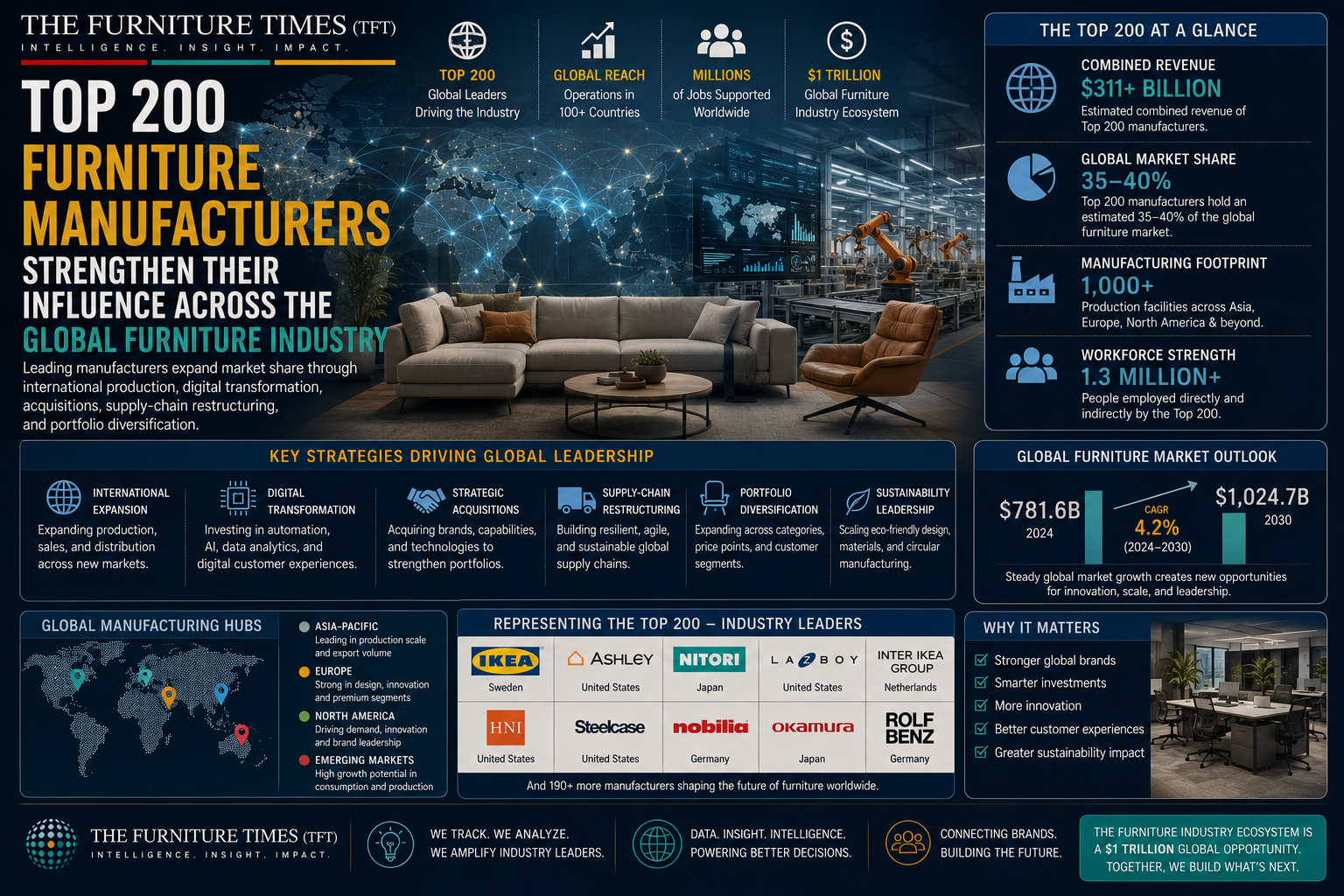
Leading manufacturers expand market share through international production, digital transformation, acquisitions, supply-chain restructuring, and portfolio diversification
The global furniture industry is becoming increasingly concentrated as its largest manufacturers use scale, capital, international production networks, acquisitions, and brand development to strengthen their competitive positions.
Research published by CSIL through World Furniture Online provides a detailed picture of this transformation. Its study of the world’s 200 largest furniture manufacturers indicates that these businesses generate approximately US$180 billion in combined company turnover. CSIL estimates that nearly US$120 billion of this amount comes specifically from furniture-related operations.
Together, the Top 200 companies account for more than 20% of global furniture production. Their expanding share illustrates how large manufacturers are growing faster than many smaller and medium-sized competitors, particularly when market disruption rewards financial strength, procurement scale, diversified sales channels, and the ability to reorganize supply chains quickly.
The findings are based on an extensive research system covering more than 8,000 companies across different furniture segments. CSIL uses company databases, annual reports, corporate websites, industry publications, press releases, surveys, and direct interviews to analyze the competitive structure of the worldwide industry.
The result is not simply a ranking of companies. It is a broader picture of how competition is changing across one of the world’s most interconnected manufacturing ecosystems.
A More Concentrated Global Market
The increasing concentration of furniture production among the Top 200 manufacturers is one of the study’s most important findings.
Large furniture groups have historically benefited from recognizable brands, extensive distribution, strong retail partnerships, and access to capital. These advantages have become even more valuable as manufacturers confront inflation, fluctuating demand, labor shortages, freight disruption, rising environmental expectations, and rapid changes in consumer purchasing behavior.
Scale can help companies negotiate more effectively with suppliers, spread technology investments across larger production volumes, and operate several factories or distribution centers. It may also allow manufacturers to respond more quickly when demand moves from one country, channel, or product category to another.
Smaller companies can remain highly competitive through specialization, craftsmanship, regional knowledge, design originality, or flexible production. However, they may face greater pressure when investments in automation, certification, digital commerce, logistics, and sustainability become essential rather than optional.
CSIL reports that the Top 200 manufacturers’ combined turnover increased by more than 30% between 2017 and 2022. This growth more than compensated for the pandemic-era interruption and exceeded the broader furniture sector’s sales performance over the period.
The figures suggest that the strongest companies did more than recover. Many used disruption as an opportunity to improve their competitive position.
Global Leadership Is Geographically Distributed
The Top 200 furniture manufacturers have headquarters in 30 countries, demonstrating that the industry remains geographically diverse even as corporate concentration increases.
Companies headquartered in Asia and the Pacific generate nearly 40% of the Top 200’s furniture turnover. European companies account for approximately 30%, while manufacturers based in the Americas represent another 30%.
This balance reflects three different but interconnected centers of furniture expertise.
Asia-Pacific combines massive manufacturing capacity with expanding domestic consumption, increasingly sophisticated design capabilities, and well-developed supply networks. China remains central to global furniture manufacturing, but important production bases have also developed across Vietnam, Malaysia, Indonesia, India, Japan, South Korea, and other regional markets.
Europe retains a powerful position in premium furniture, kitchens, office systems, design-led products, technology, machinery, materials, and branded manufacturing. Italy, Germany, Poland, Spain, France, Denmark, and several other countries contribute distinct manufacturing and design capabilities.
The Americas combine large consumer markets with major manufacturers in office furniture, cabinetry, mattresses, residential furniture, contract products, and retail-led furnishings. The United States is particularly influential because of its market size, institutional demand, brands, and active mergers-and-acquisitions environment.
The distribution of the Top 200 therefore shows that no single region controls every part of the industry. Competitive advantage depends on the category, price level, route to market, production model, and customer segment.
Large Manufacturers Demonstrated Greater Resilience
The pandemic tested the operational strength of furniture manufacturers around the world. Factory shutdowns, transport constraints, material shortages, retail closures, and unpredictable demand created extraordinary pressure.
According to CSIL, the decline in Top 200 manufacturers’ sales during 2020 was more contained than the contraction in overall world furniture production.
Greater financial capacity was an important advantage. Leading manufacturers could invest in new sales channels, rearrange sourcing, reposition inventories, adjust manufacturing schedules, and accelerate online commerce. Companies operating in several markets or product categories were also less dependent on a single source of revenue.
Some large businesses used their digital infrastructure to maintain contact with dealers, retailers, designers, architects, and consumers. Others introduced virtual showrooms, remote planning services, online product configuration, digital sales tools, and direct-to-consumer channels.
These capabilities helped leading manufacturers adapt to an environment in which physical access to showrooms and stores was temporarily restricted.
Preliminary figures cited by CSIL show that the Top 200 maintained approximately the same turnover level in 2022 as in 2021, while global furniture production declined by around 3%. That relative resilience further increased the strategic importance of the world’s largest manufacturers.
The period demonstrated that corporate size does not automatically guarantee success, but it can provide a wider range of options during a crisis.
Performance Varied Across Regions
Although the Top 200 collectively outperformed the wider industry, results differed by geography.
Asian manufacturers recorded particularly strong growth over the five years examined by the research. Their performance reflected a combination of export capability, manufacturing expansion, growing regional markets, and the development of larger companies serving multiple price points.
Some Asian companies have also moved beyond contract manufacturing to build proprietary brands, product-development teams, international distribution networks, and direct relationships with consumers.
European manufacturers posted encouraging results, especially in 2021, when their combined performance moved above pre-pandemic levels. Europe’s competitive strength remains closely connected to product engineering, design, flexible manufacturing, established brands, and leadership in premium and specialist categories.
North American manufacturers experienced significant development in 2019 and reached a more stable position in 2021. The region’s office, cabinetry, residential, mattress, and institutional furniture businesses faced different demand cycles, making performance highly dependent on category exposure.
These variations show why global comparisons must be interpreted carefully. A manufacturer’s growth may depend as much on its product mix and distribution model as on the country in which it is headquartered.
Kitchen and Upholstered Furniture Led Category Growth
The study identifies kitchen and upholstered furniture manufacturers among the most dynamic participants in the Top 200.
Kitchen furniture benefited from increased residential investment, renovation activity, storage demand, and consumer interest in better-integrated living spaces. Kitchens have also become technologically sophisticated environments involving cabinetry, lighting, work surfaces, appliances, hinges, drawer systems, organizers, and connected features.
This gives major kitchen manufacturers opportunities to increase value through complete systems rather than individual cabinets.
Upholstered furniture companies also continued to grow during the period examined. Demand for sofas, chairs, recliners, modular seating, and multifunctional products was supported by consumers spending more time at home and paying greater attention to comfort.
However, upholstered furniture remains exposed to fluctuations in foam, textiles, leather, timber, metals, labor, and transport costs. Manufacturers with strong supplier relationships and flexible product programs were generally better positioned to respond.
Office furniture followed a different path. Manufacturers in the category experienced a significant decline in 2020, followed by a limited recovery in 2021 that did not fully restore pre-pandemic performance.
The office sector faced uncertainty as companies reconsidered workplace requirements and adopted hybrid working models. Demand began shifting from conventional rows of desks toward adaptable spaces, collaborative furniture, acoustic products, ergonomic seating, home-office solutions, and furniture designed to support flexible occupancy.
This transition created challenges for traditional office suppliers but also opened opportunities for manufacturers able to redesign their portfolios.
Production Is Moving Closer to Customers
The geographic organization of manufacturing is becoming an important competitive tool.
CSIL reports that approximately half of the Top 200 companies conduct manufacturing activities outside the countries where their headquarters are located. North American companies show the greatest tendency to locate some production abroad, followed by Asian and European manufacturers.
The reasons for international manufacturing are changing.
For decades, furniture companies frequently relocated production to obtain lower labor and material costs. Cost remains important, but companies now consider a broader set of factors, including transport expenses, delivery times, trade policies, supply-chain resilience, skilled labor, energy availability, environmental regulations, and proximity to customers.
Manufacturers are consequently adopting more diversified production footprints. Instead of relying heavily on one distant production country, a company might combine high-volume overseas sourcing with regional assembly, domestic customization, and local distribution.
This approach can reduce exposure to disruption and shorten the time required to bring products to market.
Outdoor furniture manufacturers have been the most inclined to establish production outside their home countries. CSIL found that around 80% of the outdoor specialists included in the study had opened manufacturing plants abroad.
Office and upholstered furniture companies also demonstrated a strong tendency toward international production.
Outdoor products commonly use globally traded materials such as aluminum, steel, synthetic fibers, plastics, timber, textiles, and stone. Competitive manufacturing therefore requires access to specialized component ecosystems as well as efficient logistics.
Mergers and Acquisitions Are Reshaping Competition
Corporate acquisitions have become another major force in the restructuring of the global furniture industry.
CSIL identified approximately 80 mergers-and-acquisitions transactions involving Top 200 companies from the beginning of 2019 through the period covered by its analysis. This represents an average of about 20 significant transactions annually.
American and Italian companies were particularly active. Together, companies from the two countries completed approximately 40 transactions within the Top 200 sample. Manufacturers headquartered in China and the United Kingdom followed them in acquisition activity.
Acquisitions can give furniture companies access to new brands, technologies, designers, markets, customers, factories, or distribution channels. They may also help manufacturers enter adjacent categories without developing an entirely new business from the ground up.
In the United States, office furniture companies were among the most prominent participants. Herman Miller acquired companies and brands including Maars, HAY, and NaughtOne before combining with Knoll to form MillerKnoll. Steelcase also completed multiple acquisitions during the period examined.
Italy’s premium and luxury furniture sector experienced considerable consolidation. Groups such as Italian Design Brands—now known as Dexelance—and Design Holding used acquisitions to assemble portfolios of internationally recognized design businesses.
The strategy reflects an important change in the premium market. Rather than depending on one brand or product category, diversified groups can offer complementary collections, reach more international customers, and share selected corporate resources while preserving distinct brand identities.
CSIL also highlights three significant combinations involving Top 200 manufacturers.
ACProducts and Masco Cabinetry combined in 2020 to create Cabinetworks Group, a major participant in kitchen cabinets. Alsapan and P3G Industries merged in 2021 to form Alpagroup, strengthening their position in ready-to-assemble furniture. Herman Miller and Knoll also combined in 2021, creating MillerKnoll and establishing one of the world’s largest office furniture groups by turnover.
These transactions show that consolidation is taking place across mass-market, ready-to-assemble, kitchen, workplace, and luxury furniture segments.
The Competitive Meaning of Scale
Corporate scale creates several potential advantages, but each one requires disciplined execution.
A large manufacturer may purchase materials and components in greater volumes, improving its negotiating position. It may operate automated factories that would be difficult for a smaller business to justify. It can invest in design, product testing, digital systems, compliance, marketing, and international distribution across a larger revenue base.
Scale can also support wider product portfolios. A major group may supply seating, desks, storage, partitions, lighting, accessories, and digital workplace services to the same project.
However, size creates complexity. Large organizations must coordinate multiple brands, factories, markets, information systems, and management teams. Poorly integrated acquisitions can dilute brand value or generate unnecessary costs.
The leading groups will therefore be those that combine the resources of a large organization with the responsiveness and product focus of a specialist business.
What the Trend Means for Component Suppliers
The growing influence of large manufacturers has major implications for furniture-component and accessory companies.
Top manufacturers require dependable supplies of hinges, drawer slides, connectors, fasteners, furniture legs, casters, handles, mechanisms, lighting systems, upholstery materials, decorative surfaces, electronic controls, and many other inputs.
As furniture groups become larger and more international, suppliers may be expected to provide consistent quality across several factories and markets. They may also need to support product testing, documentation, environmental compliance, technical integration, and traceability.
This can create substantial opportunities for component producers capable of serving global accounts. A successful component can potentially be specified across several furniture collections or production locations.
At the same time, dependence on a small number of powerful customers may create commercial risk. Component suppliers need to protect their margins, maintain diversified customer portfolios, and invest in proprietary products that offer measurable performance advantages.
Innovation will be critical. Furniture manufacturers increasingly seek components that enable quiet movement, ergonomic adjustment, easy assembly, compact packaging, repairability, recycling, smart functionality, and efficient manufacturing.
The companies supplying those solutions will contribute directly to the competitiveness of the Top 200 furniture manufacturers.
Digital Capabilities Are Becoming Essential
The pandemic accelerated digital change, but its long-term importance extends well beyond online retail.
Furniture companies now use digital tools across product development, procurement, manufacturing, sales, logistics, and after-sales service. Three-dimensional product configuration can help customers visualize finishes and dimensions. Digital product data can support architects, interior designers, dealers, and e-commerce platforms.
Connected factory systems can improve scheduling and monitor quality. Data analysis can assist demand forecasting and inventory planning. Digital documentation can support regulatory compliance and material traceability.
Leading manufacturers are also developing omnichannel sales models that connect stores, dealers, websites, marketplaces, project teams, and direct sales.
These systems require investment, but they can increase both efficiency and market reach. For smaller manufacturers, partnerships with technology providers, distributors, marketplaces, and industry search platforms may help reduce the cost of building digital capability independently.
Sustainability Is Moving Into Corporate Strategy
Environmental responsibility is also becoming a competitive factor among the world’s largest furniture manufacturers.
Customers, designers, institutional buyers, investors, and regulators increasingly expect companies to explain where their materials come from, how products are manufactured, and what happens at the end of their useful lives.
Large manufacturers may have more resources to invest in certified materials, renewable energy, emissions measurement, product declarations, take-back programs, recyclable packaging, and circular design. Their scale also means that operational changes can have substantial environmental effects.
However, greater visibility brings greater scrutiny. Sustainability claims must be supported by reliable data and transparent methods. Companies that communicate ambitious goals without demonstrating progress may create reputational risk.
Furniture groups will increasingly need to integrate environmental performance into product development, supplier selection, manufacturing investment, and corporate reporting.
Opportunities Remain for Specialist Manufacturers
The rise of large groups does not eliminate opportunities for independent furniture companies.
Furniture remains culturally, aesthetically, and functionally diverse. Customers continue to value originality, local manufacturing, customization, craftsmanship, specialist knowledge, and personal service.
Smaller manufacturers can compete by occupying market positions that large groups may find difficult to serve efficiently. These include bespoke furniture, short production runs, regional styles, unusual materials, restoration, specialist institutional applications, and highly customized contract projects.
Speed can also be an advantage. A focused company may make product decisions more quickly and respond to emerging design preferences before a larger organization completes its development process.
Nevertheless, specialist manufacturers need clear differentiation. Competing with global groups on price alone is increasingly difficult. Strong design, technical expertise, authentic brand identity, reliable delivery, and close customer relationships become essential.
The Next Phase of Global Competition
The CSIL findings describe an industry moving toward greater concentration but still shaped by geographic diversity and category-specific expertise.
Future competition is likely to revolve around several connected capabilities:
Resilient and geographically diversified supply chains
Automation and flexible manufacturing
Digital product development and commerce
Strong brands and efficient distribution
Sustainable materials and circular design
Faster delivery and regional production
Strategic acquisitions and partnerships
Innovation in components, mechanisms, and smart systems
Accurate product data and greater market visibility
Large furniture manufacturers are likely to continue pursuing acquisitions where those deals deliver brands, technology, distribution, or market access. At the same time, companies will review the location of their factories and suppliers as geopolitical uncertainty and transportation costs influence production decisions.
The industry may therefore become more consolidated at the corporate level but more geographically distributed at the manufacturing level.
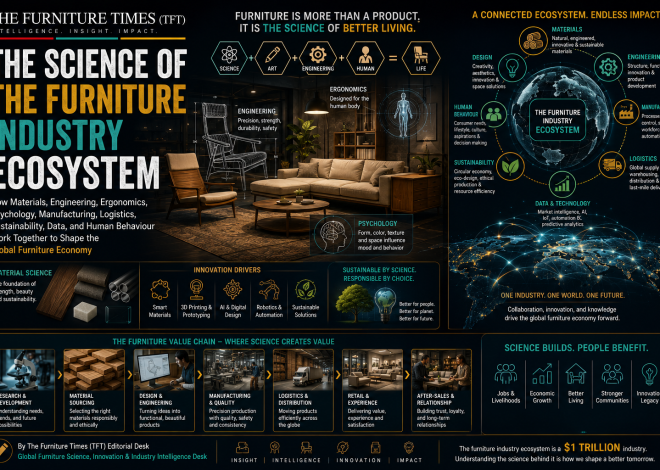
A Wider Furniture Ecosystem Worth About US$1 Trillion
Finished-furniture manufacturing is only one part of a much larger economic system.
The wider furniture ecosystem includes forestry, panels, hardware, components, chemicals, textiles, leather, machinery, software, design, logistics, real estate, retail, exhibitions, testing, repair, recycling, publishing, and professional services. Viewed through this broader lens, the furniture industry ecosystem represents an economy estimated at approximately US$1 trillion.
The Top 200 manufacturers occupy an influential position within this network. Their purchasing decisions affect thousands of material suppliers, component makers, logistics providers, designers, retailers, and service businesses.
Their growing market share means their strategies can influence technical standards, sustainability requirements, supply-chain structures, design directions, and investment priorities across the wider industry.
For every company operating in furniture, the central lesson is clear: competitiveness now depends on more than manufacturing capacity. It requires the ability to coordinate design, technology, sourcing, data, distribution, sustainability, and customer relationships as one connected business system.
The world’s largest manufacturers are strengthening those capabilities through scale and consolidation. Their competitors must respond through specialization, innovation, partnerships, agility, or a carefully chosen combination of all four.
This article is an original editorial analysis based principally on figures and findings published by CSIL through World Furniture Online. The underlying performance figures mainly cover 2017–2022 and should not be interpreted as a real-time 2026 ranking.