
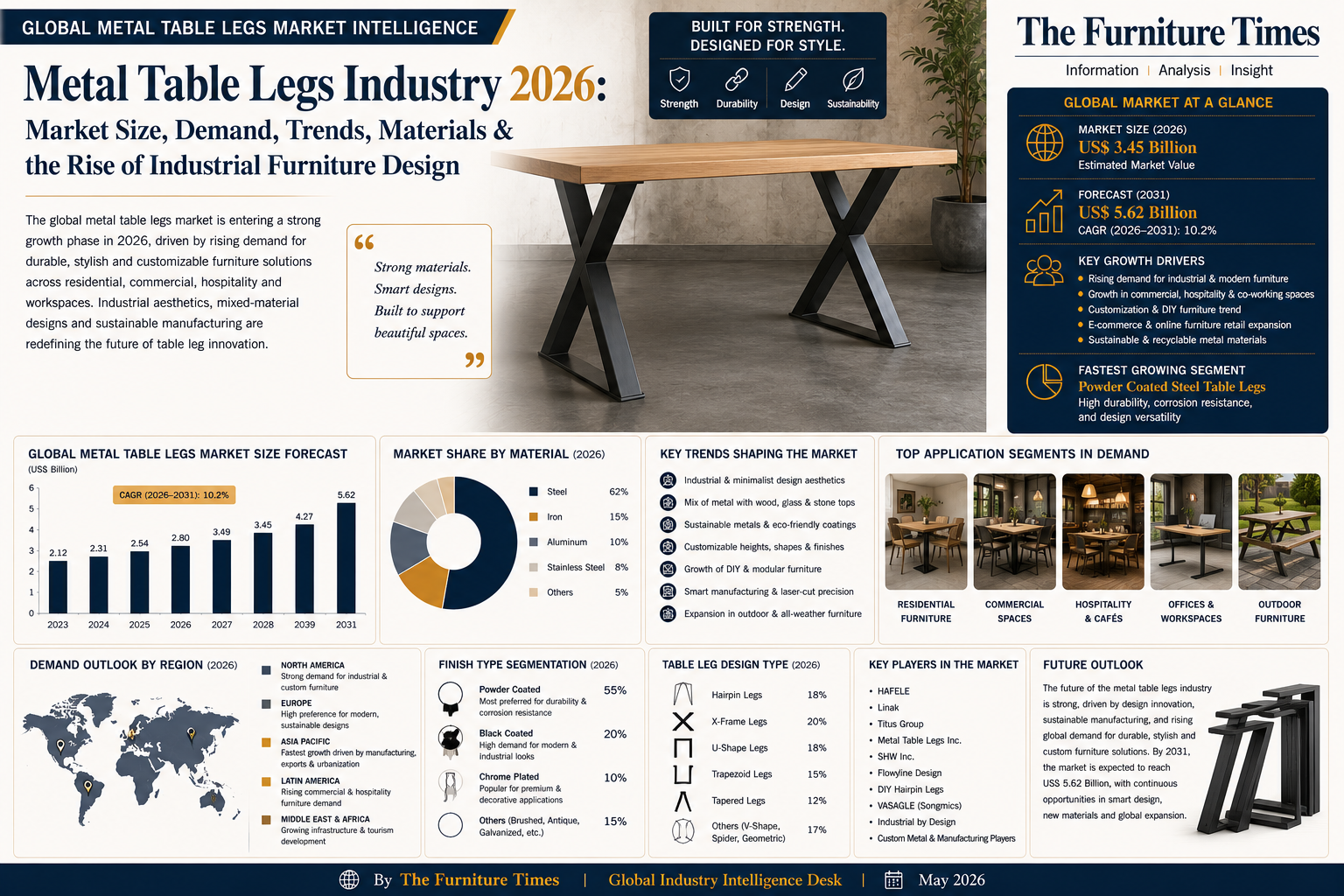
Metal Table Legs Industry 2026: Market Size, Demand, Trends, Materials & the Rise of Industrial Furniture Design
Global Metal Table Legs Market Intelligence | The Furniture Times
By The Furniture Times | Global Industry Intelligence Desk | May 2026
The global metal table legs market is rapidly emerging as one of the most important micro-segments inside the global furniture hardware, furniture components, and interior furniture systems industry.
Once viewed as a basic structural accessory, metal table legs have evolved into:
- architectural furniture elements
- industrial design statements
- premium customization components
- modular furniture infrastructure
- hospitality-grade furniture systems
- minimalist interior essentials
Across residential interiors, restaurants, cafés, offices, hotels, coworking spaces, luxury homes, retail environments, and outdoor hospitality projects, metal table legs are becoming a major driver of modern furniture aesthetics and structural innovation.
Global Market Size
The metal table legs segment sits inside the broader:
- table bases market
- table hardware market
- furniture hardware market
- metal furniture market
The global table bases market was valued at approximately US$2.5 billion in 2024 and is projected to reach around US$4.3 billion by 2033, growing at a CAGR of approximately 5.8%.
The broader table hardware market is expected to grow from approximately US$4.63 billion in 2025 to around US$6.47 billion by 2032, reflecting continued demand for structural table components and modular furniture systems.
Meanwhile, the global furniture hardware market is estimated at approximately US$22.23 billion in 2025, projected to exceed US$31.72 billion by 2034.
The wider metal furniture market itself is projected to reach approximately US$50.8 billion by 2030, supported by commercial real estate growth, hospitality expansion, office demand, and residential renovation.
These numbers show one important reality:
Metal table legs are no longer a small accessory category.
They are becoming a critical structural and aesthetic layer inside the global furniture ecosystem.
Why Demand Is Growing Worldwide
1. Rise of Industrial & Minimalist Interiors
One of the biggest drivers is the global popularity of:
- industrial interiors
- modern minimalism
- loft-style furniture
- Scandinavian design
- contemporary hospitality aesthetics
Metal table legs strongly support:
- clean lines
- geometric design
- visual lightness
- architectural styling
Black steel legs, brushed metal finishes, and minimalist frames have become especially popular in dining tables, office tables, café tables, and console furniture.
2. Explosion of Custom Furniture Market
Custom furniture demand is growing rapidly worldwide.
Consumers increasingly want:
- unique dining tables
- live-edge wood tables
- epoxy resin tables
- handmade tabletops
- custom workstations
Metal table legs make customization easier because they allow:
- interchangeable table tops
- modular production
- flexible sizing
- easier shipping
- faster manufacturing
This is especially important for:
- furniture startups
- artisan woodworkers
- boutique furniture makers
- Etsy-style furniture sellers
- hospitality furniture suppliers
3. Hospitality & Commercial Furniture Expansion
Restaurants, cafés, coworking spaces, hotels, offices, and retail environments increasingly prefer metal table legs because they offer:
- durability
- stability
- modern appearance
- commercial-grade strength
- long-term performance
The global hospitality expansion and office redesign cycle continue driving commercial metal furniture demand.
4. Growth of DIY & Modular Furniture Culture
DIY furniture culture has grown globally through:
- YouTube
- TikTok
- Etsy
- online marketplaces
Consumers increasingly buy:
- tabletops separately
- ready-made metal legs
- adjustable bases
- folding frames
- hairpin legs
- industrial steel legs
This has transformed table legs into a standalone furniture category.
Main Types of Metal Table Legs
1. Hairpin Legs
One of the world’s most recognizable vintage-modern styles.
Popular for:
- coffee tables
- side tables
- compact desks
- DIY furniture
Usually made from:
- powder-coated steel
- black steel
- stainless steel
2. X-Frame Legs
Strong in:
- industrial dining tables
- conference tables
- restaurant furniture
- rustic-modern interiors
Known for:
- structural stability
- bold appearance
- heavy-duty support
3. U-Shaped Legs
Very popular in minimalist interiors.
Common in:
- office desks
- dining tables
- workstations
- contemporary furniture
4. Trapezoid Legs
Strong design-led segment.
Popular in:
- luxury dining tables
- hospitality furniture
- live-edge wood furniture
5. Pedestal Bases
Common in:
- café tables
- restaurant tables
- meeting tables
- hospitality furniture
Advantages:
- space efficiency
- seating flexibility
- modern appearance
6. Adjustable & Folding Legs
Growing strongly due to:
- modular furniture
- flexible workspaces
- event furniture
- compact urban living
Materials Used in Metal Table Legs
Steel
The dominant material globally.
Advantages:
- strength
- affordability
- durability
- industrial aesthetics
Common finishes:
- matte black
- brushed steel
- powder-coated colors
Stainless Steel
Popular in:
- luxury interiors
- hospitality projects
- outdoor furniture
- premium commercial spaces
Advantages:
- corrosion resistance
- modern appearance
- long lifespan
Aluminum
Growing in:
- lightweight furniture
- outdoor furniture
- foldable systems
- modern office furniture
Advantages:
- lightweight
- rust resistance
- portability
Wrought Iron
Used mainly in:
- vintage furniture
- luxury handcrafted furniture
- decorative interiors
- classic European styles
Key Demand Segments
Residential Furniture
Strong demand from:
- dining tables
- coffee tables
- study desks
- home offices
- kitchen islands
Hospitality Furniture
Hotels, cafés, restaurants, and bars increasingly prefer metal table bases due to durability and commercial usability.
Office & Commercial Furniture
Modern office design increasingly uses:
- standing desks
- collaborative worktables
- minimalist workstations
- modular office systems
Outdoor Furniture
Outdoor dining and hospitality growth are increasing demand for:
- aluminum legs
- stainless steel bases
- weather-resistant metal frames
Regional Market Analysis
North America
One of the strongest markets globally.
Driven by:
- DIY furniture culture
- Etsy furniture businesses
- industrial loft interiors
- custom furniture demand
- restaurant expansion
Europe
Strong focus on:
- premium craftsmanship
- minimalist furniture
- industrial-modern aesthetics
- sustainability
Major markets:
- Germany
- Italy
- France
- Scandinavia
Asia-Pacific
One of the fastest-growing regions.
Driven by:
- urbanization
- compact living
- café culture
- furniture exports
- manufacturing growth
Key countries:
- China
- India
- Vietnam
- Malaysia
- Indonesia
Middle East
Strong luxury hospitality and commercial demand.
Popular in:
- UAE
- Saudi Arabia
- Qatar
Demand driven by:
- luxury restaurants
- hotels
- premium villas
- office developments
Africa
Emerging opportunity market.
Growth supported by:
- hospitality development
- commercial furniture demand
- urban office expansion
Manufacturing & Supply Chain Trends
China remains one of the largest global suppliers of:
- steel table legs
- industrial bases
- café table systems
- OEM metal furniture hardware
Vietnam, Malaysia, Turkey, Poland, and India are also becoming increasingly important manufacturing hubs for:
- custom table legs
- hospitality furniture bases
- export-grade furniture hardware
Major Design Trends in 2026
1. Matte Black Dominance
Matte black remains the strongest finish globally for modern interiors.
2. Sculptural Metal Legs
Metal legs are becoming design features themselves.
Recent design trends show growing interest in draped, sculptural, and artistic metal forms inside furniture design.
3. Mixed Metal Interiors
Mixed metal finishes are becoming more common in interiors, combining:
- black steel
- brass
- bronze
- copper
- stainless steel
Layered metal aesthetics are now a major interior trend.
4. Sustainable & Recycled Metal
Buyers increasingly prefer:
- recycled steel
- low-waste production
- durable long-life furniture systems
Industry commentary suggests sustainability is becoming a decisive purchasing factor for furniture components.
5. Compact & Space-Saving Systems
Urban apartments are increasing demand for:
- slim-profile legs
- foldable systems
- modular desk frames
- adaptable furniture systems
6. Industrial + Luxury Fusion
Luxury interiors increasingly combine:
- marble tops
- live-edge wood
- sintered stone
- sculptural metal bases
This creates a strong “industrial luxury” aesthetic.
Price Range
Entry-Level
US$20–US$80 per set
Includes:
- hairpin legs
- simple steel frames
- DIY furniture legs
Mid-Range
US$80–US$400 per set
Includes:
- powder-coated steel bases
- café table bases
- office desk systems
- dining table legs
Premium
US$400–US$5,000+
Includes:
- designer metal bases
- handcrafted steel structures
- luxury hospitality systems
- sculptural architectural legs
Challenges Facing the Industry
1. Steel Price Volatility
Global steel prices heavily affect:
- manufacturing costs
- export pricing
- margins
2. Freight & Logistics Costs
Metal furniture components are heavy, increasing:
- shipping costs
- warehousing pressure
- packaging requirements
3. Cheap Commodity Competition
Mass-market suppliers create intense price pressure.
4. Counterfeit & Low-Quality Products
Low-grade welding and poor finishing reduce product lifespan and damage buyer trust.
Connection to the Furniture Ecosystem
Metal table legs directly support:
- dining tables
- office furniture
- hospitality furniture
- custom furniture
- modular interiors
- smart furniture systems
This makes them highly important for:
- interior designers
- furniture manufacturers
- carpenters
- architects
- hospitality suppliers
- furniture startups
TFT Industry Insight
The metal table legs market represents a much larger shift happening inside the furniture industry:
Furniture components are becoming design categories themselves.
Consumers increasingly evaluate:
- legs
- handles
- bases
- frames
- finishes
- structural details
as important visual design elements, not hidden hardware.
The future winners will combine:
- engineering
- customization
- design aesthetics
- digital discoverability
- fast manufacturing
- modular production
- sustainable materials
inside connected furniture ecosystems.
Final Thought
Metal table legs are no longer simply structural supports.
They are becoming:
- architectural design statements
- branding elements
- customization systems
- industrial luxury components
In the new furniture economy, the table leg is no longer hidden beneath the table.
It has become part of the identity of the furniture itself.
