
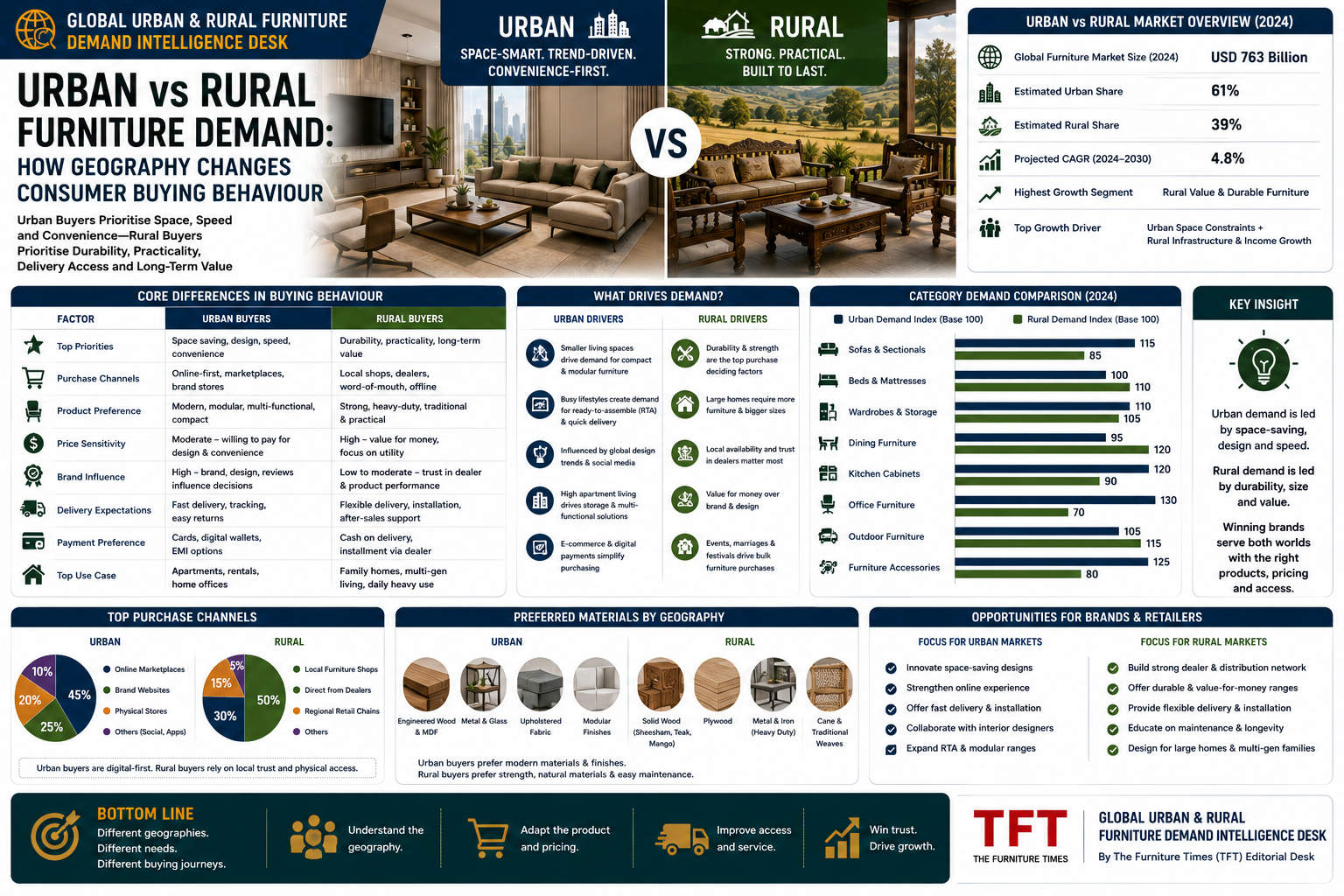
Urban vs Rural Furniture Demand: How Geography Changes Consumer Buying Behaviour
Urban Buyers Prioritise Space, Speed and Convenience—Rural Buyers Prioritise Durability, Practicality, Delivery Access and Long-Term Value
Global Urban & Rural Furniture Demand Intelligence Desk
By The Furniture Times (TFT) Editorial Desk
Geography influences almost every stage of the furniture-buying journey.
Where people live affects:
- The size and design of their homes
- The furniture products they need
- The materials they trust
- The amount they can afford
- The stores and manufacturers they can access
- The cost of delivery and installation
- The way they search for products
- How frequently they replace furniture
- Whether they prefer ready-made or custom furniture
- Whether repair is easier than replacement
An urban buyer living in a high-rise apartment may search for a compact modular sofa that fits inside a lift, arrives quickly and can be dismantled during the next relocation.
A rural household may prioritise a durable sofa, solid bed, large dining table or storage cabinet that can remain in use for many years and be repaired locally.
A city-based hotel may require contemporary contract furniture, space-efficient guest-room products and rooftop collections.
A countryside resort may require furniture capable of surviving heavy use, difficult access, humidity, dust, insects or long distances from replacement suppliers.
Urban and rural furniture demand are therefore not simply smaller and larger versions of the same market.
They are different economic systems.
The United Nations’ 2025 Revision of the World Urbanization Prospects provides estimates and projections for city, town and rural populations across 237 countries and territories through 2050. Using its harmonised settlement classification, cities contained approximately 45% of the world’s 8.2 billion people in 2025, while billions more lived in towns, semi-dense settlements and rural areas.
This means the furniture industry must serve several geographical realities simultaneously:
- Highly dense megacities
- Medium-sized cities
- Suburbs
- Small towns
- Peri-urban settlements
- Villages
- Agricultural communities
- Remote rural regions
Each requires a different product, price, logistics and retail strategy.
Geography Is a Commercial Variable
Furniture companies frequently segment customers according to:
- Age
- Income
- Product category
- Style
- Residential or commercial use
Geography should be treated with equal importance.
A household’s location can determine whether a product is commercially suitable.
A wardrobe may be attractive and affordable, but the order may fail because:
- The delivery vehicle cannot reach the property
- The product cannot enter an apartment lift
- Installation services are unavailable
- Replacement hardware cannot be obtained locally
- The product is unsuitable for the regional climate
- The final delivery charge makes it unaffordable
Furniture demand is therefore shaped by two connected questions:
- What does the customer want?
- Can the furniture ecosystem deliver it economically to where the customer lives?
Urban Furniture Demand: More People, Less Space
Cities concentrate population, employment, property development, retail, finance and digital connectivity.
The World Bank describes cities as major engines of economic growth that offer wider employment opportunities and more extensive infrastructure than rural areas, although it also warns that the benefits of urbanisation require effective planning and investment.
For furniture companies, cities offer:
- Dense concentrations of potential buyers
- High-rise housing
- Condominiums
- Rental apartments
- Student accommodation
- Offices
- Hotels
- Restaurants
- Healthcare facilities
- Retail developments
- Large furniture showrooms
- E-commerce delivery networks
However, urban consumers face powerful constraints.
These include:
- High property prices
- Expensive rent
- Smaller rooms
- Limited storage
- Lift and doorway restrictions
- Frequent relocation
- Building-management rules
- Traffic and delivery congestion
- Limited parking
- Higher service costs
The urban furniture market is therefore driven by the principle of maximum functionality within minimum space.
Rural Furniture Demand: More Space, Less Access
Rural households may have larger internal and external areas than households in dense cities.
They may possess:
- Larger bedrooms
- Formal family rooms
- Spacious kitchens
- Outdoor areas
- Storage buildings
- Extended-family living arrangements
However, rural customers often face different constraints:
- Fewer nearby showrooms
- Limited product choice
- Longer delivery distances
- Higher transport charges
- Fewer installation services
- Restricted consumer financing
- Lower or seasonal household income
- Poor road access in some locations
- Limited online inventory visibility
- Longer replacement lead times
These conditions can increase the importance of durability, repairability and local manufacturing.
A rural buyer may prefer one strong product that can remain in use for many years rather than a trend-driven item that depends on specialised replacement parts.
Urban and Rural Should Not Be Treated as Opposites
The line between urban and rural markets is becoming less clear.
Many households live in peri-urban areas located between cities and the countryside.
These communities may combine:
- Lower property prices
- Larger homes
- Urban employment
- Online shopping
- Limited physical retail
- Improving road connections
- New housing developments
Small towns may also function as commercial hubs for surrounding villages.
A retailer located in a district centre may serve customers from dozens of rural communities.
Furniture businesses should therefore analyse a settlement continuum:
City centre → urban neighbourhood → suburb → peri-urban area → small town → village → remote rural area.
The customer’s behaviour may change gradually across this continuum rather than suddenly.
Housing Type Shapes Furniture Demand
Geography affects furniture demand largely because it affects housing.
Urban Apartments
Apartment residents often need:
- Compact sofas
- Modular seating
- Storage beds
- Sliding-door wardrobes
- Extendable dining tables
- Folding desks
- Stackable chairs
- Wall-mounted storage
- Narrow shoe cabinets
- Balcony furniture
Urban Condominiums
Condominium buyers may seek a stronger balance between premium appearance and space efficiency.
Demand can include:
- Custom wardrobes
- Modular sofas
- Television walls
- Compact dining sets
- Balcony furniture
- Integrated home offices
- Premium storage
Urban Rental Housing
Renters often prioritise:
- Portability
- Low upfront cost
- Easy assembly
- Easy disassembly
- Flexible dimensions
- Fast delivery
- Resale value
- Neutral design
Suburban Homes
Suburban households may purchase:
- Larger sofas
- Complete dining sets
- Several bedroom collections
- Home-office furniture
- Outdoor furniture
- Garage or utility storage
- Children’s furniture
Rural Homes
Rural households may require:
- Large family seating
- Strong dining furniture
- Multiple beds
- Storage cabinets
- Outdoor benches and tables
- Kitchen storage
- Multipurpose furniture
- Furniture for extended family
The correct furniture strategy begins with the property type, not the regional label alone.
Urban Buyers Purchase Function per Square Metre
In an expensive city, floor area is a limited financial resource.
Furniture must justify the space it occupies.
This supports products that offer several functions.
High-Demand Urban Products
- Sofa beds
- Storage beds
- Modular wardrobes
- Folding dining tables
- Extendable tables
- Wall-mounted desks
- Nesting tables
- Mobile storage
- Benches with compartments
- Ottomans with storage
- Bunk beds with workstations
- Modular shelving
- Compact balcony sets
The value of these products is measured through:
- Space saved
- Functions added
- Ease of movement
- Adaptability
- Visual organisation
A lower-priced product that wastes space may offer weaker value than a more expensive design that replaces two or three pieces.
Rural Buyers Purchase Function per Ringgit, Dollar or Unit of Income
Rural demand is frequently shaped by long-term economic value.
Buyers may evaluate:
- How many years will it last?
- Can it support a large family?
- Can it be repaired locally?
- Will it survive frequent use?
- Can the material tolerate the climate?
- Does it require expensive maintenance?
- Can replacement parts be found?
This supports demand for:
- Strong timber beds
- Metal bed frames
- Solid or durable dining tables
- Repairable sofas
- Simple cabinets
- Locally made furniture
- Multipurpose benches
- Large storage units
- Outdoor furniture made from regional materials
The rural customer may not want the lowest purchase price.
They may want the lowest cost over the product’s full working life.
Income Differences Influence Demand—but Not Uniformly
Urban households often have access to higher-paying jobs and more diversified employment.
For example, a 2025 World Bank report concerning Indonesia noted that comparable urban workers earned approximately 40%–50% more than rural workers on average. This should not be generalised to every country, but it illustrates how employment geography can affect household purchasing capacity.
However, urban households also face higher expenses:
- Rent or mortgages
- Transport
- Childcare
- Parking
- Education
- Food
- Building service charges
A rural household may earn less money but own its home, produce part of its food or face lower housing costs.
Furniture buying power must therefore be assessed through disposable income after essential expenses, not salary alone.
Higher-Income Urban Segments
May purchase:
- Designer furniture
- Premium modular systems
- Custom storage
- Imported products
- Smart furniture
- Luxury upholstery
- High-end mattresses
Lower-Income Urban Segments
May purchase:
- Flat-pack products
- Second-hand furniture
- Compact packages
- Instalment-based furniture
- Marketplace products
- Rental furniture
Higher-Income Rural Segments
May purchase:
- Large home-furnishing packages
- Premium timber furniture
- Custom kitchens
- Outdoor furniture
- Furniture for hospitality or agricultural businesses
Lower-Income Rural Segments
May prioritise:
- Essential beds
- Basic mattresses
- Tables
- Chairs
- Storage
- Locally manufactured products
- Repair and reuse
Urban Furniture Is Replaced More Frequently
Urban furniture markets can experience shorter replacement cycles because of:
- More frequent relocation
- Rapid design exposure
- Higher retail availability
- Renovation trends
- Rental-property turnover
- Household changes
- Product convenience
- Faster e-commerce
Consumers living in major cities are continuously exposed to:
- Showrooms
- Property launches
- Interior-design media
- Social platforms
- Hotel and restaurant design
- Online advertising
- Influencers
- Global trends
This can encourage more frequent upgrading.
Urban households may replace furniture because:
- It does not fit a new property
- It is difficult to move
- The style has changed
- The household has grown
- The product no longer supports remote work
- Better storage is required
Rural Furniture Often Remains in Use Longer
Rural furniture may remain in the household across generations.
Longer use can result from:
- Stronger traditional construction
- Lower exposure to rapid trends
- Limited nearby retail
- High replacement-delivery costs
- Local repair skills
- Emotional attachment
- Family inheritance
A dining table may serve several generations.
A timber bed may be repaired or refinished.
A sofa may be reupholstered rather than replaced.
This can create business opportunities in:
- Repair
- Refinishing
- Reupholstery
- Hardware replacement
- Cushion replacement
- Timber restoration
- Mobile repair services
The rural furniture economy includes both new-product sales and long-term maintenance.
Urban Demand Favours Modular Furniture
Urban households change frequently.
People may:
- Move between apartments
- Change roommates
- Work from home
- Have children
- Downsize
- Relocate for employment
Modular furniture allows products to adapt.
Examples include:
- Sofas with removable sections
- Wardrobes that accept additional modules
- Shelving systems that expand
- Tables with removable leaves
- Children’s furniture that changes with age
- Desks that fold into storage units
A modular product creates stronger value when:
- Additional modules remain available
- Hardware survives repeated assembly
- Dimensions stay consistent
- Replacement finishes can be matched
- Instructions remain accessible
Without product continuity, modularity loses much of its advantage.
Rural Demand Favours Repairable Furniture
A complex product may be commercially unsuitable if the nearest service centre is several hours away.
Rural buyers benefit from furniture that uses:
- Standard screws and fasteners
- Replaceable hinges
- Locally available timber
- Weldable metal frames
- Removable covers
- Replaceable cushions
- Simple mechanisms
- Accessible construction
Repairability protects the customer from long supply chains.
It also creates work for:
- Carpenters
- Upholsterers
- Welders
- Furniture restorers
- Local hardware suppliers
Furniture designed for rural markets should consider the local repair ecosystem.
Material Preferences Can Differ by Geography
Material demand is influenced by price, climate, availability, tradition and maintenance.
Urban Material Demand
Urban buyers frequently encounter:
- Engineered wood
- Laminates
- Metal
- Glass
- Upholstery
- Moulded plastic
- Composite materials
- Premium stone
- Imported timber
Why Engineered Wood Is Strong in Cities
Engineered panels support:
- Compact cabinetry
- Automated production
- Standard dimensions
- Flat-pack distribution
- Broad finish choices
- Affordable pricing
Why Metal Is Important
Metal frames can create slim furniture with lower visual weight.
They are used in:
- Desks
- Beds
- Shelving
- Dining furniture
- Balcony products
- Modular systems
Why Performance Upholstery Matters
Urban families, renters and pet owners increasingly seek:
- Easy cleaning
- Stain resistance
- Replaceable covers
- High abrasion performance
- Neutral colours
Rural Material Demand
Rural buyers may show stronger interest in:
- Locally available timber
- Metal
- Bamboo
- Rattan
- Cane
- Recycled materials
- Simple upholstery
- Agricultural-residue products
Material choice can support local economic development.
FAO has emphasised that moving from raw timber exports toward engineered wood, furniture and construction products can multiply local employment and income.
Bamboo and rattan can also support rural value creation because processing furniture close to the raw-material source allows more economic value to remain within producing communities.
Climate Can Matter More Than Urban or Rural Status
A rural tropical home and an urban coastal apartment may face similar material challenges.
Furniture businesses must consider:
- Humidity
- Heat
- UV exposure
- Salt air
- Dust
- Insects
- Flooding
- Cold
- Dryness
- Seasonal variation
Humid Regions
Need:
- Moisture-resistant panels
- Well-dried timber
- Ventilated upholstery
- Corrosion-resistant metal
- Mould-resistant materials
Coastal Regions
Need:
- Suitable aluminium or stainless steel
- Protective coatings
- Replaceable hardware
- Salt-resistant finishes
Dry Rural Regions
Need:
- Materials resistant to cracking and excessive drying
- Dust-friendly surfaces
- Easy maintenance
Cold Regions
Need:
- Stable materials
- Indoor comfort
- Textile durability
- furniture that tolerates heating-related dryness
The correct product should be designed for both settlement type and climate.
Urban Buyers Have Greater Retail Choice
City buyers may have access to:
- National furniture chains
- Independent showrooms
- Designer stores
- Factory outlets
- Interior designers
- Kitchen specialists
- Department stores
- Online brands
- Marketplaces
- Second-hand platforms
Greater choice produces stronger competition.
Urban retailers must differentiate through:
- Brand identity
- Fast delivery
- Showroom experience
- Product information
- Reviews
- Financing
- Installation
- Returns
- Design services
A product can disappear among hundreds of alternatives unless it solves a clearly defined urban problem.
Rural Buyers Often Depend on Regional Retail Hubs
Rural customers may travel to:
- Nearby towns
- District centres
- Regional capitals
- Weekly markets
- Factory outlets
- Local workshops
Furniture purchases may be combined with other activities, including:
- Visiting family
- Agricultural trading
- Healthcare appointments
- Government administration
- Shopping for household goods
Retailers serving rural markets can strengthen their position by offering:
- Scheduled regional delivery
- Mobile catalogues
- Telephone or messaging orders
- Clear transport charges
- Local sales representatives
- Assembly support
- Repair services
- Collection points
The rural store’s service territory may be much larger than its immediate town.
E-Commerce Is Narrowing the Product-Discovery Gap
Digital commerce allows rural consumers to see products that were previously available only in cities.
Customers can compare:
- Styles
- Prices
- Materials
- Reviews
- Product dimensions
- Brands
However, online visibility does not automatically solve rural fulfilment.
The final purchase may still be blocked by:
- Expensive delivery
- No service coverage
- Remote-area exclusions
- Difficult returns
- Lack of assembly
- Poor road access
- Long lead times
E-commerce furniture strategy must therefore combine product discovery with a credible delivery network.
Urban and Rural Search Behaviour Is Different
Common Urban Searches
- Small sofa for apartment
- Modular furniture near me
- Wardrobe for condominium
- Same-day furniture delivery
- Furniture assembly service
- Desk for small bedroom
- Balcony furniture
- Furniture store open today
- Custom kitchen company
- Furniture with instalments
Urban searches often include:
- Space
- Speed
- Style
- Availability
- Location
- Service
Common Rural Searches
- Durable furniture near me
- Furniture delivery to my area
- Strong wooden bed
- Local furniture manufacturer
- Affordable mattress
- Custom table maker
- Furniture on monthly payment
- School furniture supplier
- Furniture repair service
- Metal wardrobe price
Rural searches often include:
- Durability
- Delivery coverage
- Local production
- Price
- Repair
- Payment
Local Search Is Essential in Both Markets
Urban customers use local search to find the nearest showroom, check opening hours or obtain directions.
Rural customers use it to identify the nearest reliable supplier or service centre.
Google’s Local Business structured-data documentation explains that businesses can provide information such as operating hours and administrative details that may help their information appear accurately in Search and Maps.
Furniture businesses should maintain:
- Correct name
- Address
- Telephone number
- Operating hours
- Delivery territory
- Product photographs
- Showroom information
- Service categories
- Customer reviews
A rural retailer should explicitly list the towns, districts and villages it serves.
An urban retailer should identify its showroom, warehouse, delivery area and parking or appointment conditions.
Product Data Helps Both Urban and Rural Buyers
Complete online product information reduces unnecessary travel.
Customers need:
- Dimensions
- Materials
- Price
- Availability
- Variants
- Delivery conditions
- Assembly requirements
- Warranty
- Reviews
Google supports product structured data that can help its systems understand prices, availability, ratings, shipping details and product variants. Furniture variants can be grouped by size, colour, material or pattern.
This information is especially valuable to rural buyers who may need to travel long distances to inspect a product.
Urban Buyers Often Expect Faster Delivery
Urban consumers are accustomed to rapid commerce.
They may search for:
- Furniture available today
- Same-week sofa delivery
- Mattress delivery tomorrow
- Ready-stock wardrobe
- Fast apartment furniture package
Dense urban demand can support:
- Local warehouses
- Route optimisation
- Scheduled delivery windows
- Installation teams
- Collection points
However, cities create delivery challenges:
- Traffic
- Parking
- Building access
- Security registration
- Lift reservations
- Narrow staircases
- Restricted delivery times
Fast urban delivery requires sophisticated coordination.
Rural Buyers Need Predictable Delivery More Than Immediate Delivery
A rural customer may accept a longer lead time if the promise is dependable.
The buyer needs to know:
- Which day the vehicle will arrive
- Whether delivery reaches the property
- Whether the product will be assembled
- Whether someone must help unload
- What happens if the item is damaged
- How warranty service will be provided
Scheduled regional routes can reduce costs.
A truck can serve several communities during one journey rather than making separate trips.
Furniture retailers can organise:
- Weekly district deliveries
- Monthly remote-area routes
- Collection at partner stores
- Community order consolidation
- Mobile installation teams
Freight Changes Product Profitability
A furniture product may be profitable inside a city but unprofitable when delivered to a remote area.
Businesses should measure:
- Product volume
- Product weight
- Delivery distance
- Road conditions
- Fuel
- Labour
- Failed-delivery risk
- Return cost
- Assembly time
Urban Freight Risks
- Congestion
- Parking fines
- Repeated delivery attempts
- Lift access
- High labour costs
Rural Freight Risks
- Long distances
- Low order density
- Poor roads
- Empty return journeys
- Weather disruption
- Limited service vehicles
Flat-pack and knock-down furniture can improve rural delivery economics, but only when customers can assemble it or installation support is available.
Urban Households May Prefer Neutral, Adaptable Design
Urban residents frequently move between properties.
A highly specific product may not fit the next home.
This supports:
- Neutral dimensions
- Modular configurations
- Light visual forms
- Detachable legs
- Reversible sections
- Expandable storage
- Multi-use furniture
- Neutral finishes
The product should be able to survive relocation physically and aesthetically.
Rural Households May Prefer Larger and More Permanent Products
Where space is available and relocation is less frequent, customers may choose:
- Large dining tables
- Full bedroom collections
- Heavy timber beds
- Deep family sofas
- Large wardrobes
- Outdoor benches
- Formal guest furniture
Furniture may be purchased around extended-family and community gatherings.
The product must support:
- More users
- Intensive family use
- Long ownership
- Local maintenance
Family Structure Influences Geographic Demand
Rural households in some regions are more likely to include:
- Extended families
- Several generations
- Larger numbers of children
- Family members involved in agriculture or local businesses
Urban households may include:
- Single professionals
- Students
- Couples
- Small families
- Shared renters
- Migrant workers
- Expatriates
These are broad patterns rather than universal rules.
Furniture for Larger Households
Demand includes:
- Bunk beds
- Larger dining tables
- Multiple storage units
- Durable sofas
- Guest sleeping furniture
- Shared study desks
Furniture for Smaller Urban Households
Demand includes:
- Compact dining
- Small sofas
- Single beds
- Home-office furniture
- Modular storage
- Convertible guest products
Homeownership Affects Urban and Rural Demand Differently
Rural homeownership may be higher in some markets because land and housing costs are lower or family property is inherited.
Urban households may rent for longer because of expensive housing.
Homeowners Tend to Purchase
- Built-in wardrobes
- Custom kitchens
- Larger furniture
- Premium materials
- Permanent storage
- Outdoor furniture
Renters Tend to Purchase
- Portable furniture
- Flat-pack products
- Compact furniture
- Lower-cost products
- Furniture rental
- Second-hand products
Rural furniture demand may therefore support larger permanent pieces even when household incomes are lower.
Urban demand may support more frequent but smaller purchases.
Financing and Payment Behaviour
Urban consumers may have greater access to:
- Credit cards
- Buy-now-pay-later services
- Retail instalments
- Digital wallets
- Consumer loans
Rural customers may rely more heavily on:
- Cash
- Informal instalments
- Cooperative finance
- Community savings
- Agricultural income cycles
- Local retailer credit
Furniture companies serving agricultural communities should recognise that income may be seasonal.
Payment plans could be aligned responsibly with:
- Harvest periods
- Salary dates
- Remittances
- Business cycles
Financing must remain transparent and affordable.
Commercial Furniture Demand Also Changes by Geography
Urban and rural differences extend beyond household furniture.
Urban Commercial Demand
Cities generate demand from:
- Offices
- Hotels
- Hospitals
- Universities
- Restaurants
- Retail stores
- Co-working centres
- Transport terminals
- High-rise developments
Urban commercial furniture often prioritises:
- Space efficiency
- Design identity
- Compliance
- Technology integration
- Fast installation
- High user density
Rural Commercial Demand
Rural regions generate demand from:
- Schools
- Clinics
- Agricultural businesses
- Community centres
- Government offices
- Tourism properties
- Local restaurants
- Small hotels
- Religious and social institutions
Rural institutional furniture often requires:
- Durability
- Simple repair
- Stackability
- Efficient transport
- Standard components
- Affordable pricing
- Local manufacturing
Rural Schools Represent a Major Furniture Need
Education furniture is essential infrastructure.
Rural schools may require:
- Student desks
- Chairs
- Teacher tables
- Storage
- Library furniture
- Dormitory beds
- Dining benches
The most appropriate products may not be those designed for premium urban campuses.
Rural school furniture should consider:
- Age-appropriate dimensions
- Rough daily use
- Limited maintenance budgets
- Local repair
- Transport
- Climate
- Shared classrooms
Furniture that can be repaired using standard timber or metal components may provide stronger lifecycle value.
Rural Healthcare Furniture Requires Practical Resilience
Clinics and health centres need:
- Waiting chairs
- Examination furniture
- Storage
- Beds
- Staff desks
- Accessible seating
Products should be:
- Cleanable
- Durable
- Easy to repair
- Suitable for local cleaning methods
- Supported with replacement components
Highly specialised imported products may create difficulties if technical service is unavailable.
Rural Tourism Creates Premium Niches
Rural does not always mean low-value.
Countryside tourism, eco-resorts, farm stays, mountain lodges and cultural destinations create premium furniture opportunities.
These properties may seek:
- Local timber furniture
- Rattan and bamboo
- Handwoven products
- Outdoor furniture
- Fireplace seating
- Rustic dining
- Custom hospitality furniture
The product’s regional identity can become part of the guest experience.
Furniture businesses can connect:
- Local craftsmanship
- Tourism
- Agriculture
- Forestry
- Interior design
- Community employment
Urban Tourism Requires Different Furniture
City hotels and serviced apartments often need:
- Compact guest-room furniture
- Space-efficient storage
- Sofa beds
- Small desks
- Modular public-area seating
- Rooftop furniture
- High-durability restaurant furniture
The room must support several functions within limited floor area.
Rural Manufacturing Can Capture More Local Value
Rural regions may supply:
- Timber
- Bamboo
- Rattan
- Natural fibres
- Agricultural residues
- Craft labour
However, raw materials are often exported or transported to cities before high-value manufacturing occurs.
Creating local furniture value chains can produce:
- Employment
- Skills
- Higher rural income
- Lower transport of finished products
- Regional identity
- Repair services
- Domestic market supply
National and regional bamboo strategies increasingly view processed products and furniture as opportunities to strengthen rural livelihoods, green industry and higher-value production.
Local Craftsmanship Can Compete Through Identity
Urban mass production competes through:
- Scale
- Automation
- Fast delivery
- Standardisation
Rural craftsmanship can compete through:
- Authenticity
- Local materials
- Cultural design
- Repairability
- Custom dimensions
- Handwork
- Storytelling
Craft furniture should not be positioned only as cheap labour.
It can become a premium category when supported by:
- Better design
- Quality control
- Responsible sourcing
- Digital visibility
- Professional photography
- Brand identity
- Reliable delivery
Second-Hand Furniture Behaves Differently by Geography
Urban Second-Hand Markets
Cities support strong resale because:
- People move frequently
- Furniture is replaced more often
- Large populations create liquidity
- Digital marketplaces connect buyers and sellers
Urban resale categories include:
- Sofas
- Desks
- Beds
- Dining furniture
- Designer furniture
- Student furniture
Rural Second-Hand Markets
Rural furniture may circulate through:
- Families
- Neighbours
- Local markets
- Auctions
- Community networks
Products may remain in use longer through:
- Repair
- Repainting
- Reupholstery
- Adaptation
- Inheritance
Furniture companies can participate through trade-in, refurbishment and certified resale services.
Urban Marketing Should Emphasise Convenience
Effective urban furniture messages include:
- Designed for small spaces
- Fits apartment lifts
- Ready for quick delivery
- Modular and movable
- Assembly included
- Easy to clean
- Available nearby
- Flexible payment
- Book a showroom appointment
Urban customers often value time as highly as price.
Rural Marketing Should Emphasise Trust and Coverage
Effective rural furniture messages include:
- Delivery to your district
- Built for long-term use
- Repairable construction
- Local material
- Installation available
- Clear transport charge
- Standard replacement components
- Order through messaging
- Regional service support
The customer needs confidence that the company will not disappear after the product leaves the city.
Urban Retail Strategy
Urban retailers should:
- Create small-apartment displays.
- Show furniture inside realistic room dimensions.
- Publish lift and doorway measurements.
- Provide rapid stock information.
- Offer precise delivery windows.
- Build installation teams.
- Offer modular collections.
- Integrate showroom and online inventory.
- Develop renter-focused products.
- Provide responsible financing.
Rural Retail Strategy
Rural retailers should:
- Build regional delivery routes.
- Offer durable core collections.
- Maintain essential spare parts.
- Partner with local installers and repairers.
- Use mobile-friendly catalogues.
- Accept messaging-based enquiries.
- Display transparent delivery zones.
- Create community collection points.
- Adapt payments to local income patterns.
- Build relationships with schools, clinics and local businesses.
Product Strategy for Urban Markets
Urban Bedroom
- Storage beds
- Sliding wardrobes
- Compact bedside tables
- Integrated desks
- Modular storage
Urban Living Room
- Small sofas
- Modular seating
- Sofa beds
- Nesting tables
- Media storage
Urban Dining
- Extendable tables
- Foldable tables
- Benches
- Stackable chairs
- Round tables
Urban Outdoor
- Balcony sets
- Folding chairs
- Narrow benches
- Lightweight modular furniture
- Vertical storage
Product Strategy for Rural Markets
Rural Bedroom
- Strong bed frames
- Durable mattresses
- Large wardrobes
- Repairable furniture
- Bunk beds for larger families
Rural Living Room
- Family-sized sofas
- Replaceable cushions
- Solid frames
- Easy-clean fabrics
- Guest seating
Rural Dining
- Large tables
- Benches
- Durable chairs
- Locally made timber furniture
- Multipurpose household tables
Rural Outdoor
- Benches
- Weather-resistant tables
- Veranda furniture
- Stackable chairs
- Locally appropriate materials
Regional Differences in Urban and Rural Demand
Asia-Pacific
Urban
Demand favours:
- Apartment storage
- Modular kitchens
- Mattresses
- Compact dining
- Home-office furniture
- Balcony furniture
Rural
Demand favours:
- Durable household basics
- Locally made timber furniture
- Bamboo and rattan
- Metal beds
- Large family tables
- Repairable storage
Asia’s rapid urban expansion will create huge furniture demand. In India alone, the World Bank expects the urban population to approach 951 million by 2050 and estimates that more than 144 million new homes will be needed by 2070.
Europe
Urban
Demand favours:
- Compact furniture
- Kitchens
- Modular storage
- Renter-friendly products
- Circular furniture
Rural
Demand may favour:
- Larger dining furniture
- Traditional timber
- Outdoor furniture
- Refurbishment
- Local craftsmanship
Strong road infrastructure reduces some delivery differences, but low population density can still increase service costs.
North America
Urban
Demand includes:
- Apartment sofas
- Home offices
- Delivery convenience
- Rental furniture
- compact dining
Suburban and Rural
Demand includes:
- Larger sectionals
- Full dining sets
- Multiple bedrooms
- Outdoor living
- Garage and utility storage
The contrast between dense city apartments and large suburban or rural homes creates substantially different product requirements.
Middle East
Urban
Demand includes:
- Luxury apartments
- Custom wardrobes
- premium living rooms
- Offices
- Rooftop furniture
Rural and Regional Communities
Demand can include:
- Large family seating
- Majlis furniture
- Durable beds
- Dining furniture
- Locally adapted outdoor products
Heat, dust and UV exposure influence both markets.
Africa
Urban
Demand includes:
- Affordable apartment furniture
- Mattresses
- Modular storage
- Office furniture
- Hospitality products
Rural
Demand includes:
- Basic beds
- School furniture
- Tables and benches
- Local timber and metal furniture
- Repairable products
Housing quality remains closely connected with wellbeing, education and economic development in African communities.
Latin America
Urban
Demand favours:
- Apartments
- Sofas
- Bedrooms
- Kitchens
- Instalment purchases
- E-commerce
Rural
Demand may favour:
- Local timber furniture
- Larger family products
- Repairability
- Basic mattresses
- outdoor furniture
- Regional delivery
Currency and financing conditions can affect both markets strongly.
Technology Will Connect Urban and Rural Furniture Markets
Digital platforms can reduce the information gap.
A rural buyer can access:
- Product education
- Price comparison
- Material guides
- Reviews
- Remote design consultation
- AI-assisted planning
- Messaging support
An urban brand can reach customers outside its traditional showroom territory.
However, digital expansion must be matched by physical capability:
- Warehousing
- Delivery
- assembly
- Returns
- Repair
- Warranty
The furniture industry should not confuse nationwide website visibility with nationwide service capacity.
AI Search Will Reveal Geographic Requirements
Customers can increasingly describe their location and conditions through conversational search.
An urban buyer may ask:
Recommend a sofa for a small rented apartment that can fit inside a narrow lift and be dismantled when I move.
A rural buyer may ask:
Which bed material is durable in a humid area where replacement parts and specialist repair services are limited?
Furniture companies should publish detailed information about:
- Product dimensions
- Packaged dimensions
- Assembly
- Material
- Climate suitability
- Delivery coverage
- Repairability
- Replacement parts
- Suitable property types
This allows search and AI systems to match products more accurately to geographic needs.
Major Urban Furniture Risks
- Overly large products
- Inaccurate dimensions
- Difficult building access
- Traffic-related delivery failure
- High returns
- Short trend cycles
- Expensive warehousing
- Frequent relocation damage
- Building restrictions
Major Rural Furniture Risks
- High delivery costs
- Low order density
- Limited service coverage
- Poor road access
- Unavailable components
- Lower financing access
- Seasonal income
- Weak digital information
- Difficult returns
Growth Opportunities Between Urban and Rural Markets
Peri-Urban Furniture Hubs
Warehouses and showrooms outside expensive city centres can serve both urban and rural buyers.
Regional Distribution Centres
Smaller distribution points can reduce long-distance delivery costs.
Mobile Furniture Showrooms
Vehicles or temporary exhibitions can bring samples to regional communities.
Community Ordering
Several rural households or institutions can combine orders to reduce freight costs.
Local Assembly
Flat-packed products can be assembled through trained local service providers.
Rural Repair Networks
Manufacturers can train carpenters, welders and upholsterers to support warranty and maintenance.
Urban Trade-In Systems
Furniture released through city moves can be refurbished and resold in value-sensitive markets.
Local Material Collections
Brands can develop furniture using timber, bamboo, rattan or fibres associated with a region.
Strategic Priorities for Furniture Manufacturers
Furniture manufacturers should:
- Design urban and rural collections separately where appropriate.
- Study common housing dimensions.
- Reduce product volume for difficult deliveries.
- Build products for repeated assembly in mobile urban markets.
- Build products for repair in remote rural markets.
- Offer replaceable components.
- Use climate-appropriate materials.
- Publish packaged dimensions.
- Develop standard parts that local technicians can replace.
- Create durable institutional collections.
- Work with rural material producers.
- Improve flat-pack strength.
- Avoid unsupported “all-weather” claims.
- Build products around real delivery infrastructure.
- Measure profitability by delivery zone.
Strategic Priorities for Furniture Retailers
Furniture retailers should:
- Map customer demand beyond the immediate showroom.
- Display accurate delivery territories.
- Create urban small-space sections.
- Create rural durability sections.
- Offer regional delivery schedules.
- Provide transparent final costs.
- Develop messaging and telephone sales support.
- Build local installer partnerships.
- Maintain spare parts.
- Collect customer location data ethically.
- Publish regional product recommendations.
- Offer virtual consultation.
- Build collection points.
- Develop trade-in and repair services.
- Track urban and rural return reasons separately.
Geography Changes the Meaning of Value
For the urban buyer, value may mean:
- Saving space
- Saving time
- Fast delivery
- Easy relocation
- Modern design
- Digital convenience
For the rural buyer, value may mean:
- Long lifespan
- Strong construction
- Local repair
- Practical dimensions
- Dependable delivery
- Honest pricing
Neither definition is superior.
They reflect different living conditions.
The Future Furniture Market Will Be Both Urban and Rural
Urbanisation will continue generating major furniture demand through new homes, commercial buildings and concentrated consumer spending.
But rural demand will remain substantial.
Billions of people will continue living in rural areas, villages, towns and low-density communities through 2050. The UN’s current urbanisation dataset therefore tracks rural and urban populations together rather than treating rural markets as economically irrelevant.
Rural regions will also supply many of the materials and skills used by the furniture industry:
- Timber
- Bamboo
- Rattan
- Natural fibres
- Craftsmanship
- Agricultural residues
The relationship is therefore two-directional.
Cities create concentrated furniture demand.
Rural regions create household demand, materials, labour, craftsmanship and production opportunities.
The Best Furniture Strategy Begins With Place
A furniture company should ask:
- Is the customer in a city centre, suburb, town or remote community?
- What type of home do they occupy?
- How much floor area is available?
- How frequently do they relocate?
- What climate affects the furniture?
- Which delivery routes exist?
- Can the product be repaired locally?
- How does the household receive income?
- Which digital channels do buyers use?
- What service can realistically be provided after the sale?
A city-centre customer may reject a product because it cannot fit through the lift.
A rural customer may reject it because delivery costs more than the furniture.
An urban renter may avoid it because it cannot be dismantled.
A rural homeowner may avoid it because replacement hardware is unavailable.
The product itself can be identical, but geography changes the buying decision.
Urban and Rural Furniture Demand Require Different Promises
Urban furniture brands must promise:
- Fit
- Flexibility
- Speed
- Convenience
- Efficient use of space
Rural furniture brands must promise:
- Durability
- Reach
- Repairability
- Practical value
- Dependable service
Businesses that recognise these differences can build stronger products, more efficient delivery networks and more honest marketing.
Urban buyers may purchase furniture to make limited space work harder. Rural buyers may purchase furniture to serve households longer. The future belongs to companies that understand both definitions of value and build a furniture ecosystem capable of reaching people wherever they live.
