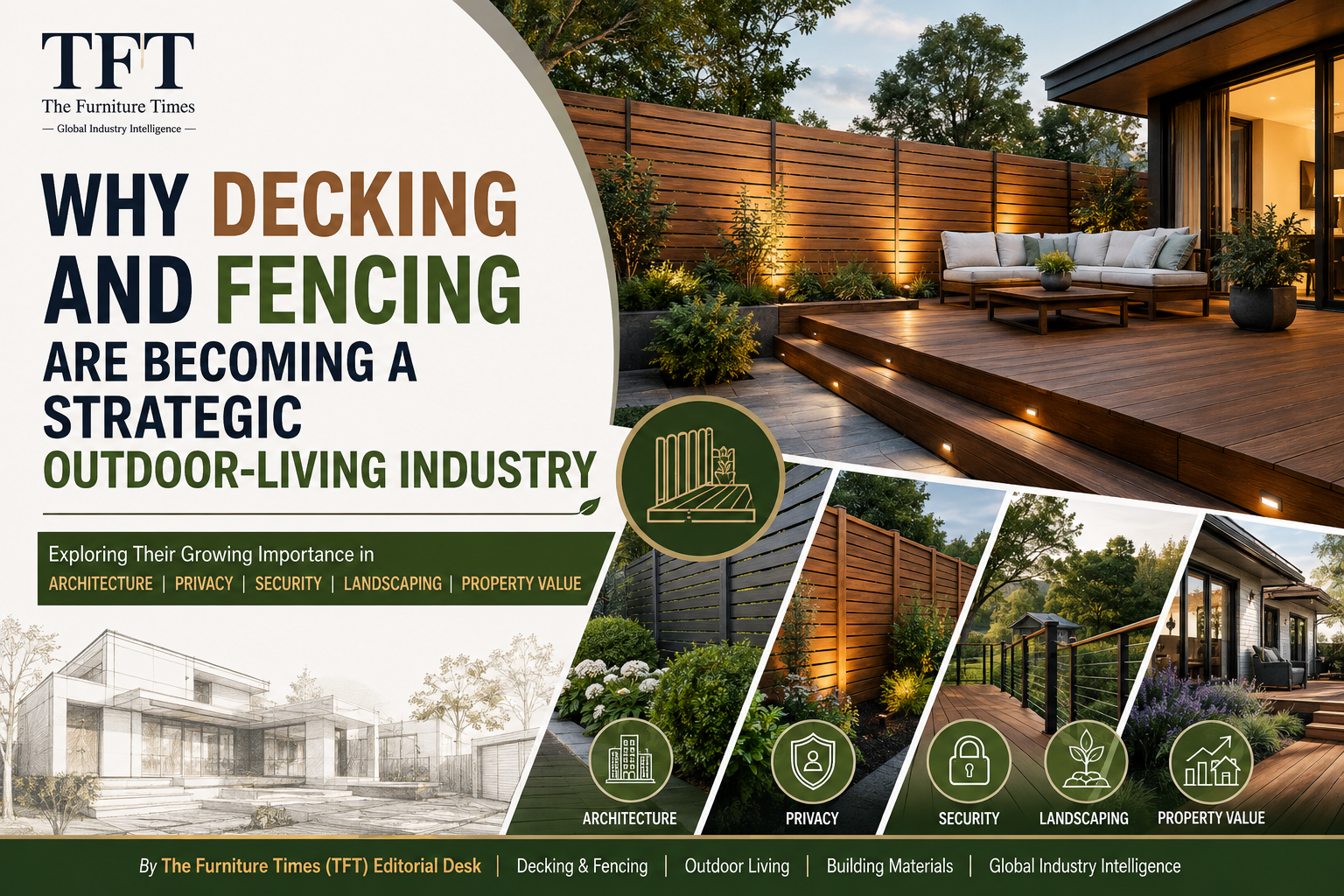
Why Decking and Fencing Are Becoming a Strategic Outdoor-Living Industry
Exploring Their Growing Importance in Architecture, Privacy, Security, Landscaping, and Property Value
By The Furniture Times (TFT) Editorial Desk | Decking & Fencing | Outdoor Living | Building Materials | Global Industry Intelligence
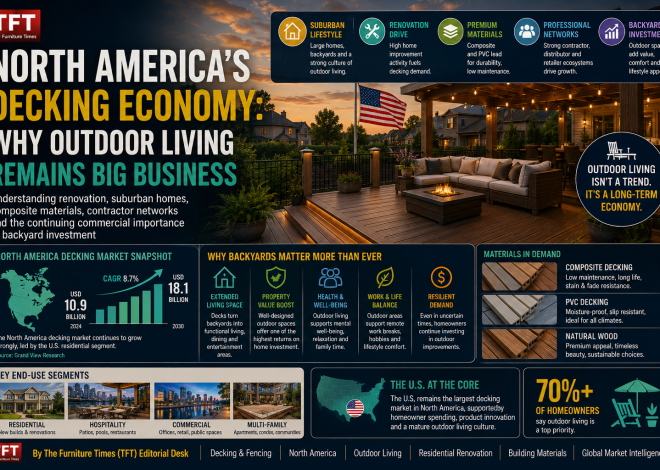
Decking and fencing were once treated primarily as practical additions to a property. A deck created a usable surface outside a house. A fence marked a boundary, provided security, or separated one property from another.
That definition is becoming increasingly outdated.
Across residential developments, hotels, resorts, restaurants, cafés, commercial properties, landscaped communities and public spaces, decking and fencing are becoming important components of a much larger outdoor-living economy.
The transformation is significant because consumers are no longer thinking about outdoor spaces merely as leftover areas surrounding buildings. Gardens, balconies, terraces, rooftops, pool areas and courtyards are increasingly being designed as extensions of interior environments.
This creates an entirely different commercial opportunity.
A deck can become an outdoor living room.
A fence can become an architectural feature.
A privacy screen can transform an exposed garden into a comfortable retreat.
A rooftop deck can turn previously unused space into a hospitality destination.
A landscaped terrace can increase the attractiveness and usability of a residential development.
The strategic importance of decking and fencing therefore extends far beyond the products themselves.
They increasingly influence architecture, privacy, security, landscaping, hospitality, outdoor furniture, renovation, property presentation and the overall experience of a space.
Outdoor Living Is Changing the Definition of Property
For decades, property development focused heavily on interior square footage.
Bedrooms, kitchens, bathrooms, living rooms and offices received the greatest attention.
Outdoor areas were often considered secondary.
That mindset is changing.
Consumers increasingly evaluate properties according to the quality of both their indoor and outdoor environments.
A relatively modest home with an attractive garden deck, outdoor dining area, privacy fencing and landscaping can offer a completely different lifestyle experience from a property where the exterior has received little attention.
This means outdoor areas are becoming functional real estate.
A garden is no longer simply a garden.
It can become a dining room, lounge, children’s area, entertainment zone, wellness space or home office extension.
A balcony can become a miniature garden.
A rooftop can become a social environment.
A hotel terrace can become a revenue-generating restaurant.
And decking frequently provides the physical foundation upon which these experiences are created.
Decking Is Becoming Outdoor Flooring
One useful way to understand the industry’s transformation is to stop thinking of decking simply as boards.
Think of it as outdoor flooring.
Interior designers understand that flooring strongly influences how a room looks and feels. The same principle increasingly applies outside.
The material, colour, texture, direction and dimensions of decking can affect the entire visual character of an outdoor environment.
Wide boards can create one impression.
Narrow profiles create another.
Natural hardwood produces a different atmosphere from contemporary composite materials.
Grey tones may complement modern architecture.
Warm timber colours can create a more natural environment.
Decking therefore participates directly in architectural design.
This shift creates opportunities for manufacturers to communicate with architects, interior designers, landscape architects and property developers—not merely contractors.
Fencing Is Becoming Outdoor Architecture
The same transformation is happening in fencing.
Traditional fencing was frequently selected primarily for function:
Where is the boundary?
How do we keep people out?
How do we keep pets or children inside?
Those remain important considerations.
But today’s customers increasingly ask additional questions.
Does the fence complement the house?
Does it provide privacy?
Does it improve the landscape?
Can plants grow around it?
Does it block undesirable views?
Can it reduce wind?
Can lighting be incorporated?
Can it hide utilities or equipment?
Does it make the property appear more premium?
These questions move fencing from a simple boundary product toward outdoor architecture.
Privacy Is Becoming More Valuable
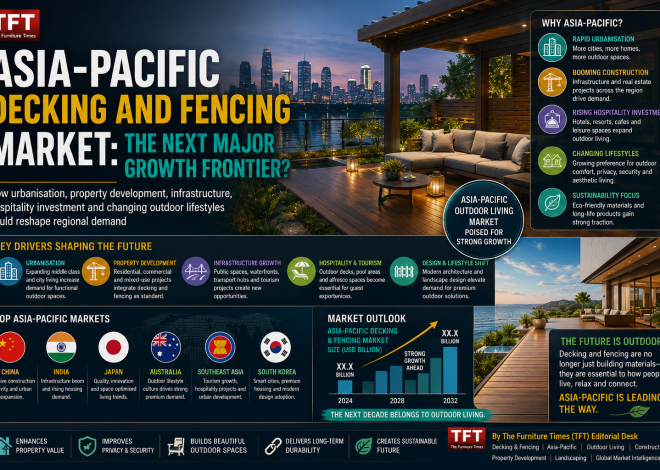
One of the strongest forces supporting fencing and screening demand is urban density.
As cities grow, homes are frequently built closer together.
Apartments overlook balconies.
Neighbouring houses overlook gardens.
Hotels require separation between guest areas.
Restaurants want to create intimate outdoor dining spaces.
Pool environments require controlled access and visual separation.
Consumers therefore increasingly value privacy.
This creates opportunities not only for traditional fencing but also for:
privacy screens, decorative panels, trellises, slatted systems, pergolas, planted screens and integrated fence-and-landscape solutions.
The commercial question is no longer simply:
“How much fencing does this property require?”
A more valuable question is:
“How can we create a comfortable and private outdoor environment?”
That opens a considerably larger market.
Security Remains Fundamental
While design is becoming more important, security remains one of fencing’s fundamental purposes.
Residential communities, industrial facilities, commercial buildings, schools, warehouses, hotels, farms and infrastructure projects all require varying levels of perimeter control.
However, the modern market increasingly seeks security without sacrificing aesthetics.
This is particularly important for premium residential developments and hospitality properties.
A luxury resort does not necessarily want its security infrastructure to make guests feel as though they are inside a fortress.
Similarly, homeowners may want secure boundaries without compromising the appearance of their landscaping.
This is encouraging innovation in decorative metal fencing, aluminium systems, composite fencing, integrated gates and concealed security solutions.
The opportunity lies in combining:
security + privacy + architecture + landscaping.
Landscaping Is Becoming a Strategic Partner
The decking and fencing industry has traditionally been associated closely with construction.
Increasingly, however, landscaping should be considered equally important.
Landscape architects and designers determine how exterior environments function.
They combine:
plants, pathways, decking, stone, water features, furniture, lighting, fencing, pergolas and architectural structures.
Decking may define the entertainment zone.
Fencing may establish privacy.
Plants soften the boundaries.
Lighting extends nighttime usability.
Furniture creates comfort.
Shade structures improve daytime usability.
When these elements work together, an ordinary outdoor area can become a carefully designed environment.
Decking and fencing manufacturers therefore have an opportunity to develop stronger relationships with the landscaping profession.
The Furniture Industry Is Part of the Same Opportunity
Decking and fencing also connect directly with the furniture ecosystem.
Consider what happens after someone builds a deck.
The deck is usually not the final purchase.
The customer may subsequently need:
outdoor sofas, lounge chairs, dining furniture, side tables, benches, swings, sun loungers, parasols, cushions, storage, planters, lighting and decorative accessories.
A resort building a pool deck will probably require loungers.
A restaurant creating a terrace requires tables and chairs.
A rooftop hospitality venue requires seating, shade and lighting.
A landscaped residential deck requires furniture.
This means decking is frequently the beginning of a much larger purchasing journey.
For the furniture industry, that relationship deserves considerably more attention.
Hospitality Is Turning Outdoor Space Into Revenue
Hotels, resorts, restaurants and cafés provide one of the clearest demonstrations of why outdoor environments have strategic economic value.
A restaurant with an attractive terrace may accommodate additional customers.
A hotel rooftop can become a bar or restaurant.
A resort pool deck supports loungers, cabanas and food-and-beverage services.
A beachfront deck can become an event venue.
A garden terrace can host weddings.
In each situation, exterior space potentially generates revenue.
Decking is therefore not simply a construction expense.
Under the right circumstances, it becomes part of a revenue-producing hospitality asset.
This changes how manufacturers should approach the hospitality market.
Instead of selling boards, they can participate in creating commercial outdoor environments.
Renovation Is Expanding the Addressable Market
The strategic importance of decking and fencing is also strengthened by renovation.
The industry does not have to depend entirely on new construction.
Existing properties constantly require improvement.
Older timber decks deteriorate.
Fence panels become damaged.
Design trends change.
Homeowners want more privacy.
Hotels renovate outdoor areas.
Restaurants expand seating.
Commercial properties modernize entrances and landscaping.
Renovation therefore creates recurring demand.
Importantly, replacement frequently becomes an opportunity for upgrading.
A homeowner replacing an old fence may choose a more contemporary privacy system.
An ageing timber deck may be replaced with a composite alternative.
A hotel renovating a pool area may simultaneously replace decking, furniture, lighting and landscaping.
Every replacement cycle can therefore generate additional value throughout the ecosystem.
Property Value Changes the Economics
Outdoor improvements can also influence how consumers perceive property value.
Buyers rarely evaluate a home only according to structural components.
They evaluate the experience.
Can we entertain here?
Is the garden private?
Is the outdoor space attractive?
Is it safe for children?
Is maintenance manageable?
Can we use the space immediately?
An attractive, usable exterior can strengthen a property’s overall appeal.
This does not mean every deck or fence automatically creates a predictable financial return. Property markets vary considerably by location, project quality and buyer preferences.
But outdoor usability and presentation can clearly influence buyer perception.
This makes decking, fencing and landscaping strategically relevant to homeowners, developers and property professionals.
Composite Materials Are Changing Customer Expectations
Material innovation is another major force transforming the industry.
Traditional timber remains enormously important, particularly where consumers value natural appearance and premium hardwood characteristics.
However, composite products have expanded the choices available to consumers.
Customers increasingly compare materials according to:
durability, maintenance, appearance, moisture resistance, colour stability, installation, sustainability and total lifecycle cost.
The conversation is therefore shifting from:
“Which material is cheapest today?”
toward:
“Which material provides the right performance over the life of the project?”
That shift can benefit manufacturers capable of demonstrating measurable value.
Natural Timber Still Has a Strong Strategic Position
Innovation should not be interpreted as the disappearance of wood.
Natural timber possesses aesthetic characteristics that remain difficult to reproduce perfectly.
Premium hardwood decking can create warmth, texture and natural variation particularly valued in luxury architecture and hospitality.
The opportunity for timber manufacturers lies in improving the surrounding value proposition.
Responsible forestry.
Traceable sourcing.
Proper drying.
Accurate grading.
Treatment technologies.
Installation guidance.
Maintenance education.
Environmental documentation.
The future timber market may increasingly reward companies that can prove both beauty and responsibility.
Climate Is Creating Regional Product Opportunities
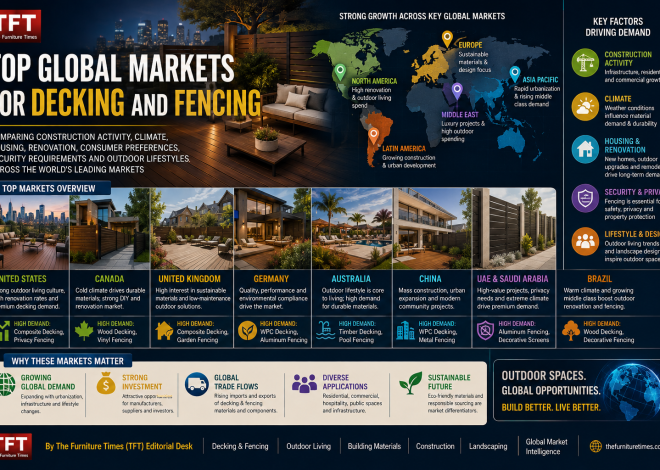
Decking and fencing products operate in very different environments around the world.
A product installed in Malaysia faces heat, humidity and heavy rainfall.
A product installed in the Middle East may experience intense solar exposure and extreme surface temperatures.
A coastal resort faces salt and moisture.
Northern climates may experience freezing conditions.
These differences create opportunities for climate-specific products.
Manufacturers that understand local environments can develop better formulations, finishes, fastening systems, substructures and maintenance recommendations.
The global market may therefore become increasingly regionalized at the technical level even while brands become more international.
Sustainability Is Moving From Marketing to Strategy
Sustainability will increasingly influence product development.
The industry uses substantial quantities of timber, polymers, metals and other materials.
Manufacturers therefore face important questions.
Where do raw materials originate?
How much recycled content is used?
How long will the product last?
Can damaged components be replaced individually?
Can products be recycled at the end of their useful lives?
How much waste does manufacturing create?
Can packaging be reduced?
Can transportation become more efficient?
Companies capable of answering these questions credibly may gain an advantage as architects, developers and consumers become more environmentally conscious.
Installation Quality Can Make or Break a Brand
A decking manufacturer can produce an excellent product and still end up with an unhappy customer if installation is poor.
Incorrect spacing, inadequate drainage, weak substructures or unsuitable fastening can create problems.
Fencing has similar challenges.
Posts, foundations, alignment, hardware and installation methods strongly influence final performance.
This means installation should be treated as part of the product ecosystem.
Manufacturers can create competitive advantages through:
installer certification, contractor education, technical manuals, installation videos, project support and authorized installer networks.
The companies that help customers achieve successful finished projects can build stronger reputations than those that simply sell materials.
Digital Visualization Could Transform Sales
Decking and fencing are highly visual purchases.
Customers want to know what their property will look like before making a decision.
Digital technology can make this easier.
A homeowner could upload a photograph of a garden and experiment with different decking colours.
Another could compare vertical and horizontal fencing.
A hotel designer could visualize multiple pool-deck materials.
An architect could test finishes against the building façade.
Artificial intelligence, augmented reality and 3D visualization could therefore become important sales tools.
Manufacturers should think beyond digital catalogues toward digital experiences.
AI Discovery Creates a New Visibility Challenge
The way customers discover manufacturers is also changing.
Google search remains important, but AI-powered discovery is expanding rapidly.
Consumers and professional buyers can increasingly ask conversational systems questions such as:
“What is the best decking for a humid climate?”
“Which manufacturers produce recycled composite decking?”
“Where can I find commercial decking suppliers?”
“Which fencing materials require less maintenance?”
If an AI system cannot understand a company’s website, products, location, technical information or market specialization, that company may be overlooked.
This creates a new strategic requirement:
Manufacturers must become understandable to both humans and machines.
Clear product information, structured websites, technical documentation, credible media coverage and consistent digital identities will become increasingly important.
SMEs Must Not Be Left Behind
The decking and fencing ecosystem includes thousands of small manufacturers, workshops, timber processors, contractors, distributors and installers.
Many possess significant craftsmanship and technical expertise.
Yet digital visibility remains a major challenge.
Some businesses depend almost entirely on word-of-mouth referrals.
Others rely on trade exhibitions.
Some maintain only social-media pages.
Others have websites containing very little structured information.
In a search-driven global economy, invisibility limits opportunity.
Industry media, specialized search platforms, directories and AI-readable company profiles can help smaller businesses become discoverable.
The future industry should create opportunities not only for companies with the largest advertising budgets, but also for capable SMEs that deserve international visibility.
From Individual Products to Complete Outdoor Solutions
Perhaps the biggest strategic opportunity is integration.
Imagine the traditional purchasing process:
One company supplies decking.
Another supplies fencing.
Another provides furniture.
Another installs lighting.
Another builds the pergola.
Another handles landscaping.
Another installs the outdoor kitchen.
From the customer’s perspective, this can become complicated.
The industry therefore has an opportunity to move toward integrated outdoor solutions.
Decking + fencing + furniture + shade + lighting + landscaping + installation.
Manufacturers do not necessarily need to manufacture every component.
Partnership ecosystems can accomplish the same objective.
Decking companies can collaborate with furniture brands.
Furniture companies can partner with landscape architects.
Fencing manufacturers can work with security companies.
Contractors can build relationships with designers.
Digital platforms can connect the entire ecosystem.
The Outdoor-Living Industry Is Bigger Than Any Single Product Category
This is ultimately why decking and fencing are becoming strategic.
They sit at the intersection of numerous industries:
Construction.
Architecture.
Furniture.
Landscaping.
Hospitality.
Real estate.
Renovation.
Security.
Sustainability.
Technology.
A single residential outdoor project can create business for companies across nearly every one of these sectors.
A single hospitality development can involve even more.
Companies that continue to view decking and fencing only as commodity building materials risk overlooking the larger opportunity.
The Future: Designing Complete Outdoor Experiences
The next decade could fundamentally change how the industry defines itself.
Consumers do not simply buy decking boards.
They buy a place to spend time.
They do not simply purchase fencing panels.
They purchase privacy, security and peace of mind.
Hotels do not simply install terraces.
They create guest experiences.
Restaurants do not simply construct decks.
They create additional dining environments.
Developers do not simply landscape properties.
They create places people want to live.
Understanding these motivations changes everything.
The winning companies of the future may therefore be those that stop asking:
“How can we sell more decking and fencing?”
and start asking:
“How can we help people create better outdoor environments?”
That is the strategic transformation now taking place.
The Furniture Times (TFT) Perspective
The Furniture Times sees decking and fencing as increasingly important parts of the wider outdoor-living and furniture ecosystem.
The opportunity extends from raw materials and manufacturing to design, distribution, installation, landscaping, furniture, hospitality, real estate and digital discovery.
For manufacturers, this means the competitive landscape is changing.
Product quality remains essential.
But future leadership may increasingly depend on the ability to combine:
Design + Performance + Sustainability + Installation + Partnerships + Digital Visibility + Customer Experience.
Decking and fencing are no longer simply products surrounding buildings.
They are becoming part of how modern properties look, function, protect, entertain and create value.
That is why the sector deserves to be recognized as a strategic outdoor-living industry.
The Furniture Times (TFT) & Furniture Industry Search Engine (FISE)
“TFT tells their story. FISE helps the world find them.”
“FurniReviewology helps the world trust them.”
The furniture industry ecosystem is a $1 trillion industry ecosystem.