
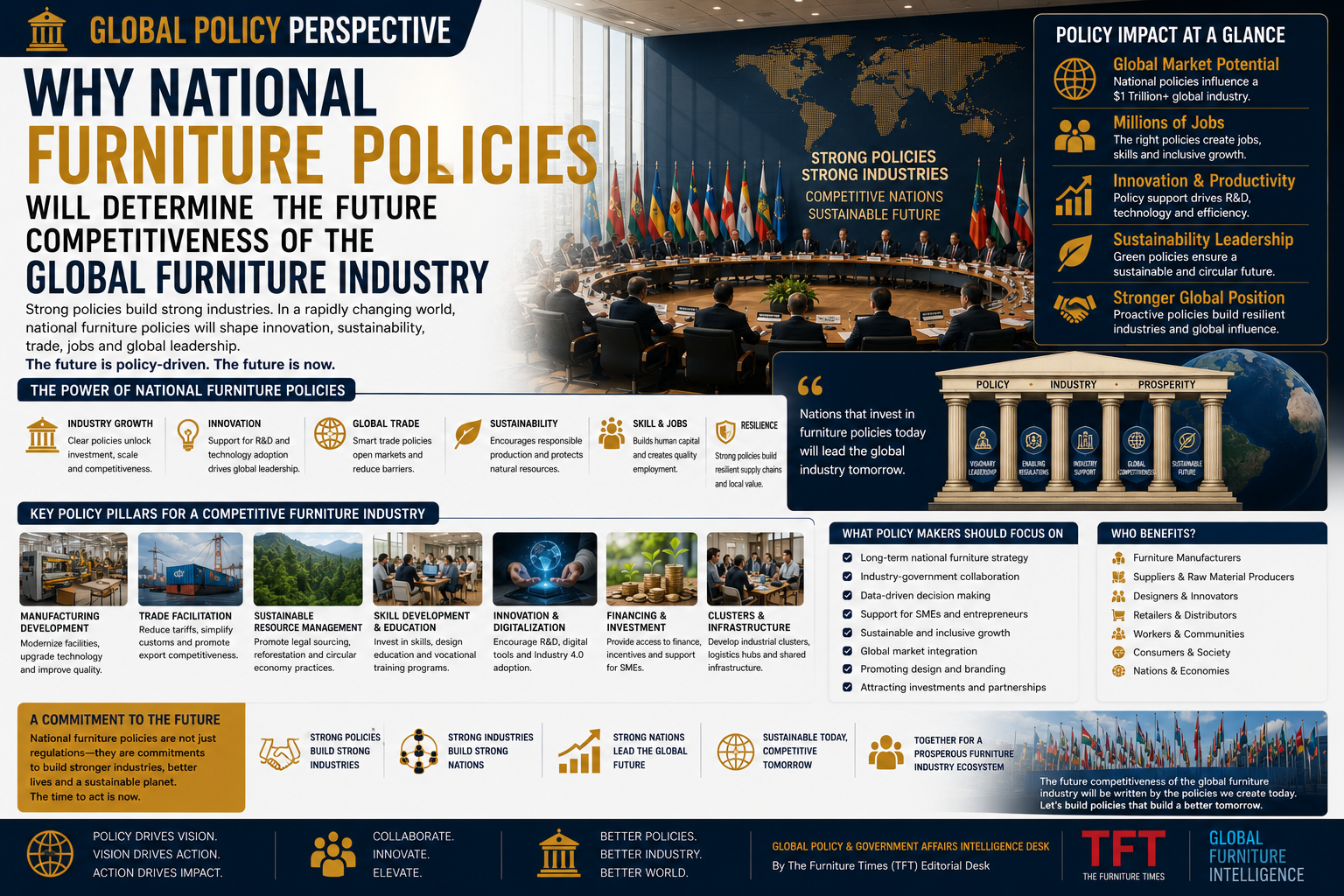
Why National Furniture Policies Will Determine the Future Competitiveness of the Global Furniture Industry
Furniture Policy News
Why National Furniture Policies Will Determine the Future Competitiveness of the Global Furniture Industry
Global Policy & Government Affairs Intelligence Desk
By The Furniture Times (TFT) Editorial Desk
Executive Summary
The global furniture industry is entering a defining decade.
While manufacturers continue investing in automation, Artificial Intelligence (AI), sustainability and international trade, one factor is becoming increasingly important but often overlooked:
Government policy.
No globally competitive furniture industry has been built through private investment alone.
Every successful furniture-producing nation has benefited from policies that support:
- Manufacturing
- Exports
- Skills development
- Innovation
- Infrastructure
- Investment
- Sustainability
- International trade
Furniture is far more than a manufacturing sector.
It contributes to housing, hospitality, healthcare, education, tourism, logistics, retail, construction and millions of direct and indirect jobs.
Yet in many countries, the furniture industry still lacks a comprehensive national development strategy.
According to The Furniture Times (TFT), the countries that establish clear furniture policies today will become the global furniture leaders of tomorrow.
Why Furniture Policy Matters
Government policy creates the environment in which businesses operate.
Strong policy can encourage:
Investment.
Innovation.
Employment.
Exports.
Technology adoption.
Skills development.
Global competitiveness.
Weak or fragmented policy can slow industry growth, reduce competitiveness and limit international opportunities.
Furniture should be recognised as a strategic economic sector rather than simply another manufacturing industry.
Furniture Is an Economic Multiplier
The furniture industry connects with numerous sectors.
Including:
Forestry.
Wood processing.
Manufacturing.
Interior design.
Architecture.
Construction.
Retail.
Hospitality.
Healthcare.
Education.
Transportation.
Logistics.
Technology.
Financial services.
Because of these linkages, investment in furniture creates economic benefits throughout the wider economy.
Every Country Needs a National Furniture Strategy
A national furniture strategy should define long-term objectives for:
Manufacturing growth.
Export development.
SME support.
Industrial parks.
Research and innovation.
Technology adoption.
Skills development.
Global branding.
Sustainability.
Digital transformation.
A coordinated strategy enables governments, industry associations and businesses to work toward shared goals.
Manufacturing Policies Drive Competitiveness
Governments can strengthen manufacturing through:
Industrial incentives.
Factory modernisation.
Automation grants.
Technology adoption.
Industrial clusters.
Research support.
Tax incentives.
Modern manufacturing policies encourage higher productivity while improving international competitiveness.
Export Policies Create Global Opportunities
Export-focused policies help businesses through:
Trade promotion.
Export financing.
Trade missions.
International exhibitions.
Market intelligence.
Customs facilitation.
Export insurance.
Strong export ecosystems enable manufacturers to reach new international markets.
SMEs Require Dedicated Support
Small and medium-sized enterprises form the backbone of many furniture industries.
Governments can assist SMEs through:
Affordable financing.
Business development programmes.
Digital transformation support.
Marketing assistance.
Export readiness.
Innovation grants.
Skills training.
Helping SMEs grow strengthens national manufacturing capacity.
Furniture Industrial Parks
Many countries have developed specialised industrial parks.
Future furniture clusters may include:
Manufacturing facilities.
Shared logistics.
Research centres.
Training academies.
Design studios.
Testing laboratories.
Export centres.
Business incubators.
Industrial clustering improves efficiency while encouraging collaboration.
Skills Development Is Essential
Modern furniture industries require professionals in:
Manufacturing.
Design.
CNC programming.
Artificial Intelligence.
Automation.
Logistics.
Digital marketing.
Sales.
Export management.
Governments should strengthen:
Technical education.
Vocational training.
Industry certification.
University partnerships.
Workforce development ensures long-term competitiveness.
Artificial Intelligence Must Be Part of National Policy
AI is transforming manufacturing worldwide.
Governments should encourage adoption through:
Innovation funding.
Digital infrastructure.
Research partnerships.
AI education.
Technology grants.
SME digitalisation.
AI readiness will increasingly influence international competitiveness.
Sustainability Requires Policy Leadership
Governments play an important role in promoting:
Responsible forestry.
Renewable energy.
Circular economy.
Green manufacturing.
Waste reduction.
Environmental certification.
Clear sustainability policies strengthen both environmental protection and export competitiveness.
Infrastructure Supports Industry Growth
Furniture businesses depend upon:
Road networks.
Ports.
Rail.
Air cargo.
Industrial land.
Digital connectivity.
Reliable infrastructure reduces operating costs while improving supply chain performance.
Furniture Tourism Can Become National Policy
Countries with strong furniture industries can develop:
Factory tourism.
Design districts.
Furniture museums.
Manufacturing tours.
International buyer programmes.
Furniture festivals.
Business tourism.
National tourism agencies and industry associations can collaborate to create entirely new economic opportunities.
Digital Infrastructure Is Now Critical
Governments increasingly support:
Broadband expansion.
Digital commerce.
Cybersecurity.
Smart manufacturing.
Digital identity.
Industry platforms.
Digital infrastructure has become as important as physical infrastructure.
Public-Private Partnerships
Successful furniture policies often involve cooperation between:
Government.
Industry associations.
Universities.
Research institutions.
Technology companies.
Financial institutions.
Manufacturers.
Retailers.
Collaboration accelerates innovation while reducing duplication of effort.
Financing Industry Growth
Governments can strengthen the furniture sector through:
Development banks.
Export credit.
Innovation funds.
SME loans.
Equipment financing.
Green finance.
Investment incentives.
Access to capital supports expansion and modernisation.
International Cooperation
Global partnerships continue creating opportunities through:
Trade agreements.
Technology exchange.
Joint ventures.
Skills development.
Research collaboration.
Investment promotion.
International cooperation strengthens long-term competitiveness.
Policy Should Support the Entire Ecosystem
Furniture policy should not focus only on manufacturers.
It should also support:
Retail.
Interior design.
Logistics.
Technology.
Education.
Hospitality.
Tourism.
After-sales services.
Digital platforms.
Circular economy.
The entire ecosystem contributes to national economic development.
Measuring Success
Governments should evaluate policy outcomes through:
Export growth.
Employment creation.
Investment levels.
Manufacturing productivity.
Technology adoption.
SME growth.
Sustainability performance.
Global competitiveness.
Data-driven policymaking supports continuous improvement.
The Furniture Times Analysis
The global furniture industry has reached a point where government policy will increasingly influence international success.
Countries that develop comprehensive furniture strategies today will strengthen:
Manufacturing.
Innovation.
Employment.
Exports.
Investment.
Digital transformation.
Sustainability.
National branding.
Furniture policy should be viewed as economic development policy.
Final Verdict
The future of the global furniture industry will not depend solely on private businesses.
It will also depend on governments that recognise furniture as a strategic national industry.
Forward-looking furniture policies can create:
Stronger economies.
More jobs.
Higher exports.
Greater innovation.
Smarter manufacturing.
International investment.
Sustainable growth.
The countries that lead the furniture economy of tomorrow will be those that build supportive policy frameworks today.
Because industries do not grow by accident.
They grow through vision.
Leadership.
Partnership.
And policies that empower businesses to compete on the global stage.
By The Furniture Times (TFT) Editorial Desk
Global Policy & Government Affairs Intelligence Desk | July 2026
“TFT tells their story. FISE helps the world find them.”
The furniture industry ecosystem is a $1 Trillion Dollar Industry.
